
What did each company actually report in Q3 2026?
SoFi reported before the open on Tuesday, October 27; Robinhood reported after the close. This analysis draws on both companies' Q3 2026 earnings releases and earnings calls.
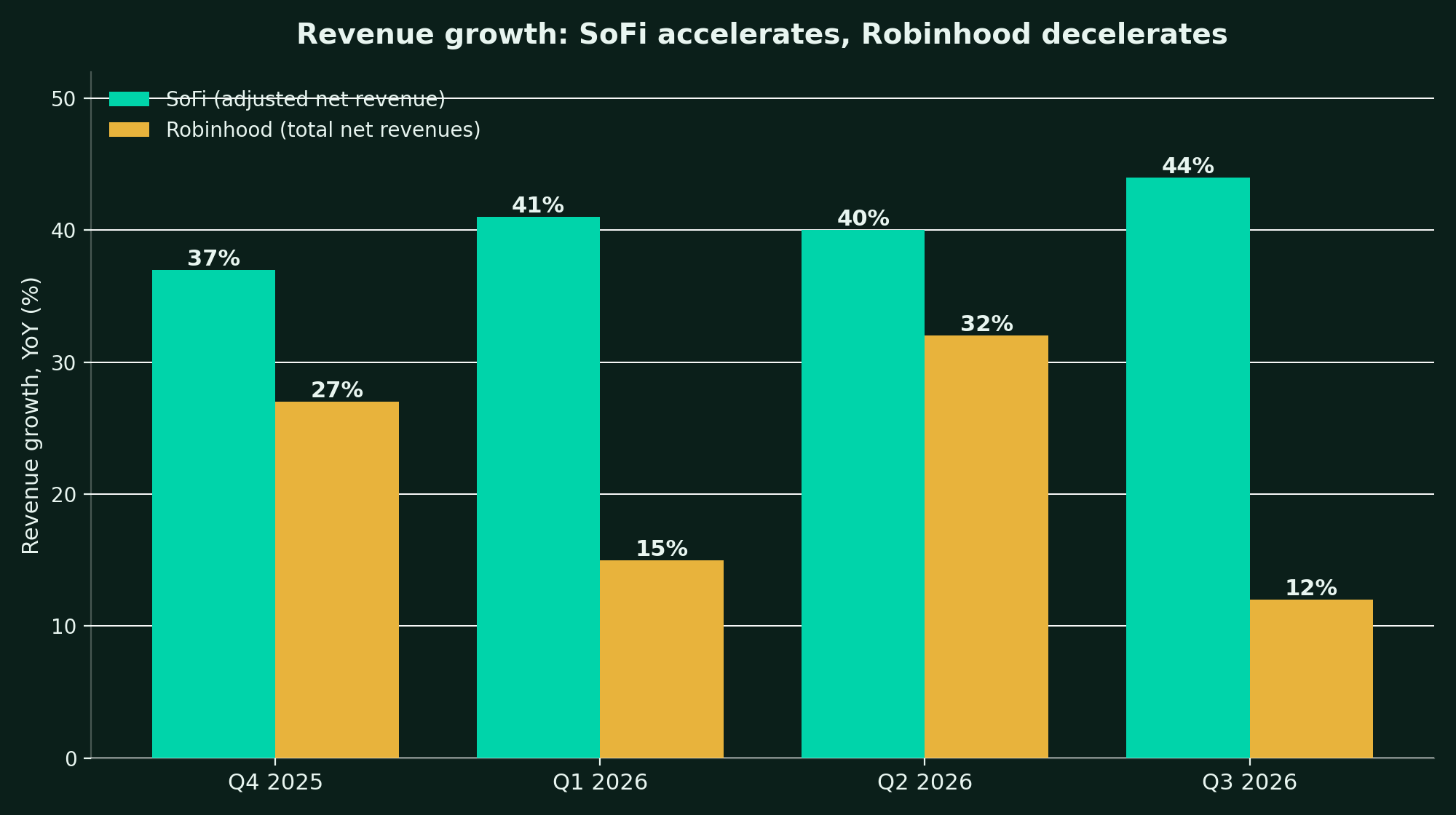
Start with SoFi's print. It beat on every headline line, and the beat was not cosmetic: revenue cleared consensus by about 9%, adjusted EBITDA margin hit a record, and the company posted its twelfth consecutive GAAP-profitable quarter.
| SoFi, Q3 2026 | Yardstick | |
|---|---|---|
| Adjusted net revenue | $1,371.1M, +44% YoY | Consensus $1.26B (Zacks): beat about 9% |
| GAAP net revenue | $1,385.1M, +44% | Includes fair value effects |
| Adjusted EBITDA | $469.8M, +70%, 34.3% margin | Record margin |
| GAAP net income | $241.0M, +73% | 12th straight GAAP-profitable quarter |
| EPS, GAAP and adjusted | $0.18 | Consensus $0.17 |
| Net interest margin | 6.14% | Fee revenue was 42% of total |
| Members | 17.1M, +35% | Record 1.2M added in the quarter |
| Products | 26.7M, +44% | 51% of new products from existing members |
| Deposits | $51.3B | Up $5.8B in the quarter |
| Total originations | $16,932.3M, +71% | A record quarter |
The segment mix shows where the growth came from. Lending revenue of $807.4M on an adjusted basis grew 68%, at a 56% adjusted contribution margin. Financial Services revenue of $525.1M grew 25%, with contribution profit of $261.0M at a 50% margin and interchange at a record $52M, up 77%. The one shrinking segment was Technology Platform, down 24% to $87.4M, a story told in full below.
Robinhood's print is a different animal: still growing, still highly profitable, but decelerating, with the mix rotating hard underneath the headline.
| Robinhood, Q3 2026 | Yardstick | |
|---|---|---|
| Total net revenues | $1,424M, +12% YoY | Consensus $1.43B (LSEG): slight miss |
| Transaction revenues | $867M, +19% | Options remained the largest line |
| Options revenue | $399M, +31% | The anchor line |
| Event contracts revenue | $173M, up over 6x | Now the No. 2 transaction line |
| Equities revenue | $121M, +41% | Ahead of crypto for the quarter |
| Crypto revenue | $120M, -55% | Street forecast was $114.1M |
| Net interest revenues | $415M, -9% | Lower securities lending, lower short rates |
| Other revenues | $142M, +61% | Trump Account services and Gold subscriptions |
| Net income | $476M, -14% | Includes a $67M mark on Ventures Fund I |
| GAAP diluted EPS | $0.51 | Consensus about $0.55: miss |
| Adjusted EPS (new measure) | $0.60 | Scored a beat by Zacks, a miss by StockStory |
| Adjusted EBITDA | $808M, +9%, 57% margin | Still a very profitable machine |
| Total Platform Assets | $396B, +19% | Net deposits $15.7B in Q3, $71.0B TTM |
| Gold subscribers | 5.2M, +34% | A record, at 18% adoption |
Two opposite tapes, both earned. The rest of this article works through why SoFi's quarter answered its skeptics, where Robinhood's quarter bent, and what the two businesses are actually worth side by side.
How did SoFi clear the bar its skeptics set?
The single most important fact in either print is that SoFi did not merely hold guidance. It raised 2026, then did something it did not have to do: it introduced 2027 guidance, a quarter early, above consensus, with the assumptions stated out loud, including two rate hikes in 2027, a 24% tax rate, and no capital raise.
| SoFi guidance | Before the print | After the print |
|---|---|---|
| FY2026 adjusted net revenue | $4.75-4.85B | About $5.04B |
| FY2026 adjusted EBITDA | About $1.60B | About $1.66B |
| FY2026 adjusted EPS | $0.60 | About $0.61 |
| FY2027 adjusted net revenue | Not guided (consensus about $6.0B, FactSet) | About $6.4B, +27% |
| FY2027 adjusted EBITDA | Not guided | About $2.24B, a 35% margin |
| FY2027 adjusted EPS | Not guided (consensus $0.82) | About $0.90 |
The 2027 guide has structure behind it: Lending guided to grow about 25%, Financial Services about 35%, and Technology Platform about 25%, funded, management says, entirely by organic capital generation. CFO Chris Lapointe pointed to roughly $29B of risk-weighted asset capacity that the 2027 plan does not even require. CEO Anthony Noto explained the early guide in one sentence worth quoting in full: "We didn't change our behavior because we had the same visibility we've had in the past. We changed our behavior because of the visibility that we have."
He added a second line that matters for a bank whose model was supposed to need falling rates: "I now have as much confidence in our ability to drive durable growth in a high-rate environment as I do in a low-rate environment." The origination engine backs the claim up so far: a record $16,932.3M in the quarter, with personal loans at $12,622.1M (including $3.6B through the Loan Platform Business), student loans at $2,922.1M, up 96% and the best quarter in company history, and home loans at $1,361.0M. On personal loans, Lapointe gave the unit economics directly: a 12.8% weighted average coupon, 3.4% annualized losses, and a risk-adjusted margin of about 7.6%.
Then there is the credit file, the contested ground since Muddy Waters published its short report on March 17, 2026, alleging a true personal loan charge-off rate of about 6.1% against the roughly 2.89% SoFi then reported. This print puts three numbers on the record, and none of them is close to 6.1%.
| SoFi credit and marks, Q3 2026 | Figure | Direction |
|---|---|---|
| Personal loan NCO, as reported | 2.26% annualized | Down 34bp YoY |
| Personal loan NCO, all-in company estimate | About 3.4% | Down 80bp YoY |
| Student loan NCO | 0.63% | Stable |
| Personal 90-day delinquency | 0.42% | In line with prior quarters |
| Vintage losses, Q4 2022 to Q4 2025 cohorts | 4.71% cumulative, 33% of principal left | Versus 6.62% at the same point for the 2017 vintage |
| Fair value marks: personal / student / home | 103.3% / 101.9% / 101.5% of principal | All three books still above par |
| Cumulative fair value adjustment | +$1,399.5M | Down from +$2,027.1M at June 30, on rates |
| CET1 ratio (company estimate) | 16.9% | Total capital ratio 17.0% |
Read the marks honestly, in both directions. Fair value marks fell in the quarter: benchmark rates rose, the markdown cost the book over $800M before hedges, and about $734M of hedge gains absorbed most of it. Management also nudged its default assumptions up, personal loans from 4.77% to 5.10%, even as realized losses improved. That is what a conservative mark looks like, and it is the opposite of the pattern the short thesis alleged. Tangible book value reached $7.48 per share, up 25% year over year, and return on tangible common equity ran at about 10%.
The Loan Platform Business, the other half of the short debate, also moved the right way on volume: $3.8B of third-party originations in the quarter, adding $153.4M to adjusted revenue, with total loan sales and platform transfers above $5.3B and the eighth SCLP securitization, $460M, priced at a spread of 83bp. One wrinkle belongs in the open-items file, and it is in the checkpoint below: GAAP loan platform fees of $151.16M were actually down 8.3% year over year as a large prior-year item rolled off, and management did not comment on it.
The market's verdict was unambiguous. SoFi closed Monday, October 26 at $14.46, down about 45% year to date at that point, and on Tuesday it closed at $16.40, up 13.42%, on volume of 158.8M shares, inside a session range of $15.67 to $16.76. Morningstar raised its fair value estimate to $18.80 from $17.80 on the print. Noto's only direct nod to the shorts came in his closing line, crediting the results with refuting "the prognostications of the haters." He did not need to say more. Notably, no analyst on the call asked about Muddy Waters, charge-off definitions, or the alleged $312M JPMorgan arrangement at all.
Where did Robinhood's quarter bend?
Robinhood's quarter bent in the mix. Look at the four transaction lines side by side and the rotation is violent: the legacy growth engine, crypto, halved, while the newest and most legally contested line, event contracts, multiplied.
| Robinhood transaction revenue | Q3 2026 | Change |
|---|---|---|
| Options | $399M | +31% YoY |
| Event contracts | $173M | Up over 6x YoY, +11% QoQ |
| Equities | $121M | +41% YoY |
| Crypto | $120M | -55% YoY |
| Other transaction lines (calculated residual) | About $54M | Includes futures and other |
| Total transaction revenues | $867M | +19% YoY |
Event contracts are no longer an experiment. Robinhood traded 16.4B contracts in the quarter, a record, up over 7x year over year. Rothera, its joint venture with Susquehanna, has traded over 6.4B contracts since launch at over a $100M annualized revenue run rate, per the release, and The Block reported that $28M of the quarter's $173M of event contract revenue came through Rothera. Annualize the $173M and the line runs at about $692M (calculated), already ahead of Bernstein's pre-print estimate of about $650M for all of 2026. Prediction markets are now Robinhood's second engine, whether or not the legal system agrees they should exist. The risk section below takes that up.
The profit lines bent too. Net income fell 14% to $476M and GAAP diluted EPS of $0.51 missed the roughly $0.55 consensus. Two items explain most of the gap: a $67M unrealized loss marking Robinhood Ventures Fund I to market, worth $0.07 of EPS, and an effective tax rate of about 24% (calculated), up from about 16% a year ago. Operating expenses of $739M rose 16%, including a provision for credit losses of $71M, up 173% as the Gold Card loan book grows, and operations costs up 139%. Adjusted operating expenses and stock compensation of $664M rose a more controlled 8%, and management trimmed the top end of the FY2026 adjusted expense guide by $25M, to $2.675B to $2.75B. The release gave no formal 2027 financial guidance and no 2027 expense plan.
The quarter also produced a scoring dispute that says something real about where the story is. This quarter, for the first time, Robinhood introduced an adjusted net income figure, $550M, and an adjusted EPS of $0.60. The same $0.60 was scored three ways within hours: a beat against Zacks' $0.56 adjusted consensus, a miss against the S&P consensus of $0.64 that StockStory uses, and, on the GAAP number that preceded it, a clean miss. A company does not usually debut an adjusted EPS measure in a quarter when the GAAP measure is falling 16%. The adjusted number may well be the cleaner read of the underlying business, but readers should notice when the yardstick changes and who moved it.
The platform metrics, to be fair, were strong almost everywhere. Funded customers reached 28.7M, up 7%, with 30.4M investment accounts. Gold subscribers hit a record 5.2M, up 34%, at 18% adoption and roughly 40% adoption among new customers. ARPU was $200, up 5%. Retirement assets under custody were $36.6B, up 51%, the margin book a record $22.1B, up 59%, Gold Card at 1.3M customers with over $19B of annualized payment volume, and Robinhood Banking holding nearly $5B of deposits from over 350,000 customers. Fourteen business lines now run at $100M or more of annualized revenue, and Robinhood Chain, in its first mainnet quarter, processed over $80B of DEX volume by the company's count. Monthly active users, notably, are no longer disclosed.
The forward signal management chose to print, in the release, came from CFO Shiv Verma: "And we're entering Q4 with strong momentum, as October Net Deposits have already topped $13 billion month-to-date, including $6 billion from the Dell family's contribution to Trump Accounts." That is a genuinely strong deposit number, and it anchors the asset-gathering story even in a decelerating revenue quarter. Capital return was quieter: buybacks of just $25M in the quarter, executed at an average of about $105 per share, above where the stock traded after hours tonight. Cumulative buybacks since Q3 2024 stand at $1.3B at an average of about $48. The company also raised $500M of long-term borrowings in the quarter and holds $5.8B of corporate cash.
The tape read the quarter the way the headline numbers suggested. Robinhood closed Tuesday, October 27 at $94.56, up 1.85% on the day, and fell after hours into an $89 to $90.52 band, down roughly 4.3% to 5.5%: $90.90 at 4:11 PM ET, $90.05 at about 4:35 PM, $89.22 at 4:55 PM, $90.22 at 4:59 PM, and $90.52 at 5:01 PM. Options had priced a move of about 9.5%, so the verdict may not be finished. The stock was down about 16 to 18% year to date going into the print, inside a 52-week range of $63.52 to $150.47, and the Street came into the print nearly unanimous: TipRanks showed a Strong Buy consensus (20 Buys, 3 Holds, 0 Sells) with an average target of about $139 to $141.
How do the two businesses actually compare?
The strangest fact in this comparison is the size gap. At the closes going into their prints, Robinhood's market capitalization was about $85B (at Tuesday's $94.56 close) against SoFi's roughly $18.7B (at Monday's $14.46 close), about 4.5 times larger. Yet trailing-twelve-month revenue was $4.93B at Robinhood against about $4.31B at SoFi on a GAAP basis, only about 1.14 times larger. Almost the entire difference between these two companies, as the market prices them, is multiple, not scale.
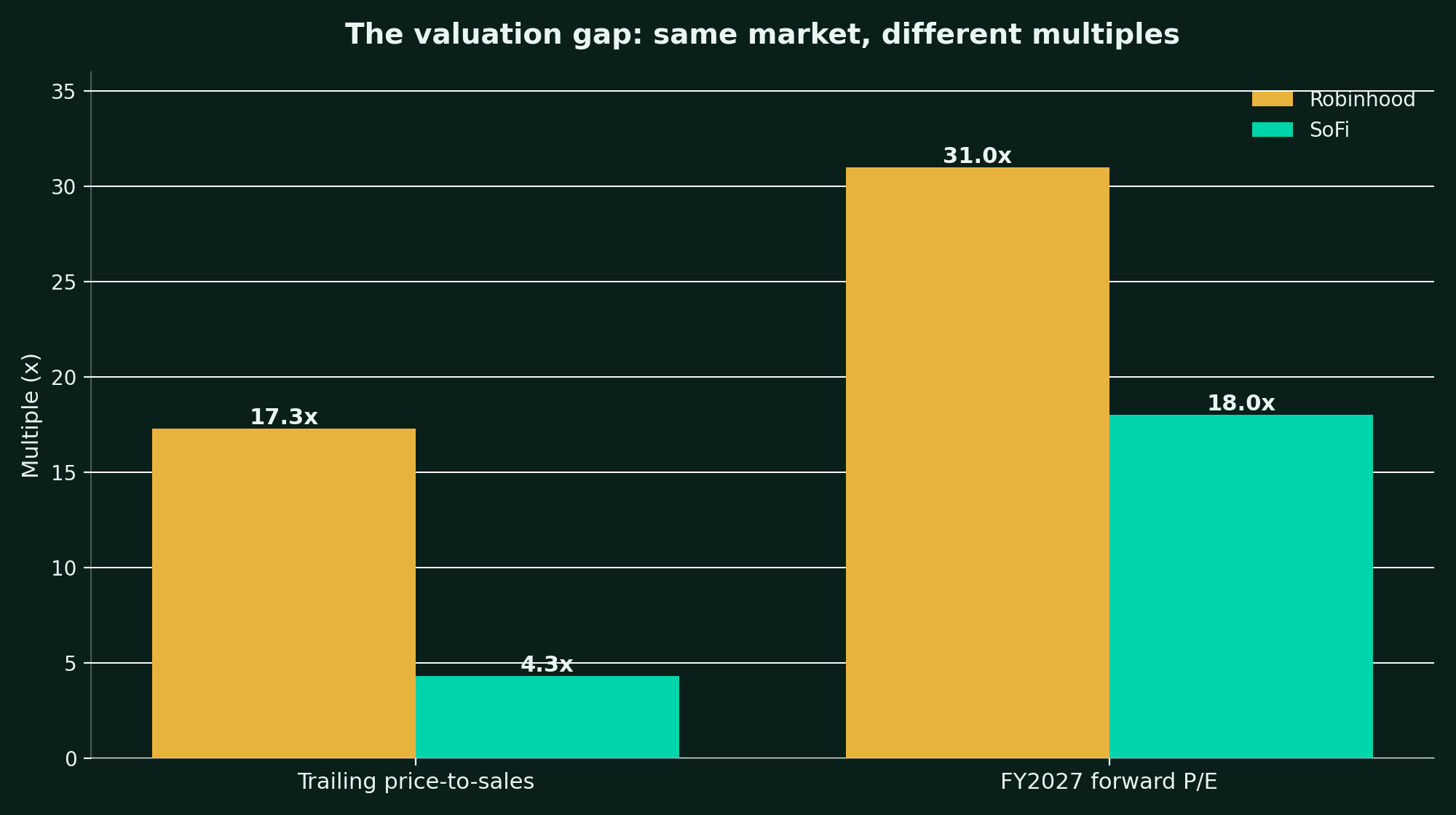
After the prints, the gap survives the re-rating (calculated): SoFi at about $16.40 trades at roughly 18 times its own FY2027 adjusted EPS guidance; Robinhood at about $90 after hours trades at roughly 30 times FY2027 consensus. The market is paying for certainty of a very different kind in each name. Robinhood's multiple prices a high-beta engagement machine whose newest engine is compounding at triple-digit rates. SoFi's prices a bank that must keep proving its book, even after a quarter in which it guided a full year ahead, above the Street, on the first attempt.
Profitability runs the other way, and needs its caveat printed next to it. Robinhood's adjusted EBITDA margin was 57% in the quarter; SoFi's was 34.3%. That gap is structural, not an efficiency verdict. A custody and transaction model carries no deposit funding cost and almost no credit cost; a net-interest-margin bank carries both by design. Comparing the two margins as if they measured the same thing would be a category error.
Two comparisons to refuse. First, deposits and platform assets: SoFi's $51.3B of deposits are balance-sheet funding it lends against, funding a $52.5B loan book carried at fair value; Robinhood's $396B of platform assets are customer custody held off balance sheet, alongside a collateralized margin book of $22.1B. They are not the same kind of scale. Second, people: SoFi's 17.1M members are registrations, while Robinhood's 28.7M funded customers hold funded accounts. The two populations are not comparable, and neither are per-customer revenue figures built on them.
Which risks are real after today?
The contrast in one line each. SoFi's core risk is a balance sheet that must be believed: its marks, its sale accounting, its charge-off definitions. Robinhood's core risk is an activity level and a legal perimeter that must hold: trading volumes, crypto prices, and the legal status of event contracts.
SoFi's version of that risk narrowed today but did not close. The definitional spread is now on the record for anyone to check: 2.26% reported charge-offs, about 3.4% on the company's all-in construction, about 6.1% alleged by the short report. KBW, which carries a Sell rating, warned before the print of a possible pre-hedge fair value hit above $1B; the actual quarter delivered over $800M of negative mark impact, mostly absorbed by about $734M of hedge gains, with all three loan books still marked above par. What would change the story is not another quarter of this. It is a credit cycle: charge-offs rising from a benign base while the marks are tested by falling rates in the other direction. Until then, the book keeps passing its own exams.
Robinhood's version widened today, because the contested line got bigger. Crypto shows what activity risk looks like when it bites: revenue of $252M in Q1 2025 has become $120M now, a $132M hole the rest of the machine had to fill. Finnhub puts Robinhood's beta at 2.50, against 2.29 for SoFi; both are high-beta names, and Robinhood is the higher. But the sharper exposure is legal. Event contracts, now the second-largest transaction line at $173M, are being fought in 21 states that are suing, ordering, or defending suits over them. The appeals courts are split: the Third Circuit sided with Kalshi in New Jersey in April 2026; the Ninth Circuit ruled against platforms including Robinhood in Nevada in August 2026; the Sixth Circuit ruled for Ohio and Tennessee on September 25, 2026. Ohio sent cease-and-desist letters to 10 platforms including Robinhood on October 2, 2026. Three Supreme Court petitions are pending, with responses due in November 2026, and today, October 27, the CFTC sued Utah asserting federal preemption. Robinhood's own release risk language concedes it has previously stopped offering certain event contracts under state enforcement pressure. The growth engine and the legal exposure are now the same line item.
Thesis checkpoint: the SoFi report's gates were cleared
The published DalalBytes report on SoFi is 68/100 Selective Positive (October 21, 2026; see the SoFi investment report). The gates that report set were three: hold or raise the FY2026 adjusted EPS guide of $0.60, keep the credit story credible against the short report's claims, and show the Loan Platform Business on a durable trajectory.
This print clears all three. The EPS guide rose to about $0.61, with revenue and EBITDA guides raised alongside it, and management added an FY2027 guide above consensus rather than waiting. Every reported credit metric moved the right way, on both the reported and the all-in charge-off definitions, with vintage disclosure supporting the marks. Loan Platform volume reached $3.8B of third-party originations in the quarter. The checkpoint reads positive for the thesis.
Two open items carry forward. First, Technology Platform: revenue down 24%, contribution margin halved to 16% from 28% as the exited client (Chime, unnamed in the Q3 materials) rolled off, and the new 2027 guide now assumes the segment grows 25%; excluding the exited client it grew 18%, accounts rose 6M sequentially to 140.4M, and nine clients were added year to date, so the guide is a delivery test, not a fantasy, but it has to be delivered. Second, the unexamined file: no analyst asked about the short report, GAAP loan platform fees fell 8.3% year over year without explanation, and SoFi's crypto business is currently a pass-through, $161.6M of transaction revenue against $160.0M of cost, while SoFi Plus, at 272,835 subscribers, missed internal growth expectations (Noto blamed "nefarious actors" and reaffirmed a target of 1M by the end of next year).
Thesis checkpoint: the Robinhood report's gates met a split print
The published DalalBytes report on Robinhood is 66/100 Selective Positive (see the Robinhood investment report), with a reference price of $94.56 at the October 27 close. Its FY2029 targets are Bear $46, Base $110, and Bull $158, each built as adjusted EPS times an exit multiple. The pillar grades (see the five-pillar analysis) are Sunrise PASS, Leadership PASS, Moat PARTIAL, Iron Fortress PASS, and Free Cash Flow PARTIAL.
The gates this print was tested against follow from the base case. Base $110 is worth only about 16% over three years from the $94.56 reference, and reaching it needs FY2027 consensus EPS of $3.04 delivered and then high-teens growth after that. The case rests on revision momentum and bull-case asymmetry, so the print is judged on three things: the growth trajectory, expense discipline, and whether the newer engines keep compounding.
On the engines, the print delivered. Event contracts printed $173M of revenue, with October daily volumes up about 10% more and non-sports contracts at 30% of event activity. Gold reached a record 5.2M subscribers. Net deposits were $71.0B over the trailing twelve months, with the 20% annual growth target already surpassed, and management trimmed the top end of the FY2026 expense guide by $25M.
On the trajectory and the accountability file, it dented. Headline growth decelerated to 12% and GAAP EPS missed, which cuts directly against the report's revision-momentum premise. There is no 2027 plan until the January and February reveal. Trump Account service revenue durability remains undisclosed. And the buyback pace and the event-contract litigation both went entirely unaddressed on the call.
The checkpoint reads mixed. The franchise engines performed ahead of the print's headline; the accountability items stayed open, and a base case worth only about 16% over three years cannot absorb many decelerating quarters.
What did the two earnings calls add?
The prints told the day's story. The calls told a second one about how each management team wants its numbers read.
SoFi: a guide with visible scaffolding
The segment math does not foot to the guide, and that is the point. Piper Sandler's Patrick Moley did the arithmetic on CFO Chris Lapointe's own 2027 segment growth rates: Lending up 25%, Financial Services up 35%, Technology Platform up 25%. Applied to the 2026 bases, those rates sum to about $6.7B of revenue, roughly $300M above the $6.4B guide, and Moley asked whether the difference was a step-up in the corporate line or conservatism. Lapointe's complete answer: "There's a slight uptick in the corporate line is the direct and straightforward answer."
| The 2027 guide, taken apart | Figure | Note |
|---|---|---|
| Segment growth rates applied to 2026 bases | About $6.7B | Moley's arithmetic, from Lapointe's own rates |
| FY2027 adjusted revenue guide | About $6.4B | Roughly $300M below the segment sum |
| Corporate line, Q3 2026 (calculated) | About -$49M | Total adjusted revenue less the three segments |
| Corporate drag, annualized at the Q3 rate (calculated) | Roughly -$200M | Bridging the full $300M through corporate alone implies about -$300M of 2027 drag, a step-up of about half again |
Read that plainly: the 2027 revenue guide sits below the sum of management's own segment growth rates. That makes it a floor with visible scaffolding rather than a stretch target, and management, offered the word conservatism on a plate, declined it and pointed at a cost line instead.
The no-capital-raise claim got arithmetic. To Dan Dolev of Mizuho, Lapointe quantified the funding bridge. About $9.6B of capital supports about $71B of risk-weighted asset capacity at a 13.5% ratio, which is $15B above the $56B in use today. Guided earnings, about $270M of Q4 net income plus $1.28B in 2027, together with stock compensation, add about $14B more. In his words: "about $29 billion of risk-weighted asset capacity, which is not planned for nor required to meet our 2027 guidance." Two caveats belong next to that number. The 13.5% assumption sits well below today's 17.0% total capital ratio, so the bridge spends ratio on the way down its normalization path. And the bridge assumes the guided earnings actually arrive.
The deposit story moved, honestly. To Don Fandetti of Wells Fargo, CEO Anthony Noto reframed the headline deposit APY as customer acquisition spend, and then said the quiet part out loud: "It's actually cheaper for us to use brokered deposits to fund our business than SoFi Money deposits." Lapointe anchored member deposits at 80 to 90% of funding over time. The implication deserves stating plainly, including for our own published research on this name: the deposit moat is real, but it has relocated. Member deposits are the cheapest acquisition channel that also funds the balance sheet. They are not the cheapest funding on the stack, and the 80 to 90% member-funding anchor is now the number carrying the story.
Personal loans are being repriced through fees, not coupons. To Will Nance of Goldman Sachs, Lapointe disclosed that more than 50% of new personal loan originations now carry origination fees, generating about $270M of fee revenue in Q3, up about 2.5 times year over year and 36% sequentially. Coupon plus fee yield held flat sequentially even as the weighted average coupon fell, from 12.89% to 12.78%. Fee borrowers, he said, prepay 600 to 700 basis points slower and default 40 to 50 basis points less, worth 200 to 300 basis points of return on equity. Two cautions, labeled as ours. The behavioral deltas are partly borrower self-selection: a borrower who pays points upfront intends to hold the loan, which mechanically slows prepayment whether or not the fee caused it. And fee income is recognized at origination, so it is more volume-cyclical than the interest income it replaces. One open item: the roughly $270M is a gross measure that does not reconcile to the Lending segment's $151.1M of noninterest income on the public materials, and nothing on the call reconciled it.
SoFi Plus got an escalation and an excuse in the same answer. Noto, verbatim: growth "was fundamentally due to some nefarious actors, and so we had to change some things which impacted the growth. That said, those things are fixed." In the same breath he said, "I'm holding the team accountable to achieving a million SoFi Plus members before the end of next year," and then, "If we don't get to a million by our deadline, so what?" The math (calculated): from 272,835 members at September 30, one million by the end of 2027 requires about 145,000 net adds per quarter for five straight quarters, from a product whose Q3 adds management would not quantify.
Technology Platform's recovery cannot be underwritten from outside. Asked by Lance Jessurun of Scotiabank how much of the guided 25% segment growth in 2027 is third-party revenue versus SoFi's own volume running through the platform, Noto refused the frame, verbatim: "I could not even tell you what the SoFi revenue number is in the SoFi Technology platform." Whatever one thinks of the answer, the guided return to growth in the segment now rests entirely on management's word, which hardens the open checkpoint item above. A small script note: Lapointe's prepared remarks described the segment as down 20%; the release figure is down 24%, and the release governs.
And then there is what nobody asked. It is a checked fact, not an impression: across 14 questioners, the names Muddy Waters and JPMorgan appear zero times in the transcript. No analyst asked about the short report, charge-off definitions, mark methodology, or sale accounting. Management's rebuttal ran through the prepared remarks instead: leading with the all-in 3.4% charge-off figure, the delinquency data, and the hedge numbers, and closing with Noto's taunt about refuting "the prognostications of the haters," which named no claim and defended no specific number. The call did close one loop from the risk section above. KBW's Tim Switzer had warned before the print of a gross fair value headwind above $1B; the call put gross fair value losses at over $800M, largely offset by about $734M of hedge gains.
Post-call color matched the tape. Barron's noted the rise "broke SoFi out of the post-earnings slump it has endured since last October," and a Dow Jones verdict line read that SoFi "just might have finally won over its Wall Street skeptics."
Robinhood: answers on products, silence on the two fights
Robinhood's call ran about 25 questions. IR VP Chris Koegel opened with three Say Technologies shareholder questions, on banking expansion, global expansion, and 2027 product plans; management then took live room questions and a long analyst queue over Zoom. The analyst questioners included Devin Ryan, Steven Chubak, Michael Cyprys, Benjamin Budish, Patrick Moley, Brian Bedell, James Yaro, Dan Dolev, David Smith, Adam Frisch, Edward Engel, John Todaro, Andrew Harte, and Kenneth Worthington. The dominant topics were product monetization, Chain and tokenization, prediction markets and venues, Banking and Gold, Trump Accounts, deposits and ARPU, and October volumes.
One framing from the evening's side interviews is worth separating from the call itself. CFO Shiv Verma told CNBC (paraphrase, not a quote) that event contracts tied to crypto price moves performed well in the quarter, giving customers another way to express a view on crypto while spot trading slumped, and he told MarketWatch, verbatim: "There was a lot of volatility for semis in the quarter. When we saw that, we saw our customers engage, and then use that as buying opportunities for a lot of these names that they had really done research on." On the call itself, management did not repeat the release-valve framing for crypto-linked event contracts.
Two topics were absent from start to finish. The call contains no discussion of the event-contract legal fight at all: no state suits, no cease-and-desist orders, no circuit split, no Supreme Court petitions, and no CFTC preemption suits. The operator gave only the standard risk disclosure pointing listeners to SEC filings. Buybacks and repurchases are likewise absent; the only adjacent line is Verma introducing the new adjusted EPS: "As I've said before, many times, share count and the denominator matters." Across about 25 questions, no questioner raised either topic, and the $25M Q3 buyback at an average of about $105 a share was never explained. The Wall Street Journal tokenized-share opt-out campaign was never mentioned either. That matters because the call happened on the day the CFTC sued Utah asserting federal preemption: the legal perimeter around Robinhood's second-largest transaction line received zero questions and zero answers.
The 2027 point needs the precise version. Robinhood gave no formal 2027 financial guidance. On expenses, Verma deferred the plan, verbatim: "For next year, it is early, and we're going to finish our planning process, and we'll come back in January and February and share the full plan. So nothing to share on that yet." But 2027 products were discussed. Asked about major 2027 product plans, CEO Vlad Tenev pointed to agentic trading, prediction markets, perpetual futures, Trump Accounts, Robinhood Ventures, tokenization, Robinhood Chain, and the wallet, closing: "So those are kind of several areas, not just one where we think we can surprise to the upside with the product bets that we're making." Verma added that some pulled-forward investments "you'll see them launch in 2027."
Prediction markets got operating detail. Verma said October event-contract average daily volumes were already up about 10% from Q3. The mix is broadening beyond sports, verbatim: "On the non-sports side, if you look in the quarter, it was actually about 30% was nonsports, and that was up from 15% the quarter before." Management wants to lead financial contracts: a midterms hub, 15-minute crypto up-or-down contracts, and company KPI and earnings contracts that are "coming very soon" pending final approvals. Verma: "They're both coming very soon. And so the teams are hard at work on them. We're getting the final approvals." Dynamic pricing cut customer prices without hurting Robinhood's take rate. The framing stayed early: "We believe it's really early innings for the asset class, and we're investing to be a leader in the space."
The venue strategy is now explicit. Rothera crossed $100M of annualized revenue in its first full quarter. Tenev's case for it is neutrality, verbatim: "I think Rothera could become the default neutral gateway for FCMs because a lot of the other prediction market venues, they have their first-party offerings where they are trying to acquire customers while they're offering a service to others." Robinhood also received an initial 1% equity stake in each of Crypto.com and OG.com with no cash outlay, earnable up to 10%, per Verma. The flow plan was unusually specific, verbatim: "What you should expect is Rothera will be our primary exchange and crypto.com/og.com will now be our main second exchange, and we'll be getting off most of our competitors. By the end of the year into early next year, you should expect the vast majority of our flow goes through both of those."
Robinhood Chain economics were quantified for the first time. Verma, verbatim: "On monetization, the only piece I'll add is it was about $50 million gross revenue in the quarter. We shared the schedule before. We shared something with [indiscernible] was about 50%. So even on a net basis, about $25 million or $100 million annualized." He added: "You should expect in a normalized environment, it's probably a couple of basis points on notional value is what we monetize." One discrepancy should not be smoothed over: Tenev cited more than $100B of DEX volume on the call, against the release's over $80B, and the difference was not explained.
Tokenization got support, caveats, and a promise, but not the opt-out fight. Tenev on the SEC innovation exemption, verbatim: "As far as the innovation exemption goes, I think it's a really positive step. We're supportive of it... I do think more needs to be done to give people a little bit of certainty... So I still think some rulemaking or legislation is going to be necessary, even though, of course, it's a positive step, and we hope to have more to share on our own U.S. tokenization plans in the near future." Read plainly: Robinhood backs the exemption, is openly asking for rulemaking or legislation to make the regime durable, and says U.S. tokenization plans are coming soon. The Journal's opt-out campaign itself went unmentioned.
The crypto decline got a mechanical explanation. Verma told David Smith, in paraphrase, that the Q3 crypto revenue decline in rate terms was a mix effect from Robinhood Earn, the stablecoin product with over $500M of assets, which monetizes below the normal platform rate; excluding Earn, the take rate was similar to the prior quarter. That distinction matters because it separates a product-mix headwind from a collapse in the core crypto take rate.
Gold is being reframed as retention, not a toll. Verma, verbatim: "We don't view it as a subscription product. We view it as a loyalty product." Tenev said Robinhood Banking this quarter became the number one withdrawal destination for Robinhood brokerage customers for the first time, and that was before general availability. A text-based peer-to-peer product, where recipients can accept through Apple Pay or Google Pay without a Robinhood account, rolls out more broadly in the coming weeks. Management also drew a scaling distinction: Banking can scale like software once product-market fit is proven, unlike the card. Trump Accounts remain a strategic bet with thin economics disclosed: about $100M of investment for the full year, continuing next year, per Verma, and Tenev sees the accounts becoming "the default vehicle for philanthropic giving in this country." What was still not addressed was durability: no fee schedule, no per-account economics, and no service-revenue run-rate.
One precision note belongs here: the release's Gold subscriber figure of 5.2M governs over Tenev's rounded "5M" on the call. That is rounding, not a discrepancy to manufacture.
Expenses and October were more concrete. Q3 adjusted operating expenses and stock compensation of $664M printed inside the prior outlook, and Verma said revenue per employee of nearly $2M was a company record. The efficiency philosophy was explicit, verbatim: "As we go through planning, we're asking each of the teams to be more efficient in those core business. We take those efficiencies and we reinvest it." October went beyond the release's deposit headline. Year-to-date net deposits were above $68B, a new annual record, and the 20% annual growth target had already been surpassed. Equity, options, and crypto average daily volumes were within about 5% of the Q3 record, spreads were tighter early in Q4, and Verma told John Todaro of Needham, verbatim: "On down days, we tend to see some of our strongest net buying."
That is the call in one paragraph: management answered at length on products and venues, and the two accountability topics, the legal perimeter and the buyback, received zero questions and zero answers between them.
Post-print analyst moves trimmed targets, not ratings. On the morning of Wednesday, October 28, Wells Fargo cut its target to $100 from $120 and kept an Equal Weight rating, Scotiabank cut to $124 from $136 and kept a Sector Outperform rating, and Truist cut to $125 from $134 and kept a Buy rating. The bulls who held their ground held high targets: Mizuho reiterated Outperform at $130 and called the post-earnings drop a buying opportunity, BTIG reiterated Buy at $135, Needham maintained Buy at $116, and Citizens JMP reaffirmed Market Outperform at $165. Read together, the Street marked down the near-term monetization, not the franchise.
What should investors watch next?
Two opposite tapes, both earned. SoFi printed the diversified-bank quarter: growth accelerating, guidance raised twice over, credit evidence improving on both definitions, and a stock that, even after closing up 13.42% at $16.40, trades at a bank-adjacent multiple of about 18 times its own FY2027 adjusted EPS guidance. Robinhood printed the high-beta broker quarter: the mix rotated violently, headline EPS fell, and growth decelerated to 12% while the stock carries a growth multiple of about 30 times forward earnings.
The day's real information is about predictability. SoFi's compounding is becoming more predictable at the same moment Robinhood's becomes more concentrated in its most legally contested line. Neither verdict requires the other stock. SoFi's open question is whether a bank earning a 34% EBITDA margin deserves a fintech multiple through a full credit cycle. Robinhood's is whether prediction markets survive the state-law fight long enough to justify being valued as its second engine.
Both names now carry published DalalBytes scores, SoFi at 68/100 Selective Positive and Robinhood at 66/100 Selective Positive, and both prints have been checkpointed against those reports in this article.
Robinhood's January and February plan reveal. Management deferred the 2027 expense plan to the planning reveal in January and February, after naming 2027 product launches as possible upside drivers. That is now the next hard catalyst for the 2027 debate.
Prediction-market approvals and venue consolidation. Watch for final approvals for company KPI and earnings contracts, and for Robinhood's flow to consolidate onto Rothera and Crypto.com/OG.com by the end of the year into early next year, as management guided on the call.
Banking, tokenization, and the unanswered file. Banking's broader peer-to-peer rollout lands in the coming weeks, and management promised more on U.S. tokenization plans "in the near future"; the open question is whether rulemaking or legislation follows the SEC innovation exemption. The litigation and buyback questions remain unanswered and now carry into Q4 with the stock about 5% lower.
November's Supreme Court petition responses on event contracts, and the state cases moving in parallel. The legal calendar is now a Robinhood earnings variable.
SoFi's Q4 delivery against the implied adjusted revenue guide of about $1.375B, and Technology Platform bookings against the 2027 growth guide of 25%.
Robinhood's October and November net deposits after tonight's $13B month-to-date print, and whether the after-hours decline completes the roughly 9.5% move options had priced.
Research and opinion, not investment advice. Do your own due diligence before investing.
Frequently asked questions
Who had the better quarter, SoFi or Robinhood?
SoFi, on the evidence. It beat revenue consensus by about 9%, printed EPS of $0.18 against $0.17 expected, raised its FY2026 guide, and introduced FY2027 guidance above consensus, with credit metrics improving on both reported definitions. Robinhood grew revenue 12%, missed on revenue and GAAP EPS, and saw net income fall 14%.
Why did SoFi stock jump while Robinhood fell?
SoFi's print removed the overhangs priced into a stock that had fallen about 45% year to date: guidance went up twice and the credit data contradicted the short thesis. Robinhood decelerated to 12% growth with a GAAP EPS miss while carrying about 30x forward earnings, so even a roughly 5% after-hours fall repriced only part of the gap.
What is the biggest risk each print left open?
For SoFi, the Technology Platform: revenue fell 24% and its margin halved to 16%, yet the new 2027 guide assumes the segment grows 25%, and the accounting claims behind the March short report were never examined on the call. For Robinhood, event contracts are now its second-largest transaction line at $173M, and that line is being litigated across 21 states with Supreme Court petitions pending.
Disclosures
Not financial advice. This article is published for educational purposes only. Nothing here is a recommendation to buy, sell, or hold any security, and nothing here is financial advice. Investing involves risk, including the possible loss of principal.
Positions. The author holds a long position in SoFi Technologies. The author holds no position in Robinhood Markets.
Accuracy. This analysis is built from public sources believed to be reliable, including company filings, earnings releases, earnings call transcripts, and market data. Errors can occur and facts change; verify independently before acting on anything you read.
No advisory relationship. Reading this site does not create an advisor-client relationship of any kind. See the full disclosures page.