
What is the verdict?
66/100. Selective Positive. The most complete retail financial platform ever built in the US, priced as if its newest and fastest business has already won in court.
| 66/100 | DalalBytes score |
| $94.56 | Reference price, Oct 27, 2026 close |
| $85.2B | Market cap, 901M shares outstanding |
| $46 / $110 / $158 | FY2029 bear / base / bull |
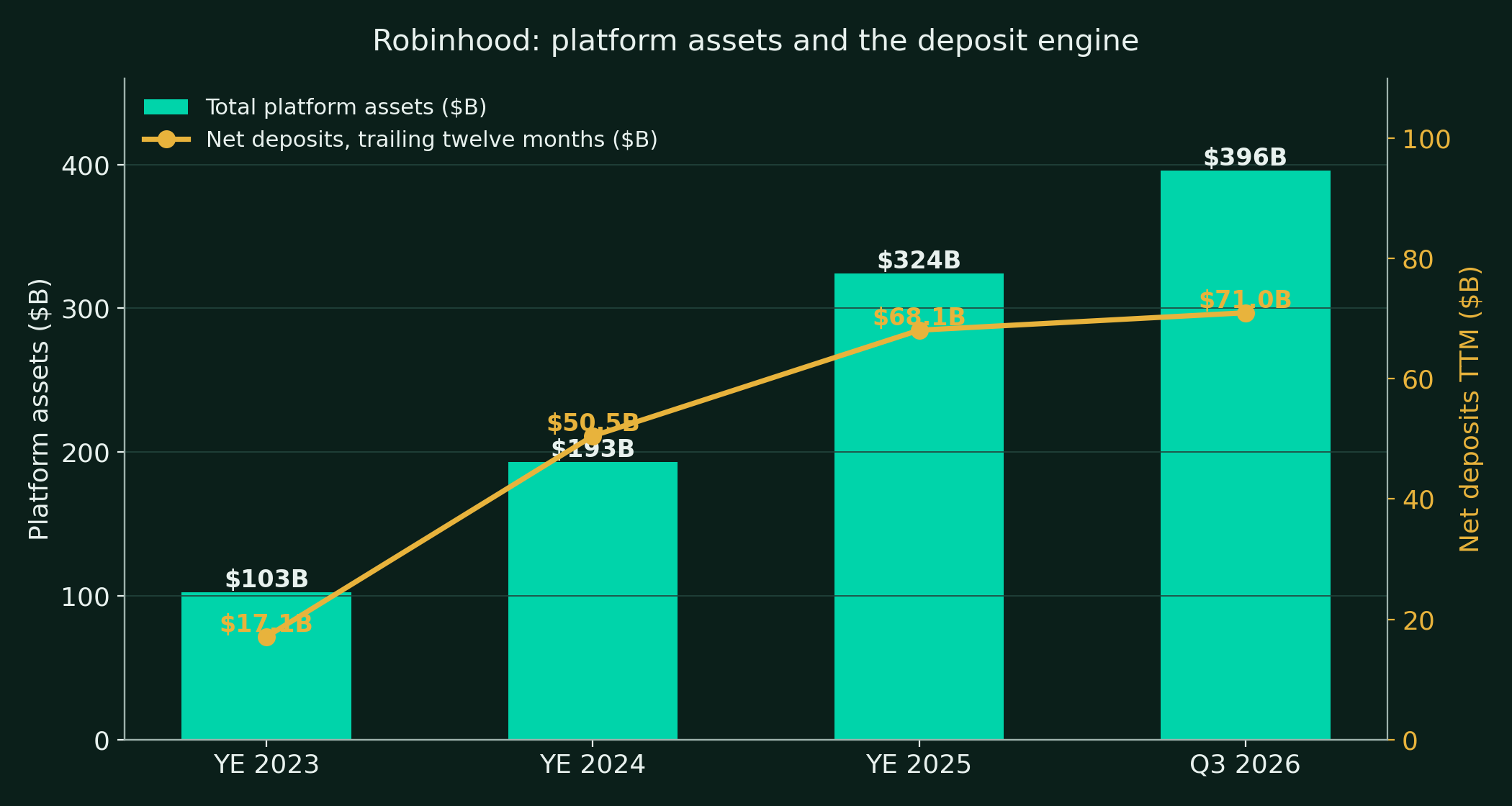
Robinhood has finished the buildout its critics spent a decade calling impossible. Fourteen separate business lines now run above $100M in annualized revenue. Platform assets reached $396B on $71.0B of trailing-twelve-month net deposits. The company holds the Treasury's Trump Accounts trusteeship for nearly 70 million auto-enrolled children, owns a licensed prediction-market exchange through the Rothera joint venture, launched its own blockchain on July 1, 2026, and runs a banking product that became the number one withdrawal destination for its own brokerage customers before it was even generally available. Adjusted EBITDA margin was 57% in Q3 2026. This is no longer a trading app with a story. It is a financial supermarket with a bank's economics arriving line by line.
The stock has de-rated into the print anyway. From the all-time intraday high of $153.86 on October 6, 2025, HOOD fell to $94.56 by the October 27, 2026 close, down 16.4% year to date, and it fell again after hours on the Q3 print, the fifth straight post-earnings decline. Three things weigh on it. The fastest-growing revenue line, event contracts at $173M in Q3 and up more than 6x year over year, is being litigated by 21 states, with a live circuit split and three Supreme Court petitions whose responses come due in November 2026. Crypto revenue fell 55% in Q3, a reminder that 60.9% of revenue still comes from transactions. And at $94.56 the stock trades at 31.1x FY2027 consensus earnings, a multiple that pays for delivery in advance.
Our read: the franchise quality is verified in filings, quarter after quarter, and the roadmap audit in Section 11 is the strongest we have scored in this library. The constraint is not the business. It is the price, and a legal perimeter fight that management pointedly did not mention once on the Q3 call. That combination is a Selective Positive: own the quality, respect the multiple, and treat the November court calendar as a position-level event.
The one number that decides this stock
Event contracts produced $173M of Q3 2026 revenue, 12.2% of the total, from a standing start in 2024. Whether that line is a durable business or a regulatory loan is being decided now: state responses in the Supreme Court petitions are due November 9, 13, and 16, 2026, and CFTC comments on its October rulemaking close November 18, 2026.
What is Robinhood today?
Robinhood Markets, founded in 2013 by Vladimir Tenev and Baiju Bhatt, is a US retail financial platform built on commission-free trading and now organized around a stated strategy it calls the Financial SuperApp: be number one for active traders, number one in wallet share for the next generation, and number one as a global financial ecosystem. The operating businesses sit in regulated subsidiaries: Robinhood Securities (broker-dealer), Robinhood Crypto, Robinhood Derivatives (futures commission merchant and the event-contract facing entity), and partner-bank arrangements for the card and banking products through Coastal Community Bank.
| Metric | YE 2023 | YE 2024 | YE 2025 | Q3 2026 |
|---|---|---|---|---|
| Funded customers | 23.4M | 25.2M | 27.0M | 28.7M |
| Investment accounts | n/d | 26.2M | 28.4M | 30.4M |
| Total platform assets | $102.6B | $193B | $324B | $396B |
| Net deposits, trailing 12 months | $17.1B | $50.5B | $68.1B | $71.0B |
| Gold subscribers | 1.42M | 2.6M | 4.2M | 5.2M |
| ARPU, annualized for the quarter | $81 | $164 | $191 (Q4) | $200 |
Sources: company earnings releases, Q4 2023 through Q3 2026. Funded customers include WonderFi customers from June 2026. Total platform assets include TradePMR assets from 2025, Trump Account assets custodied from July 2026, and WonderFi crypto from June 2026, and exclude non-custodial Wallet assets. Definitions matter here: platform assets are not all custodied, and assets per funded customer, about $13,800, remain a fraction of incumbent levels, which is both the bear point and the runway.
The second layer of the platform is the balance sheet customers carry inside it:
| Balance | Q3 2025 | YE 2025 | Q3 2026 |
|---|---|---|---|
| Retirement AUC | $24.2B | $26.5B | $36.6B |
| Margin book | $13.9B | $16.8B | $22.1B |
| Cash sweep balances | $35.4B | $32.8B | $32.3B |
| Cash and deposits | n/d | n/d | $20.4B |
Sources: company releases. Retirement AUC grew 51% year over year and the margin book 59%, to records. The February 2026 redefinition moved over $6B from cash sweep into cash and deposits as free credit balances funding margin lending, so sweep comparisons across that date need care.
How does Robinhood make money?
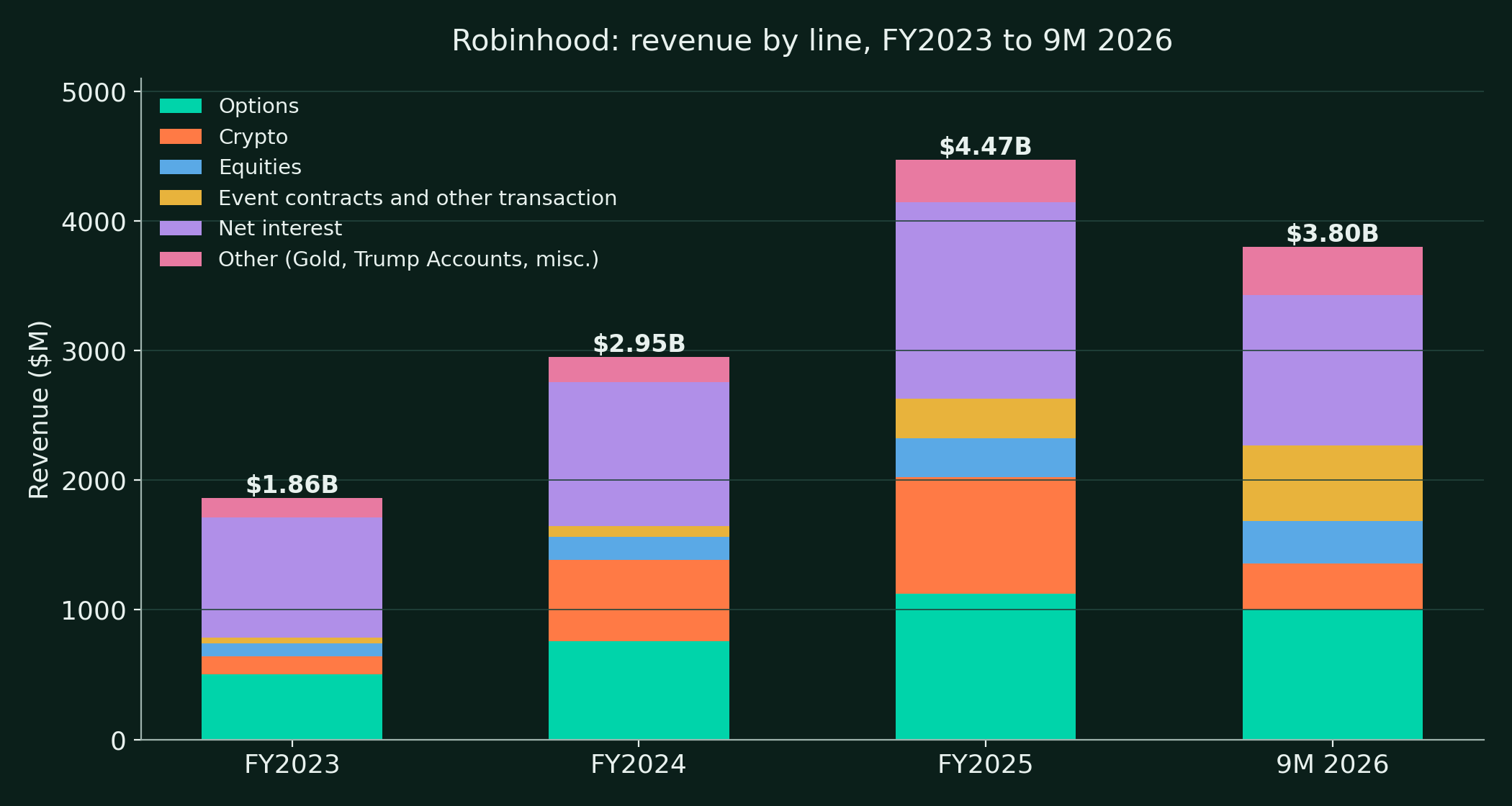
The revenue mix has rotated hard in three years. Net interest was half the company in FY2023. By 9M 2026 the transaction engine, now including event contracts, was the largest block again, and the other line, Gold subscriptions plus Trump Account services plus proxy and fractional-share items, had tripled.
| Revenue line ($M) | FY2022 | FY2023 | FY2024 | FY2025 | 9M 2026 |
|---|---|---|---|---|---|
| Options | 488 | 505 | 760 | 1,123 | 1,001 |
| Crypto | 202 | 135 | 626 | 901 | 354 |
| Equities | 117 | 104 | 177 | 302 | 332 |
| Event contracts and other transaction | 7 | 41 | 84 | 302 | 579 |
| Net interest | 424 | 929 | 1,109 | 1,514 | 1,163 |
| Other | 120 | 151 | 195 | 331 | 370 |
| Total net revenues | 1,358 | 1,865 | 2,951 | 4,473 | 3,799 |
Sources: FY2025 10-K and Q1 to Q3 2026 releases. Event contracts were broken out as a reporting line from Q1 2026; the FY2025 figure of $302M is the reported other transaction-based line, of which about $276M is implied event-contract revenue on company disclosures. 9M 2026 event contracts alone were $433M. Other revenue includes Gold subscriptions ($179M in FY2025) and, from 2026, Trump Account service revenue.
Inside net interest, the mix tells the balance-sheet story: margin lending is now the engine, securities lending has tripled since FY2024 on the loaned book, and corporate cash interest fell as cash was deployed.
| Net interest component ($M) | FY2024 | FY2025 |
|---|---|---|
| Margin interest | 319 | 573 |
| Interest on segregated cash and securities | 261 | 319 |
| Corporate cash and investments | 256 | 167 |
| Cash sweep | 179 | 229 |
| Securities lending | 94 | 190 |
| Credit card | 24 | 64 |
| Interest expense on credit facilities | (24) | (32) |
| Total net interest revenue | 1,109 | 1,514 |
Source: FY2025 10-K. Management quantified rate sensitivity on the Q3 2026 call: each 25 basis point move in short rates is worth about 1.5% of revenue, computed on about $80B of interest-earning assets of which about $40B is rate sensitive. Higher rates help net interest; lower rates tend to help trading. The mix is a partial natural hedge, not an immunity.
What did Robinhood report in Q3 2026?
Q3 2026, reported after the close on October 27, 2026, was a slight revenue miss against consensus (about $1.43B expected) and a GAAP EPS miss ($0.51 against about $0.55), with the quality of the miss depending on which adjustments a reader accepts. The company used the quarter to introduce an adjusted EPS measure. It excludes RVI marks, restructuring, CFO-transition and restructuring-related stock compensation, and intangible amortization, with tax effects. It does not add back ordinary stock compensation, a discipline point in its favor.
| $M except EPS | Q1 2026 | Q2 2026 | Q3 2026 |
|---|---|---|---|
| Total net revenues | 1,067 | 1,308 | 1,424 |
| Transaction-based | 623 | 776 | 867 |
| Net interest | 359 | 389 | 415 |
| Other | 85 | 143 | 142 |
| Total operating expenses | 656 | 734 | 739 |
| Stock-based compensation | 92 | 105 | 80 |
| Net income, total | 346 | 573 | 476 |
| GAAP diluted EPS | $0.38 | $0.62 | $0.51 |
| Adjusted EPS (company measure) | n/a | $0.50 | $0.60 |
| Adjusted EBITDA | 534 | 741 | 808 |
| Adjusted EBITDA margin | 50% | 57% | 57% |
Sources: Q1, Q2, and Q3 2026 releases. Q3 2026 GAAP opex includes a $71M provision for credit losses, up 173% year over year on Gold Card growth, and a $149M tax provision, a 23.8% effective rate against 12.3% a year earlier. The FY2026 adjusted operating expenses and SBC guide was trimmed at the top end by $25M to $2.675B to $2.75B. That guide excludes credit provisions, a point Section 7 returns to.
The one-off ledger matters for anyone summing EPS by hand:
| Item | Quarter | Effect |
|---|---|---|
| Deferred tax valuation allowance benefit | Q4 2024 | +$369M, +$0.41 of EPS |
| Regulatory accrual reversal | Q4 2024 | +$55M, +$0.06 of EPS |
| RVI deconsolidation gain | Q2 2026 | +$129M, +$0.14 of EPS |
| Restructuring charges (about 10% workforce reduction) | Q2 2026 | $23M |
| RVI unrealized mark-to-market loss | Q3 2026 | -$67M, -$0.07 of EPS |
Trailing-twelve-month revenue through Q3 2026 was $5,082M, and the sum of the last four quarters of GAAP diluted EPS is $2.17, which still carries about $0.07 of net RVI mark benefit. The full financial arc:
| $M except EPS | FY2022 | FY2023 | FY2024 | FY2025 | 9M 2026 |
|---|---|---|---|---|---|
| Total net revenues | 1,358 | 1,865 | 2,951 | 4,473 | 3,799 |
| Total operating expenses | 2,370 | 2,401 | 1,897 | 2,379 | 2,129 |
| Stock-based compensation | 654 | 871 | 304 | 305 | 277 |
| SBC as % of revenue | 48.2% | 46.7% | 10.3% | 6.8% | 7.3% |
| Net income (loss) | (1,028) | (541) | 1,411 | 1,883 | 1,395 |
| Diluted EPS | ($1.17) | ($0.61) | $1.56 | $2.05 | $1.51 (sum of quarters) |
| Adjusted EBITDA | (94) | 536 | 1,429 | 2,522 | 2,083 |
| Adjusted EBITDA margin | n/m | 29% | 48% | 56% | 55% |
Sources: FY2025 10-K and 2026 releases. FY2023 opex includes a $485M Founders Award cancellation charge and a $104M regulatory accrual inside G&A; SBC excluding the founders charge was $386M, 20.7% of revenue. FY2024 net income includes the Q4 tax and regulatory benefits above. Cash flow needs its own honest line: the company defines no free cash flow measure, and operating cash flow is dominated by customer balance flows, printing $(157)M in FY2024 against $1,411M of net income as margin receivables grew, $1,638M in FY2025, and $3,983M in 9M 2026 as customer payables grew. Capex is trivial, $54M in FY2025. Quote conversion ratios only with that float caveat attached.
How are the brokerage core and crypto performing?
The core is printing records. Q3 2026 equity notional volume was $992B, up 53% year over year, and options contracts were 905M, up 48%, both records. Legend, the desktop platform launched in October 2024, crossed $100M in annualized revenue in Q2 2026. Futures and index options, announced at the first HOOD Summit in October 2024 and rolled out in early 2025, sit inside other transaction revenue, which the company does not split out.
| Volume | Q4 2025 | Q1 2026 | Q2 2026 | Q3 2026 |
|---|---|---|---|---|
| Equity notional | $710B | $638B | $956B | $992B |
| Options contracts | 659M | 586M | 774M | 905M |
| Crypto notional, total | $82B | $66B | $40B | $50B |
| of which Bitstamp | $48B | $42B | $22B | $29B |
| Event contracts | 8.5B | 8.8B | 13.6B | 16.4B |
Source: company releases. October color from the call: equities, options, and crypto average daily volumes ran within about 5% of the record Q3 level to start Q4, with spreads a little tighter.
Crypto is the weak line and the report should say so plainly. Revenue fell 55% year over year to $120M in Q3. Of that, about $26M was Robinhood Chain revenue, so crypto trading itself was about $94M, down 6% sequentially. Management attributed the take-rate decline mainly to mix: the Robinhood Earn stablecoin lending product, over $500M of assets, monetizes below spot trading, and ex-Earn the take rate was described as broadly similar to the prior quarter. Bitstamp, acquired for $200M cash in a deal announced June 2024 and closed June 2, 2025, brought over 50 licenses, about 500,000 funded retail customers, about 5,000 institutional customers, and about $95M of trailing revenue at close: the institutional and international leg of the crypto strategy. In October 2026 the Ripple partnership put RLUSD settlement onto Bitstamp and Robinhood Chain. US perpetual futures launched for eligible customers at the September 2026 Summit via Robinhood Derivatives with Bitstamp, eight assets, up to 10x leverage on BTC and ETH, and a 0.01% introductory fee through December 2026.
How big are prediction markets, and how serious is the legal fight?
No business in the S&P 500 has grown this fast from zero. Election contracts launched in October 2024 through ForecastEx. The Prediction Markets Hub launched March 17, 2025 through KalshiEX. In November 2025 Robinhood formed a joint venture with Susquehanna International Group, which on January 20, 2026 closed the acquisition of 90% of MIAXdx, a CFTC-licensed designated contract market and clearinghouse formerly in the LedgerX lineage, with Miami International Holdings retaining 10%. The rebranded exchange, Rothera, self-certified its first contracts in May 2026 and took live flow on June 4, 2026.
Q3 2026 economics: 16.4B contracts, $173M of revenue, about 1.05 cents of revenue per contract on a simple division, and Rothera contributed $28M of the revenue on 3.4B contracts in its first full quarter, crossing $100M annualized and becoming the 14th business line at that scale. Non-sports categories rose to about 30% of activity from 15% in Q2, the single most important mix datapoint in the business, because the sports book is where the state legal attack concentrates. Pricing moved to a dynamic model when Rothera launched, lowering wing prices without reducing Robinhood's take rate, with better pricing for Gold members. In September 2026 the company took initial 1% equity stakes in Crypto.com and OG.com at no cash cost, earnable to 10%, and told analysts the vast majority of flow will run through Rothera and those two venues by early 2027, consolidating off competitor exchanges including, by implication, Kalshi. Earnings and KPI contracts announced at the Summit remain pending final approvals, in management's words "coming very soon."
Two structural caveats belong in the main text, not the footnotes. Robinhood does not wholly own or operationally control Rothera; Tenev described the company and SIG as significant equity holders in an independently run business positioned as a neutral gateway for other futures commission merchants. And the venture's revenue quality is untested through a full sports calendar: Q3 contained no NFL regular season until September and no election.
The legal file, dated and sourced, is the risk that prices the stock:
| Date | Event |
|---|---|
| Dec 2020 to Mar 2025 | The older file: SEC $65M (Dec 2020), FINRA $57M fine plus $12.6M restitution (Jun 2021), NYDFS $30M (Aug 2022), Massachusetts $7.5M (Jan 2024), SEC $45M across two entities (Jan 2025), FINRA $26M fine plus $3.75M restitution (Mar 2025). Cumulative confirmed penalties about $246.9M. The SEC crypto Wells notice was closed with no action on Feb 24, 2025 |
| Apr 6, 2026 | Third Circuit sides with Kalshi in New Jersey |
| Apr 28, 2026 | CFTC sues Wisconsin asserting federal preemption of state gaming law |
| Jul 29, 2026 | Wisconsin preliminary injunction denied |
| Aug 28, 2026 | Ninth Circuit rules against the platforms, including Robinhood, in Nevada |
| Sep 10, 2026 | Connecticut orders nine platforms to halt sports event contracts |
| Sep 25, 2026 | Sixth Circuit rules for the platforms in Ohio and Tennessee |
| Oct 2, 2026 | Ohio cease-and-desist letters to ten platforms including Robinhood |
| Oct 19, 2026 | CFTC interim final and proposed rules on event contracts published; comments due Nov 18, 2026 |
| Oct 26, 2026 | Tracker count: 21 states suing, ordering, or defending suits (WSN) |
| Oct 27, 2026 | CFTC sues Utah, the same day Robinhood reported earnings |
| Nov 2026 | Supreme Court response deadlines: Flaherty v KalshiEX (No. 26-299) Nov 9; Robinhood Derivatives v Dreitzer (No. 26-338) Nov 13; Crypto.com v Nevada (No. 26-344) Nov 16 |
States have prevailed in 19 of 23 preliminary injunction decisions to date, a count attributed to legal commentator Daniel Wallach. The honest summary: the federal preemption argument is winning in some circuits and losing in others, the Supreme Court has been asked to settle it three times, and the CFTC under its current leadership is litigating on the platforms' side against the states. Payment for order flow, the older existential question, is not banned and is not the live fight: the 2026 change is expanded Rule 605 execution-quality disclosure from August 2026. What is disclosed instead is concentration: market makers and liquidity providers were 55% of FY2025 total revenue, with Citadel Securities alone at 13% and Wintermute at 6%; in Q2 2026 the figures were 47% and 16% respectively.
How are Gold, the card, and banking doing?
Gold is the loyalty engine the whole wallet-share strategy runs on. The verified price is $5 per month or $50 per year, unchanged through October 2026; claims of a general increase to $10 do not appear in company materials. Subscribers reached a record 5.2M in Q3 2026, up 34% year over year, an 18% adoption rate overall and about 40% among new customers. The 3% IRA contribution match is the stickiest benefit, with a five-year holding requirement on matched funds.
We don't view it as a subscription product. We view it as a loyalty product.
Shiv Verma, CFO, Q3 2026 earnings call
The Gold Card, issued by Coastal Community Bank on Visa, 3% cash back on all categories with no annual fee beyond Gold membership, reached 1.3M customers and over $19B of annualized payment volume in Q3 2026. Net credit card interest revenue nearly tripled to about $50M in the quarter on deck disclosures. The cost side is arriving on schedule for a young card book: the provision for credit losses rose to $71M in Q3, up 173% year over year and 27% sequentially, and nine-month provisions were $163M against $78M a year earlier. Funding is increasingly term: on July 23, 2026 the Credit Card Funding Trust completed a $500M inaugural Series 2026-1 asset-backed note issuance secured by card receivables, four fixed-rate classes at a weighted average coupon of about 4.86%, revolving to June 2029 with final maturity in July 2031.
The guided number excludes the fastest-growing cost
The FY2026 adjusted operating expenses and SBC guide of $2.675B to $2.75B excludes the provision for credit losses by definition. Provisions were 5.0% of Q3 revenue, against 2.0% a year earlier, and management guided Q4 investment into scaling both the Gold and Platinum cards. Judge the card on the provision trajectory, not on the adjusted expense line.
Banking, announced in March 2025 for a fall 2025 Gold-subscriber launch, is the clearest roadmap slip and the clearest product win at the same time. The rollout began on schedule, with over 20,000 customers and about $300M of deposits by January 31, 2026, but general availability, gated on independent onboarding outside the brokerage app, had still not arrived by October 27, 2026. Inside the limited release the numbers are striking: over 350,000 funded customers, nearly $5B of deposits, about 40% signed up for direct deposit, and, in Tenev's words, Robinhood Banking became the number one withdrawal destination for Robinhood brokerage customers in Q3, ahead of the large incumbent banks, before general availability. The peer-to-peer Send Money product, demonstrated live on the call, lets a Banking customer send money by text to anyone, who accepts through Apple Pay or Google Pay without a Robinhood account: a viral acquisition channel aimed at Zelle's use case.
What are Strategies, Trump Accounts, and Ventures worth?
Robinhood Strategies, the managed-portfolio product launched March 2025 at a 0.25% annual fee capped at $250 for Gold members, reached 350,000 funded customers and over $2B of assets under management in Q3 2026. Retirement AUC was a record $36.6B, up 51%. Trust accounts hold over $300M at an average size above $400,000, a datapoint that matters: the wealthier customer is arriving through products, not marketing.
Trump Accounts are the largest distribution event in the company's history, and the least proven economically. The accounts are 530A accounts created under the One Big Beautiful Bill Act. Treasury selected Robinhood as broker and sole initial trustee at launch, with BNY as financial agent and custody partner. Treasury's seed is $1,000 per child born from January 1, 2025 to December 31, 2028; family and employer contributions are capped at $5,000 a year; funds are locked until age 18. Automatic enrollment in Q3 2026 established accounts for nearly 70 million children. The Michael and Susan Dell pledge of $6.25B put $250 into accounts for 25 million children, and about $6B of it landed inside October's month-to-date net deposits of over $13B, which is 46% of that headline figure: a one-off donor inflow inside a growth metric, disclosed by the company itself and worth remembering whenever the 20% deposit goal is quoted. The contract is cost-plus with a small margin. Management guides the FY2026 build investment at about $100M, and deck coverage puts Q3 service revenue at about $47M inside other revenues. The strategic value, a generation of future customers auto-enrolled at birth with Robinhood as trustee, is real and unpriced by any model we trust, including ours. The durability risk is equally real: the program is one administration's statute, and trustee status can be re-competed.
Robinhood Ventures is the private-markets leg. Fund I (NYSE: RVI), launched March 6, 2026 at $25 a share with no accreditation requirement, no minimums, and no performance fees, was deconsolidated in Q2 2026, which produced the $129M gain in that quarter's net income; the Q3 mark against the retained stake was the $67M unrealized loss. Holdings at September 30, 2026 on the fund's own page: 17 positions, Databricks 13.67%, Mercor 11.20%, OpenAI 9.43%, Revolut 9.03%, Erebor 5.89%, ElevenLabs 5.00%, with cash at 15.23% and a 3.13% expense ratio. A second fund, RVII, targeting seed-stage companies, followed later in 2026 with a 20% performance fee. Treat Ventures as brand and funnel, not earnings: its marks will swing reported EPS by design, which is precisely why the company now publishes an adjusted EPS that excludes them.
What are Robinhood Chain and stock tokens?
Robinhood Chain, a permissionless Ethereum Layer 2 built on Arbitrum Orbit and described by the company as AI-native and financial-grade, launched on mainnet on July 1, 2026 at the London event. First-quarter scale: the written release reports over $80B of DEX volume and over $50M of chain fees, top five among chains by revenue and volume on company metrics; Tenev's oral remarks cited over $100B of DEX volume and over $1B per day of recent DeFi perpetuals volume. The two volume figures are both company statements from the same day and cannot both be right; this report uses the written release figure. Verma quantified monetization at about $50M gross and about $25M net in Q3 after an approximately 50% share, with normalized monetization of a couple of basis points on notional, and explicitly declined to call Chain a $100M cylinder yet.
I do think more needs to be done to give people a little bit of certainty because as we talk to customers, I think the uncertainty of what happens in 5 years is likely to be an impediment to putting serious assets onto this technology.
Vladimir Tenev, CEO, on the SEC innovation exemption, Q3 2026 earnings call
Tokenization runs on two legally distinct structures, and most coverage conflates them. Classic Stock Tokens, launched June 30, 2025 in Cannes and now about 2,000 names, are MiFID II derivative contracts with Robinhood Europe, UAB under Bank of Lithuania authorization, held in-app and not transferable. Chain Stock Tokens, over 190 names in over 120 countries, are tokenized debt securities issued by Robinhood Assets (Jersey) Limited, backed 1:1 by shares at a US custodian, carrying no voting or shareholder rights, and traded through self-custody wallets and DEXs. The US path turns on the SEC's Innovation Exemption for Tokenized Securities Venues, dated September 17, 2026: five years, a same-rights condition the current Jersey debt structure does not meet, an issuer 30-day opt-out, and listing caps. Twenty-two issuers, including Microsoft, Alphabet, Goldman Sachs, Cisco, Marvell, Wells Fargo, and Arm, have formally objected (Reuters, October 23, 2026). Tenev backs the exemption and says rulemaking or legislation is still required for certainty. A 2027 US launch is analyst expectation, not company guidance. Agentic trading, the other 2026 build, had about 200,000 opened accounts and over $1.6B of notional volume by the Q3 release, up from over 150,000 accounts at the September 29, 2026 HOOD Summit, with over $250M transferred into agentic accounts: real traction, pre-revenue in any disclosed sense.
How far has Robinhood expanded internationally?
| Market | Status at October 28, 2026 |
|---|---|
| United Kingdom | Brokerage generally available since March 2024; stocks and shares ISA in the Q4 2025 to Q1 2026 window; crypto trading launched in the UK in 2026; Cortex Digests live since August 2025 |
| European Union and EEA | Crypto since late 2023, transfers from October 2024; Classic Stock Tokens across 31 jurisdictions from June 30, 2025; perpetual futures from 2025, expanded April 2026 |
| Canada | Via WonderFi (Bitbuy and Coinsquare), announced May 13, 2025 at C$0.36 per share, about C$250M fully diluted; closed June 1, 2026; over 300,000 funded customers and over C$2B of client assets at announcement |
| Dubai and MENA | DFSA authorization received, announced with Q3 2026 results; all ten DFSA approved asset classes; rollout planned from 2027 |
| Singapore and APAC | Capital markets services license from MAS on July 1, 2026 per the Q2 2026 release; hub for Southeast Asia; brokerage offering still to come |
| Indonesia | Agreements to acquire a brokerage and a crypto firm announced in Q4 2025; close status not verified in sources reviewed |
International funded customers passed 1M in Q2 2026. Management's stated long-run ambition is over half the business outside the US. The honest grade today: the licenses are accumulating faster than the revenue, which is the correct order for a regulated buildout, and Canada arrived through acquisition rather than a full brokerage launch.
Has Robinhood delivered on its roadmap?
Management's promise-versus-delivery record is the spine of our Leadership grade, and it is unusually checkable because the expense guide is restated every quarter and the product dates were public.
| Commitment | What was promised | What was delivered | Score |
|---|---|---|---|
| Net deposit growth of 20% plus in 2026 | Annual goal stated through 2026 | Beaten by October: year-to-date net deposits over $68B passed the full prior year, with two months left; TTM growth rate 21% at Q3. Caveat: October includes the $6B Dell one-off | Beaten, with the one-off flagged |
| FY2026 adjusted opex and SBC guide | $2.600B to $2.725B at Q4 2025 | Raised $100M at Q1 2026 entirely for Trump Accounts, then trimmed at Q2 ($2.675B to $2.775B) and again at Q3 (top end to $2.75B) on efficiency gains | Met, three restatements, each explained |
| Trump Accounts build | Cost-plus contract; about $100M FY2026 investment | Launched July 4, 2026; auto-enrollment of nearly 70M children delivered in Q3; investment still guided at about $100M | Met |
| Robinhood Chain mainnet | 2026 launch | Live July 1, 2026; first quarter top five by company metrics, over $80B DEX volume per the release; management ramping investment after beating internal expectations | Met, scale above plan |
| Own prediction-market exchange | JV November 2025; Rothera live for the 2026 World Cup window | MIAXdx closed January 20, 2026; flow live June 4, 2026; first full quarter $28M revenue and $100M plus annualized | Met |
| Earnings and KPI contracts | Announced at HOOD Summit, September 29, 2026 | Not live at October 27, 2026; final approvals pending, no date committed on the call | Pending |
| Banking general availability | Announced March 2025 for a fall 2025 Gold launch | Rollout began on time; general availability still pending at October 2026 with no new date; 350,000 customers and nearly $5B of deposits inside limited release | Partially missed |
| Gold growth | No formal numeric target | 1.42M to 2.6M to 4.2M to 5.2M subscribers across 2023 to Q3 2026; adoption 18%, about 40% of new customers | Beaten against trajectory |
| Gold Card rollout | Cautious rollout from March 2024 | 1.3M customers and over $19B annualized volume at Q3 2026; provision for credit losses up 173% year over year is the cost of the pace | Met on scale, credit cost flagged |
| Tokenization, EU | Stock Tokens at the June 2025 Cannes launch, thousands of names by year end | Launched June 30, 2025; about 2,000 Classic tokens by Q4 2025; Chain tokens in over 120 countries from July 2026 | Met |
| Tokenization, US | No dated company commitment | Exemption welcomed; management says rulemaking or legislation still needed; 2027 launch is analyst expectation only | Pending, regulatory gated |
| 24/7 equities | Announced at the Summit | Not live at October 27, 2026; company-linked phrasing is inconsistent between "later this year" and "early next year, pending approval" | Pending |
The pattern is the opposite of the usual fintech file. The dated, quantified commitments on deposits, expenses, and launches were kept or beaten. The misses are sequencing slips on regulated rollouts (Banking general availability) and products awaiting approvals the company does not control. The June 16, 2026 reduction of about 10% of full-time staff, roughly 290 roles framed as efficiency from strength, followed by two consecutive guide trims, is consistent with the stated philosophy of harvesting efficiency in the core and reinvesting it.
How does Robinhood compare with Schwab, Interactive Brokers, and Coinbase?
Robinhood wins on product velocity, engagement, and the young cohort. It trails, by an order of magnitude, on assets per customer. Both facts are in the same table:
| Company | Accounts | Client assets | Assets per account | Latest quarter revenue | Latest quarter net income |
|---|---|---|---|---|---|
| Charles Schwab | 48.6M brokerage accounts | $13.33T | about $274K | $7,171M (Q3 2026) | $2,906M |
| Interactive Brokers | 5.58M accounts | $964.7B customer equity | about $173K | $1,914M (Q3 2026) | pretax margin 78% |
| Robinhood | 28.7M funded customers | $396B platform assets | about $13.8K | $1,424M (Q3 2026) | $476M total |
| Coinbase | 7.6M monthly transacting users (Q2 2026) | $245.9B assets on platform | n/a | $1,154M net revenue (Q2 2026) | GAAP net loss of $359.5M |
| Webull | 5.13M funded accounts (Q2 2026) | $28.5B | about $5.6K | $198.8M (Q2 2026) | $24.4M |
| eToro | 4.28M funded accounts (Q2 2026) | $19.2B AUA | n/a | $229M net contribution (Q2 2026) | $53M |
Sources: company releases for the latest reported quarter at October 28, 2026; Coinbase reports Q3 on October 29, so its Q2 figures are shown. Fidelity, private, reported FY2025 revenue of $37.7B and operating income of $12.7B, with $19.9T of administered assets at Q2 2026. Account definitions differ across companies and are not perfectly comparable.
The Q3 contrast with Coinbase is the diversification argument in one line: with crypto revenue down 55%, Robinhood still grew total revenue 12% and earned $808M of adjusted EBITDA; Coinbase's Q2, in the same crypto drawdown, shrank revenue 17% to a GAAP loss. Schwab wins scale and balance: $13.33T of client assets is 34 Robinhoods. Interactive Brokers wins professional depth, margin pricing, and a 78% pretax margin Robinhood will not approach while it is buying growth. Robinhood's counter is arithmetic: if assets per funded customer merely double over the next decade as the cohort ages into peak earning years, platform assets approach $800B at today's customer count, before another customer is added.
In prediction markets the share picture is dollar-weighted and Robinhood is not the leader. Aggregator data for the 30 days to October 14, 2026 (Surgence) puts Kalshi at 76% of dollar volume, Polymarket's US operation at 12%, and Rothera at 4.6%. Kalshi's last confirmed priced round was $1B at a $22B valuation in May 2026, with reports in late September and early October 2026 of talks near $40B, not closed; its revenue run rate passed a reported $2B mid-2026, and August 2026 dollar volume was about $37.2B. Robinhood's 16.4B quarterly contracts are a count, not a notional: at about a cent of revenue per contract, the revenue pool share matters more than the contract share, and on revenue Robinhood's $173M quarter is already material against the field. The exchange entrants, CME with FanDuel Predicts (December 22, 2025) and DraftKings Predictions on its own exchange (from June 2026), have distribution and no traction yet: DraftKings' measured share is about 0.01%.
How should investors grade Tenev, Verma, and the board?
Vladimir Tenev, co-founder, has been sole CEO since November 2020 and is also President and Chair. The delivery record in Section 11 is his: the SuperApp strategy held without revision through the 2022 downturn, profitability arrived in 2024, S&P 500 inclusion followed in 2025 on secondary coverage, and the 2024 to 2026 expansion shipped banking, a card, an exchange, a blockchain, and a government trusteeship in under three years. The debits are governance-shaped rather than delivery-shaped: the triple role, and a selling program that deserves exact statement. Under a Rule 10b5-1 plan adopted September 5, 2025, Tenev sold about 2M Class B shares through conversions in 2026 for about $220M, including 375,000 shares for about $42.6M on October 5, 2026. He retains about 47.4M Class B shares, worth roughly $5.2B at early-October prices, and his voting control is intact. The viral claim that he sold his stake to zero confuses the directly held Class A line, which mechanically prints zero after each conversion sale, with the retained supervoting stake.
CFO Shiv Verma is an internal succession, and the record should correct a circulating error: he did not arrive from outside in 2025. Verma joined Robinhood in 2018, served as SVP of Finance and Strategy and Treasurer, was announced as successor in November 2025 when Jason Warnick's retirement was announced, and took the seat on February 6, 2026, with Warnick advising until September 1, 2026. His promotion package, per the March 2026 8-K/A summary, is a $600,000 salary, a 75% bonus target, and a promotion RSU grant of about $18M over four years. The finance function's conduct since, a thrice-restated expense guide with each move explained and an adjusted EPS definition that keeps ordinary stock compensation inside, supports the appointment.
Governance structure is the weakest formal element. Class B carries ten votes per share and the founders and affiliates hold all of it: at April 8, 2026, Baiju Bhatt held 32.0% of total voting power and Tenev 26.1%, a 58.6% group position. The counterweights are a lead independent director, a ten-member board, and Ernst & Young as auditor. Capital allocation verdict, item by item: the June 2026 zero-coupon convertible raise was the cheapest capital available and was structured to neutralize dilution to a $303.95 share price on the company's own framing; the acquisitions were small and strategic (Bitstamp $200M cash, WonderFi about C$250M, TradePMR about $100M in stock, MIAXdx at an undisclosed price); the buyback record is two-sided, $1.3B at a $48 average since Q3 2024 against $25M spent at about $105 in Q3 2026; the $25M corporate Bitcoin purchase in October 2026 is a statement, not an allocation, and it sits oddly against Verma's public skepticism a year earlier about Bitcoin as a use of capital.
How strong is the balance sheet, and where does the cash go?
The balance sheet is a customer-float balance sheet with a genuinely strong corporate core inside it. Read the two separately:
| $M | Dec 31, 2025 | Sep 30, 2026 |
|---|---|---|
| Cash and cash equivalents (corporate) | 4,261 | 5,829 |
| Cash and securities segregated for users | 5,749 | 13,443 |
| Receivables from users (margin and other) | 17,994 | 23,598 |
| Total assets | 38,137 | 58,271 |
| Payables to users | 11,986 | 18,473 |
| Securities loaned | 11,626 | 19,480 |
| Long-term borrowings | 0 | 2,660 |
| Total stockholders' equity | 9,151 | 10,078 |
Source: Q3 2026 release balance sheet. Total assets grew 53% in nine months because customer activity grew; that is float mechanics, not corporate leverage, and data providers that print a 2.4x debt-to-equity ratio for this company are counting customer obligations as debt. The new long-term borrowings are two instruments, and the brief version that calls all of 2026 borrowing convertible debt is wrong. The first is $2.2B of 0.00% convertible senior notes due October 1, 2029, issued June 25, 2026 under Rule 144A at a conversion price of about $174.42, a roughly 65% premium at pricing: about $290M of proceeds repurchased 2.743M shares at $105.71 alongside the offering, outside the buyback authorization, and $123M bought capped calls struck at the conversion price with a cap near $237.85. The second is the $500M Credit Card Funding Trust Series 2026-1 asset-backed issuance of July 23, 2026 described in Section 7, secured by card receivables and self-liquidating against them. Net of the $5.83B of corporate cash, the corporate entity is in a net cash position against both. The accumulated deficit narrowed to $773M from $2,152M at year-end 2025 on nine months of earnings retained after buybacks. Tangible book value per share computes to $10.27 at September 30, 2026, our calculation from the release's equity, intangibles, and share count, up from $9.53 at year-end 2025.
The return-of-capital ledger:
| Period | Repurchased | Average price |
|---|---|---|
| FY2024 | $257M | n/d |
| FY2025 | $653M | about $54 on about 12M shares |
| Q1 2026 | $250M | about $81 |
| Q2 2026 | $414M | about $94, including the $290M convertible-linked trade |
| Q3 2026 | $25M | about $105 |
| Cumulative since Q3 2024 | $1.3B, 27M shares | about $48 |
Authorization history: $1.0B in May 2024, raised to $1.5B in April 2025, then replaced by a fresh $1.5B program on March 25, 2026 with over $1.1B of incremental capacity. The earnings release does not state remaining capacity; the Q3 2026 10-Q issuer purchases table is the document that settles it. Share count was flat at 901M in total across the period (793M Class A plus 108M Class B at September 30, 2026), because buybacks roughly offset stock compensation and conversions: the dilution machine of FY2023, when SBC was 46.7% of revenue, is now a 7% cost line managed against repurchases.
What is Robinhood worth at $94.56?
At the $94.56 reference close on October 27, 2026, market capitalization computes to about $85.2B on 901M shares. On trailing figures the stock prints 41.25x to 41.66x earnings on provider calculations; summing the last four quarters of GAAP diluted EPS to $2.17 gives 43.6x on our math, the difference being share-count and mark treatments, and we show both rather than silently picking one. Trailing price to sales is about 16.7x on $5,082M of TTM revenue. Forward, on Zacks consensus crawled October 26 to 28, 2026 (FY2026 revenue $5.29B and EPS $2.20; FY2027 revenue $6.82B and EPS $3.04, both confirmed exactly as published), the stock trades at 31.1x FY2027 earnings and 12.5x FY2027 sales. FY2028 EPS consensus of about $3.50 exists only in a Zacks commentary chart and is low precision; FY2028 revenue consensus was not verified. Consensus moved up hard during October 2026 itself: FY2027 EPS rose from $2.60 in September to $3.04. Beta is 2.35 on MarketBeat and 2.50 on Finnhub; name your source before quoting either.
| Ticker | Price, Oct 27, 2026 | P/E trailing | P/S trailing | Beta |
|---|---|---|---|---|
| HOOD | $94.56 | 41.7x (provider); 43.6x (derived) | 16.7x | 2.35 to 2.50 |
| SCHW | $89.30 | about 16.2x | about 5.7x (derived) | 0.76 |
| IBKR | $82.25 | about 31.5x | n/a | n/d |
| COIN | $161.09 | n/m (TTM losses) | 7.03x | 3.35 |
Sources: MarketBeat, FinanceCharts, Finnhub snapshots at October 27, 2026. Multiples move daily; treat as a snapshot, not a quote. Interactive Brokers' entity-level market capitalization is not comparable without adjustment for its partnership structure and is not shown.
The Street is bullish and dispersed. TipRanks at October 26, 2026: Strong Buy, 20 buys, 3 holds, 0 sells, average target $139.00. MarketBeat: Moderate Buy, average $130.29. The target range runs from $57 to $170, which is the litigation binary expressed as a spreadsheet. October 2026 actions verified in our pass: Morgan Stanley raised to $160 (October 9, Overweight), BofA to $156 (October 5), JPMorgan raised to $115 while staying Neutral (October 20, the lowest target among active raisers), Wells Fargo cut to $120 (October 14), Rosenblatt initiated Buy at $135 (October 20), StoneX set the Street high at $170 (October 1), Piper $145, Barclays raised to $132, Evercore initiated Outperform at $130, Truist raised to $134. For the record, Bernstein's $160 target dates from a July 2026 raise and was reissued September 8, 2026; it is not an October action, whatever roundup tables imply.
What are the FY2029 bear, base, and bull targets?
Targets are built on the company's adjusted EPS, the measure management now guides around, which retains ordinary stock compensation and strips RVI marks, restructuring, and deal amortization. The anchor is FY2027 consensus adjusted EPS of $3.04 (Zacks). Each scenario states its revenue, its adjusted net margin, and its share count, so the reader can rebuild the number rather than trust it.
| Scenario | FY2029 revenue | Adj. net margin | Diluted shares | FY2029 adj. EPS | Exit P/E | Target |
|---|---|---|---|---|---|---|
| Bear | $7.2B | 30.5% | 910M | $2.42 | 19x | $46 |
| Base | $9.5B | 39% | 877M | $4.23 | 26x | $110 |
| Bull | $10.8B | 42% | 860M | $5.27 | 30x | $158 |
The bear case is a perimeter and winter case: a Supreme Court or circuit outcome that curtails sports event contracts in large states, a two-year crypto drawdown, and margin compression as the card book seasons. It is not an invention: Bernstein's published bear work in February 2026 put 2027 EPS at $2.40 to $3.10 on comparable assumptions with targets of $24 to $61. Our bear EPS of $2.42 in FY2029 sits below FY2027 consensus, which is what a lost perimeter means. The base case delivers FY2027 consensus, then grows revenue 18% a year for two years as Banking reaches general availability, Chain adds a second year of fees, and the retirement and margin books compound, at a 39% adjusted net margin and a de-rated 26x exit. The bull case holds the perimeter, keeps non-sports mix climbing toward half of event activity, takes revenue to $10.8B at a 42% margin, and re-rates toward 30x, about today's forward multiple, on a larger and more diversified base.
From $94.56 the arithmetic is honest and unflattering to the base case: bear is -51%, base is +16% in total over three years, about 5% a year, and bull is +67%, about 18% a year. The Selective Positive does not rest on the base case being generous. It rests on the revision pattern (FY2027 consensus up 17% in a single month), the probability that the base is again conservative for a management team whose audited record is beating its own guides, and the bull asymmetry if the perimeter holds. At the October 28 premarket prints near $88, the base return improves to about +25%: the entry price is doing real work in this file, and the report's rating assumes the buyer notices.
What does the chart say?
The trend is down and the report says so. HOOD closed at $94.56 on October 27, 2026, 13.1% below its 50-day average near $108.8 and only 1.1% to 1.2% above its 200-day average near $93.5, a level the October 28 premarket session (prints between $86.84 and $88.93, down 6% to 8%) has taken out on an unsettled basis. The 52-week intraday range is $63.51 to $150.47; the all-time high of $153.86 dates to October 6, 2025. RSI (14) was 36.46 on October 23, soft but not washed out. Short interest was 36.5M shares at the October 15 settlement, 4.69% of float and 1.9 days to cover, and shorts covered about 3.5M shares into mid-October: the bearish positioning into this print was lighter than the narrative suggested. Thirty-day implied volatility was 65.7%, and the options market priced a 9.54% move into the print. The stock had fallen after each of its previous four earnings reports; the after-hours decline of about 5% on October 27 makes five, a pattern that says more about positioning into prints than about the prints themselves. Support on a closing basis sits at the 200-day area near $93.5, then the premarket shelf near $87, then the 52-week low zone; resistance begins at the 50-day near $108.8. A fundamental buyer here is buying against the tape, which is one reason the rating is Selective rather than full Positive.
What are the main risks?
- The litigation binary. Event contracts are 12.2% of revenue and the fastest-growing line. An adverse Supreme Court outcome or a cascade of state injunctions removes growth the forward multiple already capitalizes. States have won 19 of 23 preliminary injunction decisions to date.
- Transaction concentration. 60.9% of Q3 revenue was transaction-based. Options, equities, crypto, and event contracts all fall together in a risk-off tape, as the Q3 crypto print showed even in a strong quarter.
- Market-maker concentration. 55% of FY2025 revenue ran through market makers and liquidity providers, Citadel Securities alone 13%. A Rule 605-driven change in execution economics, or a single relationship change, moves the model.
- Credit arrives quietly. The Gold Card book is young, growing fast, and already producing a provision line up 173% year over year that sits outside the adjusted expense guide. Card charge-off and delinquency rates are not disclosed in the release; the 10-Q notes are the check.
- Political concentration in the deposit story. $6B of October's $13B plus of net deposits was one family's gift into a program created by one administration's statute. The 20% growth headline is beaten; its composition is more fragile than the headline.
- Chain fee quality. Q3 Chain fees were generated in a memecoin-heavy on-chain environment on multiple published accounts. A couple of basis points on shrinking notional is a small number; TVL durability is unproven past one quarter.
- Rothera is not controlled. The exchange at the center of the growth story is a joint venture Robinhood does not wholly own or operationally control, dependent on Susquehanna on both the venture and liquidity sides, with the venture split and the MIAXdx purchase price undisclosed.
- Governance entrenchment. Dual-class control at 58.6% of votes, a combined Chair, President, and CEO, and a founder selling roughly $220M of stock in 2026 under a pre-set plan. None of this is hidden; all of it caps the multiple some institutions will pay.
- Valuation itself. At 31.1x FY2027 consensus after October's upward revisions, the stock needs the revisions to keep coming. Two of the last five prints were revenue misses against consensus; the guide for 2027 expenses, and any 2027 outlook, does not arrive until January and February 2027.
- Float arithmetic. The consolidated balance sheet and operating cash flow swing with customer behavior. In a disorderly market, segregated and payable balances shrink quickly; the corporate core is strong, but headline total assets are not a stability metric.
What should investors watch next?
The calendar is unusually concrete. November 9, 13, and 16, 2026 bring the state response deadlines in the three Supreme Court petitions; November 18 closes CFTC comments on the October rulemaking. Coinbase's Q3 print on October 29 is the read-across for the crypto line. In January and February 2027, Verma delivers the expense plan and the first formal framing of 2027, the gap this quarter's call conspicuously left open. On the Q4 print, the checklist is: event-contract revenue and the non-sports mix, the credit provision against card growth, Chain's second quarter of fees against the $50M gross bar, Gold net adds against the roughly 330,000-a-quarter pace of 2026, Banking general availability, and the first approval news on earnings and KPI contracts.
The conclusion folds the year together. In the past twelve months Robinhood took platform assets from $324B to $396B, beat its own 20% deposit goal by October, launched a blockchain, took delivery of an exchange, became the trustee for nearly 70 million children's accounts, introduced an honest adjusted EPS, and cut its expense guide twice while absorbing a government build and a 10% workforce reduction. The stock fell 38% from its high over the same span, because the market is pricing a court fight and a multiple, not a buildout. Both halves of that sentence are true. Our verdict: 66/100, Selective Positive, FY2029 targets of $46 / $110 / $158 on a $94.56 reference price. The SuperApp is built. The perimeter is the fight, and the fight has dates.
The proof points that would raise the score
A Supreme Court or rulemaking outcome that settles federal preemption for event contracts, Banking at general availability with deposits compounding, and a 2027 expense plan that holds margins while the new cylinders scale. Any two of the three, and this becomes a high-conviction compounder file. A perimeter loss, or two more quarters of card provisions growing at triple-digit rates, and the thesis is wrong regardless of the deposit count.
Frequently asked questions
Is Robinhood profitable?
Yes. Robinhood earned GAAP net income of $1.88B in FY2025 and $476M in Q3 2026, with adjusted EBITDA of $808M at a 57% margin in the quarter. The company introduced an adjusted EPS measure in Q3 2026 that printed $0.60 against GAAP EPS of $0.51, the gap being mainly a $67M unrealized mark on its Robinhood Ventures Fund I stake.
What is the biggest risk in the Robinhood story?
The legal status of event contracts. The line produced $173M of Q3 2026 revenue, 12.2% of the total, up more than 6x year over year, and 21 states are suing, ordering, or defending suits over it. The circuits are split, three Supreme Court petitions are pending with responses due in November 2026, and the CFTC is litigating for federal preemption against the states.
What are the DalalBytes FY2029 targets for HOOD?
Bear $46, Base $110, Bull $158, built on FY2029 adjusted EPS of $2.42, $4.23, and $5.27 against FY2027 consensus of $3.04, from a reference price of $94.56 on October 27, 2026. The score is 66/100, Selective Positive.