
What is the question here?
Can AMD grow into a $1 trillion valuation while handing a fifth of itself to its customers? That is the whole article in one sentence. Everything below is evidence for or against.
Start with what nobody disputes. AMD's business is firing. Q2 2026 revenue hit a record $11.5 billion, up 50%, with data center revenue up 107% to $6.7 billion, now 58% of the company. Gross margin expanded to 54% GAAP and 56% non-GAAP. Lisa Su guides data center revenue to more than double again in 2027. The OpenAI deal (up to 6 gigawatts of Instinct deployments, October 2025) and the Meta deal (another 6 gigawatts, February 2026) are contracted demand, not design-win hype. This is not the MI300 story of 2024.
The dispute is only about the price. And on price, the comparison with NVIDIA is brutal.
What do three years of numbers actually show?
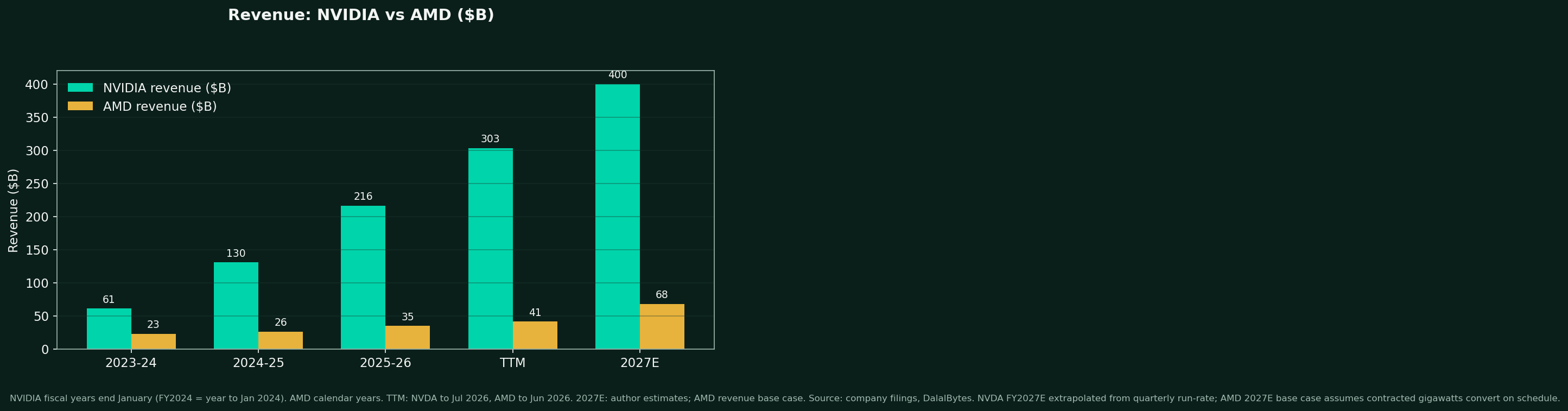
NVIDIA's fiscal 2026 revenue was $215.9 billion, up 65%, and the trailing twelve months are already at $303 billion after a $96.2 billion quarter that grew 106% year over year. AMD's 2025 revenue was $34.6 billion, up 34%, with the trailing twelve months around $41 billion. NVIDIA's quarterly profit ($59.7 billion) is larger than AMD's quarterly revenue ($11.5 billion). The scale gap is not closing; on an absolute basis it is widening every quarter.
Growth rates flatter AMD until you look at the base. AMD growing 50% on $11.5 billion adds $3.8 billion of quarterly revenue. NVIDIA growing 106% on $96.2 billion adds $49 billion. One company's great quarter is the other company's rounding error.
Whose margins are whose?
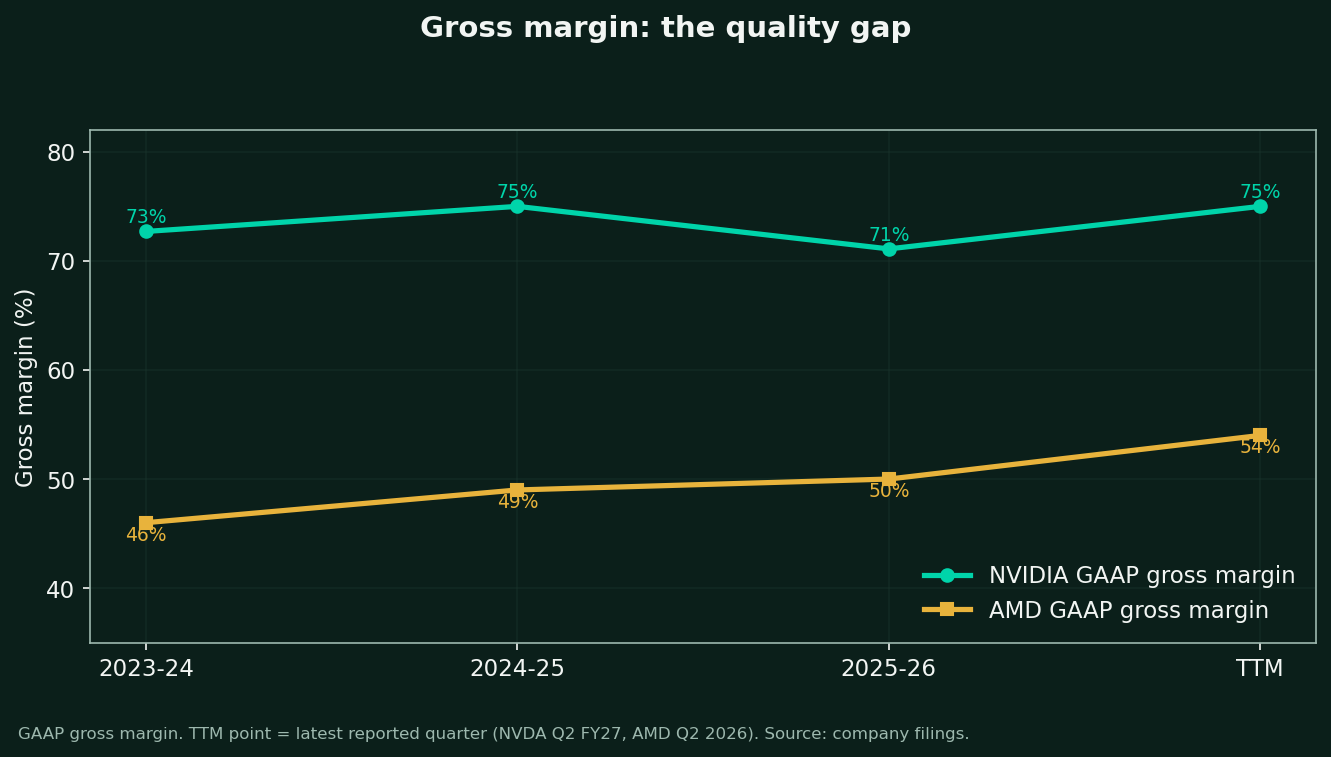
This is the quality gap the market is ignoring. NVIDIA prints 75% gross margins and 66% operating margins at $96 billion of quarterly revenue. AMD prints 54% gross margins and 17% GAAP operating margins (27% non-GAAP) at $11.5 billion. AMD's margins are improving fast, up from 46% in 2023, and the mix shift toward data center helps every quarter. But the market is pricing AMD as if the margin convergence has already happened. It has not.
What is the market charging per dollar of sales and earnings?
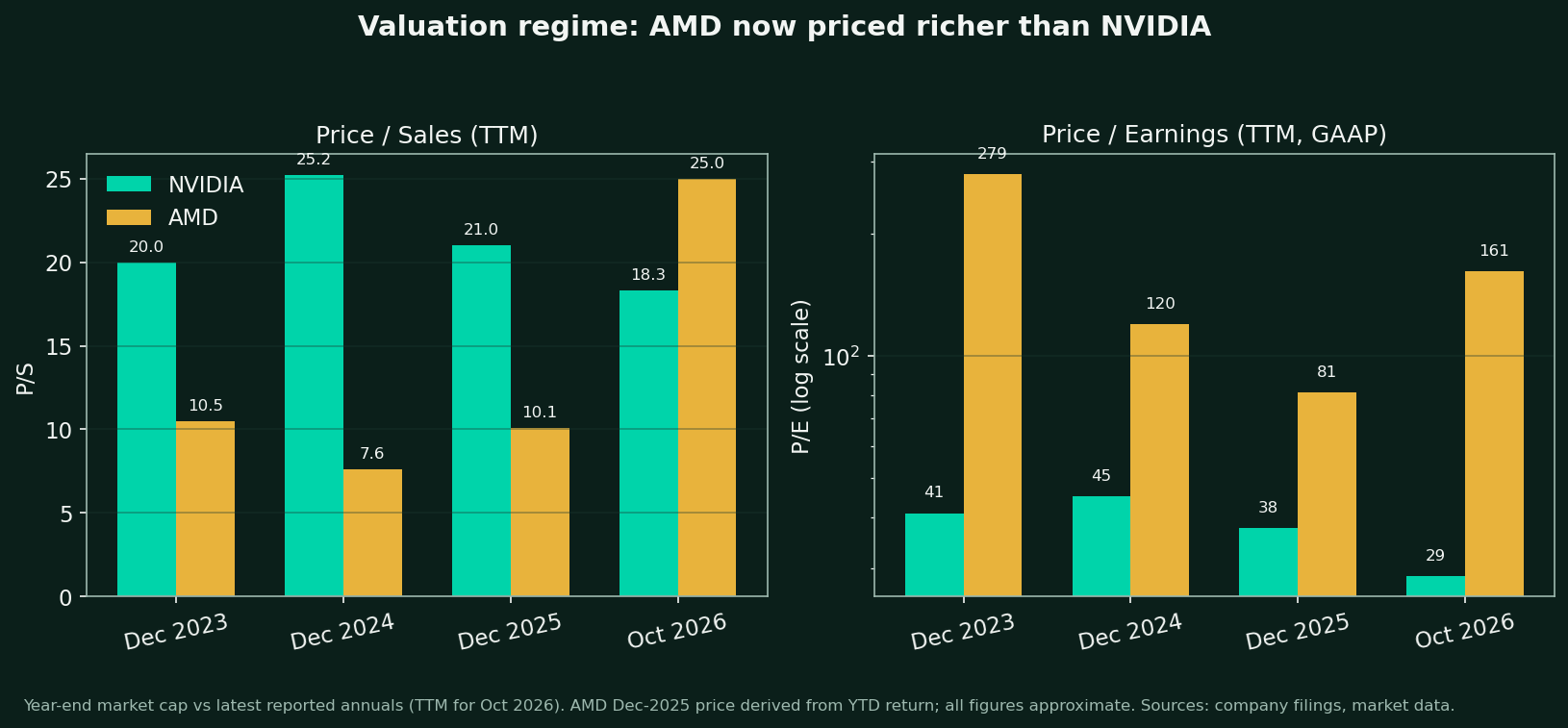
Read the two panels together, because they tell the stall story in miniature.
NVIDIA spent 2024 and 2025 digesting its own monster run. Its P/E compressed from 45x to 29x while earnings nearly tripled. Time did the derating instead of price, the stock chopped sideways for the better part of a year, and then the recent run began once growth re-accelerated to triple digits. That is the template.
AMD is now entering the same digestion phase, but from a worse starting point. Its P/S went from 10x to 25x in under a year, and its P/E re-expanded from 81x to 161x. You are paying more per dollar of AMD sales than NVIDIA sales, and five times more per dollar of earnings, for half the margin. The entire valuation rests on one number: the $13.57 consensus non-GAAP EPS for 2027, up 111% from 2026. At $608, even that heroic number is 45 times forward earnings.
How do the warrants change the per-share math?
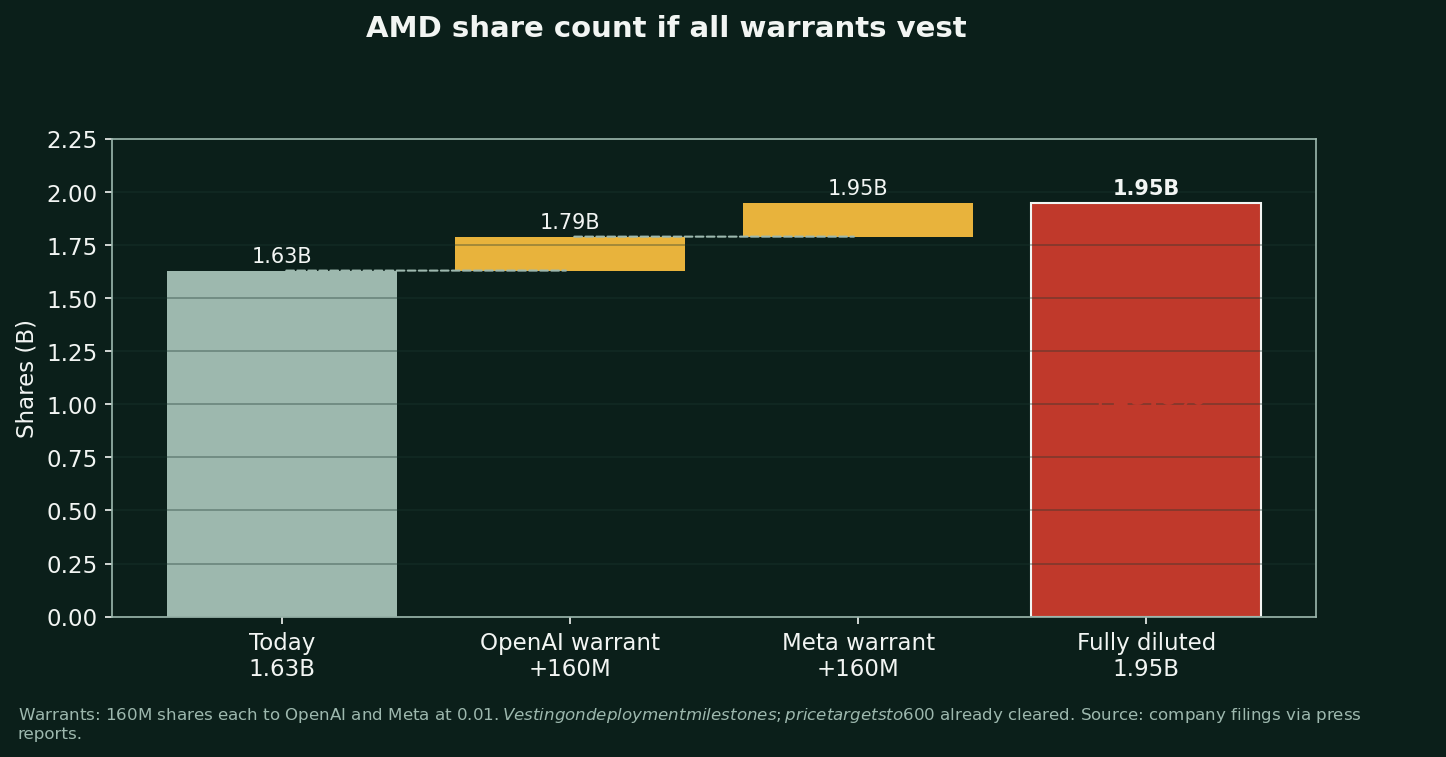
AMD issued OpenAI a warrant for 160 million shares at $0.01, and Meta an identical one. Against 1.63 billion shares outstanding, full vesting is 19.6% dilution, roughly $195 billion of equity value at current prices transferred to its two largest AI customers.
Here is the part that gets missed. The warrants' final vesting tranche required the stock to reach $600. It now trades above $600 with no meaningful deployment yet. So the price conditions are effectively cleared and vesting keys off shipment milestones alone. AMD gave away the equity upside before earning the revenue. NVIDIA never paid customers in stock to win orders. That difference in bargaining power is the real story of the two deals.
For the stall thesis, the mechanics matter more than the morality. NVIDIA digested its 2024 run with a flat-to-shrinking share count, so every dollar of earnings growth flowed to EPS. AMD will digest its 2026 run while up to 320 million shares vest, so earnings have to grow roughly 20% for EPS to stand still. Same stall, slower digestion.
What does 2027 look like if the contracts convert?
Give the bull case its full weight. If the gigawatts deploy on schedule, the numbers can be enormous. Three scenarios, all on non-GAAP EPS since that is what the street quotes:
| Scenario | 2027 revenue | Net margin | Diluted shares | EPS |
|---|---|---|---|---|
| Bear: GW delays | $55B | 22% | 1.70B | $7.12 |
| Base: consensus | $74B | 34% | 1.85B | $13.59 |
| Bull: expansion orders | $90B | 38% | 1.95B | $17.54 |
The base case matches the $13.57 street consensus and requires revenue to roughly double from the 2026 run rate at a 34% net margin, a huge mix-driven expansion that the data center ramp has to deliver in full. Note what even the bull case implies: $17.54 of EPS at $608 is still 35 times earnings. There is no scenario in this table where the stock is cheap. The only question is whether it is fairly priced for perfection or overpriced for it.
What breaks this argument?
Honesty requires the other side, in full:
Deployment beats. If MI450 ramps on schedule and data center revenue actually doubles in 2027, the $13.57 prints and the forward multiple was fair all along.
Expansion orders. OpenAI and Meta expanding beyond 6 gigawatts each would put Citi's $50 billion of 2028 AI revenue in view, and the out-years start justifying the price.
Margin convergence. If mix pushes gross margins toward 60% and beyond, the quality gap with NVIDIA narrows and the multiple premium earns its keep.
Earnings outrun dilution. NVIDIA's digestion worked because earnings tripled underneath a flat multiple. If AMD's earnings do the same, the warrants get absorbed and nobody remembers this article.
NVIDIA stumbles. Export controls, a hyperscaler capex pause, or genuine share loss would flip the relative trade overnight.
The circularity worry proves wrong. If OpenAI and Meta take delivery, pay cash on schedule, and the warrants look in hindsight like a clever customer-financing structure rather than desperation, the discount this thesis applies evaporates.
What should you watch?
Four things decide whether the stall thesis holds or breaks. First, the November 3, 2026 earnings print: another beat-and-drop would confirm the bar problem. Second, revenue recognition on the first OpenAI gigawatt in H2 2026, the moment contracted demand becomes recognized dollars. Third, the quarterly data center prints through 2027 against the $13.57 consensus; any quarter that trails the required run rate pushes the digestion out. Fourth, the 10-Q warrant disclosures: watch the diluted share count creep, because that is where the per-share math quietly leaks.
The investment read: this is not a call to short AMD. The contracts are real, the product is competitive, and Lisa Su has earned the benefit of the doubt. It is a call about price versus time. NVIDIA showed the pattern: rip, digest for a year while earnings catch up, then break out. AMD just finished the rip. The next twelve months look like digestion, with dilution making it slower than NVIDIA's was. Good quarters, flat stock. Position accordingly.
Research and opinion, not investment advice. Do your own due diligence before investing.
Frequently asked questions
Is this a short call on AMD?
No. The business is genuinely accelerating: data center revenue up 107%, gross margins expanding, contracted gigawatts from OpenAI and Meta. The call is narrower: after a 180% run to $1 trillion, with 20% dilution vesting into the share count, the stock needs roughly a year for earnings to grow into the price. Dead money, not a collapse.
Why did AMD fall on record quarters twice in 2026?
In February and again in August 2026, AMD reported record results and the stock fell about 8% each time. That is textbook priced-for-perfection behavior: when the numbers are great and the price drops anyway, the bar is the problem, not the business. Every quarter now has to clear a bar set by a $1 trillion valuation.
What exactly did AMD give OpenAI and Meta?
Warrants for 160 million shares each at $0.01, vesting on deployment and commercial milestones, with price targets up to $600. The stock already trades above $600, so vesting now depends only on shipments. At current prices the two warrants transfer roughly $195 billion of equity value, about a fifth of the company, to its two largest AI customers.
Disclosures
Not financial advice. This article is published for educational purposes only. Nothing here is a recommendation to buy, sell, or hold any security, and nothing here is financial advice. Investing involves risk, including the possible loss of principal.
Positions. The author holds a long position in AMD, materially smaller than a year ago after trims during 2026. The author may also hold positions in other securities mentioned here, including NVIDIA. Assume a position is possible in any name written about on this site.
Accuracy. This analysis is built from public sources believed to be reliable, including company filings, earnings releases, and market data. Errors can occur and facts change; verify independently before acting on anything you read.
No advisory relationship. Reading this site does not create an advisor-client relationship of any kind. See the full disclosures page.