

What happened to GPU prices this year?
For two years, the price of rented AI compute did one thing. It fell. H100 rates that spiked above $8 per GPU-hour in the 2023 shortage slid through 2024 as supply caught up, and in June 2025 AWS cut on-demand pricing for its H100 P5 instances by 44%, with comparable reductions following at Google Cloud and Azure. Budgeting for 2026 on the assumption that the slide would continue was the consensus move. It was also wrong.
The turn came in the fall of 2025, and it came in the contract market first. SemiAnalysis's one-year H100 rental price index, built from a monthly survey of more than 100 market participants and validated against transaction data, recorded $1.70 per GPU-hour in October 2025. By the end of March 2026 it stood at $2.35, up about 40%, because on-demand capacity had sold out across nearly every GPU generation and holders of locked-up capacity would not release it back into the pool.
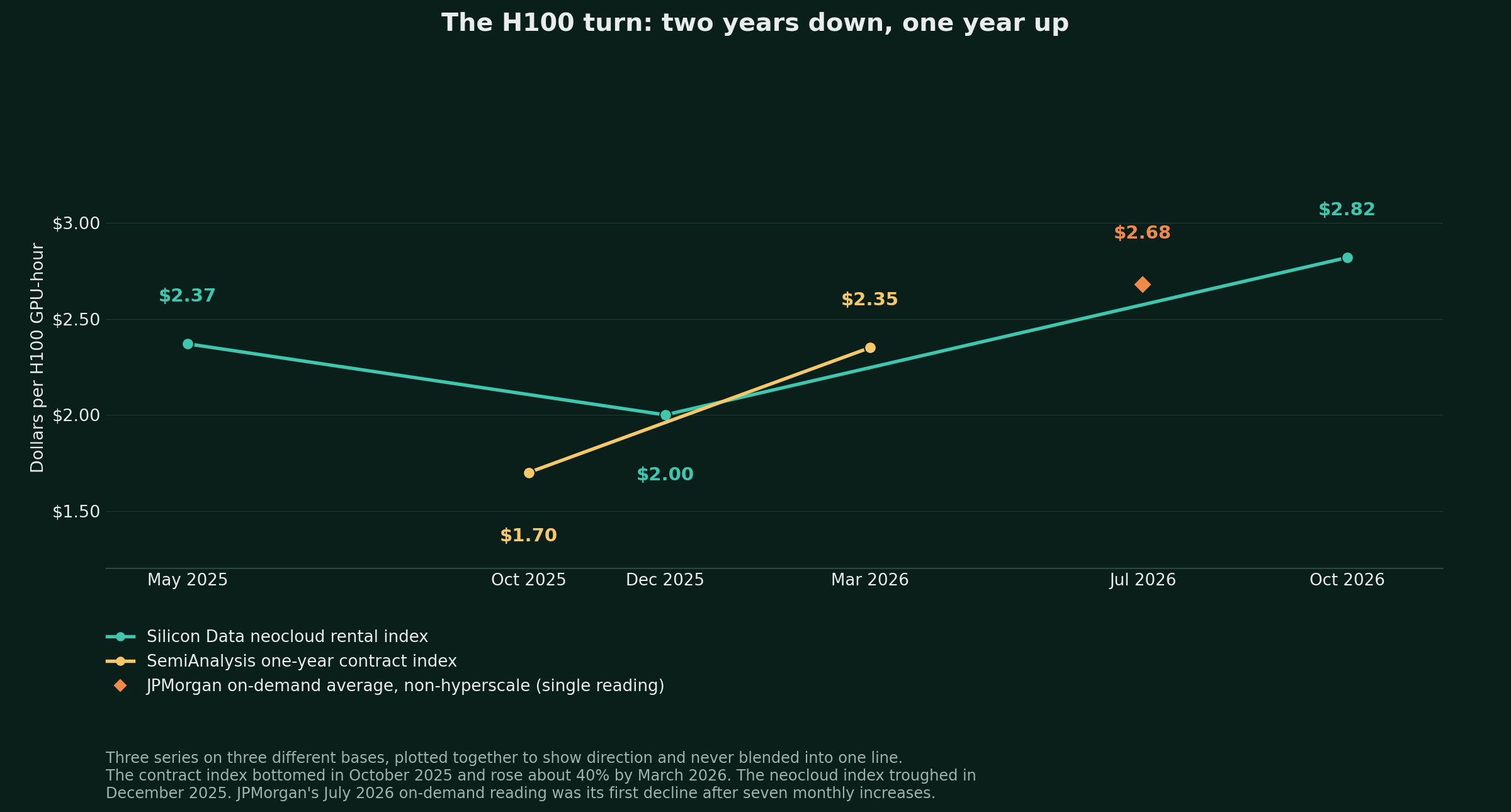
Spot and on-demand series followed the contract market up, with one pause in the summer. Silicon Data's neocloud H100 index, $2.37 per GPU-hour when it launched in May 2025, troughed at $2.00 in December 2025 and reached $2.82 on October 10, 2026, and $2.88 by October 24. JPMorgan put the average H100 on-demand rental in the non-hyperscale market at $2.68 per GPU-hour in July 2026, down 1.1% on the month and the first decline after seven consecutive increases, with utilization still above 70%. GetDeploying's median on-demand H100 rate across 41 providers was $3.50 in October 2026, about 13% above a year earlier. The H200 median rose about 26% over the same twelve months, to $4.70.
Blackwell, the current generation, was the most volatile line in the market. Its rental index rose 27.6% year to date by September 2026, after a spring round trip that took spot rates from $2.75 in mid-February to $4.08 by mid-April on Ornn's live transaction index. By October 10, Silicon Data's indexes stood at $5.93 per GPU-hour for the B200 and $6.71 for the B300.
Into the fall, list prices followed the market up, which is the step that turns a squeeze into a reset. These are posted prices, the ones a new customer is quoted before any negotiation.
| Posted price increase | Was | Now | When |
|---|---|---|---|
| Lambda, H100 SXM on demand | $2.99 | $3.99 | June 2026 |
| Runpod Secure Cloud, H100 SXM | $3.29 | $3.99 | By October 2026 |
| Nebius, HGX H100 on demand | $3.85 | $4.50 | October 1, 2026 |
| Nebius, HGX B300 on demand | $7.85 | $9.50 | October 1, 2026 |
| AWS P5 Capacity Blocks, per H100 | $5.191 | $5.970 | August to October 2026 |
The older generation rising is the tell. The H100 is two product cycles behind the frontier now, and its price is going up anyway, because the binding constraint is not the chip. It is the powered, memory-equipped capacity around the chip.
Who charges what for the same silicon?
An H100 is an H100. The hourly price of renting one in October 2026 ranged from under $2 on peer-to-peer marketplaces to $12.29 at the top of the hyperscaler list stack, and the spread did not narrow during the year. It stratified, into a market layer where prices float and a list layer where they are posted, premium, and sticky.
| Eight-GPU H100 node, on-demand list | Per hour | Per GPU |
|---|---|---|
| CoreWeave, HGX node | $49.24 | $6.16 |
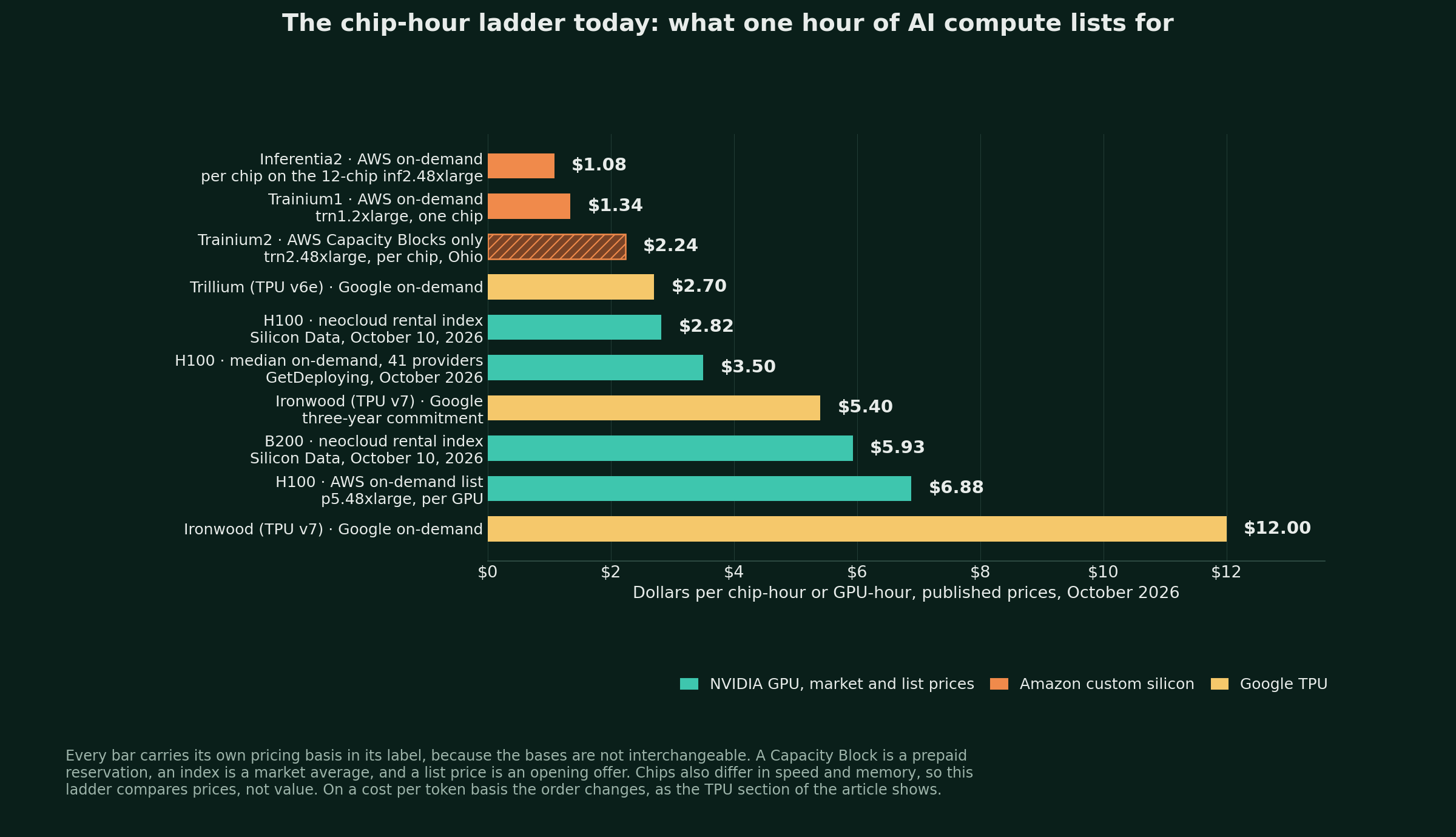
| AWS, p5.48xlarge | $55.04 | $6.88 |
| Google Cloud, a3-highgpu-8g | $88.49 | $11.06 |
| Microsoft Azure, ND96isr H100 v5 | $98.32 | $12.29 |
Below the hyperscalers, the specialist clouds price the same GPU by the hour at $3.99 at Lambda, $3.99 at Runpod, and $4.50 at Nebius after its October increase, against the $2.82 neocloud index and the $3.50 market median. What the hyperscaler premium buys is everything around the GPU: enterprise agreements, global regions, networking and storage bundles, support, and capacity that is there when called. What it does not buy is a different chip.
The discount tiers under list tell the same shortage story from the other side. At Google, the same A3 node drops to $50.32 an hour on Spot pricing and $38.86 on a three-year commitment. At AWS, P5 spot capacity barely exists at any price, because the on-demand pool itself is thin. Azure quotes a deep spot discount on paper, about $18.17 an hour for the same ND node, in the few regions where the capacity can actually be claimed. When every seller's interruptible tier is either expensive or empty, the market is not clearing at list. It is clearing above it, which is what the auction in the Nebius section below measured directly.
What do Amazon's own chips cost?
Amazon is the only hyperscaler that rents its own AI silicon to all comers, and it prices that silicon as the value tier of its own catalog. The lineup has three chip families, and each is sold on a different pricing model, which is itself part of the story.
Trainium1, the plain list. The first Trainium generation still carries a simple on-demand price. A single-chip trn1.2xlarge lists at $1.34 per hour, and the 16-chip trn1.32xlarge at $21.50, the same $1.34 per chip-hour. Through Capacity Blocks the same 16-chip instance runs $9.532 an hour, about $0.60 per chip-hour, less than half the on-demand rate.
Trainium2, the unlisted chip. The current training chip has no on-demand list price at all. AWS sells Trainium2 only through EC2 Capacity Blocks, prepaid reservations whose prices AWS states are updated regularly based on trends in supply and demand, with the next update scheduled for January 2027. The trn2.48xlarge, 16 chips in US East (Ohio), prices at $35.76 an hour, or $2.24 per chip-hour, about 37% of the $5.97 Capacity Block price of an H100 in the same program. A single-chip trn2.3xlarge exists in select regions at the same $2.24 per chip-hour.
Trainium3, the allocated chip. The third generation is real: it appears in AWS's Neuron documentation at roughly 2,517 FP8 TFLOPS per chip, and Trn3 UltraServers scale to 144 chips in one system. It has no public per-hour price. Amazon's newest silicon is, for now, allocated to chosen customers rather than listed for rent.
Inferentia2, the quiet floor. The inference line keeps the simple on-demand list. The inf2.xlarge carries one Inferentia2 chip at $0.758 an hour. The inf2.48xlarge carries 12 chips at $12.98 an hour, about $1.08 per chip, the cheapest published per-chip rate on the ladder chart below.
The scale behind these prices is not a side project. The anchor deployment is Anthropic's Project Rainier in Indiana, an $11B campus where nearly half a million Trainium2 chips are already running Claude workloads, and AWS has said Claude is expected to run on more than a million Trainium2 chips. In April 2026 Anthropic committed to up to 5 gigawatts of Trainium capacity and more than $100B of AWS spending over the next decade. Amazon said in the first quarter of 2026 that its chips business, Trainium, Inferentia, and Graviton together, had passed a $20B annual revenue run rate and was growing at triple-digit rates. The quiet tier is one of the largest silicon businesses in the world, priced deliberately below the GPU market it competes with.
On the CPU side of the same strategy sits Graviton, Amazon's Arm server processor, priced about 15% below comparable x86 instances. It gets its own treatment in the CPU section below.
How does Google price the TPU ladder?
Google does the opposite of Amazon. Where AWS leaves its current Trainium unlisted, Google publishes a full TPU price ladder, per chip-hour, with every discount tier printed next to the headline rate.
| Google TPU, per chip-hour, US | On demand | 1-year commitment | 3-year commitment | Flex-start |
|---|---|---|---|---|
| TPU v5e | $1.20 | $0.84 | $0.54 | $0.60 |
| Trillium (v6e) | $2.70 | $1.89 | $1.22 | $1.35 |
| TPU v5p | $4.20 | $2.94 | $1.89 | $2.10 |
| Ironwood (v7) | $12.00 | $8.40 | $5.40 | $6.00 |
Read the ladder as a menu of trade-offs rather than a ranking. The same Trillium chip costs $2.70 on demand and $1.22 on a three-year commitment, a 55% cut for certainty. Ironwood costs 4.4 times Trillium's hourly rate and delivers about 2.5 times the BF16 throughput per chip with six times the memory, so its sticker is the highest on the ladder while its cost per unit of finished work is not.
The per-token arithmetic is where the ladder earns its keep. SemiAnalysis estimated Ironwood's inference total cost of ownership at $0.18 per million tokens in February 2026, against $0.31 for comparable B200 configurations, an advantage of about 42%. That gap, not the $12.00 sticker, is the context for Anthropic signing for up to a million TPUs in October 2025 and then for multiple gigawatts of next-generation TPU capacity in April 2026.
One widely repeated claim needs correcting here, because it shows how this market's numbers travel. Several 2026 write-ups describe an April 2026 Google Cloud release note cutting headline on-demand TPU pricing from $6.50 to $4.50 per TPU-hour, with preemptible capacity falling from $1.95 to $1.35. The figures are real, but the date is not: they come from July 2018, when Google cut the price of its original Cloud TPU. No equivalent headline cut appears anywhere in the 2026 ladder. Google's TPU prices this year were a ladder that held still while GPU prices climbed past it.
Why did CPU prices not move?
General-purpose compute is the control group in this experiment. A 4 vCPU instance with 16 GB of memory listed at about $0.19 an hour on AWS, about $0.19 on Google Cloud, and about $0.19 on Azure in April 2026 reference pricing, and comparisons published in August 2026 show the same numbers, matched to within fractions of a cent across the big three. CPU list prices are set in a mature market with deep spot and commitment discounts underneath them, and in a year when AI accelerators repriced by double digits twice, nobody moved them at all.
The deflation ran through performance instead. Every hyperscaler now fields its own Arm CPU: Graviton5 at AWS, Axion at Google, and Cobalt 100 at Azure. Each new generation held its hourly price roughly flat while lifting performance, so the cost of a unit of work fell without any price being cut. AWS prices Graviton at roughly 15% below comparable x86 instances, closer to 20% on memory-optimized families, and claims up to 40% better price-performance; independent benchmarks of the current Arm lines put the advantage at roughly 15% at AWS and Azure and slightly ahead at Google. A workload that migrated from x86 to Arm this year got cheaper the way compute used to get cheaper, silently, through the hardware.
The one CPU price move of the year ran the other way, and quietly. In June 2026 Oracle cut its Always Free Arm allowance in half, from 4 OCPUs and 24 GB of memory to 2 OCPUs and 12 GB, without an announcement. Even the free tier repriced.
Who is bringing back price discovery?
For most of this market, price is something a provider posts and a customer accepts. The exception of the year is Nebius, the neocloud that spent 2026 finding out what its capacity was actually worth, in public.
It started with an auction. Nebius disclosed its first capacity auction with its second-quarter 2026 results, and CEO Arkady Volozh described the outcome on the earnings call: "It was very successful and cleared at the highest price we have seen for the Blackwell generation of chips, 15% above the highest price we ever charged before. This gives us a strong signal on the value of this capacity in the market in real time." Chief revenue officer Marc Boroditsky added that the clearing price was 20% above the company's Blackwell pipeline pricing. The sequence matters. Nebius had already raised prices by hand, repeatedly, and demand had not blinked. The auction's message was that the manual increases had still been too small.
The posted prices followed. On October 1, 2026, Nebius raised on-demand rates by 17% to 21% across its NVIDIA line: the H100 from $3.85 to $4.50, the H200 from $4.50 to $5.40, the B200 from $7.15 to $8.50, and the B300 from $7.85 to $9.50. Its second-quarter shareholder letter had already reported pricing for older-generation GPUs running more than 30% above the first quarter. Management told investors it sold out of capacity as fast as new capacity came online, and that it could sell its 2027 capacity today at current deal terms but is holding some of it back for customers with immediate needs.
Then came the structural move. On October 8, 2026, Nebius switched its preemptible GPU capacity to dynamic spot pricing. The price is set per GPU type and per region from available capacity and demand, it can change as often as every 15 minutes, and it floats between a floor Nebius sets for each GPU type and a ceiling of the on-demand price minus $0.01. A customer either follows the spot price or sets a maximum price, and a machine whose cap is crossed stops. The prices are public without an account: seven days of history on the website and 30 days through the API.
Silicon Data sampled that API through the first nine days, October 8 to 16, and the newborn market behaved like a market. Nebius's H100 spot price sat at its $0.79 floor for most of the window, about two thirds below the $2.33 market spot median, and changed on only two of the eight measured days. Its H200, B200, and B300 prices moved on most days, mostly below market spot medians of $2.92, $4.01, and $4.95 respectively, and Nebius quoted below every other seller on most days for every GPU it lists. Set against the wider market, the contrast is sharp: more than half of all the spot price series Silicon Data tracks did not change once in the same nine days. Nebius is, so far, the only major seller whose prices actually float.
The industry's anchor used to run this experiment, and chose to stop. AWS built the original cloud spot market, then replaced its bid-driven pricing in November 2017 with a model that, in AWS's words, delivers prices that adjust gradually based on long-term trends in supply and demand. The spikes disappeared, and so did the information a floating price carries. AWS's accelerator capacity does reprice today, through Capacity Blocks, on a schedule measured in months; the current rates are next scheduled to update in January 2027. Nebius reprices in minutes and publishes the tape. In a shortage, that difference is worth money, and the auction measured how much: 15% above the best price the company's own sales process had ever achieved.
Where do prices go from here?
Start with what the trackers agree on, because it is the durable statement. The floor under AI compute moved up in late 2025 and is not returning to 2024 levels. The rate of increase moderated over the summer, JPMorgan's July decline was real, and utilization stayed above 70% while it happened. Providers were still raising posted prices in October. A 2027 budget built on the price collapse of 2024 is priced off the wrong year.
The constraint behind the floor is rotating. Through 2026 it has been memory: high-bandwidth memory supply caps how many accelerators can ship, whatever the demand. From 2027 it becomes power, as grid connections and on-site generation pace the data center buildout. After second-quarter 2026 earnings, all four hyperscalers reported 2027 capacity largely reserved and 2028 partly reserved, which means the marginal buyer next year is bidding for a small uncommitted remainder, in a market where one seller has just demonstrated what an auction does to the clearing price.
The strategic consequence runs straight into the companion piece to this article, The Compute Share Wars. Every dollar added to the rental price of NVIDIA compute improves the arithmetic of building your own chip. At a $2.24 Trainium2 chip-hour, and a published TPU ladder whose committed rates undercut the GPU medians, Amazon and Google are selling into a market whose reference price rose all year, and each program behind them, Meta's MTIA, Microsoft's Maia, and the efforts at ByteDance and OpenAI, gets easier to justify at these levels. Rising GPU prices are the custom silicon industry's best salesperson.
The price in one line. Compute stopped getting cheaper in 2026. The sellers with their own silicon now anchor the floor, CPU prices never moved at all, and the one seller running an auction found the market price 15% above its own best guess. The next thing to watch is whether anyone follows Nebius.
Frequently asked questions
Did GPU rental prices go up or down in 2026?
Up. After two years of decline, the H100 one-year contract index bottomed at $1.70 per GPU-hour in October 2025 and rose about 40% by March 2026. Neocloud indexes and on-demand medians climbed through October 2026, and Lambda, Runpod, Nebius, and AWS Capacity Blocks all raised list prices into the fall.
What is the cheapest published way to rent AI compute?
Interruptible capacity on custom silicon. Nebius spot H100 capacity sat at a $0.79 per GPU-hour floor for most of its first nine days. On demand, Amazon's Trainium1 lists at $1.34 per chip-hour and Trainium2 at $2.24 through Capacity Blocks, while three-year commitments cut Google's Ironwood TPU from $12.00 to $5.40.
Why do hyperscalers charge so much more than neoclouds for the same GPU?
The GPU is bundled with everything around it. Hyperscaler prices carry enterprise agreements, global regions, networking, storage, support, and capacity that is actually there when called. The same eight-GPU H100 node lists at $55.04 an hour on AWS and $98.32 on Azure, against $49.24 at CoreWeave and a $2.82 per GPU neocloud index.
Disclosures
Not financial advice. This article is published for educational purposes only. Nothing here is a recommendation to buy, sell, or hold any security, and nothing here is financial advice. Investing involves risk, including the possible loss of principal.
Positions. The author holds long positions in Amazon, Alphabet, AMD, Meta, and Nebius, all discussed in this article. The author holds no position in NVIDIA or Microsoft.
Accuracy. Compute price figures come from the trackers and providers named beside them: the SemiAnalysis one-year H100 rental index as reported; JPMorgan's July 2026 on-demand reading as reported; Silicon Data's neocloud rental indexes and its October 8 to 16, 2026 study of Nebius spot pricing; GetDeploying's provider medians; Ornn's transaction index; and provider price lists checked in October 2026, including AWS on-demand and Capacity Blocks pricing, Google Cloud TPU pricing, Azure and CoreWeave list prices, and the Lambda, Runpod, and Nebius price pages. Nebius auction and spot pricing details are from the company's second-quarter 2026 earnings call, its shareholder letter, and its published documentation. Amazon chip figures are from AWS pricing pages and company statements. The July 2018 Cloud TPU price cut is from Google Cloud's own release notes of that date. Prices in this market change often and by region and commitment; figures here are dated snapshots, not quotes. Errors can occur and facts change; verify independently before acting on anything you read.
No advisory relationship. Reading this site does not create an advisor-client relationship of any kind. See the full disclosures page.