

What does the land look like in one view?
Five years into the AI buildout, the market for compute has settled into a recognizable landscape. One company holds the high ground in every market it contests. One challenger grew large, but on a different front than the one it advertises. One former incumbent contracted everywhere. An architecture that sells nothing spread into PCs and servers alike. And the fastest growth now belongs to chips that are never sold at all, built by cloud companies for their own data centers. This article lays out that landscape market by market, in share and in shipments, with what happened over the past five years and what is happening now.
Two reading notes before the tour. First, share and shipments tell different stories in a market growing this fast, and both are given here. Several companies in this article are losing share while shipping more chips every year. Second, most of the global series describe, in practice, the market outside China. China has become a walled landscape of its own, and it gets its own section near the end.
Who holds the GPU market?
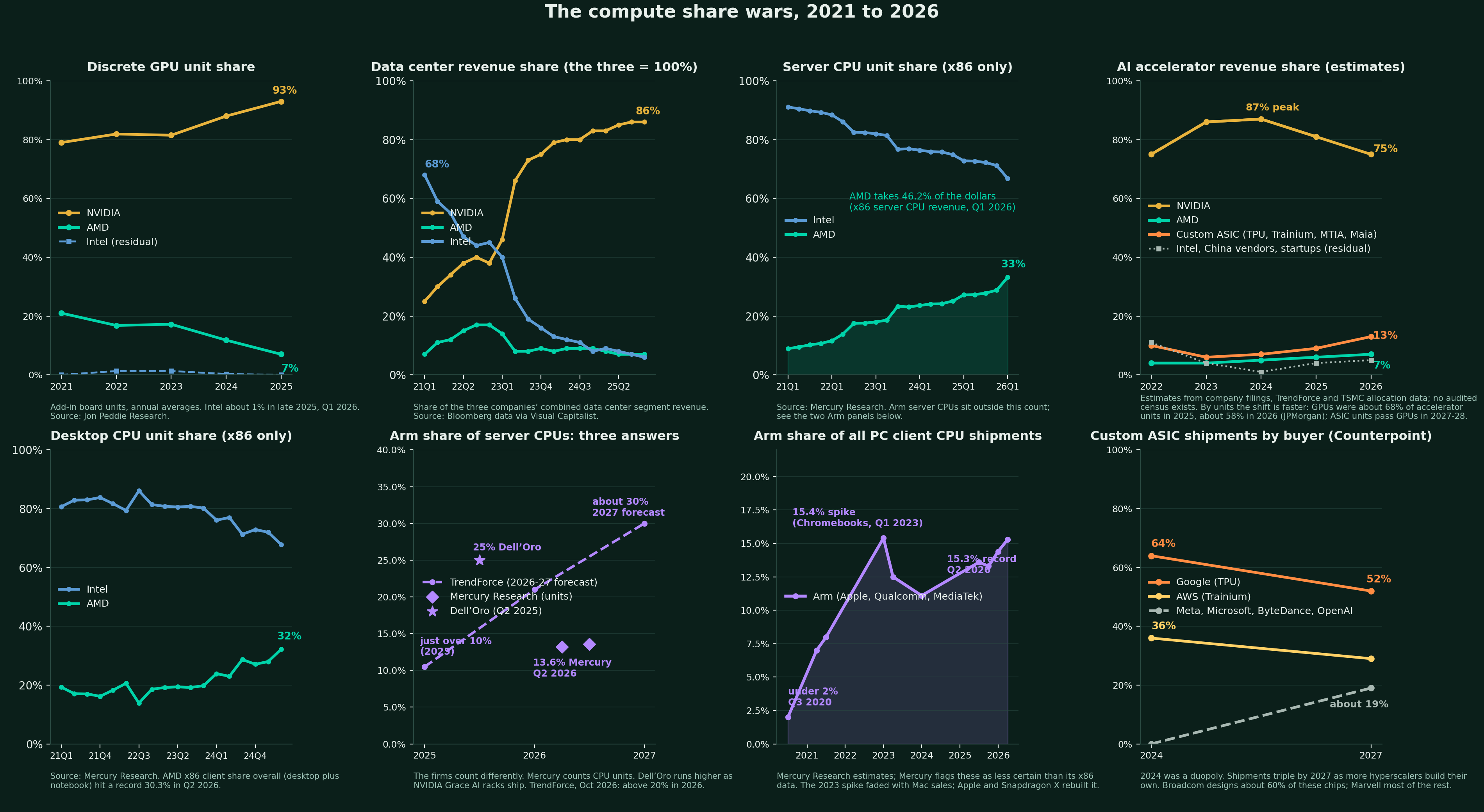
NVIDIA does, and the grip tightened over the period. In discrete graphics cards, the add-in boards that go into PCs and workstations, NVIDIA's share of units rose from 79% in 2021 to 93% in 2025, on Jon Peddie Research's annual averages. AMD's share fell from 21% to 7% over the same five years. Intel entered this market in 2022 and has never held more than about 1% of it, including in the most recent quarters, when the split ran at roughly 90% NVIDIA, 8% AMD, and 1% Intel.
This is the purest form of the pattern that repeats across the article. The market NVIDIA created around its CUDA software platform did not fragment as it grew. It consolidated. AMD competes in it with capable hardware and open software, and its share of units has halved twice over in five years anyway.
What happened in data center revenue?
Measured in dollars, the data center tells the story of the decade. In the first quarter of 2021, of the combined data center segment revenue of NVIDIA, AMD, and Intel, Intel held 68%, NVIDIA 25%, and AMD 7%. Intel was the data center. NVIDIA was a gaming company with a growing side business.
Three things then happened in sequence. AMD's share climbed first, peaking at 17% in late 2022, as its EPYC server CPUs took business from Intel. Then the AI accelerator era arrived, and from early 2023 NVIDIA's share rose almost vertically, crossing Intel's falling line and reaching the mid-80s by 2024. Intel's share fell through the floor of the chart. By late 2025 the split stood at about 86% NVIDIA, 7% AMD, and 6% Intel. AMD's brief rise to 17% deserves a footnote of its own. It was share of a market still dominated by CPUs. When accelerators flooded the denominator, AMD's slice returned to the 7% to 9% band it has occupied since, even as its data center revenue grew to a $16.6B annual segment on the strength of server CPUs.
Where did AMD actually gain share?
In CPUs, at Intel's expense, steadily and without a single reversal of consequence. AMD's share of x86 server CPU units rose from 8.9% in the first quarter of 2021 to 33.2% in the first quarter of 2026, per Mercury Research. Because AMD sells the premium sockets, its share of the money is higher than its share of the units. In the first quarter of 2026 it took a record 46.2% of x86 server CPU revenue, nearly half the dollars on a third of the shipments. Desktop CPUs followed the same direction at a slower pace, from 19% of units in 2021 to 32% by mid-2025, and AMD's combined share of x86 client CPUs, desktop plus notebook, reached a record 30.3% in the second quarter of 2026.
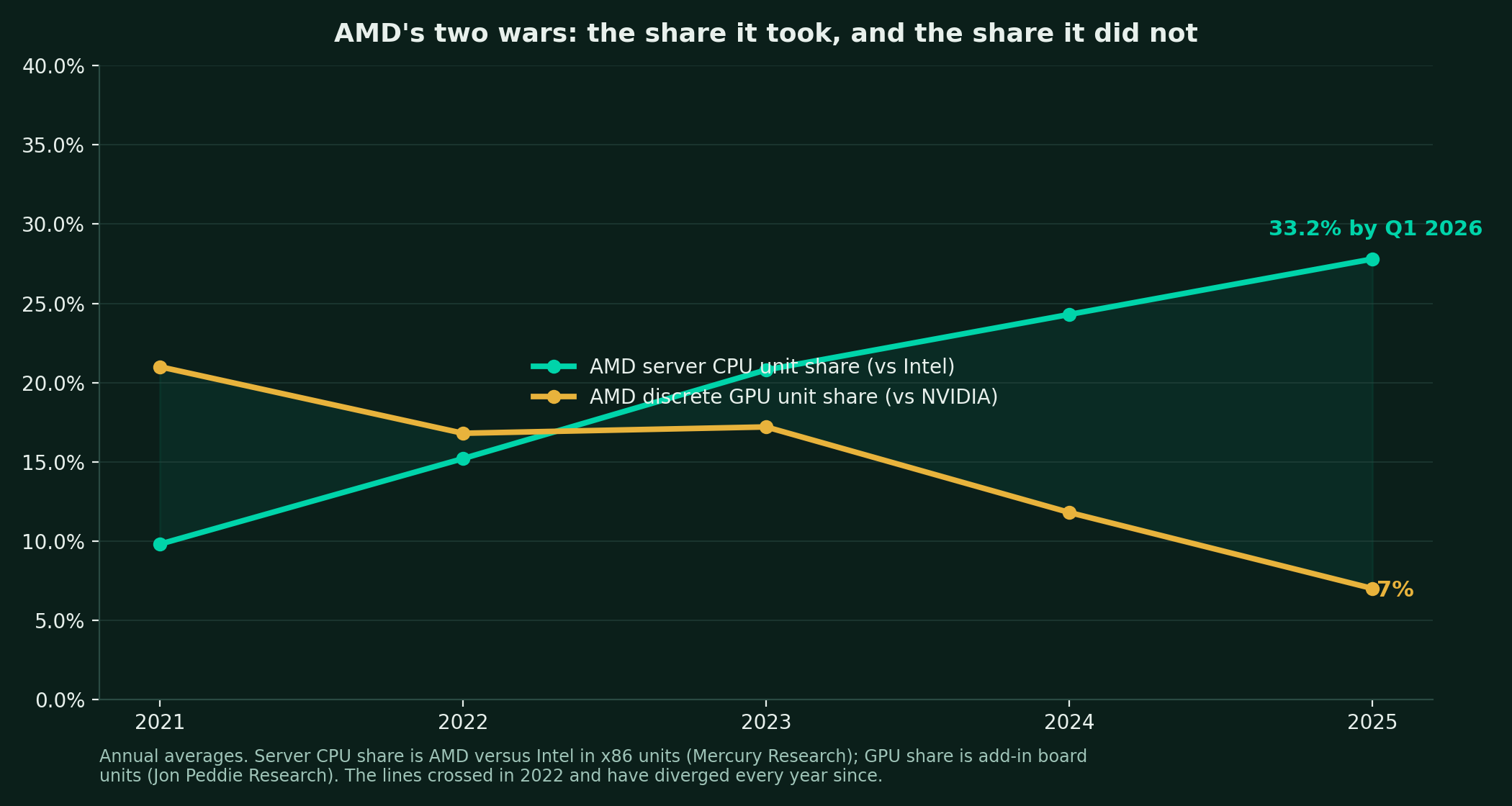
Set the two AMD stories side by side and the company's five years come into focus. Against Intel, a wounded incumbent defending legacy markets, AMD is a proven share taker with an unbroken record of quarterly gains. Against NVIDIA, a founder-led company at the center of a new platform, the same AMD has not moved the share line at all. The products differ. The execution differs. The results differ completely.
How did Arm spread without selling a chip?
Arm Holdings designs processor architectures and licenses them. It ships nothing. That is why Arm is missing from vendor share tables, and why its advance is easy to miss. Its licensees' chips ship inside other companies' products, and on Mercury Research's estimates those chips now power 15.3% of all PC processors, a record, and 13.6% of server CPUs, also a record.
In PCs, the line starts at under 2% in the third quarter of 2020, just before Apple's M1 chip demonstrated that an Arm design could beat x86 processors on performance per watt in a real laptop. It spiked to 15.4% in early 2023 on Arm-based Chromebooks, faded to 11.1% in early 2024 as Mac sales fell, and rebuilt to the current record on Apple silicon and Qualcomm's Snapdragon X laptops. The composition matters as much as the total. Most of the Arm PC line is Apple, which designs its own cores and sells them only inside Macs. Qualcomm, the only merchant vendor selling Arm PC chips to other manufacturers, holds roughly 1% to 2% of PC units today and is pushing toward the data center next. MediaTek supplies much of the Chromebook remainder. Apple is also, on its own, one of the largest compute suppliers alive. It ships well over 200 million of its own processors a year in iPhones alone, every one of them captive to its own devices and outside every market in this article.
In servers, the counters disagree, and the disagreement is reported here rather than smoothed over. Mercury counts Arm at 13.6% of server CPU units in the second quarter of 2026. Dell'Oro put it at 25% a year earlier, a higher reading driven by how NVIDIA's Grace processors ship inside AI racks. TrendForce had Arm just above 10% in 2025 and expects it above 20% in 2026 and at about 30% in 2027, as agentic AI workloads raise the number of CPUs each rack needs and hyperscalers fill those sockets with their own designs: AWS Graviton, Google Axion, Microsoft Cobalt, and NVIDIA Grace. The levels differ by firm. The direction does not. Arm collects a royalty on every one of these chips, a few dollars or less each, which is how an architecture can hold a seventh of the PC market and a growing slice of servers while booking less revenue than the vendors it is displacing.
Who leads AI accelerators in revenue, and who leads in units?
By revenue, NVIDIA, by a wide margin, though its share has passed its peak. Estimates built from company filings, TrendForce data, and TSMC capacity allocations put NVIDIA at about 87% of AI accelerator revenue in 2024, easing to about 81% in 2025 and roughly 75% in 2026. There is no audited census of this market, because most custom chips are built for a single buyer and never sold openly, so every figure in this section is an estimate and is labeled as one.
| Share of AI accelerator revenue | 2022 | 2023 | 2024 | 2025 | 2026 est. |
|---|---|---|---|---|---|
| NVIDIA | 75% | 86% | 87% | 81% | 75% |
| AMD | 4% | 4% | 5% | 6% | 7% |
| Custom ASICs | 10% | 6% | 7% | 9% | 13% |
| Intel, Chinese vendors, startups | 11% | 4% | 1% | 4% | 5% |
By units, the market is moving much faster than the revenue table suggests, because a custom ASIC sells for a fraction of a top-end GPU. JPMorgan's fall 2026 forecast has total AI accelerator shipments rising from about 10.0 million units in 2025 to 16.3 million in 2026 and about 23.4 million in 2027. GPU shipments rise every year in that forecast, from 6.8 million to 9.5 million to 10.9 million units. Custom ASIC shipments nearly quadruple, from 3.2 million to 6.8 million to 12.5 million, passing GPU shipments in 2027. TrendForce's growth rates point the same way, with custom ASIC shipments growing about 44.6% in 2026 against about 16.1% for merchant GPUs.
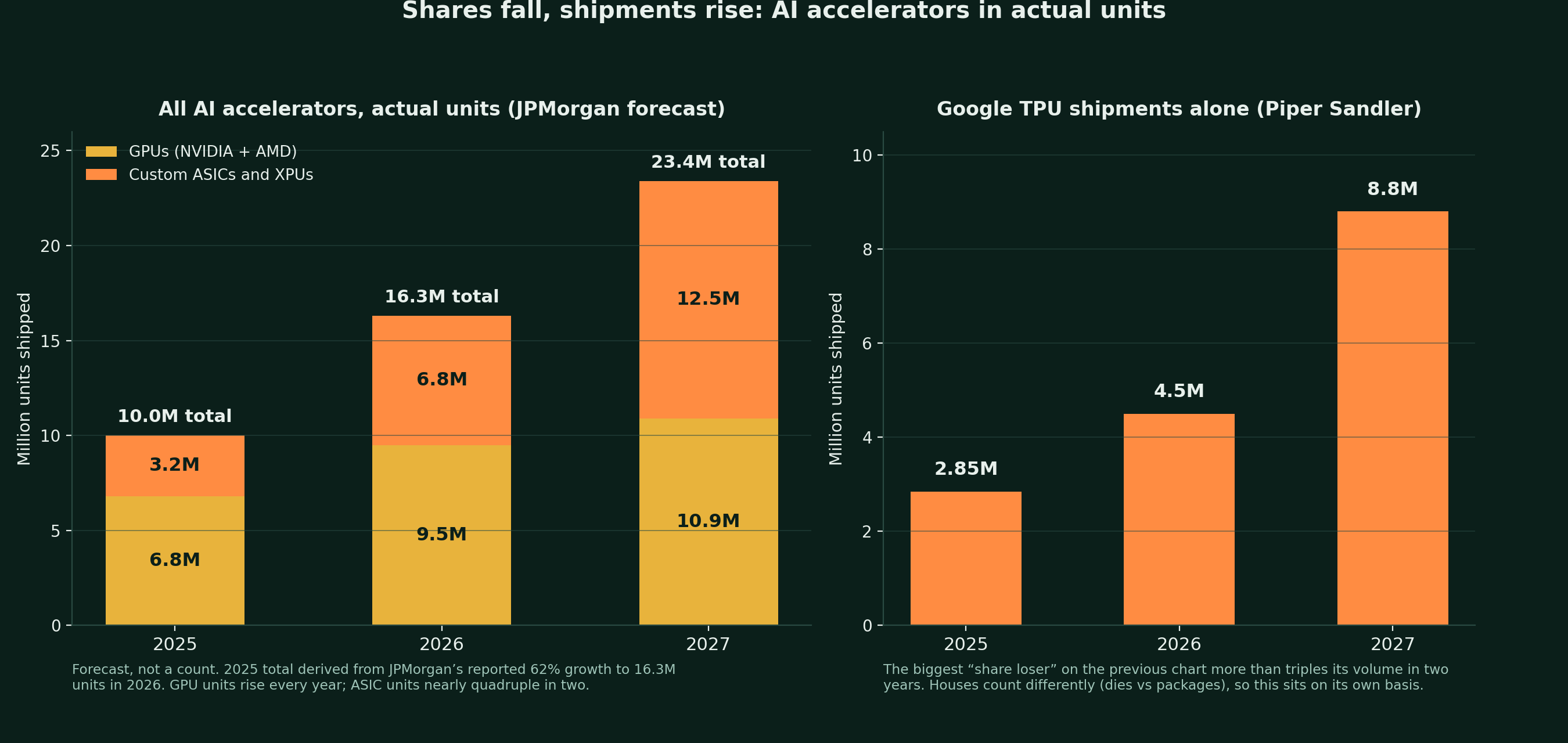
This is the corrective the share charts need. NVIDIA's revenue share sliding from 87% toward 75% coincides with its data center revenue roughly doubling. A falling share line in this market is usually what early leadership looks like when the denominator explodes, not what decline looks like.
Who is inside the custom ASIC market?
Until recently, almost nobody. Counterpoint Research's shipment figures show a duopoly in 2024: Google's TPUs were 64% of custom AI ASIC shipments and Amazon's Trainium was 36%, and there was effectively no one else. By 2027 Counterpoint expects Google at 52% and Amazon at 29%, with Meta's MTIA, Microsoft's Maia, and programs at ByteDance and OpenAI taking the remainder to about a fifth of a market whose shipments triple over the period.
The share declines are arithmetic, not retreat. Piper Sandler estimates Google's TPU shipments at 2.85 million units in 2025, 4.5 million in 2026, and 8.8 million in 2027. The largest share loser in the ASIC market more than triples its volume in two years. Standing behind most of these chips is a design layer that appears on no share chart in this article. Broadcom co-designs about 60% of custom AI ASICs, including Google's and Meta's programs, and holds most of the rest of that design market alongside Marvell. The hyperscalers own the chips. Broadcom owns a toll position on building them.
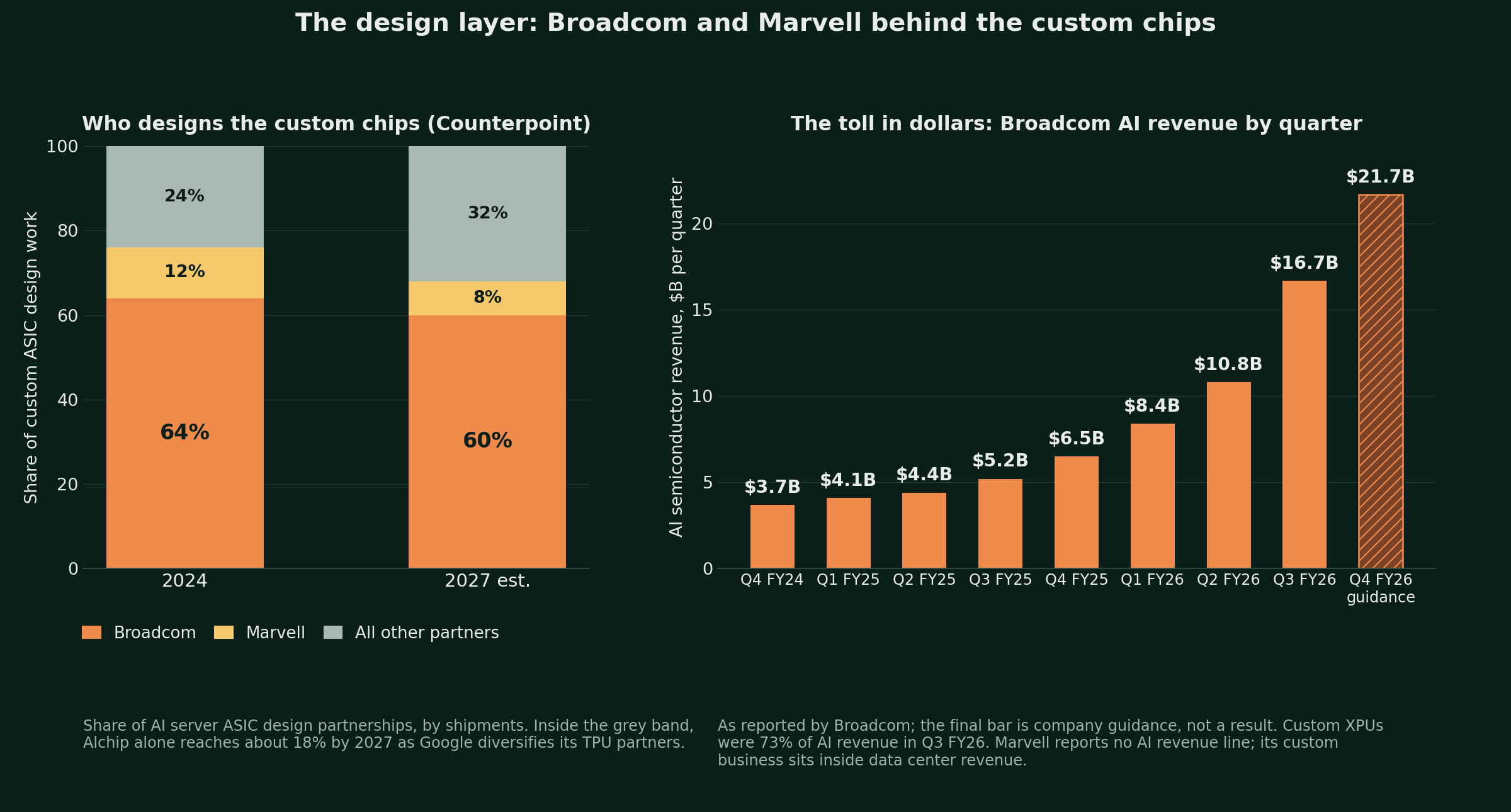
The toll is now the size of a market of its own. Broadcom's AI semiconductor revenue was $3.7B in the quarter that ended in November 2024. Eight quarters later it reported $16.7B, up 221% year over year, with custom XPUs making up 73% of that total, and it has guided to $21.7B for the current quarter and to more than $100B of AI revenue for fiscal 2027. Its disclosed AI chip backlog stands at about $73B. The customer list is widening past the hyperscalers, too. Broadcom expects Anthropic to become its largest XPU customer next year, on a deployment it sizes at 5 gigawatts, and OpenAI to be its second largest by fiscal 2028.
Marvell is the second designer, and the contrast is instructive. It is the engineering partner behind Amazon's Trainium and Microsoft's Maia, and Counterpoint expects its shipments to double between 2024 and 2027 while its share of design work falls from 12% to 8%, the same split between share and shipments that runs through this entire article. Marvell reports no AI revenue line, so its custom business cannot be charted the way Broadcom's can. It sits inside the company's data center segment, at a fraction of the scale Broadcom now reports for AI alone. The third name in the layer, Alchip, is rising from the other direction, toward about 18% of design work by 2027, helped by Google spreading its TPU partnerships beyond Broadcom, where Macquarie estimates Broadcom's share of the TPU program falls from about 95% in 2026 to 80% in 2027 and 65% by 2028.
What does the walled market in China look like?
A separate landscape, with its own leader, created by export controls. China's AI accelerator card shipments were about 4 million units in 2025, per IDC figures reported by Reuters. NVIDIA remained the largest single supplier with about 2.2 million units and a 55% share, down from roughly 95% before United States restrictions and 66% in 2024 on Bernstein's estimates. Domestic Chinese vendors shipped about 1.65 million units between them, a 41% share. AMD held about 4%.
| China AI accelerator cards, 2025 | Units | Share |
|---|---|---|
| NVIDIA | About 2.2M | 55% |
| Huawei (Ascend) | About 812,000 | 20% |
| Alibaba T-Head | About 265,000 | 7% |
| AMD | About 160,000 | 4% |
| Baidu Kunlun | About 116,000 | 3% |
| Cambricon | About 116,000 | 3% |
| Other domestic vendors | Remainder | About 8% |
Huawei is the center of the domestic side, with about half of all Chinese-vendor shipments, and its lead widened through 2026. In the first half of 2026, IDC's figures as reported put NVIDIA at 34% of China's accelerator units, with its shipments down 44% year over year, Huawei at 28% on 572,000 units, and the named Chinese vendors together at 47%. The constraint on the Chinese side is supply, not demand. Huawei's output is capped by SMIC's advanced capacity and by high-bandwidth memory, and Epoch AI estimates Huawei produces under 4% of the compute NVIDIA produces in 2026 despite its unit growth. Two cautions belong with this section. Chinese figures are the softest data in this article, since none of it comes from filings-grade disclosure, and trackers using revenue or high-end segment definitions put the domestic share higher than the unit figures above. And the wall runs both ways. The global series in the earlier sections should be read as describing the world outside this one.
Where do the trajectories point from here?
Three motions are underway, and each is visible in the charts above rather than in anyone's guidance. Custom silicon is becoming the second pole of AI compute, passing merchant GPUs in unit shipments in 2027 on JPMorgan's forecast while still trailing far behind in revenue, which means the contest between NVIDIA and the hyperscalers' own chips will be fought on volume first and dollars later. Arm is compounding at a point or so a year in PCs and faster in servers, with every major cloud now fielding its own Arm CPU, which makes the x86 duopoly's remaining share a slowly shrinking island. And the two incumbents' lines point in opposite directions. Intel's shares are still falling in every panel. NVIDIA's revenue share is gliding down from its peak while its absolute revenue compounds, the signature of a leader in a market outgrowing even it.
The open question the landscape leaves is AMD's. Its CPU lines bend upward in every period measured. Its GPU and accelerator lines have not bent yet, not in the 2023 reset, not in the Blackwell cycle, not on the strength of the largest design wins in its history, the multi-gigawatt agreements with Meta and OpenAI that begin shipping into 2027. If those wins are ever going to appear in share, they appear in the next four quarters of the series this article has laid out. Until a teal line on the GPU panels actually turns up, the map stays as drawn.
The land in one line. NVIDIA holds the new market, AMD holds the share it took from Intel, Intel holds less of everything each year, Arm holds a growing slice of all of it without selling a chip, and the hyperscalers are building a second supply of compute that answers to no vendor at all.
Frequently asked questions
Who is winning the AI chip market?
By revenue, NVIDIA, with about 75% of AI accelerator revenue in 2026 estimates, down from an 87% peak in 2024, and 93% of discrete GPU units. By unit growth, custom ASICs built by hyperscalers, whose shipments nearly quadruple between 2025 and 2027 and pass GPU shipments in 2027.
Why does Arm not appear in most market share tables?
Arm licenses processor designs and sells no chips of its own, so its share ships inside other companies’ products, Apple Macs, AWS Graviton servers, NVIDIA Grace systems, and Qualcomm laptops. Vendor tables leave it out. Mercury Research estimates Arm designs at 15.3% of PC CPUs and 13.6% of server CPUs.
Did AMD take market share from NVIDIA?
No. AMD’s discrete GPU share fell from 21% in 2021 to 7% in 2025, its share of data center revenue stayed in a 7% to 9% band, and it holds about 7% of AI accelerator revenue. AMD’s gains came against Intel in server and desktop CPUs, where its unit share roughly tripled.
Disclosures
Not financial advice. This article is published for educational purposes only. Nothing here is a recommendation to buy, sell, or hold any security, and nothing here is financial advice. Investing involves risk, including the possible loss of principal.
Positions. The author holds long positions in AMD, Alphabet, Amazon, and Meta, all discussed in this article. The author holds no position in NVIDIA, Intel, Apple, Qualcomm, Broadcom, Marvell, or Arm Holdings.
Accuracy. Discrete GPU shares are Jon Peddie Research annual averages and quarterly readings as reported. CPU shares and Arm estimates are Mercury Research figures as reported, and Mercury flags its Arm estimates as less certain than its x86 data. Data center revenue shares are computed from company segment revenue as compiled by Bloomberg and published by Visual Capitalist. AI accelerator revenue shares are estimates from company filings, TrendForce data, and TSMC allocation data compiled by Silicon Analysts; no audited census of that market exists. AI accelerator unit figures are JPMorgan's fall 2026 forecast as reported, with the 2025 total derived from its reported 62% growth rate for 2026. Custom ASIC shipment shares and design partner shares are Counterpoint Research figures as reported; TPU unit estimates are Piper Sandler's as reported, and the Broadcom program share path is Macquarie's as reported. Broadcom AI semiconductor revenue, backlog, and guidance are as reported by the company. Arm server share alternatives are from Dell'Oro Group and TrendForce as reported. China figures are IDC data as reported by Reuters, with Bernstein estimates for earlier years and Epoch AI estimates for compute comparisons. Forecasts are labeled as forecasts where they appear. Errors can occur and facts change; verify independently before acting on anything you read.
No advisory relationship. Reading this site does not create an advisor-client relationship of any kind. See the full disclosures page.