
The thesis under test is the one this site has built in print. Akamai is the first inference cloud, the argument runs, a distributed platform of more than 4,400 locations sitting where agentic AI traffic has to travel, with security attached to every call. The third quarter print on November 5, 2026 gave that thesis a dated shape. Revenue rose 6% to $1.122B. Cloud Infrastructure Services grew 34% to $109M in the quarter. The company has signed more than $14B of multi-year cloud commitments this year, $11.6B of it from Anthropic over seven years, and it guided CIS revenue to $1.1B to $1.3B in 2027, total revenue growth of 17% to 22% that year, and revenue above $7.0B in 2028. Our grading of that print proposed raising the library score to 78/100 Positive. The full case sits in the research report and in our efficiency wave landscape.
Now the other side. Every phone and laptop shipping this year carries a neural processor. Every large systems vendor will sell an enterprise its own AI factory for its own hall. A box the size of a paperback can hold a 70 billion parameter model. If inference migrates onto devices and into customer premises, what exactly is left for a distributed inference cloud to sell? This article takes that question seriously, on a three year horizon from late 2026 through 2029. It defines the threat in three lanes, argues the invalidation case at full strength, argues the defence at full strength, lays the two sides on one dated timeline, and lands a verdict with named conditions under which the verdict flips. Figures are labeled as shipped fact, roadmap claim, or analyst forecast wherever the distinction matters, because in this debate the three are constantly blended.
What exactly is the threat?
The short version
The threat is not one technology. It is three different machines taking three different slices of the same inference dollar.
- Phones and PCs now ship NPUs rated from 35 to 80 TOPS, and AI capable models took roughly a third of phone and PC shipments in 2025 (Gartner and Counterpoint series).
- The models actually shipped on phones converge near 3B parameters and do bounded tasks only. Apple says its own on-device model is not designed for world knowledge or advanced reasoning.
- Enterprises can buy turnkey AI factories from Dell and HPE today, and the workhorse card inside them is the same RTX PRO 6000 that Akamai rents by the hour.
- A desk box with 128GB of unified memory serves a dense 70B model at 2.7 to 6.0 tokens per second for one user. That is a prototype tier, not a serving tier.
Lane one is the device. The neural processing unit is now standard equipment. Apple's A19 Pro carries a 16-core Neural Engine rated at 35 TOPS, a headline number that has not moved in three iPhone generations, with the 2025 gains coming from GPU Neural Accelerators and memory bandwidth instead. On the PC side the numbers run higher. Qualcomm's Snapdragon X2 Elite rates its Hexagon NPU at 80 TOPS, AMD's Ryzen AI 400 reaches 60 TOPS, and Intel's Core Ultra Series 3 reaches 50 TOPS on the NPU and 180 TOPS across the platform, with the caveat that platform TOPS pools three engines that share one memory bus and one power budget. Microsoft's Copilot+ certification floor, 40 TOPS of NPU with 16GB of RAM, is now cleared by every vendor's current generation.
What matters is what those chips actually run, and here the platform owners have converged with unusual honesty. Apple's shipped on-device foundation model has about 3 billion parameters, described to developers as quantized to 2 bits, and Apple tells those developers in plain words that it is optimized for summarization, extraction, and classification and is not designed for world knowledge or advanced reasoning, which are tasks for server-scale models. Google's published Gemini Nano sizes are 1.8B and 3.25B parameters at 4-bit quantization, and its developer API surface is summarization, proofreading, rewriting, and image description. Two competing platforms, independently, ship the same size of model doing the same bounded jobs. Microsoft draws the same line inside its own product. The local Copilot+ features, Recall, Live Captions, Studio Effects, semantic file search, run on the NPU. Microsoft 365 Copilot, the paid drafting and meeting product, runs in the cloud on a separate subscription, and general assistant chat does not use the local NPU at all.
The binding constraint is not TOPS. It is memory, and the arithmetic is unforgiving. At 4-bit quantization, the standard local format, an 8B model needs about 6GB of planned memory and fits a 16GB machine comfortably. A 14B model needs about 10GB and fits tightly. A 32B model needs about 21GB before context, about 27GB at a 32K context window, and physically does not fit in the 16GB Copilot+ floor. A 70B model needs 40GB to 44GB, which means a 64GB to 128GB workstation. The flagship iPhone carries 12GB of RAM that the model shares with the operating system, the camera stack, and every open app. The device lane, as shipped, is a 3B phone tier and an 8B to 14B laptop tier, with a 70B tier that exists only on premium workstations.
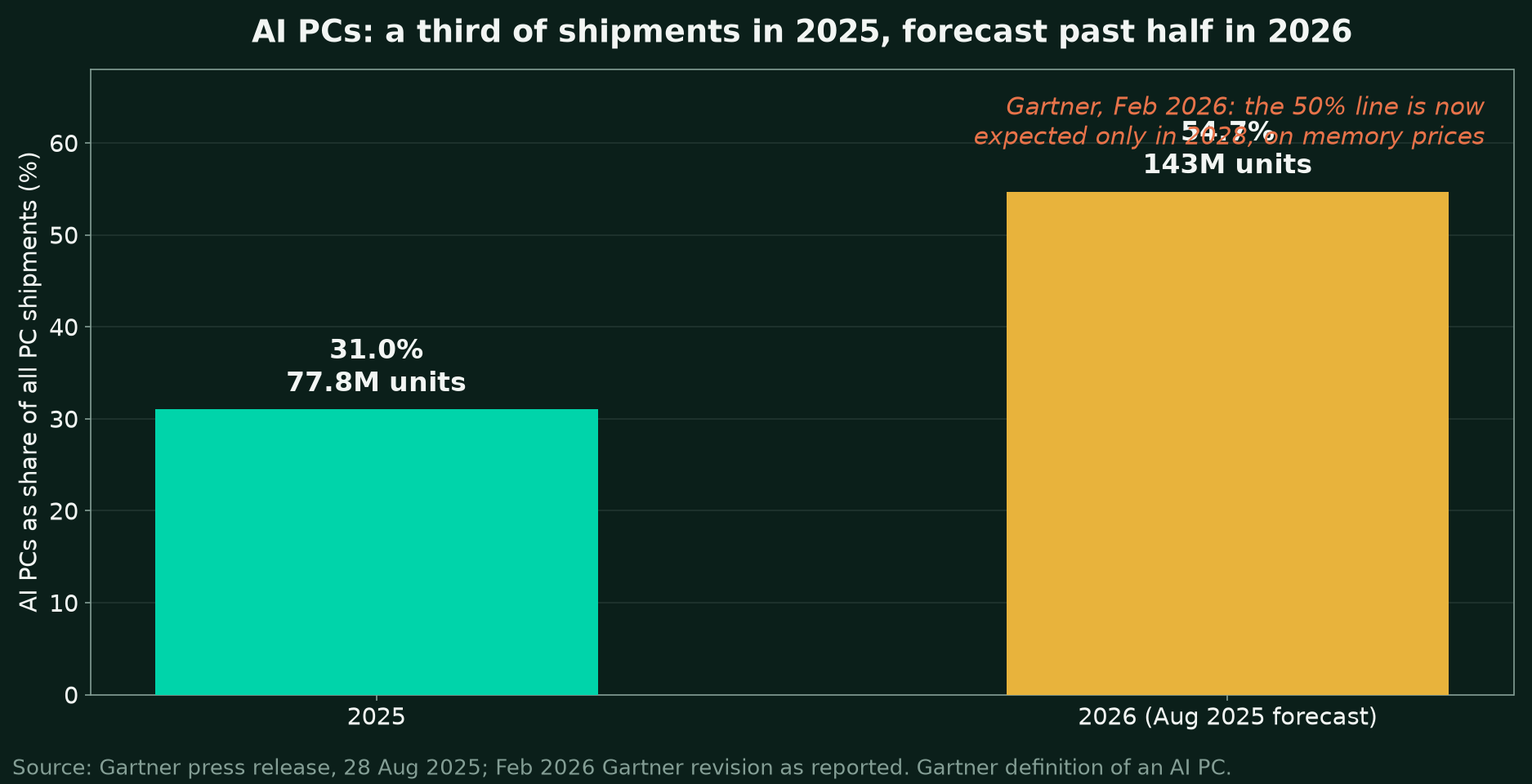
Penetration is fast on shipments and slower in the field. Gartner put AI PCs at 31% of PC shipments in 2025 and forecast 54.7% for 2026, then revised in February 2026, saying rising memory prices will delay 50% penetration until 2028. Counterpoint's series has generative AI phones at 36% of shipments in 2025, 45% in 2026, and 52% in 2027, with the installed base passing one billion units only in 2028. Phones are held about 43 months on Counterpoint's replacement cycle series and business laptops about four years, so the fleet in use turns over far more slowly than the fleet on shelves.
Lane two is the premises. This is the enterprise AI factory, and it is shipped product, not vapor. NVIDIA's DGX B200 packs eight B200 GPUs with 1,440GB of HBM3e memory into a 10U chassis drawing about 14.3 kW, and DGX SuperPOD scales that into the customer's own hall. Dell says more than 6,500 enterprises have adopted its AI Factory with NVIDIA, up from 5,000 a quarter earlier, with the honest caveat from Dell's own executives that the count includes large neoclouds and sovereign programmes alongside enterprises. HPE booked $6.8B of AI system orders in its fiscal 2025, more than 60% of the backlog from sovereign and enterprise customers, and in November 2025 the Defense Information Systems Agency awarded HPE a ten year, $931M agreement built on HPE Private Cloud Enterprise with on-premises and air-gapped management. The workhorse card of this lane is NVIDIA's RTX PRO 6000 Blackwell Server Edition, 96GB of GDDR7 memory on a PCIe card with no NVLink, built to drop into standard air-cooled servers from Dell, HPE, Lenovo, and Supermicro. Hold that card in mind. It comes back.
Sovereign AI is the largest single pool in this lane, and most of it is not what the phrase suggests. NVIDIA's sovereign AI revenue more than tripled in fiscal 2026 to over $30B, about 14% of its total. But South Korea's 260,000 GPU programme shows the split cleanly. Samsung, SK, and Hyundai are building factories inside their own walls, true on-premise deployments. The government's 50,000 GPUs run through NAVER Cloud, NHN, and Kakao, which is an in-country cloud that customers rent, not boxes in ministry basements. India's AI Mission empanels private providers and subsidizes access rather than buying state hardware. Gartner forecasts sovereign cloud IaaS spending of $80.4B in 2026 rising to $110.6B in 2027, and the wording matters: that money flows mostly to local cloud providers, not to customer-owned hardware. Much of the sovereign wave is a demand for clouds with a nationality, and a distributed operator with in-country points of presence can compete for it. The genuinely walled-off slice, defence and regulated estates that cannot touch a public network, is real but narrower than the headlines.
Lane three is the small cluster. NVIDIA's DGX Spark put a Grace Blackwell chip, 128GB of unified memory, and a rated one petaFLOP of sparse FP4 performance into a box 150 millimetres square. ASUS, HP, Dell, Lenovo, and others sell the same GB10 silicon as the Ascent GX10, the ZGX Nano, and their own variants. Apple's Mac Studio with M3 Ultra is the capacity outlier, up to 512GB of unified memory at 819 GB/s, and it demonstrably runs the full DeepSeek R1, a 671B parameter mixture of experts model at 4-bit quantization in about 404GB, at 17 to 18 tokens per second for one user. AMD's Strix Halo, in the Framework Desktop and its rivals, matches the 128GB ceiling at 256 GB/s of bandwidth. These machines genuinely serve a department's prototyping, fine-tuning, and privacy-pinned work. What they do not do is serve a crowd. Independent measurements put dense 70B generation on a Spark at 2.7 to 6.0 tokens per second for a single user, below comfortable reading speed at the low end. Under concurrency the aggregate throughput of that 70B model peaks at 485 tokens per second at 128 simultaneous requests and then falls to 300 at 256, with per-request speed collapsing. Akamai's own published benchmark for one of its cloud servers, running a 49B model on the RTX PRO 6000, is 24,240 tokens per second at 100 concurrent requests. Different models and engines make that an order-of-magnitude illustration rather than a head-to-head, but the gap between a desk and a serving tier is roughly fiftyfold, and it is made of memory bandwidth and pooled capacity, not of TOPS.
What is the strongest case that local AI invalidates the thesis?
The short version
Argue it honestly and the threat takes real territory: the small end of inference, the steady-state enterprise workload, and every workload the law walls off.
- NVIDIA Research estimates small models could handle about 40% to 70% of calls inside real agent frameworks, at 10 to 30 times the efficiency of a 70B to 175B model.
- Lenovo's published TCO model prices self-hosted Llama 70B inference at about $0.11 per million tokens against about $2.00 on a hosted API, a 17x gap, where utilization stays high.
- Sovereign and air-gapped demand is structurally closed to Akamai. Management states on the record that it does not offer bare metal, and no on-premise or air-gapped Akamai product exists in its releases.
- The device fleet compounds. AI PCs are forecast to be the norm by 2029, and every refresh enlarges the local tier while the installed software routes local first.
Start with the workload mix, because that is where the case is strongest. Inference is not one workload. A large share of the calls inside real systems are repetitive, bounded, and small: classify this, extract that, summarize the thread, route the ticket, check the format. NVIDIA Research's 2025 position paper on small language models, the strongest sourced version of this argument, estimates that small models could handle about 40% of the calls in Open Operator, about 60% in MetaGPT, and about 70% in Cradle, three real agent frameworks, at 10 to 30 times the serving efficiency of a 70B to 175B model. Gartner forecasts that by 2027 organizations will use small task-specific models three times more than general purpose LLMs by usage volume. Intel claims its hybrid execution work cut cloud token consumption by up to 70% on its own tested enterprise workloads, a vendor figure from vendor testing, but directionally the same claim from a second silicon vendor. If even the low end of that range is right, a third or more of inference calls never need a cloud at all, and agent traffic, the exact growth engine of the Akamai story, is where the substitution bites hardest.
Then the cost argument, which at the endpoint is close to unanswerable. A phone or laptop NPU is a sunk cost bundled into a device the user already bought, so the marginal cost of a local token is the electricity to produce it. On-premise, the published vendor models say ownership wins wherever utilization stays high. Lenovo's 2026 TCO paper, a vendor model selling Lenovo servers and labeled as such, works an eight GPU H200 configuration against Azure pricing and finds breakeven against on-demand cloud in about 3,793 hours, roughly 5.2 months of continuous use, and prices self-hosted Llama 70B inference at about $0.11 per million tokens against about $2.00 on a comparable hosted API. Dell claims savings of up to 90% against cloud APIs over two years on its AI Factory page. These are sales documents, and their scope limits are real, since Lenovo's own paper excludes staffing, licensing, and patching. But the shape of the math is not in dispute. A steady, predictable, high-volume inference workload is cheaper on owned hardware than on rented capacity. Every CFO who finds one will move it.
Regulation is the third force, and it is a forcing function rather than a preference. Data sovereignty law, health and finance privacy rules, and defence security requirements do not ask whether cloud inference is better. They specify where data may sit. Gartner's sovereign cloud forecast, $80.4B in 2026 and $110.6B in 2027, and its expectation that governments lead the buying, followed by regulated industries and critical infrastructure, describe a demand pool whose first question is jurisdictional. IDC's sovereignty research finds more than half of organizations already use sovereign cloud for AI. The DISA award shows the extreme of the pool: a ten year, $931M programme whose management plane is air-gapped by design. For that slice of demand, the competitor is not a better cloud. It is a locked room, and Akamai cannot enter it with its current offer. Management said on the Q3 call, in its own words, that Akamai does not even offer bare metal as a service, selling virtual machines, managed Kubernetes, storage, and networking instead. No Akamai release describes an on-premise appliance, an air-gapped deployment, or a customer-premise product. The walled segment is structurally unavailable, and it is growing on law rather than on fashion.
The fourth force is that models shrink toward the hardware. Microsoft's Phi-4, a 14B model, scores 80.4 on the MATH benchmark in Microsoft's own technical report evaluations, ahead of GPT-4o at 76.6, and 56.1 on GPQA, ahead of GPT-4o at 53.6, while still trailing on breadth and code. Four-bit quantization is now the standard local format rather than an exotic compromise. Architecture is helping too. DeepSeek's multi-head latent attention cuts the per-token cache to roughly 70KB, an order of magnitude below a conventional design of similar size, which directly attacks the memory wall that confines local serving. Each year the capability that fits inside 16GB, then 32GB, then 128GB of unified memory climbs, and the set of workloads that require a cloud shrinks from below. The device fleet compounds underneath. AI PCs were 31% of shipments in 2025 and Gartner expects them to be the norm by 2029. Every refresh cycle replaces a machine that could not run a local model with one that can, and the operating systems now route local first by default, escalating only what does not fit.
Now map the damage onto the thesis, leg by leg, because that is what invalidation would actually mean. The inference cloud leg takes the direct hit. Akamai Inference Cloud, launched in October 2025 on RTX PRO 6000 GPUs across its network, and the AI Grid orchestration layer launched at GTC in March 2026, exist to sell exactly the latency-sensitive, small-to-mid-model, geographically scattered inference that devices and desks absorb first. Worse, the hardware identity cuts against differentiation. Akamai rents the same RTX PRO 6000 card, 96GB of GDDR7, PCIe, no NVLink, that a customer can buy from a reseller, where listings clustered around $15,000 to $20,000 per card in September 2026, and install in a standard server in its own hall. When the silicon is identical, the cloud case rests entirely on pooling, placement, and operational burden, and for a steady workload the customer can test that case against its own electricity bill. The delivery leg takes a slower hit. Assistants that answer on the device summarize content without fetching it, and every summary generated locally is a page view, an ad call, and an origin fetch that never crosses the delivery network. Delivery revenue already declines, down 3% in the third quarter, and local answering steepens the slope rather than starting it. The security leg looks insulated and is not, entirely. Security attaches to traffic. Inference that never leaves a phone generates no API calls to inspect, no prompts to firewall, and no agent sessions to govern. Firewall for AI and API Security sell protection for endpoints that exist on a network. A model inside a handset is not one. Add the pieces and the invalidation case is coherent: the small end of inference goes local, the steady enterprise workload goes on-premise, the regulated workload was never available, and what remains for the distributed cloud is the frontier tail, which is precisely the part the hyperscalers serve from giant centralized campuses. On that telling, Akamai built a network for a middle that is being eaten from both ends.
What is the strongest case that it does not?
The short version
Substitution is real and the denominator is exploding. Local capacity is chasing a target that compounds faster than devices refresh.
- Google's company-reported token volume rose about 330x in two years, to 3.2 quadrillion tokens a month by May 2026. Goldman Sachs Research forecasts 24x growth from 2026 to 2030.
- The physics cap the local tier. One sequence at a 1M token context needs about 128GB of cache alone on an 8B model of conventional design, the whole memory of the biggest desk box, before weights.
- Ownership math needs near-continuous use. Microsoft Research found all 400 production deep learning jobs it studied averaged 50% GPU utilization or less.
- Cloud and shared environments took over 86% of AI server spending in the third quarter of 2025 on IDC's tracker, up from 72% in the first half of 2024. On-premise share is shrinking even as its dollars grow.
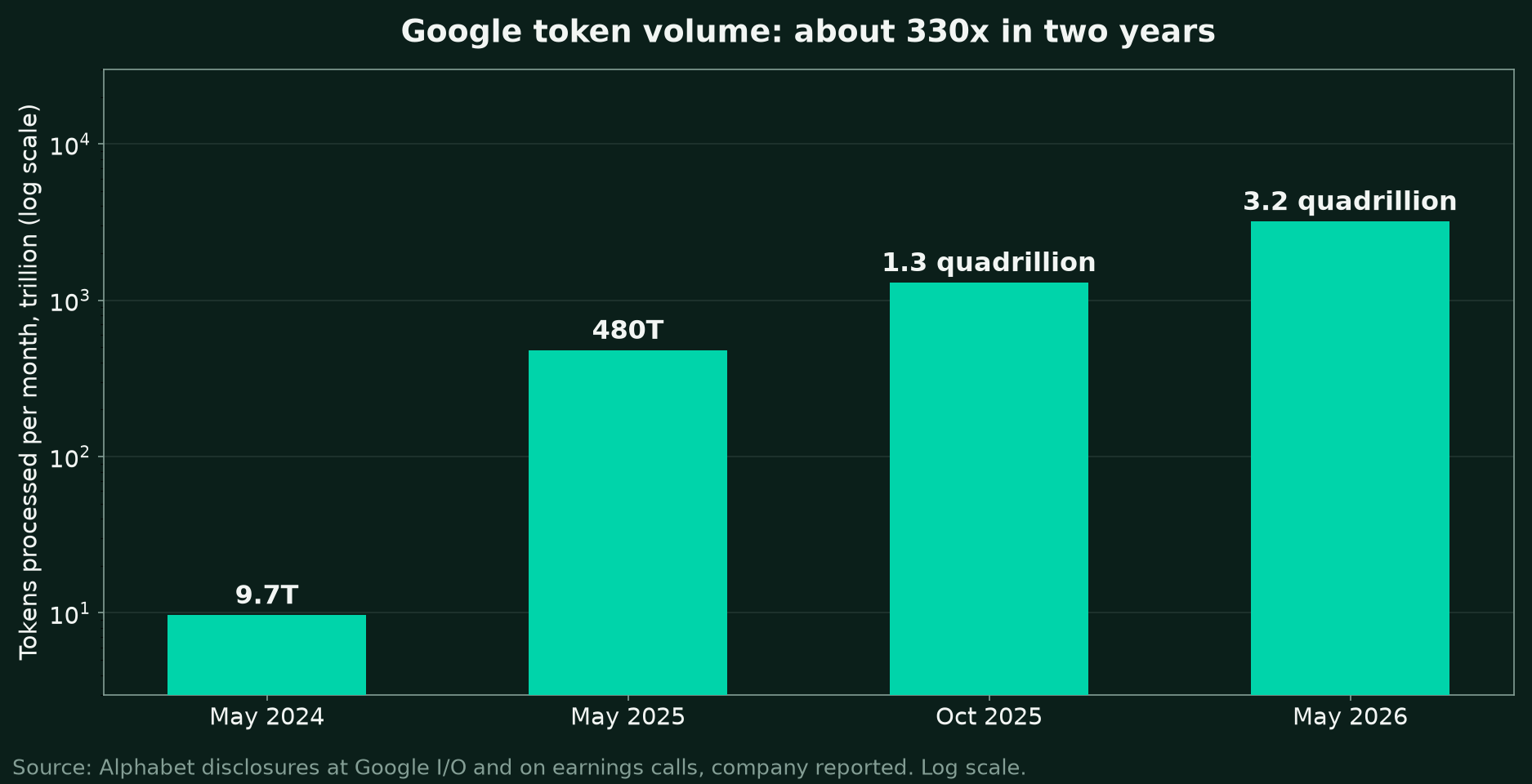
Begin with the denominator, because the invalidation case quietly assumes a fixed pie. Inference demand is not fixed. Google's company-reported token volume went from 9.7 trillion tokens a month in May 2024 to 480 trillion in May 2025 to 3.2 quadrillion in May 2026, roughly 330 times in two years. Microsoft reported more than 100 trillion tokens processed in a single quarter back in the quarter ending March 2025, five times the prior year. Gartner's AI-optimized IaaS series has inference spending passing training in 2026, $23.3B against $19B. Goldman Sachs Research forecasts global token consumption growing 24 times between 2026 and 2030, to 120 quadrillion tokens a month, on agentic adoption. Local hardware can take a rising share of a market growing at that speed and the cloud side can still grow in absolute terms every single year. Substitution percentages and cloud growth are not enemies. They have coexisted for the entire period in which NPUs have shipped, which is why IDC's tracker shows cloud and shared environments taking over 86% of AI server spending in the third quarter of 2025, up from 72% in the first half of 2024. The local lane is growing. Its share of the money is falling.
Then the physics, which do not negotiate. A serving model carries two memory loads: its weights and its key-value cache, the stored attention state for every token of context for every simultaneous user. The cache grows linearly with context length times concurrency, and context lengths shipped at the frontier are now 1M to 2M tokens. The arithmetic, derived from published model configurations, is stark. A Llama 3.1 8B model of conventional design stores 128 KiB of cache per token. At a 128K context that is 16GB per user, the model's own weight size again. At a 1M context it is 128GB per user, the entire memory of the largest desk box, for the cache of one sequence, before weights. A 70B model of the same design stores 320 KiB per token, about 320GB of cache for one 1M token sequence. DeepSeek's latent attention design cuts the per-token figure by roughly an order of magnitude, and that offset is real, but per-token cache still varies by more than 300 times across 2026 flagship designs, and the efficient architectures are specific models, not a general pardon. The frontier itself keeps moving away from the desk. DeepSeek R1 at 4-bit quantization needs about 404GB, which is why its famous local demonstration required the single most expensive Mac Apple sells and served exactly one user at reading speed. A device bought today holds its memory for about three and a half years of phone life or four years of laptop life. In that span, at the 2025 to 2026 cadence, its owner lives through six to twelve flagship model generations. The box is fixed. The models are not. That mismatch is not a marketing position. It is the reason every platform built escalation into the product on day one.
Which is the third argument: hybrid is not a transitional embarrassment, it is the shipped architecture, stated by the vendors themselves. Apple's design runs what fits on the device and escalates complex requests to Private Cloud Compute, where larger server models run, and Apple expanded that cloud tier in 2026 rather than shrinking it. Microsoft's developer guidance recommends, in its own words, trying a local model first and falling back to a cloud endpoint when the task requires a larger model, and its Windows leadership describes the platform in October 2026 as the home for hybrid intelligence, local when it makes sense and cloud when needed. Qualcomm's handset chief told the Snapdragon Summit audience, as reported from the stage, that Qualcomm is never going to replace the cloud with the edge. Intel's commercial leadership calls hybrid AI reality. The enterprise surveys agree with the vendors. Cloudera's 2026 survey of 1,500 enterprise architects found hybrid the most-cited inference location at 31%, with pure on-premise at 8%. Fortanix's survey of AI leaders in regulated industries found hybrid expected to be the primary inference location over the next 24 months. In a hybrid world, the routing layer is a product. Someone decides, per request, what runs on the device, what runs nearby, and what runs in a core region, and that someone sells orchestration, security, and the nearby tier. That is a description of the business Akamai is building, not of the business local AI destroys.
The fourth argument is utilization, the quiet killer of the on-premise spreadsheet. Lenovo's breakeven of about 3,793 hours assumes the box runs continuously. Measured production fleets do not. A Microsoft Research study of 400 real production deep learning jobs found every one averaging 50% GPU utilization or less, with data operations and batch sizing, not silicon, as the leading causes. A 2026 vendor measurement across tens of thousands of Kubernetes clusters put average GPU utilization at 5% before optimization, a self-interested source to treat as directional rather than precise, but pointing the same way as the peer-reviewed work. An enterprise that cannot keep its AI factory busy does not get the vendor TCO. A distributed cloud pools demand across customers, industries, and time zones, which is exactly the asset a single wall cannot replicate. The repatriation surveys show the same selectivity from the buyer's side. Barclays' CIO survey has 86% of CIOs planning to move at least some workloads back, the highest reading on record, while IDC finds only 8% to 9% planning to repatriate entire workloads and Flexera puts the share of workloads actually moved at about 21%. Intent is broad. Volume is narrow. Dell'Oro's analysts describe the expected sequence out loud: rent first, then migrate the stable and heavily utilized workloads on-premise, keeping variable demand in the cloud. That sequence grows the on-premise lane and grows cloud with it.
Finally, the legs of the thesis that local compute does not touch, and one it feeds. The largest CIS fact of 2026 is not edge inference at all. It is $11.6B of contracted CPU capacity for Anthropic, inside a signed book above $14B that management says ramps to about $2.2B of annual revenue at full ramp, at about 75% adjusted EBITDA margin on the published frame. Well over 90% of the servers being deployed for that book are CPUs. No NPU roadmap un-signs a seven year contract, and the 2028 revenue guide above $7.0B was confirmed on the call as achievable from signed business alone, assuming no further Anthropic orders. Security is the leg local AI may actually feed. Akamai's own State of the Internet telemetry recorded AI bot activity surging 300% in 2025, with commerce taking 48% of AI bot activity in the second half of that year and North America retail alone absorbing 33 billion AI bot counts. Agents act on networks wherever their models run. A local agent still fetches, scrapes, calls APIs, and exposes new surfaces at machine speed, and Gartner estimates an agentic workflow consumes 5 to 30 times the tokens of a chat query, with every one of those calls a candidate for inspection, routing, and billing. Our own published work adds a structural point here. For personalized agentic traffic, requests are unique, so exact-match caching does nothing for them, and neither Akamai nor Cloudflare has published production hit rates for semantic caching, as our efficiency wave audit documented. The efficiency contest is therefore not cache versus device. It is routed, pooled, right-sized compute across a tiered network, edge locations, metro GPU clusters, regional capacity, and core regions, against a fixed box under a desk that is idle most of the day. Akamai's tiered structure is built for the first side of that contest. It is harder to replicate than a uniform edge, as our head-to-head comparison graded it, and local hardware does not replicate any of it.
What does the three-year timeline actually look like?
Put both sides on one calendar. The local milestones below are shipped facts and dated analyst forecasts. The Akamai checkpoints are the ones already on this site's record from the Q3 print. The right-hand column says what each row would actually prove, because a milestone that proves nothing is decoration.
| Period | On the local side | On the Akamai side | What it would prove |
|---|---|---|---|
| Late 2026, now | Snapdragon X2 Elite devices at 80 TOPS shipping. Dell AI Factory past 6,500 customers (Dell, October 2026). AI PCs at 31% of 2025 shipments (Gartner). GenAI phones at 36% of 2025 shipments (Counterpoint) | Akamai Inference and Agent Sandbox launched in beta the week before the Q3 call, with 12 open-weight models from 8B to 2.8T parameters (650 Group). CIS at $109M in Q3, up 34% | The threat is shipping, and so is the response. Nothing yet decided |
| 2027 | Gartner expects organizations to use small task-specific models three times more than general LLMs by volume (forecast, April 2025). Counterpoint has GenAI phones at 52% of shipments. Gartner forecasts sovereign cloud IaaS at $110.6B | The guide year. CIS revenue guided to $1.1B to $1.3B, with the ramp weighted 70% to 75% to the second half. Total growth guided at 17% to 22% | The mid-2027 CIS prints are the first hard grade. Tracking below the $1.1B low end by mid-2027 is the cut line this site set on the Q3 print |
| 2028 | Gartner's revised line has AI PCs crossing 50% penetration only in 2028, on memory prices. Counterpoint has the GenAI phone installed base passing one billion units. IDC's cloud share series is the one to watch for a first on-premise share gain | Revenue guided above $7.0B, confirmed on the Q3 call as achievable from signed business alone, with the year itself still a ramp year for the book | If the 2028 guide lands, the invalidation case is dead for this window whatever devices do, because the path was contracted. A miss reopens everything |
| 2029 | Gartner expects AI PCs to be the norm. Goldman Sachs Research has token volume compounding toward 24x the 2026 level by 2030. Device fleets bought in 2026 reach mid-life with 2026 memory ceilings | The signed book approaches its full ramp run rate of about $2.2B of annual revenue on management's published frame. Growth beyond the book becomes the whole question | By 2029 the debate stops being about the contracted book and becomes about who wins the uncontracted inference market. That is the fight local AI is actually in |
Read the table as a race between two clocks. The device clock ticks at refresh speed: roughly 43 months for a phone, four years for a business laptop, with Gartner expecting business PC lifetimes to lengthen further as prices rise. The demand clock is compounding at rates no fleet plan matches: 330 times in two years on Google's series, 24 times forecast for the next four on Goldman's. The Akamai clock, unusually for this industry, is printed on contracts: quarterly CIS prints against a dated guide, then a 2028 revenue line management says is already signed. Three clocks, three speeds, and only one of them is gradeable in advance. That asymmetry is why the verdict below can be stated with dates.
What is the verdict?
THE VERDICT
Local AI is a real, partial pressure on the Akamai thesis inside three years. It is not an invalidation. It credibly takes the walled-off segment Akamai never had, competes down the uncontracted edge inference tier Akamai is still building, and leaves the contracted core of the thesis, the signed CIS book and the 2028 revenue path above $7.0B, standing on this horizon. The honest grade is a trim to the growth story beyond the book, not a break in the thesis itself.
Leg by leg, so the verdict can be graded later. The inference cloud leg splits in two, and the split is the whole answer. The contracted half, Anthropic's $11.6B of CPU capacity and the rest of the $14B book, is not exposed to local compute in any scenario the evidence supports: it is one lab renting distributed infrastructure for its own products, at published returns, with power and hardware already secured. The uncontracted half, the Inference Cloud and AI Grid business of winning scattered enterprise inference deal by deal, is genuinely exposed. That is the tier where a 128GB desk box, a departmental cluster, and an on-premise AI factory all bid, where hybrid routing sends the small work local first, and where Akamai's differentiation is pooling and placement rather than exclusive silicon. Expect that tier to grow more slowly and price harder than the bull case assumes. The delivery leg keeps its existing slope: local answering shaves fetches at the margin, agent traffic adds requests at machine volume, and the segment was already declining at 3% before any of this. The security leg is a net beneficiary on the evidence of Akamai's own telemetry, because agents multiply exactly the traffic security inspects, wherever the model weights happen to sit.
Quantify the exposure against the path. The 2028 revenue line above $7.0B assumes no Anthropic orders beyond the signed $11.6B and no revenue from the $9B expansion option, and management confirmed it is reachable from signed business alone. Local AI cannot reach that number from outside. What it can reach is everything after: the assumption that CIS keeps compounding past the book into open-market inference, and the multiple the market pays for that assumption. If the uncontracted tier stalls under local competition, Akamai in 2029 is a company that executed a large contracted build, holds a strong security franchise, and grows at the speed of contract renewals rather than at the speed of the inference market. That is a materially worse story than the thesis as told. It is not a broken one, and the distance between those two outcomes is exactly what the flip conditions below are for.
The flip conditions. Any two of these, sustained, upgrade the threat from partial pressure to thesis-breaking, and each is checkable from public sources:
- Device memory breaks the ceiling. A flagship phone line ships 24GB of RAM as its standard tier, or Apple or Google publishes an on-device model above 10B parameters as the shipped default.
- The fleet turns faster than the revised forecast. AI PCs cross half of shipments before 2028 on Gartner's series, with 32GB established as the standard memory tier rather than the premium one.
- On-premise share stops falling. The dedicated on-premise share of AI server spending on IDC's tracker rises for two consecutive years, reversing the 72% to 86% cloud climb.
- The rented side of the lane outgrows the cloud. Dell or HPE discloses on-premise AI system growth above the cloud AI infrastructure growth rate for two straight years, in orders or revenue, not in customer counts.
- A frontier model shrinks to desk size. A frontier lab ships a flagship whose published serving footprint, weights plus cache at production concurrency, fits a 128GB box, or latent-attention-class cache compression becomes the standard across flagship releases rather than one lab's design.
- Akamai's own prints fail first. CIS revenue tracks below the $1.1B low end of the 2027 guide by mid-2027, the score cut line this site published on the Q3 print. Local AI would not be the only suspect in that failure, but a stalled ramp beside a rising local fleet would end the argument about which force mattered.
Until at least two of those lines cross, the correct posture toward the local threat is the one the evidence supports today: respect the lanes, watch the prints, and do not confuse a real share shift at the small end with the end of the distributed inference story. The devices are coming. So is the traffic. Both things have been true for two years, and in those two years the cloud share of the money rose.
Research and opinion, not investment advice. Do your own due diligence before investing.
Frequently asked questions
Can my next laptop or phone replace cloud AI?
For bounded tasks, yes, and it already does. Phones ship models near 3B parameters that summarize, rewrite, and transcribe on device. A 16GB laptop runs an 8B model well. Anything open-ended escalates to cloud by design at Apple, Google, and Microsoft alike, because frontier models and their caches outgrow device memory.
What part of Akamai does local AI actually threaten?
The exposed piece is the uncontracted edge inference business Akamai is building with Inference Cloud and the AI Grid, where small models on devices and desks compete for the same latency sensitive work. The signed book above $14B is contracted CPU capacity that local hardware cannot un-sign, and security grows with agent traffic wherever models run.
When would the verdict on local AI change to thesis-breaking?
If AI PCs cross half of shipments before 2028 with 32GB as the standard tier, and on-premise share of AI server spending rises for two straight years on the IDC tracker, and Akamai CIS tracks below the $1.1B low end of its 2027 guide by mid 2027, the partial verdict becomes a breaking one. None of the three has happened.
Disclosures
Not financial advice. This article is published for educational purposes only. Nothing here is a recommendation to buy, sell, or hold any security, and nothing here is financial advice. Investing involves risk, including the possible loss of principal.
Positions. The author is long Akamai Technologies (AKAM). AKAM is an owned position and is researched in the DalalBytes library, most recently in the September 24, 2026 research report graded 75/100 Positive, with a raise to 78/100 proposed on the Q3 2026 print. The author is a former Akamai employee (2013 to 2018). Nothing in this article draws on non-public information from that employment; every figure and quotation here comes from public releases, public earnings calls, or the public sources listed below. The author also holds positions in Alphabet, Amazon, and AMD, which are named in this article, and holds no position in Dell Technologies, Hewlett Packard Enterprise, Qualcomm, Intel, or Apple.
Accuracy. This analysis is built from public sources believed to be reliable, including Akamai's Q3 2026 earnings release and call, its Inference Cloud launch release of October 28, 2025 filed as an 8-K exhibit, and its published RTX PRO 6000 benchmark; Apple Machine Learning Research and WWDC 2025 materials and Google's Gemini technical reporting for the shipped on-device models; Qualcomm, Intel, and AMD product materials for NPU ratings; Gartner press releases of August 28, 2025, April 9, 2025, and February 9, 2026, and its February 2026 PC forecast revision; Counterpoint Research GenAI smartphone and replacement cycle series; IDC AI Infrastructure Tracker releases and its June 2024 repatriation study; Dell Technologies and HPE press releases of October 21, 2026, August 11, 2025, and November 25, 2025; Lenovo Press TCO paper LP2368 (2026 edition), labeled in the text as a vendor model; the NVIDIA Research position paper on small language models (arXiv 2506.02153); Microsoft Research's ICSE 2024 GPU utilization study; Alphabet and Microsoft company-reported token volumes; Goldman Sachs Research's May 2026 agentic economy forecast; and Akamai's State of the Internet reporting. Figures are labeled shipped fact, roadmap claim, vendor model, or analyst forecast where the distinction matters. Derived figures, including the key-value cache arithmetic, are shown from their published inputs where they appear. Errors can occur and facts change; verify independently before acting on anything you read.
No advisory relationship. Reading this site does not create an advisor-client relationship of any kind. See the full disclosures page.