

What did Akamai actually report in Q3 2026?
Akamai reported third quarter 2026 results after the close on Thursday, November 5, 2026. The verdict first: the quarter itself was in line, and the print still mattered more than most beats this season. Revenue of $1.122B rose 6% as reported and 7% in constant currency, and non-GAAP EPS of $1.77 beat the $1.67 consensus point inside the company's own wide guide. Underneath, the transition arithmetic held: security grew, delivery shrank slowly, and Cloud Infrastructure Services (CIS) grew 34% off a small base. The story of the night was not the quarter. It was management using the earnings call to put dates, phasing, and published returns on the more than $14B of multi-year CIS commitments signed this year, while trimming the 2026 guide at the edges for a $30M revenue shift into 2027.
Basis of this piece. This article is built from Akamai's written Q3 2026 earnings release, the full earnings call transcript (prepared remarks and the complete analyst Q&A), and the scorecard we set on November 1, before the print. Call commentary is graded here directly, not deferred.
| Akamai, Q3 2026 | Yardstick | Call | |
|---|---|---|---|
| Total revenue | $1.122B, +6% YoY (+7% cc) | About $1.12B consensus | In line |
| Non-GAAP EPS | $1.77, -5% YoY | $1.67 consensus | Beat |
| GAAP EPS | $0.77, -21% YoY | Not guided on this basis | Down 21% |
| Security revenue | $622M, +9% (+10% cc) | Double-digit growth | Borderline |
| Delivery and other cloud apps | $391M, -3% YoY | No worse than -6% to -7% | Pass |
| CIS revenue | $109M, +34% (+35% cc) | About 35% growth, with conversion | Pass on conversion |
| Non-GAAP operating margin | 25% | 24% to 26% guide | Pass |
| Q3 capex | $464M, 41% of revenue | A payback frame, not just spend | Answered on the call |
| Cash from operations | $433M, 39% of revenue | Self-funding the build | Strong |
THE VERDICT
The print strengthens the 75/100 Positive from our September 24 research report. The library proposes 78/100 Positive at the formal research refresh, and that number is labeled proposed here, not struck. What would change the score from here: CIS revenue tracking below the low end of the 2027 guide by mid-2027, a second delay of this kind, or returns evidence that contradicts the published frame. Any of those cuts it. A clean first half of ramp execution raises it further.
How did the six pre-print gates score?
Before the print we set six pass or fail gates for this quarter, scored against the second quarter baseline and the guidance the company had on record. Here they are, graded one by one against the release and the call.
| Gate | The bar | The print | Grade |
|---|---|---|---|
| 1. Revenue and EPS | Revenue at or above $1.12B and non-GAAP EPS at or above $1.67 | Revenue of $1.122B and EPS of $1.77, ten cents clear of the bar | Pass |
| 2. CIS growth and conversion | Growth at or above about 35%, with signed commitments tied to a dated revenue ramp | Growth of 34% as reported and 35% in constant currency, right at the bar. Conversion was answered decisively: two of the first three large deals are billing, the third is in final testing, and 2027 CIS revenue is guided to $1.1B to $1.3B | Pass |
| 3. Security holds double digits | Growth at or above about 10%, keeping the largest engine funding the transition | $622M, up 9% as reported and 10% in constant currency. At the line rather than clear of it | Borderline pass |
| 4. Delivery drag does not widen | Decline no worse than about 6% to 7% | Down 3%, well inside the line, with pricing described on the call as holding better than it has in a long time | Pass |
| 5. Margin and the Anthropic capex frame | Non-GAAP operating margin inside 24% to 26%, and the $5.5B Anthropic-related capex framed with a payback shape | Margin printed 25%, in range. On the call, management published the full returns frame for the signed book: about 13% after-tax IRR, about 15% average annual adjusted ROIC, and deal margins at full ramp | Pass |
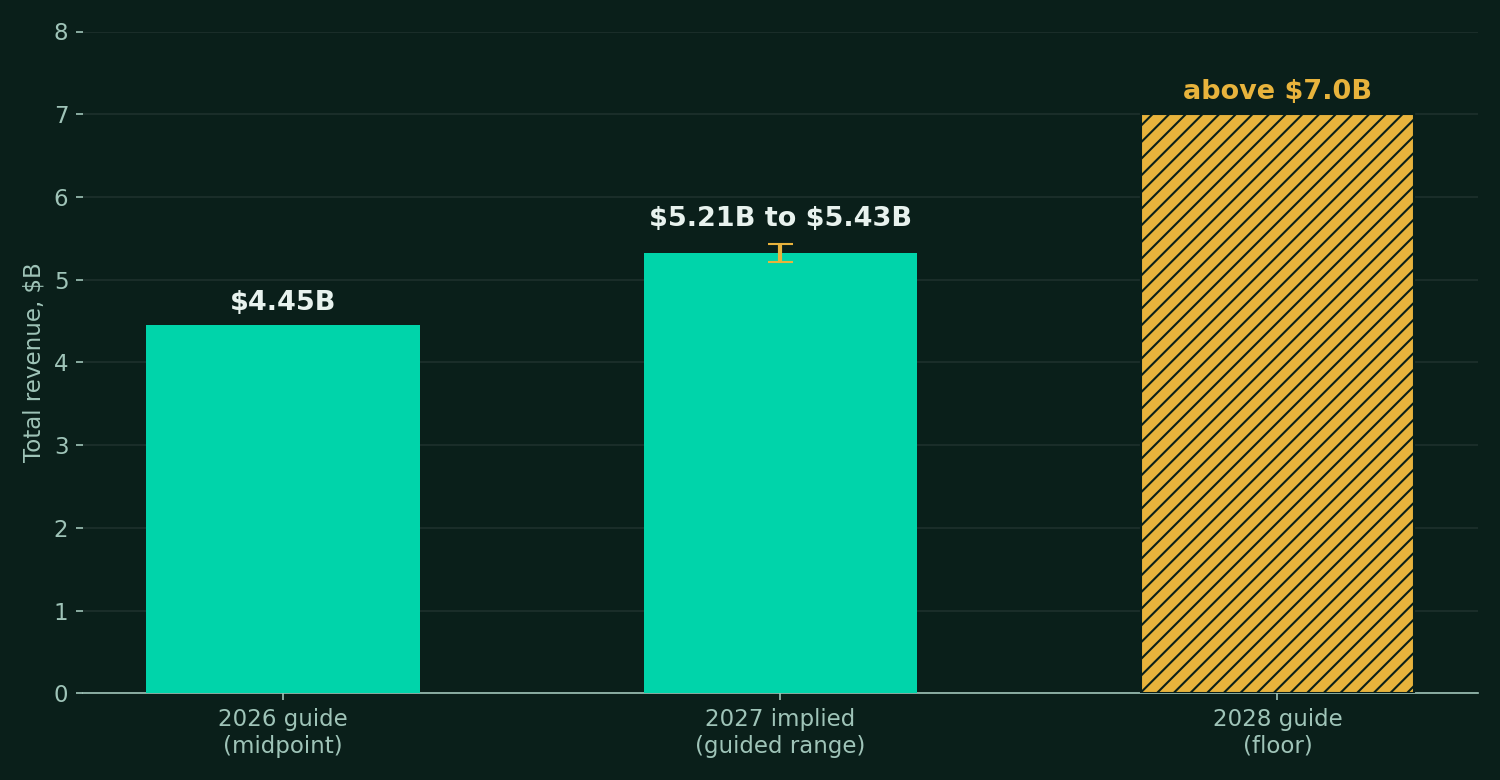
| 6. The full year guide | FY2026 revenue guide of $4.445B to $4.530B held or raised, with 2027 color pointing to CIS-led acceleration | The 2026 revenue guide was trimmed to $4.44B to $4.465B on a $30M shift into 2027, and the EPS midpoint eased slightly. The 2027 color over-delivered: growth of 17% to 22% guided, with 2028 revenue above $7.0B | Mixed |
Four passes, one borderline pass, and one mixed grade whose two halves point in opposite directions. The near-term half of Gate 6 failed on its letter: the guide was trimmed, and our scorecard said a cut is a cut. The forward half passed by more than the gate asked for. A low-teens color was the pass condition for 2027; management guided 17% to 22% and dated the ramp. Both halves stay on the record.
What did the call add that the release could not?
The release carried the guide. The call carried the economics. CFO Ed McGowan opened his remarks by addressing the question investors have asked since the Anthropic commitment was announced in September: what do these contracts actually earn? The company posted a returns slide for the full $14B of signed CIS commitments, and walked through it on the call.
| The signed $14B book, at full ramp | Management figure |
|---|---|
| Annual revenue once fully ramped | About $2.2B |
| Adjusted EBITDA margin | About 75% |
| Non-GAAP operating margin | About 30% |
| After-tax internal rate of return | About 13% |
| Average annual adjusted ROIC (non-GAAP) | About 15% |
| Revenue per megawatt of contracted power | About $22M |
The framing around the numbers mattered as much as the numbers. McGowan stressed that these are the returns on the largest-volume, longest-term deals, which carry the lowest unit pricing Akamai will sign. Smaller or shorter commitments price higher, and recent deals are already pricing at a premium to the roughly $22M per megawatt in the earlier ones. CEO Tom Leighton added the structural reasons: Akamai does not sell bare metal, it sells an infrastructure platform of virtual machines, managed Kubernetes, storage, and networking, which produces more revenue per megawatt and per capex dollar than a bare metal contract. Well over 90% of the servers being deployed are CPUs, the same fleet type that runs the security and delivery platform, with useful lives of seven to ten years and contract terms that guarantee revenue across that span.
On execution risk, management gave specifics rather than adjectives. All of the space and power for the $11.6B Anthropic contract is secured and contracted, at sites available across the ramp period. About 70% of the required hardware, memory, and components is secured, including $1.7B of memory and other critical items being purchased in the fourth quarter. The un-ordered remainder sits under a pricing adjustment mechanism, so component price rises do not come out of Akamai's margin. The 2027 CIS ramp is phased at 25% to 30% in the first half and 70% to 75% in the second. Margins trough first: colocation costs land ahead of revenue, straight-line lease accounting adds a non-cash charge, and management estimated one to two points of margin pressure next year, with operating margins bottoming in the first half of 2027 in the mid-20s before EBITDA leverage builds through 2028. On funding, the plan is the existing $4.2B cash balance plus operating cash flow, covering both the CIS build and the 2027 convertible maturity, with measured incremental financing only as a supplement, and a stated goal of holding investment grade, which itself helps win colo space.
Where did the analysts push hardest?
The Q&A was skeptical in a specific way: not about demand, but about whether this management team has earned the right to be believed on compute. James Fish of Piper Sandler put it plainly, noting that Akamai has missed or merely met its compute numbers in nearly every quarter it has reported the business, and asking why a target this far above expectations should be credited now. McGowan's answer was a checklist rather than a promise: the contracts are signed, the power is secured, the majority of the equipment is in hand with the rest covered by the pricing mechanism, and the guided range is built on signed deals only, with the low end already assuming further delays of the kind just experienced. No unsigned deal sits inside the 2027 range.
The second push was on unit economics. Param Singh of Oppenheimer argued that revenue per dollar of capex still looks light against hyperscalers and some neocloud contracts. McGowan's rebuttal was that the comparison mixes unlike things: short-term GPU rental pricing against a seven-year CPU commitment at maximum volume, which is by construction the cheapest capacity Akamai sells. John DiFucci of Guggenheim pressed on execution risk outside Akamai's control, and Leighton's answer leaned on the architecture: many small permitted sites rather than a few giant ones, power already contracted, and no exposure to the permitting fights around frontier training campuses. Peter Levine of Evercore ISI extracted the night's most useful concession, that Anthropic, as the largest and longest commitment, received the most favorable pricing in the book, which makes its return the floor rather than the average. Rudy Kessinger of D.A. Davidson closed the loop: pipeline deals of a few hundred million dollars, McGowan said, carry IRRs significantly higher than the blended 13%, and the company is walking away from deals that miss its return threshold.
Two smaller items deserve a line each. Leighton said Akamai has already signed very large physical AI contracts, and that sovereign AI fits the distributed platform, which connects the CIS build to the physical AI demand our research has tracked elsewhere. And McGowan noted, almost in passing, that the Anthropic relationship carries warrants whose value rises with the stock, one reason the additional $9B option is not assumed in any guide. Management also said it does not plan to announce every large CIS transaction from here, so the signed-book total will be updated in the quarterly narrative rather than deal by deal.
What did the three segments actually do?
| Segment | Q3 2026 | Year over year | What drove it |
|---|---|---|---|
| Security | $622M | +9% reported, +10% cc | API Security and Guardicore Segmentation led, with web application firewall demand strong. LayerX, closed a few months ago, is already selling into large enterprises |
| Delivery and other cloud applications | $391M | -3% | Pricing holding better than it has in a long time. Revenue broadly stable across the last four quarters, with the company selective on low-end media deals |
| Cloud Infrastructure Services | $109M | +34% reported, +35% cc | Two of the first three large deals now billing. The third is in final testing and expected to start this quarter |
Security remains the funder of the transition at 55% of revenue, growing at the low edge of double digits. McGowan quantified its cadence on the call: sequential revenue additions of roughly $12M to $13M a quarter, adjusted for the license anomaly in last year's fourth quarter, with API Security early in its penetration and Guardicore still at low penetration in the installed base. Component guidance for 2027 arrives on the February call. Delivery, at 35% of revenue, is shrinking at 3% and stabilizing rather than collapsing, which is all the thesis asks of it. International revenue was $563M, half the total, up 7% as reported and 9% in constant currency. CIS is still only about 10% of revenue. That is precisely the gap the 2027 guide has to close.
How big is the fourth quarter capex mountain?
Very big, and worth staring at without flinching. Fourth quarter capex is guided at $2.445B to $2.645B, against $464M spent in the third quarter. The single largest piece is the $1.7B pre-purchase of memory and other critical components for the Anthropic build. Full-year 2026 capex lands at $3.462B to $3.662B. Three things keep this from being the unframed spend our Gate 5 warned about. First, the spend is contracted against signed revenue, and its returns are now published. Second, depreciation on the pre-purchased equipment begins only when revenue recognition starts across 2027 and 2028, so the cost and the revenue arrive together. Third, the balance sheet carries it without strain so far: $4.2B of cash and marketable securities at September 30, $433M of operating cash flow in the quarter, and no share repurchases in Q3, with $565M of authorization left after roughly $616M spent buying back about 5 million shares earlier this year. The honest cost is visible in the GAAP lines: GAAP EPS fell 21% to $0.77, GAAP operating income fell 35%, and adjusted EBITDA fell 5%. This is what the build phase looks like on the income statement. The question the next four quarters answer is whether the ramp repays it on schedule.
What did the guide actually change?
| Guide line | Before the print | After the print | Read |
|---|---|---|---|
| FY2026 revenue | $4.445B to $4.530B | $4.44B to $4.465B | Trimmed on the $30M shift |
| FY2026 non-GAAP EPS | $6.40 to $7.05 | $6.47 to $6.68 | Floor raised, cap cut |
| FY2026 non-GAAP operating margin | 25% to 26% | About 25% | Held at the low end |
| Q4 2026 revenue | Not guided | $1.145B to $1.170B | Below the roughly $1.2B Street mark |
| Q4 2026 non-GAAP EPS | Not guided | $1.50 to $1.70 | Soft against expectations |
| 2027 CIS revenue | Not guided | $1.1B to $1.3B | New. The core of the print |
| 2027 total revenue growth | Low-teens color | +17% to +22% cc | New. Well above prior color |
| 2028 total revenue | Not guided | Above $7.0B | New. Assumes no new Anthropic orders |
The fourth quarter guide is soft on its own terms: revenue of $1.145B to $1.170B against a Street mark near $1.2B, EPS of $1.50 to $1.70, and a non-GAAP operating margin of about 24%, with colocation costs ramping ahead of revenue and a tough license comparison against last year's fourth quarter, which carried an unusually high $18M of security license revenue against a normal $4M to $5M expected this year. The delays behind the softness were described by Leighton as punch-list items at third-party data centers, a couple of months of slippage, since resolved, with no penalties and no change to total contract revenue. That is either a construction footnote or the first page of an execution problem, and the honest position is that Q4 and Q1 deliveries will tell us which. What is not in doubt is the direction of the outer years. McGowan confirmed to UBS that the 2028 target is achievable from signed business alone, with 2028 itself a ramp year, meaning the full $2.2B run rate is not in that year either.
What did the stock do?
Akamai closed the regular session at $77.84, down 9.41% on the day, in a broad tech selloff that hit the whole AI complex before any of these numbers were public. In extended trading after the release and during the call, shares recovered modestly, up about 1.8% to $79.24 as of 7:39 PM ET per MarketBeat, and Barron's characterized the after-hours move as mostly flat. The market's verdict, in other words, was a shrug with a slight positive lean: it neither paid for the 2027 staircase nor punished the 2026 trim. At $77.84 the market capitalization is roughly $11.5B. Against the guide, that is about 11.8 times the FY2026 EPS midpoint of $6.58 and about 1.6 times the 2028 revenue floor of $7.0B, both derived from the closing price and the guided figures. The stock is still priced as a slow-growth delivery company with a cloud option attached. The call argued, with numbers, that the option is now a dated construction project. Friday's session, not Thursday's after-hours, will show how much of that argument the market is willing to underwrite.
Does the 75/100 still stand?
It stands, and it strengthens, with the size of the move capped by what has not happened yet. Graded leg by leg: the conversion leg improved most, because backlog language became billing language for two of the three large deals and a dated range for the third leg of the ramp. The disclosure leg improved with it; a management team that publishes a 13% IRR and a 15% ROIC for its biggest bet is accepting a grade it can be held to. The base-business leg held: security at the line, delivery stabilizing, international at half of revenue. The capital leg is the watch item, with $2.4B to $2.6B of capex in a single quarter, GAAP profitability falling, and a funding plan that leans on operating cash flow arriving as scheduled from 2028. The concentration leg cuts the other way and did not improve: Anthropic is $11.6B of a $14B book, and being the best-priced customer does not reduce what rides on one counterparty.
That mix supports a step up, not a leap. The library proposes 78/100 Positive at the formal research refresh, labeled proposed rather than final. What would rebuild the score further is boring and specific: the third deal billing on time, Q1 2027 CIS revenue tracking the guided phasing, and no second delay headline. What would cut it is the mirror image: another slippage, CIS tracking below the $1.1B low end by mid-2027, or returns evidence that contradicts the published frame. The next checkpoints are close together: the Akamai AI Summit in San Francisco on November 10, where this print is the freshest material in the room, and then the fourth quarter print in February, which carries the first delivery test of the ramp.
Research and opinion, not investment advice. Do your own due diligence before investing.
Frequently asked questions
Did Akamai beat expectations in Q3 2026?
On the two headline lines, yes. Revenue of $1.122B matched the roughly $1.12B consensus, and non-GAAP EPS of $1.77 beat the $1.67 bar by ten cents. The quarter itself was not the story, though. Management trimmed the 2026 revenue guide and used the call to attach dates and published returns to the 2027 ramp.
What did Akamai guide for 2027 and 2028 on the Q3 2026 call?
Management guided 2027 Cloud Infrastructure Services revenue to $1.1B to $1.3B and total revenue growth of 17% to 22% in constant currency, with the ramp weighted 70% to 75% to the second half. For 2028 it guided total revenue above $7.0B, assuming no Anthropic orders beyond the signed $11.6B commitment.
Does the DalalBytes score on Akamai change after Q3 2026?
The library proposes a raise from 75/100 Positive to 78/100 Positive at the formal research refresh, labeled proposed rather than final. The conversion evidence and the published returns framework strengthened the thesis, while the trimmed 2026 guide, the fourth quarter capex spike, and single-customer concentration cap the size of the move.
Disclosures
Not financial advice. This article is published for educational purposes only. Nothing here is a recommendation to buy, sell, or hold any security, and nothing here is financial advice. Investing involves risk, including the possible loss of principal.
Positions. The author is long Akamai Technologies (AKAM). AKAM is an owned position and is researched in the DalalBytes library, most recently in the September 24, 2026 research report graded 75/100 Positive. The author is a former Akamai employee (2013 to 2018). Nothing in this article draws on non-public information from that employment; every figure and quotation here comes from the public release, the public earnings call, or the public sources listed below.
Accuracy. This analysis is built from public sources believed to be reliable, including Akamai's Q3 2026 earnings release via GlobeNewswire, the full Q3 2026 earnings call transcript as published by MarketBeat, the November 1, 2026 pre-print scorecard graded against both, consensus and guidance figures as reported by MarketBeat and Barron's, and regular and extended session prices as reported by Finnhub and MarketBeat. Derived figures are labeled as derived where they appear. Errors can occur and facts change; verify independently before acting on anything you read.
No advisory relationship. Reading this site does not create an advisor-client relationship of any kind. See the full disclosures page.