
The comeback is built and largely in production; what has not arrived is the revenue proof, and that proof now carries dates.
DalalBytes attended Akamai's AI Summit at Oracle Park in San Francisco on November 10, 2026. Vendor summits are usually marketing with catering. This one is worth a report because the company laid out, in public and in unusual technical detail, the whole of its AI cloud: the stack, the security doctrine, the customer problem, and, in a teardown co-taught with NVIDIA, the engineering underneath. The CEO compared AI to the takeoff of the internet, a comparison his company was founded in 1998 to answer the first time. This article reports what was shown, grades what is live against what is labeled future, and lists what the stage never addressed.
Why does hyperscale now mean proximity?
The short version
The summit's one-sentence argument: training concentrates near power, but inference spreads toward people, because agent workflows pay the distance toll at every step.
- A 20-step agent workflow at 200 ms per round trip to a distant region burns 4 seconds of pure network time
- IDC projections presented on the panel run to more than 1B deployed agents by 2029, 217B actions and 3.7T tokens a day; forecasts, not measurements
- Proximity owns interactive inference; batch work that cannot feel 200 ms stays in cheap mega-regions
The framing came from an IDC analyst on the buyers' panel: running AI agents at scale takes inference spread across many places, not a few mega-regions. The strongest number in his deck was not a forecast but an arithmetic fact. A chat call is one round trip, and a 200 ms trip hides inside it. An agent workflow is a chain of sequential steps, and chains multiply latency: 20 steps at 200 ms a hop is 4 full seconds in which no model is thinking and no work is advancing. The user experiences that dead time as a broken product. Move the steps near the user, or near each other, and most of the toll disappears.
The larger figures in the same deck are IDC projections, material prepared for the company's own channels, and should be read as scenario framing rather than evidence: more than a billion actively deployed agents worldwide by 2029, roughly 40 times the 2025 count, executing 217 billion actions and consuming 3.7 trillion tokens a day. The direction, agent load that is wide, spiky and local, is the load-bearing part.
The honest boundary was visible in the deck itself. Training concentrates dense compute near power, and nothing at the summit disputed that. Inference is the workload that spreads, across edge sites and sovereign sites, because its binding constraints are latency, data gravity and jurisdiction rather than raw throughput. The summit's claim on the future is therefore the interactive share of inference: voice, video, personalization, physical AI and agent chains, the workloads a human or a machine is waiting on in real time.
What does the AI cloud stack actually look like?
The short version
Five layers, drawn with the network on top, running over four tiers of compute whose official counts were shown on stage.
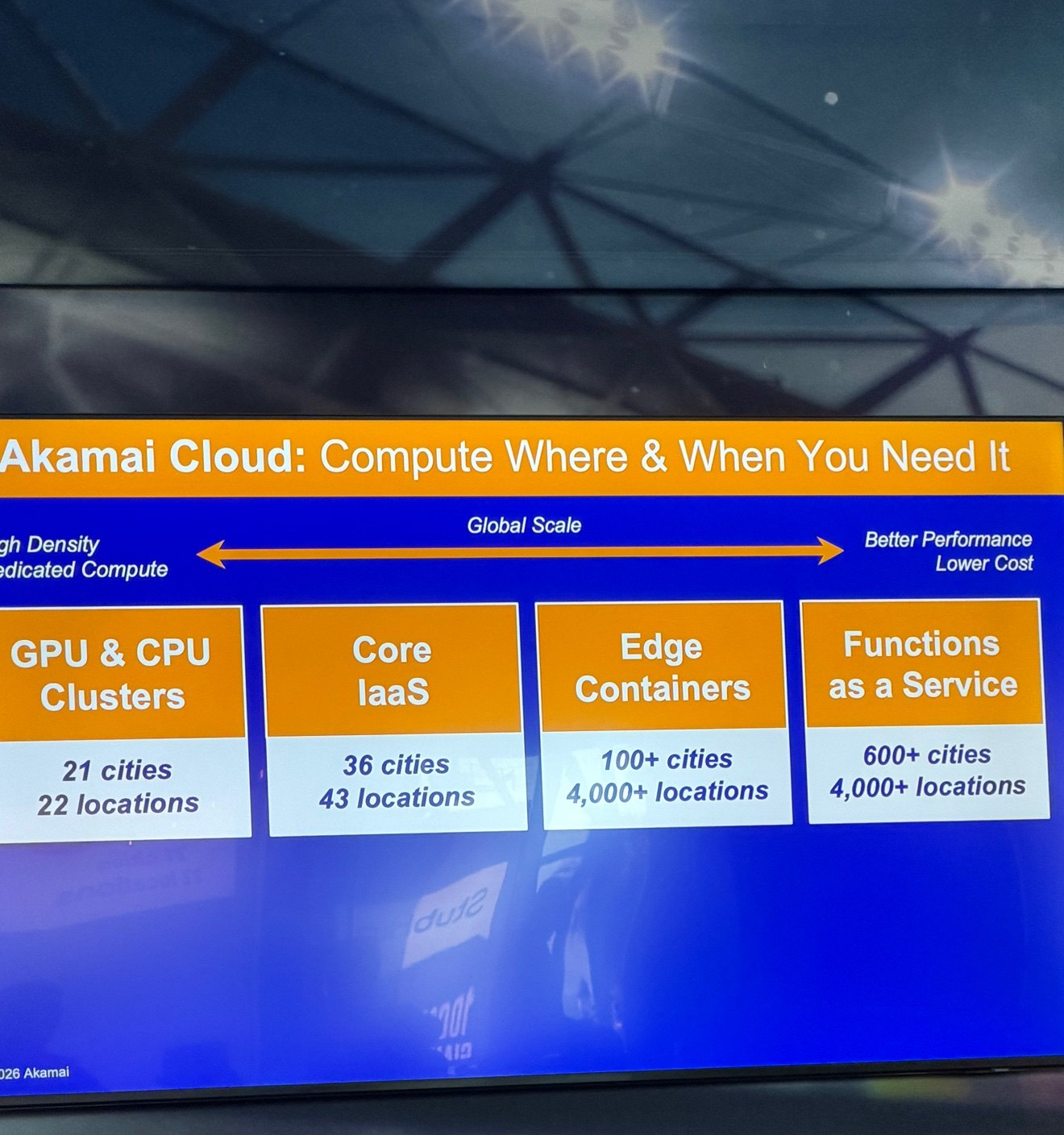
- GPU and CPU clusters sit in 22 locations; the 4,000+ location figure belongs to the two lightest tiers
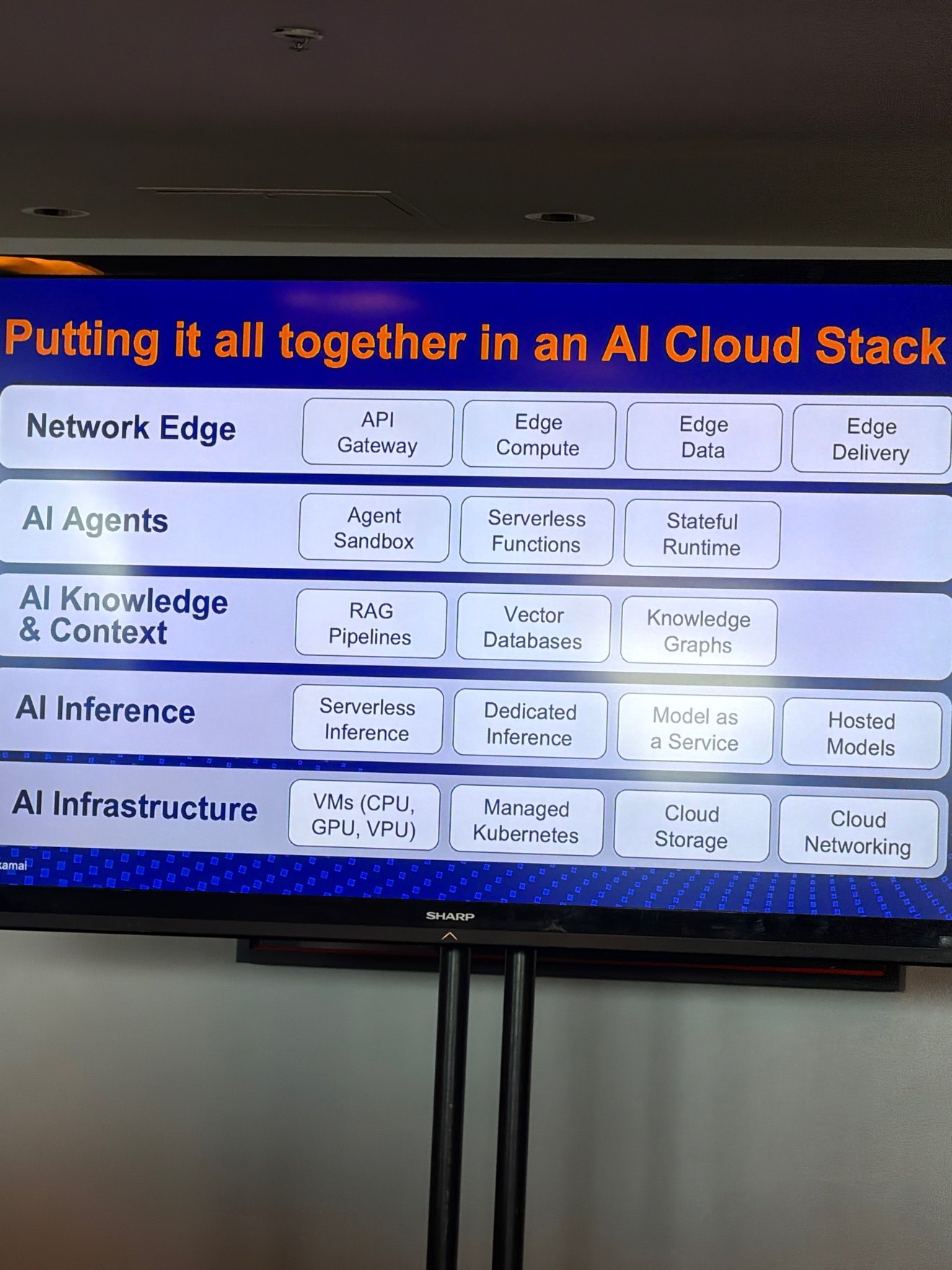
- The capstone slide puts Network Edge above AI Agents, Knowledge and Context, Inference and Infrastructure
- A named orchestration platform is meant to assign every workload across the tiers by cost, capacity and distance
The strategy framing came in three buckets: powering AI with Akamai Cloud, making AI secure, and navigating the age of agents through identification and management. The legacy delivery business was absent from the AI framing entirely. Underneath the buckets sits a four-tier compute pyramid, shown with official counts:
| Tier | Cities | Locations |
|---|---|---|
| GPU & CPU Clusters | 21 | 22 |
| Core IaaS | 36 | 43 |
| Edge Containers | 100+ | 4,000+ |
| Functions as a Service | 600+ | 4,000+ |
Read the pyramid honestly. Heavy compute is concentrated: 22 cluster sites hold the GPUs. The 4,000+ location figure belongs to containers and functions, the light tiers. The bet is that most agent-era work is light, stateful only in small ways, and latency-bound, so a footprint that is thin in most places and deep in a few is the right shape. Whether that shape matches where inference demand actually concentrates is the empirical question the next two years answer.
The capstone slide stacked the products into five layers and placed Network Edge at the top as the customer-facing layer: API gateway, edge compute, edge data and edge delivery. Below it sit AI Agents (agent sandbox, serverless functions, stateful runtime), AI Knowledge and Context (RAG pipelines, vector databases, knowledge graphs), AI Inference (serverless and dedicated inference, model as a service, hosted models) and AI Infrastructure (virtual machines across CPU, GPU and VPU, managed Kubernetes, storage and networking). The cross-tier layer has a name, the Akamai Intelligent AI Orchestration Platform, described as assigning each workload to the resource with the lowest cost, active capacity, and closest position to users and data. Its status is covered in the production section below.
How do you build an agent worth trusting?
The short version
The doctrine session reduced agent trust to four rules, and every rule maps onto a security product the company already sells.
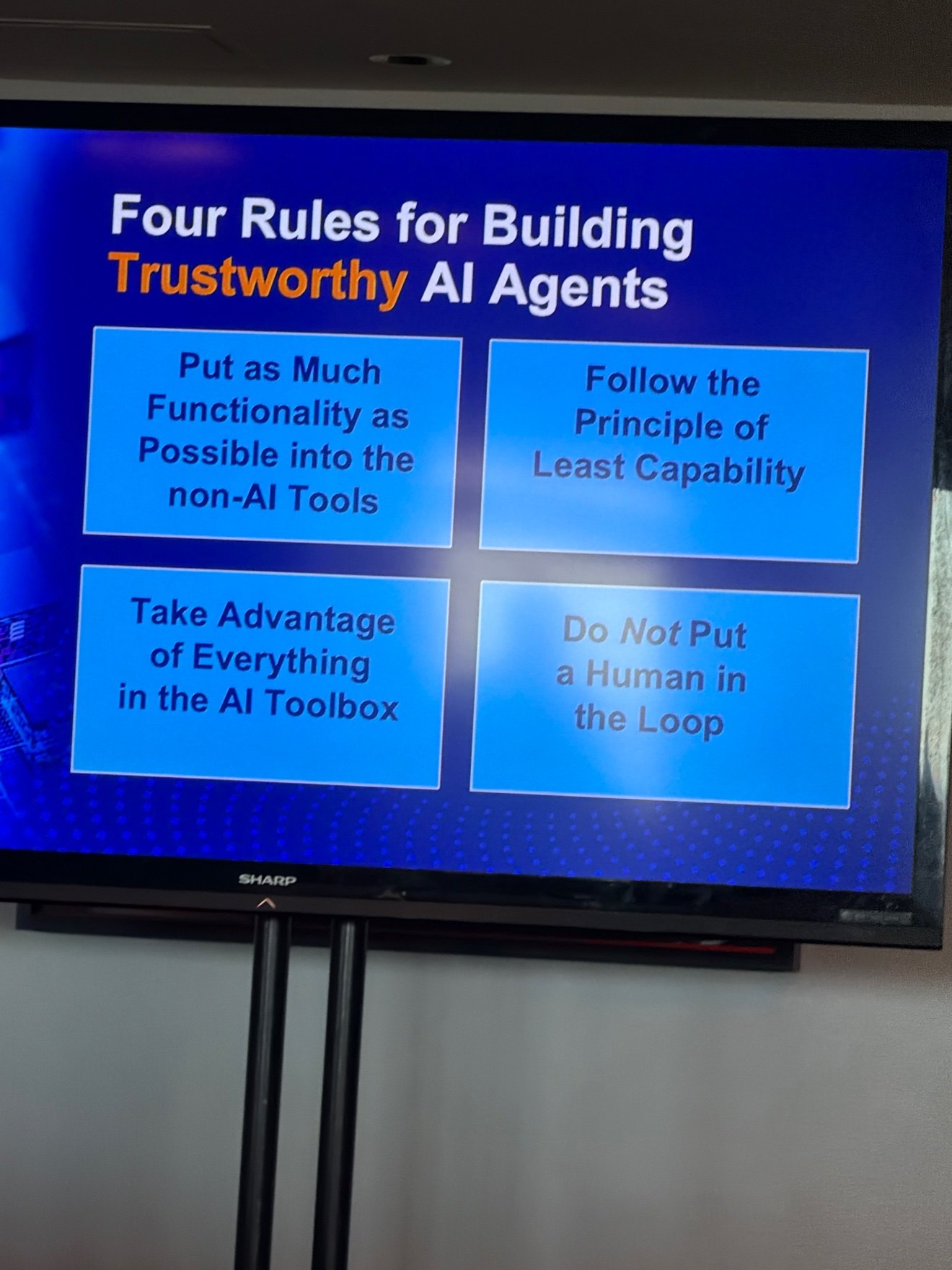
- Push functionality into deterministic non-AI tools, scope capability to the minimum, use the whole AI toolbox, and do not put a human in the loop
- Guardrails inspect both sides of the model, inbound and outbound, because one-sided filtering leaks
- Session data stays inside the selected site, so a compromised agent's blast radius is bounded by construction
The most quotable artifact of the day was a doctrine slide: four rules for building trustworthy AI agents. Put as much functionality as possible into the non-AI tools, because deterministic code cannot be prompt-injected or talked out of its constraints. Follow the principle of least capability, the stricter form of least privilege, with narrow, scoped and revocable permissions instead of broad keys. Take advantage of everything in the AI toolbox, embeddings and classifiers and small models each where they fit, rather than asking one frontier model to do and police everything. And, with the emphasis printed on the slide, do not put a human in the loop: at machine speed and volume, per-action human approval decays into rubber-stamping, so safety has to be architectural, with humans overseeing exceptions and audits instead.
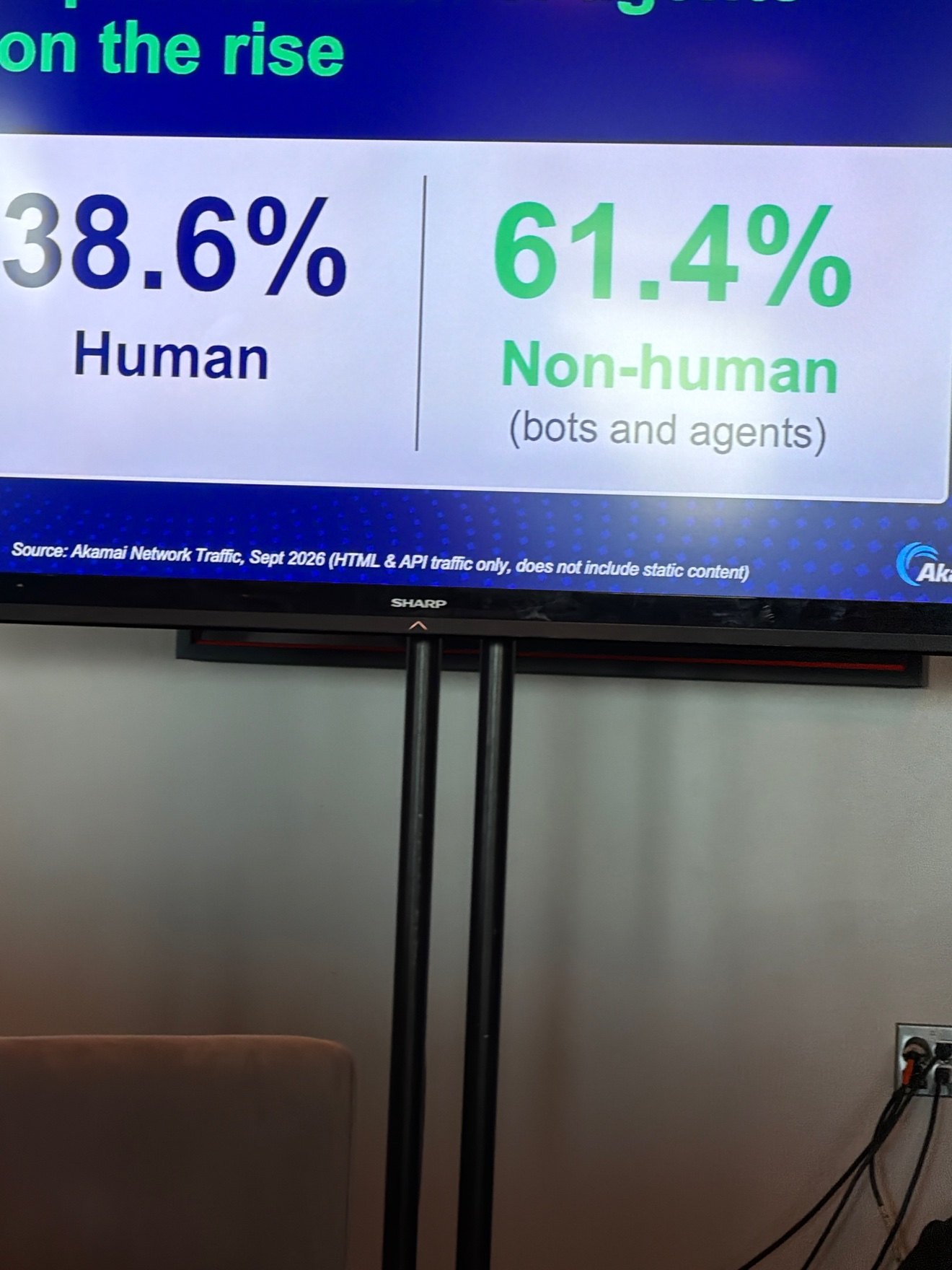
The machinery under the doctrine is automated guardrails, the AI Gateway and Firewall for AI composed together, under the tagline of giving the agent harness a brain. The firewall is positioned to protect exposed AI applications from prompt injection, harmful output and data leakage without rebuilding the app or changing models, and the App and API Protector family carries inspection on both sides of the model: inbound prompts screened for injection and leaked secrets, outbound responses screened for harmful content and data leaving. Around those sit two newer products. Agent Security discovers and governs the agents an enterprise itself runs. Agent Intelligence identifies, validates and engages the agents that arrive from outside, which is bot management grown into agent management. The demand context for that second product is a number from the company's own network: in September 2026 traffic, counting HTML and API requests only, 38.6% of requests were human and 61.4% were non-human, bots and agents combined.
Containment is the doctrine's foundation. In the architecture shown later in the day, a session's data stays inside the boundary of the site selected for it, inside a tenant lane isolated from neighbors. A manipulated agent can therefore only reach what lives inside its own boundary, which bounds the blast radius by geography and tenancy rather than by incident response. That is the design assumption that makes the fourth rule survivable, and it doubles as a data-sovereignty property: data that never leaves the boundary never crosses a jurisdiction.
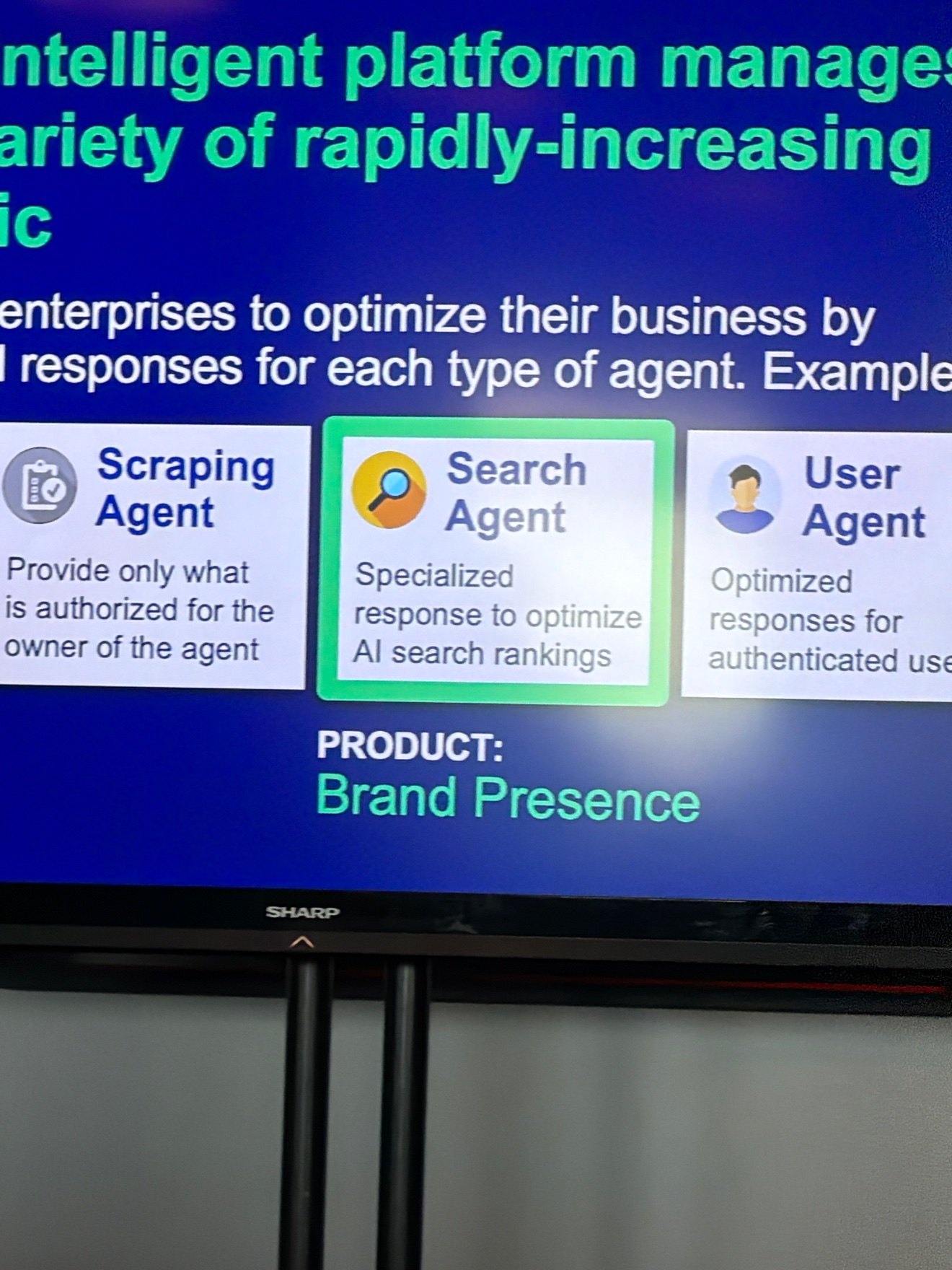
Brand Presence deserves its own paragraph, and a fair one. It is a named product, not a concept: the edge serves tailored responses by agent type. A scraping agent receives only what it is authorized to take. A search agent receives a specialized response designed to optimize AI search rankings, which is answer engine optimization productized. A user agent acting for an authenticated customer receives an optimized response of its own. The commercial logic is real, because the majority of requests are already non-human and the audience for a website increasingly arrives as software. Two open questions ride with it. Serving materially different renditions to different agents sits close to the old cloaking line that search engines once punished, and the norms here are unwritten. And there is no public efficacy data yet: no ranking movement, no conversion deltas, nothing a buyer could grade. The product is genuinely novel. Its evidence file is currently empty.
What did the buyers in the room actually ask for?
The short version
The panel's buyers described a production agent whose top user complaint is speed, and an economics in which outcomes, not tokens, are the scoreboard.
- A major US retailer's AI chief: their own agent and own model shipped, and the No. 1 feedback was too slow
- Agents are benchmarked against the humans they replace, so the latency budget is set by conversation, not by rival clouds
- Speed plus scale plus responsibility is the hard combination, and the combination is where the return lives
The demand-side evidence of the day came from a panel of buyers and operators, and its strongest moment was a scar, not a projection. The AI chief of a major US retailer described building their own customer agent on their own model and shipping it. The number one complaint from real users was not accuracy, not hallucinations, not tone. It was speed. His direction of travel is distribution: the agent kept the brain in-house and needs the ground it runs on to move closer. His excitement, by contrast, was personalization: tailoring the retailer's storefront in real time, which only works if inference happens where the page is already served. Retailers' traffic, as the host noted in a later session, already lands on this edge, which makes the inference conversation an expansion inside existing accounts rather than a cold displacement.
A startup founder on the same panel named the benchmark that makes speed non-negotiable: a customer agent is never compared with other software, it is compared with the human it replaces, and humans answer inside a fraction of a second. The panel's shared diagnosis was a trilemma: speed without scale is a demo, scale without responsibility is a liability, and getting all three at once is the actual difficulty, with the return on investment located in the combination rather than in any single leg. Underneath sat an economics the panel called the foundation, tokenomics: every deployment reduces to tokens per completed task and cost per token, which is why the follow-up question, posed by the same founder, was how to ensure value: evaluation before deployment, per-action cost tracing, and budgets with circuit breakers per agent.
The retailer's KPI discipline closed the loop: his organization scores the agent on the customer outcome, not on tokens, uptime or even latency, and the panel's services line followed from it, that services which delight the customer are the escape from a race to the bottom on raw compute. The host's own CIO supplied the organizational half: deployers tied at the hip with the people function, so transformation lands at org level rather than as a technology rollout; a named role watching how the tools are actually used and asking whether the company can go faster; a workforce spread along a ladder from training, to taking advantage of the tools, to amplifying work; and an endpoint where agents become the interface to enterprise systems, so people stop logging in to bad interfaces and the systems of record become tools behind the agent. Her timeline for that endpoint, about a year, is summit-optimistic. The direction is the credible part.
What did the NVIDIA teardown show under the hood?
The short version
An architecture teardown co-taught with NVIDIA's DSX ecosystem team reduced the orchestration story to placement: pick the right site once, pin the session, and spend the whole latency budget on work.
- Sessions are placed across candidate GPU sites on readiness, capacity, latency, cost, site health and security posture, then pinned
- KV cache is the physical reason sessions cannot wander: the state is large, grows every turn, and lives where the session started
- NVIDIA's own agent framework, NemoClaw, was cited as deployed securely on Akamai end to end
The teardown, a walk-through of a retail voice workload co-presented with the director of NVIDIA's DSX ecosystems group, began from the workload rather than the hardware: understand what the workload is, its chained stages, session state and latency budget, and the infrastructure follows. The NVIDIA side supplied the day's bluntest framing of the moat question. CPUs, GPUs and wires do not make a cloud; AWS, Google Cloud and Akamai were named in one breath as companies that spent decades building the stack above the metal. He added that inference has to be tiered or the network itself cannot carry the aggregate load, that a GPU failure in inference is a customer event under an SLA where in training it is only a checkpoint and lost hours, and that NVIDIA is not a security company, so it works with the best security companies, naming Akamai, for that layer. The calibration belongs in print: NVIDIA sells silicon into every architecture and profits from durable platforms, so the endorsement is ecosystem work. It is also, on the merits, correct.
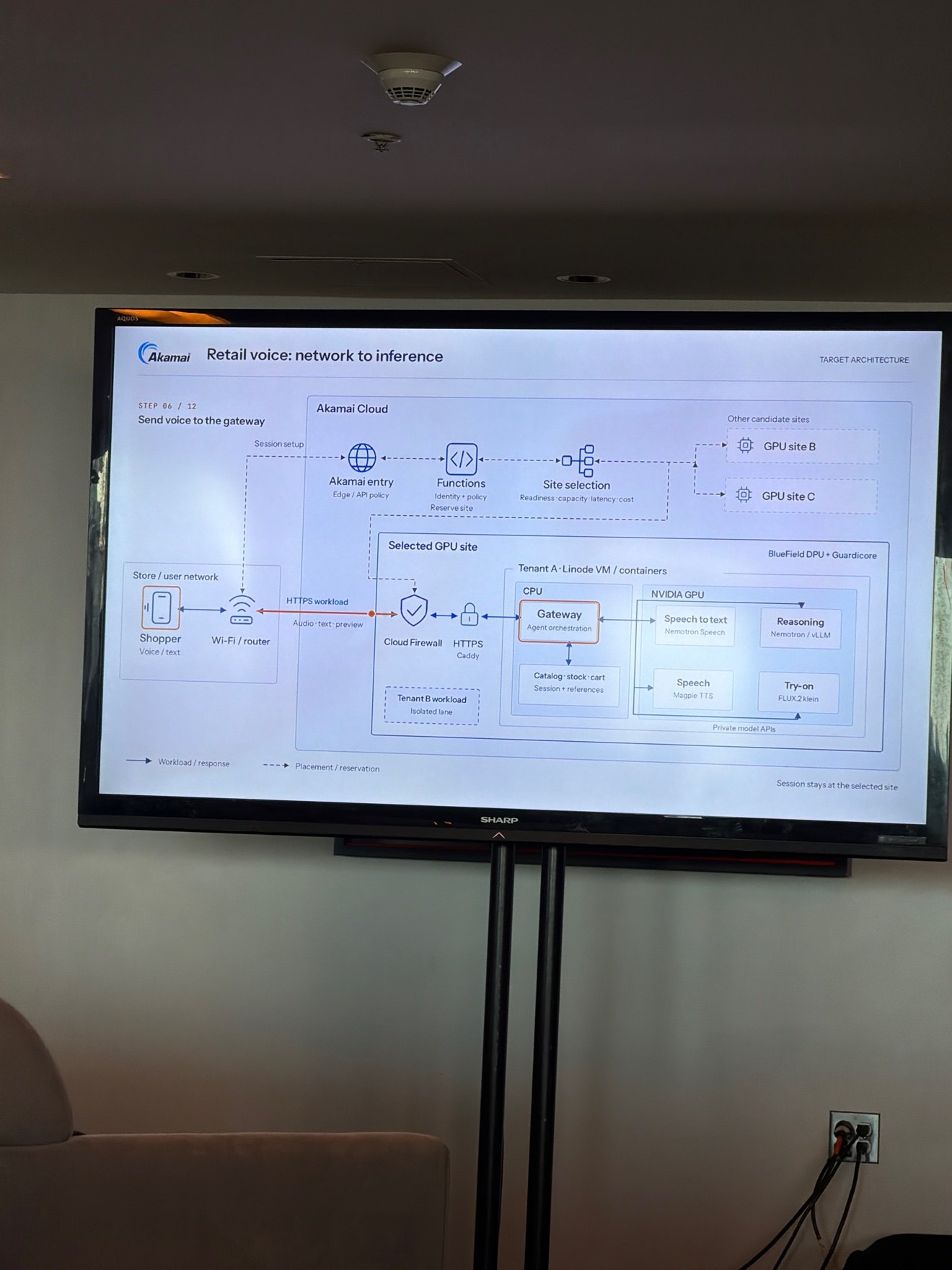
Inside the selected site, the design is specific. A cloud firewall and tenant isolation, hardware offload on the DPU so isolation does not tax the host, and a second tenant in an isolated lane. The model stack is openly plural: speech recognition, reasoning on an open inference engine, speech synthesis and a small image model for try-on, with model choice made per site, since a flagship GPU site and a light site cannot host the same model. Placement is a per-workload decision, closest site for what a human is waiting on, cheapest for what nobody feels, and because the session is pinned, none of its latency budget goes to routing after setup.
Two details deserve emphasis. The first is KV cache, the memory a model accumulates about a conversation, which grows with every turn and decides how many live sessions a GPU can hold. It is welded to the session that created it, which is why the architecture pins sessions instead of migrating them, and why shared context, like a store catalog grounding, is valuable: computed once, reused across thousands of sessions at one site. The second is a named instance: NVIDIA's NemoClaw, its agent framework on the NeMo ecosystem, was cited on stage as deployed by Akamai securely, end to end. The scope of that deployment, reference, demonstration or production customer, was not stated, and the distinction matters for grading it. The session closed with a claim worth recording as a claim: next-generation inference is distributed, at cloud-like performance. The demos support that for small-model, multi-modal work at one site. Frontier-scale reasoning at the same standard across a fleet is the unproven stretch.
How much of this is live today?
The company's position, stated plainly at the event, is that most of what the summit showed is in production and used by customers. Public anchors support a good part of that: the inference service and the agent sandbox were launched on October 27, 2026, a fortnight before the summit, and the security products attach to a security segment that reported $622M of revenue in Q3. The teardown diagram is labeled target architecture, so the honest reading is a reference design whose components are largely live and whose full composition is still being assembled.
Two items carry their own honest labels, and the labels matter more than the marketing around them. Semantic caching, flagged in our Efficiency Wave article as this network's sharpest potential edge, is early-stage: the company is iterating on it with customer feedback, and no hit-rate metrics have been published by anyone. The contrast with Cloudflare narrows accordingly, from shipped versus planned to early versus planned: Cloudflare's gateway caching is exact-match today with semantic caching still labeled planned in its own documentation, as our head-to-head comparison records. And the orchestration platform, the layer that would turn four tiers into one fluid system, is described in small print on its own slide as in active development. A wider rollout of the new inference stack was signaled for January 2027, the first dated checkpoint, landing just ahead of the February earnings call.
What was missing from the stage?
A landscape report owes its reader the gaps, and a full day on tokenomics produced several worth listing.
No pricing, anywhere. Not one rate, cost-per-token comparison or customer before-and-after figure appeared all day. The thesis claims a cost and latency advantage; only the latency half received evidence. No new demand artifacts. No new customer logo, spend figure or production conversion was announced; the strongest demand evidence remains the previously disclosed commitments book, $14B in total with the Anthropic agreement at $11.6B of it. No competitor was named. Not the other global edge network, not a hyperscaler edge offering, not a neocloud, so the why-not-them question was never put to the home team. No financial voice. No guidance was reiterated, no capex discipline discussed, and the guide items the stock trades on went unaddressed. The sizing splits stayed closed. The agent share inside the 61.4% non-human traffic figure was never broken out, no semantic caching metrics exist, and Brand Presence has no efficacy data. Finally, the bridge went unbuilt: the strategy framing omits the delivery business, shrinking at about 3% a year, and nobody quantified the growth needed to offset it.
What does the summit change for the Akamai thesis?
The short version
The architecture and ecosystem leg of the thesis strengthened materially in one day. The demand leg is untouched, and it still grades on dated checkpoints rather than on summit evidence.
- A complete stack, a doctrine that generates products, and NVIDIA publicly slotting Akamai as its distribution and security layer
- Most of the shown stack is in production per the company, with semantic caching and orchestration honestly labeled early
- At the November 6 close of $83.09 the stock traded near 2.7x guided fiscal 2026 sales, pricing the signed book at close to zero
Start with what genuinely improved. Before the summit, the distributed inference case rested on a footprint, a contract book and a set of product announcements. It now also rests on a coherent internal logic that held up under a full day of scrutiny: physics that forces tiering, a placement architecture that spends no latency on routing, a security doctrine whose rules generate the products rather than decorate them, and the silicon platform owner publicly assigning the distribution and security layer to this company rather than to a GPU landlord. A bare-metal neocloud sells capacity and price. What was shown at Oracle Park is an operating system around capacity, and assembling it is measured in decades, which is precisely the asset the market has been pricing as legacy.
What did not change is the leg the thesis actually breaks on. The summit could not and did not prove demand at scale: no paying production inference customer with numbers, no pricing, no supply update on the large contracted build whose first services are scheduled for late Q2 2027. Our Q3 earnings coverage, Akamai Put a Return on the $14 Billion, set out the financial frame the summit leaves untouched: revenue guided to grow 17% to 22% in 2027, cloud infrastructure revenue guided to $1.1B to $1.3B for 2027 against a roughly $436M annualized run rate in Q3, and a fourth-quarter capex guide of $2.445B to $2.645B that will be graded in February. The summit upgraded confidence in the plan's coherence. Execution remains the open variable, exactly where it was before the doors opened.
What to watch, with dates
January 2027: the wider inference rollout, and whether wider means regions, models or general availability. February 2027, the Q4 call: capex against the $2.445B to $2.645B guide, security segment growth as the tell for AI product attach, and cloud infrastructure commentary against the 2027 guide. Through 2027: the orchestration platform reaching general availability with a named cross-tier production customer, trials converting to production at marquee accounts, the agent share inside non-human traffic getting its first public split, and any published caching metrics from either edge network. What would change this read: a January rollout that slips or shrinks, or a February print that trades the guide for the story.
The day in one line. In 1998 the problem was content too far from the user; in 2026 it is intelligence too far from the user, and the company built for the first problem spent a day arguing, with unusual engineering candor, that it owns the scarce asset for the second.
Frequently asked questions
What was the Akamai AI Summit's central claim?
That hyperscale now means proximity, not size. Agent workflows chain many steps together, so distance to a distant region is paid again at every step: a 20-step workflow at 200 milliseconds a hop burns 4 seconds on geography alone. Inference therefore spreads across many places near users, while training stays concentrated near power.
Is the Akamai AI stack actually in production?
The company says most of what the summit showed is in production and used by customers. Two honest exceptions carry labels: semantic caching is early-stage and being iterated on customer feedback, and the cross-tier orchestration platform is still described on its own slide as in active development.
What would prove the distributed inference case wrong?
The checkpoints are dated. A January rollout that slips or shrinks; a February earnings call where fourth-quarter capex misses the guided range or security growth stalls; cloud infrastructure revenue tracking below the guided path for 2027; and orchestration that never reaches general availability with a named cross-tier production customer.
Disclosures
Not financial advice. This article is published for educational purposes only. Nothing here is a recommendation to buy, sell, or hold any security, and nothing here is financial advice. Investing involves risk, including the possible loss of principal.
Positions. The author holds a long position in Akamai, discussed in this article. The author holds no position in Cloudflare or NVIDIA.
Accuracy. Summit material is from Akamai's public AI Summit at Oracle Park, San Francisco, on November 10, 2026, attended by the author; slide figures, including the four compute tiers and the September 2026 traffic split, are the company's as presented. The agent, action and token figures are IDC forecasts presented at the event and are projections, not measurements. Company financials and guidance are from Akamai's Q3 2026 earnings release and call. The share price and the sales multiple are as of the November 6, 2026 close. Errors can occur and facts change; verify independently before acting on anything you read.
No advisory relationship. Reading this site does not create an advisor-client relationship of any kind. See the full disclosures page.