
Where does QNX sit in the physical AI stack?
The short version
Every autonomous machine splits into a layer that thinks and a layer that acts. QNX sells the layer that acts, and that layer must be certified.
- The cognitive layer runs neural networks and path planning and is allowed to be probabilistic.
- The deterministic layer drives motors, brakes, and steering, and is certified to ISO 26262 ASIL-D and IEC 61508 SIL 3.
- QNX technology is embedded in more than 275 million vehicles, and NVIDIA builds QNX OS for Safety into both its DRIVE Thor car platform and its IGX Thor robotics platform.
- This article values that position for 2030 from the company's own disclosed numbers, segment by segment.
Start with the architecture, because the architecture is the business. A robotaxi, a humanoid robot, and a software-defined truck all contain the same split. On top sits a cognitive layer: perception models, vision and language models, mapping, and planning. It runs on Linux and accelerated compute, it is retrained constantly, and it is probabilistic by design, which is acceptable because its outputs are proposals. Underneath sits a deterministic layer: the code that turns proposals into torque, braking pressure, steering angle, and balance corrections, on deadlines measured in microseconds. That layer cannot be probabilistic and cannot be late. Regulators certify it to functional safety standards, ASIL-D for passenger vehicles and SIL 3 for industrial systems, and the certification attaches to a small, auditable, real-time operating system, not to a 30 million line general purpose kernel. BlackBerry QNX is the most widely deployed such system in the world.
The Brain: the cognitive layer
Foundation models, perception, SLAM, and path planning. Data heavy and dynamic. Runs on Linux, ROS 2, and accelerated compute from NVIDIA and others. Probabilistic by design.
The Spine: the deterministic layer, where QNX sits
Motor control, torque distribution, drive-by-wire steering, emergency braking, and balance loops. Hard real time and pre-certified to ASIL-D and SIL 3. The layer a machine cannot legally be sold without.
The position shows up in the current numbers. QNX revenue hit a record $80.3 million in the second quarter of fiscal 2027, up 27 percent year over year, at a segment gross margin of 87 percent and a segment EBITDA margin of 36 percent. Full year guidance stands at $315 million to $325 million of QNX revenue within total company revenue of $616 million to $636 million. The rest of the company is not trivial either: Secure Communications produced $258.9 million in fiscal 2026, the patent estate produced a $22.1 million quarter in Q2 of fiscal 2027, and the balance sheet holds $447.1 million of cash and investments against a single $200 million convertible issue. A serious 2030 case has to count all of it, on if-converted shares of 638.5 million, with corporate costs subtracted and the result discounted back to today. That is what follows.
| Segment | FY2026 revenue | FY2026 EBITDA | FY2027 guide revenue | FY2027 guide EBITDA |
|---|---|---|---|---|
| QNX | $268.0M | $71.0M | $315M to $325M | $95M to $105M |
| Secure Communications | $258.9M | $56.1M | $260M to $270M | $50M to $58M |
| Licensing | $22.2M | $21.0M | about $41M | about $36M |
| Corporate and total | $549.1M total | about $105M total | $616M to $636M | $141M to $158M |
What does the backlog raise actually tell us?
The short version
The backlog rose $250 million in two quarters while royalties were being paid out of it. The gross design win pace behind that net figure is the real story.
- Backlog is a stock, not a flow: estimated future royalties from secured design wins, recognised as programs enter production.
- Net growth of more than $250 million plus roughly $85 million of royalties recognised in the same half implies gross design wins above $335 million in six months.
- Management confirmed first half design win dollars exceeded the previous record for any full fiscal year.
- New contracts increasingly carry minimum volume commitments instead of forecasts, which raises the quality of each backlog dollar.
On October 20, 2026, BlackBerry announced that the QNX royalty backlog had exceeded $1.2 billion, up more than $250 million, or more than 26 percent, from about $950 million at the end of fiscal 2026. The company defines backlog as estimated future revenue from forecasted royalties, based on royalty rates and projected production volumes over the life of each design, and it warns the figure may not match actual future revenue. Read it as what it is: a warehouse of secured future royalties, stocked by design wins and emptied by production.
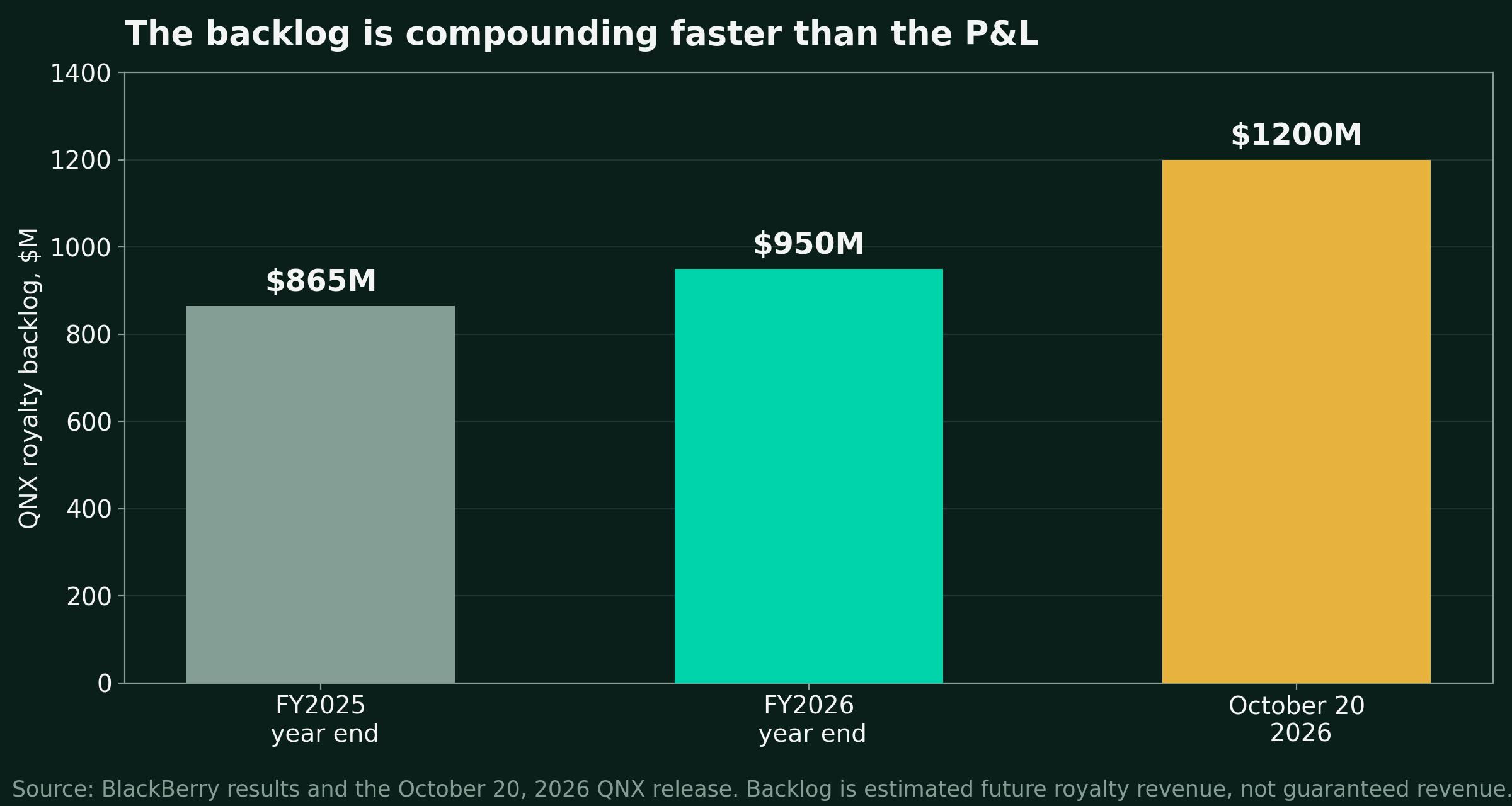
The net increase understates the win rate, because the warehouse was being emptied at the same time. Royalties recognised in the first half of fiscal 2027 were roughly $85 million on our estimate, the largest component of the $152 million of QNX revenue reported across the two quarters. For the stock to rise by more than $250 million while about $85 million flowed out, gross design win additions must have exceeded $335 million in six months, a pace above $670 million a year. Management's own framing matches that arithmetic: design win dollars secured in the first half of fiscal 2027 already exceeded the previous record for any full fiscal year, and the second quarter was the strongest design win quarter in the company's history. Two quality upgrades ride with the quantity. First, the growth was broad: SDP 8.0 automotive wins, the first Alloy Kore award, and general embedded design wins across robotics, industrial automation, and medical devices all contributed. Second, for new commercial arrangements BlackBerry is increasingly securing minimum contractual volume commitments rather than non-contractual forecasts, and it says this can bring cash and some revenue recognition earlier. A backlog dollar backed by a committed minimum is worth more than a backlog dollar backed by a customer's spreadsheet.
What does a $1.2 billion backlog support? Spread over typical design lives, it underwrites a royalty run rate well above the roughly $170 million annual pace embedded in fiscal 2027 numbers, and it does so before any further design wins. The conversion lag is the honest caveat: design wins take two to four years to reach production, so the October backlog mostly funds fiscal 2029, 2030, and 2031 royalties, not next quarter's. That timing is exactly why a 2030 model is the right lens for this company now. The question the backlog cannot answer is price: how many dollars per vehicle the future programs carry. For that, there is now one very large data point.
What is Alloy Kore worth per vehicle?
The short version
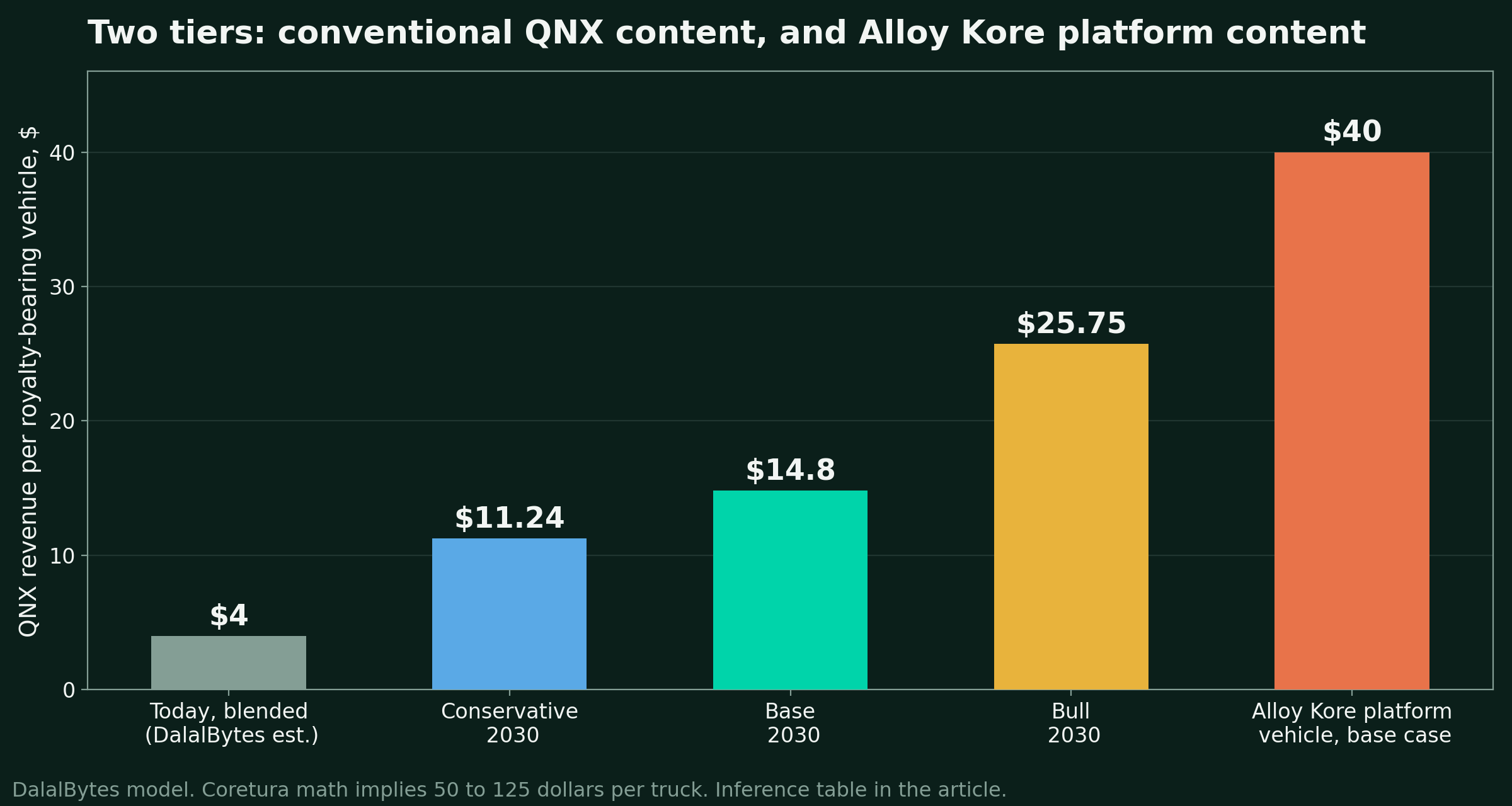
Coretura's deal is worth more than $100 million on truck volumes a fraction of car volumes. The arithmetic implies $50 to $125 of QNX revenue per truck, an order of magnitude above a cluster royalty.
- Coretura is the Daimler Truck and Volvo Group joint venture building one software-defined platform for heavy commercial vehicles. The two parents sold about 625,000 trucks and buses combined in 2025.
- Management states the ASP per instance on this deal is approximately three times the customer's current QNX operating system deployment, across multiple software domains per vehicle.
- At platform volumes of 100,000 to 250,000 trucks a year over an eight year design life, more than $100 million of royalties implies $50 to $125 per truck.
- Our model therefore prices vehicles in two tiers: conventional QNX content, and Alloy Kore platform content at $30 to $55 per passenger vehicle, with commercial vehicles at the top of the range.
In September 2026, Coretura selected Alloy Kore, the pre-integrated QNX and Vector foundational software platform, as the base for its next-generation high-performance compute architecture. Coretura matters out of proportion to its size because of who owns it: Daimler Truck and Volvo Group, two of the largest commercial vehicle makers in the world, building a single shared software-defined platform intended to become an industry standard, with first products in vehicles by the end of the decade. Daimler Truck sold 422,510 trucks and buses in 2025 and Volvo Group delivered 202,911 trucks, about 625,000 vehicles combined, heavily weighted to heavy-duty trucks. BlackBerry values the future royalties from this single design win at more than $100 million, the largest in QNX history, and management volunteered the two facts that let us price it: annual commercial vehicle volumes are significantly smaller than passenger car volumes, and the ASP per instance on this deal is approximately three times the customer's current QNX operating system deployment, with Alloy Kore deployed across multiple software domains in each vehicle.
Now do the division the announcement invites. A heavy truck platform produces for roughly eight to ten years. The Coretura platform will not cover every vehicle its parents sell: it targets the next-generation heavy-duty architectures, phased in from the end of the decade, and both parents also sell medium-duty, light-duty, and bus lines outside its scope. A reasonable maturity band is 100,000 to 250,000 platform vehicles a year. Divide the royalty floor of $100 million, remembering the deal is worth more than that, by the vehicle count under each assumption:
| Platform volume per year | Vehicles over 8 years | Implied royalties per vehicle | Vehicles over 10 years | Implied royalties per vehicle |
|---|---|---|---|---|
| 75,000 | 600,000 | $167 | 750,000 | $133 |
| 100,000 | 800,000 | $125 | 1,000,000 | $100 |
| 150,000 | 1,200,000 | $83 | 1,500,000 | $67 |
| 200,000 | 1,600,000 | $63 | 2,000,000 | $50 |
| 250,000 | 2,000,000 | $50 | 2,500,000 | $40 |
Every cell in that grid sits far above the economics the market usually assigns to QNX. The centre of the grid, platform volumes of 150,000 to 200,000 a year, implies roughly $50 to $85 per truck. The cross-checks agree. An ASP per instance at three times a conventional operating system deployment, multiplied across several domains in one vehicle, lands in the same range. And the internal consistency check runs the other way: if Alloy Kore were worth only $15 a vehicle, a $100 million deal would require more than 6.6 million trucks, roughly ten years of both parents' entire output on one platform, which contradicts everything disclosed about the program's scope. The honest conclusion is that platform deals reprice QNX content per vehicle by an order of magnitude relative to a digital cluster, and that commercial vehicles, with high vehicle prices, long service lives, and fleet buyers who pay for uptime software, carry the richest version of that pricing.
Passenger cars will not pay truck prices. Volumes are larger, model cycles are shorter, and carmakers negotiate harder. We translate the Coretura evidence into passenger platform pricing of $35 in the conservative case, $40 in the base case, and $55 in the bull case per Alloy Kore vehicle, against conventional QNX content of $8.00, $8.50, and $10.00 as multi-instance conventional deployments grow. What changes across the cases is mostly the mix: Alloy Kore vehicles are 12 percent of QNX royalty-bearing vehicles in the conservative case, 20 percent in the base case, and 35 percent in the bull case by 2030, which is a statement about how fast a platform whose first products arrive at the end of the decade can spread, and about how many of the global OEM and Tier 1 Alloy Kore engagements management describes, concentrated in Europe and Asia, convert into signed programs in time for 2030 production.
| Auto royalty driver | Conservative | Base | Bull |
|---|---|---|---|
| Global production | 90M | 92M | 95M |
| Centralized architecture share | 65% | 75% | 85% |
| QNX share of centralized | 58% | 60% | 68% |
| Royalty-bearing vehicles | 33.9M | 41.4M | 54.9M |
| Alloy Kore share of those vehicles | 12% | 20% | 35% |
| Blended revenue per vehicle | $11.24 | $14.80 | $25.75 |
| Auto royalty revenue | $381M | $613M | $1,414M |
Two risks belong in this section rather than a footnote. First, timing: Coretura's first products reach vehicles by the end of the decade, so nearly all of its $100 million plus lands in the 2030s, and the passenger Alloy Kore wins that drive the 2030 mix in this model must be signed in the next several quarters to produce by 2030. Management says potential further wins could come in coming quarters; until they are announced, the base case mix is an informed extrapolation, not a secured fact. Second, substitution: QNX is the certified default in these architectures, not the only conceivable option, and safety-focused Linux efforts continue to work through certification grades. A certified safety Linux carrying a major centralized platform would compress both QNX share and platform pricing at once. Neither risk is in the price of the deal Coretura already signed; both are in the price of the ones that have not been signed yet.
What do the other parts of BlackBerry contribute?
The short version
Secure Communications is a second business the size of QNX with a retention problem to fix. The patents pay a capped annuity. Arctic Wolf is a real option worth about $44 million today.
- Secure Communications: $258.9 million of fiscal 2026 revenue, $221 million of ARR growing 4 percent, and 91 percent net retention leaking about 9 percent of the base a year.
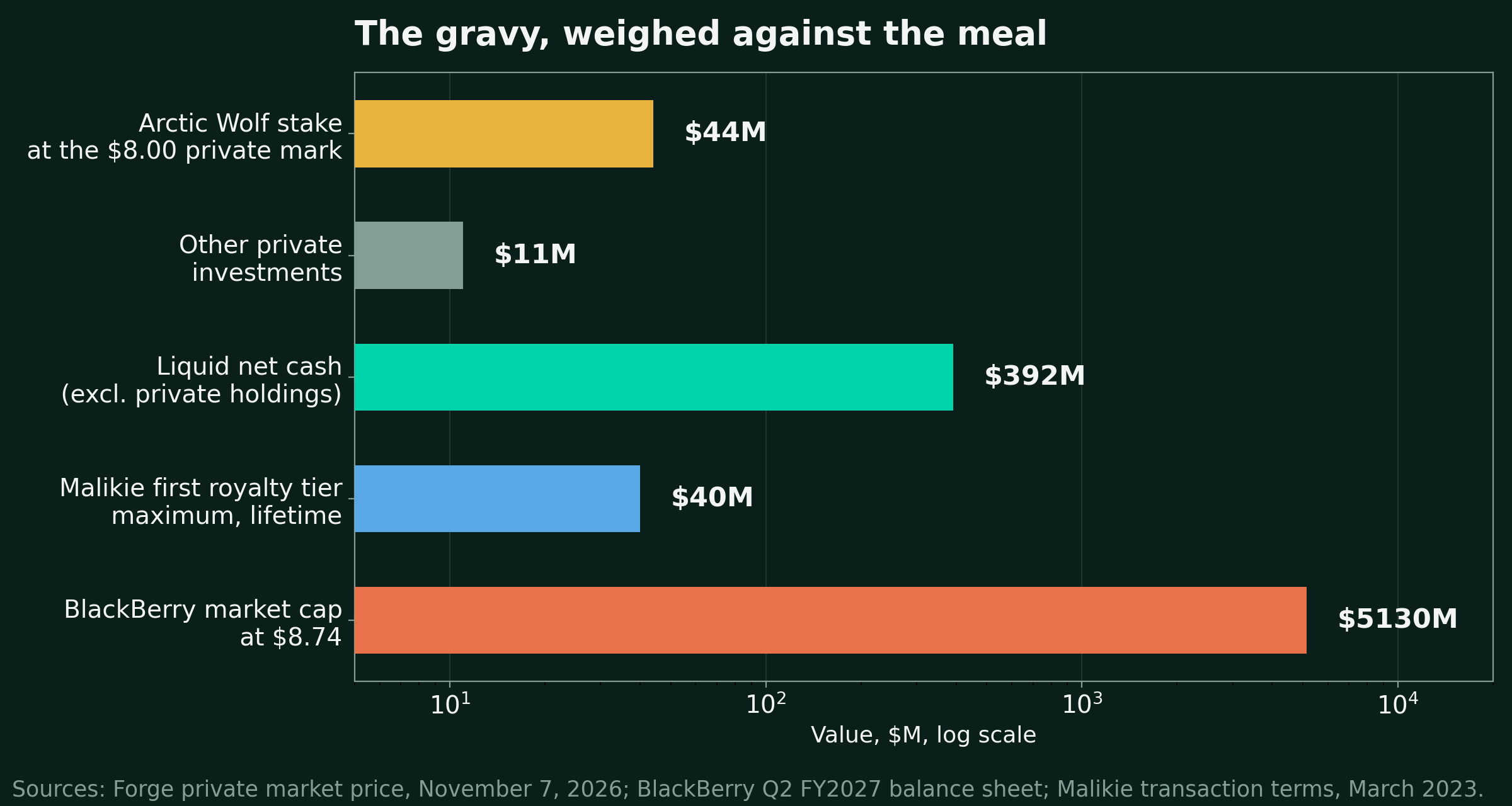
- Patents: the Malikie royalty stream is capped at $700 million over its life and the first tier pays at most $40 million in total. The retained families and existing agreements are the producing asset, worth a $22.1 million quarter in Q2 of fiscal 2027.
- Arctic Wolf: about 5.5 million shares at an $8.00 private market mark is about $44 million, roughly $0.07 per BlackBerry share, and a free option on a future listing.
- Radar and Certicom are reported inside the QNX division, so they are already inside the QNX lines of this model and are not counted twice.
Secure Communications sells UEM device management, SecuSUITE encrypted communications, and AtHoc critical event management, mostly to governments and regulated industries. Its $258.9 million of fiscal 2026 revenue roughly equals QNX, and its strategic tailwind is real: digital sovereignty has become a procurement theme, defence budgets are expanding, and a Canadian supplier with decades of certifications is a credible beneficiary when allied governments diversify critical software supply. Its problem is equally concrete. ARR of $221 million grew only 4 percent, dollar-based net retention is 91 percent, second quarter segment EBITDA fell 18 percent to $8.0 million, and management trimmed the fiscal 2027 guide for the segment, citing the US federal backdrop and Canada-US trade tensions. A base that leaks 9 percent a year must win that much new business before it grows at all. We model $250 million in the conservative case, $330 million in the base case where retention recovers toward full retention and sovereignty deals convert, and $450 million in the bull case where secure sovereign communications becomes a named budget line across allied governments.
The patent estate works on a longer clock. In May 2023 BlackBerry sold about 32,000 non-core patents to Malikie Innovations for $170 million at closing and $30 million more by the third anniversary, plus profit-share royalties: 8 percent of Malikie's first $500 million of profits, 15 percent of the next $250 million, 30 percent of the next $250 million, and 50 percent beyond, capped at $700 million in total. The structure is deliberately back-ended, since the entire first tier is worth at most $40 million, so the retained estate matters more near term: all core-business patents, about 120 monetizable non-core families excluded from the sale, and every existing revenue agreement. That retained estate, with one new arrangement, produced the $22.1 million licensing quarter in Q2 of fiscal 2027 and supports guidance near $41 million for the year. We model licensing at $20 million, $35 million, and $75 million across the cases at roughly 90 percent margin.
Arctic Wolf is the balance sheet's option. BlackBerry sold Cylance to Arctic Wolf for $160 million of cash across closing and the first anniversary, subject to adjustments, plus approximately 5.5 million common shares, and it remains a reseller of the Cylance portfolio to government customers. Private market pricing gives the stake a checkable value: Forge marked Arctic Wolf common stock at $8.00 a share on November 7, 2026, implying a company valuation of about $4.21 billion, so the stake is worth about $44 million today, consistent with the $55.5 million carrying value of all of BlackBerry's non-marketable private investments. At $20 a share on a future listing it would be worth about $110 million, and at $40 about $220 million, which is how the base and bull cases carry it. Real, worth counting, and small against a $5.13 billion market capitalisation: the option pays in the bull case, not before.
What does the full 2030 model say?
The short version
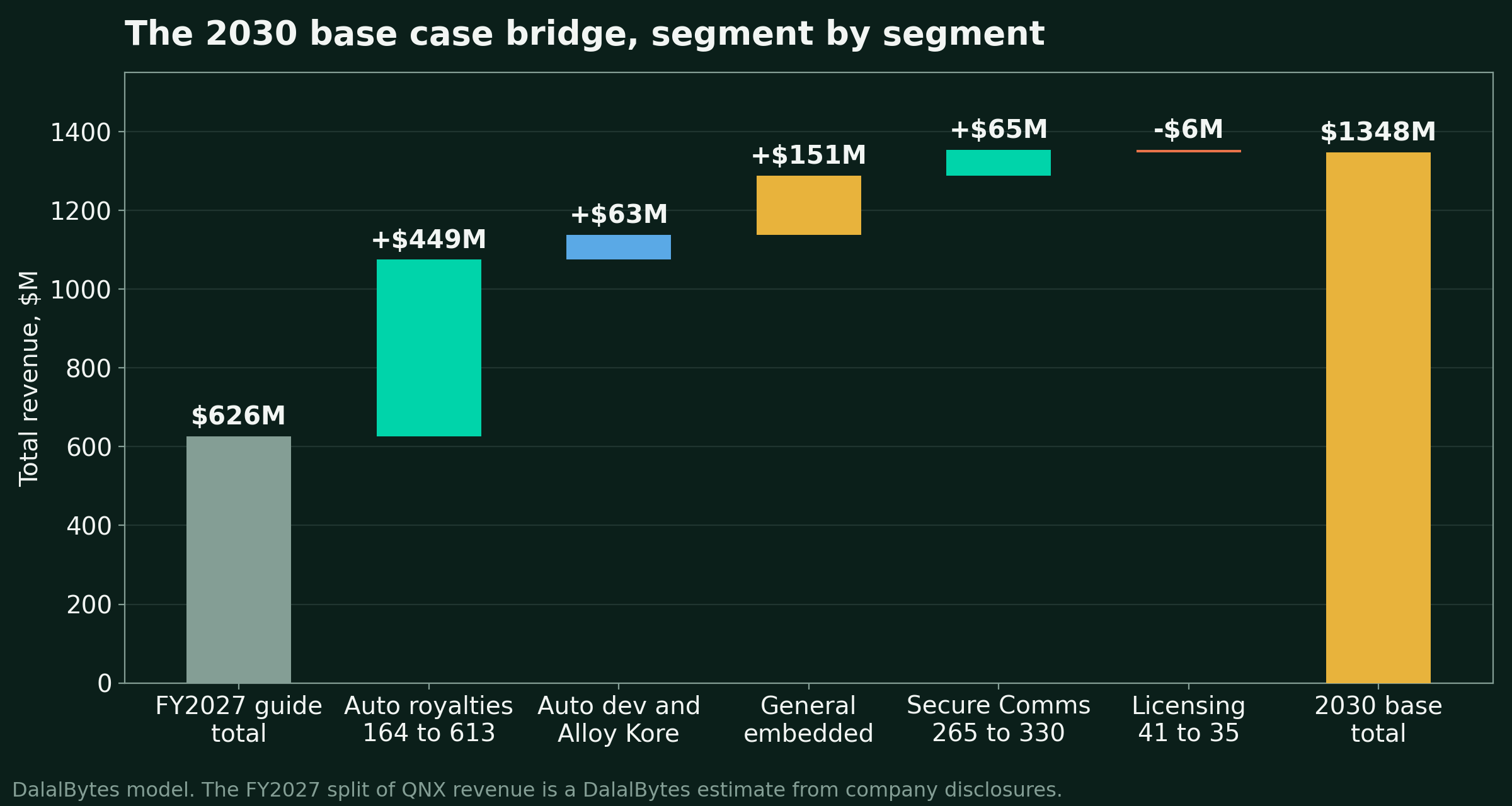
Total revenue of $953 million, $1,348 million, or $2,594 million, and adjusted EPS of $0.34, $0.60, or $1.55. The base case needs QNX to compound at 32 percent a year, which is what the backlog trajectory is for.
- General embedded markets grow from about $64 million to $110 million, $215 million, or $420 million. The bull figure needs 60 percent annual growth and is flagged as the most speculative line in the model.
- QNX EBITDA margins rise to 38, 42, and 48 percent on royalty and platform mix, extending a trend already visible in the 36 percent margin printed in Q2 of fiscal 2027.
- The conservative case is calibrated to mediocrity, not failure: the secured backlog converts on schedule, QNX grows near its guided rate, Secure Communications goes flat instead of shrinking, and licensing normalises between its fiscal 2026 result and its fiscal 2027 guide.
- Corporate costs are subtracted in every case, and per-share figures use if-converted share counts after scenario buybacks.
General embedded markets, the non-automotive QNX business spanning robotics, medical devices, industrial automation, rail, aerospace, and defence, are about 20 percent of QNX revenue today, roughly $64 million in fiscal 2027, and the backlog release confirms design wins in robotics, industrial automation, and medical devices contributed to the 26 percent backlog growth. Management calls robotics among the fastest growing QNX businesses, the Uber robotaxi program selected QNX this quarter, and more than 20 companies are engaging around NVIDIA-based physical AI platforms. We grow general embedded at 14 percent a year in the conservative case, 35 percent in the base case, and 60 percent in the bull case, and we repeat the flag: the bull figure is the most speculative line in this model, because no disclosed segment has yet compounded at that rate for four years. Auto development, Alloy Kore integration services, and professional services scale with the platform win rate, from about $92 million to $95 million, $155 million, and $235 million.
| Revenue, fiscal year ending Feb 2031 | Conservative | Base | Bull |
|---|---|---|---|
| QNX auto royalties | $381M | $613M | $1,414M |
| QNX auto development, Alloy Kore, services | $120M | $155M | $235M |
| QNX general embedded | $142M | $215M | $420M |
| QNX total | $643M | $983M | $2,069M |
| Secure Communications | $280M | $330M | $450M |
| Licensing and patents | $30M | $35M | $75M |
| Total revenue | $953M | $1,348M | $2,594M |
| Earnings build | Conservative | Base | Bull |
|---|---|---|---|
| QNX EBITDA (38%, 42%, 48% margin) | $244M | $413M | $993M |
| Secure Communications EBITDA (21%, 24%, 28%) | $59M | $79M | $126M |
| Licensing EBITDA (about 90% margin) | $27M | $32M | $68M |
| Corporate and unallocated | -$55M | -$58M | -$80M |
| Consolidated adjusted EBITDA | $275M | $466M | $1,107M |
| Adjusted net income | $215M | $368M | $907M |
| Shares, if-converted, after buybacks | 630M | 615M | 585M |
| Adjusted EPS | $0.34 | $0.60 | $1.55 |
Read the base case for what it demands. QNX revenue compounds at 32 percent a year for four years, against 19 percent guided growth in fiscal 2027 and 27 percent printed in its best quarter. That is an acceleration, and the only honest defence of it is the one this article is built on: the design win pace of the last two quarters, annualising above $670 million of gross additions, is precisely the input that produces royalty acceleration two to four years later, and the Alloy Kore tier reprices the vehicles those wins land on. If the win pace halves from here, the base case melts toward the conservative case, which at $953 million of revenue and $0.34 of EPS still values the shares near today's price in 2030 dollars. A genuine thesis-break bear, where a certified safety Linux takes the platform layer and the backlog itself disappoints, would land nearer $4 a share; that is a different animal from conservative operations, and it is not one of the three cases modelled here. The bull case, with QNX compounding at about 60 percent, is not a forecast. It is the shape of the outcome if the platform tier becomes the default buying pattern for software-defined vehicles while general embedded scales on the same certification moat. Two accounting cautions complete the picture. Adjusted EPS excludes stock compensation, a real cost in the tens of millions a year, so a GAAP view sits roughly $0.05 to $0.15 a share lower. And the EBITDA to net income conversion, 76 to 82 percent across cases, is calibrated to the company's own fiscal 2027 guidance of about $120 million of adjusted net income on $149.5 million of adjusted EBITDA.
What is BlackBerry worth today?
The short version
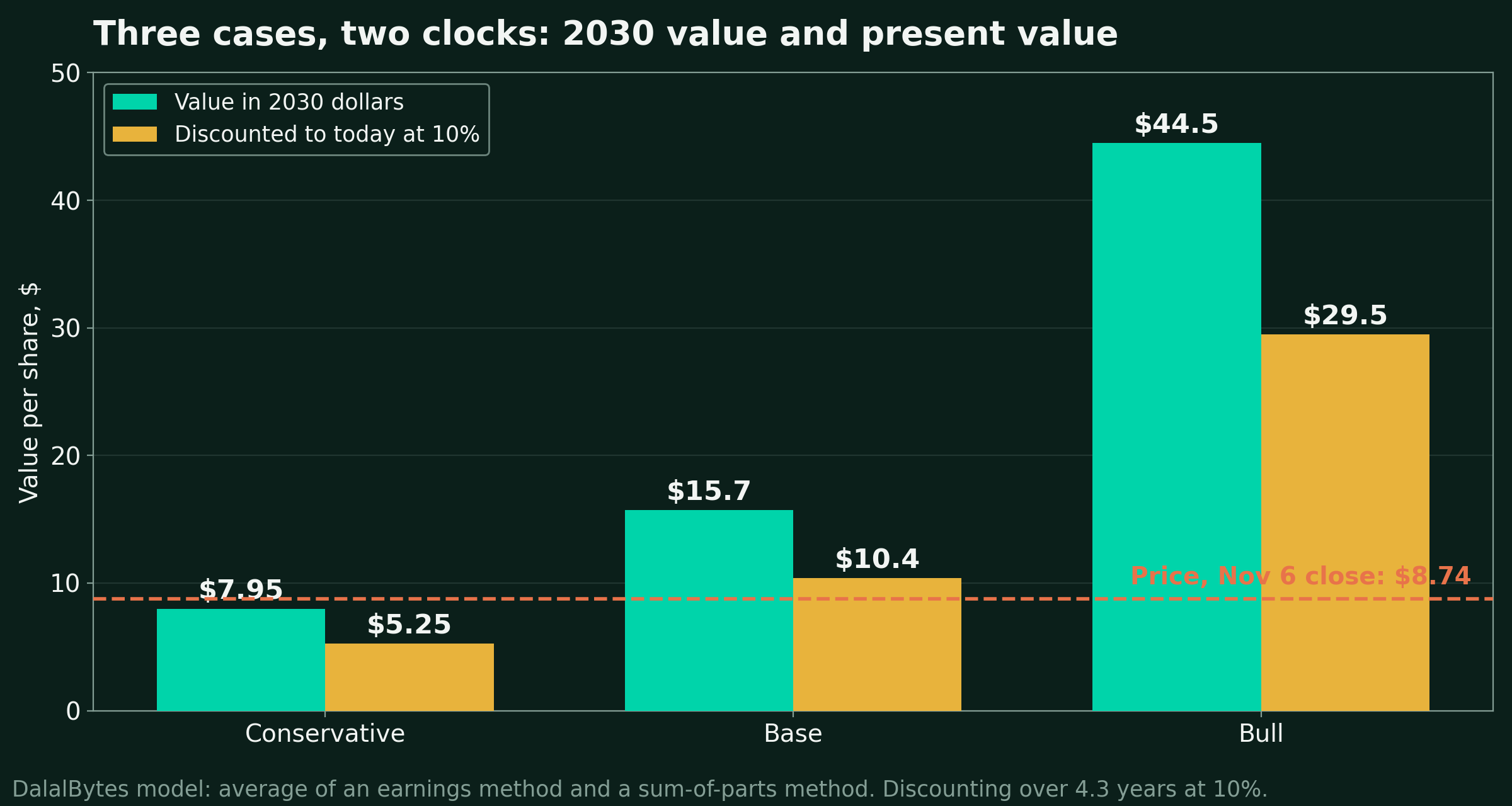
About $7.95, about $15.70, or about $44.50 a share in 2030 dollars. Discounted, about $5.25, about $10.40, or about $29.50. The $8.74 price sits below the discounted base case.
- Two methods, an earnings method and a sum-of-parts method, land within about two dollars of each other in every case.
- Probability weighted at 35, 45, and 20 percent, the model gives about $18.75 in 2030 dollars and about $12.40 in today's dollars.
- The conservative case assumes the secured backlog converts and the guided growth rate roughly holds. A thesis-break bear, with the platform layer lost to a certified rival, sits nearer $4, and the article names it separately rather than dressing it as conservatism.
- The December 17, 2026 earnings print is the first grading event, and the grading lines are set below, in advance.
We value each case two ways and average them. The earnings method applies an exit multiple to 2030 adjusted EPS: 24 times in the conservative case, 28 times in the base case, and 32 times in the bull case, where a royalty compounder still growing at platform speed would hold a premium multiple. The sum-of-parts method applies EBITDA multiples by segment, 16, 18, and 20 times for QNX, 12, 13, and 15 times for Secure Communications, and 7, 8, and 10 times for the finite-life Licensing stream, capitalises the corporate drag at 12 times, and adds the balance sheet: liquid net cash accumulated to 2030 of $650 million, $850 million, and $1,300 million by case, the Arctic Wolf stake at $44 million, $110 million, and $220 million, and $10 million for the remaining private investments.
| Value per share | Conservative | Base | Bull |
|---|---|---|---|
| Earnings method, 2030 dollars | $8.18 | $16.75 | $49.64 |
| Sum-of-parts method, 2030 dollars | $7.70 | $14.61 | $39.31 |
| Blended, 2030 dollars | about $7.95 | about $15.70 | about $44.50 |
| Discounted to today at 10% | about $5.25 | about $10.40 | about $29.50 |
The verdict
At $8.74, the market is paying for less than the base case in this model, and what it is declining to pay for is specific: it does not yet believe that the design win pace of the last two quarters converts into royalties at platform prices. That is a falsifiable position, and the next two years will settle it in the open. What would change the score: a second Alloy Kore design win at a passenger car maker (the platform tier stops being a single data point and the base case mix firms up), royalty revenue growth above 30 percent in fiscal 2028 as the backlog converts (the base case starts behaving like the bull case), Secure Communications retention back above 100 percent (worth roughly $1 to $2 a share across cases), an Arctic Wolf listing with a real price (turns a $44 million mark into a market number), or a certified safety Linux winning a major centralized platform (breaks the share and pricing assumptions in every case at once).
The grading lines for December 17. BlackBerry reports its third quarter on December 17, 2026, and this model will be graded against it in the open. Five lines, set today. One: QNX revenue inside the guided range of about $82 million to $88 million keeps the conversion schedule intact, and a print above the top of the range pulls every case forward. Two: design win commentary that annualises anywhere near the first half pace, or any backlog update materially above $1.2 billion, strengthens the engine of the whole model. Three: a second Alloy Kore win, or named passenger car programs entering the Alloy Kore pipeline with production dates, is the single highest value disclosure available to this stock. Four: Secure Communications retention at 91 percent is neutral, a move toward 95 percent is worth real money, and a slip below 90 percent takes the middle cases down. Five: licensing at or above the guided level for the quarter confirms the retained patent estate as an annuity rather than a run of one-off arrangements.
The deepest fact in this story remains the simplest. The certified layer underneath physical AI is bought once per program, paid for every year the program produces, and almost never ripped out, because re-certification costs more than the royalty ever will. BlackBerry owns the largest share of that layer, it is winning designs at a record pace, its newest product reprices those designs at platform rates, and it funds the wait with net cash and a patent annuity. Priced at $8.74, the shares ask you to believe the conversion happens at conventional prices. The backlog says the volume is coming. Coretura says the price is not conventional anymore. The 2030 case is the distance between those two sentences: about $15.70 a share if both are half right, about $44.50 if both are fully right, and about $7.95 if execution is merely mediocre. Nearer $4 requires the thesis itself to break. We know which way the evidence of the last two quarters points.
Frequently asked questions
What does the $1.2 billion QNX backlog actually mean?
It is estimated future royalty revenue from design wins already secured, calculated from royalty rates and projected production volumes over each design's life. It is not revenue today. It converts as the won programs enter production over the following two to four years and then produce for years more. Its growth rate is the signal: the backlog rose more than $250 million in two quarters while royalties were simultaneously being recognised out of it.
How much does QNX earn per vehicle?
It depends on the tier. A basic digital cluster deployment is worth a few dollars. Our base case blends conventional QNX vehicles at $8.50 with Alloy Kore platform vehicles at $40, for a blended $14.80 per royalty-bearing vehicle in 2030. The Coretura commercial vehicle deal, at more than $100 million of royalties on truck volumes, implies roughly $50 to $125 per truck, which is why the platform tier is modelled so far above the conventional tier.
What is BlackBerry worth in 2030 on this model?
About $7.95 a share in the conservative case, about $15.70 in the base case, and about $44.50 in the bull case, all in 2030 dollars. Discounted to today at 10 percent a year, those values are about $5.25, about $10.40, and about $29.50. Probability weighted, the model gives about $18.75 in 2030 dollars and about $12.40 in today's dollars, against a price of $8.74 at the November 6 close. The conservative case assumes mediocrity, not failure: backlog conversion on schedule, growth near the guided rate, and a flat Secure Communications.
Disclosures
Not financial advice. This article is published for educational purposes only. Nothing here is a recommendation to buy, sell, or hold any security, and nothing here is financial advice. Investing involves risk, including the possible loss of principal.
Positions. The author holds a long position in BlackBerry Limited, the company discussed in this article.
Accuracy. Segment revenue, margins, and guidance are from BlackBerry's fiscal 2026 results release of April 9, 2026 and its second quarter fiscal 2027 results release and Form 10-Q of September 24, 2026. The royalty backlog figure of over $1.2 billion, its definition, and its caution are from the QNX release of October 20, 2026. The Coretura design win value of more than $100 million, the ASP per instance of approximately three times the customer's current QNX operating system deployment, deployment across multiple software domains, the shift toward minimum contractual volume commitments, first half design win dollars exceeding the previous full year record, and general embedded markets representing approximately 20 percent of QNX revenue are from BlackBerry's second quarter fiscal 2027 earnings call of September 24, 2026 and the QNX release of September 22, 2026. Coretura's ownership, purpose, and first products in vehicles by the end of the decade are from the Daimler Truck and Volvo Group joint venture launch release of June 2025. Daimler Truck unit sales of 422,510 for 2025 are from Daimler Truck's results release; Volvo Group truck deliveries of 202,911 for 2025 are from the Volvo Group Annual Report 2025. The implied per-vehicle royalty figures are DalalBytes arithmetic on those disclosed values, using eight and ten year design lives and the platform volume bands stated in the article; the platform volume band is a DalalBytes assumption, not a company disclosure. Convertible note terms, the share count of 587,032,279 at September 21, 2026, the balance sheet at August 31, 2026, and the carrying value of non-marketable investments are from the fiscal 2027 second quarter Form 10-Q. The Cylance sale terms are from the Arctic Wolf and BlackBerry announcement of December 16, 2024. The Malikie patent transaction terms are from BlackBerry's announcement of March 22, 2023. The Arctic Wolf private market price of $8.00 a share and implied valuation of about $4.21 billion are Forge Global data dated November 7, 2026; private market marks are indicative, not exchange prices. The closing price of $8.74 at November 6, 2026 and the resulting market capitalisation are market data as published by StockAnalysis. The fiscal 2027 split of QNX revenue into royalties, development, and general embedded components, and the estimate of royalties recognised in the first half of fiscal 2027, are DalalBytes estimates built from company disclosures. All 2030 figures are DalalBytes scenario estimates, not company guidance. Errors can occur and facts change; verify independently before acting on anything you read.
No advisory relationship. Reading this site does not create an advisor-client relationship of any kind. See the full disclosures page.