
What did Netflix actually build?
Start with what the thing is not. When co-CEO Ted Sarandos first teased Netflix House at Bloomberg's Screentime conference in October 2023, he drew the line himself: "Don't think of it like Disneyland. [It is] something you might go to a couple of times a month, not just once every couple of years." Bloomberg reported at the time that Netflix internally framed the venues more as a way to promote content than as a meaningful revenue source. The formal announcement followed on June 18, 2024: two venues, at King of Prussia in Pennsylvania and at Galleria Dallas, each covering more than 100,000 square feet inside former department store anchors, a Lord & Taylor and a Belk. CMO Marian Lee promised guests could "enjoy regularly updated immersive experiences, indulge in retail therapy, and get a taste, literally, of your favorite Netflix series and films." A third location, at BLVD Las Vegas on the Strip, was confirmed on June 17, 2025 for a 2027 opening.
Under the permanent venues sits a decade of smaller bets: a touring slate of immersive pop-ups run with partners such as Fever, a restaurant concept, a stage play, and now a concert tour. This is the full slate, with each item's state as of October 30, 2026.
| Venue or format | Location | Opened | State at October 2026 |
|---|---|---|---|
| Netflix House | King of Prussia, Pennsylvania | November 12, 2025 | Open. KPop Demon Hunters replaces the Wednesday experience on November 20, 2026 |
| Netflix House | Galleria Dallas, Texas | December 11, 2025 | Open. KPop Demon Hunters replaces Escape the Dark on November 12, 2026 |
| Netflix House | BLVD Las Vegas, the Strip | 2027 | Announced. Construction banners reported in June 2026. No date, slate, or ticketing yet |
| Netflix BITES restaurants | Inside both Houses | November and December 2025 | Operating as the in-house food format |
| Netflix Bites Vegas | MGM Grand, Las Vegas | February 11, 2025 | Closed January 4, 2026 at the end of its one-year residency |
| Stranger Things: The First Shadow | London and Broadway | December 2023 | In final extension. London closes December 27, 2026 and Broadway on January 3, 2027 |
| Stranger Things: The Experience | More than a dozen cities worldwide | 2022 | Still touring. Also playing inside the Philadelphia House since July 10, 2026 |
| Squid Game: The Experience and The Trials | New York, Madrid, Sydney, Seoul, London, Los Angeles | October 2024 | Most runs have ended. The format survives inside Dallas as Survive the Trials |
| The Queen's Ball: A Bridgerton Experience | Ten cities | March 2022 | Tour completed and wound down |
| Money Heist: The Experience | Five cities | 2021 | Ended with the franchise's final season cycle |
| KPop Demon Hunters world concert tour | Global arenas, with AEG Presents | 2027 | Announced at the May 2026 upfront. No cities, dates, or prices released |
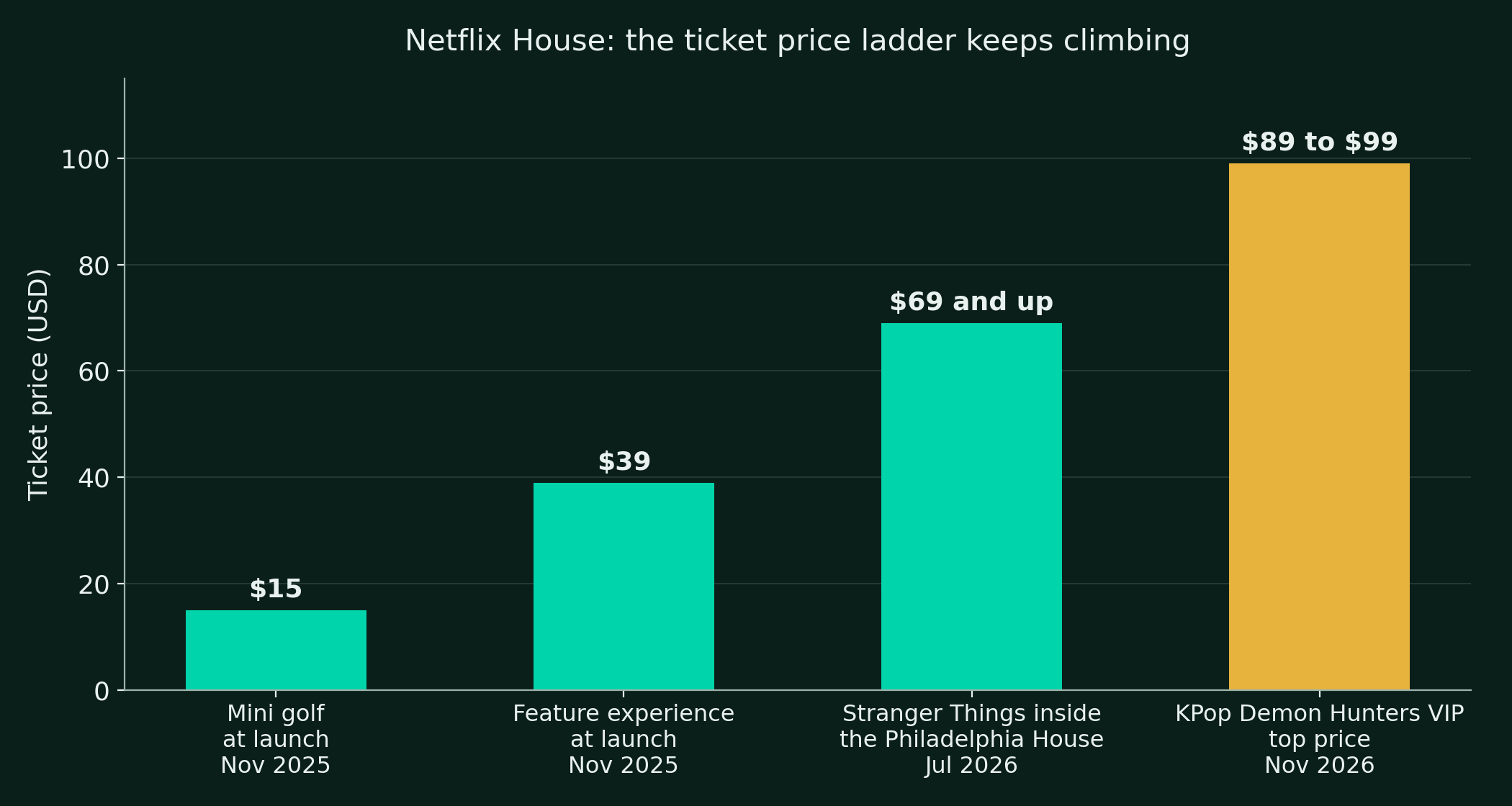
Inside the Houses, the model is a mall with a cover charge per ride. Entry is free. At the King of Prussia launch, the paid layer was two feature experiences (Wednesday: Eve of the Outcasts and ONE PIECE: Quest for the Devil Fruit), Netflix Virtuals VR games from Sandbox VR built on Stranger Things, Squid Game, and Rebel Moon, a Top 9 mini golf course, the 229-seat TUDUM Theater screening premieres and streaming live events such as WWE Raw and NFL games, a Netflix BITES restaurant, and a Netflix Shop where about 70% of items are exclusive to the location. Launch pricing ran from $15 for mini golf and $25 for VR to $39 for the feature experiences. Dallas opened with Stranger Things: Escape the Dark, Squid Game: Survive the Trials, the RePLAY arcade, BITES, and the Shop; Netflix's Tudum coverage noted that about 270 local residents worked on construction and nearly 300 people work at the location.
The touring slate is the research and development layer. Stranger Things: The Experience has played more than a dozen cities since 2022, and its Mexico City run, opened December 13, 2025, passed 100,000 tickets by April 2026, per the production partner. Squid Game: The Experience ran in six cities from October 2024; Netflix said the New York run sold out its first six weeks, and the Tokyo run closed in August 2026. The Queen's Ball toured ten cities from March 2022 at about 300 guests per session and tickets from $49, then wound down as the tour completed. Greg Lombardo, the executive who ran the slate, put the cumulative draw on the record in November 2025: "With those popups, we've had over 10 million fans go through them."
Food was the experiment that stayed small. Netflix Bites began as a Los Angeles pop-up in 2023 with chefs from Chef's Table, Iron Chef, Is It Cake?, and Nailed It; Netflix later said it became the most searched restaurant in LA with reservations fully booked for over six weeks, a company claim that was never independently audited. The scaled version, Netflix Bites Vegas, opened at MGM Grand on February 11, 2025 with a menu built from about 30 titles, explicitly as a one-year residency. It closed on January 4, 2026, when the residency ended, and the space reopened as MGM's own Avenue Café on January 12. The format did not die. It moved indoors, as the permanent BITES restaurants inside both Houses.
How is it panning out?
The openings landed. Both Houses opened on schedule, King of Prussia on November 12, 2025 and Dallas on December 11, 2025, and both were named to TIME's World's Greatest Places 2026 list. For a company whose core product is software, delivering two 100,000 square foot physical builds on time is not nothing. The harder question is whether anyone comes back, and that is where the evidence gets thinner and more interesting.
The rotation promise is being kept, at higher prices. Rotating content is the concept's central claim: the venue swaps its attractions the way the homepage swaps its rows, so a fan has a reason to return every few months. In July 2026 the touring Stranger Things production moved inside the Philadelphia House at $69 and up, well above the $39 launch price for feature experiences. This November, KPop Demon Hunters: The Immersive Experience replaces the launch attractions at both Houses, opening in Dallas on November 12, 2026 and in Philadelphia on November 20, 2026, with the Wednesday experience closing in Philadelphia and Escape the Dark closing in Dallas. KPop pricing runs from $39 for adults and $34 for children up to $89 to $99 for VIP, a tier anchored by a Derpy Tiger built by Jim Henson's Creature Shop. The price ladder is the only public proxy for pricing power this business produces, and it points up.
The standout is a play, not a venue. Stranger Things: The First Shadow, Netflix's first stage production, opened in London in December 2023 and on Broadway in March 2025. It won two Olivier Awards and four 2025 Tony Awards, including a Special Tony, making it the most Tony-winning play of 2025. It set a Marquis Theatre house record of $2,510,948 in the nine-performance week ending December 28, 2025, and it has sold nearly 1.6 million tickets across more than 1,500 performances. In June 2026 the producers announced a final extension: London closes December 27, 2026 and Broadway on January 3, 2027. That is a planned end at the top, the cleanest success in the entire experiential portfolio, and notably the one format where the industry publishes box office numbers whether Netflix wants it to or not.
The cautionary tale is the restaurant. Bites Vegas ended on schedule and was not renewed as a standalone, and no covers or revenue figures were ever published for it. Casino.org, in opinionated local coverage rather than data, judged that the residency "didn't gain much traction." Read carefully, the Vegas outcome says the food concept works as a component inside a venue and not yet as a destination on its own. It is also the only experiential format Netflix has let end on camera.
Reviews split the way the model predicts. King of Prussia opened to a 4.6 star average on Google in its first week. By 2026, review platforms show the split: Dallas sits at 3.8 of 5 on TripAdvisor, on a small sample, with complaints that attractions feel brief and highly structured for the price, while Philadelphia carries a tail of one-star reviews citing broken games, overbooked time slots, and restaurant waits. The praise concentrates where the spending went, on set design and cast. That pattern, spectacle admired and value questioned, is exactly the tension a $39 to $99 ticket has to resolve on the second and third visit, and no review platform can answer it. Only repeat attendance can, and repeat attendance is the number Netflix does not publish.
What numbers will Netflix not give you?
State it plainly: Netflix discloses no experiences revenue line, no consumer products revenue line, no venue attendance, and no build-out cost for either House. There is no segment to model and no figure to audit. Every number attached to this business in public is either a proxy or an estimate, and the honest ones say so. The verifiable proxies are these.
- More than 10 million fans through the touring pop-ups, per Lombardo's November 2025 statement.
- Nearly 1.6 million tickets for The First Shadow, with a $2,510,948 record Broadway week, from producer reporting.
- More than 100,000 tickets for the Mexico City Stranger Things run in about four months, per the production partner.
- A ticket price ladder that has climbed from $15 to $39 at launch to $69 and up in July 2026 and a $99 VIP top price in November 2026.
- Promoter demand for the KPop Demon Hunters concert tour, where Bloomberg reported in March 2026 that promoters offered tens of millions of dollars in upfront guarantees before Netflix chose AEG Presents.
The scale arithmetic is not close. Netflix guides FY2026 revenue to $51.1B. Two mall venues selling $39 to $99 tickets, plus food and retail, cannot plausibly reach even $500M of gross revenue, and $500M would still be under 1% of the company. That is arithmetic on stated inputs, not an estimate of what the Houses actually take in, which nobody outside Netflix knows. The natural comparison makes the same point from the other direction.
| Business | Revenue | Profit disclosure |
|---|---|---|
| Disney Experiences, fiscal 2025 | $36.16B | Record $10.0B of operating income, more than half of Disney's total segment operating income |
| Netflix, total company, FY2026 guidance | $51.1B | Experiences revenue and profit inside it: not disclosed at any level |
Disney's experiences segment alone earns more operating income than most media companies are worth, built over decades of destination assets. Netflix's entire physical footprint is two mall anchors, a touring slate, and a play. Analysts are not hostile to the gap; Wedbush's Alicia Reese called Netflix's merchandising pivot "a great turning point" in November 2025. But no analyst model of record carries a material experiences revenue line, because there is nothing disclosed to model. Warmth without numbers is the Street's position, and it is a reasonable one.
Why did the builder leave?
Greg Lombardo built this business, and he is gone. Lombardo, Netflix's VP of Experiences, ran the physical expansion from 2019: the touring slate, the Queen's Ball, Netflix Bites, and both Houses. His exit was reported on October 9, 2026 by Deadline and TheWrap, with no successor named and no reason given. He was the second senior marketing departure in the same week, and strategic ownership of the business sits with CMO Marian Lee. A founder leaving quietly, at the exact moment his creation faces its first retention test, is the single most important fact of the last month in this story.
The reporting around the exit is pointed, and it is reporting. Around the October 2026 layoffs, which cut about 1,000 roles or roughly 6% of staff, sources inside Netflix told reporters that the retail and experiential businesses hold promise but "had yet to demonstrate returns sufficient to justify the investment," that the division was being reworked with cuts expected, and that Netflix "hasn't cracked the code" on measuring experiential value against its costs. That is insider sourcing as summarized from Wall Street Journal and Puck reporting in October 2026, not an audited finding, and Netflix has not commented on the record. But note what the complaint actually is. It is not that fans stayed away. It is that the company cannot measure what the fans are worth, which is the disclosure problem wearing an internal version of the same face.
The Las Vegas build is now the tell. The Strip venue was announced in June 2025 for 2027, construction banners were reported up in June 2026, and as of October 30, 2026 there is no opening date within 2027, no attraction slate, and no ticketing. Las Vegas is the most expensive stage Netflix has chosen, in the city where Bites already ended quietly. If the Vegas House opens on something like its announced schedule with a full slate, the business survived its internal review. If it slips, shrinks, or goes quiet, the rework the insiders described will have reached the flagship plan. Either outcome will say more than any earnings call answer on the subject, because no earnings call answer on the subject has ever contained a number.
What does management say it is for?
Sarandos frames it as fandom infrastructure, and he keeps shrinking the claim on purpose. In a 2025 interview he said: "It's good for marketing and branding. This is all expressions of fandom. I don't really see us having theme parks, but I do see us having a lot of touch points with consumers like this. I admire the Topgolf model versus the Disneyland model." Topgolf is the tell in that sentence: local, repeatable, an evening out rather than a pilgrimage, profitable at modest scale without pretending to be a destination empire. At a live event in May 2026 he went further, calling the efforts "toe dipping," saying live experiences can be profitable "done right and at scale," and restating that subscribers remain the prize. Bulls on this business should notice that its own chief executive will not call it a growth engine.
Lee's ambition runs in the opposite direction, and both things are true at once. At Licensing Expo in May 2026, the CMO said fandom, not revenue, is the starting point, called Netflix House a "casual neighborhood place," and stated the goal plainly: "Our goal is to have one in every major city around the world." Set the two quotes side by side and you have the strategy as management actually holds it. The format is meant to be everywhere, and it is also, by design, not expected to move the financial statements anywhere it lands. The consumer products business runs on the identical thesis, the first master toy deal with Jazwares for Stranger Things in January 2025, Hasbro and Mattel for KPop Demon Hunters in 2025, Ferrero and Moose Toys announced at Licensing Expo in May 2026, and it carries the identical disclosure: none. The Houses are where that licensing and fandom machine becomes a place, and the TUDUM Theaters inside them, streaming WWE Raw and NFL games, are where it plugs back into the live programming strategy. Fandom is the asset. The venue is the receipt.
No target has ever been attached. Across three years of announcements, openings, and interviews, no Netflix executive has put a revenue target, an attendance target, or a payback period on Netflix House on the record. That absence is a choice, and it cuts both ways. It protects a young business from being graded like a segment before it has found its repeat customer. It also means the business cannot be defended with evidence when a layoff round asks what it earns, which, on the October reporting, is roughly what happened.
What should investors watch?
The November rotation is the first retention test, and it is checkable in weeks. KPop Demon Hunters is the strongest IP Netflix has launched in years, and it is being asked to do the hardest job in this business: bring fans back to a venue they already visited, at prices above the launch ladder. Watch the run's length, whether weekend slots sell through at the $89 to $99 VIP tier, and whether a second rotation gets announced at either House in early 2027. A format that rotates twice is a business. A format that rotates once and stalls is a launch with good marketing.
Then watch the org chart and the Strip. A named successor to Lombardo with a real mandate would signal the business graduated. Silence, or the role folded into a broader marketing remit, would signal the reclassification the insider reporting predicted. The Las Vegas slate announcement, whenever it comes, is the capital commitment test: full slate and a firm 2027 date means the build survived; drift means it did not. And watch for the smallest possible disclosure, any number at all. The day Netflix puts an attendance figure or a revenue line next to this business, it will be telling you the business has started being managed as one.
Where this fits the research package
DalalBytes published its five-pillar Netflix report today, scoring the company 72 of 100, Positive, at a $62.05 reference price, with fiscal 2029 scenarios of $46 bear, $85 base, and $118 bull. Experiences are far too small to carry any part of that score, and the report does not ask them to. They belong to the moat story instead: the same fandom that fills a mall venue in King of Prussia is what pricing power and a 325M member base are built on, and the score's own checkpoints turn on advertising and revenue growth, not on venues. Read the full package: Netflix investment report.
The fair summary is that Netflix House works as the thing management says it is: a fandom machine that opened on time, rotates its content, raises its prices, and put a hit play on Broadway along the way. What it has not done, and what its builder's exit puts in question, is prove it works as a business, because Netflix has arranged the disclosure so that nobody outside the building can tell. The concept has passed every test that can be seen from outside. The math is the test it has not taken in public.
Research and opinion, not investment advice. Do your own due diligence before investing.
Frequently asked questions
Is Netflix building theme parks?
Management says no. Sarandos has said repeatedly that he does not see Netflix having theme parks and prefers the Topgolf model of frequent local visits over the Disneyland model of rare destination trips. What exists is two mall venues of more than 100,000 square feet each, with free entry and paid rotating attractions, plus a third announced for the Las Vegas Strip in 2027.
How much money does Netflix House make?
Nobody outside Netflix knows. The company discloses no experiences revenue line, no venue attendance, and no build-out cost, so any figure in circulation is an estimate. The arithmetic is not close: against FY2026 guided revenue of $51.1B, two mall venues cannot plausibly reach even $500M of gross revenue, and $500M would still be under 1% of the company. That is arithmetic on stated inputs, not a disclosed figure.
What happened to Netflix Bites in Las Vegas?
It completed its plan. Netflix Bites Vegas opened at MGM Grand on February 11, 2025 as an explicit one-year residency and closed on January 4, 2026 when the residency ended. No covers or revenue were ever published. The format survives as the permanent Netflix BITES restaurants inside both Netflix Houses.
Disclosures
Not financial advice. This article is published for educational purposes only. Nothing here is a recommendation to buy, sell, or hold any security, and nothing here is financial advice. Investing involves risk, including the possible loss of principal.
Positions. The author holds no position in Netflix.
Accuracy. This analysis is built from public sources believed to be reliable, including Netflix press releases and Tudum coverage of the Netflix House openings, Netflix's June 2025 investor relations release on the Las Vegas location, Disney's fiscal 2025 results, and reporting from Bloomberg, Variety, The Hollywood Reporter, Attractions Magazine, PhillyVoice, Deadline, TheWrap, Eater Vegas, Casino.org, and License Global, together with review data from TripAdvisor and Google as crawled in October 2026. Statements attributed to company insiders are labeled as reporting in the text and have not been commented on by Netflix. Figures for Disney are Disney's own reported results. Errors can occur and facts change; verify independently before acting on anything you read.
No advisory relationship. Reading this site does not create an advisor-client relationship of any kind. See the full disclosures page.