
What has Netflix actually said about AI?
Netflix does not hold AI days and does not break out an AI segment. The transformation shows up instead in the documents the company files every quarter. The Q2 2026 shareholder letter states the program in one sentence: "We are leveraging AI to provide a more personalized, immersive and interactive experience for members, enhance ads capabilities for brands, and improve the quality of our series and films." One quarter earlier, the Q1 2026 letter tied the same tools to the biggest line in the business: "Leveraging GenAI, we are enabling our creative partners with more and better tools to help them tell their stories, with the potential to make our single largest area of spend, content, even more impactful."
The Q3 2026 letter, published October 20, 2026, organizes the company around three priorities: more entertainment value for members, leveraging technology to improve every aspect of the service, and improving monetization. Even the boilerplate has moved. The forward-looking statements disclaimer in the 2026 letters now lists "use of artificial intelligence technologies in content production and product development" among the things that could affect results. AI is no longer an experiment at Netflix. It is written into the risk language.
This article separates four kinds of evidence, because Netflix watchers often blur them. Letter text is what the shareholder letters say. Call commentary is what executives said on earnings calls and interviews, attributed to the speaker. Company publications are the Netflix Technology Blog, product announcements, upfront presentations, and the partner guidelines. Reporting is what reputable outlets documented that the company itself has not, and it is flagged as reporting wherever it appears.
How is AI changing what members see?
The recommendation engine became a foundation model. In March 2025 the Netflix Technology Blog described a centralized foundation model for personalized recommendation. It learns member preferences from hundreds of billions of interactions, tokenizes viewing history and context the way a language model tokenizes text, and shares its embeddings with the many specialized ranking models downstream. The point of the architecture is consolidation: one large model that understands taste, replacing a fleet of narrower models that each saw only part of the picture. Source: Netflix Technology Blog, March 21, 2025.
The next step is an LLM-native ranker. In July 2026 the Technology Blog published GenRec, a recommendation system built on an in-house foundation language model. Instead of hand-built features, GenRec reads a member's history written out as natural language and reasons over it. Netflix reports offline gains of about 1.6% on its ranking metric using roughly 40 times fewer labeled examples, and an online A/B test on about 10% of traffic over four weeks produced statistically significant gains on short and long term metrics. Source: Netflix Technology Blog, July 30, 2026, and the accompanying research paper.
Search is becoming a conversation. At its May 2025 product event, Netflix announced a generative AI search on iOS, launched as a small opt-in beta using OpenAI models, that accepts natural phrases such as "I want something funny and upbeat" instead of titles and genres. The same event introduced the redesigned TV experience and a plan to use generative AI to update title cards in each member's preferred language. CTO Elizabeth Stone framed it plainly: "Generative AI allows us to take this a step further, for example, by showcasing our titles in more languages and locations around the world." In 2026, The Verge reported hands-on testing of an AI voice search beta with select US members; that is reporting, not a company announcement, and the beta was notably not yet connected to the personalization engine.
Personalized artwork is the quiet veteran. Netflix has used machine learning for years to choose which artwork each member sees for the same title, a contextual bandit problem it documented long before generative AI arrived. The generative layer now extends that idea from choosing images to creating localized title cards, which matters for a service where about a third of viewing is non-English content.
Localization is where AI meets its limits, on the record. The Q4 2025 letter says Netflix is "using AI to improve subtitle localization, making it easier for our titles to reach more viewers around the world." Dubbing is a different posture. At a Seoul localization roundtable on October 15, 2026, Catherine Retat, Netflix's senior director of global content localization, said the company dubs into 36 languages and subtitles in 33 through 122 partner companies, that one dubbed version takes 50 to 60 people, and that AI supports the work without replacing the experts who carry emotion in a performance. The labor rules are tightening in the same direction: on October 29, 2026, SAG-AFTRA members ratified animation contracts that require a voice actor's specific consent before a digital replica can dub their performance into another language.
How is AI changing the ads business?
Advertising is where Netflix's AI work meets a revenue line fastest, because Netflix built the entire stack itself. The Netflix Ads Suite, its in-house ad platform, rolled out in the United States and Canada in the spring of 2025, replacing the original Microsoft partnership, and has been expanding market by market since. The Technology Blog documents the engineering underneath it, including the ads event processing pipeline that feeds measurement, billing, and frequency capping for billions of ad events. In March 2026 the company layered on the buying infrastructure advertisers expect: Amazon DSP and Yahoo DSP audience integrations, its own Conversion API for outcome measurement, and an attention measurement partnership with Lumen.
The creative layer is where generative AI enters. The Q4 2025 letter discloses that in 2025 Netflix "began testing new AI tools to help advertisers create custom ads based on Netflix's intellectual property," used "automated workflows for ad concepts," and applied "advanced AI models to streamline campaign planning, significantly speeding up these processes." At the May 2025 upfront, ads president Amy Reinhard announced generative AI interactive midroll and pause formats for 2026 that would, in her words, "marry advertisers' ads with the worlds of our shows." By August 2026, at the close of the upfront selling season, Netflix had launched an AI-powered tool that generates pause ad formats from an advertiser's existing assets, and upfront commitments had nearly doubled year over year, per TheWrap's reporting of the company announcement.
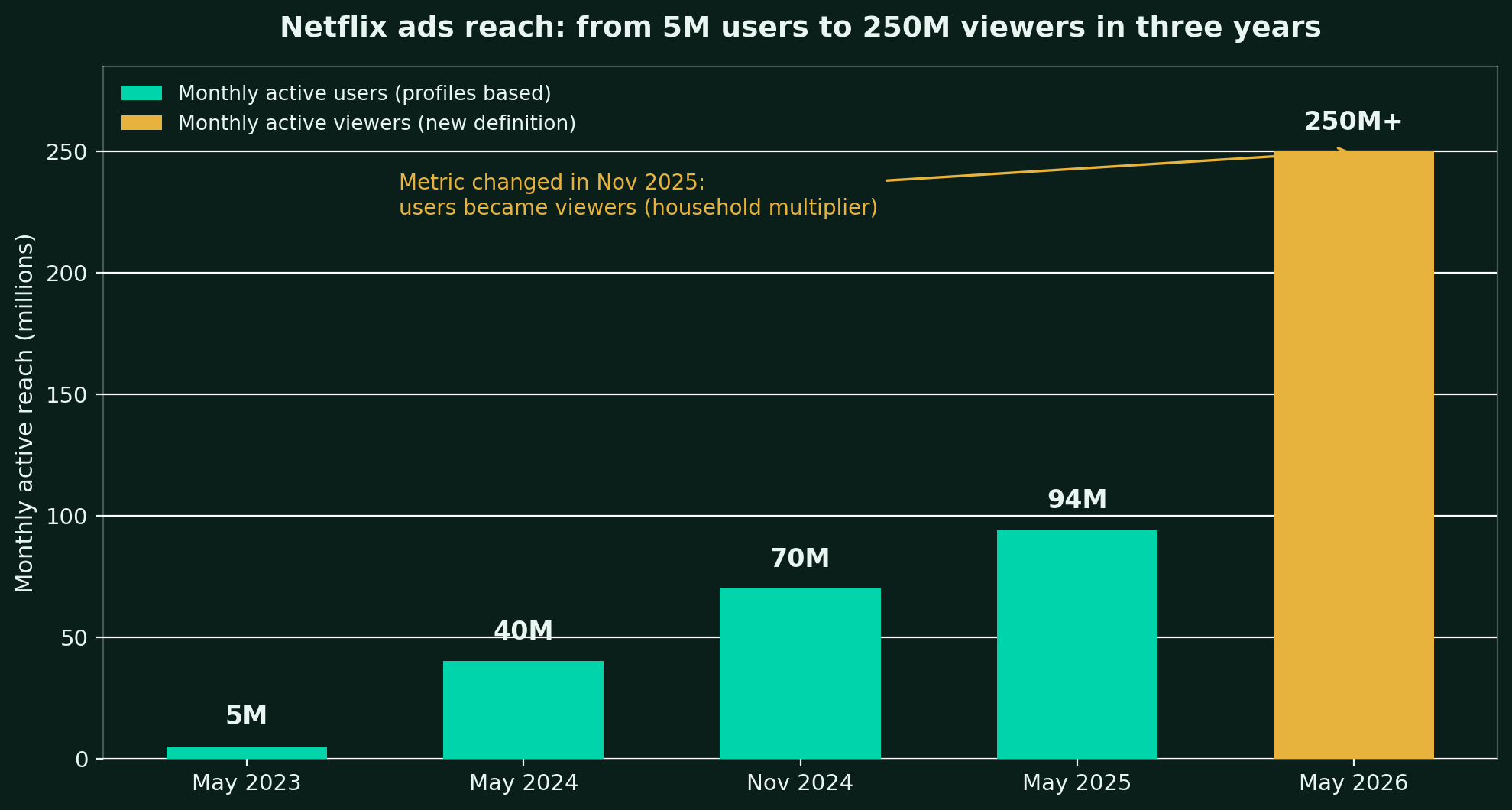
The money is real but still small. Ad revenue more than doubled to over $1.5B in 2025, per the Q4 2025 letter. The October 2026 letter then cut the 2026 guide to about $2.7B from about $3B, citing a "slightly slower than expected rollout of some ad product capabilities." On the October 20, 2026 earnings interview, co-CEO Greg Peters attributed the cut to rollout and partner integration delays and called it "a modest short-term hit for a better long-term strategic position," while noting ad revenue still grows more than 80% in 2026 and the ad tier expands to 15 more countries in 2027. Reported internal targets, published by the Wall Street Journal and not guidance, aim at $9B of ad sales by 2030. Getting there from $2.7B requires roughly 35% annual growth for four years, on a platform whose product rollout just slipped. That gap is the honest summary of the ads AI story: the ambition is documented, the tooling is shipping, and the timeline already moved once.
How is AI changing how shows and films get made?
The documented first is The Eternaut. The Argentine series, released April 30, 2025, contains a building collapse sequence produced with generative AI by Netflix's in-house Eyeline Studios. On the Q2 2025 earnings call, co-CEO Ted Sarandos said it was the first generative AI final footage in a Netflix original production, that the sequence was completed about 10 times faster than traditional visual effects workflows, and that "the cost of it just wouldn't have been feasible for a show on that budget." His framing matters: "an incredible opportunity to help creators make films and series better, not just cheaper." No dollar saving has ever been disclosed for the sequence.
The rules are published. In August 2025 Netflix posted generative AI guidelines for production partners on its Partner Help Center. The five principles require that generated output not recreate identifiable characteristics of copyrighted material the production does not own; that generative tools not store, reuse, or train on production data inputs or outputs; that tools run in enterprise-secured environments where possible; that generated material is temporary and not part of final deliverables by default; and that AI not replace or generate talent performances or union-covered work without consent. Partners must tell their Netflix contact about planned generative AI use in advance, and uses touching final deliverables, key characters, likenesses, or digital replicas need written approval and legal review.
The biggest check went to post-production. In March 2026 Netflix acquired InterPositive, the filmmaking technology company founded by Ben Affleck. The Q2 2026 10-Q discloses a March 2026 acquisition for about $587M in cash without naming the target; Variety and TechCrunch identified the target as InterPositive, and Affleck later disputed the $587M figure in an October 2026 GQ interview, noting he did not own the whole company. The tools work on footage already shot: relighting, background replacement, missing shots, and continuity fixes, trained on a proprietary soundstage dataset, and explicitly not performance generation. Then-CCO Bela Bajaria said the aim is tools that do not "replace the work of writers, directors, actors, and crews." Affleck used the tools on his Netflix film Animals, released October 9, 2026, and said at Bloomberg's Screentime conference on September 30, 2026 that he used AI "for lots of things in that movie," without specifying where.
One initiative is reporting only. Engadget reported in May 2026 that Netflix has stood up a generative-AI-native animation studio called INKubator, based on job listings, aimed first at animated shorts and specials. Netflix has not announced it. Treat it as a signal of direction, not a confirmed program. The guild backdrop constrains all of this: the 2023 WGA and SAG-AFTRA agreements established that AI is not a writer or a performer and that digital replicas need consent and compensation, and the 2026 rounds tightened those terms further.
When did each initiative land?
| Initiative | Date | Source type |
|---|---|---|
| Foundation model for personalized recommendation | March 2025 | Netflix Technology Blog |
| Ads Suite in-house platform launches in the US and Canada | April 2025 | Company announcement |
| The Eternaut airs with the first generative AI final footage in an original | April 2025 | Company disclosure on Q2 2025 earnings call |
| Generative AI search beta on iOS and the redesigned TV experience | May 2025 | Company product announcement |
| Generative and interactive ad formats promised for 2026 | May 2025 | Upfront announcement |
| Generative AI guidelines for production partners | August 2025 | Partner Help Center publication |
| Custom ads built on Netflix IP and automated campaign planning in testing | 2025, disclosed January 2026 | Q4 2025 shareholder letter |
| InterPositive acquisition announced | March 2026 | Company announcement |
| Amazon DSP and Yahoo DSP audiences, Conversion API, attention measurement | March 2026 | Company announcements |
| Ads reach passes 250M monthly active viewers | May 2026 | Upfront announcement |
| INKubator generative AI animation studio | May 2026 | Reporting (Engadget) |
| AI voice search beta with select US members | 2026 | Reporting (The Verge) |
| GenRec LLM-native recommendation system published | July 2026 | Netflix Technology Blog |
| AI tool generating pause ad formats from advertiser assets | August 2026 | Company announcement, via TheWrap |
| 2026 ads guide cut to about $2.7B on rollout delays | October 2026 | Q3 2026 shareholder letter |
| SAG-AFTRA animation consent rule for AI dubbing replicas | October 2026 | Reporting (TheWrap) |
What does Netflix not disclose about AI?
Start with the plain fact: Netflix reports no AI revenue line and no AI capex or spend line. Nothing in the letters, the 10-K, or the 10-Q filings quantifies what AI earns or what it costs. The financial case has to be read through proxies: ad revenue of over $1.5B in 2025 guided to about $2.7B in 2026, engagement of more than 97B hours viewed in the first half of 2026, and a content budget that management says AI should make "even more impactful." Anyone quoting a precise dollar figure for Netflix's AI contribution is estimating, not citing.
Engagement per member is drifting the wrong way on third-party estimates. Netflix calls engagement healthy and points to an internal quality metric at all-time highs, but it has stopped publishing the data that would settle the argument, moving What We Watched reporting from semiannual to annual starting in 2027. Jefferies estimates average monthly viewing per member fell from about 66 hours in the first half of 2023 to about 49 in the first half of 2026. Those are third-party estimates, labeled as such, but they frame the real question for the recommendation rebuild: whether a foundation model and an LLM-native ranker can move a per-member number that has been sliding since the password crackdown, not just a total.
The timelines slip. The ads guide cut is the cleanest evidence. The AI-driven ad products were announced in May 2025 for 2026, and by October 2026 the rollout delays cost roughly $300M of expected 2026 revenue. Peters framed the delay as a deliberate trade for a better long-term position, which may be right, but the pattern is worth pricing: at Netflix, AI product timelines are management intentions, not schedules. The quality debate runs alongside it. Sarandos argues AI makes productions "better, not just cheaper," while the published partner guidelines, the guild agreements, and the Seoul localization posture all show a company fencing the technology away from performances, voices, and final deliverables unless humans approve each step. The IP questions, training data, likeness rights, and replica consent, are being settled contract by contract, not by policy.
What is the investor read?
Ads are the monetizable piece, on a visible timeline. The revenue is disclosed, the reach is disclosed, and the gap to the reported $9B internal 2030 goal is arithmetic anyone can check. AI is the product roadmap for closing that gap: targeting, measurement, and creative generation are exactly the layers where the platform was thinnest against Meta and Google. The October guide cut says the roadmap is late, not wrong.
Production and localization are margin leverage, not growth. Content is Netflix's largest spend, guided revenue of $51.1B for 2026 at a 31.5% operating margin leaves the leverage in cost per hour of quality content, and that is precisely what InterPositive, the Eternaut workflow, and subtitle localization attack. The catch is the disclosure gap: savings will surface, if they surface, inside content costs and margins generally, with no AI line to audit. Investors will have to take the margin trend on faith in management's framing.
Discovery is defensive. YouTube took 15.8% of US TV time in Nielsen's August 2026 Gauge against Netflix's 7.7%, and YouTube's Q3 2026 ad revenue of $11.21B is more than four times Netflix's full-year ads guide. YouTube's feed is the most scaled AI recommendation product in media. Netflix's foundation model, GenRec, and conversational search are how it keeps the opening screen of the TV from becoming a search box it loses. None of that shows up as AI revenue. It shows up as whether 325M members keep opening Netflix first.
Where this fits the research package
DalalBytes published its five-pillar Netflix report today, scoring the company 72 of 100, Positive, at a $62.05 reference price, with fiscal 2029 scenarios of $46 bear, $85 base, and $118 bull. The AI build-out is woven through that score rather than scored separately: it supports the moat and free cash flow pillars, and the report's own checkpoint cuts both ways. The score rises if the 2027 guide puts advertising back on the original doubling path, and it falls if the advertising guide is cut a second time. Read the full package: Netflix investment report.
The quiet version of the AI story is the true one. Netflix is not selling AI, and it is not buying headlines with it. It is rebuilding the three systems its economics run on, what members watch, what advertisers buy, and what content costs, and declining to put a single AI number on any of them. The transformation is verifiable in the letters, the Tech Blog, and the 10-Q. The return on it is not, yet.
Research and opinion, not investment advice. Do your own due diligence before investing.
Frequently asked questions
Does Netflix report how much money AI makes or saves?
No. Netflix discloses no AI revenue line and no AI capex or spend line in its letters or filings. The only financial proxies are ad revenue, $1.5B in 2025 and guided to about $2.7B for 2026, and engagement, more than 97B hours viewed in the first half of 2026. Any precise third-party figure for AI's dollar contribution is an estimate, not a disclosure.
Where is Netflix using generative AI today?
In three places. Member-facing, a foundation model anchors recommendations, an LLM-native ranker called GenRec has run live tests, and AI search betas let members describe what they want in plain words. Advertiser-facing, Netflix tests custom ads built on its own IP and launched a tool that generates pause ad formats from advertiser assets. In production, AI delivered final VFX footage in The Eternaut, powers the InterPositive post-production tools, and supports subtitle localization, all under published partner guardrails.
Why did Netflix cut its 2026 advertising guidance?
The Q3 2026 letter cut the 2026 ads guide to about $2.7B from about $3B, citing a slightly slower than expected rollout of some ad product capabilities. On the October 20, 2026 earnings interview, co-CEO Greg Peters pointed to rollout and partner integration delays and called it a modest short-term hit for a better long-term position. Peters also said ad revenue still grows more than 80% in 2026.
Disclosures
Not financial advice. This article is published for educational purposes only. Nothing here is a recommendation to buy, sell, or hold any security, and nothing here is financial advice. Investing involves risk, including the possible loss of principal.
Positions. The author holds no position in Netflix.
Accuracy. This analysis is built from public sources believed to be reliable, including Netflix's shareholder letters for Q4 2025 through Q3 2026, the Q1 2026 letter filed with the Q1 2026 Form 8-K, the Q2 2026 Form 10-Q, Netflix Technology Blog posts, Netflix product, upfront, and partner announcements, and reporting from The Verge, Engadget, TheWrap, Variety, Adweek, and Korean entertainment press coverage of the October 2026 Seoul localization roundtable. Items sourced only to reporting are labeled as reporting in the text. Errors can occur and facts change; verify independently before acting on anything you read.
No advisory relationship. Reading this site does not create an advisor-client relationship of any kind. See the full disclosures page.