
What did Nebius actually report in Q3 2026?
Nebius reported third quarter 2026 results before the open on Thursday, November 12, 2026. The headline was a record: revenue of $980.8M rose 571% year over year and 68% from the second quarter. The quarter underneath the headline was more interesting than the headline. A third of the revenue happens once, the funding model changed shape in the company's favor, and the year's most important delivery slipped on a power decision at a partner site. This article reads the full earnings call against the release and the financial statements.
Basis of this piece. This article is built from the Nebius Q3 2026 earnings release and shareholder letter, the full earnings call transcript, and the Form 6-K financial statements. Call commentary is graded here directly.
| Nebius, Q3 2026 | Read | |
|---|---|---|
| Revenue | $980.8M | +571% YoY and +68% QoQ |
| AI cloud revenue | $973.8M | +643% YoY and about 99% of group |
| Adjusted EBITDA | $465.8M | 47.5% margin and up from 40.6% in Q2 |
| AI cloud adjusted EBITDA margin | 53.2% | Up from 50% in Q2 |
| GAAP net result | Loss of $37.5M | From continuing operations |
| Adjusted net income | $90.9M | Positive despite the GAAP loss |
| Operating cash flow | -$273.0M | Negative in a prepayment-heavy quarter |
| Capex in the quarter | About $7.3B | Servers and networking plus own sites |
| Cash | $7.4B | Plus $1.2B of restricted cash |
| Total debt | $14.2B | After the $5.75B August convertibles |
Two smaller units sit outside the AI cloud. Avride ran a fleet of 250 vehicles past 2 million miles and 100,000 passenger rides, and TripleTen cut its cash burn 44% from the second quarter. Neither moves the investment case this quarter.
THE VERDICT
The print moves Nebius to 65/100 Selective Positive in our library, from 70/100 before it. The FY2029 scenarios from the rebuilt model are $190 bear, $440 base, and $740 bull. What would change the score: Q4 revenue at or above the implied $1.04B with Vineland tranches landing on the reset schedule moves it back toward 70. Another delivery slip or a distressed equity raise takes it under 60. The head-to-head file is our paired Nebius vs Akamai report, and the deep file is the Nebius investment report.
How much of the $980.8M happens only once?
About $325M of it. CFO Dado Alonso attributed that revenue to the first phase of the asset-light rollout, in which partners fund capacity and Nebius enables its architecture and platform on that capacity. The company itself labels the amount nonrecurring. The recurring revenue base for the quarter was therefore near $656M, not $980.8M.
Ophir Nave explained the mechanics on the call. Some revenue is recognized when the capacity, the supply chain, and the architecture are locked. The rest lands when the capacity comes online and is sold. Recognition at a point in time front-loads the model into a single quarter, and Q3 took the front-loaded part.
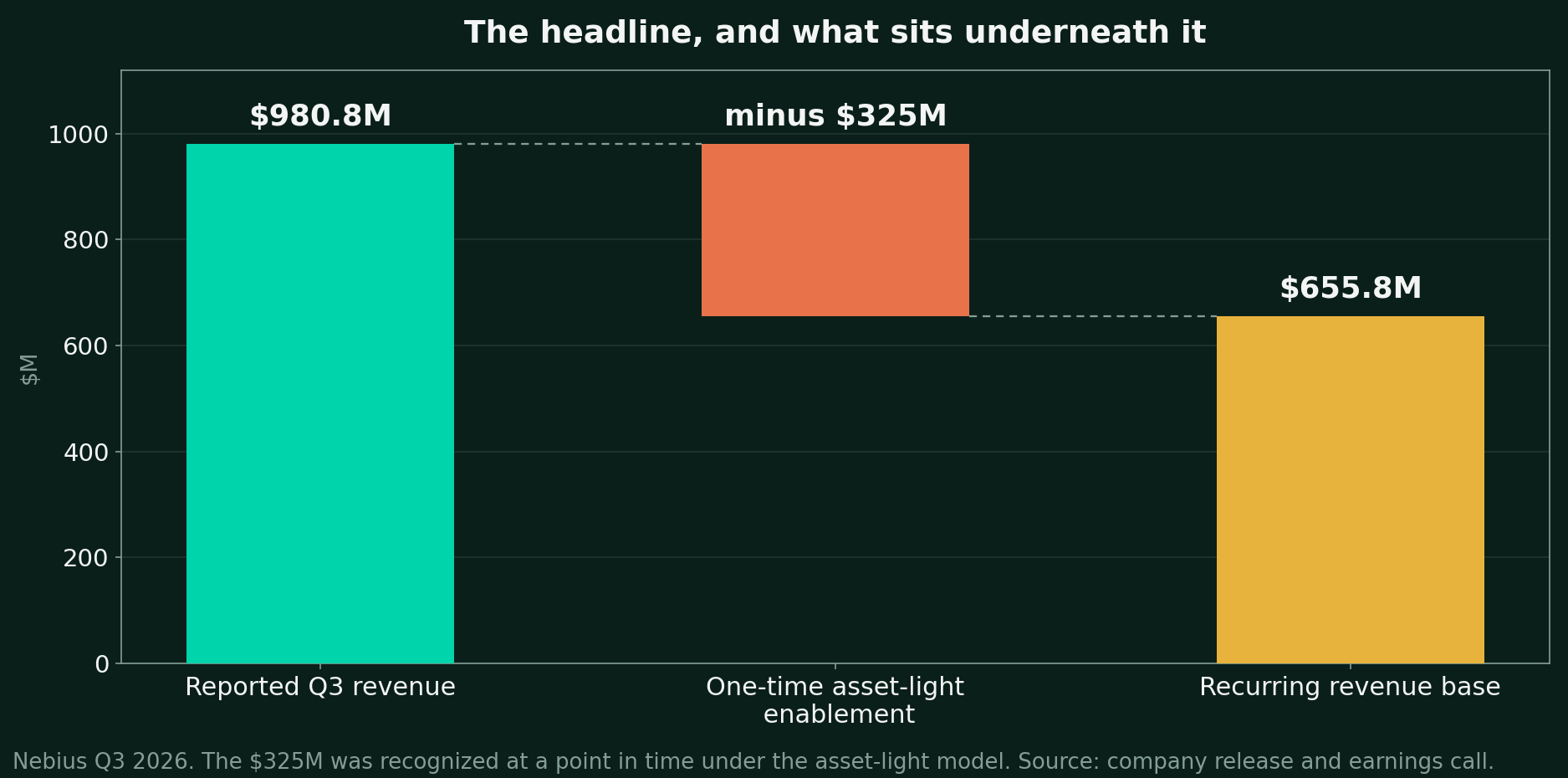
The margin tells the same story. Adjusted EBITDA margin printed 47.5%, up from 40.6% in the second quarter. Asked directly about the step-up, Alonso pointed to revenue recognized at a point in time that does not recur in the same form, and he held the full-year margin guide at about 40%. One quarter at 47.5% against a held guide near 40% implies a softer fourth quarter. New sites carry rent, power, and people ahead of their revenue.
What actually happened at Vineland?
Vineland is the New Jersey colocation site being built by DataOne to serve the Microsoft contract. The power plan changed in the summer. Temporary diesel generation from DataOne was meant to bridge the site until Bloom Energy fuel cells ramped up as the permanent source.
In late Q3, DataOne decided to wind down the temporary generation faster than expected. Andrey Korolenko's telling was plain: Bloom generation is live on site and producing power, and the work now is ramping it as fast as possible. The gap between the diesel exit and the fuel cell ramp is the delay.
Volozh said the company learned in August that the diesel plan would not work. The Bloom replacement cost a couple of months. Deliveries never stopped. Nebius handed Microsoft new tranches through the third quarter, and deliveries continue through November and December. The reset schedule puts more than half of the contracted Microsoft capacity online by year-end and the remaining tranches in the second quarter of 2027.
Two absences on the call deserve noting. No capacity was canceled, and Volozh said so explicitly. No remedies, credits, or penalties appeared anywhere in the discussion either.
The strategic answer is to own the ground. Volozh stressed that sites Nebius builds itself remain on track or ahead of schedule, with the Independence site in Missouri the named example. The 2027 delivery mix leans on owned sites in Alabama, Missouri, and Pennsylvania. Two Finland projects come online alongside them. The lesson the company is selling is that third-party power is the risk, and owned sites are the fix.
Who is paying for the build?
The customers are. That is the quarter's real story. Prepayments became the standard structure of Nebius agreements in Q3, with more than 90% of the contract value signed in the quarter carrying a prepayment. The average prepaid share of each agreement rose about 20 percentage points from the second quarter.
The coverage number is the one to remember. Prepayments on Q3 contracts covered more than 100% of the capex behind those wins, up from 50% to 60% in the second quarter. Boroditsky confirmed the coverage includes data center costs, not just servers and networking. Customers are funding whole sites before the sites exist.
The committed totals are large. Alonso expects $10B of committed customer prepayments in 2026 and $17B to $20B in 2027. His words on the 2027 figure: "This number is not a ceiling." The second leg is asset-backed financing, framed against more than $40B of committed investment-grade contract revenue anchored by the Microsoft and Meta agreements. The July facility, $775M at SOFR plus 250 basis points, is the framework's first draw.
Two numbers still do not exist in public. Management has never quantified the asset-backed framework's advance rate or its total dollar capacity. On disclosed figures alone, the 75% to 85% coverage claim leaves a residual 2027 gap of about $6B to $11.25B against capex of $40B to $45B. A $3.5B Citi bridge also matures on October 16, 2027, inside the very window it helps fund.
| The 2027 funding frame | Figure |
|---|---|
| 2027 capex guidance | $40B to $45B |
| Claimed coverage from prepayments and asset-backed financing | 75% to 85% |
| Expected 2027 customer prepayments | $17B to $20B |
| Residual gap on disclosed figures | About $6B to $11.25B |
| Citi bridge maturity inside the window | $3.5B on October 16, 2027 |
| Cash at September 30, 2026 | $7.4B plus $1.2B restricted |
Management's answer to the gap is a lever, not a loan. The company chooses its contract mix, and the mix sets how much external capital it needs. When corporate debt is expensive, Nave explained, Nebius allocates more capacity to long prepay-heavy contracts. When capital is cheap, it keeps more capacity for the spot market and raises debt opportunistically instead.
How candid was the guidance?
More candid than the headline trim suggests, in both directions. On the call, Alonso narrowed full-year 2026 revenue guidance to $3.0B to $3.2B, from the $3.0B to $3.4B range. The trim is timing, he argued, because third-party capacity shifted into 2027 rather than demand weakening.
The ARR story needs its own paragraph. The December run-rate target of $7B to $9B became a promise to exceed $7B for the month of February 2027. After February, the metric retires as a guided number. Management gave two reasons: ARR annualizes a single month and misses the base, and partnership revenue adds choppiness to it until that revenue ramps.
The 2027 guide went the other way. Revenue of $12B to $13B is roughly four times the 2026 guide, and Alonso defended it as built on a very conservative view of capacity timing. Most of that capacity sits on sites Nebius owns, which is the control argument again. Capex tells the scale: about $27B now expected for 2026, and $40B to $45B for 2027, sized for more than a gigawatt of new capacity.
One promise carries an accounting footnote. Pretax breakeven is expected in the fourth quarter of 2027, and Alonso stated the target on a five-year depreciation life for servers and network equipment. The company lengthened that life from four years in 2026. A longer life lowers annual depreciation, and readers should hold the breakeven promise and the accounting choice in the same hand.
Where does the new demand actually come from?
Mostly from customers Nebius already had. Boroditsky said the high majority of the more than $12B of new contract value signed since the start of Q3 came from AI natives. These are not cold logos. Most started somewhere small on the platform, through a capacity auction or a modest deployment, and then scaled into landmark expansions.
That makes the auction a funnel, not a sideshow. Nebius now runs reserve capacity auctions and publishes spot pricing, and Volozh described both as the mechanism that tells the company what its capacity is worth. Prices were raised at the start of September. The new release of capacity carried higher prices, higher prepayment terms, and longer durations at the same time.
The terms held. Q3 agreements closed above $25M of annual contract value per megawatt, up from $20M to $25M in the second quarter. Payback on new capacity shortened to 1 year and 7 months. Enterprise logos are arriving behind the natives, with first multiyear agreements from Databricks and Datadog and Snowflake.
Why did the backlog barely move?
Here is the quarter's arithmetical puzzle. Customers signed more than $12B of new contract value from the start of Q3, yet remaining performance obligations rose only 3% in the quarter, to $38.7B. Tyler Radke of Citi asked the question directly.
Boroditsky's answer had two moving parts. Several of the agreements were signed after the quarter ended, so they land in next quarter's reported commitments. The rest is mix: existing customers expanded on longer terms and higher rates rather than entirely new obligations stacking onto the total.
The explanation is plausible, and it is also testable. If signings after quarter-end explain the gap, fourth-quarter RPO should jump by roughly the deferred amount. If it does not, the question returns with interest. We will grade this one on the next print.
Is the platform a business yet?
Not yet, and the call was unusually clear about the distance. The asset-light deal behind the $325M was the model's first transaction. Nave walked through the two revenue moments again. Value is recognized when the capacity and the architecture and the supply chain are locked. It is recognized again when the capacity comes online and is sold through Nebius channels.
Here is the tell worth underlining. The 2027 revenue guidance includes zero asset-light revenue. Management framed the exclusion as conservatism, one more prudent assumption inside a prudent guide. If a second transaction lands in 2027, it arrives as upside the guide never claimed.
The product layer keeps compounding quietly. Token Factory is priced per token as a managed service with service levels distinct from raw GPU hours, and Chernin confirmed it will be the first platform to support NVIDIA's Groq 3 LPX. The inference product is approaching a multi-hundred-million-dollar run rate, with contract value up 17x quarter over quarter.
The stack underneath is shipping like software. The cloud platform versions as a product under the Aether name. The quarter folded Eigen and Clarifai and Inferize into it. Inferize attacks model loading and cold starts, which is utilization, which is margin. Palantir sits on top of the same stack as its preferred sovereign AI infrastructure partner, a channel into enterprise demand rather than a booked contract.
What would prove the platform story? A named partner, a disclosed fee, or a second transaction with terms attached. What would kill it? A 2027 that ends with the first transaction still standing alone. Until one of those prints, the platform is a documented option on a second business, and it should be priced as an option.
What did nobody ask about?
Receivables. The balance reached $4039.9M at September 30 against $720.3M at the end of 2025. The timing matters more than the total. The balance shrank during the first half of the year, so the entire build happened inside the third quarter. One quarter added about $3.76B of money owed to Nebius.
The call contained no discussion of receivables at all. No analyst asked, and management did not volunteer the topic. The filing names no debtor and gives no concentration percentage, and the only credit signal on record is a nine-month expected credit loss provision of $15.0M, about 0.4% of the book.
We offer no explanation here because the public record offers none. A balance of this size turning over in one quarter is either a timing artifact of very large deliveries or the start of a collection question. The fourth quarter cash flow statement will separate those two readings. Until then it sits on the open list, at full size.
How fast is the share count growing?
Slower than the build, and by choice of instrument. The at-the-market program issued 4.6M shares in the quarter at a weighted average price of $229.10, raising about $1.0B. Alonso's description was precise: "The ATM remains a flexible tool, not a commitment." Another 7.6M shares remain available under the program.
The cumulative effect still compounds. The weighted average share count is up about 24% year over year. The ATM, the convertible exchanges, and the NVIDIA pre-funded warrants did the lifting. No new equity raise was announced on the call. Dilution is a standing cost of this model rather than this quarter's surprise, and the rebuilt scenarios in our paired report carry it explicitly.
What did the market say, and where do we land?
The market graded the quarter before it could read it. NBIS rose 15.44% on November 11, closing at $154.69, in sympathy with CoreWeave's print the night before. On Nebius's own numbers the shares fell hard, trading near $127 intraday on November 12. At that level the market pays roughly three to four times guided 2027 revenue for the fastest-growing infrastructure name in its class.
Our read holds both halves. The demand evidence strengthened again: pricing up, prepayments past full capex coverage, and a funnel that converts auctions into landmark contracts. The delivery and disclosure evidence weakened: a flagship site slipped on a partner's power decision, the backlog barely moved, and a $4B receivable appeared without a word of explanation.
That mix is why the score sits at 65 and not back at 70, and also why it does not fall further. The next grading date is the fourth quarter print. The RPO explanation and the Vineland schedule and the receivable all come due at once.
Related reading: the paired Nebius vs Akamai report, the Nebius investment report and five-pillar analysis, and Nebius at Goldman Sachs on the demand script this quarter had to cash.
Frequently asked questions
Did Nebius beat Q3 2026 expectations?
On growth yes, and on quality only partly. Revenue of $980.8M rose 571% year over year and adjusted EBITDA margin printed 47.5%. About $325M of that revenue was one-time asset-light recognition, though, leaving a recurring base near $656M. Management held the full-year margin guide near 40% regardless.
What is funding Nebius's 2027 capex plan of $40B to $45B?
Mostly the customers. Prepayments covered more than 100% of the capex behind Q3 contracts, $17B to $20B of prepayments are expected in 2027, and asset-backed financing sits against more than $40B of committed investment-grade contracts. A residual gap near $6B to $11.25B remains on disclosed figures.
What would change the DalalBytes score on Nebius?
Delivery, graded on the fourth quarter. Q4 revenue at or above the implied $1.04B with Vineland tranches landing on the reset schedule moves the 65/100 Selective Positive score back toward 70. Another delivery slip, or an equity raise on distressed terms, takes it under 60 instead.
Disclosures
Research and opinion, not investment advice. The author holds a long position in Nebius (NBIS). Positions may change without notice. Figures are drawn from the company earnings release and shareholder letter and from the earnings call and Form 6-K statements. DalalBytes research on Nebius: investment report, five-pillar analysis, and the paired Nebius vs Akamai report.
© 2026 DalalBytes Research · For educational purposes only. Not investment advice.