

What did CAVA actually report in Q3 2026?
CAVA reported third quarter 2026 results after the close on Wednesday, November 4, 2026. The verdict first: this was two prints in one. The forward print was strong, with the full-year comps guide raised to 6.0% to 7.0%, the openings guide raised to 76 to 78, and the 500th restaurant opened ahead of the plan. The backward print was weak where our October research said it could not afford to be weak. Same-restaurant sales of 3.1% missed the guide floor, and restaurant-level margin of 23.4% broke the floor of the company's own full-year range. The market graded the backward print.
Basis of this piece. This article is built from CAVA's written Q3 2026 earnings release and the scorecard we set before the print. We have not yet read the earnings call transcript, so no call commentary is included and nothing here asserts what management did or did not say on the call. The call grading lands in the Friday Weekly Close pass.
| CAVA, Q3 2026 | Yardstick | Call | |
|---|---|---|---|
| Total revenue | $356.4M, +22.0% YoY | About $358M consensus mark | Near miss |
| CAVA revenue | $353.7M, +22.1% YoY | Growth above 20% | Pass |
| Diluted EPS | $0.11 | $0.12 consensus bar | Near miss |
| Same-restaurant sales | +3.1% | 4.5% full-year guide floor | Fail |
| Net new openings | 24, to 500 restaurants | At least 19, to about 495 | Pass |
| Restaurant-level margin | 23.4% | 23.7% full-year guide floor | Fail |
| Adjusted EBITDA | $42.3M, +5.7% YoY | About $40M keeps the year on pace | Pass |
| Full-year guide | Comps and openings raised | Raised or held, no line cut | Partial |
THE VERDICT
The print weakens the 74/100 Positive from our October 6 research report without breaking it. The library proposes 68/100 Selective Positive at the formal research refresh, and that number is labeled proposed here, not struck. The business did not break. The perfection premise did, and the score should stop paying for it.
How did the six pre-print gates score?
Before the print we set six pass or fail gates for this quarter, scored against the full-year guide ranges and the second quarter baseline, since CAVA guides the full year only. Here they are, graded one by one against the release.
| Gate | The bar | The print | Grade |
|---|---|---|---|
| 1. Revenue and EPS | Total revenue at or above about $358M and EPS at or above $0.12 | Revenue of $356.4M sat under the pass mark and above the $350M fail line. EPS of $0.11 was a penny under the bar | Near miss |
| 2. Same-restaurant sales, traffic first | Comps at or above the 4.5% guide floor with guest traffic positive | Comps rose 3.1%. Traffic was slightly positive and price and mix added 3.0 points, so the quality shape held while the level missed | Fail |
| 3. Unit growth | At least 19 net new openings, to about 495 or more | 24 openings took the count to 500. Average unit volume held at $3.1M | Pass |
| 4. Restaurant-level profit and margin | Profit at or above about $83.8M with margin at or above 24.3% | Profit of $82.7M missed the mark and margin of 23.4% broke the 23.7% guide floor | Fail |
| 5. Adjusted EBITDA pace | About $40M or more keeps the year tracking inside the guide | Adjusted EBITDA of $42.3M. Forty-week EBITDA of $158.8M leaves about $25M to $30M needed from the fourth quarter | Pass |
| 6. The full-year guide | Raised on a line or reaffirmed intact, with any cut a fail | Comps raised to 6.0% to 7.0% and openings to 76 to 78. EBITDA midpoint held. The margin range top was trimmed and pre-opening costs rose | Partial |
Two passes, one near miss, one partial, and two fails. The fails are not randomly distributed. They sit exactly on the two lines the October report said a perfection price cannot tolerate for long: comp momentum and restaurant-level margin.
Why did the margin break its own floor?
Restaurant-level profit was $82.7M at a 23.4% margin, about $1.1M under the consensus mark for the profit line. The margin fell 230 basis points in one quarter, from 25.7% in the second quarter, and 120 basis points year over year. The full-year guide the company reaffirmed in August carried a floor of 23.7%. This print came in under the floor of a range the company itself set, which makes it the first margin print of the story that management's own framing cannot absorb.
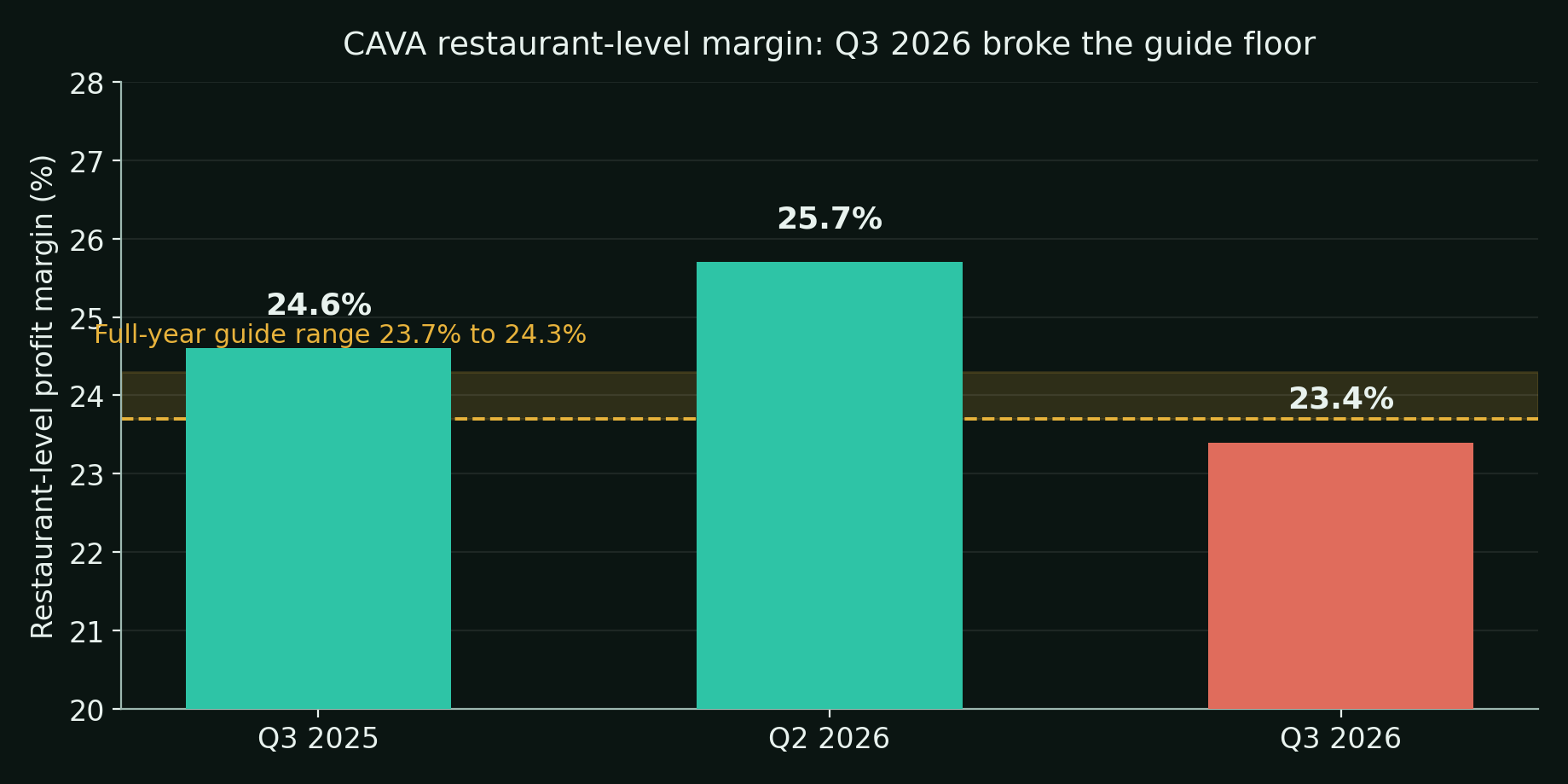
The release names the causes, and the list changed from the second quarter:
- Labor investments inside the restaurants
- A higher mix of third-party delivery orders
- Repairs and maintenance spending
The salmon input cost that pressured the second quarter is gone from the list. Delivery mix is not, and it is the structural item on it, because a delivery order carries a platform cost a dining room order does not. After the print, the company trimmed the top of its full-year margin range from 24.3% to 24.0% while holding the 23.7% floor. Read together, the guide now defends the floor it just broke rather than the range it set in August.
How much of the comp miss was the produce scare?
Same-restaurant sales rose 3.1%, against 9.0% in the second quarter, when guest traffic added 5.3 points on its own. This quarter traffic was only slightly positive, and menu price and mix supplied 3.0 of the 3.1 points. The release quantifies the headwind the second quarter had already flagged: Cyclospora concerns and broader fresh produce worries cut comps by about 150 basis points in the quarter. On that arithmetic the ex-impact comp of about 4.6% would have sat right at the 4.5% floor.
Our gate had no ex-impact clause, so it grades fail with the cause on the record. That is the honest way to run a scorecard, and it cuts both ways. The traffic line is the piece of good news inside the fail: guests still came, in slightly larger numbers, through a quarter in which the category had a food safety headline running against it. A traffic-negative print would have broken the quality claim in the October report. This one bent it.
What did the guide actually change?
| Full-year 2026 guide line | Before the print | After the print | Read |
|---|---|---|---|
| Same-restaurant sales | 4.5% to 6.5% | 6.0% to 7.0% | Raised |
| Net new openings | 75 to 77 | 76 to 78 | Raised |
| Adjusted EBITDA | $181M to $191M | $184M to $189M | Midpoint held at about $186M |
| Restaurant-level margin | 23.7% to 24.3% | 23.7% to 24.0% | Top trimmed, floor held |
| Pre-opening costs | $22.0M to $22.5M | $28.5M to $29.5M | Raised on the faster opening pace |
The comp raise is the upside surprise the October report flagged as missing in the second quarter, when guidance was reaffirmed rather than raised. Issuing it against a soft quarter is a credibility deposit, and it matters more than the margin trim at the top of the range. Our scorecard's fail trigger for this gate was any line cut, with a comp or EBITDA cut the most damaging. Neither of those two was cut. The margin top end was, and the pre-opening line rose because the company is opening restaurants faster than planned, which is the good kind of cost increase.
What did the stock do?
CAVA closed the regular session at $61.98 on Wednesday, up from $60.31 at the prior close, and then fell 11.2% in after-hours trading to $54.68, per StockStory's snapshot published at 5:12 PM ET. The market did not sell the comp miss, which came with a named and quantified cause. It sold the margin break, the one number in the release that contradicts the unit-economics claim the valuation rests on.
Our October 6 report graded CAVA 74/100 Positive at a $51.58 reference price, with 12-month scenario values of bear $30, base $85, and bull $120. The after-hours price of $54.68 sits just above that reference price and far closer to the base case than to the bear. The market has repriced the perfection premise, not the business.
Does the 74/100 still stand?
Not at full strength. Graded leg by leg, the unit-economics leg takes the direct hit, because 23.4% is the first margin print under the company's own guide floor and the second straight sequential decline. The growth runway leg is intact to stronger, with 24 openings, the 500th restaurant ahead of schedule, the openings guide raised, and average unit volume held at $3.1M. The guide-credibility leg improved on the line that mattered most. The cash leg is steady, with forty-week operating cash flow of $181.6M and free cash flow of $37.1M.
That mix supports a downgrade, not an exit from the thesis. The library proposes 68/100 Selective Positive at the formal research refresh, labeled here as proposed rather than final. What would rebuild the score is the mirror image of this print: margin back inside the guided range with comps still traffic-led. What would cut it further is another sequential margin decline, or a comp guide cut of the kind this quarter avoided. The next checkpoint is the fourth quarter print, and the call transcript grading lands first, in the Friday Weekly Close pass.
Research and opinion, not investment advice. Do your own due diligence before investing.
Frequently asked questions
Did CAVA beat expectations in Q3 2026?
Not cleanly. Total revenue of $356.4M, up 22.0%, landed just under the roughly $358M consensus mark, and diluted EPS of $0.11 came in a penny under the $0.12 bar. The quarter mixed strong unit growth and a guidance raise with a comp shortfall and a restaurant margin that broke the company's own floor.
Why did CAVA's restaurant-level margin fall in Q3 2026?
The release names three causes: labor investments, a higher mix of third-party delivery orders, and repairs and maintenance spending. Margin printed 23.4%, down 230 basis points from the second quarter and below the 23.7% floor of the company's full-year guide. The salmon input cost that pressured the second quarter was no longer on the list.
Does the DalalBytes score on CAVA change after Q3 2026?
The library proposes a cut from 74/100 Positive to 68/100 Selective Positive at the formal research refresh, and this article labels it as proposed rather than final. The unit-economics leg weakened on the margin break, while the growth runway and guide-credibility legs improved. The business did not break; the perfection premise did.
Disclosures
Not financial advice. This article is published for educational purposes only. Nothing here is a recommendation to buy, sell, or hold any security, and nothing here is financial advice. Investing involves risk, including the possible loss of principal.
Positions. The author is long CAVA Group (CAVA). CAVA is an owned position and is researched in the DalalBytes library, most recently in the October 6, 2026 research report graded 74/100 Positive.
Accuracy. This analysis is built from public sources believed to be reliable, including CAVA's Q3 2026 earnings release via Business Wire, CAVA's Q2 2026 release, the pre-print scorecard graded against that release, consensus figures as reported by Zacks and MarketBeat, the regular session close as reported by Finnhub, and after-hours price coverage by StockStory. The earnings call transcript had not been read when this article was published, and no call commentary is included. Errors can occur and facts change; verify independently before acting on anything you read.
No advisory relationship. Reading this site does not create an advisor-client relationship of any kind. See the full disclosures page.