
Frequently asked questions
Is Vinati Organics a buy at current prices?
DalalBytes rates Vinati Organics Selective Positive at 70/100. It holds about 65% global share in both IBB and ATBS per CARE, trades at 25.9 times FY26 EPS of Rs 42.80 near its 52-week low of Rs 1,115, carries almost no debt with a CARE AA+ Stable rating, and grew Q1 FY27 revenue 28%.
What are Vinati Organics' FY2029 price targets?
DalalBytes' FY2029 targets for Vinati Organics are bear Rs 1,090, base Rs 1,685, and bull Rs 2,390, from a Rs 1,118.60 reference price (NSE close, October 19, 2026). Scenarios build on FY26 EPS of Rs 42.80. Bear: 5% EPS CAGR, about Rs 50 EPS, 22x. Base: 12%, about Rs 60, 28x. Bull: 18%, about Rs 70, 34x.
What is the verdict on Vinati Organics?
The business quality grades in the high 70s: two world-title products at about 65% global share, an integrated feedstock chain, operating margin of 29% in FY26, operating cash conversion above 100%, a near debt-free balance sheet rated AA+ Stable, and promoters at 74.29% with zero pledging. Three deductions bring it to 70: a partial sunrise in steady or cyclical end markets, a flat FY26 with a delayed Veeral Organics ramp costing roughly Rs 44 crore of consolidated PAT against standalone, and free cash flow that was negative in three of the last five years with a cash conversion cycle of 152 days.
How did Vinati Organics start?
Vinod Banwarilal Saraf, an MBA topper at BITS Pilani with Aditya Birla and MRPL experience, founded the company in 1989 and named it after his daughter Vinati, then age six. The first product was IBB, made with French IFP technology in a Rs 14 crore project at Mahad, with commercial production from July 1992 at 1,200 TPA. Indian ibuprofen makers then imported IBB at 110% duty, and the only two global makers, in the UK and US, later exited; the 2007 Chevron Phillips exit shifted US demand to Vinati. ATBS followed at Lote in October 2002 at 1,000 MT, making Vinati the third global producer. His daughter Vinati Saraf Mutreja (Wharton, ex-Oliver Wyman) joined in 2006 and has been MD and CEO since 2018.
What does Vinati Organics make?
Thirty-plus products from four sites at Mahad and Lote, Maharashtra, with exports at about 56% of revenue across 40+ countries. IBB is the ibuprofen intermediate, a pharmaceutical annuity where supplier changes trigger regulatory revalidation. ATBS is the growth engine, a monomer that keeps polymers stable at high temperature and salinity for oilfield and enhanced oil recovery, water treatment, personal care, adhesives and specialty polymers. Isobutylene (IB), where Vinati is India's largest maker, is the integrated feedstock backbone feeding IBB, butyl phenols (India's largest; sole domestic producer) and sole-producer derivatives including TBA, TB Amine, OSBP and DSBP. Customers include BASF, Dow, SNF, Mitsubishi and Chemtall, and sales are largely cost-plus or long-term contracts.
How do the Veeral deals and the expansion programme fit?
Veeral Additives was merged in December 2023 under an NCLT scheme, bringing antioxidant capacity of 24,000 TPA, among Asia's largest setups, and internalising the conversion step downstream of Vinati's own butyl phenols. Wholly owned Veeral Organics (VOPL) is building MEHQ and Guaiacol (3,000 TPA combined), Anisole (5,000 TPA), Iso Amylene (30,000 TPA) and 4-MAP (1,000 TPA) in an about Rs 500 crore programme; CARE records the ramp as delayed in FY26, and the gap between standalone PAT of Rs 488 crore and consolidated PAT of Rs 444 crore is its current cost. ATBS Phase 1 added 10,000 TPA on November 5, 2025, taking capacity to 50,000 MT. Capex was Rs 391 crore in FY25 with FY26 guided at Rs 350 to 400 crore; 32.5 MW of solar was added in FY25, and a US subsidiary was incorporated in February 2025.
What do Vinati Organics' financials show?
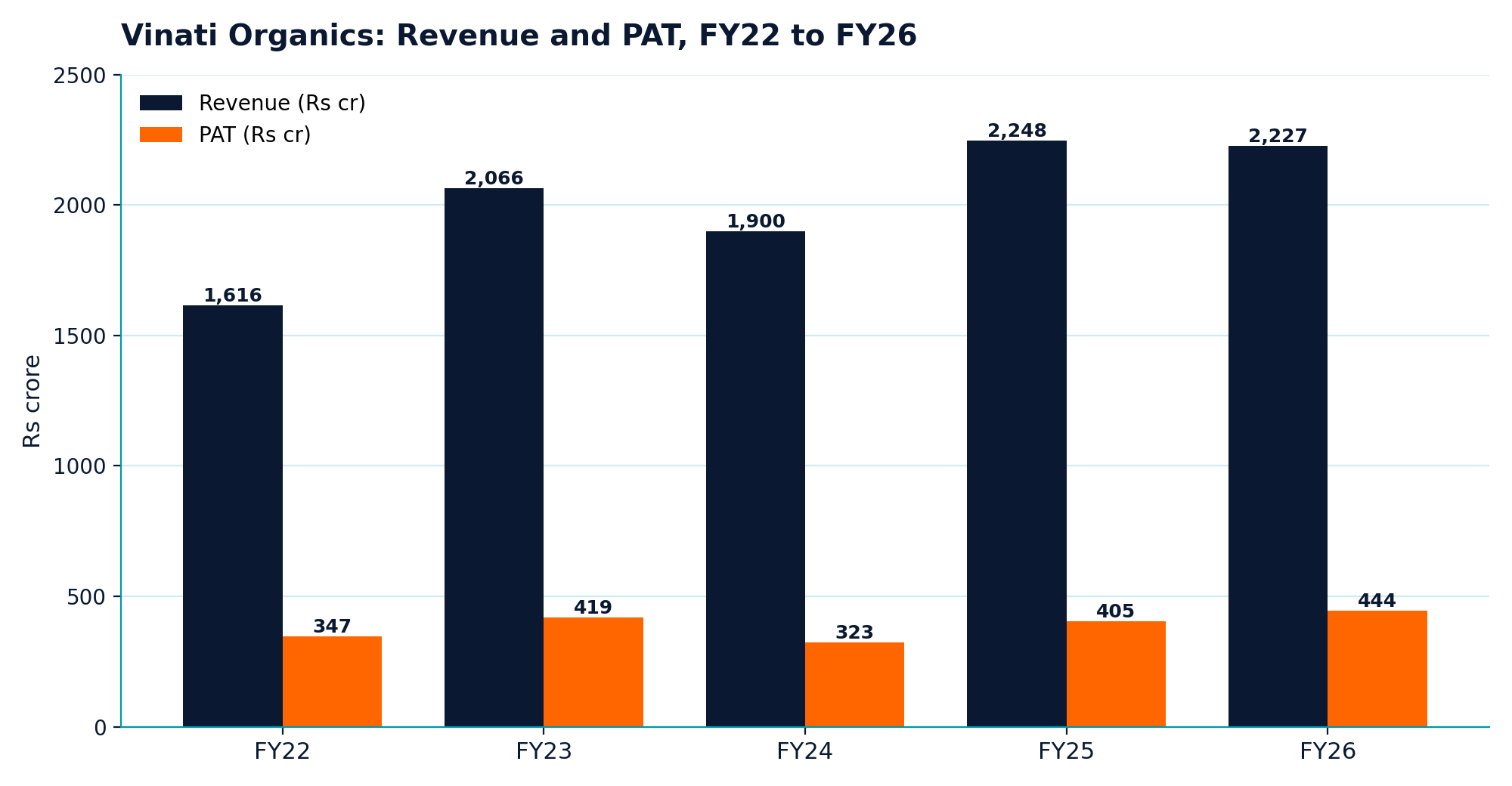
| Fiscal year | Revenue (Rs cr) | Operating profit (Rs cr) | OP margin | PAT (Rs cr) | EPS (Rs) |
|---|---|---|---|---|---|
| FY22 | 1,616 | 435 | 27% | 347 | 33.72 |
| FY23 | 2,066 | 573 | 28% | 419 | 40.78 |
| FY24 | 1,900 | 471 | 25% | 323 | 31.15 |
| FY25 | 2,248 | 582 | 26% | 405 | 39.09 |
| FY26 | 2,227 | 655 | 29% | 444 | 42.80 |
| Q1 FY27 | 696 | 170 | 24% | 109 | n.d. |
Screener.in consolidated. FY24 was the destocking correction (revenue down 8%, PAT down 23%); FY26 was margin-led on flat revenue; Q1 FY27 revenue grew 28% on Q1 FY26 revenue of Rs 542 crore. Management guides FY27 EBITDA margin at 26 to 27%.
How strong are the balance sheet and cash flow?
Fortress grade. Borrowings were about nil on Screener at FY26 end (CARE records total borrowings of Rs 26.71 crore and gearing of 0.01x), net worth was about Rs 3,161 crore, and CARE reaffirmed AA+ Stable and A1+ on October 8, 2026. Operating cash flow reached Rs 558 crore in FY26 with CFO to EBITDA of 106%, and free cash flow printed Rs 288 crore. The honest deduction: free cash flow was negative in FY22, FY24 and FY25 as capex funded the build, and working capital is lengthening, with inventory days up to 110 from 68, debtor days of 85, and a cash conversion cycle of 152 days. The FY26 dividend is Rs 8.50 a share, a payout of about 20% and a yield of 0.76%.
Who runs Vinati Organics, and is governance clean?
The founder is Chairman; his daughter has run the company as MD and CEO since 2018 after a twelve-year apprenticeship from 2006. The delivery record under her tenure is the current investment case: the ATBS expansion commissioned in November 2025, the Veeral Additives merger closed in December 2023, the VOPL programme, solar and the US subsidiary, all funded internally in the founder's financial style. The recorded miss is the delayed VOPL ramp. Promoters hold 74.29%, unchanged for eight-plus quarters, with zero pledging and no dilutive raises; FII holds 3.64% and DII 9.00%, so institutional discovery is still early.
Who competes with Vinati Organics?
In the flagship ponds, the competition is mostly history: the original IBB makers exited, and no named challenger matches about 65% global share in either IBB or ATBS. The contestable business is antioxidants, where China and Singapore producers set the price ceiling for the 24,000 TPA Veeral capacity, per broker notes. Among listed Indian specialty peers, Fine Organic Industries holds premium niche positions, Aarti Industries is larger and more diversified, Galaxy Surfactants owns consumer-linked surfactant niches, and SRF combines chemicals with textiles and films. None holds two global titles, and Vinati currently carries the lowest multiple of the set because its recent growth print is the weakest.
What is Vinati Organics worth?
At Rs 1,118.60: 25.9x FY26 EPS of Rs 42.80, about 3.7x book value of Rs 305, dividend yield 0.76%, market cap Rs 11,596 crore, a one-year return of about -34%, and a price near the bottom of the 52-week range of Rs 1,115 to Rs 1,713. Approximate peer multiples at October 19, 2026: Fine Organics about 37.8x, Galaxy Surfactants about 25.2x, Aarti Industries about 34.5 to 36x, SRF about 36.4x. FY2029 scenarios (DalalBytes modelling on FY26 EPS of Rs 42.80 and about 10.37 crore shares): bear Rs 1,090 (5% EPS CAGR, about Rs 50 EPS, 22x), base Rs 1,685 (12% CAGR, about Rs 60 EPS, 28x), bull Rs 2,390 (18% CAGR, about Rs 70 EPS, 34x). The base case is about 51% above the reference price, conditional on the new capacities converting into volume.
What are the key risks for Vinati Organics?
Ramp risk first: a second year of VOPL delay turns a timing drag into a capital allocation verdict. Pricing risk: antioxidants earn against China and Singapore supply, without the flagship moat. Cycle risk: FY24 showed revenue can fall 8% and PAT 23% in a destocking year, and oilfield demand inside ATBS is cyclical. Working capital: inventory days of 110 and a 152-day cash conversion cycle make growth more balance-sheet hungry. Concentration: two products carry the global-title economics across four Maharashtra sites. Trade: CARE assesses US tariff impact as negligible today, with ATBS exempt and limited substitutability, but exports are 56% of revenue and exemptions are policy decisions.
© 2026 DalalBytes Research · For educational purposes only. Not investment advice.