
Frequently asked questions
How does Unicommerce eSolutions score on the five pillars?
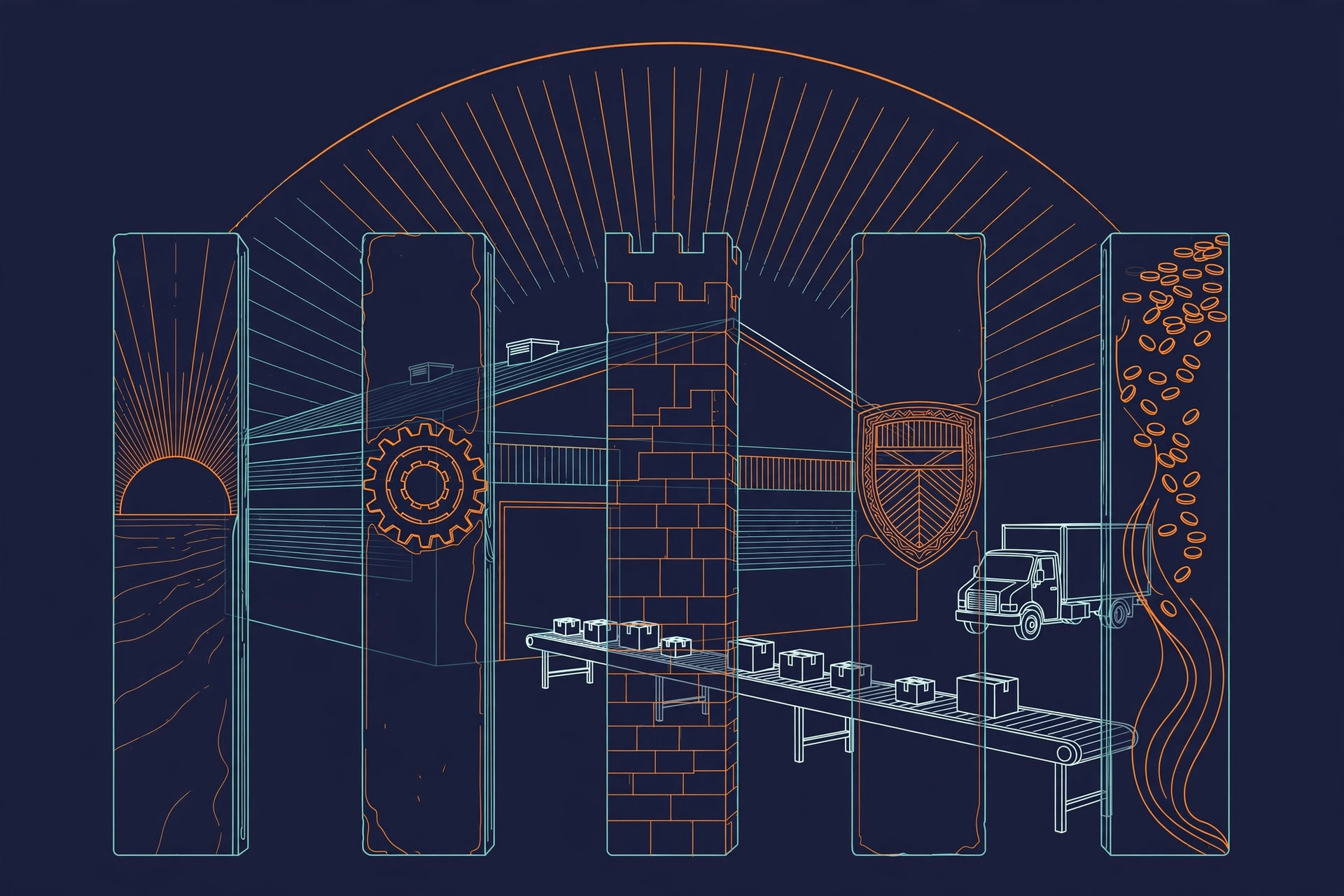
Unicommerce eSolutions passes three of five pillars: sunrise, iron fortress and free cash flow, with leadership and moat grading partial. Borrowings are about Rs 9 crore against Rs 92.6 crore of cash and bank balances at June 2026, free cash flow was Rs 45 crore in FY26, and the niche rides India's fragmented multi-channel commerce. The partials reflect a workflow moat rivals can build against, promoter dilution to 36.01%, and a near-total institutional exit from the register.
Why does leadership only grade partial for Unicommerce eSolutions?
DalalBytes grades Unicommerce eSolutions' leadership partial because the operating record and the alignment record point in different directions. Kapil Makhija has run the company profitably since July 2017, kept it independent through Snapdeal's crisis and a failed sale process, listed it in 2024 and integrated Shipway quickly. Against that, promoter holding has been diluted from 39.42% to 36.01%, the board interlocks with the AceVector group, no dividend has ever been paid, and FII and DII holdings have fallen to 0.02% and 2.38% since listing.
Pillar 1: Is the sector a sunrise? (PASS)
The tailwind is the fragmentation of Indian commerce itself. No single channel dominates: Amazon, Flipkart, Meesho, quick commerce and thousands of D2C webstores split the market, so every serious brand must sell in many places at once and every added channel multiplies operational complexity. Middleware that absorbs that complexity is not discretionary. Processed order items rose from 772 million in FY24 to 950 million in FY25, the annualised run rate crossed 1 billion in February 2025, quick commerce items jumped from about 20 million in Q4 FY25 to about 70 million plus in Q3 FY26, and the company reported festive week volumes up 31% year on year in October 2026 with quick commerce up 85%. PASS.
Pillar 2: Can the leadership execute? (PARTIAL)
On operations, yes: Kapil Makhija became CEO in July 2017 after the founders' post-acquisition exit, has kept the company profitable on an adjusted basis since FY18 on management's account, delivered a 168x subscribed IPO in August 2024 and integrated Shipway in months. The business survived Snapdeal's 2017 crisis and a failed sale to Infibeam without rescue capital. The deductions are alignment: promoter holding diluted from 39.42% to 36.01% (dilution from the Shipway share swap, not selling; AceVector still held 29.11 million shares in June 2026, no pledging reported), an AceVector-interlocked board, no dividend ever, and FII and DII holdings down to 0.02% and 2.38%. PARTIAL.
Pillar 3: Does a moat protect returns? (PARTIAL)
The evidence is operational: Uniware sits inside the daily workflow of 1,039 enterprise clients and 7,500+ businesses, with 285+ integrations, 11,700+ connected warehouses and stores, and a claimed 25 to 30% of India's dropship volumes processed in FY25. Client concentration is improving (top 10 Uniware clients at 12.6% of Uniware revenue in 9M FY26, from 19.0% in FY25) and Shipway cross-sell into the base doubled in a year. The limits: order management is buildable software, Increff, Vinculum, EasyEcom and Anchanto compete for the same budgets, Shopify and marketplace tools keep absorbing features, and fulfilled-by-marketplace programmes could pull volume inside Amazon and Flipkart's walls. A moat of habit and integration count, not of law or network effect. PARTIAL.
Pillar 4: Is the balance sheet a fortress? (PASS)
Net worth of Rs 193 crore at March 2026 against borrowings of about Rs 9 crore, cash and bank balances of Rs 92.6 crore by June 2026 (about 10% of market capitalisation), no pledging reported, and an IPO that raised no fresh money, so the cash is earned. The honest deduction inside the pass: about Rs 164 crore of the Rs 271 crore asset base is fixed assets including Shipway intangibles and goodwill, so an impairment would dent net worth without touching cash. Survivability is not in question. PASS.
Pillar 5: Does the free cash flow show up? (PASS)
Operating cash flow of Rs 6 crore, Rs 28 crore and Rs 47 crore across FY24 to FY26, and free cash flow of Rs 6 crore, Rs 21 crore and Rs 45 crore: a free cash flow yield of about 4.8% at the October 16, 2026 market capitalisation. FY26 operating cash flow was about 153% of operating profit on Screener's measure, debtor days improved from 47 to 20, and capex is a rounding error in an asset-light SaaS model. The watch item is mix quality: part of the consolidated cash machine now runs on Shipway's courier float and pass-through economics, and Q1 FY27 operating margin fell to 10.6% on front-loaded growth investment. On the record to date, generation and conversion pass clearly. PASS.
What would change the grade?
Leadership upgrades if promoter holding stabilises and institutional holders return, and downgrades on any related party transaction that moves value toward the AceVector group. Moat upgrades if Uniware holds its share of processed volumes as quick commerce scales, and downgrades if marketplace fulfilment programmes visibly take volume. Sunrise downgrades only if Indian e-commerce consolidates into one or two walled gardens, which would shrink the middleware opportunity with it.
© 2026 DalalBytes Research · For educational purposes only. Not investment advice.