
Frequently asked questions
Is Sterling Tools a buy at current prices?
DalalBytes rates Sterling Tools Neutral at 56/100. At Rs 201.63 the stock trades at 62x trailing earnings on trough EPS of Rs 3.30 and 1.39x book value of Rs 145. The standalone fastener business earned PAT of Rs 64.20 cr in FY26, while consolidated PAT was Rs 29 cr, because the EV subsidiaries lost money after Ola Electric insourced motor control units and removed about Rs 280 cr of revenue.
What are Sterling Tools' FY2029 price targets?
DalalBytes' FY2029 targets are bear Rs 120, base Rs 285, and bull Rs 510, from a Rs 201.63 reference price. Bear: 4% revenue CAGR to Rs 931 cr, PAT of Rs 34 cr, EPS of Rs 9.4 at 13x. Base: 12% CAGR to Rs 1,155 cr, PAT of Rs 68 cr, EPS of Rs 18.7 at 15x. Bull: 17% CAGR to Rs 1,326 cr, PAT of Rs 106 cr, EPS of Rs 29.2 at 17.5x. FY2029 is the year ending March 2029.
Why did consolidated profit fall when the fastener business grew?
Sterling E-Mobility earned Rs 380 cr of revenue in FY25, over 94% of it from Ola Electric. When Ola insourced MCU production for its Gen 3 platform, about Rs 280 cr of annual revenue vanished. Consolidated revenue fell from Rs 1,026 cr in FY25 to Rs 828 cr in FY26 and PAT halved to Rs 29 cr, even as standalone fastener income rose 11.4% to Rs 725.9 cr. In Q2 FY27 two EV subsidiaries lost Rs 9.81 cr on Rs 24.46 cr of revenue.
What is the verdict on Sterling Tools?
Sterling is two companies on one balance sheet. The fastener company is India's second largest high tensile fastener maker, running at 90 to 95% utilisation, with record standalone total income of Rs 228.0 cr in Q2 FY27. The EV company lost its anchor customer, guides to losses through FY27, and targets breakeven in FY28 at revenue thresholds several times its current run rate. The FY27 capex plan was raised to about Rs 135 cr on October 27, 2026, and borrowings rose 38% since March 2026 to about Rs 203 cr. Neutral, because the core is already the reason the stock is not cheaper, and the rebuild has not yet earned a multiple.
How did Sterling Tools start, and who owns it now?
Sterling was incorporated on June 7, 1979, began production in 1981 in Faridabad, and listed in 1995. It built its position over 47 years on the approved vendor lists of Maruti Suzuki, Honda, Hyundai, Hero, Tata Motors, Mahindra, Bajaj Auto, Ashok Leyland, Eicher, Volvo, Daimler, Cummins, John Deere and JCB. The Aggarwal family holds 64.86% (September 2026), down slightly from 65.77% held for years, with pledging at 0.00%. The 2026 share transfers were intra family gifts, not sales.
What does the business actually do?
Fasteners: steel wire is drawn at Ballabgarh, cold forged at room temperature for strength and tolerance, heat treated, threaded and coated at Faridabad, Prithla and Bengaluru. Output is over 2,000 types of bolts, nuts and special fasteners from 5 mm to 24 mm, at a combined 45,324 MTPA on company material. EV parts: SEM (Sterling E-Mobility Solutions) makes motor control units under a Jiangsu Gtake licence, plus motors, onboard and off board chargers, DC/DC converters and power distribution units. STML makes HVDC contactors (GLVAC) and latching relays (Meishuo) at Bengaluru. A Nanjing Haohang collaboration adds two wheeler rider assistance systems.
Where does the revenue come from?
Standalone fasteners earned revenue of Rs 716.72 cr and total income of Rs 725.9 cr in FY26, up 11.4%, with PAT of Rs 64.20 cr. SEM earned Rs 380 cr in FY25, 37% of group revenue, then collapsed to about Rs 37 cr in H1 FY27 after the Ola exit. STML is pre-scale, with HVDC production from mid 2026. Consolidated revenue was Rs 828 cr in FY26. About 99% of FY25 revenue was domestic, with exports down to about 1% from 7 to 9% in FY20 to FY22.
What do the financials show?
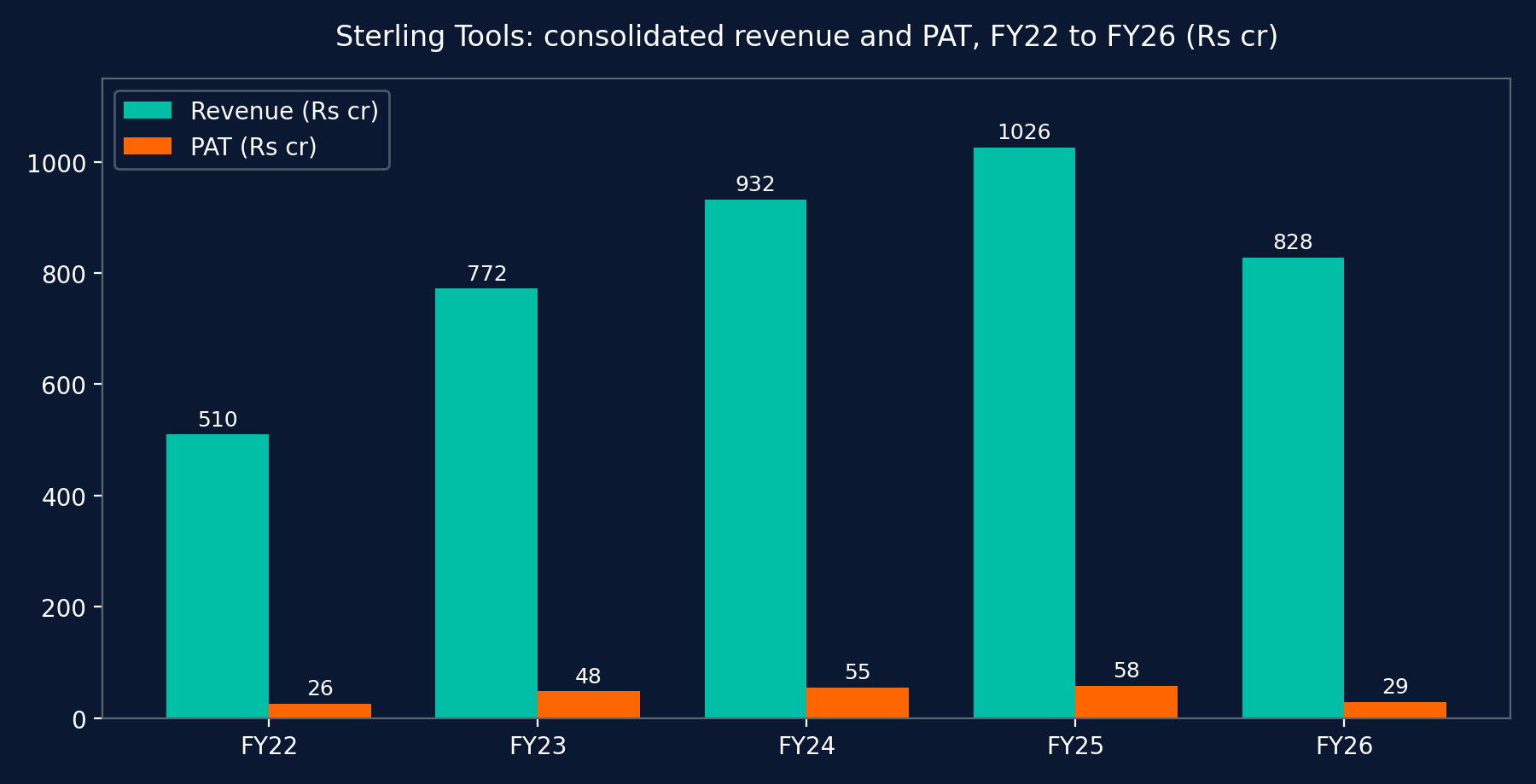
Consolidated revenue went Rs 510 cr, Rs 772 cr, Rs 932 cr, Rs 1,026 cr, Rs 828 cr across FY22 to FY26, with operating margin of 13%, 13%, 12%, 11% and 9%, and PAT of Rs 26 cr, Rs 48 cr, Rs 55 cr, Rs 58 cr and Rs 29 cr. FY26 was not an industry downturn: Indian vehicle production set records and standalone fastener income rose. It was one customer's insourcing decision. Screener puts FY26 ROCE at 7.2% and ROE at 3.1%, against standalone ROE of about 12%. Q2 FY27, reported October 27, 2026, showed consolidated revenue of Rs 250.35 cr, up 20.4%, and PAT of Rs 2.97 cr, down 82.7%.
How strong is the balance sheet and cash flow?
Net worth is Rs 526 cr at March 2026, borrowings were Rs 147 cr then and about Rs 203 cr by September 2026. Management describes the standalone fastener business as net debt free, and standalone operating cash flow was Rs 83 cr in FY26. The weak spots are working capital and conversion: inventory days rose to 172, the cash conversion cycle to 136 days, consolidated operating cash flow fell to Rs 56 cr, free cash flow to Rs 5 cr, and H1 FY27 operating cash flow was negative. A Section 9 petition claims about Rs 29.8 cr of dues from Ola Electric, which Ola contests. The dividend rose to Rs 2.75 a share, a 34% payout of consolidated PAT.
What is Sterling Tools worth versus peers?
At Rs 201.63: P/E 62.0x TTM, 25.0x on FY26 EPS of Rs 8.07, 12.5x on FY25 EPS of Rs 16.11, P/B 1.39x, yield 1.36%. The quality benchmark, Sundram Fasteners, trades at Rs 1,071.60 and about 37x, with a market cap of about Rs 22,652 cr, FY26 revenue of Rs 6,368 cr and ROE of 13.8%. Happy Forgings trades at about 52x and CIE Automotive India at about 21x on recent peer tables. A market cap of about Rs 735 cr is about 11.5x FY26 standalone PAT: the EV subsidiaries are priced at roughly zero, which is defensible today and wrong only if the FY28 breakeven arrives. FY2029 scenarios: bear Rs 120, base Rs 285, bull Rs 510.
What are the key risks?
First, concentration, proven the hard way: over 94% of SEM's FY25 revenue came from one customer, and fasteners carry a top customer at about 20% and a top five at about 61% of standalone revenue. Second, EV losses with a long fuse: breakeven is guided for FY28 at about Rs 175 cr of SEM revenue and about Rs 70 cr for STML, against SEM revenue of about Rs 37 cr in H1 FY27. Third, licensed and largely Chinese technology across every growth product. Fourth, rising leverage: borrowings up 38% since March 2026 and a capex plan raised to about Rs 135 cr. Fifth, working capital, a contested Ola receivable, and an institutional register that has fallen from 5.49% DII holding in March 2024 to 0.01%.
© 2026 DalalBytes Research · For educational purposes only. Not investment advice.