

Frequently asked questions
Is Saksoft a buy at current prices?
DalalBytes rates Saksoft Selective Positive at 66/100. At Rs 131.28 the stock trades at 12.6x FY26 earnings (EPS Rs 10.42), about 1.75x sales and 7.5x EV/EBITDA, against FY26 revenue of Rs 1,007 cr (up 14.1%), PAT of Rs 133 cr (up 22.5%), free cash flow of Rs 167 cr, net cash of about Rs 207 to 250 cr, and promoters at 66.72% with zero pledging. The selective part is growth proof: Q1 FY27 revenue was flat and the USD 500 million FY30 target needs about 33% compound growth.
What are Saksoft's FY2029 price targets?
DalalBytes' FY2029 targets for Saksoft are bear Rs 95, base Rs 185, and bull Rs 260, from a Rs 131.28 reference price. Bear: 5% revenue CAGR to Rs 1,166 cr, PAT of Rs 128 cr, EPS of Rs 10.0 at 9.5x. Base: 12% CAGR to Rs 1,414 cr, PAT of Rs 184 cr, EPS of Rs 14.4 at 13x. Bull: 18% CAGR to Rs 1,655 cr, PAT of Rs 232 cr, EPS of Rs 18.1 at 14.5x. FY2029 is the year ending March 2029.
Why did Saksoft's growth stall in Q1 FY27?
Q1 FY27 revenue was Rs 249 cr, down 0.2% year on year, as top clients delayed decisions and discretionary spending stayed soft, per management and MNCL research. EBITDA margin held at 18.3%. Management maintained FY27 guidance and pointed to recovery from H2 FY27, supported by a qualified pipeline that rose to about USD 28 million from USD 25 million in Q4 FY26 and about USD 5 million six months earlier.
What is the verdict on Saksoft?
Saksoft just crossed Rs 1,000 cr of revenue the hard way: five years of double-digit growth, an EBITDA margin widened to 18.6% in FY26, PAT up 22.5% to Rs 133.3 cr, and free cash flow of Rs 166.8 cr, more than the year's profit. Promoters hold 66.72% with zero pledging, the balance sheet carries about Rs 250 cr of net cash on management's count, and the price is 12.6x FY26 earnings. The gap is the promise: USD 500 million of revenue by FY30 needs about 33% compound growth from about USD 120 million, while Q1 FY27 was flat and the covering broker models 6.4% growth in FY27. On October 12, 2026 the company appointed Gurmeet Chahal, who listed Digitide in 2025, as its first non-promoter CEO, with founder Aditya Krishna moving to Chairman. At this price the market pays for neither the promise nor its failure, which is why the verdict is Selective Positive, not Positive.
How did Saksoft start, and who owns it now?
Founded in Chennai in 1999 by Autar Krishna and his son Aditya Krishna, Saksoft built on an inch wide, mile deep doctrine: depth for mid-tier clients in the US and UK instead of scale against TCS and Infosys. It expanded early (Singapore 2000, the US via Synertech 2001, London 2001, Germany 2003), listed in 2005, and bought capability in steps: EDP (2012), ThreeSixty Logica (2014), DreamOrbit (2016), Faichi, Acuma, CEPTES, Terafast (2022), Solveda in New York (2023), Augmento Labs (June 2024, Rs 97.5 cr including earn-out, amalgamated into the parent under an NCLT order in September 2026) and Zetechno, a Premier ServiceNow partner (December 2024). Promoters hold 66.72% at September 2026, flat for eight quarters, with pledging at 0.00%. FII holding fell to 1.46% and DII holding is 0.01%, so the register is mostly retail.
What does the business actually do?
Four service lines. Digital engineering and modernisation, including the SakMod framework and AI-assisted code transformation. Data and AI: data platform modernisation, managed analytics, agentic and generative AI, with named assets SakPilot and the Sakcelerate AIOps and FinOps platform; management says AI is embedded in nearly all engagements, so it no longer breaks out AI revenue. Quality engineering, built on the 360 Logica heritage. And platform practices: Salesforce via CEPTES, ServiceNow via Zetechno, cloud engineering, cybersecurity and DevSecOps. FY26 delivery was 56% offshore and 44% onsite, with 2,494 employees, 2,277 of them technical, at 83% utilisation.
Where does the revenue come from?
By vertical in FY26: emerging verticals (hi-tech, telecom, media, utilities, healthcare, public sector) 47%, banking and financial services 31%, logistics 14%, and commerce 8%. By geography: Americas about 50%, Europe 29%, Asia Pacific and others 21%. The concentration sits in clients, not verticals: the top 10 clients contributed 58% of revenue in H1 FY26, the top 20 about 70%, and 16 clients bill over USD 1 million a year. Management's growth engine is wallet share inside the top 20 plus vendor consolidation deals, which is efficient in good quarters and is exactly why one soft quarter at the top stopped growth in Q1 FY27.
What do the financials show?
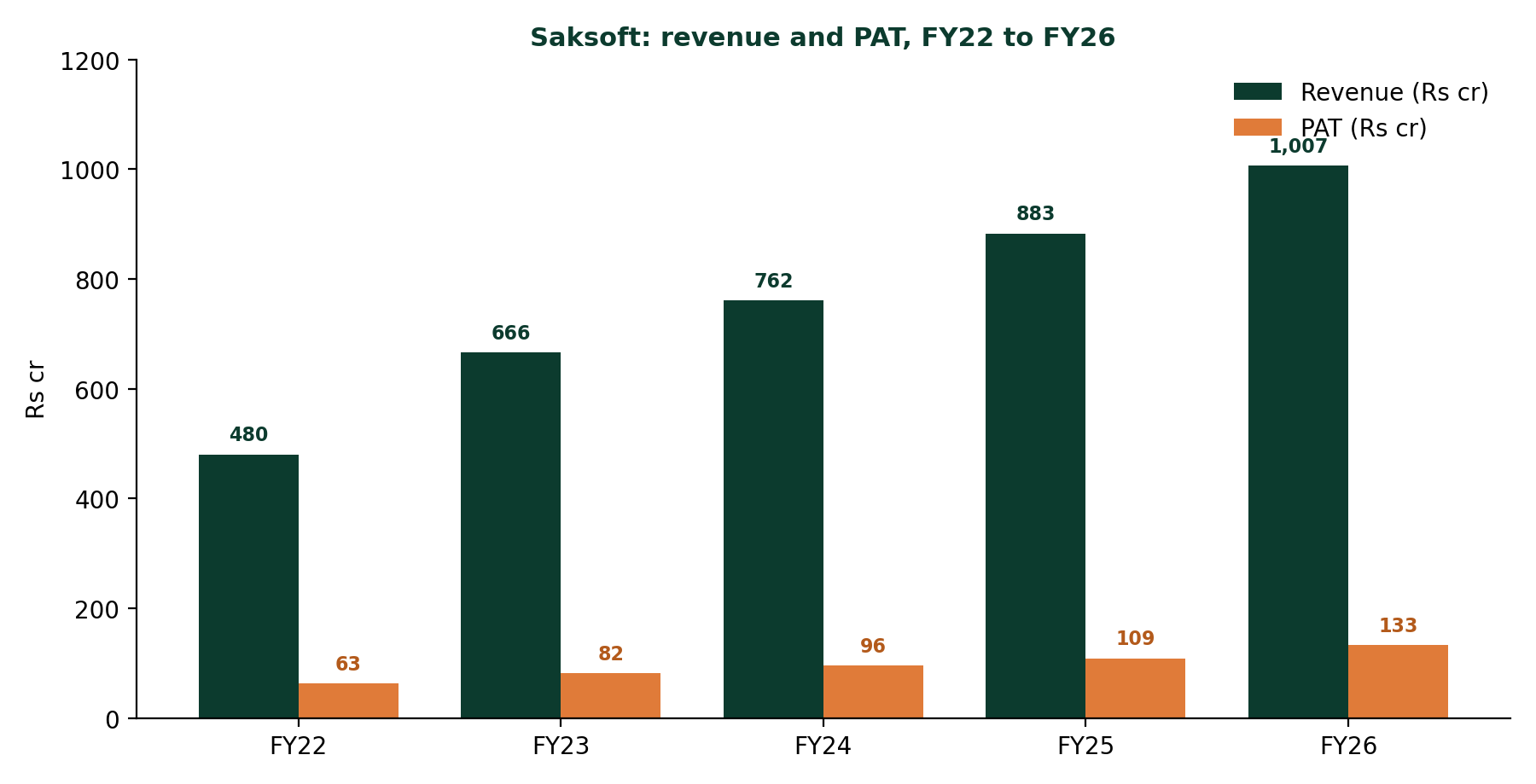
Revenue compounded at about 20% a year from Rs 480 cr in FY22 to Rs 1,007 cr in FY26, and PAT compounded at about 20% too, from Rs 63 cr to Rs 133 cr, with the EBITDA margin expanding from 16.5% to 18.6%. Q4 FY26 was the best quarter in company history (PAT Rs 35.9 cr, up about 20%). Q1 FY27 then printed flat revenue of Rs 249 cr with margin intact at 18.3% and PAT of Rs 29.3 cr. Q3 FY26 carried a Rs 4.86 cr exceptional charge for the new Labour Codes. The record is five clean years and one flat quarter; the question the next four quarters answer is which one is the trend.
How strong is the balance sheet and cash flow?
This is the strongest part of the case. Net worth is Rs 779 cr. Cash and short-term investments of Rs 251 cr stand against total debt of Rs 43.7 cr, for net cash of about Rs 207 cr on a narrow count. Operating cash flow rose to Rs 171.1 cr in FY26, capex was Rs 4.3 cr, and free cash flow of Rs 166.8 cr exceeded PAT for the third straight year. Capital allocation is small capability acquisitions from accruals, a dividend of about 10% of PAT (yield about 0.75%), and deal debt taken briefly then repaid. The watch item is debtor days near 80, high for IT services, because mid-market clients pay slowly.
What is Saksoft worth versus peers?
At Rs 131.28: P/E 12.6x, P/S about 1.75x, P/B about 2.2x on book value of about Rs 60 a share, EV/EBITDA about 7.5x, ROE about 19% and ROCE about 23 to 25%. Larger peers price higher: Birlasoft at 15.3x earnings (market cap about Rs 8,780 cr) and Happiest Minds at 21.0x (about Rs 4,680 cr), with the industry median P/E at 21.9x on MoneyWorks4Me. Microcap peer Ksolves trades near 17x with PAT flat for three years. MNCL, the one covering broker, holds a Buy with a Rs 225 target at 18x earnings, above this report's Rs 185 base case. FY2029 scenarios: bear Rs 95, base Rs 185, bull Rs 260. Even the bull case reaches only about USD 195 million of FY29 revenue, less than half the FY30 target, which is the honest scale of the promise gap.
What are the key risks?
First, concentration: top 10 clients at 58% of revenue means a handful of budget decisions set the growth rate. Second, the target: USD 500 million by FY30 needs about 33% compound growth that no recent quarter or broker model supports yet. Third, AI deflation: if clients capture productivity gains as price cuts, the 18.6% margin is a high-water mark. Fourth, succession: the first non-promoter CEO started on October 12, 2026 and his agenda is untested inside a founder-led culture. Fifth, receivables: debtor days near 80 are where a mid-market downturn would show up first. Finally, liquidity and coverage: one broker, near-zero domestic institutional holding, and a stock down about 41% from its 52-week high of Rs 222.99.
© 2026 DalalBytes Research · For educational purposes only. Not investment advice.