

What is the verdict?
62/100. Selective Positive. The fastest growth in big cloud, a database moat that still prints cash, and a balance sheet that now funds the growth with debt and new shares.
| 62/100 | DalalBytes score |
| $130.53 | Reference price, Oct 27, 2026 close |
| $395B | Market cap, 3.024B shares outstanding |
| $102 / $230 / $330 | FY2029 bear / base / bull |
What would change the score. The score rises if free cash flow turns positive on the guided path while the $20B funding cap holds in filed numbers, and it falls if the cap breaks or the rating slips below investment grade.
Oracle is growing faster than any large cloud rival, with cloud infrastructure revenue up 121% in the latest quarter and a contracted backlog of $664B. The old software core still throws off cash while that growth lands, and support revenue alone was $19.8B in FY2026. The growth story therefore sits on a proven annuity, not on bookings alone.
The cost of that growth is now the story. Free cash flow was negative $23.7B in FY2026, and the credit rating sits one notch above junk. Growth funded with debt and new shares leaves the balance sheet to absorb any delivery slip.
The stock has already paid for much of this fear. It trades about 60% below its September 2025 record close. Our read is simple. The growth is real. The funding risk is also real. At $130.53 the price carries more fear than the filings support.
The price basis of this report
Oracle shares jumped more than 8% in afternoon trading on October 28, 2026 after the investor day funding pledge, as reported by Reuters. The October 28 session was still open when this report was written. All valuation math in this report uses the October 27 close of $130.53.
What is Oracle today?
Oracle was founded in 1977 and is based in Austin, Texas. Larry Ellison founded the company, and he is now executive chairman and chief technology officer. He owns 38.2% of the shares.
Oracle sells four things: cloud services, software licenses and support, hardware, and services. The fiscal year ends on May 31, so FY2026 ended on May 31, 2026. The latest reported quarter is Q1 FY2027, which ended on August 31, 2026.
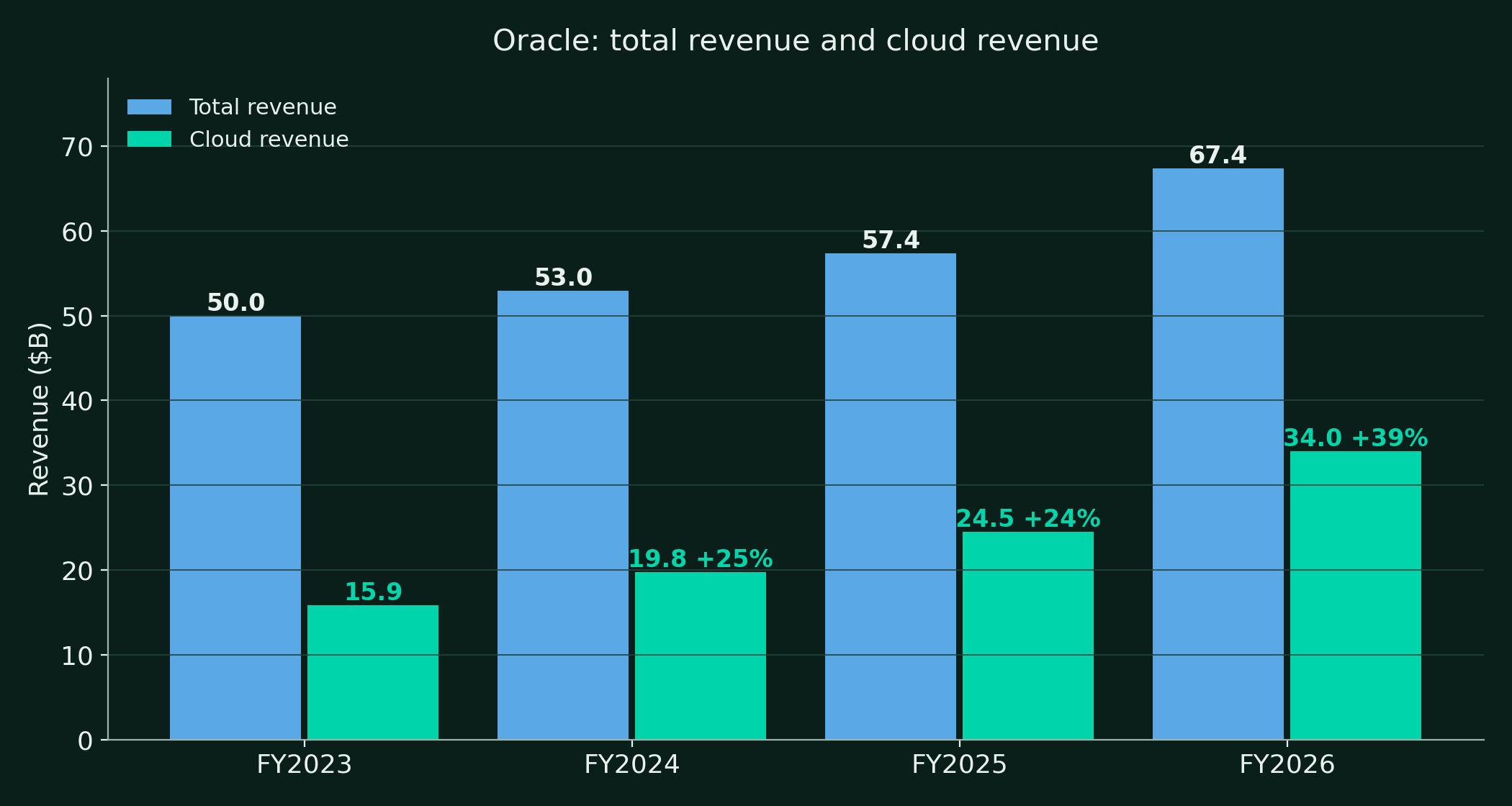
| Metric | FY2024 | FY2025 | FY2026 | Q1 FY2027 |
|---|---|---|---|---|
| Total revenue ($M) | 52,961 | 57,399 | 67,357 | 19,345 |
| Cloud revenue ($M) | 19,774 | 24,506 | 33,989 | 11,607 |
| RPO at period end ($B) | 98 | 138 | 638 | 664 |
| Net income to common ($B) | 10.5 | 12.4 | 17.0 | 4.7 |
| Free cash flow ($B) | 11.8 | (0.4) | (23.7) | (5.4) |
Sources: Oracle 10-K filings, 10-Q filings, and earnings releases. The story of the table is stark. Revenue and backlog inflected up in FY2026. Free cash flow inflected down at the same time.
How does Oracle make money?
| Revenue line ($M) | FY2025 | FY2026 | Change |
|---|---|---|---|
| Cloud applications (SaaS) | 14,272 | 15,888 | +11% |
| Cloud infrastructure (IaaS) | 10,234 | 18,101 | +77% |
| Total cloud | 24,506 | 33,989 | +39% |
| Software license | 5,201 | 4,737 | -9% |
| Software support | 19,523 | 19,804 | +1% |
| Total software | 24,724 | 24,541 | -1% |
| Hardware | 2,936 | 3,084 | +5% |
| Services | 5,233 | 5,743 | +10% |
| Total revenue | 57,399 | 67,357 | +17% |
Source: Oracle Q4 FY2026 earnings release and the FY2026 10-K.
- Cloud passed half of total revenue in FY2026.
- Infrastructure is the growth engine. It grew 77% in FY2026 and 121% in Q1 FY2027.
- Support is the quiet giant. It grew just 1% and still funds much of the company.
- New license sales shrink each year.
- Customers now rent the software. They no longer buy it once.
- GAAP operating income was $20.6B in FY2026. The GAAP operating margin was 31%.
- Non-GAAP operating income was $28.9B. The non-GAAP margin was 43%.
- One caution sits inside the FY2026 profit. The year included one-time gains from the Ampere stake sale and Bloom Energy warrants.
- Non-GAAP EPS was $7.63 with those gains. It was $6.83 without them, per the company.
What did Oracle report in Q1 FY2027?
Q1 FY2027 was reported on September 10, 2026. The quarter ended on August 31, 2026.
| $M except EPS | Q1 FY2026 | Q1 FY2027 | Change |
|---|---|---|---|
| Total revenue | 14,926 | 19,345 | +30% |
| Cloud revenue | 7,186 | 11,607 | +62% |
| Cloud infrastructure | 3,347 | 7,388 | +121% |
| Cloud applications | 3,839 | 4,219 | +10% |
| Software | 5,721 | 5,550 | -3% |
| Hardware | 670 | 774 | +15% |
| Services | 1,349 | 1,414 | +5% |
| GAAP operating income | 4,277 | 6,728 | +57% |
| GAAP diluted EPS | $1.01 | $1.56 | +55% |
| Non-GAAP EPS | $1.47 | $1.92 | +30% |
| Operating cash flow | 8,100 | 23,103 | +184% |
| Capital spending | (8,502) | (28,499) | +235% |
| Free cash flow | (362) | (5,396) | n/m |
| RPO ($B) | 455 | 664 | +$209B |
Source: Oracle Q1 FY2027 earnings release and 10-Q.
- The quarter set records. Revenue hit a record. Operating income hit a record. Operating cash flow hit a record.
- Delivery drove the print.
- Oracle added 850 MW of data center capacity in one quarter.
- The company delivered more than 300,000 GPUs after the end of Q4.
- GPU use ran at 97.9%, per the earnings call. Demand still exceeds supply.
- Bookings stayed strong. Oracle signed more than $30B of new AI contracts in the quarter.
- Most new contracts need no new Oracle capital. Customers prepaid or supplied their own hardware.
- The company raised the FY2027 guide at the print. Revenue of at least $90B. Non-GAAP EPS of $8.10.
- The guide for Q2 FY2027 is also strong. Total revenue growth of 30% to 34%. Cloud growth of 65% to 71%.
- The market still sold the print. Press reports put the drop at 5.4% in the next session.
- The market now prices funding first and growth second.
What makes OCI different under the hood?
OCI is the second generation of the Oracle cloud. The first generation failed to win share. The rebuild started from a clean sheet.
- Customer machines run no Oracle hypervisor code.
- The cloud control layer sits on separate hardware. Oracle calls this off-box virtualization.
- Customers rent bare metal servers. No other tenant shares the machine.
- GPU clusters link with RDMA networking.
- RDMA moves data between machines with very low delay. AI training needs that speed.
- The network is flat. Every server in a cluster can reach every other server at full speed.
- Exadata hardware runs the database in the cloud.
- The same hardware runs inside customer data centers as Cloud@Customer.
- Dedicated regions give one customer a full private cloud.
- Sovereign regions keep data inside one country or one bloc.
- Oracle is adding NVIDIA Blackwell B300 GPUs to its US government regions, per company announcements in October 2026.
- Chip choice is a stated strategy. OCI sells NVIDIA GPUs today.
- At AI World the company also pointed to Google TPUs and Cerebras systems as options on OCI, as reported by Particle News.
- Scale is now visible. The Abilene campus in Texas is live. It is building toward 1.2 GW of capacity.
The design goal is plain. Oracle wants the fastest path between GPUs and the lowest risk of noisy neighbors. The design wins AI training deals. It does not by itself win general cloud share.
How strong is the database moat?
The database is the root of the company. Banks run core ledgers on it, airlines run bookings on it, and governments and hospitals run their records on it. Those systems are hard to move, because a failed migration can stop the business, so customers renew instead.
The renewal economics turn that position into cash. Support contracts price off the license value and renew each year at very high rates, and support revenue was $19.8B in FY2026. It grew 1% in a year of heavy cloud migration, so the base held even while customers rebuilt around the cloud.
Oracle keeps lowering the cost of staying. The Autonomous Database runs itself, patching, tuning, and backing up with no human operator. The AI Database adds vector search, so customers can search text, images, and documents with AI inside the database, and models from OpenAI, Google, and others can reason over private data in place, because the data does not need to move.
Multicloud is the new distribution for that moat. Oracle Database now runs inside Azure, Google Cloud, and AWS data centers, so the customer keeps its main cloud and Oracle sells the database inside that cloud. Multicloud AI Database revenue grew 404% in Q4 FY2026, per the company release, and growth stayed hot in Q1 FY2027 at 353%, with 70 multicloud regions live, as reported by Zacks.
The rivals now host the database they tried to replace. That is the moat working as distribution, not just as defense.
How are Fusion, NetSuite, and Oracle Health doing?
- Cloud applications revenue was $15.9B in FY2026. It grew 11%.
- Q1 FY2027 applications revenue was $4.2B. It grew 10%.
- Fusion ERP is the core suite for large firms.
- Fusion grew 14% in Q1 FY2027, as reported by Zacks.
- Fusion and NetSuite each passed $1B in a single quarter for the first time in Q1 FY2026, per the company release at the time.
- NetSuite serves smaller and mid-size firms.
- Oracle is adding AI agents across the Fusion suite.
- The pitch is simple. Software does more of the office work itself.
Oracle Health is the hard part:
- Oracle bought Cerner in 2022 for $28.3B.
- Health has lagged the plan since the deal.
- Product rebuilds and delivery took longer than promised.
- A new AI version of the Cerner patient system is now the fix.
- Management guides Oracle Health to double-digit growth in FY2027, per the Q4 FY2026 release.
- That guide is a test. Health must now prove the rebuild worked.
What sits inside the $664B backlog?
RPO is signed contract value that is not yet revenue. The line was flat for years. Then it jumped in one quarter.
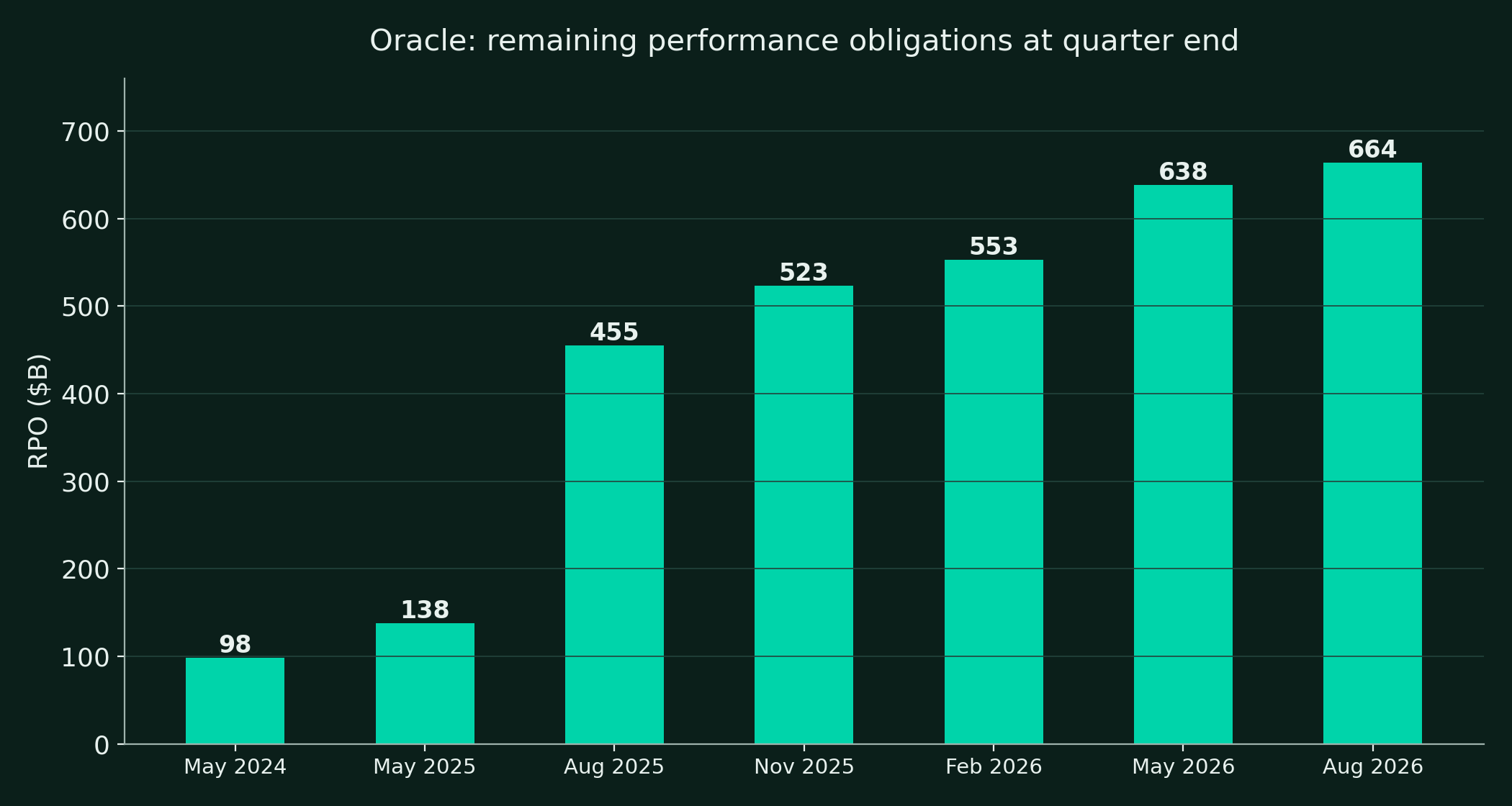
- RPO rose from $138B in May 2025 to $455B in August 2025.
- One deal did most of it.
- OpenAI signed a five-year contract worth about $300B, as reported by the Wall Street Journal and Reuters.
- Payments under that contract start in 2027.
- A second named deal is Meta. Oracle counted a $20B Meta deal in bookings, as its CFO said at the October 2025 analyst meeting, as reported by Reuters.
- xAI is a model partner, not a disclosed mega-deal.
- Grok models run on OCI. Oracle has not disclosed a large xAI capacity contract in its filings.
- TikTok US is closed business. The deal closed on January 22, 2026.
- Oracle owns 15% of the US joint venture. It also hosts the US data and audits the algorithm as the security partner.
Contracted is not delivered. The split matters:
| Item | Contracted | Delivered so far |
|---|---|---|
| OpenAI capacity | About $300B over five years from 2027, as reported | Abilene is live. IaaS revenue was $18.1B in FY2026 across all customers |
| Customer funded hardware | $75B of prepay and customer supplied GPUs inside RPO | In place at May 31, 2026, per the company |
| Whole backlog | $664B at August 31, 2026 | About 12% was set to convert in the 12 months after May 2026, per the 10-K |
- Management said about half of RPO converts into revenue in the next 36 months, per the Q1 FY2027 call.
- Concentration is the catch.
- Bank of America estimates that OpenAI alone is more than half of the backlog.
- That is one bank estimate. It is not a company disclosure.
- OpenAI is still loss-making.
- It told investors its annualized revenue was near $50B in September 2026, as reported.
- The lease stack sits under the backlog.
- Oracle had about $248B of data center lease commitments at November 30, 2025 that were not yet on the balance sheet, per its 10-Q.
- Later reports put the stack near $260B.
- Project debt also sits off the balance sheet.
- Lenders funded $38B of facilities for two Vantage campuses tied to Stargate, as reported by Bloomberg.
- Two delivery flags are on the record.
- Oracle and OpenAI dropped a 600 MW Abilene expansion in March 2026, as reported.
- Oracle sent a force majeure notice on Project Jupiter in New Mexico in September 2026 over power timing, as reported. Oracle said the project stays on schedule.
- Oracle denied delay reports in October 2026. A spokesperson said no site needed for its contracts is delayed, as reported by Reuters.
What did Oracle promise on October 28, 2026?
Oracle held an investor day in Las Vegas on October 28, 2026. The event ran inside Oracle AI World. Magouyrk, Sicilia, and CFO Maxson presented.
Every claim in this section is a management statement from that day. None of it is a filed result.
- The FY2030 targets now stand as floors.
- Revenue of more than $225B in FY2030.
- Non-GAAP operating margin of 40% or more.
- Non-GAAP EPS of more than $21.
- The path implies revenue growth above 35% a year from FY2026 to FY2030.
- The FY2027 guide was reaffirmed. Revenue of at least $90B. Non-GAAP EPS of $8.10.
- The funding cap is the new promise.
- Total new capital for the FY2027 to FY2030 cycle is capped at $20B.
- The split is $10B of equity and $10B of gross debt.
- Refinancing of old debt does not count against the cap.
- The cap sits on top of the $20B stock sale that closed in Q1 FY2027.
- Free cash flow turns positive in the second half of FY2028, on the plan.
- Free cash flow reaches at least $30B in FY2029, on the plan.
- Capex peaks in FY2027 and FY2028. It steps down in FY2029.
- Growth funds itself from FY2029, on the plan.
- Net debt to adjusted EBITDA falls below 3.5 times in FY2029, on the plan.
- Capital priorities stay in this order. Keep the investment grade ratings. Pay the dividend. Fund growth.
- The market liked the cap. Shares rose more than 8% in afternoon trading on October 28, as reported by Reuters.
- The stock was down about a third in 2026 before the day, per Reuters.
This $20 billion, split evenly between debt and equity, is the final amount needed to fund the remainder of this cycle.
Hilary Maxson, CFO, at the October 28, 2026 investor day, as reported by Reuters
Product news shared the same week:
- OpenAI models, ChatGPT, and Codex now sell in the Oracle Marketplace.
- Customers can pay with Oracle Universal Credits, as the companies announced at AI World.
- Grok 4.6 and Grok 4.7 from xAI joined OCI Enterprise AI in October 2026, per Oracle.
- One trade report named new joint offers called AI Workspace, AI Security Mesh, and App Composer. We treat those names as single-sourced.
How to read this section
The cap is a promise, not a result. It earns credit in our leadership grade. It does not change the debt and cash grades in the companion pillar analysis, because those pillars grade filed numbers.
Has Oracle delivered on its roadmap?
| Plan | When set | What happened | Call |
|---|---|---|---|
| OCI revenue of $18B in FY2026 | September 2025 | Delivered $18.1B | Met |
| FY2026 capex of about $35B | Early FY2026 guide | Raised to about $50B in December 2025, then delivered $55.7B | Missed high |
| FY2027 revenue of $90B | October 2025 | Reaffirmed in June, September, and October 2026. Q1 grew 30% | On track |
| FY2027 funding of about $40B | February 2026 plan | The $20B stock sale closed in Q1 FY2027. The rest now sits inside the new cap | On track |
| TikTok US deal close | September 2025 framework | Closed January 22, 2026 with Oracle at 15% | Done |
| Abilene expansion of 600 MW | Stargate plan | Dropped in March 2026, as reported | Missed |
| FY2030 revenue above $225B and EPS above $21 | October 16, 2025 | Restated as floors on October 28, 2026 | Pending |
| Buybacks as the main capital return | The old model | Buybacks fell to $206M in FY2026 | Retired |
The revenue side of the roadmap has landed, and the cost side has not. Capex is the one guide that keeps breaking, and it broke upward twice in one year. The dividend held at $0.50 a quarter through the whole build.
The OCI revenue path is the steepest part of the plan. Management set OCI targets of $32B in FY2027, $73B in FY2028, and $114B in FY2029 in September 2025, and the FY2030 OCI target was raised to $166B in October 2025. The first step landed, and the next steps get much bigger.
How does Oracle compare with AWS, Azure, and Google Cloud?
The cloud infrastructure market was $143.4B in Q2 2026. It grew 43% in a year, per Synergy Research.
| Provider | Share of Q2 2026 cloud infrastructure revenue | Latest growth print |
|---|---|---|
| Amazon Web Services | 28% | Revenue up 37% in Q2 2026 |
| Microsoft Azure | 20% | Azure revenue up 43% in the June 2026 quarter |
| Google Cloud | 15% | Revenue up 82% in Q2 2026 |
| Oracle | About 4% | OCI revenue up 121% in the August 2026 quarter |
| CoreWeave | About 2% | GPU rental pure play |
Source: Synergy Research Group data for Q2 2026, as reported. Growth prints are company reported for the nearest quarter.
- Oracle is the smallest of the four majors.
- It is also the fastest growing of the four.
- Scale still matters.
- AWS booked $42.2B in one quarter.
- OCI booked $18.1B in all of FY2026.
- The rivals fund growth from profit.
- Oracle funds growth from debt and stock sales.
- That funding gap is the core competitive gap.
- In databases the fight is different.
- The rivals there are Microsoft, open source PostgreSQL, Snowflake, and Databricks.
- In applications the rivals are SAP and Workday in big suites.
- Salesforce leads in sales software, a field Oracle does not lead.
- The neoclouds rent GPUs with no software annuity behind them.
- CoreWeave is the largest of them at about 2% share.
How should investors grade Ellison, the co-CEOs, and the board?
- Two co-CEOs have run Oracle since September 22, 2025.
- Clay Magouyrk runs cloud. Mike Sicilia runs applications.
- Safra Catz is executive vice chair. She ran the company for a decade before the change.
- The stock closed at $328.15 on the day the co-CEOs were named.
- It closed at $130.53 on October 27, 2026. The drop since the handover is about 60%.
- CFO Hilary Maxson started on April 6, 2026.
- She came from Schneider Electric, where she ran finance for a capital heavy business.
- The CFO chair sat open for about six months before her start. Doug Kehring filled it on an interim basis.
- The new team kept every revenue guide it inherited. It raised the FY2027 EPS guide once.
- It also raised the capex guide twice. Section 10 has the detail.
Pay and alignment:
- Magouyrk got a one-time option award valued at $250M at grant.
- Sicilia got a one-time option award valued at $100M at grant.
- Both awards carry a strike price of $308.46.
- Both were worth nothing at the end of FY2026. The stock sat far below the strike, per the FY2026 proxy.
- Ellison got a $50M option award at a $280.07 strike. It was also worth nothing at year end.
- The leaders are paid only if the stock recovers a long way. That is real alignment, bought at a high headline cost.
The Ellison position:
- Ellison owns 38.2% of the shares, about 1.16B shares, per the FY2026 proxy.
- About 413M of those shares are pledged as collateral for personal loans, per the proxy.
- He adopted a plan in June 2026 to sell up to 50M shares.
- He cancelled it on September 12, 2026. No shares were sold. The company said he has no other plan to sell.
Other governance facts:
- Press reports put the FY2026 job cuts at about 21,000 roles, near 13% of staff.
- The restructuring plan costs up to $2.1B. Oracle booked $1.8B of it in FY2026, per the 10-K.
- A shareholder lawsuit filed in February 2026 claims the company misled investors about the cloud infrastructure business.
- Oracle says it has meritorious defenses. It expects no material impact, per its filings.
The governance discount
One holder controls 38.2% of the vote. Outside holders cannot outvote him. The structure is legal and disclosed in full. It still caps the leadership grade in the companion analysis.
How strong is the balance sheet?
The balance sheet at August 31, 2026, per the 10-Q:
| Item | $B |
|---|---|
| Borrowings, current and non-current | 125.3 |
| Cash and equivalents | 36.4 |
| Net borrowings, our math | 88.9 |
| Non-current operating lease liabilities | 30.6 |
| Mandatory convertible preferred | 5.0 |
| Total assets | 303.3 |
| Total equity | 67.2 |
| Shares outstanding | 3.024B |
- Borrowings peaked at $129.5B at May 31, 2026.
- They eased to $125.3B at August 31, 2026 after the stock sale.
- A year earlier they stood at $92.6B.
- The rise in one year was about $33B at the peak.
- Book equity is thin for the asset base.
- Equity of $67.2B supports $303.3B of assets.
- The near term maturity wall is light. Current borrowings are $7.6B.
- Interest cost is climbing fast.
- Interest expense was $1.4B in Q1 FY2027. It rose 55% in a year.
The three agencies now disagree in public:
| Agency | Rating | Latest move |
|---|---|---|
| Fitch | BBB, stable outlook | Affirmed on February 2, 2026 |
| Moody's | Baa2, negative outlook | Outlook cut on February 2, 2026 |
| S and P | BBB- | Cut one notch on July 9, 2026 |
- S and P named two reasons for its cut. The capex path. And backlog concentration in one loss-making AI customer.
- S and P sees a free operating cash flow deficit near $42B in FY2027, as summarized from its research.
- It sees the deficit near $25B in FY2028.
- The credit market charges Oracle like a weaker credit.
- Five-year credit default swaps hit 261 basis points on October 8, 2026.
- They set a record high in August 2026.
- One notch is now the whole cushion. A move below BBB- ends the investment grade status.
Where does the cash go?
| $M | FY2023 | FY2024 | FY2025 | FY2026 | Q1 FY2027 |
|---|---|---|---|---|---|
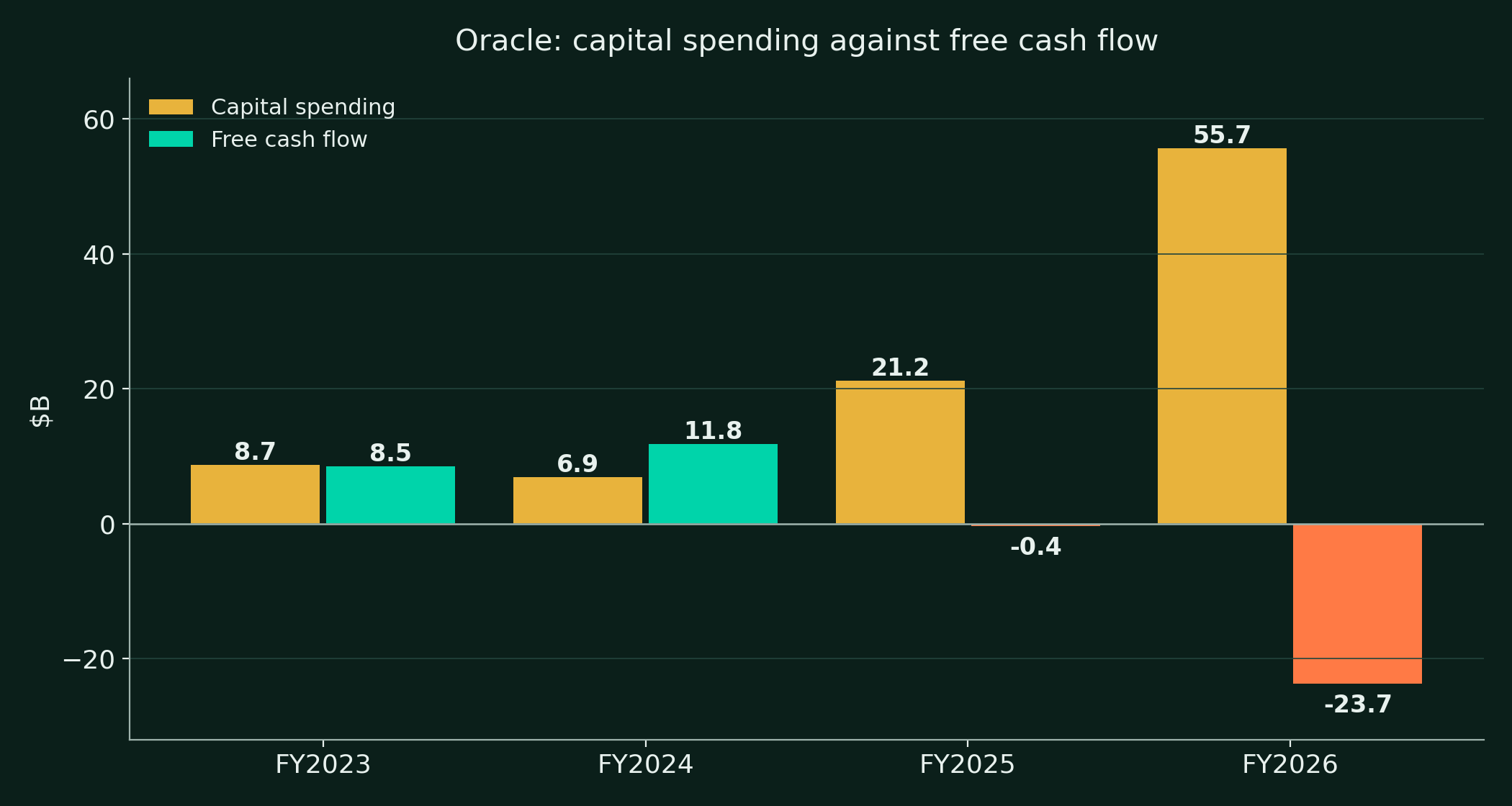
| Operating cash flow | 17,165 | 18,673 | 20,821 | 31,977 | 23,103 |
| Capital spending | (8,695) | (6,866) | (21,215) | (55,663) | (28,499) |
| Free cash flow | 8,470 | 11,807 | (394) | (23,690) | (5,396) |
Source: Oracle 10-K cash flow statements, the Q1 FY2027 release, and the Q1 FY2027 10-Q.
- The cash machine still works. Operating cash flow rose 54% in FY2026.
- The build simply eats more than the machine makes.
- Q1 operating cash flow needs a footnote.
- It includes $11.4B of customer prepayments with a significant financing part, per the 10-Q.
- Net cash capex in Q1 was $18.0B after those prepayments.
- The FY2027 capex guide is $90B to $95B.
- Net cash capex is guided at no more than $70B.
- The dividend costs real money.
- Oracle paid $5.8B of dividends in FY2026.
- It pays them while free cash flow is negative.
- Buybacks are off. Oracle spent $206M on buybacks in FY2026.
- Stock pay stays large. Stock-based compensation was about $4.8B in FY2026.
- Cash interest paid was $3.4B in FY2025. The bill rises with each new bond sale.
What is Oracle worth at $130.53?
- At $130.53 the market cap is about $395B.
- The trailing P/E is 20.5 times on GAAP EPS of $6.38, per data providers.
- The forward P/E is 17.8 times, per data providers.
- On the FY2027 guide EPS of $8.10, the price is 16.1 times. That is our math on the company guide.
- The guide itself is not clean. FY2026 EPS included one-time gains, and the $8.10 guide grows off the adjusted base the company set.
Enterprise value, piece by piece:
| Piece | $B |
|---|---|
| Market cap at $130.53 | 394.7 |
| Plus borrowings | 125.3 |
| Minus cash and equivalents | (36.4) |
| Plus mandatory convertible preferred | 5.0 |
| Plus non-current operating lease liabilities | 30.6 |
| Enterprise value, our math | About 519 |
- The street is split wide.
- The average analyst target was $244.89 in late October 2026, per TipRanks.
- Goldman Sachs cut its target to $206 on October 23, 2026. It questioned the FY2028 to FY2030 targets.
- Cantor Fitzgerald held a $284 target on October 22, 2026.
- The plan math is stark.
- At the FY2030 EPS target of more than $21, the stock trades at 6.2 times the target.
- The gap is not about the multiple.
- The gap is about proof of delivery and proof of funding.
What are the FY2029 bear, base, and bull targets?
We value Oracle on FY2029 non-GAAP EPS and an exit multiple. The share count drifts up in each case. The guided $10B equity sale is inside the EPS path.
| Case | FY2029 revenue | FY2029 EPS | Exit multiple | FY2029 target |
|---|---|---|---|---|
| Bear | About $135B | $8.50 | 12x | $102 |
| Base | About $165B | $13.50 | 17x | $230 |
| Bull | About $185B | $16.50 | 20x | $330 |
The math, line by line:
- Bear: $8.50 times 12 equals $102.
- Base: $13.50 times 17 equals $229.50, rounded to $230.
- Bull: $16.50 times 20 equals $330.
What each case assumes:
- Bear. OCI reaches about $75B in FY2029 against the $114B plan.
- Bear. OpenAI slows its build. Power and permits slip more sites.
- Bear. The rating slips below investment grade. The multiple falls to 12 times.
- Base. OCI reaches about $100B. Delivery runs about a year behind the plan.
- Base. Free cash flow turns positive on the guided path. The rating holds at BBB- or better.
- Base. Applications keep growing near 10% a year.
- Bull. The OCI plan lands on time at $114B.
- Bull. Growth funds itself from FY2029, as management guided on October 28, 2026.
- Bull. The market pays 20 times for a self funding grower.
- Even the bull case sits below a straight line to the FY2030 targets.
- The plan needs a very steep FY2030 after any of these paths.
- The bear target sits below the 52-week low of $114.50.
- A credit event would have to drive the stock there.
What does the chart say?
- The close of $130.53 sits below the 50-day average of $142.08.
- It also sits below the 200-day average of $157.89.
- RSI is 44.6. The stock is not oversold on that gauge.
- Averages and RSI are per Gotrade data at October 27, 2026.
- The 52-week range is $114.50 to $287.19.
- The record close was $328.33 in September 2025.
- The fall from that close is about 60%.
- Volume on October 27, 2026 was 26.0M shares.
- The October 28 investor day pop helps the chart.
- One strong day does not repair a downtrend.
What are the main risks?
Credit risk leads the list because it can compound every other risk on this page. One more downgrade ends investment grade status, mandate driven selling would follow, and funding costs would jump at the worst time. Each new bond sale already prices off a weaker rating, and interest expense rose 55% in a year.
Customer and delivery risk sit right behind it. One loss-making customer drives more than half of the backlog, on one bank estimate, so the largest revenue promise rests on the weakest credit in the chain. Power, permits, and labor can slip sites, and the record already shows the strain, because one expansion was already dropped and one site took a force majeure notice.
The build also carries dilution and asset risk. Oracle sold $20B of stock in one quarter and guides $10B more under the new cap, so holders fund part of the growth directly. A young GPU fleet ages fast, and rental prices can fall before the fleet is paid off, while about $260B of leases start over the next two years, run 15 to 19 years, and serve customer contracts that run far shorter.
Margin, legal, and governance risks complete the picture. Cloud and software margins already fell as infrastructure costs rose, and more AI mix can press them further. The shareholder suit over cloud statements is live and adds cost and headline risk, and one holder controls 38.2% of the vote, with about 413M of his shares pledged.
What should investors watch next?
- Q2 FY2027 results land in December 2026. Oracle has not confirmed the date.
- The quarter guide is revenue growth of 30% to 34% and cloud growth of 65% to 71%.
- Watch the first debt sale under the new cap.
- Watch the rating agencies after the investor day.
- Watch RPO conversion each quarter. Bookings are no longer the question. Conversion is.
- Watch OpenAI. Its payments to Oracle start in 2027.
- Watch the Abilene and Project Jupiter timelines.
The conclusion, in short:
- Oracle is two companies in one ticker.
- The first is a database and applications annuity. It is durable and cash rich.
- The second is a leveraged AI data center builder. It grows at 121% and burns cash.
- At $130.53 the market prices the builder as a problem.
- It prices the annuity as an afterthought.
- Our score of 62/100 says the truth sits between the two.
Frequently asked questions
Is Oracle stock cheap at $130.53?
On the company guide the stock trades at 16.1 times FY2027 non-GAAP EPS of $8.10. That is cheap for revenue growth of 30%. The discount is not a mistake. It pays for negative free cash flow and a rating one notch above junk. The price works only if delivery holds.
What is the biggest risk in Oracle?
Funding is the biggest risk. Oracle plans capex of $90B to $95B in FY2027 while free cash flow stays negative. A downgrade below investment grade would raise its costs at the worst time. Customer concentration sits right behind it. One bank estimates that OpenAI is more than half of the backlog.
When does free cash flow turn positive?
Management gave the date on October 28, 2026. Free cash flow turns positive in the second half of FY2028 on the plan. It reaches at least $30B in FY2029 on the plan. Capex peaks in FY2027 and FY2028 and then steps down. These are targets. The filed record still shows a deficit.
Disclosures
- This report is research and opinion.
- It is not investment advice.
- DalalBytes Research. For educational purposes only. Not investment advice.
- Numbers come from company filings, company releases, and named press reports.
- Estimates are labeled as estimates where they appear.
- Management targets are labeled as targets. They are not results.
- The author holds no position in Oracle at the time of publication.
- The author held a position in Oracle in the past and exited it.