
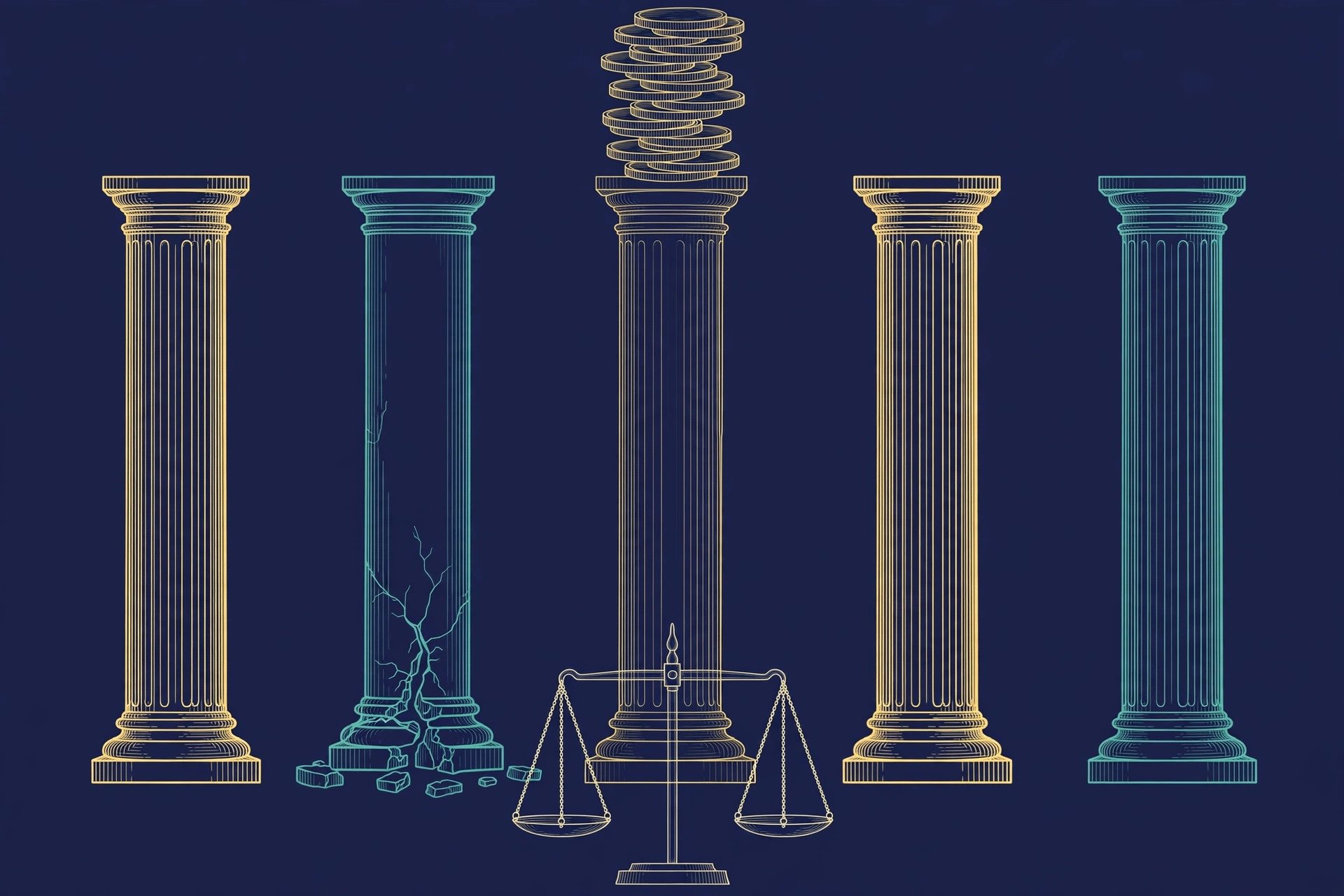
What is the five-pillar scorecard?
Mixed fit: 2 of 5 pillars pass, 1 partial, 2 fail. Score 62/100, Selective Positive.
| PASS | Sunrise industry, Moat |
| PARTIAL | Leadership |
| FAIL | Iron Fortress, Free Cash Flow |
| 62/100 | Overall DalalBytes score |
What would change the score. The score rises if free cash flow turns positive on the guided path while the $20B funding cap holds in filed numbers, and it falls if the cap breaks or the rating slips below investment grade.
| Pillar | Grade | One-line evidence |
|---|---|---|
| 1. Sunrise industry | PASS | The cloud infrastructure market grew 43% in a year and AI services grew far faster |
| 2. Leadership | PARTIAL | Revenue guides landed and capex guides broke upward twice in one year |
| 3. Moat | PASS | The database installed base renews at very high rates and now sells inside rival clouds |
| 4. Iron Fortress | FAIL | Borrowings of $125.3B, a BBB- rating, and about $260B of leases still to start |
| 5. Free Cash Flow | FAIL | Negative $23.7B in FY2026 with a guided deficit through FY2027 |
The two fails sit on the same root. Oracle chose to fund a historic build with its balance sheet, and the debt and cash grades broke together as a result.
The two passes sit on the old root. The database franchise is as strong as ever, and it is the earnings base the whole build leans on. The score holds the two halves together, a pass-grade franchise carrying fail-grade finances until the build starts to pay for itself.
Pillar 1, Sunrise industry: why does it pass?
The sunrise test asks if the industries are rising. Both of Oracle's main industries are.
- The cloud infrastructure market was $143.4B in Q2 2026, per Synergy Research.
- It grew 43% in one year. That is the fastest pace in eight years.
- AI cloud services grew 165% in the same period, per Synergy.
- OCI grew 121% in the August 2026 quarter. It was the fastest growth among large providers.
- Enterprise databases still grow too. Every AI system needs a store of record.
- Oracle sells both the compute and the store of record.
The counter-evidence is real, and it does not break the grade:
- Raw GPU rental can commoditize. Nine neocloud firms now rank in the top 40 providers.
- Rental prices can fall as supply catches up.
- A sunrise industry can still produce poor returns for late, leveraged entrants.
The pillar grades the industry, not the entrant. The industries are rising fast. Pass.
Pillar 2, Leadership: why only partial?
The leadership test is simple: did they do what they said, in order, on dates. On revenue, the record is strong. Oracle set an $18B OCI revenue target for FY2026 in September 2025 and delivered $18.1B, and the FY2027 revenue guide of $90B, set in October 2025, was reaffirmed three times in 2026.
Delivery promises landed the same way. The TikTok US framework was set in September 2025, and the deal closed on January 22, 2026. Oracle added 850 MW of capacity in one quarter and delivered more than 300,000 GPUs in that span, and on October 28, 2026 management capped new cycle funding at $20B, a dated and testable promise that is a management claim today, not a result.
The cost side of the record is weaker. The FY2026 capex guide started near $35B, rose to about $50B in December 2025, and the year closed at $55.7B, so the guide that sets the funding need broke upward twice. FY2026 EPS also included one-time gains from the Ampere sale and Bloom Energy warrants, so the clean growth rate was lower than the headline.
Governance and pay hold the grade down further. The finance chair sat open for about six months after the CEO change, and the co-CEO option awards carried headline values of $250M and $100M and both sat underwater at year end. One holder controls 38.2% of the vote, and about 413M of his shares are pledged as loan collateral, per the FY2026 proxy.
Delivery on the build is excellent, and discipline on the cost of the build is not yet proven. The October 28 cap is the first hard test of that discipline. Partial is the honest grade, and it can rise if the cap holds through FY2027.
Pillar 3, Moat: why does it pass?
The moat test asks if rivals can take the core profit pool, and for Oracle the core is the database. Core systems at banks, airlines, governments, and hospitals run on Oracle Database, and a failed migration can stop the business, so customers stay. Support revenue was $19.8B in FY2026 and grew 1% in a year of heavy cloud migration, so the pool held while customers rebuilt around the cloud.
The moat is also getting cheaper to stay inside. The Autonomous Database lowers the cost to stay because it runs itself, and the AI Database adds vector search inside the same product, so AI use cases now pull toward the moat, not away from it. Multicloud turns rivals into channels, because Oracle Database now runs inside Azure, Google Cloud, and AWS data centers, and multicloud AI Database revenue grew 404% in Q4 FY2026 and 353% in Q1 FY2027, with 70 regions live, as reported.
The limits of the moat are plain. The moat covers the database and the applications, and it does not cover raw GPU rental, which is a capital race that AWS, Azure, and Google Cloud fight with far more capital. Open source PostgreSQL keeps taking new workloads at the low end, and Snowflake and Databricks own much of the analytics mindshare.
The profit pool that funds the company sits behind high switching costs, and that pool held share and grew in the hardest migration year on record. The new growth engine has no moat yet, and the old one is deep enough to carry the grade. Pass.
Pillar 4, Iron Fortress: why does it fail?
The fortress test asks if the balance sheet can take a hit. Right now it is the hit absorber for the whole strategy.
The filed numbers at August 31, 2026, per the 10-Q:
- Borrowings of $125.3B.
- Cash and equivalents of $36.4B.
- Non-current operating lease liabilities of $30.6B.
- Total assets of $303.3B against total equity of $67.2B.
- Mandatory convertible preferred of $5.0B on top of the debt stack.
The stack around the filed numbers:
- About $260B of data center leases are still to start, per company disclosures as reported.
- Those leases run 15 to 19 years.
- Lenders funded $38B of project debt for two Stargate campuses. It sits off the balance sheet, as reported by Bloomberg.
- Interest expense was $1.4B in one quarter. It rose 55% in a year.
The credit market has voted:
- S and P cut the rating to BBB- on July 9, 2026.
- BBB- is one notch above junk.
- S and P named the capex path and the single customer concentration as reasons.
- Moody's holds Baa2 with a negative outlook.
- Fitch holds BBB with a stable outlook.
- Five-year credit default swaps hit 261 basis points on October 8, 2026. They set a record in August 2026.
The mitigants, stated fairly:
- Cash of $36.4B is real.
- The near term maturity wall is light at $7.6B of current borrowings.
- The support annuity throws off steady cash.
- Management said on October 28, 2026 that it will cap new cycle funding at $20B and keep the investment grade ratings as its first capital priority.
- That statement is a management claim. It is not yet a filed result.
The grade:
- A fortress does not sit one notch above junk in the middle of its biggest build.
- The pillar grades the balance sheet as filed, not as promised.
- Fail. The cap pledge is the path back. It must show up in filed debt counts first.
Pillar 5, Free Cash Flow: why does it fail?
The cash test asks if the business funds itself. Oracle funded itself for decades. It does not right now.
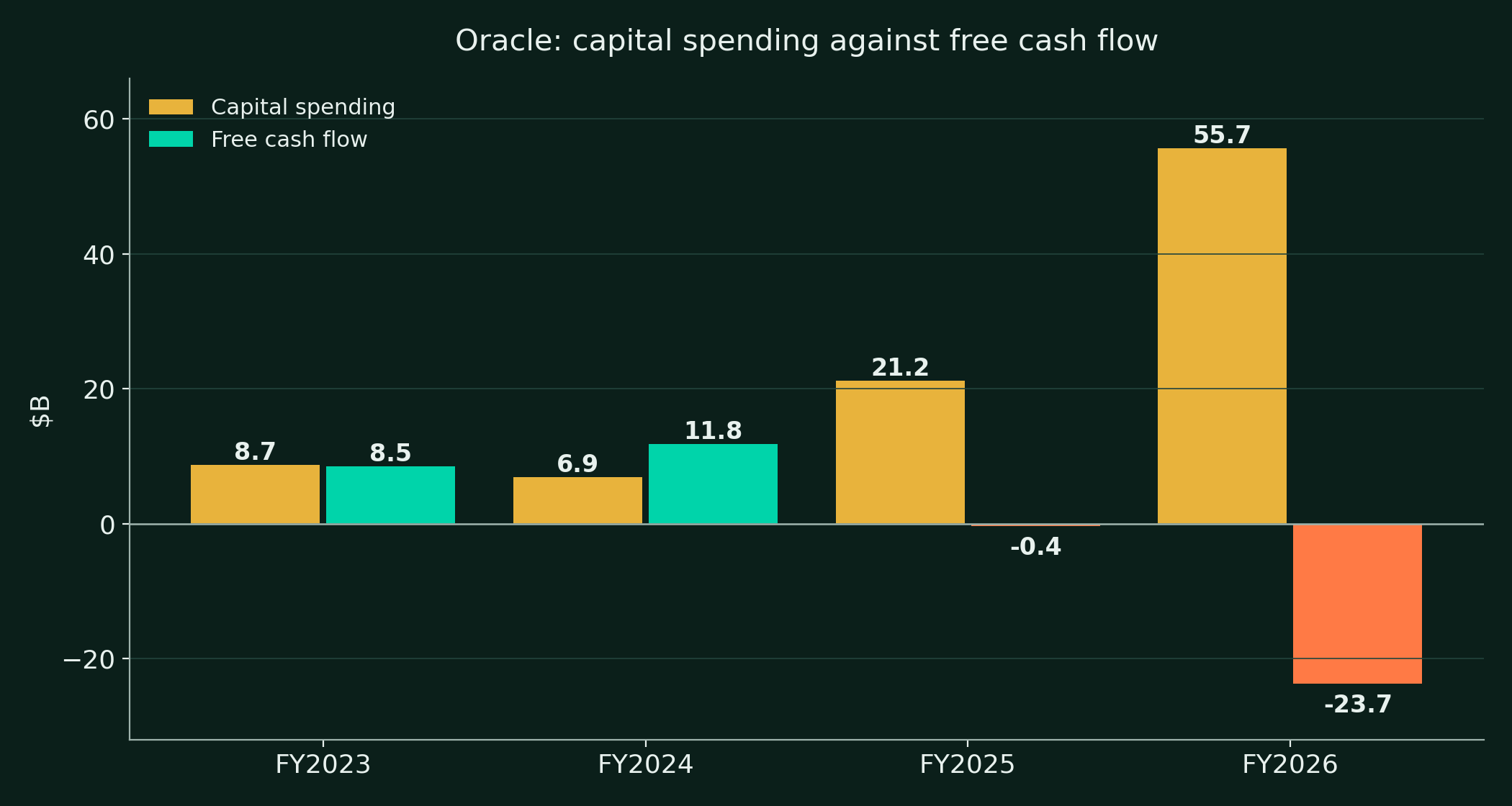
| $M | FY2024 | FY2025 | FY2026 | Q1 FY2027 |
|---|---|---|---|---|
| Operating cash flow | 18,673 | 20,821 | 31,977 | 23,103 |
| Capital spending | (6,866) | (21,215) | (55,663) | (28,499) |
| Free cash flow | 11,807 | (394) | (23,690) | (5,396) |
- Operating cash flow is not the problem. It rose 54% in FY2026.
- Capex is the problem. It rose eightfold in two years.
- Q1 FY2027 operating cash flow also needs care.
- It includes $11.4B of customer prepayments with a significant financing part, per the 10-Q.
- Part of the cash inflow is customer funding, not profit conversion.
- The dividend still goes out. Oracle paid $5.8B in FY2026 while free cash flow was negative.
- Buybacks stopped in practice. The FY2026 total was $206M.
- Stock pay adds hidden cost. It ran at about $4.8B in FY2026.
- S and P sees the deficit near $42B in FY2027 and near $25B in FY2028, as summarized from its research.
- Management said on October 28, 2026 that free cash flow turns positive in the second half of FY2028 and tops $30B in FY2029.
- That path is a management claim. The filed record shows two straight deficit years and a third one guided.
The grade:
- A pillar that grades cash generation cannot pass a guided third deficit year.
- Fail. The fix is mechanical. Capex must fall and conversion must print in the filings.
What would change the grades?
| Pillar | Upgrade trigger | Downgrade trigger |
|---|---|---|
| Sunrise | AI cloud growth holds above 30% for the market into 2027 | GPU rental prices fall hard as supply lands |
| Leadership | The $20B funding cap holds through FY2027 with no quiet raise | A third upward break in the capex guide |
| Moat | Multicloud database revenue keeps doubling and support holds flat to up | Support revenue starts to shrink as migrations bite |
| Iron Fortress | Filed borrowings fall for two straight quarters and S and P lifts the outlook | Any move below BBB- or a new lease stack above plan |
| Free Cash Flow | A positive free cash flow year prints in the 10-K | The FY2028 turn slips past the guided second half |
The five-pillar read and the report verdict agree. Oracle has a pass-grade moat in a sunrise market. It also has two fail-grade financial pillars in the middle of a leveraged build. The October 28, 2026 funding cap is the first promise that speaks to both fails at once. Score 62/100, Selective Positive, with the grade path now tied to one test. The cap must hold.
Frequently asked questions
Why does Iron Fortress fail?
The filed balance sheet carries $125.3B of borrowings and $30.6B of non-current operating lease liabilities. About $260B of leases are still to start. S and P cut the rating to BBB- in July 2026. That is one notch above junk. A fortress grade needs far more cushion than that.
Why does the moat still pass?
The database installed base is the moat. Core systems at banks, airlines, governments, and hospitals run on it, and support revenue held at $19.8B in FY2026. The database now also sells inside Azure, Google Cloud, and AWS. Switching costs stay high even as the cloud mix changes.
What would lift the two failed pillars?
Filed results would do it. Borrowings must fall for two straight quarters. Free cash flow must print a positive year. Management guided both on October 28, 2026, with a funding cap of $20B and a positive turn in FY2028. Promises set the test. Filings decide the grade.
Disclosures
- This analysis is research and opinion.
- It is not investment advice.
- DalalBytes Research. For educational purposes only. Not investment advice.
- Numbers come from company filings, company releases, and named press reports.
- Statements from the October 28, 2026 investor day are management claims. They are labeled as such.
- The author holds no position in Oracle at the time of publication.
- The author held a position in Oracle in the past and exited it.