

What is the five-pillar scorecard?
Three pass, two partial, no fails. The pillars grade the business, not the price. The business is the strongest operating franchise in the library, and the two partials sit exactly where the investment debate sits, on a balance sheet being pledged to the ecosystem and on a cash line whose second quarter converted at half its usual rate.
What would change the score. The score rises if Vera Rubin holds the fiscal 2028 growth guide near 70% with gross margin settling at or above 72% and receivables growth back in line with revenue, and it falls if gross margin breaks below 70%, if a top hyperscaler shifts a training generation to its own silicon at scale, or if a guaranteed customer campus fails to reach service.
| 72/100 | DalalBytes score |
| 3 pass | 2 partial, 0 fail |
| $204.64 | Reference price. October 30 2026 close |
| $140 / $425 / $610 | Fiscal 2029 bear / base / bull |
| Pillar | Grade | The one-line reason |
|---|---|---|
| 1. Sunrise | PASS | Revenue up 106% and fiscal 2028 guided near 70% growth |
| 2. Leadership | PASS | Guides beaten, cadence held, margin guided down before being forced |
| 3. Moat | PASS | CUDA plus a fabric attach that reached a fifth of Data Center |
| 4. Iron Fortress | PARTIAL | Net cash and $56.6B liquid, against $366B of commitments |
| 5. Free Cash Flow | PARTIAL | $69.9B in the half, with Q2 conversion cut in half on receivables |
Each pillar below carries its own evidence, with filed numbers carrying the grades and management claims labeled as claims. This scorecard is struck before the fiscal Q3 2027 print on November 17, 2026 and refreshes on November 18.
Pillar 1, Sunrise: why does it pass?
The sunrise test asks one question. Is the industry itself rising?
- Total revenue grew 106% year over year in Q2 fiscal 2027 to $96.2B.
- Data Center revenue grew 117% to $89.0B, and the AI Clouds, Industrial & Enterprise class grew 138%.
- Management guides fiscal 2028 revenue growth of about 70% and describes the guide as supply-constrained, with customer forecasts pointing nearer 100%.
- The constraint set is memory and packaging, not orders. Supply commitments of $279B are the tide measured as purchase orders.
- Every large buyer is expanding capacity into 2027, and sovereign programs in Korea and Japan are building national AI infrastructure on NVIDIA platforms.
- The tide extends below the data center. Edge Computing grew 27% year over year on Blackwell workstations.
- A sunrise this strong forgives many execution sins. NVIDIA's sins, the margin path and the ecosystem pledges, are graded where they belong, under Iron Fortress and Free Cash Flow.
- The grade is PASS.
Pillar 2, Leadership: why does it pass?
- Jensen Huang has led the company since founding it in 1993, and the platform strategy being executed now was set years before the demand arrived.
- Q1 fiscal 2027 revenue was guided at $78.0B and delivered at $81.6B. Q2 was delivered at $96.2B against a guide near $91B.
- Guided gross margins are being met to the tenth of a point. Q1 GAAP gross margin printed 74.9% against a 74.9% guide.
- The annual platform cadence has held since Blackwell, and Vera Rubin moved from unveiling in February 2026 to full production in August 2026.
- Management guided its own gross margin down in August 2026, naming the 71% to 72% bottom and the price increases meant to recover it, before any print forced the admission.
- The dividend was raised from $0.01 to $0.25 per share during fiscal 2027, and $39.0B of stock was repurchased in the first half.
- Stock-based compensation was brought inside non-GAAP results from Q1 fiscal 2027, an accountability upgrade few companies volunteer.
- The deduction is concentration of judgment. The ecosystem pledges in section 5 are one team's conviction expressed at balance sheet scale, and there is no second signature on them.
- The grade is PASS on the delivery record, with the margin guide's honesty counted in the company's favor rather than against it.
Pillar 3, Moat: why does it pass?
- CUDA is the base layer, two decades of libraries and developer habit that make NVIDIA the default target for new architectures.
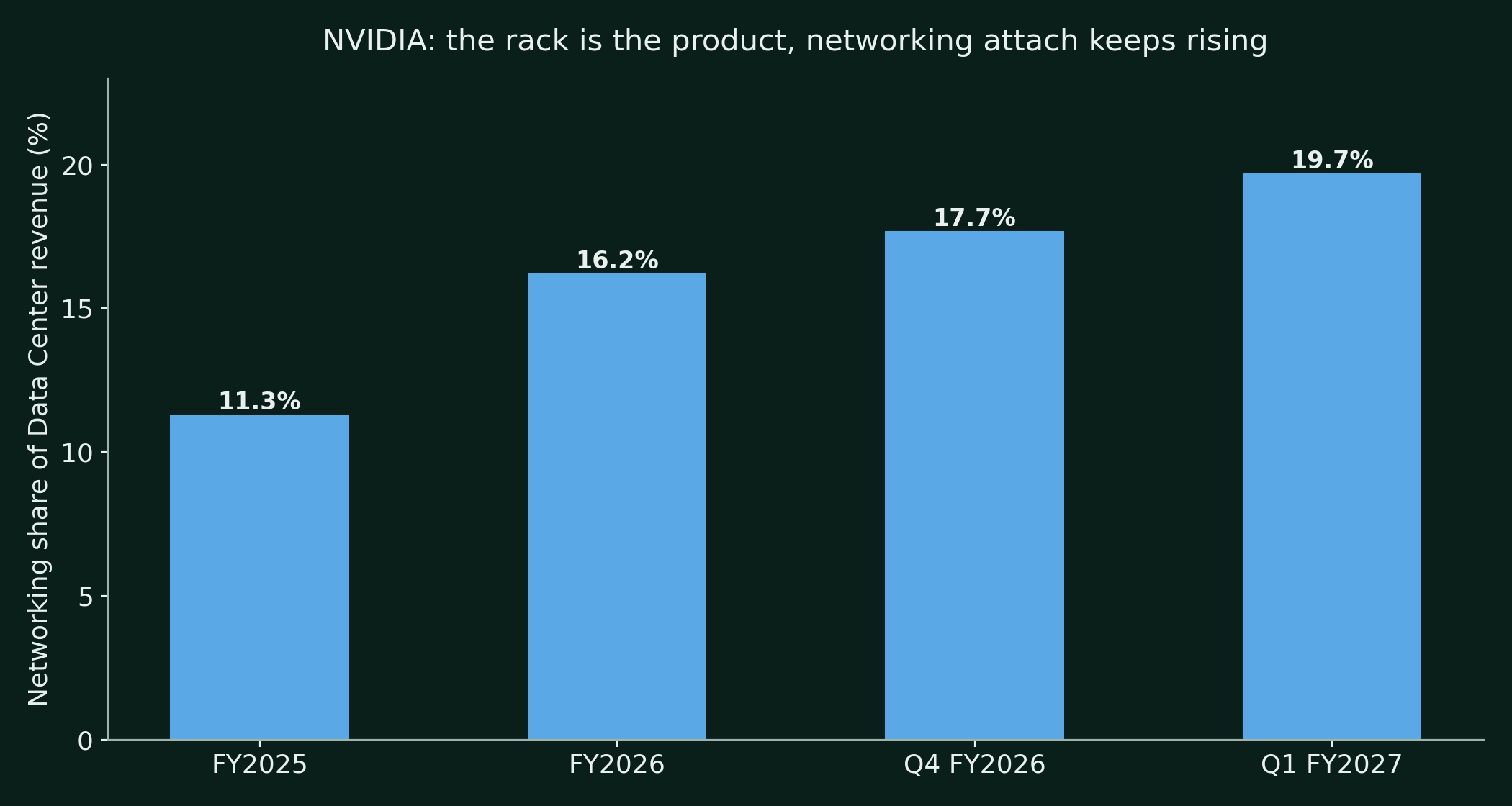
- Networking revenue rose from $13.0B in fiscal 2025 to $31.4B in fiscal 2026, and networking reached 19.7% of Data Center revenue in Q1 fiscal 2027.
- A customer who buys the NVLink fabric has bought the architecture. The fabric is the switching cost, and it is now a fifth of the platform sale.
- Revenue opportunity per gigawatt rises from about $18B on Hopper to about $40B on Vera Rubin, per management, because the platform sale keeps absorbing more of the building.
- NVIDIA holds about 75% of AI accelerator revenue on 2026 estimates and about 86% of the three-vendor data center revenue set, per the DalalBytes compute research.
- The moat is narrowest at the base of the workload pyramid, where inference and fine-tuning run on TPU, Trainium and AMD at an adaptation cost.
- The apex, frontier training where time-to-model is the product, remains NVIDIA's by merit, with Vera Rubin racks live at every major cloud.
- A moat that holds the apex and taxes the base passes. The networking attach rate is the line that would show widening or narrowing first.
- The grade is PASS.
Pillar 4, Iron Fortress: why only partial?
- Cash and marketable debt securities were $56.6B at July 26, 2026, against total debt of $33.4B. The company holds about $23B of net cash on liquid securities alone.
- Shareholders' equity was $229.0B, and first half free cash flow was $69.9B. Survival in a bad year is not in question.
- The same filing carries $366B of total future commitments, led by $279B of supply and capacity commitments phased across fiscal 2027 to 2029.
- A further $36B of AI cloud agreements and $20B of leases signed for third parties sit below the commitment table.
- Guarantees cap at $108.5B of maximum gross exposure, including $105B behind the SB Energy campus in Ohio that will host NVIDIA infrastructure under 20-year leases to OpenAI, phasing in from fiscal 2029 as sites reach service.
- The equity book stands at $94.0B, concentrated in the ecosystem the company sells to, including roughly $21B in SpaceX and stakes in CoreWeave, Nebius and Intel.
- The fortress test is survival, and this fortress survives. The grade turns on direction. Each quarter a larger share of the strongest balance sheet in the industry is pledged to the buildout it supplies, and the pledges run for twenty years.
- The grade is PARTIAL, the only partial in the library that is caused by strength being spent rather than by weakness.
Pillar 5, Free Cash Flow: why only partial?
- Free cash flow was $27.0B in fiscal 2024, $60.9B in fiscal 2025 and $96.7B in fiscal 2026, a conversion record few companies in history match.
- The first half of fiscal 2027 produced $69.9B more. The engine is not in question.
- The quarters split. Q1 operating cash flow was $50.3B and Q2 was $24.1B, while GAAP net income rose from $58.3B to $59.7B.
- Accounts receivable climbed 64% in six months to $63.1B, with days sales outstanding up from 45 to 60 days, on extended payment terms for large multi-quarter agreements with investment-grade customers.
- Inventory rose to $31.6B from $21.4B at fiscal year end ahead of the Vera Rubin introduction, a build the Q3 print will either validate or strand.
- Cash taxes and working capital explain the quarter in management's account, and the customers extending terms are investment-grade. Both things can be true while the trend still grades partial.
- A cash pillar that finances its customers' payment schedules while its own guarantees phase in does not pass on the strength of its trailing total.
- The upgrade path is stated in the scorecard. Two straight quarters of receivables growth in line with revenue restores the pass.
- The grade is PARTIAL.
What do the pillars miss?
The pillars grade the business, and on that test NVIDIA is the strongest operating company in this library. What they cannot grade is the calendar. The sunrise, the moat and the leadership record are all measured at the top of a pricing cycle the company's own guidance says is turning, and the two partials are both forward-looking instruments, guarantees that phase in from fiscal 2029 and receivables that grade the demand's credit quality rather than its size.
That is why the investment report, not this scorecard, carries the final number. The business earns three passes against the strongest field it has ever faced. The price, which capitalizes a 75% gross margin as if it were a steady state, earns the 72/100 Positive that goes with them.
Frequently asked questions
Why does Iron Fortress grade only partial at a company with $56.6B of cash and securities?
Because the fortress is being spent as ecosystem ammunition. Cash and marketable debt securities of $56.6B exceed $33.4B of debt, but the same filing carries $279B of supply commitments, $36B of AI cloud agreements and guarantees capped at $108.5B. Survival is not in question. The direction of the obligations is.
Why does Free Cash Flow grade partial when the half produced $69.9B?
The half produced $69.9B of free cash flow and the second quarter converted weakly. Operating cash flow fell from $50.3B in Q1 to $24.1B in Q2 while GAAP net income rose, because receivables climbed 64% in six months to $63.1B on extended terms for investment grade customers.
What would change the pillar grades?
Iron Fortress upgrades if guarantee exposure phases in against campuses that reach service and begin paying, and Free Cash Flow upgrades when receivables growth returns in line with revenue for two straight quarters. Both partials fall if gross margin breaks below 70% or a guaranteed campus stalls.
Sources and disclosures
- NVIDIA press release, Financial Results for Second Quarter Fiscal 2027, August 26, 2026, for the statements, balance sheet and cash flows behind the pillar evidence.
- NVIDIA CFO Commentary on Second Quarter Fiscal 2027 Results, Form 8-K exhibit, August 26, 2026, for platform revenue, commitments, guarantees and working capital commentary.
- NVIDIA press release, Financial Results for Fourth Quarter and Fiscal 2026, February 25, 2026, for the fiscal 2025 and 2026 history.
- NVIDIA Q2 fiscal 2027 earnings call reporting of August 26, 2026, for the fiscal 2028 growth guide and the margin path.
- The Compute Share Wars and The Compute Price Reset, DalalBytes, November 2026, for accelerator share and the custom silicon curve.
- The companion investment report carries the full financial statements, the margin analysis, the roadmap audit and the fiscal 2029 scenarios behind this scorecard.
- Disclosures. DalalBytes holds no position in NVIDIA (NVDA) at publication. This analysis is research and opinion for educational purposes only and is not investment advice, a recommendation, or a solicitation. Prices and estimates are as of November 2, 2026.