
Frequently asked questions
Is NDR Auto Components a buy at current prices?
DalalBytes rates NDR Auto Selective Positive at 62/100. At Rs 658.95 the stock trades at about 24x consolidated trailing earnings (TTM EPS Rs 27.29), about 4.4x book value and 0.61% dividend yield, against FY26 revenue of Rs 822.54 cr (up 15.4%), consolidated PAT of Rs 62.09 cr, an 11% operating margin, zero bank debt, and promoters at 73.36% with zero pledging. The selective part is concentration (about 70% of end revenue from Maruti Suzuki), negative FY26 free cash flow of Rs 36 cr, and a Rs 3,000 cr FY30 target that needs 38% compound growth.
What are NDR Auto's FY2029 price targets?
DalalBytes' FY2029 targets for NDR Auto are bear Rs 400, base Rs 800, and bull Rs 1,175, from a Rs 658.95 reference price. Bear: 8% revenue CAGR to Rs 1,036 cr, PAT of Rs 67 cr, EPS of Rs 28.3 at 14x. Base: 16% CAGR to Rs 1,284 cr, PAT of Rs 100 cr, EPS of Rs 42.1 at 19x. Bull: 24% CAGR to Rs 1,565 cr, PAT of Rs 133 cr, EPS of Rs 55.9 at 21x. FY2029 is the year ending March 2029.
How much of NDR Auto's revenue comes from Maruti Suzuki?
About 70% of end revenue traces to Maruti Suzuki and 85 to 90% to Maruti plus Toyota, per ICRA's July 2025 rationale. NDR is a Tier 2 supplier: it sells seat frames and trims mainly to Bharat Seats (28.66% associate), which assembles complete seats for Maruti. NDR supplies 30 to 35% of Maruti's frame and trim requirement. Kia seating sales began in January 2025.
What is the verdict on NDR Auto Components?
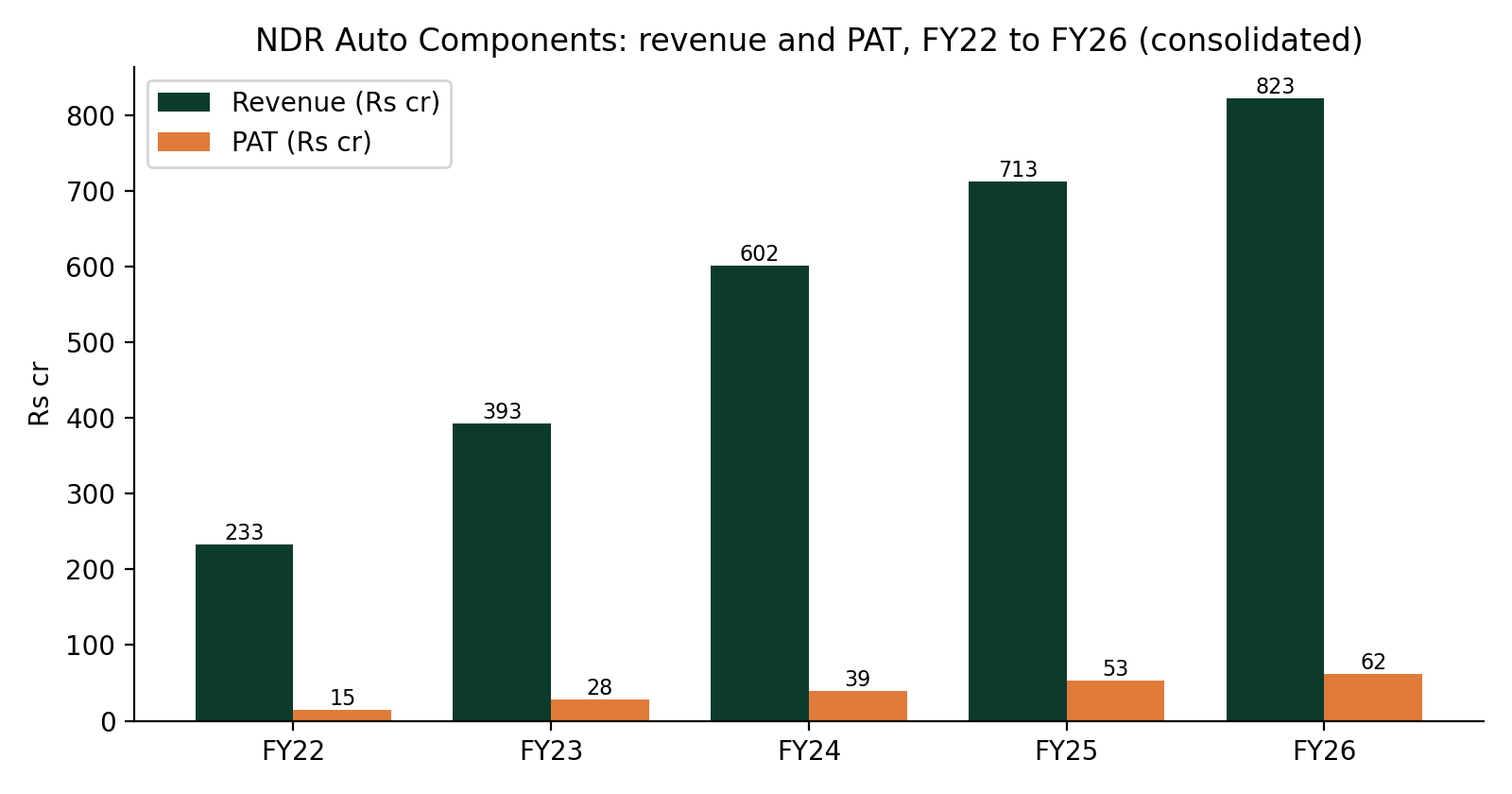
The operating record since the 2020 demerger listing is genuinely strong: revenue from Rs 233 cr in FY22 to Rs 822.54 cr in FY26, operating margin up every year from 6% to 11%, PAT from Rs 15 cr to Rs 62.09 cr, and Q1 FY27 revenue up 19.6% to Rs 221.45 cr with PAT up 20.6% to Rs 16.40 cr. Against that sit three facts. Concentration: about 70% of end revenue from Maruti Suzuki, reached mainly through Bharat Seats. Cash: FY26 free cash flow was negative Rs 36 cr as the Rs 149.80 cr expansion programme was built, and cash fell from Rs 58 cr to Rs 23.26 cr. And the promise: Rs 3,000 cr of revenue by FY30 needs 38% compound growth, while management's own project maths (Rs 823 cr plus about Rs 450 cr of new-project revenue) bridges only to about Rs 1,300 cr and the order book was flat at Rs 650 cr in Q1 FY27. At about 24x earnings, a premium to Sharda Motor at about 14x and Jay Bharat Maruti at about 9x, the price pays for the compounder, not yet for the promise: Selective Positive.
How did NDR Auto start, and who owns it now?
The Rohit Relan Group traces to the 1930s, when N. D. Relan started as a stockbroker. The family entered auto manufacturing in the mid-1980s through Bharat Seats and Sharda Motor, and in 1988 formed Bharat Seats as a joint venture with Maruti Udyog and Suzuki Motor Corporation, one of Maruti's first JVs. NDR Auto was incorporated on March 19, 2019 to demerge Sharda Motor's seating business; the scheme took effect on March 16, 2020 and the shares listed on July 30, 2020, with no IPO and no fresh capital. In September 2025 the entire promoter holding was gifted to the Rohit Relan Family Trust; promoters hold 73.36% at September 2026 with pledging at 0.00%, FIIs hold 0.05% and mutual funds 0.00%.
What does the business actually do?
NDR is a Tier 2 seating supplier. Seat frames, the welded steel skeleton of the seat including high-tensile frames made with Toyo Seat technology, were about 60% of FY25 revenue. Seat trims, cut and stitched fabric and leather covers, were about 40%. Body in White stampings, added in 2021, supply models including the Jimny. The growth kit is content per car: seat insert fabric (Manesar, January 2027), seat latches (Pathredi, 3 million pieces a year), seat belt reminder systems (Gujarat, 1.5 million pieces a year), and through the 50:50 Hayashi Telempu JV, sunshades (in production at Bengaluru from Q1 FY27), ambient lighting and NVH carpets. Management frames current seating content at Rs 10,000 to Rs 15,000 per car and the JV kit at Rs 20,000 to Rs 25,000. Plants: Pathredi and Sector 37 in Gurugram, Harohalli in Karnataka, Naviyani in Gujarat, and Penukonda in Andhra Pradesh (inaugurated July 2026). Material cost is 74.5% of sales, with fortnightly to monthly raw material pass-through.
Where does the revenue come from?
From two OEM groups, through Tier 1 assemblers. Direct customers include Bharat Seats (the largest), Toyota Boshoku Automotive India, Hyundai Transys and Bellsonica. End models span Maruti's Grand Vitara, Brezza, Fronx, Dzire, e-Vitara, Wagon R, Alto and Jimny, Toyota's Hyryder and Urban Cruiser, and Kia's Syros and Carens. Frames are model-specific and programmes run about seven years, so concentration is at model level as well as OEM level. Maruti sold 24.23 lakh vehicles in FY26, which is the tide this P and L floats on.
What do the financials show?
Revenue compounded at about 53% a year over FY22 to FY25, then grew 15.4% in FY26 to Rs 822.54 cr as the base enlarged. Operating margin rose every year: 6%, 8%, 9%, 10%, 11%, with Q4 FY26 at 12%. Consolidated PAT of Rs 62.09 cr includes about Rs 9 cr of equity-accounted profit from Bharat Seats; standalone PAT was Rs 53.05 cr (standalone EPS Rs 22.30 vs consolidated Rs 26.04), a distinction the full report keeps explicit. ROCE was 22.2% and ROE 18.9% on Screener's consolidated basis; the company cites 36.22% ROCE excluding non-productive land and surplus cash. Q2 FY27 results had not been announced at this report's date.
How strong is the balance sheet and cash flow?
Net worth is Rs 358 cr, the company reports zero bank debt, interest cost is Rs 3 cr, interest cover is 31.73x, and the cash conversion cycle is minus 1 day (debtors 45 days, inventory 28, payables 74). Screener's Rs 62 cr borrowings line is flagged in the report as lease and similar liabilities on the company's own account, not bank debt. The weak spot is cash generation through the cycle: operating cash flow fell to Rs 37 cr in FY26 from Rs 84 cr, investing outflow rose to Rs 59 cr as fixed assets jumped from Rs 153 cr to Rs 269 cr, free cash flow printed negative Rs 36 cr, and five-year cumulative free cash flow is negative despite about Rs 207 cr of cumulative PAT. Growth here eats cash before it returns it. Dividends still rose: Rs 4.00 a share for FY26, a 15% payout, at the top of management's stated 10 to 15% policy.
What is NDR Auto worth versus peers?
At Rs 658.95: P/E about 24x consolidated trailing (25.3x on FY26 EPS, 29.6x standalone), P/B about 4.4x, P/S about 1.9x, EV/EBITDA about 14 to 17x by definition, yield 0.61%. Direct Maruti-ecosystem peers price lower: Bharat Seats at about 25x on its cleaner October 26 price of Rs 185.22 (it spiked 12.6% on October 27), Sharda Motor at about 14x with a 2.5% yield (market cap about Rs 4,643 cr), and Jay Bharat Maruti at about 9x (about Rs 1,211 cr). The broad auto-component industry average near 46x includes high-multiple names and is not a fair comp. FY2029 scenarios: bear Rs 400, base Rs 800, bull Rs 1,175. Even the bull case reaches only about Rs 1,565 cr of FY29 revenue, roughly half the FY30 target in the year before it falls due.
What are the key risks?
First, concentration: about 70% of end revenue from Maruti Suzuki, 85 to 90% from Maruti plus Toyota, model-specific tooling, and no non-auto business by deliberate policy. Second, the target: Rs 3,000 cr by FY30 needs 38% compound growth with no published quantified bridge, and the order book was flat at Rs 650 cr in Q1 FY27. Third, competition: the Gabriel-Forvia JV announced on October 7, 2026 brings Rs 100 cr of equity and a 10% India seating share target, with Maruti already a Forvia customer; every new programme from 2027 is contested. Fourth, cash: negative FY26 free cash flow and a cash balance down to Rs 23.26 cr. Fifth, governance watch items: about Rs 11.25 cr spent on Aerocity office space at a luxury hotel address, an income tax demand under appeal with the amount unquantified in reviewed material, and terse disclosure on kit values and orders. Finally, liquidity: mutual funds hold 0.00% and average daily traded value is about Rs 2.4 cr.
© 2026 DalalBytes Research · For educational purposes only. Not investment advice.