
What is the five-pillar scorecard?
Four pass, one partial, no fails. The pillars grade the business, not the price. The price is graded in the companion investment report, and the business grades at the top of the DalalBytes library while its cash pillar carries the largest build in the industry.
What would change the score. The score rises if Azure growth holds at or above 45% through fiscal 2027 with Microsoft Cloud gross margin steady near 65% and free cash flow back to growth by fiscal 2028, and it falls if Azure growth drops below 35%, if Maia is still internal only at the end of 2027, or if a top AI workload moves from Azure to a rival cloud at scale.
| 74/100 | DalalBytes score |
| 4 pass | 1 partial, 0 fail |
| $521.91 | Reference price. October 30 2026 close |
| $425 / $720 / $950 | Fiscal 2029 bear / base / bull |
| Pillar | Grade | The one-line reason |
|---|---|---|
| 1. Sunrise | PASS | Azure grows 48% and the backlog grew 73% to $677B |
| 2. Leadership | PASS | Guides get beaten and the build is self-funded |
| 3. Moat | PASS | The enterprise agreement renews as one relationship |
| 4. Iron Fortress | PASS | Net cash and $470.5B of equity against the lease pipeline |
| 5. Free Cash Flow | PARTIAL | Three straight annual declines under the capex program |
Each pillar below carries its own evidence, with filed numbers carrying the grades and management claims labeled as claims. The partial sits on the pillar the whole investment debate is about, which is where a partial belongs.
Pillar 1, Sunrise: why does it pass?
The sunrise test asks one question. Is the industry itself rising?
- Azure revenue grew 48% in Q1 fiscal 2027 to $33.2B in its first quarter of dollar disclosure.
- Commercial remaining performance obligations grew 73% to $677B.
- Management reports demand still exceeding supply, with 24 data centers added in one quarter.
- Copilot daily users rose more than five times year over year.
- Agent registrations passed 50 million in the Agent 365 registry, up 30% in one quarter.
- Every hyperscaler on the field is raising capacity into 2027, and the constraint set is power and packaging, not orders.
- The tide extends past the cloud. Foundry customers rose 300% to 120,000 and Fabric paid customers passed 44,000.
- A sunrise this strong forgives many execution sins. Microsoft's sin, the silicon timeline, is graded where it belongs, under Leadership and in the roadmap audit.
- The grade is PASS.
Pillar 2, Leadership: why does it pass?
- Satya Nadella has led the company since 2014 and rebuilt it around cloud and subscriptions.
- Azure growth was guided at about 45% in constant currency for Q1 fiscal 2027 and delivered 48%.
- Management then guided Q2 Azure growth up, to 49 to 50% in constant currency, rather than banking the beat.
- The build is self-funded. Operating cash flow of $182.9B in fiscal 2026 covers the capex program without dependence on capital markets.
- Shareholder returns continued through the build, $22.3B of buybacks and $26.4B of dividends paid in fiscal 2026.
- The OpenAI restructuring was executed on Microsoft's terms twice, keeping the stake, the $250B commitment and the payment flow while surrendering exclusivity that was decaying anyway.
- CFO Amy Hood reset segment reporting to match the strategy and began Azure dollar disclosure, an accountability upgrade few companies volunteer.
- The deduction is the silicon program. Maia is three years in and still internal only, a timeline this leadership team owns.
- The fiscal 2027 free cash flow commitment, remaining positive, is set far below this team's usual standard.
- The grade is PASS on the delivery record, with the silicon flag stated rather than buried.
Pillar 3, Moat: why does it pass?
- The enterprise agreement bundles identity, productivity, security, developer tooling and cloud into one renewable relationship.
- The $677B backlog is that relationship in numbers, at a weighted average duration of 2.3 years.
- Microsoft 365 commercial seats grew 5% while Microsoft 365 cloud revenue grew 17%, so growth comes from selling more to seats already owned.
- Copilot passed 30 million paid seats by Q4 fiscal 2026, attaching to the existing seat base.
- Customers with more than 50,000 Copilot seats rose more than eight times year over year.
- Segment operating margins price the moat in numbers, shown in the chart below.
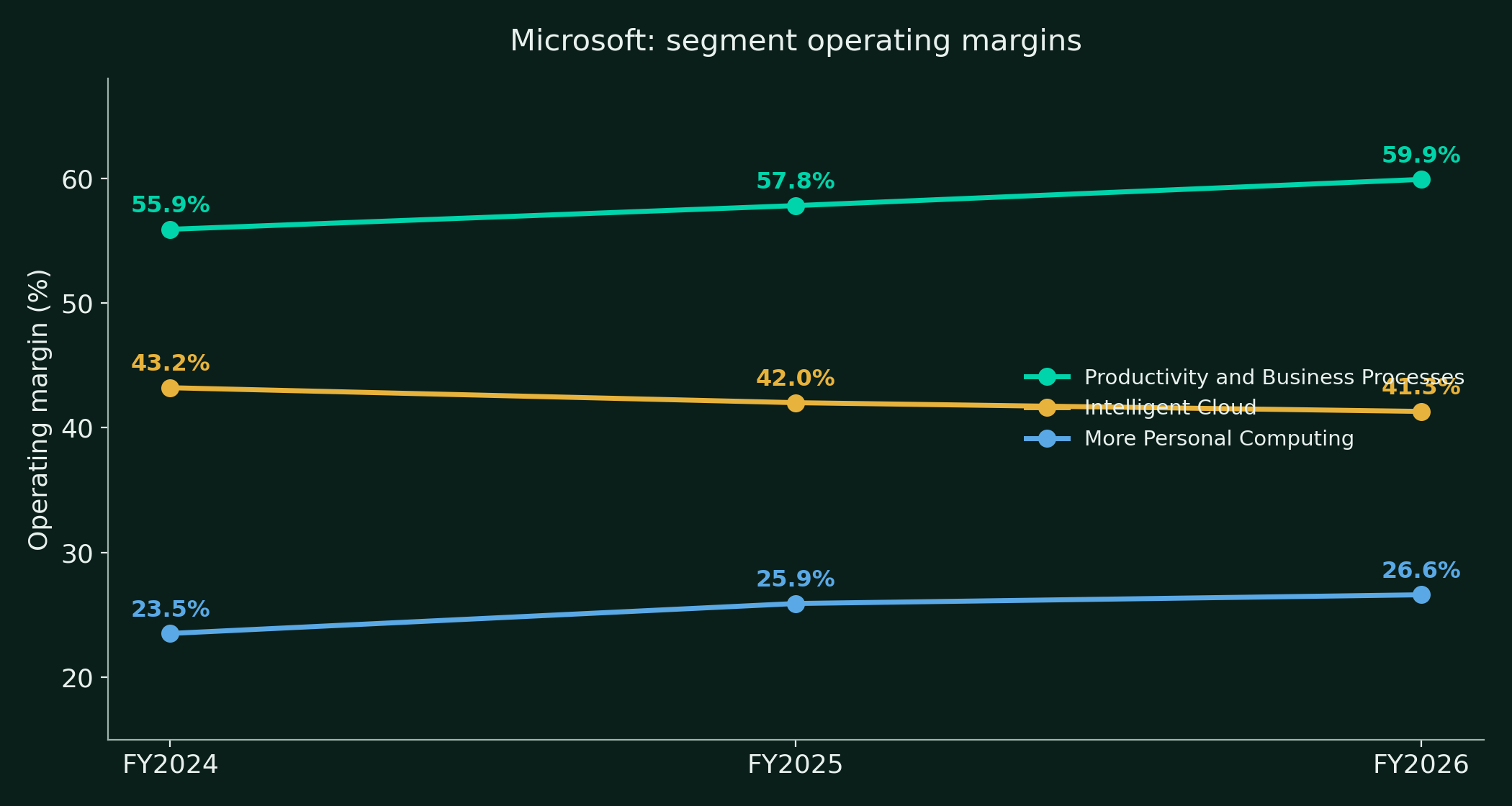
- Productivity and Business Processes operating margin expanded to 59.9% in fiscal 2026.
- Intelligent Cloud operating margin compressed to 41.3% from 43.2% in fiscal 2024, the build showing up inside the moat rather than breaching it.
- The moat is narrowest at the model layer, where Microsoft rents intelligence through a partner that now also sells through AWS.
- Contested at one layer is not breached. The distribution layers above and below the model remain Microsoft's.
- The grade is PASS.
Pillar 4, Iron Fortress: why does it pass?
- Cash and short-term investments were $64.5B at September 30, 2026.
- Total debt was $35.5B on the same date, so the company held about $29B of net cash excluding leases.
- The October 29, 2026 bond sale of $25B was the first US issue since 2017 and was a choice, not a need. Pro forma debt near $60.5B still sits below pro forma cash and investments near $89.5B.
- Total equity was $470.5B and total assets $779.4B.
- One quarter of operating cash flow, $58.0B, covers the entire pre-sale debt stack more than one and a half times.
- The deduction is the lease pipeline. Leases of $364.6B had been signed but had not yet commenced, running from fiscal 2027 to fiscal 2034.
- Purchase commitments of $194.1B and construction commitments of $34.6B stood at June 30, 2026.
- Those obligations are matched against a $677B customer backlog, and the fortress test is survival in a bad year, not comfort in a good one.
- In a bad year the company still holds net cash, the strongest credit standing in the sector and a cost base it is already trimming.
- The grade is PASS, with the lease pipeline recorded as the reason the next fortress review matters.
Pillar 5, Free Cash Flow: why only partial?
- Free cash flow was $74.1B in fiscal 2024, $71.6B in fiscal 2025 and $67.0B in fiscal 2026.
- Q1 fiscal 2027 free cash flow fell 27% year over year to $18.6B.
- Free cash flow margin compressed from 30.2% of revenue in fiscal 2024 to 20.2% in fiscal 2026.
- Cash capex rose from $44.5B to $115.9B across the same two years, and total capex including finance leases was $45.2B in Q1 fiscal 2027 alone.
- The calendar 2026 capex outlook is near $170B, with Q2 fiscal 2027 guided above $50B.
- The engine underneath is not in question. Operating cash flow grew 34% in fiscal 2026 to $182.9B.
- Stock compensation of $12.4B is about 19% of free cash flow, a modest deduction by sector standards.
- The grade turns on trajectory. A pillar that has declined three years in a row, with the largest spending year still ahead, does not pass on the strength of its starting point.
- The upgrade path is stated in the scorecard. Free cash flow returning to growth, which the base case places in fiscal 2028, restores the pass.
- The grade is PARTIAL.
What do the pillars miss?
The pillars grade the business, and on that test Microsoft is one of the strongest names in the library. What they cannot grade is duration. The fortress, the moat and the backlog are all measured today, while the question the price asks is about fiscal 2029, after three more years of quarters with capex above $50B and a lease pipeline larger than the current debt stack by an order of magnitude.
That is why the investment report, not this scorecard, carries the final number. The business earns four passes. The price, which already assumes the build works, earns the 74/100 Positive that goes with them.
Frequently asked questions
Why does Free Cash Flow grade only partial?
Free cash flow fell from $74.1B in fiscal 2024 to $71.6B in fiscal 2025 and $67.0B in fiscal 2026, then fell 27% year over year in Q1 fiscal 2027. Cash capex rose from $44.5B to $115.9B in two years and runs near $170B in calendar 2026.
Why does Iron Fortress pass with $364.6B of leases ahead?
The fortress grades the balance sheet as it stands. Cash and short-term investments of $64.5B exceed total debt of $35.5B, equity is $470.5B, and one quarter of operating cash flow was $58.0B. The $364.6B of uncommenced leases is a commitment against a $677B customer backlog, flagged here rather than netted.
What would change the pillar grades?
Free Cash Flow upgrades when capex intensity peaks and free cash flow returns to growth, which the base case places in fiscal 2028. Iron Fortress comes under review if lease commencements outrun backlog conversion, and Sunrise and Moat come under review if Azure growth falls below 35% or Maia is still internal only at the end of 2027.
Sources and disclosures
- Microsoft Form 10-K for fiscal 2026, filed July 29, 2026, for segment margins, cash flow and the consolidated statements.
- Microsoft Form 10-Q for Q1 fiscal 2027, for the September 30, 2026 balance sheet, segment detail and lease commitments.
- Microsoft Q1 fiscal 2027 earnings release and earnings call reporting of October 28, 2026, for guidance, RPO and the capex outlook.
- Microsoft bond offering prospectus supplement of October 29, 2026, for the $25B ten-series sale.
- The companion investment report carries the full financial statements, the roadmap audit and the fiscal 2029 scenarios behind this scorecard.
- Disclosures. DalalBytes holds no position in Microsoft (MSFT) at publication. This analysis is research and opinion for educational purposes only and is not investment advice, a recommendation, or a solicitation. Prices and estimates are as of November 2, 2026.