

Frequently asked questions
Is Marico (MARICO) a buy at current prices?
DalalBytes rates Marico Selective Positive at 70/100. FY26 revenue was Rs 13,611 crore, up 25.7%, with India volume growth of 11% in Q1 FY27 and 10% in Q2 FY27. Parachute gained share through the copra spike. At Rs 911.00, about 59 times trailing earnings, the price assumes the FY29 plan is delivered.
What are Marico's FY2029 price targets?
DalalBytes' FY2029 targets (year ending March 2029) are bear Rs 660, base Rs 1,050 and bull Rs 1,430, from a Rs 911.00 reference price (NSE close, November 16, 2026). Bear: 10% revenue CAGR, EPS of about Rs 17.4 at 38 times. Base: 14.5% CAGR, EPS of about Rs 22.0 at 48 times. Bull: 17% CAGR, EPS of about Rs 26.0 at 55 times. These are DalalBytes scenarios, not broker consensus.
What is Marico's copra risk?
Copra is the dried coconut kernel behind Parachute, 34% of India revenue. Copra rose 113% year on year at the FY26 peak and Parachute took about 60% pricing growth, cutting FY26 operating margin to 17.1%. Copra then fell about 35% from its peak, which powers the FY27 margin recovery and creates a hard FY28 comparison.
What is the verdict on Marico?
Marico just passed the hardest stress test an Indian consumer company can face. Copra, the dried coconut kernel behind Parachute, rose 113 percent year on year at the worst point in FY26. Parachute took about 60 percent pricing growth in response. Volumes dipped for two quarters and then came back. In Q2 FY27 Parachute Rigids volume grew 13 percent, the best print in 22 quarters, and its volume share hit a new high of 60 percent. A brand that can raise prices 60 percent into a commodity spike and gain share is not a commodity business wearing a brand. It is a brand that rents a commodity.
The growth around that core is real and broadening. FY26 revenue rose 25.7 percent to Rs 13,611 crore, the fastest growth in 14 years on company framing. India volume growth printed 11 percent in Q1 FY27 and 10 percent in Q2 FY27. International constant currency growth was 20 percent in FY26. Foods crossed Rs 1,000 crore in FY26 and a Rs 1,500 crore annualised run rate in Q2 FY27. The digital-first portfolio exited FY26 above Rs 1,100 crore of annualised revenue. Management raised FY27 guidance twice in two quarters, and pulled the Rs 20,000 crore revenue ambition forward from FY30 to FY29.
The deduction is price, and one cycle warning. At Rs 911.00 the stock trades at about 59 times trailing earnings and about 67 times FY26 recurring earnings. The FY27 margin recovery is powered by copra falling about 35 percent from its peak, and that tailwind anniversarises in FY28. The stock also sits about 1.5 percent below its 52-week high after an 8 percent jump on the Q2 FY27 print. The buyer today pays in advance for the FY29 plan, and the plan has to be delivered almost in full to earn the base case.
What would change the score: two more quarters of double-digit India volume growth with Foods and digital-first margins improving would lift the score toward 78. A copra rebound that cuts gross margin back below the FY26 level, or a guidance slip on the Rs 20,000 crore path, would cut it toward 60.
Reference price: Rs 911.00 (NSE close, November 16, 2026). Market cap about Rs 1,18,449 crore. 52-week range Rs 707 to Rs 925. The stock is up about 29 percent from its 52-week low and about 1.5 percent below its 52-week high.
FY2029 targets: Bear Rs 660 / Base Rs 1,050 / Bull Rs 1,430. See Section 17 for assumptions.
What is Marico at a glance?
| Item | Detail |
|---|---|
| Company | Marico Ltd, Mumbai, India |
| Founded | 1990, carved out of Bombay Oil Industries by Harsh Mariwala; listed 1996 |
| Listed | NSE: MARICO; BSE: 531642; face value Rs 1 |
| Business | Branded consumer goods: coconut oil, hair oils, edible oils, foods, premium personal care, digital-first brands, plus an international business at 24 percent of revenue |
| Lead brands | Parachute, Saffola, Nihar Naturals, Hair & Care, Parachute Advansed, Set Wet, Livon, Beardo, Just Herbs, True Elements, Plix, Cosmix, 4700BC |
| FY26 revenue | Rs 13,611 cr, up 25.7 percent |
| FY26 profit | Reported PAT Rs 1,813 cr; recurring PAT Rs 1,762 cr, up 11 percent |
| Latest result | Q2 FY27, declared November 2, 2026: revenue Rs 3,897 cr (+13 percent), EBITDA Rs 709 cr (+27 percent), PAT attributable Rs 550 cr (+31 percent) |
| Balance sheet | Borrowings Rs 557 cr at March 2026 against net worth of Rs 4,210 cr; investments of Rs 2,083 cr |
| Promoter | Mariwala family 58.83 percent (September 2026) |
How was Marico founded?
Bombay Oil Industries was founded in 1948 by Charandas Mariwala and his brothers. It traded and manufactured spices, oils and chemicals in bulk. Parachute coconut oil and Saffola refined oil existed by 1965, but most of the business was unbranded and sold in tanks, barrels and 15 kg containers. The consumer was a trader, not a household.
Harsh Mariwala joined the family business in 1971 at age 20. He started its consumer products business in 1975 and spent about 15 years building Parachute and Saffola into national brands. The core innovation was packaging and reach: branded small packs sold to households through a national distribution network, in a category that had been sold loose from a tin.
It took about three years to convince the family to hive the consumer business off. Marico was founded on April 2, 1990. Its name is a play on Mariwala and Company. It listed in 1996. At the start, Parachute and Saffola were 100 percent of revenue. The company presentation puts the long-run record plainly: Rs 100 invested at the 1996 listing was worth Rs 35,926 by May 31, 2025, a 22 percent total shareholder return CAGR on the company's own count.
The defining fight came in 1999, when Hindustan Lever relaunched Nihar against Parachute. Parachute then supplied up to 60 percent of Marico's profits, so the attack was existential. Marico held its ground on distribution and packaging, and in January 2006 it bought the Nihar brand from Hindustan Lever, in a deal reported at over Rs 200 crore. The challenger became the second brand in the portfolio. Parachute and Nihar together later commanded close to 60 percent of the coconut hair oil market.
The second defining act was subtraction. Kaya, the skincare clinic business Marico had built since 2003, was demerged in 2013 into Marico Kaya Enterprises and listed separately in 2014. Marico became a pure branded consumer goods company. Harsh Mariwala stepped down as Managing Director in 2014 and stayed as Chairman. Saugata Gupta, who had joined in 2004, became MD and CEO and has run the company since.
What does Marico sell?
Marico reports two geographic segments. The brand portfolio inside them is where the economics differ, so this report works at brand level.
| Segment, FY26 audited | Revenue (Rs cr) | Share | Segment result (Rs cr) |
|---|---|---|---|
| India | 10,348 | 76 percent | 1,661 |
| International | 3,263 | 24 percent | 813 |
| Unallocated and corporate | n.a. | n.a. | -144 |
• International earns the higher segment margin. The FY26 segment result is about 25 percent of revenue in International against about 16 percent in India. Bangladesh-led coconut oil and premium hair care abroad are more profitable per rupee than the India mix today.
• The India mix is shifting on a TTM basis. The Q2 FY27 presentation puts Parachute at 34 percent of India revenue, Saffola Edible Oils at 16 percent and Value Added Hair Oils at 18 percent. Foods plus Premium Personal Care, the growth portfolio, was 23 percent of India revenue in FY26.
| India portfolio | Share or scale | Position |
|---|---|---|
| Parachute coconut oil | 34 percent of India revenue (TTM, Q2 FY27) | About 63 percent total volume share of branded coconut oil (company, March 2025 MAT); Parachute brand alone 55 percent |
| Saffola edible oils | 16 percent of India revenue (TTM) | Premium heart-health niche; value leader framing inside its niche, not the volume leader in edible oils |
| Value Added Hair Oils | 18 percent of India revenue (TTM) | About 28 to 30 percent value share; Nihar Naturals, Hair & Care, Parachute Advansed |
| Foods | Rs 1,000 cr plus in FY26; Rs 1,500 cr plus run rate in Q2 FY27 | Saffola Oats is the number one oats brand at about 41 percent value share on the company presentation basis |
| Premium Personal Care | Rs 500 cr plus run rate in Q2 FY27 | Set Wet, Livon, premium hair nourishment, male grooming, skin care |
| Digital-first brands | Rs 1,100 cr plus exit ARR in FY26; about Rs 1,150 cr run rate in Q2 FY27 | Beardo, Just Herbs, Plix, True Elements, Cosmix, 4700BC |
• Parachute is an edible-grade oil sold as hair care. The product is 100 percent coconut oil, and its technical moat is pack architecture as much as formulation. Marico pioneered the move from tin to plastic in the 1980s with a round bottle rats could not grip, after retailers rejected an earlier square plastic pack that rats had bitten through. A wide-mouth jar solved winter freezing, when coconut oil solidifies. A pilfer-proof flip-top answered copycat packs that Mariwala said once took about 20 percent of sales. His own summary: the tin-to-plastic conversion took ten years, and share rose from 15 percent to 50 percent through it.
• Rigids are the profit core inside Parachute. The rigid bottle and jar business is reported separately from small flexible packs. Rigids carry the brand's pricing power, and their volume line is the cleanest demand signal in the portfolio.
• Saffola is a health platform, not an oil brand anymore. The edible oil anchors trust on heart health, built since 1965 and reinforced by the Saffola Healthy Heart Foundation from 1991. The foods range now runs across oats and muesli, soya chunks and honey, plus peanut butter and snacks. Foods scaled about 5x from FY20 to FY25.
• VAHO is the quiet compounder. The value added hair oil market is about Rs 8,500 crore on company estimates. Marico leads amla oils through Nihar Naturals Shanti Amla and has printed six straight quarters of strong growth to Q2 FY27.
• The portfolio claim is leadership density. The company states that 95 percent of revenue comes from brands ranked number one or number two in their categories. That is a company claim, and the category definitions are its own, but the Parachute and VAHO share data support the direction.
How did Marico handle the copra cycle?
Copra is the single most important input in this company, and FY26 to FY27 is a complete cycle in fast motion. The sequence matters because it proves the moat and warns on the margin at the same time.
| Phase | What happened |
|---|---|
| FY25 build-up | Domestic copra prices rose sharply on erratic monsoons and weak coconut yields in Kerala and Tamil Nadu; rice bran oil prices rose about a quarter |
| Q2 FY26 peak stress | Copra up 113 percent year on year; Parachute pricing up about 60 percent year on year; Parachute Rigids volume down 3 percent; gross margin down about 810 bps year on year in the quarter |
| FY26 full year | Copra averaged up 57 percent year on year; revenue grew 25.7 percent on pricing; operating margin fell to 17.1 percent from 19.7 percent |
| Correction through FY27 | Copra fell about 35 percent from its peak and stayed range-bound there through Q2 FY27 |
| Q2 FY27 release | Selective price cuts in larger packs; Parachute Rigids volume up 13 percent; gross margin up about 600 bps year on year; material cost down to 51.9 percent of revenue from 57.9 percent |
• Pricing power was proven under maximum pressure. Management said on the Q2 FY26 call that it had never heard of a power brand anywhere taking 60 percent pricing growth. Volumes fell only modestly at the peak, and share was held, then extended on the way down.
• The margin recovery is a cost gift, not a demand miracle. Q2 FY27 gross margin expansion of about 600 bps came from softer copra and mix. Revenue of Rs 3,897 crore slightly missed the LSEG consensus of about Rs 3,962 crore while PAT beat, which tells the same story in one line.
• The FY28 base is the risk built into today's price. When copra deflation anniversarises, gross margin stops expanding mechanically. Growth then has to come from volume and mix alone, with advertising already running hot at Rs 451 crore in Q2 FY27, up 44 percent.
How strong is Marico's distribution?
Distribution is the second moat, and its current state is specific.
| Reach item | Latest figure |
|---|---|
| Total outlets reached | 5.8 million of about 11.3 million outlets in India (company, June 2025) |
| Direct reach, FY24 base | About 1 million outlets |
| Direct reach, Q2 FY27 | More than 1.5x the FY24 level, delivered ahead of the FY27 timetable |
| Sales mix | Urban about 70 percent, rural about 30 percent, broadly stable |
| SETU 2.0 | Launched in Q2 FY27: AI-led capabilities plus a dedicated Foods and Premium Personal Care go-to-market |
| SETU exports | Playbook live in Vietnam with encouraging results; Bangladesh rollout begun |
• SETU was designed to be cost-neutral. The original three-year plan funded wider direct coverage by reallocating wholesale spends, organised-trade promotions and supply-chain savings. Delivery ahead of schedule, without a stated cost overrun, is a management quality signal.
• Reach is doing measurable work. Management credits the thinner distributor pipeline and deeper rural distribution under SETU for part of the Parachute volume recovery, and for VAHO's structural growth shift. Over 95 percent of the business gained or sustained share and penetration on a MAT basis in Q2 FY27.
• Headroom remains the story. Reaching 5.8 million of 11.3 million outlets means the company itself maps a large uncovered tail. The constraint is economics per outlet, not geography, which is why SETU 2.0 pairs coverage with assortment and AI-led productivity.
How does the digital-first acquisition machine work?
Since 2017 Marico has run a staged acquisition playbook for digital-first brands. It buys a stake and keeps founders running the brand. It learns the category, then steps up to control over years. Beardo is the proof of concept: a 45 percent stake in 2017, full ownership in 2020, and a brand now expected to top Rs 400 crore of revenue in FY27 at double-digit EBITDA margin.
| Deal | Terms | Status |
|---|---|---|
| Nihar, from Hindustan Lever (2006) | Reported at over Rs 200 cr | Owned; now the number two coconut oil brand in the house |
| Paras personal care, from Reckitt Benckiser (2012) | Undisclosed; expected FY12 turnover over Rs 150 cr; Set Wet, Livon, Zatak | Owned |
| Isoplus, South Africa (2017) | About Rs 36 cr at 1.2x revenue | Owned |
| Beardo / Zed Lifestyle (2017 to 2020) | 45 percent in 2017, balance by 2020; consideration undisclosed | 100 percent owned |
| Just Herbs / Apcos Naturals (2021 to 2024) | 60 percent by 2022; balance 40 percent for up to Rs 70 cr in September 2024 | 100 percent owned |
| True Elements / HW Wellness (2022 to 2025) | 53.98 percent in 2022; balance 46.02 percent for up to Rs 138 cr in September 2025 | 100 percent owned |
| Plix / Satiya Nutraceuticals (2023 to 2026) | 60 percent for Rs 380 cr in 2023; a further 24.09 percent for Rs 1,012 cr in October 2026 | 84.09 percent; a further 14.09 percent due July 2027 on filing summaries |
| 4700BC / Zea Maize (January 2026) | 93.27 percent for Rs 226.8 cr, bought from PVR INOX | Owned |
| Cosmix Wellness (February 2026) | 60 percent for Rs 225.67 cr at about Rs 375 cr equity value; a further 20 percent for Rs 113.65 cr in November 2026 | 80 percent owned |
| Skinetiq, Vietnam (February 2026) | 75 percent for up to Rs 261.6 cr at about Rs 350 cr equity value | Completed April 2, 2026; first overseas digital-first deal |
| Bonorizon (November 2026) | Definitive agreements for 51 percent for up to Rs 35 cr | Announced |
• The Plix step-up is the capital allocation question of the year. The October 2026 purchase of 24.09 percent for Rs 1,012 crore implies an equity value of about Rs 4,200 crore for Satiya Nutraceuticals. That is about 4.9 times its FY26 consolidated turnover of Rs 864 crore, against the Rs 380 crore paid for 60 percent in 2023. Plix earned the re-rating by growing turnover from Rs 155 crore in FY24 to Rs 864 crore in FY26, but the step-up price leaves no room for a growth stumble.
• The new discipline is scale before purchase. Management now says it buys only digital-native brands already at Rs 100 crore or more of revenue, not the Rs 20 to 30 crore bracket. Cosmix fits the rule: about Rs 100 crore of annualised revenue and a high-teen EBITDA profile at announcement.
• Profitability is promised, not yet proven at portfolio level. Management states Beardo is at double-digit EBITDA and Plix at high single digits, with the portfolio reaching double-digit EBITDA by the FY27 exit. Just Herbs and True Elements were still to turn profitable in November 2026, with an 18-month management timeline to get there.
• Calendar 2026 commitments are heavy. Press tallies put about Rs 1,700 crore of commitments across 4700BC, Skinetiq, Cosmix and the Plix step-up in 2026 to November. That is roughly one year of free cash flow, spent into the fastest-growing but least proven part of the portfolio.
How strong is the international business?
International was 24 percent of FY26 revenue and the higher-margin segment. Its mix is being deliberately rebalanced.
| Market | Recent constant currency growth | Read |
|---|---|---|
| Bangladesh | 4 percent in Q1 FY27, 5 percent in Q2 FY27 | Largest market, about 42 percent of international in FY25, down from 51 percent in FY22; high inflation and high bases are the current drag |
| Vietnam | 27 percent in Q1 FY27, 22 percent in Q2 FY27 | Recovery delivered after a flat FY25; X-Men male grooming leads; SETU playbook and Skinetiq added |
| MENA | 24 percent in Q1 FY27, 15 percent in Q2 FY27 | Gulf and Egypt resilient in FY27; Q4 FY26 fell 7 percent on Gulf supply disruption, the clearest geopolitical hit in the portfolio |
| South Africa | 8 percent in Q1 FY27, 15 percent in Q2 FY27 | Hair care led; Caivil, Black Chic, Isoplus |
| NCD and exports | 16 percent in Q1 FY27, 17 percent in Q2 FY27 | Diaspora and non-core markets |
• Bangladesh survived its political shock. After the August 2024 unrest and the fall of the Sheikh Hasina government, Marico's Bangladesh manufacturing halted briefly and resumed at full capacity on August 11, 2024. No renewed closure was reported in company updates through 2025 and 2026. The current problem is inflation-hit demand, not operations.
• The mix targets are explicit. Non-Bangladesh markets were about 55 percent of international revenue in FY26, targeted at about 65 percent by FY30. Premium categories were about 30 percent of international revenue in FY26, targeted at about 40 percent by FY30.
• The growth record is strong. International constant currency growth was 14 percent in FY25 and 20 percent in FY26, a 14-year high, then 15 percent and 13 percent in the first two quarters of FY27. The standing medium-term guide is double-digit growth with operating margins held at 20 percent or better.
What do the financials show?
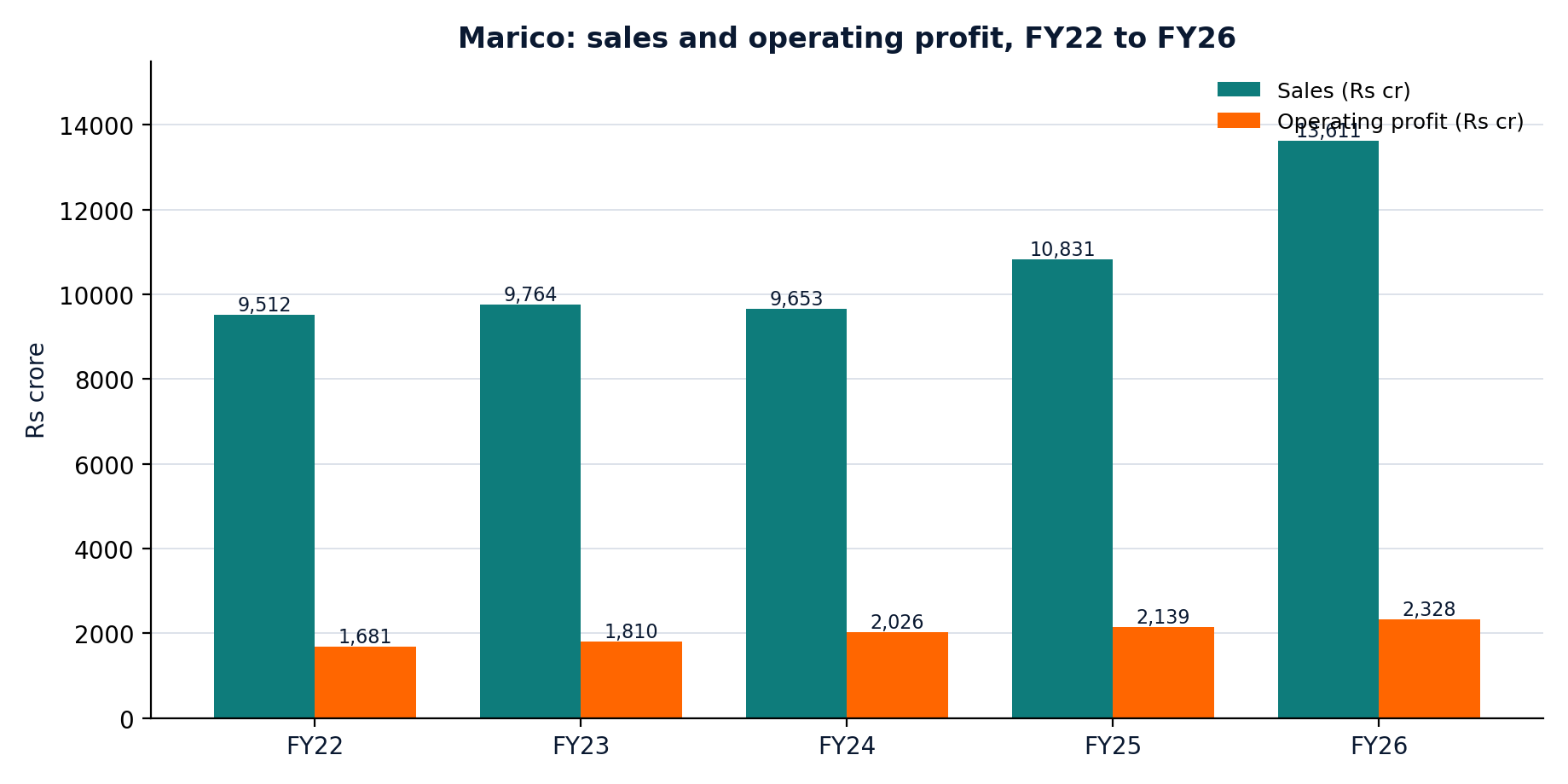
Consolidated figures from Screener, in Rs crore. FY26 revenue is the originally reported Rs 13,611 crore. From Q1 FY27 the company nets some promotional spends against revenue and restates past periods, which is why company updates show FY26 revenue as Rs 13,478 crore on the restated base. Growth rates below use one base at a time and say which.
| Year | Sales | YoY | Operating profit | OPM | PAT reported | EPS (Rs) |
|---|---|---|---|---|---|---|
| FY22 | 9,512 | n.a. | 1,681 | 18 percent | 1,255 | 9.48 |
| FY23 | 9,764 | +2.6 percent | 1,810 | 19 percent | 1,322 | 10.07 |
| FY24 | 9,653 | -1.1 percent | 2,026 | 21 percent | 1,502 | 11.44 |
| FY25 | 10,831 | +12.2 percent | 2,139 | 20 percent | 1,658 | 12.57 |
| FY26 | 13,611 | +25.7 percent | 2,328 | 17 percent | 1,813 | 13.57 |
• Read the arc in three acts. FY23 and FY24 were near-flat on revenue as volumes stalled across Indian FMCG. FY25 recovered 12.2 percent. FY26 jumped 25.7 percent, but most of that growth was Parachute pricing over the copra spike. It was not volume. India volume growth for FY26 was 8 percent, a seven-year high, on the company's count.
• Recurring earnings are the honest base. FY26 recurring PAT was Rs 1,762 crore, up 11 percent, below reported PAT of Rs 1,813 crore. Recurring EPS is about Rs 13.6. This report values the recurring line.
• Margins tell the commodity story. Operating margin peaked at 21 percent in FY24, held 20 percent in FY25, and fell to 17.1 percent in FY26 as copra inflation outran even 60 percent pricing. The FY27 recovery to 20.7 percent EBITDA margin in Q1 and 18.2 percent in Q2 is the same cycle in reverse.
• Return ratios stay elite. ROE was 42.9 percent and ROCE 47.0 percent on the Screener series. The thin equity base flatters both ratios, because high historical payouts keep equity small. The direction is consistent across providers.
Latest quarters
| Quarter | Sales (Rs cr) | YoY | EBITDA (Rs cr) | EBITDA margin | Net profit (Rs cr) |
|---|---|---|---|---|---|
| Q2 FY26 | 3,450 restated | n.a. | 560 | 16.2 percent | 432 |
| Q1 FY27 | 3,957 | +23 percent | 819 | 20.7 percent | 652 |
| Q2 FY27 | 3,897 | +13 percent | 709 | 18.2 percent | 558 |
Net profit is the total including minority interest. PAT attributable to owners was Rs 630 crore in Q1 FY27 and Rs 550 crore in Q2 FY27, up 25 percent and 31 percent. Q2 FY26 sales were Rs 3,482 crore as originally reported and Rs 3,450 crore restated.
• Volume is the headline that matters. India volume growth of 11 percent in Q1 FY27 was the highest in 20 quarters on the company count, and Q2 FY27 made it two straight double-digit quarters. Parachute Rigids volume rose 13 percent, VAHO value grew 21 percent for a sixth straight strong quarter, and Foods grew 45 percent to a Rs 1,500 crore plus run rate.
• One deliberate drag is disclosed. Saffola edible oils revenue grew 6 percent in Q2 FY27 with a high single-digit volume decline, because Marico is cutting supply of low-margin variants. Management says the reset completes over the next two to three quarters, and the premium range led by cold-pressed oils grew ahead of the portfolio.
• H1 FY27 in one line. Revenue Rs 7,854 crore, up 18 percent. EBITDA Rs 1,528 crore, up 26 percent, at a 19.5 percent margin. PAT attributable was Rs 1,180 crore, up 28 percent.
How strong are cash flow and the balance sheet?
| Metric (Rs cr) | FY22 | FY23 | FY24 | FY25 | FY26 |
|---|---|---|---|---|---|
| Operating cash flow | 1,016 | 1,419 | 1,387 | 1,363 | 2,084 |
| Free cash flow | 884 | 1,237 | 1,234 | 1,241 | 1,772 |
• Free cash flow tracks recurring profit. FY26 free cash flow of Rs 1,772 crore is almost exactly recurring PAT of Rs 1,762 crore. The model is formulation, brand and distribution, so capex stays light against sales of Rs 13,611 crore.
• The balance sheet is net cash on any reasonable count. At March 2026 borrowings were Rs 557 crore against investments of Rs 2,083 crore plus cash. Liquid assets less borrowings give net cash of roughly Rs 1,900 to 2,000 crore. That figure is a DalalBytes estimate from the balance sheet lines, not a company disclosure.
• Working capital tightened in H1 FY27. By September 2026 borrowings had risen to Rs 1,238 crore and net worth to Rs 4,735 crore, with investments at Rs 2,634 crore. The borrowing rise funded seasonal working capital and the 2026 deal calendar, and it is the line to watch if deal pace stays at the 2026 rate.
• The payout is generous but lumpy in measurement. Declared dividends were Rs 10.50 per share across FY25 and a final Rs 4.00 per share for FY26. Screener attributes a 30 percent payout to FY26 on its timing basis, against 83 percent in FY25. The dividend yield at Rs 911 is only about 0.43 percent. The multiple, not the payout, sets the yield.
• No buyback was found in this research pass. Capital returns run through dividends. Growth capital runs through the staged digital-first buyouts listed in Section 6.
Who competes with Marico?
Marico's competitive position splits by category. In coconut oil and hair oils it is the leader setting the price umbrella. In edible oils it is a premium niche inside a giant's market.
| Company | Price (Rs) | Market cap (Rs cr) | P/E | ROE |
|---|---|---|---|---|
| Marico | 911.00 | 1,18,449 | 59.7 | 42.9 percent |
| Hindustan Unilever | 2,000.30 | 4,70,000 | 31.2 reported, about 42 underlying | 21.7 percent |
| Nestle India | 1,297.00 | 2,50,000 | 60.5 | 67.9 percent |
| Britannia | 4,754.00 | 1,15,000 | 42.9 | 49.4 percent |
| Tata Consumer | 1,117.50 | 1,11,000 | 65.0 | 7.1 percent |
| Godrej Consumer | 892.70 | 91,350 | 46.2 | 14.7 percent |
| Dabur | 381.90 | 67,747 | 33.4 | 15.8 percent |
| Emami | 413.60 | 18,054 | 24.3 | 26.5 percent |
Peer prices, market caps and multiples are provider figures at November 16, 2026 (Tapetide list). Marico's P/E and ROE are from Screener. HUL's reported P/E uses earnings that include its Rs 4,611 crore ice cream demerger gain. The underlying figure is derived in the DalalBytes HUL report.
• In coconut oil the rival is the loose market. About 30 percent of coconut oil is still sold loose and unbranded on company estimates. Regional brands and Patanjali compete on price beneath the umbrella. The FY26 cycle squeezed loose and regional players at both ends: they could not match Marico's pricing on the way up or its price cuts and supply assurance on the way down.
• In hair oils the fight is segment by segment. Dabur Amla and Bajaj Almond Drops hold strong segment positions. So do Emami and HUL's Indulekha. Mordor Intelligence sizes the market at USD 1.94 billion in 2026, growing at about 6.85 percent a year to 2032. Marico's answer is the mid and premium push through Nihar Naturals, Hair & Care and Parachute Advansed, plus SETU reach.
• In edible oils Saffola does not fight Fortune for volume. AWL Agri Business, owner of Fortune, is the branded edible oil volume leader with the largest distribution in the category. Saffola defends a heart-health premium niche and is now pruning its own low-margin tail. The risk is niche compression if premium demand slows, not a share war it can win on price.
• In foods and digital, everyone is buying the same shelf. HUL bought Minimalist and completed the OZiva buyout. ITC took Yoga Bar to full ownership in 2026. Emami owns The Man Company. Marico's edge is that it started in 2017 and has the deepest staged-buyout record. Its risk is that auction prices for proven digital brands now capitalise success in advance. Its own Plix step-up is part of that pattern.
What are the strengths?
• 1. Pricing power proven at the extreme: about 60 percent pricing taken through a 113 percent copra spike, with share held and then extended to a 60 percent Rigids volume share.
• 2. Volume growth is back at scale: India volumes up 11 percent and 10 percent in the first two quarters of FY27, with over 95 percent of the business gaining or holding share.
• 3. A growth portfolio with real scale: Foods at a Rs 1,500 crore plus run rate, digital-first above Rs 1,100 crore of exit ARR in FY26, and the growth portfolio targeted at 27 percent of India revenue by end-FY27 from 23 percent in FY26.
• 4. International diversification that is working: 20 percent constant currency growth in FY26, a 25 percent segment margin, and Bangladesh deliberately diluted from 51 percent to about 42 percent of the business.
• 5. Elite returns and clean cash conversion: ROE of 42.9 percent, ROCE of 47.0 percent, and FY26 free cash flow of Rs 1,772 crore against recurring PAT of Rs 1,762 crore.
• 6. Guidance credibility: FY27 guidance raised twice in two quarters, SETU delivered early, and the Rs 20,000 crore ambition pulled forward a year to FY29.
What are the weaknesses?
• 1. The multiple prices the plan, not the present: about 59 times trailing earnings and about 67 times FY26 recurring earnings. The price sits about 1.5 percent below the 52-week high after an 8 percent post-results jump.
• 2. The margin engine is a commodity in reverse: FY27 gross margin expansion is copra deflation anniversarising into FY28, and FY26 showed the same lever cutting operating margin to 17.1 percent on the way up.
• 3. The core is still a third of India revenue: Parachute at 34 percent of India revenue sits in a category whose medium-term volume aspiration is 5 to 7 percent, and management itself aims to shrink commodity-linked share over time.
• 4. Digital profitability is a promise with a date, not a record: double-digit portfolio EBITDA is targeted only by the FY27 exit, and Just Herbs and True Elements were still loss-making on the last disclosures reviewed.
• 5. The Plix step-up concentrates capital at a peak price: Rs 1,012 crore for 24.09 percent of an already-controlled subsidiary, at about 4.9 times FY26 turnover, with a further 14.09 percent due in July 2027.
• 6. Saffola edible oils is in a self-imposed reset: volumes down high single digits by design for two to three more quarters, inside the most contested category Marico plays in.
How good is management and governance?
Harsh Mariwala remains Chairman and a non-executive director, with the board approving continuation of his directorship in May 2025. Two other Mariwala family members, Rajendra Mariwala and Rishabh Mariwala, sit as non-executive directors. The promoter family holds 58.83 percent. The board carries a lead independent director and a professional bench below the family, and every digital-first stake change in this report came from a Regulation 30 exchange disclosure, which is the disclosure standard minorities should expect.
Saugata Gupta is the operating story. He joined in 2004 as head of marketing, ran India from 2007, and became MD and CEO in 2014. In May 2025 the board reappointed him for two more years, from April 2026 to March 2028, which takes his tenure at the top to about 14 years. Under his watch revenue rose from about Rs 4,600 crore before the Kaya demerger to Rs 13,611 crore in FY26. The diversification out of a two-brand company, the SETU distribution rebuild and the staged digital buyout programme are all his constructions.
The supporting bench moved in 2025 and 2026 without drama. Pawan Agrawal, Group CFO, took charge of the South Asia and South East Asia international business in April 2025 and of the overall international business in April 2026. That pairing of the finance chair with the international P&L is a governance positive for a segment that is 24 percent of revenue and the higher-margin one. The capital allocation questions are not integrity questions: they are the Plix step-up price, the 2026 deal pace of about Rs 1,700 crore of commitments, and a promoter structure where the family that sets the pace also owns 58.83 percent of the outcome.
How do Marico's promises grade against delivery?
| Plan | Set | Verdict |
|---|---|---|
| Rs 20,000 cr revenue by FY30 (Vision 2030) | 2025, from the FY25 base of Rs 10,831 cr | Raised. Pulled forward to FY29 in November 2026 on FY26 growth of 25.7 percent and H1 FY27 growth of 18 percent |
| Foods at 20 to 25 percent plus CAGR, 2x FY24 revenue by FY27 | Q3 FY25, January 2025, after an admitted FY24 reset | Delivering. Rs 1,000 cr plus in FY26 and a Rs 1,500 cr plus run rate in Q2 FY27, helped by acquired brands inside the foods perimeter |
| Digital-first ARR: 2.5x FY24 by FY27, double-digit EBITDA in FY27 | June 2025, raised from 2x | Scale delivered, profit narrowed. Exit ARR above Rs 1,100 cr in FY26; double-digit EBITDA now framed as an FY27 exit target |
| Foods plus Premium Personal Care at 25 percent of India revenue by FY27 | 2024 to 2025 statements | Raised. Target lifted to about 27 percent by end-FY27 and about 33 percent by FY30, from 23 percent in FY26 |
| International double-digit CCG, margins at 20 percent plus | Standing medium-term guide | Delivered. CCG of 14 percent in FY25 and 20 percent in FY26; FY26 segment margin about 25 percent |
| Project SETU: direct reach 1.0m to 1.5m outlets by FY27, cost-neutral | FY24 to June 2025 | Delivered early. More than 1.5x the FY24 base by Q2 FY27, with SETU 2.0 launched |
| Parachute volumes revert to growth as pricing headwinds recede | Q2 FY26, November 2025 | Delivered. Rigids volume up 13 percent in Q2 FY27, best in 22 quarters |
| FY27 guidance: teens revenue growth, comfortably over Rs 15,000 cr, mid-twenties EBITDA growth | Raised in Q2 FY27 from high-teen EBITDA growth guided in Q1 FY27 | In delivery. H1 FY27 revenue up 18 percent and EBITDA up 26 percent |
The audit pattern is unusually clean for Indian FMCG. The scale targets were met or raised: SETU early, international growth delivered twice, the revenue ambition pulled forward. The two honest deductions are both about profit timing, not scale. The first foods timeline slipped and was reset in FY24 before the current run began. The digital EBITDA promise has stayed an exit-rate promise rather than becoming a delivered full-year margin. An investor should grade Marico as a management that delivers what it dates, and dates its profit promises carefully.
How is Marico valued against peers?
At Rs 911.00 the market cap is about Rs 1,18,449 crore. Price to sales is about 8.7 times FY26 revenue. Dividend yield is about 0.43 percent, and the free cash flow yield is about 1.5 percent on FY26 free cash flow.
• Two P/E numbers, both high. On trailing EPS of Rs 15.53 the stock trades at about 59 times. That EPS includes the strong H1 FY27. On FY26 recurring EPS of about Rs 13.6 it trades at about 67 times. Provider P/E readings on the same day ranged from 57 to 61 times on differing EPS bases.
• Against peers it sits at the rich end, with the growth to argue for it. Nestle India at 60.5 times and Tata Consumer at 65.0 times are the only richer large names in the peer table. HUL trades at about 42 times underlying earnings, Britannia at 42.9 times and Dabur at 33.4 times, all on slower recent growth. Marico's FY26 revenue growth of 25.7 percent and H1 FY27 growth of 18 percent are the fastest in this set, and the multiple is the market pricing exactly that.
• Against its own history the stock has re-rated on delivery. The share price rose from a 52-week low of Rs 707 to Rs 925 as the copra cycle turned and volumes returned. The re-rating is already in the price. What is not yet in the record is FY28 earnings power after the copra tailwind anniversarises.
• Broker anchors bracket the debate. After Q2 FY27, Jefferies rated the stock Buy with a target of Rs 1,035. Motilal Oswal rated it Buy at Rs 975 and HDFC Securities Buy at Rs 950, on press summaries of the reviews. The bull broker case and this report's base case land in the same neighbourhood, which is itself a caution: consensus already believes the plan.
What are the risks?
The first risk is the copra cycle turning again. Coconut supply depends on weather and yields in Kerala and Tamil Nadu, and FY25 showed how fast that can move: copra up 113 percent year on year at the peak quarter. Marico proved it can pass pricing through, but FY26 operating margin still fell to 17.1 percent, and a second spike arriving while advertising runs at the Q2 FY27 level would hit margin from both sides. The mirror risk is quieter. Copra staying low flatters FY27, and the FY28 comparison then demands volume growth the core category cannot supply alone. Its medium-term aspiration is 5 to 7 percent.
The second risk is that the growth portfolio's profit proof keeps slipping. Foods growth of 45 percent in Q2 FY27 includes acquired brands, and Saffola Foods alone grew in the early teens. Digital-first profitability is an FY27 exit target, with two brands still loss-making in November 2026. If the FY27 exit print misses double-digit EBITDA, the market will reprice the digital portfolio. It will also reprice the acquisition model that the Plix step-up has made expensive to doubt, at about Rs 4,200 crore of implied equity value.
The third risk is geographic concentration wearing a diversification costume. Bangladesh is about 42 percent of international revenue and is growing at 4 to 5 percent on inflation-hit demand, two years after a political upheaval closed its factories for days. MENA took a geopolitical supply hit in Q4 FY26. International is the higher-margin segment, so a bad year in Dhaka or the Gulf lands directly on the group's best profit pool.
The fourth risk is valuation itself. At about 59 times trailing earnings and 1.5 percent below the 52-week high, the stock has no slack for a guidance slip. Management has raised guidance twice in FY27, which builds a ratchet: the next raise is expected, and a merely in-line quarter would read as a downgrade against the Rs 20,000 crore by FY29 path the price now assumes.
What are the FY2029 price targets?
Built off FY26 revenue of Rs 13,611 crore and about 130 crore shares. FY26 recurring PAT margin was 12.9 percent of revenue. Assumptions are explicit and are DalalBytes scenarios, not broker consensus.
Bear Rs 660: 10 percent revenue CAGR (volumes cool after the pricing year, Bangladesh stays soft), PAT margin of 12.5 percent (copra rebounds and advertising stays high), EPS of about Rs 17.4, exit at 38 times earnings. FY29 revenue about Rs 18,116 crore, PAT about Rs 2,265 crore.
Base Rs 1,050: 14.5 percent revenue CAGR (the Rs 20,000 crore ambition lands in FY29, foods and digital compound, core volumes hold mid single digits), PAT margin of 14 percent (mix and operating leverage offset the copra anniversary), EPS of about Rs 22.0, exit at 48 times earnings. FY29 revenue about Rs 20,433 crore, PAT about Rs 2,863 crore.
Bull Rs 1,430: 17 percent revenue CAGR (foods and digital beat the plan, international re-accelerates), PAT margin of 15.5 percent (growth portfolio margins arrive at scale), EPS of about Rs 26.0, exit at 55 times earnings. FY29 revenue about Rs 21,800 crore, PAT about Rs 3,379 crore.
Base-case value at Rs 1,050 is about 15 percent above the Rs 911.00 reference price, before dividends of about 0.5 percent a year. That is a plan-delivery return, not a re-rating windfall, and it is why the rating is Selective Positive: the business grades higher than the entry price does.
Why does Marico matter?
Marico is the cleanest live test of whether an Indian commodity brand can become a modern consumer platform without losing its core. The FY26 copra spike was the kind of shock that exposes weak brands, and Parachute came out of it with more share than it took in. The question for the next three years is different: whether foods and premium personal care can carry group growth when the coconut cycle stops helping. The digital-first brands sit inside that test. Together they are 23 percent of India revenue today and targeted at 33 percent by FY30.
At 70/100 Selective Positive the verdict is this. The franchise, the management and the cash flow grade at the top of Indian FMCG. The roadmap is being delivered ahead of its own dates. And Rs 911.00 already charges for most of that. What the buyer gets is a compounding machine priced like one, with a commodity cycle and a peak-priced acquisition programme as the named deductions.
Sources
• Company filings and results: Q2 FY27 Information Update and media release (November 2, 2026), Q1 FY27 Information Update (August 4, 2026), Q4 FY26 Information Update (May 5, 2026), Q2 FY26 results and earnings call transcript (November 2025), Integrated Annual Report 2025-26 segment disclosures
• Company sources: Marico Corporate Presentation (June 2025) for category shares, SETU and strategy. Marico Dividend Distribution Policy. Exchange filings for Apcos Naturals (2022, 2024), HW Wellness (2025), Cosmix Wellness (February 2026), Skinetiq (February 2026) and Satiya Nutraceuticals stake changes (2023, October 2026)
• Market and financial data: Screener consolidated series for MARICO (sales, profit, cash flow, balance sheet, ratios, shareholding, November 16 to 17, 2026). NSE close of Rs 911.00 on November 16, 2026 via StockAnalysis and Anand Rathi snapshots. Tapetide FMCG peer list (November 16, 2026)
• Broker and research: Jefferies, Motilal Oswal and HDFC Securities Q2 FY27 reviews as summarised by Hindu BusinessLine (November 3, 2026). BOBCAPS Q2 FY27 review (November 2, 2026). HDFC Securities and Motilal Oswal Q1 FY27 reviews (August 2026)
• News and deal coverage: Hindu BusinessLine (2013, 2025, November 2026), Inc42 and Storyboard18 on the digital-first programme (February 2026), TradeBrains and RetailTribe filing summaries (November 2026), INSEAD Knowledge on the Marico story (2019), Harvard Business Review (January to February 2023), Forbes India on the Nihar acquisition
© 2026 DalalBytes Research · For educational purposes only. Not investment advice.