
Frequently asked questions
Is MapmyIndia a buy at current prices?
DalalBytes rates MapmyIndia (C.E. Info Systems) Selective Positive at 68/100. FY26 revenue grew just 2.3% to Rs 474.1 crore and PAT fell 9% to Rs 134 crore, but the order book rose 17% to Rs 1,754 crore, the balance sheet holds Rs 685 crore of cash against Rs 7 crore of borrowings, and Q1 FY27 revenue recovered 14.9%. The deductions are governance, Google's price competition, and debtor days of 136.
What are MapmyIndia's FY2029 price targets?
DalalBytes' FY2029 targets for MapmyIndia are bear Rs 865, base Rs 1,600, and bull Rs 2,580, from a Rs 904.70 reference price (NSE close, October 16, 2026). The scenarios build on FY26 EPS of Rs 24.50. Bear: 8% PAT CAGR, about Rs 31 EPS, 28x exit. Base: 20% CAGR, about Rs 42 EPS, 38x. Bull: 30% CAGR, about Rs 54 EPS, 48x, with the Rs 1,000 crore FY28 revenue milestone hit.
What is the verdict on MapmyIndia?
The business quality grades in the high 70s: a three-decade data asset, 37 to 43% EBITDA margins, a debt-free balance sheet with Rs 685 crore of cash, free cash flow positive every year, and a Rs 1,754 crore order book. Four deductions bring it to 68: the FY26 stall and a Rs 1,000 crore FY28 promise that now needs about 45% compound growth, the December 2024 governance episode and a second promoter vehicle at ClarityX, a moat whose API half faces Google's price cuts, and debtor days stretched to 136.
How did MapmyIndia start?
Rakesh Kumar Verma (ex-General Motors) and Rashmi Verma (ex-IBM) returned from the US and founded C.E. Info Systems in New Delhi in 1995 with about Rs 50 lakh of savings. After a 1995 Comdex meeting led to a MapInfo digitisation deal, their teams charted India's cities largely on foot from 1995 to 2004. Coca-Cola was an early anchor customer; Ericsson, Motorola and Qualcomm followed. The portal launched in 2004, and the December 2021 IPO, a pure offer for sale of Rs 1,039.61 crore at Rs 1,033, was subscribed 154.71 times.
What does MapmyIndia sell?
Four engines. Automotive: the N-CASE embedded navigation and ADAS suite, inside over 3.5 million new vehicles built in FY26, a reported 80 to 90% share of OEM-fitted navigation, on three to five year per-vehicle contracts. Enterprise: location APIs, GIS platforms and AI products such as Geo-Verify for banks. Government and defence, through Mappls DT: digital twins, geo-enabled property records, the Survey of India national geo-spatial platform, and a five-year Rs 110.19 crore Indian Oil contract covering about 23,000 LPG trucks. IoT, through Gtropy (96% owned): telematics hardware shifting to SaaS, about 66% of IoT revenue by Q4 FY26. FY26 mix: Automotive and Mobility Tech Rs 230.0 crore (48.5%), Consumer Tech and Enterprise Digital Transformation Rs 244.1 crore (51.5%).
What do MapmyIndia's financials show?
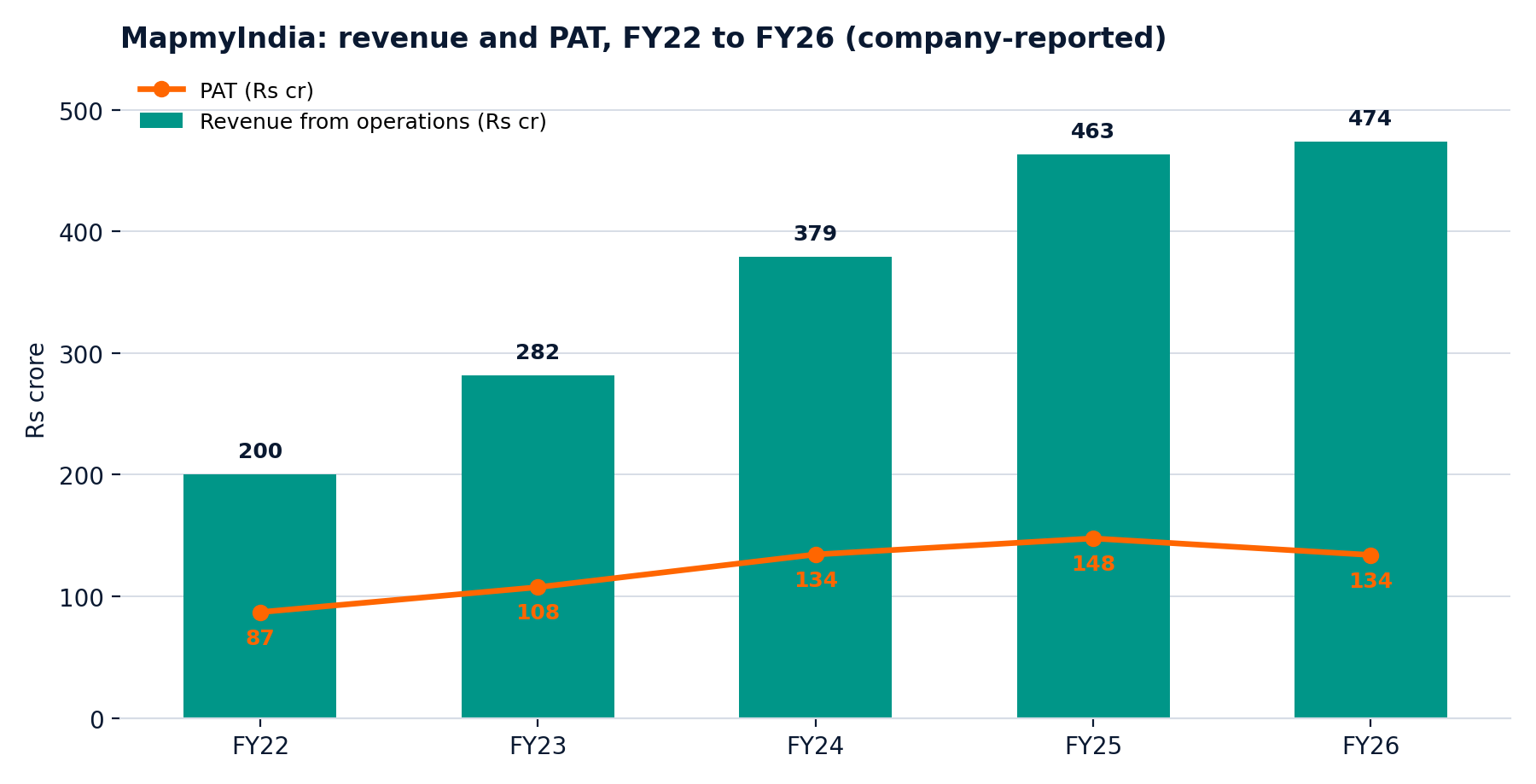
| Fiscal year | Revenue (Rs cr) | EBITDA (Rs cr) | EBITDA margin | PAT (Rs cr) | EPS (Rs) |
|---|---|---|---|---|---|
| FY22 | 200.0 | 86.0 | 43% | 87.0 | 16.34 |
| FY23 | 281.5 | 117.9 | 42% | 107.5 | 19.99 |
| FY24 | 379.4 | 156.2 | 41% | 134.4 | 24.77 |
| FY25 | 463.3 | 179.9 | 39% | 147.6 | 27.05 |
| FY26 | 474.1 | 175.5 | 37% | 134.0 | 24.50 |
| Q1 FY27 | 139.7 | 56.1 | 40.2% | 49.7 | 9.09 |
Company-reported revenue, EBITDA and PAT; EPS from Screener.in consolidated. Q2 and Q3 FY26 were the stall quarters, with EBITDA margins of 24.7% and 28.6% on government execution delays; Q4 FY26 recovered to 44.6%.
What is the order book, and can it deliver the Rs 1,000 crore promise?
The open order book grew from Rs 918 crore at FY23 end to Rs 1,754 crore at FY26 end, up 17% in the stall year, about 3.7 times FY26 revenue with a typical three to four year duration. Management has reiterated a Rs 1,000 crore revenue milestone for FY28. DalalBytes arithmetic: from Rs 474.1 crore, that requires about 45% compound growth for two years, against 2.3% delivered in FY26 and 14.9% in Q1 FY27. Conversion, not order intake, is the investment question.
How strong is the balance sheet and cash flow?
Fortress grade. Borrowings were Rs 7 crore at FY26 end; cash and financial investments were Rs 685 crore, rising to Rs 745.3 crore by Q1 FY27. Free cash flow on Screener's series was positive every year from FY22 to FY26 (Rs 25, 67, 45, 77 and 59 crore), including Rs 59 crore in the stall year, and the Rs 3.50 dividend (about 14% payout, 0.39% yield) is covered several times over. The watch item is working capital: debtor days rose from 79 in FY22 to 136 in FY26, and Screener ROCE fell from 26% in FY24 to 19.1%.
Who runs MapmyIndia, and is governance clean?
The founders still run it: Rakesh Verma as Chairman and Managing Director, Rashmi Verma as CTO, promoters at 51.36%. The deduction is the Rohan Verma sequence. The then-CEO was to move the Mappls consumer business into a new company he would own 90% of, with the listed company taking 10% for Rs 10 lakh plus Rs 35 crore of convertible debentures. Minority investors objected, the Rs 35 crore was reversed within a day, Rohan stepped down on March 31, 2025, and on July 1, 2026 he returned as Joint Managing Director, subject to shareholder approval. Whether the B2C venture still exists, and on what brand and data terms, is undisclosed. The founders' separate ClarityX analytics company, a common-director entity partnering with the listed company on undisclosed terms, is the second instance of the same pattern.
Who competes with MapmyIndia?
Google sets the price ceiling: it cut India Maps Platform prices by up to 70% in July 2024 with rupee billing, and Ola Maps priced at half of Google's reduced rates with free tiers. Genesys International, the closest listed peer, won a six-year agreement in October 2025 to supply SD and HD maps to Tata Motors Passenger Vehicles, proving OEM seats are contestable at renewal; its FY26 revenue was Rs 347.5 crore with PAT of Rs 32.8 crore on secondary analysis. HERE and TomTom reach India through partners and global platforms, and OpenStreetMap sets a zero floor for basic web mapping. MapmyIndia is strongest where the buyer is an Indian OEM, a PSU or a ministry, and weakest where the buyer is a price-shopping app developer.
What is MapmyIndia worth?
At Rs 904.70: about 37x FY26 EPS of Rs 24.50, about 5.5x book value of Rs 165, dividend yield 0.39%, market cap about Rs 4,955 crore, and a price about 48% below the 52-week high of Rs 1,894 (range Rs 795 to Rs 1,894). Genesys trades at about 45.6x on a fraction of the profitability; MapmyIndia's own five-year median multiple, per secondary analysis, is 55 to 60x. FY2029 scenarios: bear Rs 865 (8% PAT CAGR, 28x), base Rs 1,600 (20% CAGR, about Rs 42 EPS, 38x), bull Rs 2,580 (30% CAGR, about Rs 54 EPS, 48x). The base case is about 77% above the reference price, conditional on the order book converting.
What are the key risks for MapmyIndia?
Conversion risk first: FY26 proved government revenue arrives in bursts, and the FY28 promise needs about 45% compound growth. Pricing risk: Google and Ola deflate the API layer permanently. Renewal risk: the Genesys Tata deal, and Android Automotive platform decisions, can erode a reported 80 to 90% OEM share one model cycle at a time. Receivables: debtor days of 136 mean growth is funded by the company's own balance sheet. Governance: two promoter vehicles adjacent to the listed company, on terms minorities cannot see. Consumer: about 45 million app downloads with no disclosed active-user or consumer revenue line. Legal: the July 2024 notice to Ola Electric alleging copying of licensed map data, denied by Ola, with no public outcome at the time of writing.
© 2026 DalalBytes Research · For educational purposes only. Not investment advice.