
Frequently asked questions
How does MapmyIndia score on the five pillars?
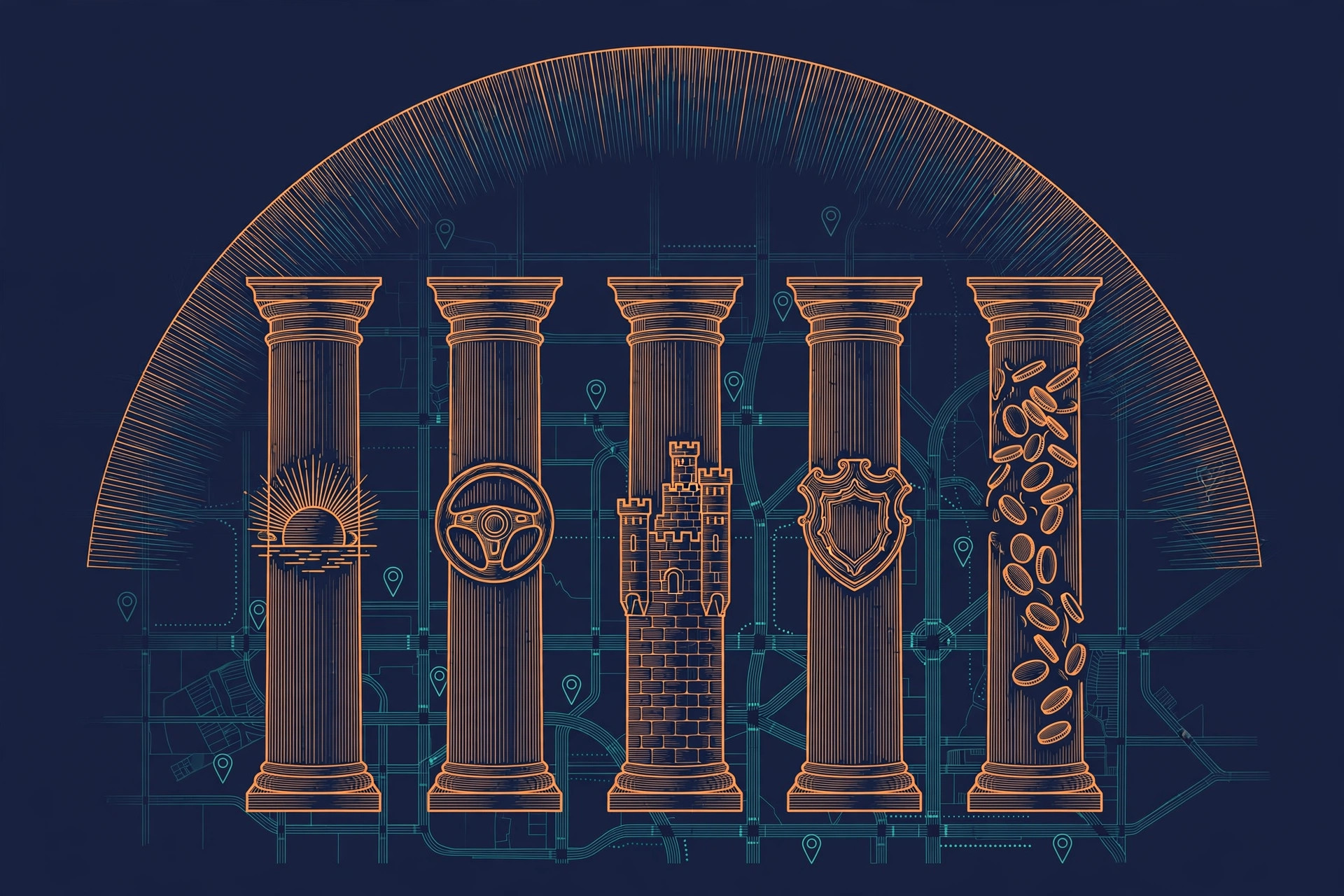
MapmyIndia passes three of five pillars: Sunrise, Iron Fortress and Free Cash Flow. Leadership is partial because an elite 30-year operating record carries the December 2024 consumer hive-off episode, reversed under minority pressure, with its architect back as Joint Managing Director and the founders' ClarityX terms undisclosed. Moat is partial because the data asset, OEM incumbency and sovereign preference are real, but Google's 70% India price cut and Ola's free tier deflate the API layer, and Genesys won a six-year Tata Motors map deal in October 2025.
Why do MapmyIndia's fortress and cash flow pillars pass?
Borrowings were Rs 7 crore at FY26 end against cash and financial investments of Rs 685 crore, rising to Rs 745.3 crore by Q1 FY27, and free cash flow was positive every year from FY22 to FY26 on Screener's series, including Rs 59 crore in the FY26 stall year. The named watch item is working capital: debtor days rose to 136 in FY26 from 79 in FY22.
Pillar 1: Is the sector a sunrise? (PASS)
Every demand pool is expanding. Automotive content per vehicle rises with connected cars and ADAS, and the company already sits inside over 3.5 million new vehicles a year, up 16% in FY26. Government geospatial spend is routed by liberalised policy, data localisation and digital-twin adoption toward domestic suppliers, and the Rs 1,754 crore order book, about 3.7 times FY26 revenue, is that sunrise already contracted. Enterprise location APIs keep embedding into delivery, commerce and banking, with AI products such as Geo-Verify extending the pool. The caveat sits inside the pass: sunrise grades direction, not capture or price, and FY26 proved government demand arrives on sovereign timelines. PASS.
Pillar 2: Can the leadership execute? (PARTIAL)
The operating record is elite: founded in 1995 on Rs 50 lakh of savings, India's map built on foot over a decade, buyout approaches from Yahoo, Flipkart and PhonePe declined, a profitable 2021 listing, then four years of 20% plus growth at 39 to 43% EBITDA margins with no debt. The governance record is the deduction. In November 2024 the board proposed moving the Mappls consumer business into a company 90% owned by then-CEO Rohan Verma, funded in part by Rs 35 crore of listed-company debentures; minority investors objected, the investment was reversed within a day, the stock fell 8.92% in a session, Rohan stepped down in March 2025, and he returned as Joint Managing Director on July 1, 2026, with the B2C venture's brand and data terms still undisclosed. The founders' ClarityX operates beside the listed company on terms that are not public. PARTIAL, with an upgrade path entirely in management's hands: publish the terms, or bring the assets inside.
Pillar 3: Does a moat protect returns? (PARTIAL)
Three layers are real: a field-verified, address-level map of India built over three decades and refreshed by the transaction flow of its own customers; a reported 80 to 90% share of OEM-fitted navigation, embedded by model for three to five year cycles; and sovereign preference for the Indian champion in defence, survey and ministry work, receipted by the Survey of India platform and a government order book above Rs 200 crore at Mappls DT. The ceilings are named: Google cut India API prices by up to 70% in July 2024 and Ola priced below that, so the API layer's price ceiling deflates permanently; Genesys's six-year Tata Motors Passenger Vehicles deal proves OEM seats are contestable at renewal; and consumer was never moated against Google's distribution. Deep at the sovereign and factory gates, shallow at the API and the phone. PARTIAL.
Pillar 4: Is the balance sheet a fortress? (PASS)
The cleanest pillar. Borrowings of Rs 7 crore against net worth of about Rs 905 crore; cash and investments of Rs 685 crore at FY26 end and Rs 745.3 crore by Q1 FY27, roughly 15% of the market capitalisation; interest of Rs 2 crore in FY26; no dilutive raise since a pure offer-for-sale IPO; a steady Rs 3.50 dividend; and promoters at 51.36%. The FY26 stall, the worst earnings year in a decade, passed without the balance sheet noticing. Two watch items: debtor days of 136 mean the fortress increasingly funds government and IoT execution, and the cash pile compounds at treasury rates with no buyback. A fortress with rising receivables and idle cash is still a fortress. PASS.
Pillar 5: Does the free cash flow show up? (PASS)
Every year. On Screener's series, free cash flow was Rs 25, 67, 45, 77 and 59 crore from FY22 to FY26, on operating cash flow of Rs 29, 90, 76, 117 and 93 crore. FY26 is the load-bearing year: PAT fell 9% and two quarters printed crisis margins, yet the business still produced Rs 93 crore of operating cash, Rs 59 crore of free cash flow, and a higher cash balance. The qualification is conversion quality, not existence: receivables build with the government and IoT mix, so operating cash runs below EBITDA in most years. The pillar grades cash delivered, and five straight years through a stall is delivery. PASS, with the test named: free cash flow stays positive and CFO to PAT returns above 0.8 times as the order book converts.
What would change the grade?
Leadership upgrades to pass if the B2C venture and ClarityX terms with the listed company are disclosed and clean, and downgrades to fail if another asset moves toward a promoter vehicle. Moat upgrades if the next OEM renewal cycle holds reported share and API revenue grows through the price cuts; it downgrades if a second marquee OEM dual-sources. Iron Fortress is re-graded only if receivables funding turns into borrowing. Free Cash Flow downgrades if FY27 free cash flow turns negative or receivables write-offs repeat.
© 2026 DalalBytes Research · For educational purposes only. Not investment advice.