
Frequently asked questions
Is Jindal Drilling a buy at current prices?
DalalBytes rates Jindal Drilling Selective Positive at 62/100. At Rs 511.65 the stock trades at 0.81x book value, 7.6x reported FY26 earnings and about 9.8x DalalBytes underlying earnings estimate near Rs 52 a share, with net cash of Rs 183 crore and a Rs 1,310 crore order book. The selective part: one customer, ONGC, takes effectively all rig revenue, reported profit is flattered by litigation receipts, and three rigs come off hire in H2 FY27 for refurbishment at Rs 90 crore to Rs 110 crore each.
What are Jindal Drilling's FY2029 price targets?
DalalBytes' FY2029 targets for Jindal Drilling are bear Rs 320, base Rs 650, and bull Rs 1,040, from a Rs 511.65 reference price. Bear: revenue of Rs 1,050 crore, PAT of Rs 145 crore, 6.5x exit. Base: revenue of Rs 1,255 crore at a 35% EBITDA margin, PAT of Rs 210 crore, EPS of Rs 72, 9x exit. Bull: revenue of Rs 1,440 crore, PAT of Rs 275 crore, 11x exit. FY2029 is the year ending March 2029.
Why will Jindal Drilling's revenue dip in H2 FY27?
Management guided on the Q1 FY27 call that three of its six jack-up rigs are expected to be dehired within FY27. Each rig then spends 4 to 6 months in refurbishment at an estimated cost of Rs 90 crore to Rs 110 crore, earning no revenue while in the yard. Management expects EBITDA to hold up better than revenue because its owned rigs, including Jindal Pioneer deploying in Q3 FY27, carry richer margins, and it is conserving cash with acquisitions on hold.
What is the verdict on Jindal Drilling?
The market prices this like a melting asset: about Rs 1,482 crore of market cap for six jack-up rigs, a Rs 1,310 crore order book, net cash of Rs 183 crore at June 2026 and a promoter who raised his holding from 64.26% to 66.78% during FY26 with zero pledging. The discount has reasons: one customer, noisy reported profit, a guided H2 FY27 air pocket, and ONGC cancelling a jack-up tender in April 2026 after bids jumped about 60% in nine months. At 0.81x book and about 3.7x estimated EV to EBITDA, the price pays you to carry those risks if Pioneer deploys on time and the re-hires land. 62/100 Selective Positive.
How did Jindal Drilling start, and who owns it now?
Incorporated on October 17, 1983 and promoted by D. P. Jindal, the company originally mixed seamless casing pipe manufacture with offshore drilling. Court-approved schemes in 2006 demerged the investment division, merged in Newsco Newtech and Discovery Hydrocarbons, and sold the casing pipe division, leaving a focused drilling contractor that has supported ONGC for more than 30 years. Chairman is D. P. Jindal and Managing Director is Raghav Jindal. Promoters held 66.78% at September 2026, up from 64.26%, with pledging nil; FII and DII holdings are under 1% combined.
What does the fleet look like, rig by rig?
Six jack-ups: three owned (Discovery-I, built 2008, ONGC at USD 46,908 a day; Jindal Supreme, built 1975 and life-extended three times, at USD 86,327 a day, the fleet's top operated rate; Jindal Pioneer, built 2015, bought from the group's Singapore JV for USD 75 million and contracted to ONGC for three years at Rs 45.83 lakh a day from Q3 FY27) and three chartered (Virtue-I at USD 77,964 a day; Jindal Star; Jindal Explorer on a USD 35,139 a day bareboat charter, which is rent for the steel alone and not comparable to operated rates). Five rigs are deployed with ONGC; Pioneer is refurbishing in the UAE. Rigs contributed about Rs 325 crore of FY26 EBITDA of about Rs 349 crore, directional drilling about Rs 23 crore and mud logging about Rs 1 crore.
What do the financials show, and how clean is the profit?
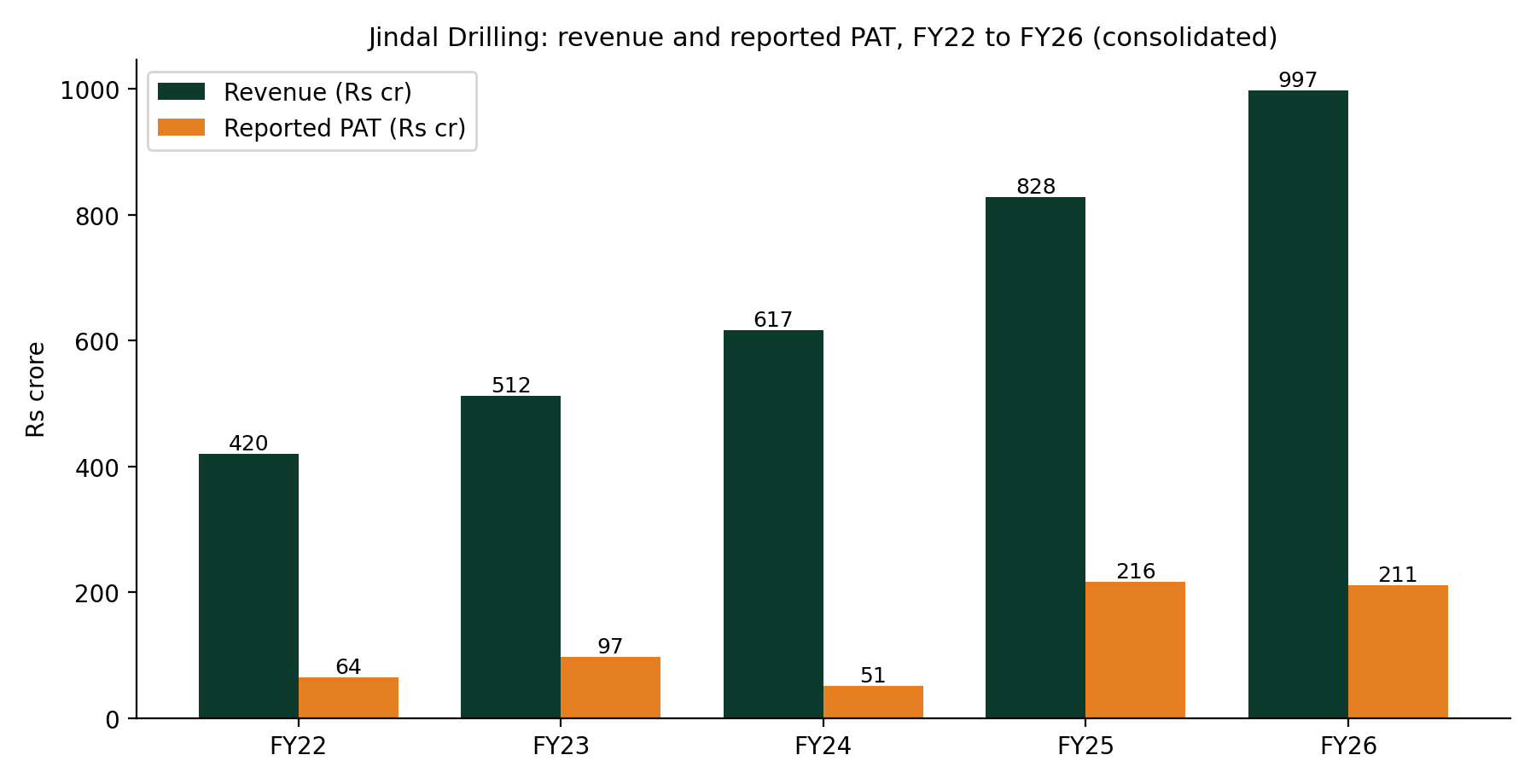
Revenue compounded from Rs 420 crore in FY22 to Rs 997 crore in FY26 as operating margin expanded from 26% to 35% and depreciation rose from Rs 43 crore to Rs 151 crore with the fleet. Reported PAT is the noisy line: Rs 64 crore, Rs 97 crore, Rs 51 crore, Rs 216 crore, Rs 211 crore. Q2 FY26 alone included a Rs 100.43 crore ONGC litigation receipt, and Q3 FY26 printed a Rs 33 crore loss when other income swung to about negative Rs 81 crore. DalalBytes estimates underlying FY26 PAT near Rs 150 crore (EPS near Rs 52). Q1 FY27: revenue up 8.4% to Rs 275 crore, operating profit Rs 98 crore at 36%, PAT down 28.7% to Rs 47 crore on lower other income and a joint venture loss. ROE is 10.2% and ROCE 13.7%: adequate, not elite.
How strong is the balance sheet?
Gross debt fell from Rs 282 crore at March 2024 to Rs 52 crore at June 2026. Net cash reached Rs 183 crore at June 2026 with liquid investments of Rs 248 crore, after paying USD 75 million for Pioneer. CRISIL reaffirmed A+/Stable and A1 on Rs 655 crore of facilities, with interest coverage of 12.58x in FY25, while flagging high exposure to group companies. Debtor days improved from 134 in FY22 to 82 in FY26. Cash flow is lumpy: operating cash flow of Rs 864 crore in FY25 (a litigation and recovery year) against Rs 178 crore in FY26, and free cash flow of Rs 129 crore in FY26 after negative Rs 57 crore in FY24.
What is Jindal Drilling worth versus peers?
At Rs 511.65: P/E of 7.6x reported and about 9.8x underlying estimated earnings, P/B of 0.81x, dividend yield of 0.20% on a Rs 1 dividend, and estimated EV to EBITDA near 3.7x. There is no pure listed India jack-up peer: Aban Offshore is distressed at about Rs 88 crore of market cap with negative book value, Dolphin Offshore trades near 36x on an EPC-heavy mix, Great Eastern Shipping anchors Indian marine assets near 5.7x, and global drillers such as Borr and Valaris sit near 5.3x to 6.7x EV to EBITDA on 2025 estimates. FY2029 scenarios: bear Rs 320 (about 2% revenue CAGR, PAT Rs 145 crore, 6.5x), base Rs 650 (about 8% CAGR, PAT Rs 210 crore, EPS Rs 72, 9x), bull Rs 1,040 (about 13% CAGR, PAT Rs 275 crore, 11x).
What are the key risks?
First, the customer: ONGC cancelled a jack-up tender in April 2026 after bids rose from USD 35,606 to USD 56,195 a day, and four tenders covering about fifteen rigs have been scrapped since early 2024, while global average jack-up rates near USD 112,900 a day do not transmit into Indian awards. Second, the cliff: three rigs off hire in H2 FY27, Rs 270 crore to Rs 330 crore of refurbishment, guided revenue down. Third, the iron: the top-earning rig was built in 1975. Fourth, the perimeter: a related-party rig purchase, group loans adjusted in its funding, Rs 792 crore of investments, and a payout near 1%. Finally liquidity: about 1.09 lakh shares traded on October 22, 2026, with institutions under 1% of the register.
© 2026 DalalBytes Research · For educational purposes only. Not investment advice.