

What is the verdict?
47/100. Negative. The turnaround evidence is real, the funding model is dilution, and at $92.07 the price paid for a finished recovery that the filings have not yet delivered.
What would change the score. A committed anchor customer for 14A or two straight quarters of positive adjusted free cash flow would lift the score, while a 14A pause or foundry losses that stop narrowing would cut it.
| 47/100 | DalalBytes score |
| $92.07 | Reference price, Oct 29, 2026 close |
| $489B | Market cap, 5315M shares outstanding |
| $24 / $72 / $143 | FY2029 bear / base / bull |
The delivery is no longer a promise. Data center revenue rose 78% in Q3 2026, the strongest growth Intel has printed in that business in 15 years. Intel 18A sits in high volume production, Panther Lake is shipping, and the foundry loss has narrowed for three straight quarters. A company that lost $18.8B in FY2024 earned $3.3B in this single quarter.
The funding is what the delivery cannot hide. Intel has not covered its capital spending from its own cash flow in any year on the recent filed record, so the United States government, NVIDIA, SoftBank, and public shareholders covered it instead. The share count carries the receipts, with 735M shares issued across the three 2025 deals and 242M more sold in August 2026. Owners get a better company and a smaller slice of it at the same time.
At $92.07 the market paid for the completed version of this story. Hours after that close, the Q4 guide missed consensus by about $1.5B at the midpoint and the stock fell about a quarter in after-hours and pre-market trading. Our base case of $72 sits below the reference price and close to where the stock now trades, which is the whole verdict in one line. The business is improving faster than the skeptics said, and the price still ran ahead of it.
The price basis of this report
Intel reported Q3 2026 after the close on October 29, 2026. Pre-market quotes on October 30 put the stock near $69, down about 25% (Finnhub and StockAnalysis). This report prices off the October 29 close of $92.07 throughout.
What is Intel today?
Intel was the defining chip company of the PC era, and its x86 processors still sit inside most of the world's computers and a majority of its servers. The company designs and manufactures its own chips, which separated it from every large rival for four decades. That model built the industry standard and then became the liability, because Intel's factories fell behind TSMC while its designs lost ground to AMD and Arm.
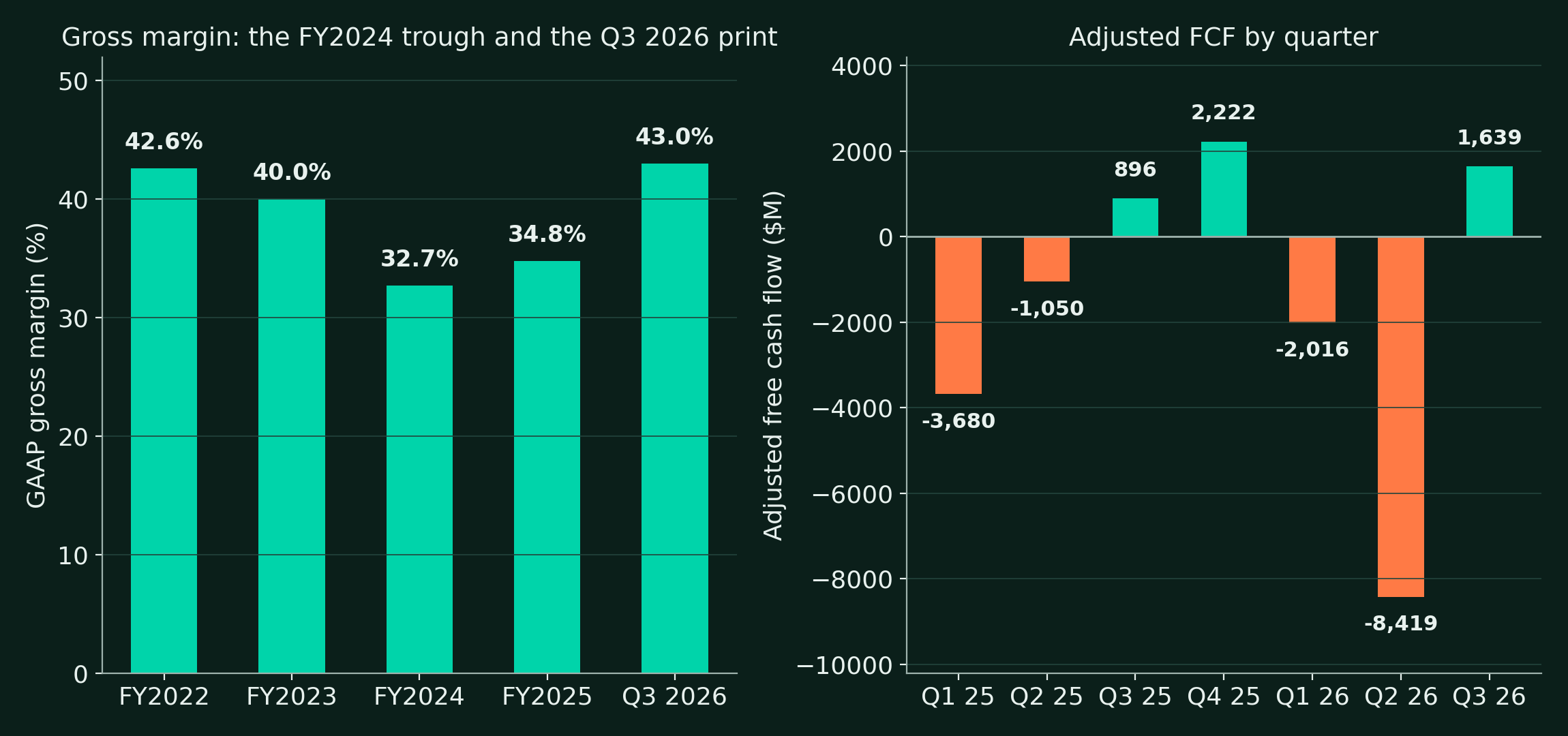
The fall was expensive and public. Revenue slid from $63.1B in FY2022 to $52.9B in FY2025, gross margin fell from 42.6% to a 32.7% trough, and FY2024 closed with a net loss of $18.8B. Pat Gelsinger returned in 2021 to rebuild the factories under IDM 2.0 and stepped down in December 2024 with the factories rebuilt on paper and the losses at their peak.
Lip-Bu Tan took over on March 18, 2025 and changed the funding question instead of the ambition. Investment now follows confirmed customer commitments, the workforce fell from 108900 at the end of 2024 to 85100 at the end of 2025, and the balance sheet was rebuilt with other people's equity. The question for the next three years is narrow. Can the products and the process carry a company that its own cash flow still does not fund?
| Metric | FY2023 | FY2024 | FY2025 | Q3 2026 |
|---|---|---|---|---|
| Total revenue ($M) | 54,228 | 53,101 | 52,853 | 16,513 |
| GAAP gross margin | 40.0% | 32.7% | 34.8% | 43.0% |
| GAAP diluted EPS | $0.40 | $(4.38) | $(0.06) | $0.60 |
| Non-GAAP diluted EPS | $1.05 | $(0.13) | $0.42 | $0.52 |
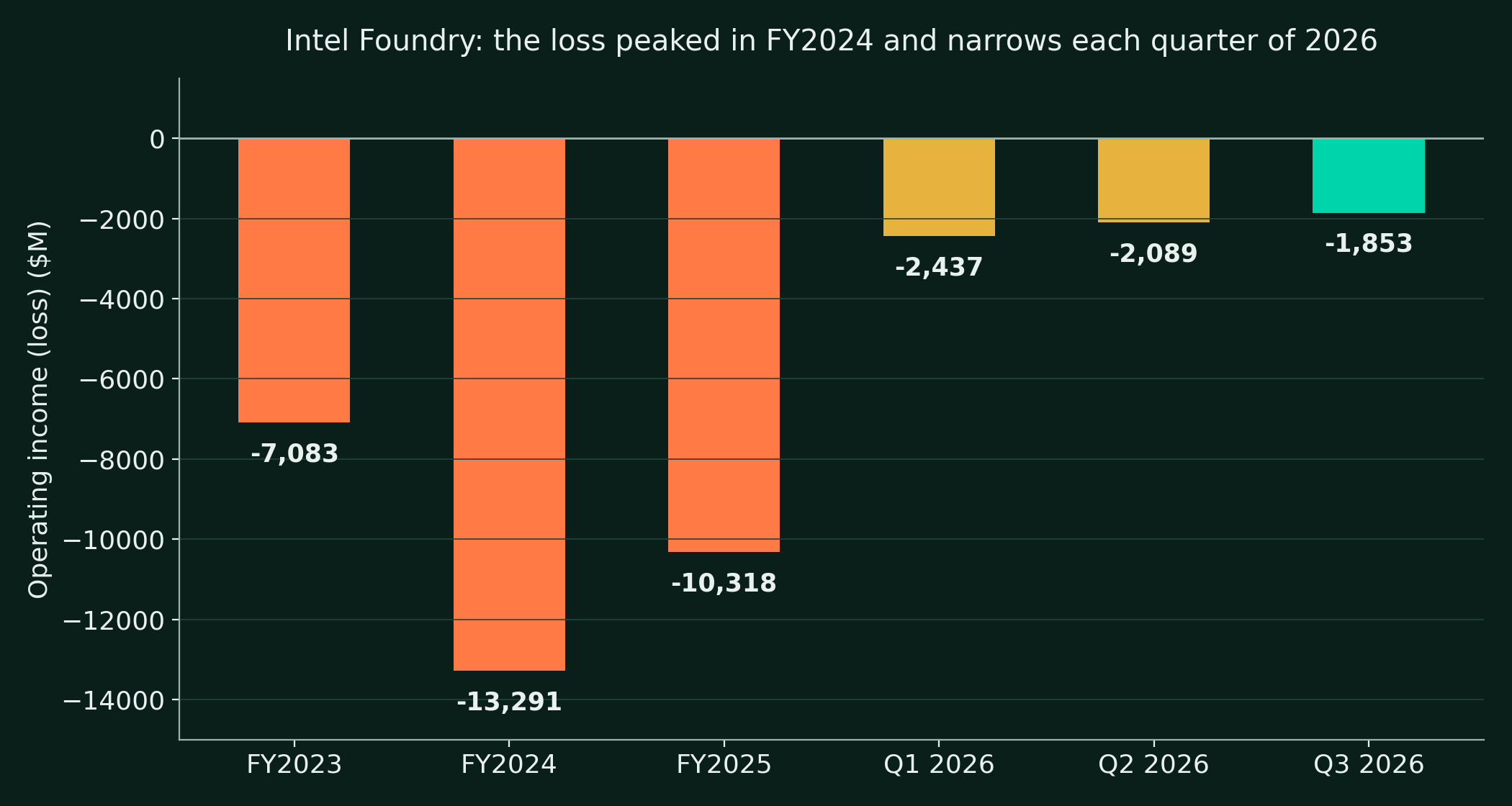
| Intel Foundry operating income (loss) ($M) | (7,083) | (13,291) | (10,318) | (1,853) |
| Adjusted free cash flow ($M) | (11,853) | (2,228) | (1,612) | 1,639 |
Intel runs on a December fiscal year. The latest reported quarter is Q3 2026, the quarter ended September 26, 2026, reported on October 29, 2026.
How does Intel make money?
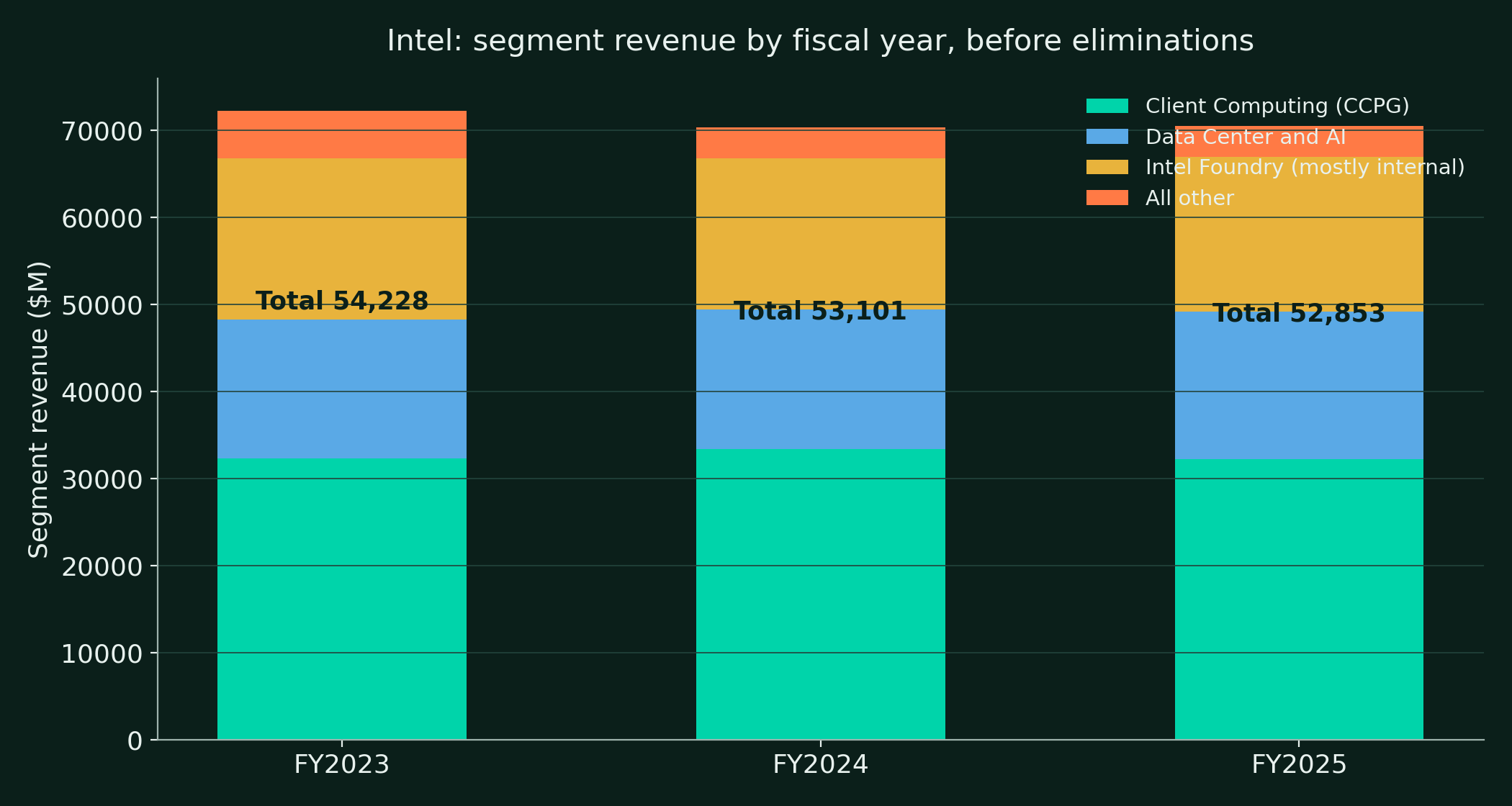
Intel reports three businesses under a foundry operating model set in 2024.
Intel Products
- Client Computing and Physical AI (CCPG) sells PC processors.
- It was renamed from Client Computing Group in Q2 2026.
- It earned $32.2B of revenue and $9.3B of operating income in FY2025.
- Data Center and AI (DCAI) sells Xeon server processors.
- It earned $16.9B of revenue and $3.4B of operating income in FY2025.
- Together the product groups earned $12.7B of operating income in FY2025.
- The product groups are the profit engine that funds everything else.
Intel Foundry
- Foundry runs the factories and sells wafer capacity.
- Most of its revenue is internal sales to Intel Products.
- External customer revenue was $307M in all of FY2025.
- It lost $10.3B in FY2025 after losing $13.3B in FY2024.
- Section 7 takes the foundry math apart.
All other
- All other holds Mobileye, networking remnants, and start-up units.
- Altera sat here until its deconsolidation in September 2025.
- The line earned $3.6B of revenue in FY2025 and fades as assets are sold.
- Mobileye is consolidated and Intel holds about three quarters of it.
What did Intel report in Q3 2026?
Q3 2026, the quarter ended September 26, 2026, reported October 29, 2026.
| Q3 2026 | Result | Year ago | Change |
|---|---|---|---|
| Total revenue | $16,513M | $13,653M | +21% |
| GAAP gross margin | 43.0% | 38.2% | +4.8 pts |
| Non-GAAP gross margin | 44.1% | 40.0% | +4.1 pts |
| GAAP operating income | $2,522M | $683M | n/m |
| GAAP net income to Intel | $3,320M | $4,063M | -18% |
| GAAP diluted EPS | $0.60 | $0.90 | -33% |
| Non-GAAP diluted EPS | $0.52 | $0.23 | +126% |
| Operating cash flow | $5,082M | n/a | n/a |
| Adjusted free cash flow | $1,639M | $896M | +83% |
| Segment, Q3 2026 | Revenue ($M) | Operating income (loss) ($M) |
|---|---|---|
| Client Computing and Physical AI | 8,097 | 2,285 |
| Data Center and AI | 7,318 | 3,039 |
| Total Intel Products | 15,415 | 5,324 |
| Intel Foundry | 6,697 | (1,853) |
| All other | 692 | 179 |
| Corporate and eliminations | (6,291) | (1,128) |
| Consolidated | 16,513 | 2,522 |
- Revenue, gross margin, and EPS all beat Intel's own Q3 guidance.
- DCAI revenue rose 78% on AI driven server demand.
- CCPG revenue fell 5% and Intel guided it down more than 20% in Q4.
- The GAAP result carries a $1005M mark-to-market gain on the government escrow shares.
- Share-based compensation was $586M in the quarter.
- The year-ago GAAP profit rested on the $5.5B Altera sale gain.
- Neither year's GAAP line is the clean read. The non-GAAP line is closer.
The Q4 guide
Intel guided Q4 2026 revenue to $15.0B to $16.0B with non-GAAP EPS of $0.25 and non-GAAP gross margin of 38.0%. Reuters put consensus at $17.07B of revenue and $0.43 of adjusted EPS. The guide, not the quarter, moved the stock.
How do the segments perform?
Annual figures sit on the recast basis of the FY2025 Form 10-K. Intel moved its Network and Edge business into CCG and DCAI in Q1 2025 and recast prior years.
| Segment | FY2023 revenue ($M) | FY2023 op. income ($M) | FY2024 revenue ($M) | FY2024 op. income ($M) | FY2025 revenue ($M) | FY2025 op. income ($M) |
|---|---|---|---|---|---|---|
| Client Computing (CCPG) | 32,305 | 10,128 | 33,346 | 11,594 | 32,228 | 9,317 |
| Data Center and AI | 15,980 | 945 | 16,125 | 1,414 | 16,919 | 3,422 |
| Total Intel Products | 48,285 | 11,073 | 49,471 | 13,008 | 49,147 | 12,739 |
| Intel Foundry | 18,504 | (7,083) | 17,317 | (13,291) | 17,826 | (10,318) |
| All other | 5,463 | 1,507 | 3,601 | (57) | 3,563 | 264 |
| Corporate and eliminations | (18,024) | (5,404) | (17,288) | (11,338) | (17,683) | (4,899) |
| Consolidated | 54,228 | 93 | 53,101 | (11,678) | 52,853 | (2,214) |
- The product groups earn real money in every year shown.
- Their combined operating income rose to $12.7B in FY2025.
- The foundry loss consumed most of it in FY2025 and all of it in FY2024.
- Corporate charges did the rest of the FY2024 damage.
- FY2024 carried $3.3B of manufacturing impairments and $3.1B of goodwill impairments.
- It also carried a $9.9B tax valuation allowance in the net loss line.
- DCAI is now the growth engine, with operating income up nine times since FY2023.
- CCPG is the cash engine, and its Q4 cliff is the near-term risk.
| Consolidated | FY2022 | FY2023 | FY2024 | FY2025 |
|---|---|---|---|---|
| Revenue ($M) | 63,054 | 54,228 | 53,101 | 52,853 |
| GAAP gross margin | 42.6% | 40.0% | 32.7% | 34.8% |
| GAAP net income (loss) ($M) | 8,014 | 1,689 | (18,756) | (267) |
| GAAP diluted EPS | $1.94 | $0.40 | $(4.38) | $(0.06) |
| Non-GAAP diluted EPS | $1.67 | $1.05 | $(0.13) | $0.42 |
The FY2022 non-GAAP EPS of $1.67 is the comparative basis printed in the Q4 2023 release. The original Q4 2022 release printed $1.84 on the basis then in use.
Where do 18A and 14A actually stand?
Intel 18A
- 18A is Intel's first node with RibbonFET transistors and PowerVia backside power.
- It entered high volume manufacturing at Fab 52 in Arizona in October 2025.
- Panther Lake, the Core Ultra Series 3 client line, launched on January 5, 2026.
- Intel claimed more than 200 Panther Lake designs at launch.
- Clearwater Forest, the first server chip on 18A compute tiles, launched in Q2 2026.
- Its flagship carries 288 efficiency cores across 12 compute tiles.
- 18A client revenue rose from under 5% of client CPU revenue in Q1 2026 to nearly a third in Q3 2026.
- On the October 29, 2026 call Tan said 18A yields improved at a double-digit rate in the quarter.
- He also said 18A costs have fallen about 40% since Q1 2026.
- Intel has never published a numeric 18A yield.
- Reuters reported in August 2025 that Panther Lake defect levels ran about three times too high for comfortable margins at that stage.
- Intel disputed the earlier leaked yield figure. Treat the Reuters reporting as reporting, not disclosure.
- Variant 18A-P entered risk production in June 2026.
- Nova Lake is the first 18A-P client product and is guided to launch by the end of 2026.
Intel 14A
- 14A is the first node Intel designed from inception for external customers.
- Intel claims 15% to 20% better performance per watt than 18A.
- It moves to PowerDirect power delivery and the first high volume use of High-NA EUV.
- The 0.9 PDK went to select customers in October 2026, as committed.
- Management expects PDK 1.0 in Q1 2027.
- Risk production for internal products is set for the second half of 2027.
- High volume manufacturing is set for 2028.
- The FY2025 Form 10-K states that 14A economics require wafer volumes beyond Intel's own products.
- The same filing says Intel may pause or discontinue 14A if it cannot secure a significant external customer.
- That conditionality is the single largest binary in the stock.
Packaging
- EMIB and Foveros give Intel a second door into customer designs.
- Packaging needs no leading-edge wafer sale to win.
- Zinsner has raised the external packaging outlook to several billion dollars per customer in conference remarks.
- A KeyBanc supply chain check put EMIB-T yield near 98% in July 2026. That is a broker check, not an Intel disclosure.
Kiryat Gat
- An explosion at Fab 28 in Kiryat Gat, Israel on October 14, 2026 killed two workers and seriously injured a third.
- The fab shut for about two weeks and was expected to restart by the end of October 2026.
- Management put the cost at about $300M of revenue in Q4 2026 and a similar amount in Q1 2027.
- The hit lands on Intel 7 server products and costs about 200 basis points of Q4 gross margin.
- Fab 28 builds Intel 7, the 10 nanometer class node. It is not a leading-edge fab.
What does the foundry earn from outsiders?
The foundry segment looks large and earns almost nothing from outsiders. Both facts matter.
| Foundry external customer revenue | $M |
|---|---|
| FY2023 | 547 |
| FY2024 | 159 |
| FY2025 | 307 |
| Nine months 2025 | 85 |
| Nine months 2026 | 878 |
| Q3 2026 | 411 |
- Most of the 2026 increase is Altera paying as an outside customer after its deconsolidation.
- Zinsner said the Q3 figure also held a non-recurring customer program.
- TSMC earned about $40.2B of foundry revenue in Q2 2026 alone (TrendForce).
- That is about 98 times Intel's Q3 external foundry revenue.
- TSMC held 72.5% of global foundry revenue in Q2 2026 (TrendForce).
- Intel's own Q2 2025 Form 10-Q said it had been unsuccessful to date in securing any significant external foundry customer for any node.
- The April 2026 Terafab announcement is the first event that could change that sentence.
- Section 9 grades the customer claims one by one.
Who funded the rebuild, and on what terms?
Intel's rebuild was funded by a stack of partners and the state. Each leg has terms, and the terms are the story.
| Backer | Deal | Terms | Status at October 2026 |
|---|---|---|---|
| US government | $8.9B of common stock | 433.3M shares at a $20.47 blended price; 274.6M issued at close and 158.7M escrowed against Secure Enclave performance; passive ownership that votes with the board; a warrant for 240.5M shares at $20.00 if Intel ever owns under 51% of the foundry | 132M escrowed shares still unreleased at September 26, 2026; the stake is about 8% after later issuance |
| NVIDIA | $5.0B private placement | 214.8M shares at $23.28; Intel to build custom x86 CPUs for NVIDIA AI platforms and PC chips with RTX chiplets over NVLink | Closed December 26, 2025; no shipped joint product and no revenue disclosed by October 2026 |
| SoftBank | $2.0B private placement | 87.0M shares at $23.00; no board seat and no purchase commitment | Closed September 2025; still held at June 30, 2026 on SoftBank's 13F |
| Apollo | $11.2B for 49% of the Fab 34 joint venture in 2024 | Intel kept control and consolidated the venture | Repurchased for $14.2B in April 2026 with cash and $6.5B of new debt |
| Brookfield | Arizona co-investment program | 49% non-controlling interest in the Arizona fab entity | Still in place; the non-controlling balance was $14,372M at September 26, 2026 |
| Silver Lake | 51% of Altera | $8.75B valuation; Intel kept 49% and booked a $5.5B pre-tax gain | Closed September 12, 2025; Altera is now an equity method stake and a foundry customer |
| Public shareholders | August 2026 offering | 242.1M new shares at $95.00 for about $22.6B net | Closed August 2026 |
- The government deal converted $5.7B of unpaid CHIPS grants and $3.2B of Secure Enclave awards into equity.
- The amended CHIPS agreement removed milestones and the old clawback on $2.2B already received.
- The escrow shares swing GAAP earnings as the stock moves.
- Their mark-to-market produced a $12.5B loss in Q2 2026 and a $1.0B gain in Q3 2026.
- NVIDIA bought a product partnership, not foundry capacity. No wafer commitment was in the release.
- The Apollo round trip cost about $3.0B across 21 months on reporter arithmetic.
- Intel said the repurchase strengthens its credit profile from 2027. The price still deserves a question.
Has Intel delivered on its public promises?
Intel's problem was never ambition. It was a decade of roadmaps that arrived late or not at all, so this audit grades the public promises against the filed record.
| Promise | Set | Delivered by October 2026 | Grade |
|---|---|---|---|
| Five nodes in four years | July 2021 | Intel 7, 4, and 3 shipped; 20A was cancelled for high volume in 2024; 18A entered high volume production in October 2025 | Mostly met |
| IDM 2.0 with an external foundry business | 2021 | External foundry revenue of $411M in Q3 2026, much of it Altera; no significant external customer named by Intel | Missed at scale |
| Foundry losses peak in 2024 | April 2024 | The FY2024 loss of $13.3B remains the peak and losses have fallen since | Met |
| Foundry break-even midway to 2030 | April 2024 | Management spoke of an internal target of the end of 2027 in August 2026 conference remarks, hedged to the end of 2028 | Still pending |
| Foundry at 40% gross margin and 30% operating margin by 2030 | April 2024 | The segment lost $1.9B in Q3 2026 on $6.7B of mostly internal revenue | Still pending, far off |
| Second largest foundry by 2030 | April 2024 | TSMC held 72.5% of foundry revenue in Q2 2026; Intel external revenue runs under $1B a half | Missed at current pace |
| Ohio fabs in production in 2025 | January 2022 | First phase completes in 2030 with production in 2030 or 2031 | Missed |
| Gaudi AI accelerators at scale | 2024 | The $500M Gaudi revenue target for 2024 was missed; Falcon Shores was cancelled as a commercial product in January 2025 | Missed |
The pattern in the table is consistent. The process promises of the Gelsinger era landed close to schedule once the 20A shortcut was taken, and 18A is a genuine delivery. The commercial promises failed almost completely, because a working node is not a foundry business and customers never signed at scale. Tan's resets accept that verdict in filings, most sharply in the 14A conditionality language, and his audit now runs on a shorter clock. The end of 2027 break-even talk out of the August 2026 conference circuit is not formal guidance, and the Q3 loss of $1.9B still needs to fall by roughly that full amount in five quarters.
How do AMD, Arm, and TSMC stack up against Intel?
Intel's moat was the x86 standard and the factory network behind it. The standard still holds most of the volume, and the share data now moves against it in every segment that pays.
| x86 unit share, Q2 2026 | AMD | Intel |
|---|---|---|
| Client, desktop and notebook | 30.3% | 69.7% |
| Desktop only | 34.9% | 65.1% |
| Server | 34.5% | 65.5% |
| Total x86 | 30.7% | 69.3% |
Source: Mercury Research for Q2 2026, as reported August 21, 2026.
- AMD took a record 46.2% of x86 server revenue share in Q1 2026 (Mercury Research).
- Revenue share is the harsher number. AMD sells the expensive sockets.
- Arm took 13.6% of server CPUs and 15.3% of client CPUs in Q2 2026 (Mercury Research).
- Both Arm figures were record highs in the same quarter.
- AMD data center revenue was $6.7B in Q2 2026, up 107%.
- Intel DCAI revenue was $6.26B in the same quarter, up 59%.
- Intel retook the growth lead in Q3 2026 with DCAI up 78% to $7.3B.
- AMD reports its Q3 on November 3, 2026, so no same-quarter comparison exists yet.
The AI accelerator gap
- Gaudi missed its $500M revenue target for 2024 and Intel stopped guiding it.
- Secondary estimators put Gaudi share at about 1% or less in 2026. No primary research firm figure was available.
- Falcon Shores became an internal test chip in January 2025.
- Intel has given no update on Jaguar Shores since January 2025 (Data Center Dynamics).
- The new entry is Crescent Island, renamed the Intel GPU D-Series on October 12, 2026.
- The first card, GPU D270, carries 160GB of memory and is sampling now.
- No price and no general availability date were disclosed.
- Intel is competing in AI with CPUs and packaging while the accelerator market belongs to NVIDIA and AMD.
Foundry rivals
- TSMC is the foundry market, with Samsung second at 5.9% (TrendForce, Q2 2026).
- Intel's pitch is geography and packaging, not price or proven yield at volume for outsiders.
- Microsoft committed a chip design to 18A in February 2024. No high volume Microsoft 18A product is confirmed.
- Tesla's Elon Musk said on April 22, 2026 that Tesla plans to use 14A at the Terafab project.
- Intel joined Terafab on April 7, 2026 and disclosed no terms and no node.
- Intel declined to confirm Musk's 14A statement, and Terafab does not appear in Intel's Q2 2026 Form 10-Q.
- Musk said in October 2026 that TSMC was in Terafab discussions and could at most sublease part of the fab.
- An October 2026 KeyBanc note claimed Intel had won Apple, Broadcom, Google, and NVIDIA manufacturing contracts.
- None of those wins was confirmed by Intel or any named customer. This report treats them as analyst claims only.
How should investors grade Lip-Bu Tan and the board?
The Tan record so far
- Tan became CEO on March 18, 2025.
- Headcount fell from 108900 at the end of 2024 to 85100 at the end of 2025 (Form 10-K).
- Management layers were cut by about half.
- Germany and Poland were cancelled and Ohio was slowed to match demand.
- Tan said in October 2026 that restructuring is about 80% complete.
- He also said most of the senior leadership team has been replaced on his watch.
- Delivery under Tan includes 18A high volume production and the DCAI surge.
- The foundry loss has narrowed for three straight quarters.
The debits
- Chief Technology Officer Sachin Katti left for OpenAI in November 2025, six months into the role.
- Intel Products CEO Michelle Johnston Holthaus departed in September 2025.
- Two successive Xeon chief architects left, one of them to Qualcomm.
- Intel booked a $3.9B Mobileye goodwill impairment in Q1 2026.
- The Q4 2026 guide missed consensus hours after a beat quarter, which is a forecasting failure whatever the cause.
- The Apollo repurchase paid $14.2B for a stake sold at $11.2B two years earlier.
Governance
- Chair Frank Yeary retired in May 2026 and Craig Barratt became independent chair.
- The board stands at 11 directors after a stated refresh.
- The US government holds about 8% and votes with the board by agreement.
- A shareholder derivative suit over the government deal was filed under seal in Delaware in March 2026. It is an allegation, not a finding.
- The government warrant for 240.5M shares at $20.00 hangs over the share count if foundry ownership ever falls below 51%.
How strong is the balance sheet?
Balance sheet at September 26, 2026, per the Q3 2026 Form 10-Q.
| Item | $M |
|---|---|
| Cash and equivalents | 21,846 |
| Short-term investments | 32,159 |
| Total cash and investments | 54,005 |
| Short-term debt | 3,817 |
| Long-term debt | 46,317 |
| Total debt | 50,134 |
| Net cash, calculated | 3,871 |
| Inventories | 13,068 |
| Property, plant and equipment, net | 105,314 |
| Goodwill | 20,465 |
| Total assets | 228,574 |
| Intel stockholders' equity | 114,914 |
| Non-controlling interests | 16,642 |
- The fortress was rebuilt in nineteen months.
- It was rebuilt with issuance, not earnings.
- Liquid assets now top total debt for the first time in this rebuild.
- The cost sits in the share count and in $16.6B of non-controlling interests.
- Book value per share is $21.64, calculated from filed equity and the share count.
- Goodwill already took a $3.9B Mobileye charge in Q1 2026.
- The dividend has been suspended since Q4 2024 and no reinstatement was announced.
Where does the cash come from?
Adjusted free cash flow here uses Intel's own definition. It nets partner contributions and capital grants against plant additions, which is why the Apollo repurchase lands inside it.
| Adjusted free cash flow | $M |
|---|---|
| FY2023 | (11,853) |
| FY2024 | (2,228) |
| FY2025 | (1,612) |
| Q1 2026 | (2,016) |
| Q2 2026 | (8,419) |
| Q3 2026 | 1,639 |
- FY2023 was reported on an older presentation and is not fully comparable.
- Operating cash flow rose from $8.3B in FY2024 to $9.7B in FY2025.
- It reached $13.2B across the first nine months of 2026.
- The Q2 2026 figure holds the $14.2B Apollo repurchase as a partner distribution.
- Without that single financing decision the nine-month line would read positive.
- The filed record still shows three straight negative years before it.
- Reuters reported on October 29, 2026 that Intel raised its 2026 capital spending forecast to about $20B.
- The same report said 2027 spending rises significantly and that Intel does not expect positive cash flow in 2026.
- Treat the $20B as Reuters reporting of management comments, not a filed guide.
The dilution ledger
- The three 2025 deals issued 735.1M shares at $20.47 to $23.28.
- The August 2026 offering issued 242.1M more at $95.00.
- Shares outstanding reached 5310M at September 26, 2026.
- The 10-Q cover count was 5315M at October 23, 2026.
- Escrow releases add more as Secure Enclave money lands.
- Every dollar of the fortress in Section 12 has a share count receipt.
What is Intel worth at $92.07?
Multiples at the October 29, 2026 close, all from StockAnalysis so the table stays on one method.
| Ticker | Close | Forward P/E | Price to sales, trailing | Price to sales, forward |
|---|---|---|---|---|
| INTC | $92.07 | 47.2 | 8.08 | 6.94 |
| AMD | $566.42 | 50.6 | 22.39 | 13.65 |
| AVGO | $345.00 | 19.8 | 18.48 | 10.47 |
| TSM | $431.81 | 20.3 | 12.15 | 8.44 |
| NVDA | $213.66 | 17.7 | 17.03 | 9.58 |
- Intel trades at 4.25 times its book value of $21.64 a share.
- Trailing earnings are negative, so no trailing multiple exists.
- The stock rose 149.5% in 2026 to the reference close.
- It also fell 23.4% in the month before the print.
- The street average target was $117.71 before the print (StockAnalysis).
- Firm targets ran from $80 at Rosenblatt to $155 at KeyBanc in October.
| Consensus | Revenue | Non-GAAP EPS |
|---|---|---|
| FY2026 | $62.48B | $1.50 |
| FY2027 | $71.82B | $1.99 |
| FY2028 | n/a | $3.09 |
| FY2029 | $90.1B | about $4.12, calculated |
- FY2026 and FY2027 are Zacks consensus as of October 29, 2026, before the print.
- FY2028 EPS is the TIKR normalized figure of October 2026.
- FY2029 revenue and earnings of $21.8B are Simply Wall St consensus as of October 30, 2026.
- That FY2029 source is a single narrative model, and the per share figure is our calculation from it.
- Every one of these lines is now being revised after the Q4 guide.
What are the FY2029 bear, base, and bull targets?
Each target is a FY2029 non-GAAP EPS path times a multiple. The share count is held at the current 5315M, which flatters every case if issuance continues.
| Case | FY2029 non-GAAP EPS | Multiple | Target | What has to happen |
|---|---|---|---|---|
| Bear | $1.60 | 15x | $24 | 14A is paused for lack of a customer, foundry losses plateau near $7B a year, and client share keeps sliding to AMD and Arm |
| Base | $3.60 | 20x | $72 | Foundry losses narrow toward break-even by 2029, DCAI compounds at market rates, and 14A ramps late in the window on Terafab volume |
| Bull | $5.50 | 26x | $143 | 14A lands Terafab plus a second anchor customer, external foundry revenue passes $10B, and DCAI holds share against AMD |
- The base EPS sits under the consensus path on purpose.
- Consensus implies about $4.12 for FY2029 from the Simply Wall St earnings line.
- We haircut it for the Q4 reset and for further dilution.
- The bear case lands near tangible support levels and 2024 prices.
- The bull case lands at the 52-week high of $142.35, which is a useful check on its ambition.
- At the reference price the base case is 22% downside and the bull case is 55% upside.
- That mix at this execution risk is why the rating is Negative and not Neutral.
What does the chart say?
- Close of $92.07 on October 29, 2026, down 3.62% on the day (Finnhub).
- The 52-week range is $32.89 to $142.35.
- The close sits 35% below the high and 180% above the low.
- The stock is up 149.5% year to date and down 23.4% in one month.
- The August 2026 offering priced at $95.00, just above the reference close.
- That price is now overhead supply as well as a funding receipt.
- Pre-market quotes near $69 on October 30 open the stock below every scenario except the bear.
- The first full session after the print will set the real level. It had not happened at publication.
What are the main risks?
The 14A binary. The entire foundry future rests on a node that Intel has told investors, in its own risk factors, it may pause or discontinue without a significant external customer. No customer has been named by Intel, the strongest claim is an unconfirmed statement by a customer's chief executive, and that customer was discussing roles with TSMC within the same month. A pause would strand the strategy and could trigger repayment of government incentives already received.
The foundry loss run rate. Losses have narrowed to $1.9B a quarter, which still annualizes near $7.4B against product profits that must also fund $20B of capital spending. The internal break-even talk points to the end of 2027 and has already been hedged once, to the end of 2028. Every year of delay is another year of issuance or debt.
The client cliff and Kiryat Gat. Client revenue fell 5% in Q3 and is guided down more than 20% in Q4, while the Kiryat Gat shutdown removes about $300M of revenue in each of the next two quarters and lands on the same server lines that carried the quarter. The Q4 guide may prove conservative, but the near-term tape now belongs to the PC business, not the data center.
The dilution habit. Three strategic deals and one public offering in fourteen months rebuilt the balance sheet by expanding the share count about a fifth. Management has shown it will issue equity when the price allows, at $23 in 2025 and at $95 in 2026, and nothing in the current plan rules out another raise if 14A needs capacity. Owners fund this company before they are paid by it.
The state as shareholder. The government stake is passive by agreement and votes with the board, and it still makes Intel a policy instrument as well as a company. The escrow accounting swings reported earnings by billions in a quarter, a derivative suit over the deal sits under seal in Delaware, and the $20.00 warrant converts a foundry separation into a further 240.5M shares of dilution. Political support built this balance sheet and political change can reprice it.
The missing accelerator. Intel's AI revenue story runs through CPUs, packaging, and other companies' accelerators, while its own accelerator line missed its targets, lost its flagship program, and fields a sampling inference card with no launch date. If AI budgets keep concentrating in accelerators, DCAI's CPU surge has a ceiling that Xeon attach rates cannot lift.
What should investors watch next?
- November 3, 2026. AMD reports Q3 and gives the first same-quarter DCAI comparison.
- Q1 2027. PDK 1.0 for 14A is due. A named customer beside it changes this report.
- Q4 2026 print. Whether the client cliff was sandbagging or signal.
- Kiryat Gat. Restart timing and the Q1 2027 revenue hit landing as guided.
- Escrow releases. Each release adds shares and removes GAAP noise.
- Nova Lake. The first 18A-P client launch, due by the end of 2026.
- Any 14A capacity commitment. Tan's own rule says investment follows commitments. Watch for the commitment.
The conclusion matches the scorecard. Intel under Tan is executing the best operational recovery in its modern history, and it is doing so on a funding model that charges shareholders first. The products deserve a higher grade than the stock does. At $92.07 the stock was the risk, and the market spent one evening proving it. At the post-print level near our $72 base case, the argument resets and this report's watch list, not its verdict, does the work.
Frequently asked questions
Why Negative when the turnaround is clearly working?
The delivery is real and the price was the problem. At the $92.07 reference close the stock paid about 47 times forward earnings for a recovery whose base case we value at $72. The after-hours fall of about 25% on the Q4 guide closed much of that gap in one session, which confirms the verdict rather than changing it.
What does the government stake mean for ordinary shareholders?
It means funding without debt and dilution without control. The government paid $8.9B for 433.3M shares at a $20.47 blended price, agreed to vote with the board, and took no board seat. The costs are the shares themselves, a warrant for 240.5M more at $20.00 if foundry ownership falls below 51%, and earnings that swing with the escrow mark.
What single event would most change this report?
A named anchor customer committing to 14A on Intel's terms. That one signature converts the foundry from an internal cost center with a side business into the second business the valuation already assumes, and it removes the pause language that hangs over the 10-K. Nothing else moves the score as far in one step.
Disclosures
- This analysis is research and opinion.
- It is not investment advice.
- DalalBytes Research. For educational purposes only. Not investment advice.
- Numbers come from company filings, company releases, and named press reports.
- Estimates are labeled as estimates where they appear.
- Management targets are labeled as targets. They are not results.
- The author holds no position in Intel at the time of publication and held and exited a position in the past.