
What is the five-pillar scorecard?
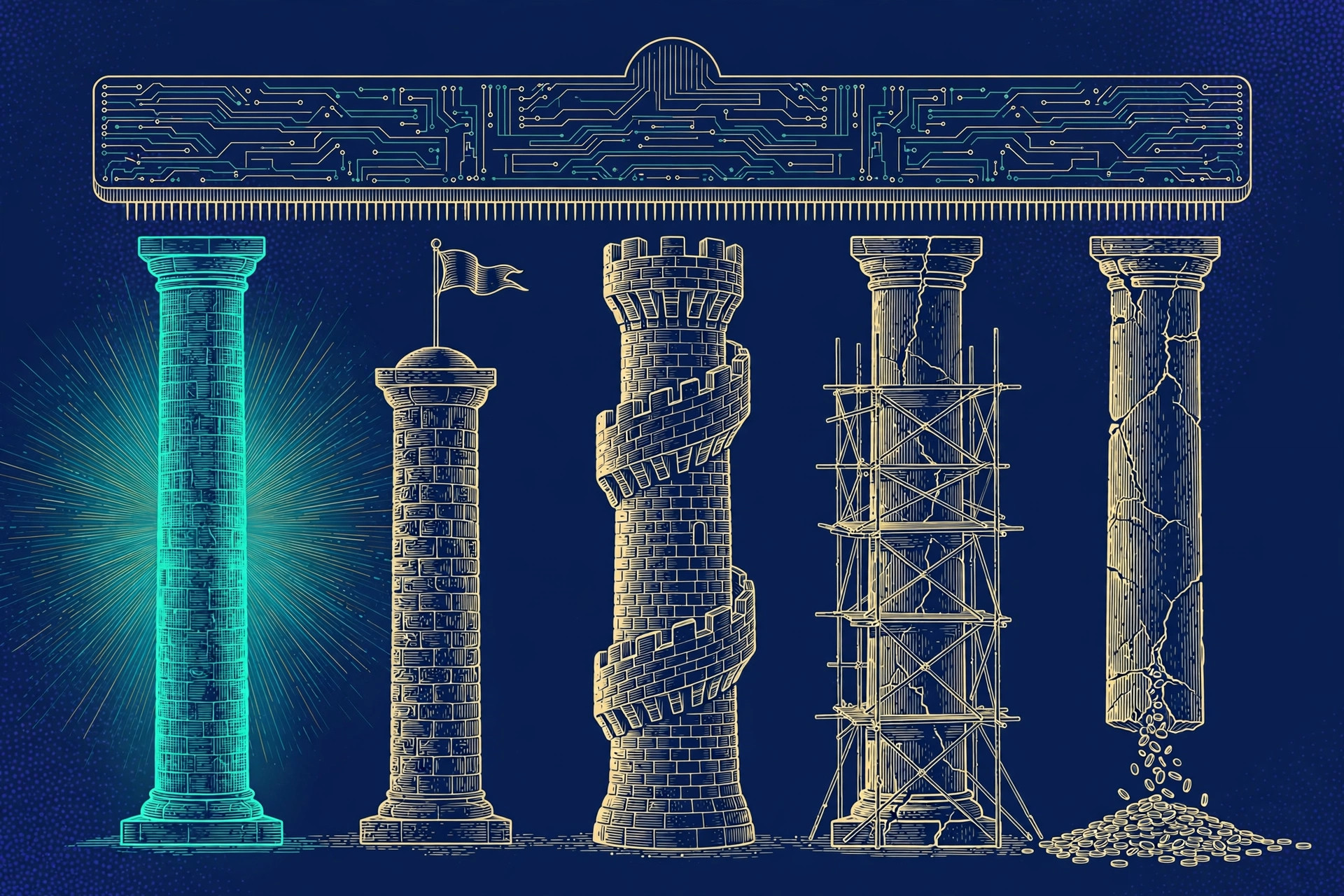
One pass, three partial, one fail. The pillars grade a company in the middle of a genuine repair, and the investment report grades the price. The price is what pulls the score under 50.
What would change the score. A committed anchor customer for 14A or two straight quarters of positive adjusted free cash flow would lift the score, while a 14A pause or foundry losses that stop narrowing would cut it.
| 47/100 | DalalBytes score |
| 1 pass | 3 partial, 1 fail |
| $92.07 | Reference price, Oct 29, 2026 close |
| $24 / $72 / $143 | FY2029 bear / base / bull |
| Pillar | Grade | The one-line reason |
|---|---|---|
| 1. Sunrise | PASS | AI lifts CPU demand in servers and foundry demand alike |
| 2. Leadership | PARTIAL | Real delivery under Tan against heavy executive churn |
| 3. Moat | PARTIAL | The x86 standard holds volume and loses the profit pool |
| 4. Iron Fortress | PARTIAL | Net cash again, rebuilt by issuance and partner claims |
| 5. Free Cash Flow | FAIL | Negative on Intel's own adjusted definition for three straight years |
The business grades better than the stock did at $92.07, and worse than a finished turnaround would. Each pillar below carries its own evidence. Management claims are labeled as claims, and filed numbers carry the grades.
Pillar 1, Sunrise industry: why does it pass?
The sunrise test asks one question. Is the industry itself rising?
- AI build outs raise CPU demand beside every accelerator.
- Agentic workloads need host CPUs to plan, fetch, and check.
- DCAI revenue rose 78% in Q3 2026.
- Intel called it its strongest data center growth in 15 years.
- New Street Research models server CPU sales reaching $50B by 2030.
- That is an analyst forecast, labeled as one.
- Foundry demand rises too. TSMC revenue rose about 50% in Q3 2026.
- TSMC holds 72.5% of a growing foundry market (TrendForce).
- The weak leg is the PC.
- Mercury Research put desktop shipments down more than 20% in Q2 2026.
- CCPG revenue fell 5% in Q3 2026 on that tape.
The grade
PASS. The markets Intel sells into are growing, and the fastest of them, AI data center, is the one where Intel just printed 78% growth. The pillar grades the industry, and the industry clears the bar with room.
Pillar 2, Leadership: why only partial?
The leadership test asks two questions. Is the current team delivering? And what did the last decade of decisions cost?
The delivery half
- Lip-Bu Tan became CEO on March 18, 2025.
- His stated rule ties investment to confirmed customer commitments.
- Intel 18A reached high volume production in October 2025.
- Panther Lake launched on January 5, 2026 as the first 18A product.
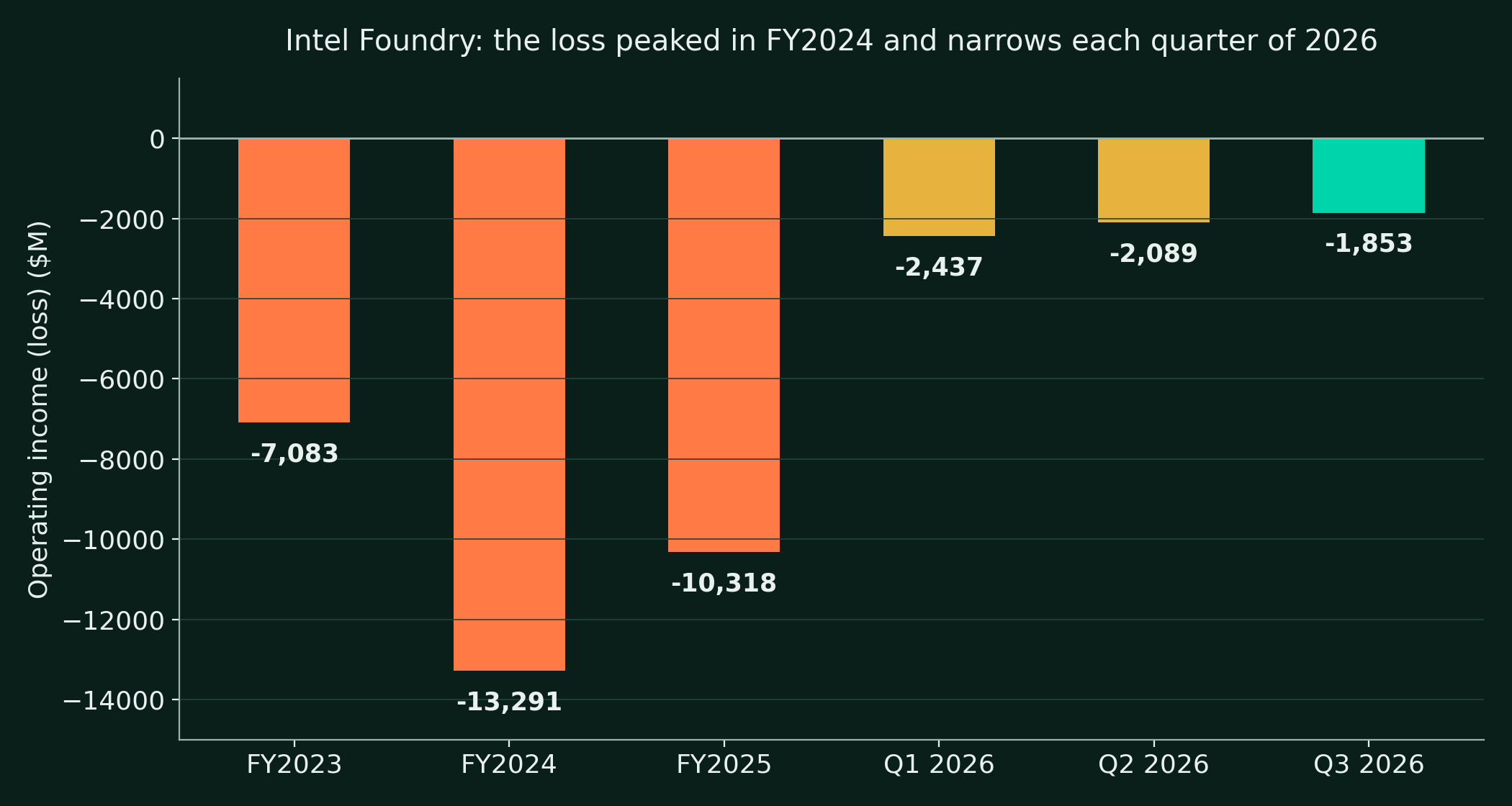
- Foundry losses narrowed for three straight quarters in 2026.
- The Q3 loss of $1.9B is about $1.5B better than the FY2024 quarterly pace.
- Headcount fell from 108900 at the end of 2024 to 85100 at the end of 2025.
- Germany and Poland were cancelled and Ohio was slowed to match demand.
- Altera was sold to control and deconsolidated in September 2025.
- The Q3 2026 print beat Intel's own guidance on revenue, margin, and EPS.
- Tan said in October 2026 that restructuring is about 80% complete.
The cost half
- The chief technology officer left for OpenAI six months into the role.
- The Intel Products CEO departed in September 2025.
- Two successive Xeon chief architects left in the same period.
- Intel booked a $3.9B Mobileye goodwill impairment in Q1 2026.
- The Q4 2026 guide missed consensus by about $1.5B at the midpoint.
- It landed hours after a quarter that beat on every guided line.
- The Apollo Ireland stake was repurchased for $14.2B.
- Intel had sold that stake for $11.2B about 21 months earlier.
- The Gelsinger era behind this team promised five nodes and a foundry business.
- It delivered the nodes late and the foundry business barely at all.
The grade
PARTIAL. The current team delivers process and cuts cost at a pace the prior regime never managed. The churn at the top and the forecasting miss keep it from a pass, and the inherited record is part of the grade.
Pillar 3, Moat: why only partial?
The moat test asks if rivals can take the core profit pool. For Intel the pool is x86 in PCs and servers.
- Intel still holds 69.7% of x86 client units (Mercury Research, Q2 2026).
- It holds 65.5% of x86 server units on the same survey.
- Enterprise software, drivers, and validation keep switching costs real.
- The installed base renews slowly and defaults to Intel.
- AMD holds 34.5% of server units and took 46.2% of server revenue in Q1 2026.
- Revenue share is where the profit pool shows. AMD sells the expensive sockets.
- AMD data center revenue grew 107% in Q2 2026 against Intel's 59%.
- Arm took 13.6% of server CPUs and 15.3% of client CPUs in Q2 2026.
- Both Arm figures were record highs.
- The foundry has no moat at all today.
- External foundry revenue was $411M in Q3 2026 against about $40.2B for TSMC in one quarter.
- Process parity is claimed on 18A and unproven with outside customers.
- The AI accelerator seat is empty after the Gaudi miss and the Falcon Shores cancellation.
The grade
PARTIAL. A standard that still ships seven of every ten client chips is a real moat, and it is narrowing at both ends, to AMD on price performance and to Arm on power. The grade falls when the server revenue share crosses, and it rises only if 18A holds the socket.
Pillar 4, Iron Fortress: why only partial?
The fortress test asks if the balance sheet can take a hit. Nineteen months ago it could not. Now it can, and the receipts are in the share count.
- Cash and short-term investments were $54,005M at September 26, 2026.
- Total debt was $50,134M on the same date.
- Net cash is $3,871M, calculated from those two filed totals.
- Intel stockholders' equity was $114,914M.
- Book value per share is $21.64, calculated from filed equity.
- The near-term funding need is covered without asset sales.
- The rebuild was financed by $15.9B of strategic equity in 2025.
- A public offering added about $22.6B net in August 2026.
- Non-controlling interests of $16,642M sit between the assets and the owners.
- Brookfield holds 49% of the Arizona fab entity.
- Capex runs near $20B a year on Reuters reporting of management comments.
- The government warrant adds 240.5M shares at $20.00 if foundry ownership falls below 51%.
- The dividend has been suspended since Q4 2024.
The grade
PARTIAL. Liquidity is no longer the question, and that is a real change from 2025. A fortress built by issuing a fifth more shares is a repaired wall, not an inherited one, and the capex queue behind it is long.
Pillar 5, Free Cash Flow: why does it fail?
The cash test asks if the business funds itself. On Intel's own adjusted definition, it has not done so in any recent filed year.
- Adjusted free cash flow was negative $11,853M in FY2023.
- It was negative $2,228M in FY2024.
- It was negative $1,612M in FY2025.
- FY2023 was reported on an older presentation and is not fully comparable.
- The direction is better. The level is still under water.
- Operating cash flow rose from $8.3B in FY2024 to $9.7B in FY2025.
- It reached $13.2B in the first nine months of 2026.
- Q3 2026 adjusted free cash flow printed positive at $1,639M.
- Q2 2026 printed negative $8,419M.
- That quarter holds the $14.2B Apollo repurchase as a partner distribution.
- Without that one financing decision the nine-month line would read positive.
- Reuters reported that Intel does not expect positive cash flow in 2026.
- The same report put 2026 capital spending near $20B with a significant rise in 2027.
The grade
FAIL. Three straight negative years on the company's own definition, a guided fourth, and a funding model that reaches for issuance is a fail whatever the slope. The slope is the bull case for an upgrade, and Q3 printed the first real evidence for it.
What would change the grades?
- Sunrise falls to PARTIAL if data center CPU growth halves for two straight quarters.
- Leadership rises to PASS if the Q4 guide proves conservative and the executive bench holds for a year.
- Leadership falls to FAIL if another top engineer tier leaves or 14A slips a full year.
- Moat rises to PASS if server unit share holds above 65% while 18A ramps.
- Moat falls to FAIL if AMD revenue share passes half the x86 server market.
- Iron Fortress rises to PASS if net cash survives a full year of $20B capex without new issuance.
- Iron Fortress falls to FAIL if the foundry needs another rescue raise at a low price.
- Free Cash Flow rises to PARTIAL on two straight positive quarters.
- It rises to PASS on a positive filed year.
- The fastest score lift is a named 14A anchor customer.
- The fastest cut is a 14A pause announcement.
Frequently asked questions
Why does Free Cash Flow fail when Q3 2026 printed positive?
One quarter does not retire three filed years. Adjusted free cash flow was negative in FY2023, FY2024, and FY2025 on Intel's own definition, and management does not expect a positive 2026 on Reuters reporting of its comments. The Q3 print of $1,639M is the first evidence for an upgrade, and two straight positive quarters would earn one.
Why does Iron Fortress grade only partial with net cash on the books?
The cash is real and so is its source. The position was rebuilt with $15.9B of strategic equity in 2025 and about $22.6B of public equity in 2026, and $16.6B of non-controlling interests and a $20B a year capex queue stand behind it. Partial grades a repaired fortress, not a failed one.
What would move the overall score the most?
A named anchor customer committing to 14A. It lifts the moat read, validates the leadership reset, and gives the foundry a path to fund itself, which touches three pillars at once. A 14A pause does the same damage in reverse.
Disclosures
- This analysis is research and opinion.
- It is not investment advice.
- DalalBytes Research. For educational purposes only. Not investment advice.
- Numbers come from company filings, company releases, and named press reports.
- Estimates are labeled as estimates where they appear.
- Management targets are labeled as targets. They are not results.
- The author holds no position in Intel at the time of publication and held and exited a position in the past.