
Frequently asked questions
Is Ingersoll Rand (India) (INGERRAND) a buy at current prices?
DalalBytes rates Ingersoll Rand (India) Selective Positive at 68/100. It is the highest-return listed compressor maker in India: FY26 ROE of 42.1%, ROCE of 56.3%, an 18.4% PAT margin, zero debt and five straight years of positive free cash flow, with the Sanand plant ramping and Q1 FY27 revenue up 20.3%. The deductions are growth of just 4.2% in FY26 with PAT down 4.3%, and a full multiple of about 44 to 46 times earnings, roughly double the price-to-sales of Elgi and Kirloskar Pneumatic.
What are Ingersoll Rand (India)'s FY2029 price targets?
DalalBytes' FY2029 targets are bear Rs 2,575, base Rs 4,600 and bull Rs 6,850, from a Rs 3,753.70 reference price (NSE close, October 26, 2026). Bear: 7% revenue CAGR, 17% PAT margin, EPS about Rs 92 at 28 times. Base: 13% CAGR, 19.5% margin, EPS about Rs 124 at 37 times. Bull: 18% CAGR, 21% margin, EPS about Rs 152 at 45 times.
What is the verdict on Ingersoll Rand (India)?
Business quality grades in the 80s: returns no Indian listed peer approaches (ROE 42.1%, ROCE 56.3% in FY26), an 18.4% PAT margin, a debt-free balance sheet, and free cash flow of Rs 69 to 216 crore in every year from FY22 to FY26. Three deductions bring it to 68: revenue growth of 4.1% in FY24 and 4.2% in FY26 (PAT fell 4.3% in FY26), a multiple of about 44 to 46 times earnings at roughly double peers' price-to-sales, and total parent control (75% promoter, group brands, about 92% payout) that makes the listed company a claim on the parent's India policy. The 24% fall from the Rs 4,955 high has not closed the valuation gap.
How did Ingersoll Rand (India) start?
Established in December 1921 in Kolkata, one of the first Indo-American ventures in India, it traded imported machinery for four decades before building its first plant at Naroda, Ahmedabad in 1965 for reciprocating compressors. It became public in 1977, started rotary screw assembly in 1983, and in 1989 began packaging Centac centrifugal compressors at Naroda, claiming to pioneer centrifugal technology in India. Between 2000 and 2005 the group exited process gas and drilling solutions (the latter to Atlas Copco), leaving a pure air-compression company. The modern parent was formed in 2020 by combining Gardner Denver with Ingersoll Rand's industrial segment; promoters hold exactly 75.00% (Ingersoll-Rand Industrial U.S. Inc. 74%, Ingersoll-Rand Inc. 1%).
What does Ingersoll Rand (India) sell, technically?
One reported segment, Air Solutions. The ladder runs from reciprocating piston machines (Naroda's original 1965 line) through oil-lubricated rotary screw (the industry workhorse, and Elgi's strongest turf), to oil-free rotary screw including the newer E-Series, where contamination-sensitive buyers in pharma, food, electronics and semiconductors pay premium prices because lifetime electricity and air purity decide the sale. The flagship is the Centac centrifugal: integrally geared, oil-free by design, engineered to order for large continuous air demand, packaged in India since 1989 and now anchored at Sanand. A secondary source puts its centrifugal segment share near 50% (labelled secondary, not filing-verified). Dryers, gas compressors and nitrogen generators complete the plant-room system sale. Services are only about 6 to 8% of revenue, against whole goods at about 90 to 92%: the aftermarket annuity that cushions global peers is underbuilt here.
Has management delivered on its roadmap?
| Commitment | Stated | Delivered | Grade |
|---|---|---|---|
| Sanand plant | Rs 170 crore, approved Dec 2022; operational Q2 FY26 per FY25 directors' report | Inaugurated October 15, 2025; Phase 1 capacity 24,000+ units a year | Delivered, about two quarters late |
| Sanand scale | Capacity 1.5x by 2028, 2x by 2030 | Q3 FY26: output scaled 1.5x in the ramp quarter; record centrifugal and E-Series output | On track, early |
| Localisation | Over 90% of rotary screw production localised within a year | Stated as a target in Q3 FY26 coverage; achievement not yet reported | Pending |
| Growth path | FY25 directors' report: continue on the growth path in FY2025-26 | FY26 revenue +4.2%, PAT -4.3% | Missed on profit |
| Growth ambition | MD, Feb 2026: double growth over the next few years | Q1 FY27 revenue +20.3%, PAT +19.5% | Promising start; aspiration, not guidance |
| Numeric guidance | None given | No formal guidance and no disclosed order book | Visibility gap |
On assets, delivery is real: the plant exists, output records followed, and internal accruals funded it. On numbers there is little to grade because management publishes no targets, which is itself the finding: investors pay a guidance-grade multiple for a company that offers no guidance.
What do the financials show?
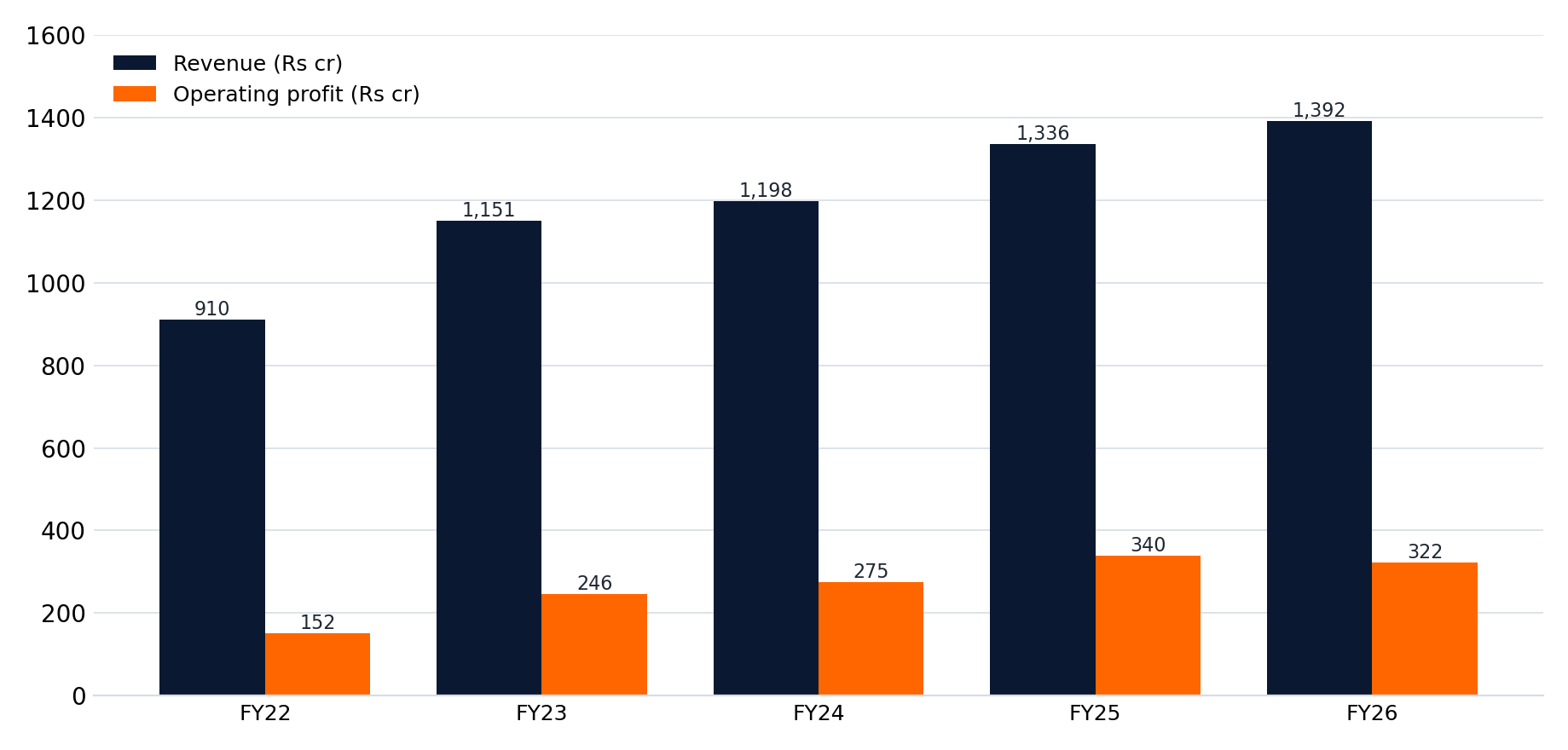
| Fiscal year | Revenue (Rs cr) | Operating profit (Rs cr) | Operating margin | PAT (Rs cr) | EPS (Rs) | Operating cash flow (Rs cr) |
|---|---|---|---|---|---|---|
| FY22 | 910 | 152 | 16.7% | 110 | 34.89 | 81 |
| FY23 | 1,151 | 246 | 21.4% | 183 | 57.86 | 148 |
| FY24 | 1,198 | 275 | 22.9% | 222 | 70.45 | 207 |
| FY25 | 1,336 | 340 | 25.5% | 268 | 84.75 | 265 |
| FY26 | 1,392 | 322 | 23.1% | 256 | 81.10 | 274 |
| Q1 FY27 | 379 | n.v. | n.v. | 70 | 22.32 | n.v. |
Standalone figures, Screener.in and filing-based vendor tables, October 2026. FY26 operating profit prints Rs 322 to 333 crore depending on exceptional-item treatment (labour-code costs were reported at Rs 26.58 crore in Q3 FY26 coverage and Rs 14.78 crore in Q4 FY26 by a result note). Quarterly revenue is lumpy: Rs 455 crore in Q3 FY26 against Rs 300 crore in Q4 FY26, because large centrifugal deliveries bunch. Q1 FY27: revenue from operations Rs 379.46 crore (+20.3%), total income Rs 389.29 crore, PAT Rs 70.46 crore (+19.5%), no exceptional items. Q2 FY27 results are due November 12 to 13, 2026.
How strong are the balance sheet and cash flow?
Fortress on leverage, generous to the point of leakage on payout. Total debt was about Rs 9 crore in FY26 (mostly leases) against net worth of Rs 616 crore, with debt to equity at 0.00x in every year FY22 to FY26; derived net cash was about Rs 151 crore. Operating cash flow covered PAT in each of the last three years (Rs 274 crore against Rs 256 crore in FY26), and Screener-definition free cash flow was positive five years running (Rs 69 / 133 / 158 / 216 / 196 crore). The other side: dividends declared rose to Rs 75 a share for FY26, a cash cost of about Rs 237 crore or roughly 92% of PAT, so cumulative FY23 to FY26 profit of about Rs 928 crore lifted net worth by only about Rs 64 crore, and net cash has fallen from about Rs 284 crore in FY22. Working capital is heavy by design: debtor days near 78, inventory days up to 102 in FY26, payables at 119 days funding a stable 62-day cycle.
Who runs the company, and is governance clean?
Sunil Khanduja became Managing Director on November 12, 2024 for five years and additionally Chairman from July 27, 2026, succeeding independent director Sekhar Natarajan in the chair; P. R. Shubhakar is Executive Director, CFO and Company Secretary in one person. Both combinations concentrate authority and are recorded as governance notes, not violations. KMP pay is small against profit (Rs 3.17 crore of short-term benefits in FY26). Promoters hold exactly 75.00%, unchanged from December 2023 to September 2026, mutual funds roughly 8 to 9%; no promoter pledging was reported in sources reviewed, and a filing-certified pledge figure was not retrieved. A specific royalty figure for FY25 or FY26 was likewise not found in sources reviewed and is not asserted.
Who competes with Ingersoll Rand (India)?
| Company | Position | Revenue (Rs cr) | PAT (Rs cr) | Approx. P/E, Oct 2026 |
|---|---|---|---|---|
| Atlas Copco India (unlisted) | Leader by revenue; oil-free and centrifugal benchmark | 5,790 (FY25) | 729 (FY24) | Unlisted |
| Elgi Equipments | Largest listed maker; screw workhorse, global aftermarket | 4,069 consolidated (FY26) | 430 consolidated | About 34 to 38x |
| Kirloskar Pneumatic | CNG compression leader; reciprocating and process gas | 1,787 (FY26) | 254 to 258 | About 29x (Oct 27 print) |
| Ingersoll Rand (India) | Centrifugal and oil-free premium niche | 1,392 (FY26) | 256 | About 44 to 46x |
Revenue scopes differ (vacuum, tools and global sales sit inside some), so the ranking is not a market-share table. The structural point stands: Ingersoll Rand is the smallest of the four by revenue and the richest by returns, with ROE of 42.1% against about 19 to 20% at Elgi and Kirloskar. Atlas Copco, at roughly four times the India revenue with nil debt, is the rival that matters in the premium categories; Kaeser contests premium screw from an unlisted base.
What is Ingersoll Rand (India) worth?
At Rs 3,753.70: trailing P/E of 44.3 to 44.6 times on vendor TTM earnings (46.3 times audited FY26 EPS of Rs 81.10), price to book of about 19.4 times, market cap of Rs 11,850 crore on 3.157 crore shares, price to FY26 sales of about 8.5 times, and a 2.00% dividend yield. Elgi trades near 4.7 to 4.9 times sales and Kirloskar near 4.9 times; the premium is defended by a PAT margin roughly double theirs, and attacked by FY26 growth of 4.2%. No broker consensus exists: no SEBI-registered broker target was found in 2025-26 coverage, and an algorithmic service's October 22, 2026 downgrade to Sell rested partly on a "flat Q1" framing that conflicts with the reported 20.3% revenue growth. FY2029 scenarios: bear Rs 2,575, base Rs 4,600, bull Rs 6,850. The base case is roughly 23% over three years plus a 2% yield: high-single-digit annualised, which is exactly why the rating is Selective Positive and not Positive.
What are the key risks?
Growth first: two of the last three years printed 4% revenue growth during an industrial capex upcycle, and the multiple assumes Q1 FY27's 20% pace becomes normal. Margin second: the FY25 peak of 25.5% already slipped to 23.1%. Parent third: 75% control, group-owned brands and designs, and a payout that returns cash instead of compounding it in India. Mix fourth: services at 6 to 8% of revenue leave the cycle undiluted. Then the disclosure gap (no order book, no guidance), single-cluster production in Gujarat, and liquidity: about 7,124 shares traded on October 26, 2026, and the stock moved roughly 5% intraday on October 27 on that tape. Q2 FY27 results on November 12 to 13, 2026 are the next checkpoint.
© 2026 DalalBytes Research · For educational purposes only. Not investment advice.