
Frequently asked questions
Is Hindustan Unilever (HINDUNILVR) a buy at current prices?
DalalBytes rates Hindustan Unilever Selective Positive at 68/100. FY26 continuing turnover was Rs 63,763 crore and Q2 FY27 printed underlying sales growth of 15% with volume growth of 7%, but reported FY26 PAT of Rs 15,059 crore includes a Rs 4,611 crore ice cream demerger gain, so underlying EPS is about Rs 46.9 and the price of Rs 1,990.30 is about 42 times underlying earnings. The Q2 FY27 growth print also sits on a GST-disrupted base quarter, with a 2-year revenue CAGR of about 5%.
What are Hindustan Unilever's FY2029 price targets?
DalalBytes' FY2029 targets (year ending March 2029) are bear Rs 1,500, base Rs 2,300 and bull Rs 3,050, from a Rs 1,990.30 reference price (NSE close, November 9, 2026). Bear: 6% revenue CAGR, EPS of about Rs 50 at 30 times. Base: 9.5% CAGR, EPS of about Rs 61 at 38 times. Bull: 12.5% CAGR, EPS of about Rs 70 at 44 times. These are DalalBytes scenarios, not broker consensus.
What happened to Hindustan Unilever's ice cream business?
The ice cream business was demerged into Kwality Wall's (India) Limited, effective December 1, 2025, with HUL shareholders receiving one KWIL share for each HUL share. KWIL listed on February 16, 2026. HUL booked a Rs 4,611 crore exceptional gain on the transfer at fair value, and The Magnum Ice Cream Company took a 61.9% stake in KWIL in March 2026.
What is the verdict on Hindustan Unilever?
Hindustan Unilever is the deepest consumer franchise in India, and the last eighteen months were surgery, not drift. The low-margin ice cream business was demerged into Kwality Wall's (India) on December 1, 2025. Minimalist was bought at a Rs 2,955 crore pre-money valuation. OZiva was bought out in full for Rs 824 crore for its remaining 49 percent. Pureit and the Nutritionalab stake were sold. What remains is a cleaner company: FY26 continuing turnover of Rs 63,763 crore, a distribution machine reaching over 9 million outlets, a cash conversion cycle of negative 89 days, and borrowings of Rs 1,478 crore against net worth of about Rs 48,739 crore.
The deduction is that the growth engine has been idle for three years and the headline numbers flatter it twice over. Consolidated sales grew 2.2 percent in FY24, fell 0.9 percent in FY25 and rose 5.1 percent in FY26, a 3-year sales CAGR of about 2 percent. Reported FY26 PAT of Rs 15,059 crore includes a Rs 4,611 crore exceptional gain on the ice cream demerger, so underlying PAT was about Rs 11,018 crore and underlying EPS about Rs 46.9. Q2 FY27 then printed underlying sales growth of 15 percent and volume growth of 7 percent, the best in 14 quarters, but against a GST-transition quarter a year earlier: HDFC Securities puts the 2-year revenue CAGR at 5 percent. At Rs 1,990.30 the stock trades at about 42 times underlying earnings, down from its old premium, not yet cheap for a 5 percent two-year stack.
What would change the score: two more quarters of volume growth at 5 percent or better on clean bases, with the EBITDA margin inside the guided 22.5 to 23.5 percent band, would lift the score toward 76. A slide back to low single-digit volume growth once the GST base washes out, or a margin print below 22 percent, would cut it toward 60.
Reference price: Rs 1,990.30 (NSE close, November 9, 2026. NSE was closed on November 10, 2026 for Diwali Balipratipada, so the last trading day's close is used). Market cap about Rs 4,67,639 crore. 52-week range Rs 1,758.20 to Rs 2,488.00. The stock is down about 14 percent over one year and about 20 percent below its 52-week high.
FY2029 targets: Bear Rs 1,500 / Base Rs 2,300 / Bull Rs 3,050. See Section 15 for assumptions.
What is Hindustan Unilever at a glance?
| Item | Detail |
|---|---|
| Company | Hindustan Unilever Ltd (HUL), Mumbai, India |
| Incorporated | 17 October 1933 as Lever Brothers India Ltd; present form from the 1956 merger; renamed Hindustan Unilever in 2007 |
| Listed | NSE/BSE; BSE 500696; face value Rs 1 |
| Business | India's largest FMCG company: Home Care, Beauty and Wellbeing, Personal Care, Foods |
| Power brands | Surf Excel, Rin, Vim, Comfort, Dove, Sunsilk, TRESemme, Pond's, Lakme, Vaseline, Lux, Lifebuoy, Pears, Closeup, Brooke Bond, Lipton, Bru, Horlicks, Boost, Kissan, Knorr, Hellmann's |
| FY26 continuing turnover | Rs 63,763 cr; consolidated revenue from operations Rs 64,468 cr |
| FY26 PAT | Rs 15,059 cr reported, including a Rs 4,611 cr demerger gain; underlying PAT about Rs 11,018 cr |
| Latest result | Q2 FY27, declared October 28, 2026: revenue Rs 18,226 cr (+14.5 percent), PAT Rs 2,796 cr (+3.8 percent), interim dividend Rs 19 per share |
| Balance sheet | Borrowings Rs 1,478 cr; net worth about Rs 48,739 cr; cash conversion cycle negative 89 days |
| Promoter | Unilever group 61.90 percent (September 2026), no pledging |
How was Hindustan Unilever founded?
The first crates of Sunlight soap, embossed as made in England by Lever Brothers, arrived at Kolkata harbour in the summer of 1888. Branded packaged goods were the novelty: soap you could trust because it carried a name. The local build followed in steps. Hindustan Vanaspati Manufacturing Company was set up in 1931 and launched Dalda. Lever Brothers India Limited was incorporated on October 17, 1933, with soap production at Sewri from 1934. United Traders followed in 1935 for personal products.
In 1956 the three companies merged to form Hindustan Lever Limited, with 10 percent Indian equity participation at the start, a structure that made the foreign parent's Indian arm a listed Indian institution rather than a branch. Prakash Tandon had become the first Indian director in 1951. The company was renamed Hindustan Unilever Limited in 2007.
Two later deals define the modern shape. The Brooke Bond and Lipton lineage built the foods and tea business over decades. Then, in April 2020, GSK Consumer Healthcare merged into HUL in an all-share deal at 4.39 HUL shares for every GSK Consumer share, valued at about Rs 31,700 crore, bringing Horlicks and Boost and lifting the equity base from about Rs 8,200 crore to about Rs 47,700 crore in one step. That merger is why the balance sheet carries large brand intangibles today, and why Foods is a scale business rather than an adjacency.
The through line of the story is category creation at mass price points: the sachet, the Rs 1 and Rs 2 pack, and distribution into villages other companies did not reach. Nine out of ten Indian households use at least one HUL brand, on the company's own count. The empire was built by making branded daily necessities affordable one small pack at a time, then premiumising the same households as incomes rose.
What does Hindustan Unilever sell?
HUL reports four continuing segments after the ice cream demerger. FY26 mix below is from the annual report's continuing operations.
| Segment | FY26 revenue (Rs cr) | Share | Lead brands and categories |
|---|---|---|---|
| Home Care | 23,672 | 37 percent | Surf Excel, Rin, Wheel, Vim, Domex, Comfort: fabric wash and household care |
| Beauty and Wellbeing | 14,990 | 24 percent | Dove, Sunsilk, TRESemme, Pond's, Lakme, Vaseline, Glow and Lovely, Minimalist, OZiva: hair care, skin care, colour cosmetics, health and wellbeing |
| Personal Care | 9,564 | 15 percent | Lux, Lifebuoy, Pears, Dove body wash, Closeup, Pepsodent: skin cleansing and oral care |
| Foods | 14,061 | 22 percent | Brooke Bond, Lipton, Bru, Horlicks, Boost, Kissan, Knorr, Hellmann's: tea, coffee, lifestyle nutrition, packaged foods |
| Others, including exports | About 1,476 | 2 percent | Exports and other operating items |
• Home Care is the volume engine. Liquids are the growth format inside fabric wash, and the premium liquids portfolio outgrows powders. In FY26 Home Care sales grew 3 percent on high single-digit volume growth, with price cuts in a deflationary detergent input cycle passing through the P&L.
• Beauty and Wellbeing is the margin and growth engine. Segment EBIT margins run near 29 percent in the latest quarter, the highest of the four. Hair care delivered double-digit growth in FY26. Vaseline and Sunsilk each crossed Rs 1,000 crore of annual turnover in FY26.
• Personal Care is the contested middle. Skin cleansing took pricing in FY26 on palm oil derivative inflation. Premium bars and bodywash grew well, mass soaps did not. Oral care grew mid single digits.
• Foods is the slowest engine with the best brands. FY26 growth was 4 percent, volume-led. Coffee grows double digits. Tea grows low single digits on volume. Lifestyle nutrition, the Horlicks and Boost business, returned to double-digit growth in late FY26.
• The technical core is formulation plus pack architecture. HUL's product edge is rarely a patent. It is the ability to hold a formulation's performance constant across a price ladder from a sachet to a premium bottle, across hard water, bucket washing and machine washing, and across climates from Kerala humidity to Rajasthan heat, at a cost the mass consumer can pay.
Latest quarter by segment: Q2 FY27
| Segment | Revenue (Rs cr) | Underlying sales growth | Segment EBIT margin |
|---|---|---|---|
| Home Care | 6,878 | 22 percent | 16 percent |
| Beauty and Wellbeing | 4,319 | 16 percent | 29 percent |
| Personal Care | 2,617 | 9 percent | 17 percent |
| Foods | 3,849 | 9 percent | 22 percent |
| Others, including exports | 563 | n.a. | n.a. |
Segment revenue and margins are as reported by HUL for Q2 FY27. Segment margins are EBIT margins before exceptional items, not EBITDA margins. Home Care's 22 percent underlying growth came off a GST-disrupted base quarter and double-digit volume growth in both fabric wash and household care.
What did the portfolio surgery involve?
The past two years are the most active portfolio period in HUL's recent history. Each transaction is stated with its terms, because the deal record is now a core part of the investment case.
| Transaction | Terms | Status |
|---|---|---|
| GSK Consumer Healthcare merger | All-share, 4.39 HUL shares per GSK Consumer share, valued at about Rs 31,700 cr; Horlicks and Boost | Completed April 2020 |
| Ice cream demerger | Kwality Wall's (India) Ltd, 1 HUL shareholder received 1 KWIL share; record date December 5, 2025 | Effective December 1, 2025; KWIL listed February 16, 2026 |
| Minimalist (Uprising Science) | 90.5 percent stake at a Rs 2,955 cr pre-money enterprise value, secondary purchase plus primary infusion, path to the balance in about two years | Completed April 21, 2025 |
| OZiva (Zywie Ventures) | 51 percent for Rs 264 cr in 2022 to 2023; remaining 49 percent for Rs 824 cr, implying an enterprise value of about Rs 1,682 cr | Buyout approved February 12, 2026 |
| Nutritionalab exit | Entire 19.8 percent stake sold to USV Pvt Ltd for Rs 307 cr | Completed March 2026 |
| Pureit water purification | Slump sale to A. O. Smith India Water Products, trademarks and identified assets included | Completed November 1, 2024 |
| VWash | Market leader in female intimate hygiene, acquired to enter an underpenetrated category | Acquired 2020 |
• The demerger gain is accounting, not cash. HUL booked a Rs 4,611 crore exceptional gain in Q3 FY26 because the ice cream assets were transferred at fair value. Reported Q3 FY26 PAT was Rs 6,603 crore; PAT from continuing operations before the gain was about Rs 2,562 crore. Any FY26 growth rate built on reported PAT is wrong, and this report uses underlying PAT of about Rs 11,018 crore for valuation.
• Ice cream was small and dilutive. The business was about Rs 1,800 crore of revenue, about 3 percent of turnover, at low single-digit to 7 percent EBITDA margins against HUL's 23 percent. Broker estimates put the post-demerger EBITDA margin uplift at 50 to 60 basis points. The Magnum Ice Cream Company took a 61.9 percent stake in KWIL in March 2026, so the separated business now sits inside Unilever's global ice cream parent, not inside HUL.
• Minimalist is the price of admission to actives. At Rs 2,955 crore of pre-money value for a brand with about Rs 350 crore of FY24 revenue, HUL paid for the science-led skincare position its own brands lacked. The staged structure, 90.5 percent now and the balance later, keeps founders inside during integration.
• OZiva shows the staged model compounding. The first 51 percent cost Rs 264 crore in 2022. The remaining 49 percent cost Rs 824 crore in 2026 because the business worked: revenue rose from Rs 104 crore in FY24 to Rs 258 crore in FY25, and HUL put its 2025 scale at about Rs 480 crore. Paying three times the first valuation for the second half is the model working, and it is also a reminder that the buyout bill arrives after success, not before.
How strong is the distribution machine?
Distribution is the physical moat, and its current state is specific.
| Reach item | Latest figure |
|---|---|
| Retail outlets selling HUL brands | 9 million plus |
| Distributors | 3,500 plus |
| Direct coverage | Over 2 million outlets covered directly by distributors; stores directly serviced account for 69 percent of category value |
| Shikhar e-B2B app | 1.4 million plus retailers onboarded; about 33,000 bills a day on the latest Unilever disclosure |
| Specialty stores | About 125,000 to 175,000 covered through a customised route to market in top towns |
| Quick commerce | Sales up over 50 percent in the September 2026 quarter; over 20,000 dark stores stocked; service levels at about 90 percent |
| Pack volume | Over 85 billion packs a year (Unilever capital markets day, November 2026) |
• The machine is being rebuilt while it runs. The Samadhan model moves fulfilment from distributor warehouses toward company-run delivery direct to retailers in pilot cities, cutting delivery time toward 24 hours. Distributor associations have pushed back publicly, because the model changes who holds inventory and credit. That friction is a real execution risk in the channel that still carries most of the volume.
• India is now the template, not the student. At Unilever's November 4, 2026 capital markets day, group leadership said the India playbook of deep distribution, price ladders and category building will be taken to Africa, Vietnam, Pakistan and Bangladesh, and put India at about 16 percent of group revenue. HUL's operating model is the parent's reference design for emerging markets.
• Rural reach runs through Shakti. The Shakti entrepreneur network and sub-stockists carry HUL into villages below the distributor threshold, and about 70 percent of Shakti partners use Shikhar. Rural demand recovery is therefore partly a distribution fact and partly an income fact; the network is built, the incomes decide the throughput.
What do the financials show?
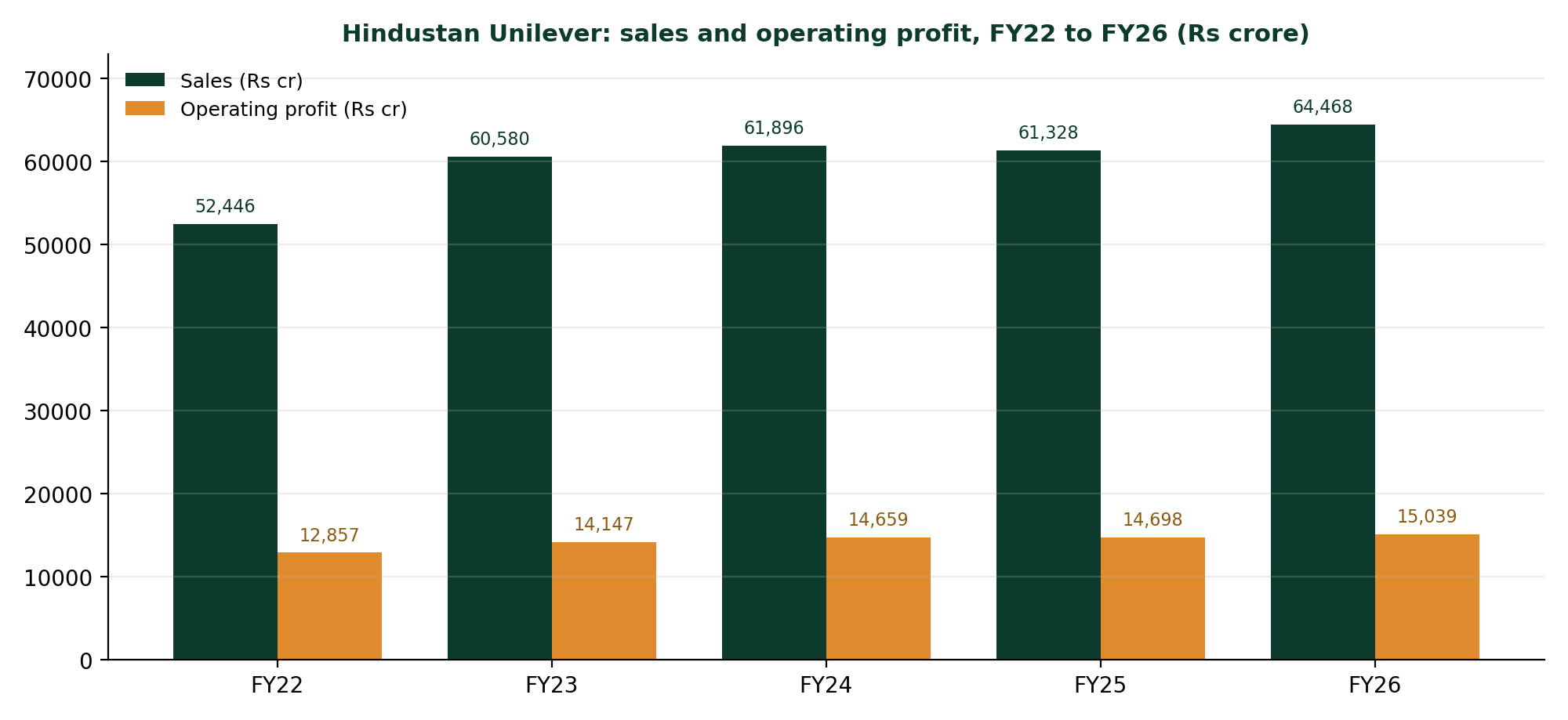
Consolidated figures from Screener, in Rs crore. FY26 PAT is reported and includes the demerger gain; the underlying line is stated below the table.
| Year | Sales | YoY | Operating profit | OPM | PAT reported | EPS (Rs) |
|---|---|---|---|---|---|---|
| FY22 | 52,446 | n.a. | 12,857 | 25 percent | 8,892 | 37.79 |
| FY23 | 60,580 | +15.5 percent | 14,147 | 23 percent | 10,143 | 43.07 |
| FY24 | 61,896 | +2.2 percent | 14,659 | 24 percent | 10,282 | 43.74 |
| FY25 | 61,328 | -0.9 percent | 14,698 | 24 percent | 10,671 | 45.32 |
| FY26 | 64,468 | +5.1 percent | 15,039 | 23 percent | 15,059 | 64.01 |
• Read the arc in two halves. FY23 growth of 15.5 percent was price-led, taken during commodity inflation. FY24 and FY25 were the hangover: volume stalled, pricing turned negative in Home Care, and sales went sideways for two full years. FY26 recovered to 5.1 percent consolidated growth as volumes returned.
• Underlying FY26 earnings. Removing the after-tax effect of the Rs 4,611 crore demerger gain (about Rs 4,041 crore on the Q3 FY26 bridge) gives underlying PAT of about Rs 11,018 crore, up about 3 percent on FY25, and underlying EPS of about Rs 46.9. That is the earnings base this report values.
• Margins are managed inside a band. Operating margin held 23 to 25 percent across five years of commodity swings. Management guided consolidated EBITDA margin of 22.5 to 23.5 percent for FY27, adjusted for the ice cream separation, on the Q4 FY26 call.
• Return ratios stay elite. ROE was about 31 percent in FY26 on the reported series and ROCE about 28 percent. Both are flattered in FY26 by the demerger gain in the numerator; the underlying return profile is in the mid to high 20s.
Latest quarters
| Quarter | Sales (Rs cr) | YoY | EBITDA (Rs cr) | EBITDA margin | PAT (Rs cr) |
|---|---|---|---|---|---|
| Q2 FY26 | 15,919 | n.a. | 3,782 | 24 percent | 2,694 |
| Q1 FY27 | 17,341 | +10.1 percent | 3,947 | 23 percent | 2,680 |
| Q2 FY27 | 18,226 | +14.5 percent | 4,089 | 22.6 percent | 2,796 |
• Q2 FY27 is a strong print on a weak base. Underlying sales growth of 15 percent was the highest in 14 quarters and underlying volume growth was 7 percent, with H1 FY27 turnover of Rs 35,255 crore at 12 percent underlying growth and 6 percent volume growth. The year-earlier quarter was disrupted by the GST rate transition, which froze channel stocking. HDFC Securities' 2-year revenue CAGR for the quarter is 5 percent. Both facts are true; the second one is the trend.
• Profit grew slower than sales. Q2 FY27 EBITDA rose 8 percent and the margin fell about 140 basis points to 22.6 percent on input costs and investment. PAT before exceptional items rose about 9 percent; reported PAT rose 3.8 percent against a base that carried a one-off tax gain of about Rs 273 crore. Advertising spend fell 9.3 percent in the quarter to Rs 1,481 crore, a cut worth watching in a quarter of claimed demand strength.
How strong are cash flow and the balance sheet?
| Metric (Rs cr) | FY22 | FY23 | FY24 | FY25 | FY26 |
|---|---|---|---|---|---|
| Operating cash flow | 9,048 | 9,991 | 15,469 | 11,886 | 10,999 |
| Free cash flow | 7,995 | 8,980 | 14,012 | 10,624 | 9,667 |
• The working capital model funds the business. The cash conversion cycle was negative 89 days in FY26: debtor days of 19 and inventory days of 61 against payable days of 169. Suppliers and the channel fund about three months of operations. That is a structural feature of category leadership, and it survives because distributors and suppliers earn from the throughput.
• The fortress is a flow, not a pile. Borrowings were Rs 1,478 crore at March 2026, mostly lease-linked, against net worth of about Rs 48,739 crore. Fixed assets and intangibles of about Rs 57,428 crore dominate the asset side, a legacy of the GSK merger's brand values. HUL does not hoard cash; it pays it out.
• The payout is the capital allocation. Dividend payout was 90 to 117 percent of reported PAT across FY22 to FY25 and 64 percent of the gain-inflated FY26 PAT, which is about 87 percent of underlying PAT. The FY27 interim dividend is Rs 19 per share. Dividend yield at the reference price is about 2.06 percent.
• Buybacks are not the tool here. With a 61.90 percent promoter holding, returns run through dividends, which treat the parent and minorities identically. The staged D2C buyouts, Minimalist and OZiva, are the growth capital allocation, at a combined announced cost well under one year of free cash flow.
Who competes with Hindustan Unilever?
HUL competes in every aisle at once, against a different leader in each. The quantified set below uses prices and multiples at November 9, 2026.
| Company | Price (Rs) | Market cap (Rs cr) | P/E | ROE |
|---|---|---|---|---|
| Hindustan Unilever | 1,990.30 | 4,67,639 | 31.0 reported, about 42 underlying | 30.7 percent |
| ITC | 278.80 | 3,49,000 | 18.5 | 29.5 percent |
| Nestle India | 1,297.80 | 2,50,000 | 61.4 | 76.3 percent |
| Marico | 902.00 | 1,17,000 | 57.7 | 44.3 percent |
| Britannia | 4,790.00 | 1,15,000 | 43.2 | 53.6 percent |
| Dabur | 375.25 | 66,572 | 33.0 | 16.8 percent |
Multiples are provider figures at November 9, 2026 and differ by source on the treatment of HUL's demerger gain; the underlying P/E is derived in Section 13. ITC's P/E reflects its cigarette-led mix and is not a like-for-like FMCG multiple.
• In Home Care, the fight is value and liquids. Godrej Consumer, Jyothy Labs and a long tail of regional detergent brands attack on price, while HUL defends with Surf Excel's premium liquids ladder. FY24 to FY26 showed the cost of that fight: Home Care growth of 3 percent in FY26 despite high single-digit volumes, because price was given back.
• In beauty, the fight is speed. Honasa's Mamaearth and The Derma Co, Marico's digital brands and Nykaa's own labels launch in weeks and buy attention on the same platforms where HUL's brands were built over decades. HUL's answer was to buy the challenger: Minimalist now sits inside HUL, aimed at the actives shelf where The Derma Co leads online.
• In foods, the fight is ITC and Tata Consumer. ITC's foods business is larger in packaged foods ambition, Tata Consumer bought Capital Foods and Organic India for category reach, and Reliance Consumer is building a price-led challenger with its own retail distribution. HUL's foods edge is tea, coffee and nutrition brands, not breadth.
• Quick commerce changes the shelf. When the shelf is a phone screen, decades of kirana placement matter less and search rank, ratings and 10-minute availability matter more. HUL's quick commerce sales grew over 50 percent in the September 2026 quarter and service levels lead the industry on Unilever's disclosure, but the channel structurally lowers the entry barrier for every challenger in this section.
What are the strengths?
• 1. Distribution depth no rival matches: 9 million plus outlets, 3,500 plus distributors, 1.4 million retailers on Shikhar, and 69 percent direct value-weighted coverage.
• 2. Brand portfolio breadth: the leader or a top-two brand in most of its categories, with Vaseline and Sunsilk each crossing Rs 1,000 crore in FY26 and Surf Excel among India's largest FMCG brands.
• 3. Margin discipline through cycles: operating margin held 23 to 25 percent across the FY22 to FY26 commodity cycle, and guidance of 22.5 to 23.5 percent was set for FY27 after the demerger.
• 4. Cash machine economics: negative 89-day cash conversion cycle, free cash flow of Rs 9,667 crore in FY26, and a dividend payout near 87 percent of underlying earnings.
• 5. Portfolio action with terms that protect the downside: staged buyouts for Minimalist and OZiva, a clean 1:1 demerger for ice cream, and exits for Pureit and Nutritionalab.
• 6. The parent's reference market: India at about 16 percent of Unilever group revenue, with the India playbook now exported to other emerging markets, keeps HUL at the centre of group strategy and talent flow.
What are the weaknesses?
• 1. Three lost growth years: sales CAGR of about 2 percent over three years to FY25 on the consolidated series, in a nominal economy growing several times faster. HUL has been losing relative ground even while defending margin.
• 2. Headline numbers need forensic reading: reported FY26 PAT growth of 41 percent is a demerger accounting gain. A company of this quality should not need its investors to rebuild the earnings line, yet in FY26 they do.
• 3. Mass categories are ex-growth or worse: mass soaps, mass skin care and tea volumes are flat to slow, and the growth is concentrated in premium tiers that are a minority of the base today.
• 4. The moat's toll is rising: challenger brands, retailer private labels and quick commerce all tax the old distribution advantage, and Q2 FY27 advertising was cut 9.3 percent in the very quarter growth returned.
• 5. Foods remains sub-scale against its ambition: 22 percent of turnover, 4 percent FY26 growth, and no answer yet to ITC and Tata Consumer's acquisition-led breadth.
• 6. Parent dependence is structural: the brands, the technology and the chief executive pipeline belong to Unilever. Royalty and central service arrangements with the parent are a permanent cost line whose terms HUL's minorities do not set.
How good is management and governance?
Priya Nair became CEO and Managing Director on August 1, 2025, for a five-year term to July 31, 2030. She is the first woman to lead HUL in its 92-year history to that date, a Unilever veteran of about 30 years, and she arrived from the role of President, Beauty and Wellbeing at Unilever, where she sat on the Unilever Leadership Executive. She had earlier led HUL's beauty and personal care business in India. The succession was orderly: Rohit Jawa, CEO from June 2023 to July 2025, stepped down at a planned date and Nair took over the ASPIRE strategy he authored rather than restarting the strategy clock.
That continuity cuts both ways. ASPIRE, Jawa's programme to shift the portfolio and channels toward high-growth demand spaces, is the right diagnosis, and Nair's beauty background matches where the growth and margin sit. But the strategy is now three years old, its author has left, and its scoreboard is the volume line: FY24 and FY25 printed near-zero sales growth under the strategy's first phase. Nair's first five quarters show the portfolio surgery completed and one very strong quarter on a weak base. The grade on delivery is still being written.
Governance is institutional grade. Nitin Paranjpe chairs the board. The promoter holds 61.90 percent with no pledging. The auditor record is clean in sources reviewed, related-party dealings with the parent are disclosed and recurring by design, and the demerger was executed through an NCLT-approved scheme with a simple 1:1 entitlement that any shareholder could verify. The standing governance question is not integrity; it is the parent's toll: royalty and service fees to Unilever, and strategy set with group priorities in view, are facts minorities accept when they buy the stock.
How does ASPIRE grade against delivery?
| Plan | Set | Verdict |
|---|---|---|
| ASPIRE portfolio shift to high-growth demand spaces | 2023 to 2024, under CEO Rohit Jawa | In delivery. Minimalist, OZiva buyout, ice cream exit and Pureit sale all executed; growth spaces now a rising share of turnover |
| Separate the ice cream business | Board decision 2024; scheme approved January 2025 | Delivered. Effective December 1, 2025, listed February 16, 2026, ahead of the end-FY26 marker |
| EBITDA margin of 22.5 to 23.5 percent for FY27, adjusted for the demerger | Q4 FY26 call, May 2026 | On track. Q1 FY27 at about 23 percent and Q2 FY27 at 22.6 percent, both inside the band |
| FY27 to be better than FY26 | Management, Q2 FY27, October 2026 | On track, base-flattered. H1 FY27 underlying growth of 12 percent against a GST-disrupted base period |
| Minimalist: path to full ownership in about two years | January 2025 deal announcement | Pending. Balance of about 9.5 percent due around 2027 on the announced path |
| Premiumisation of the core | Standing ASPIRE pillar | Partial. Premium tiers grow double digits; mass tiers are flat, so mix gain is arithmetic on a slow base |
| Volume-led growth return | Standing guidance theme since FY24 | Behind until Q2 FY27. FY24 and FY25 volumes were low single digit; Q2 FY27 printed 7 percent on a weak base |
The audit pattern is consistent. HUL delivers everything that is a transaction or a structure: the demerger landed on time, the buyouts closed on announced terms, the margin band holds. What it has not yet delivered is the one outcome that depends on the Indian consumer rather than on its own execution: sustained volume growth on a clean base. Until two or three clean quarters print at 5 percent volume growth or better, ASPIRE grades as a well-executed restructuring in search of its growth proof.
How is Hindustan Unilever valued against peers?
At Rs 1,990.30: market cap about Rs 4,67,639 crore, price to sales of about 7.3 times FY26 continuing turnover, EV/EBITDA of about 31 times on FY26 operating profit (derived, net cash is small against the market cap), dividend yield of about 2.06 percent, and a free cash flow yield of about 2.1 percent on FY26 free cash flow.
• The P/E needs two numbers, not one. On reported TTM EPS of about Rs 64, the stock trades at about 31 times. That EPS contains the demerger gain. On underlying EPS of about Rs 46.9, the stock trades at about 42 times. Provider P/E figures at November 9, 2026 ranged from 31.0 to 44.2 for exactly this reason. This report values the 42 times figure.
• Against its own history the stock has de-rated hard. The share price CAGR is negative 3 percent over five years and negative 6 percent over three years on the Screener series, while earnings compounded. HUL traded at 55 to 65 times underlying earnings for much of the last decade; at about 42 times, the market has already charged it for the flat years.
• Against peers it sits mid-pack. Nestle India at about 61 times and Marico at about 58 times trade richer on faster recent growth. Britannia at about 43 times is the closest comparable. Dabur at about 33 times is cheaper with weaker returns. HUL is no longer the sector's premium stock; it is priced as a quality compounder with a growth question.
• Broker anchors bracket the debate. Motilal Oswal rated the stock Buy with a target of Rs 2,650 in its FY26 annual report review. HDFC Securities rated it Reduce after Q2 FY27, arguing the 15 percent growth print was a 5 percent two-year CAGR in disguise. Both readings use the same quarter; the disagreement is entirely about the base.
What are the risks?
The first risk is that the recovery is a base effect wearing a recovery's clothes. GST rate cuts in late 2025 reset price points across HUL's portfolio, disrupted channel stocking in the base quarter, and restocked it a year later. Q2 FY27's 15 percent underlying growth and 7 percent volume growth are real shipments, but the two-year stack grows at about 5 percent. If the clean quarters of H2 FY27 print at 3 to 4 percent volumes, the de-rating that took the stock from Rs 2,488 to Rs 1,758 has a second leg, because the market paid for the Q2 print within days.
Input costs are the second risk, and they are already in the P&L. Q2 FY27's margin fell about 140 basis points to 22.6 percent on palm-derived and tea costs, inside the guided band but at its lower half. Personal Care pricing was taken on palm inflation in FY26, which taxes volume in the most price-sensitive categories HUL owns. The company cannot reprice monthly without breaking its mass franchise, so commodity spikes land in margin first and in volume second.
Competition is the third risk, and it is structural rather than cyclical. Every growth pocket HUL targets is contested by a funded specialist: actives by Honasa, digital hair and nutrition by Marico's portfolio, foods by ITC and Tata Consumer, value by Reliance Consumer and private labels, and the shelf itself by quick commerce platforms that own the customer relationship. HUL's distribution moat still decides who wins the kirana; it no longer decides who gets discovered.
The parent is the fourth risk, stated plainly. Unilever sets group strategy, owns the global brands HUL sells, appoints the leadership pipeline and receives royalty and service income from HUL. None of this has been abused in the public record, and the India playbook's elevation inside the group is a genuine positive. It remains true that HUL's minorities own a superb Indian franchise whose most important contracts are with its own controlling shareholder.
What are the FY2029 price targets?
Built off FY26 continuing turnover of Rs 63,763 crore and 235 crore shares. Underlying PAT margin in FY26 was about 17.3 percent of continuing turnover. Assumptions are explicit and are DalalBytes scenarios, not broker consensus.
Bear Rs 1,500: 6 percent revenue CAGR (the two-year stack stays the trend, premium pockets slow), PAT margin of 15.5 percent (input costs and channel investment bite), EPS of about Rs 50, exit at 30 times earnings. FY29 revenue about Rs 75,944 crore, PAT about Rs 11,771 crore.
Base Rs 2,300: 9.5 percent revenue CAGR (volumes recover to mid single digits with premium mix and price), PAT margin of 17 percent (margin band held, mix offsets investment), EPS of about Rs 61, exit at 38 times earnings. FY29 revenue about Rs 83,730 crore, PAT about Rs 14,234 crore.
Bull Rs 3,050: 12.5 percent revenue CAGR (ASPIRE growth spaces compound, foods and beauty both reach double digits), PAT margin of 18 percent (operating leverage on a cleaner post-demerger mix), EPS of about Rs 70, exit at 44 times earnings (today's underlying multiple, held). FY29 revenue about Rs 90,760 crore, PAT about Rs 16,337 crore.
Base-case value at Rs 2,300 is about 16 percent above the Rs 1,990.30 reference price, before dividends of about 2 percent a year. That is a compounder's return, not a re-rating windfall, and it is why the rating is Selective Positive: the buyer is paid to wait for the growth proof, not paid as if the proof had already arrived.
Why does Hindustan Unilever matter?
HUL is the reference company for Indian consumption. Its volume line is the closest thing the market has to a monthly census of the Indian household, and its distribution system is the infrastructure half the consumer economy runs on. When HUL cannot grow volumes for two years, that is not a company fact alone; it is a fact about mass incomes, and every consumer valuation in India quietly rests on when it changes.
The surgery of 2025 to 2026 makes the next three years a clean test. The portfolio excuses are gone: the dilutive ice cream business is out, the actives challenger is owned, the wellness bet is fully bought, and the margin band is stated in public. What remains is the oldest question in Indian FMCG: can the empire that taught India to buy branded soap find volume growth in an India that now discovers brands on a phone? At 68/100 Selective Positive, the verdict is: the franchise, the balance sheet and the cash flow are not in doubt, the price finally admits the growth is, and Rs 1,990.30 pays a patient buyer a dividend to wait for the answer.
Sources
• Company filings and results: Q2 FY27 consolidated results and integrated filing (October 28, 2026), Q2 FY27 results presentation and earnings call transcript filing (November 4, 2026), FY26 annual report and Q4 FY26 results coverage (April to May 2026), ice cream demerger disclosures (2025 to 2026), Minimalist and OZiva transaction filings (January 2025, February 2026), Pureit divestment completion filing (November 1, 2024)
• Company sources: HUL history and chronology pages (hul.co.in), HUL performance highlights on customers and distribution (9 million plus outlets, 3,500 plus distributors, Shikhar), Unilever capital markets day coverage (November 4, 2026)
• Broker and research: Motilal Oswal FY26 annual report review and Q4 FY26 update (Buy, target Rs 2,650); HDFC Securities Q2 FY27 results review (October 29, 2026, Reduce); HSIE segment tables for FY25 to FY26
• Market and financial data: Screener consolidated series (sales, profit, cash flow, balance sheet, ratios, shareholding, November 9, 2026), NSE price data via Finnhub and provider snapshots (close of Rs 1,990.30 on November 9, 2026; NSE closed November 10, 2026 for Diwali Balipratipada), 5paisa and ICICI Direct peer tables (November 9, 2026)
• News and deal coverage: Angel One and Business Standard Q2 FY27 reports, Inc42 on the OZiva buyout (February 2026), Finology and company disclosures on the KWIL demerger and listing, company announcement of Priya Nair's appointment (July 2025)
© 2026 DalalBytes Research · For educational purposes only. Not investment advice.