

What is the five-pillar scorecard?
Two pass, three partial, no fails. The pillars grade the business, not the price. On operations alone this is one of the strongest scorecards in the DalalBytes library. The three partials all trace to a single decision, the 2026 decision to fund the AI buildout with the balance sheet and the share count instead of waiting for the cash flow.
What would change the score. The score rises if Alphabet holds the fiscal 2027 capex guide near the fiscal 2026 exit rate and quarterly free cash flow turns positive again by Q2 2027 with Cloud growth above 60%, and it falls if Search revenue growth prints in single digits for two straight quarters or the Q4 2026 call again raises capex without naming a free cash flow recovery window.
| 74/100 | DalalBytes score |
| 2 pass | 3 partial, 0 fail |
| $279.84 | Reference price. October 30 2026 close |
| $150 / $390 / $580 | Fiscal 2029 bear / base / bull |
| Pillar | Grade | The one-line reason |
|---|---|---|
| 1. Sunrise | PASS | AI demand is the strongest tide in technology and Alphabet sells at every layer |
| 2. Leadership | PARTIAL | Elite product delivery in the weakest capital discipline year of the tenure |
| 3. Moat | PASS | Search share and the full stack held through the sharpest shock in company history |
| 4. Iron Fortress | PARTIAL | $265.1B of liquid assets against $125.1B of debt and $924B of commitments |
| 5. Free Cash Flow | PARTIAL | Record operating cash flow with free cash flow negative by choice |
Each pillar below carries its own evidence, with filed numbers carrying the grades and management claims labeled as claims. The companion investment report holds the full financial statements, the roadmap audit and the fiscal 2029 scenarios behind this scorecard.
Pillar 1, Sunrise: why does it pass?
The sunrise test asks one question. Is the industry itself rising?
- AI infrastructure demand is the strongest tide in technology, and Alphabet sells at every layer of it: cloud capacity, custom silicon, frontier models and consumer distribution.
- Google Cloud revenue growth accelerated through the year: 48% in Q4 2025, 63% in Q1 2026, 82% in Q2 and 103% in Q3.
- Revenue backlog compounded from $242.8B at December 31, 2025 to $561B at September 30, 2026.
- First-party model APIs process nearly 32 billion tokens per minute, more than four times a year earlier.
- Search query growth hit a five-year high in Q3 2026. The legacy business sits inside the sunrise rather than outside it.
- Anthropic alone has committed about $114.5B of Google Cloud spend through 2033, and external TPU demand now includes Apple, Meta and Oracle.
- The deduction is that a sunrise this strong funds undisciplined spending across the entire industry, Alphabet included. That cost is graded in pillars 4 and 5, not here.
- The grade is PASS, by the widest margin on the scorecard.
Pillar 2, Leadership: why only partial?
- Sundar Pichai has led Google since 2015 and Alphabet since 2019, through the mobile transition and into the AI transition, without losing the core franchise.
- Product delivery in 2026 is elite. Cloud acceleration was beaten quarter after quarter, Gemini 4 reached number one on the Artificial Analysis Intelligence Index, and the TPU went from internal tool to a named product line.
- Search share held at 89.94% through the sharpest competitive shock in the company's history.
- Thomas Kurian's Cloud organization delivered the backlog and the growth. Anat Ashkenazi's calls have been candid about the marks, the bridging capacity headwind and the capex path.
- The deduction is capital allocation. The fiscal 2026 capex guide was raised three times in a single year.
- The buyback, $45.7B in fiscal 2025, stopped entirely for the first three quarters of 2026, the first such pause since 2015.
- Equity was issued at scale for the first time in the company's history, taking the diluted share count up to 12.37B.
- No free cash flow recovery window has been offered, and fiscal 2027 capex is guided only as significantly higher, with the figure deferred to the Q4 call.
- A leadership grade has to price the frame management declines to give, not only the products it ships.
- The grade is PARTIAL. Excellent operators, the weakest capital discipline year of the tenure.
Pillar 3, Moat: why does it pass?
- Distribution is the first layer: Search, Chrome, Assistant and Gemini sit as defaults across Android and through paid placement on rival platforms.
- The September 2025 remedies judgment trimmed the exclusivity of those arrangements but left default payments legal, and share has not moved since.
- StatCounter put Google at 89.94% of global searches in September 2026, with Bing at 5.29%.
- The full stack is the second layer. Alphabet designs its accelerators, trains its models on them and distributes the models through its own surfaces, a chain no rival replicates end to end.
- Ironwood inference cost of $0.18 per million tokens against $0.31 for comparable B200 configurations is the moat expressed as a unit price.
- YouTube's creator library and the advertiser graph behind $294.7B of fiscal 2025 advertising revenue are cumulative assets that compound with usage.
- Paid subscriptions passed 350 million in Q1 2026, sharing one billing relationship across YouTube, Google One and Gemini.
- Segment operating margins price the moat in numbers, shown in the chart below.
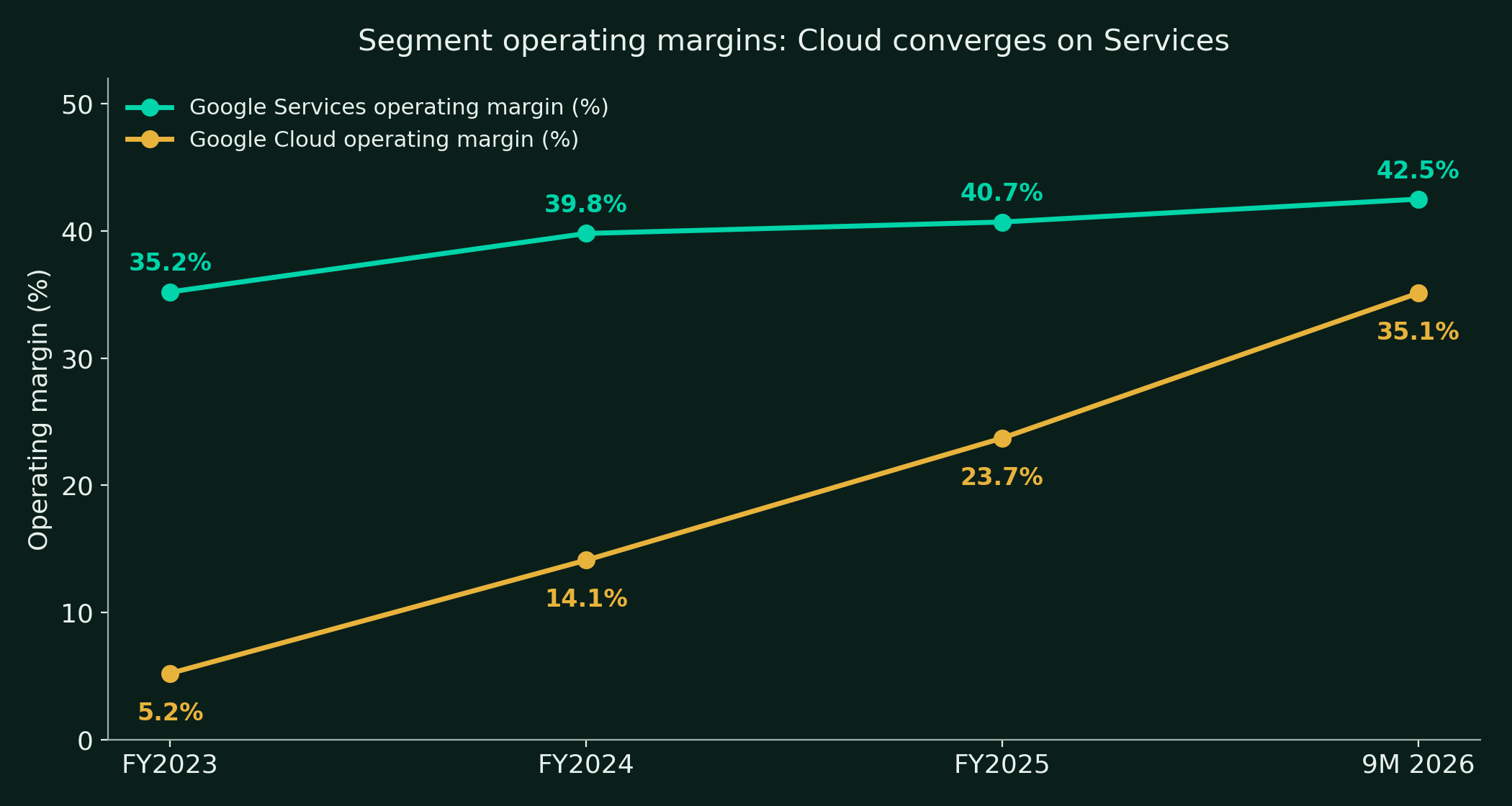
- The bend sits in monetization, not usage. AI answer formats tax the ad load per query even as query volume grows at a five-year-high rate.
- A moat that keeps the users while charging less per user is still a moat. It converts at a lower rate, and the investment report's scenarios grade that conversion honestly.
- The grade is PASS.
Pillar 4, Iron Fortress: why only partial?
- Cash and marketable securities reached $265.1B at September 30, 2026.
- Long-term debt reached $125.1B, up from $46.5B at December 31, 2025. It nearly tripled in nine months.
- Liquid assets still cover long-term debt more than twice, and total assets crossed $1.0 trillion.
- About $147B of outside capital was raised in nine months: $42.9B of common stock, about $19.1B of mandatory convertible preferred and $85.2B of debt proceeds.
- The deduction is the commitment stack: $924B of future purchase obligations plus $152B of pre-commencement leases and other obligations at September 30, 2026.
- The company states those commitments as maximum contractual amounts with variable pricing and volume flexibility. The flexibility is real, and so is the direction.
- The investment book cuts both ways. Non-marketable securities of $135.2B are an asset, and their marks now swing reported earnings by billions per quarter.
- The trajectory is the grade. A fortress is judged by whether it is being built or spent, and in 2026 it is being spent, deliberately.
- The grade is PARTIAL. The level is a fortress. The direction is not.
Pillar 5, Free Cash Flow: why only partial?
- Free cash flow was $72.8B in fiscal 2024 and $73.3B in fiscal 2025, about $146B across two years.
- Operating cash flow reached a record $179.6B in the twelve months to September 2026. The engine underneath is intact and still growing.
- Trailing free cash flow still fell to $19.7B, because trailing capex reached $159.8B.
- Q2 2026 printed the first negative free cash flow quarter in the company's history, at negative $5.9B. Q3 deepened it to negative $9.1B.
- The fiscal 2026 capex guide implies about $68B of spending in Q4 2026 at the midpoint, so the streak likely extends before it ends.
- The spend is chosen, not suffered. It runs against a $561B contracted backlog, with just over 55% converting to revenue within 24 months.
- Stock-based compensation of $25.0B in fiscal 2025, about a third of that year's free cash flow, is a real cost the pillar must carry.
- It does not fail, because the operating engine is at record levels and the outflow is contracted investment rather than deterioration.
- It does not pass, because two quarters printed negative and management has named no date for the turn.
- The grade is PARTIAL, with the clearest upgrade path on the scorecard: one guided capex plateau and two positive quarters would flip it.
What do the pillars miss?
The pillars grade the business, and on that test Alphabet is elite: the strongest sunrise in the library, a moat that survived its stress test in public, and an operating cash engine at record output. What the pillars cannot grade is the endpoint of a capex supercycle or the outcome of an appeal. Both swing factors in this report, the 2027 capex figure and the AI Mode monetization curve, are choices and mix effects rather than measures of business quality.
That is why the investment report, not this scorecard, carries the final number. The operations argue for a score in the high seventies. The capital year, three partials deep, costs the rest, and 74/100 Positive is where the two settle.
Frequently asked questions
Why does Iron Fortress grade only partial?
Iron Fortress grades partial because the fortress is being spent. Liquid assets reached $265.1B by September 2026, but long-term debt nearly tripled to $125.1B in nine months, and Alphabet committed to $924B of future purchases. The company also issued equity for the first time in decades.
Why does Free Cash Flow grade partial instead of fail?
The cash engine still runs. Operating cash flow was a record $179.6B over the twelve months to September 2026. Free cash flow fell to $19.7B only because capex reached $159.8B by choice, against a $561B backlog. It grades partial, not pass, because two quarters printed negative and no recovery date exists.
What would change the pillar grades?
The grades change on evidence. Iron Fortress and Free Cash Flow upgrade if the fiscal 2027 capex guide flattens and quarterly free cash flow turns positive during 2027. Leadership and Moat come under review if Search growth prints in single digits or AI Mode monetization stays undisclosed and dilutive.
Sources and disclosures
- Alphabet Form 10-K for fiscal 2025, filed February 5, 2026, for segment margins, cash flow history and the consolidated statements.
- Alphabet Forms 10-Q for Q1, Q2 and Q3 2026, for the September 30, 2026 balance sheet, equity issuance and commitments.
- Alphabet earnings releases through Q3 2026, for segment revenue, segment operating income and the equity securities effects.
- StatCounter global search share, September 2026, and the Artificial Analysis Intelligence Index v5.0, October 2026.
- The companion investment report carries the full financial statements, the roadmap audit and the fiscal 2029 scenarios behind this scorecard.
- Disclosures. The author is long Alphabet (GOOGL) at publication. This analysis is research and opinion for educational purposes only and is not investment advice, a recommendation, or a solicitation. Prices and estimates are as of November 2, 2026.