
What is the five-pillar scorecard?
Two pass, three partial, no fails. The pillars grade the business, not the price. The business is a fortress on a trough, and the scorecard says exactly that: the walls pass, the weather does not.
What would change the score. The score rises if US sell-through grows year on year for two straight quarters with revenue excluding safe harbor above $250M a quarter and the 2027 battery target of 675 MWh tracking on plan at mid-year, and it falls if 2027 revenue tracks the Street path near $1.02B, if battery shipments land under 550 MWh, or if foreign entity rules strip Section 45X eligibility from US-made product.
| 58/100 | DalalBytes score |
| 2 pass | 3 partial, 0 fail |
| $30.42 | Reference price. November 3 2026 close |
| $22 / $66 / $99 | Fiscal 2029 bear / base / bull |
| Pillar | Grade | The one-line reason |
|---|---|---|
| 1. Sunrise | PARTIAL | Storage rises through the cliff while solar demand contracts |
| 2. Leadership | PARTIAL | Guidance was beaten through 2025 and missed on demand in 2026 |
| 3. Moat | PASS | Panel-level architecture, 25-year warranty, 5.1M systems reporting in |
| 4. Iron Fortress | PASS | $931.8M of liquidity against one $575M zero-coupon maturity in 2028 |
| 5. Free Cash Flow | PARTIAL | $480M in fiscal 2024 became $96M in fiscal 2025 on working capital |
The split is the story. Every pillar that describes what Enphase owns passes. Every pillar that describes the weather it operates in, or the cash that weather produced last year, grades partial. Each pillar below carries its own evidence, with filed numbers carrying the grades and management claims labeled as claims.
Pillar 1, Sunrise: why does it grade partial?
The sunrise test asks one question. Is the industry itself rising?
- On the decade view, yes. Electrification, backup demand and time-of-use pricing keep pushing storage into homes.
- Battery attach rose from 25% of US residential installs in 2024 to 37% in 2025, per Berkeley Lab.
- On the 2026 view, no. US residential installations were 4,647 MWdc in 2025 and are expected to contract about 19% in 2026 after the Section 25D credit expired.
- Q2 2026 residential installations fell 12% year on year and residential storage additions fell 27% year on year in MWh.
- The sunrise is split by product. Solar-only demand is policy-impaired, and storage demand is structural.
- Enphase's own 2027 target, battery shipments up 50% to about 675 MWh, is a bet that the storage half of the sunrise carries the company.
- Commercial solar grew through 2025 and the data center transformer option sits on the strongest sunrise in the market, AI power.
- A split sunrise earns a split grade. The grade is PARTIAL, and it upgrades the quarter US installations grow again.
Pillar 2, Leadership: why does it grade partial?
- President and CEO Badri Kothandaraman has led the company through the IQ8 platform, the battery launch and two demand resets.
- The delivery record through 2025 was clean. Guidance ranges were met, the IQ9N-3P commercial microinverter shipped on plan in Q4 2025, and pull-forward demand into the credit deadline was disclosed as pull-forward while it happened.
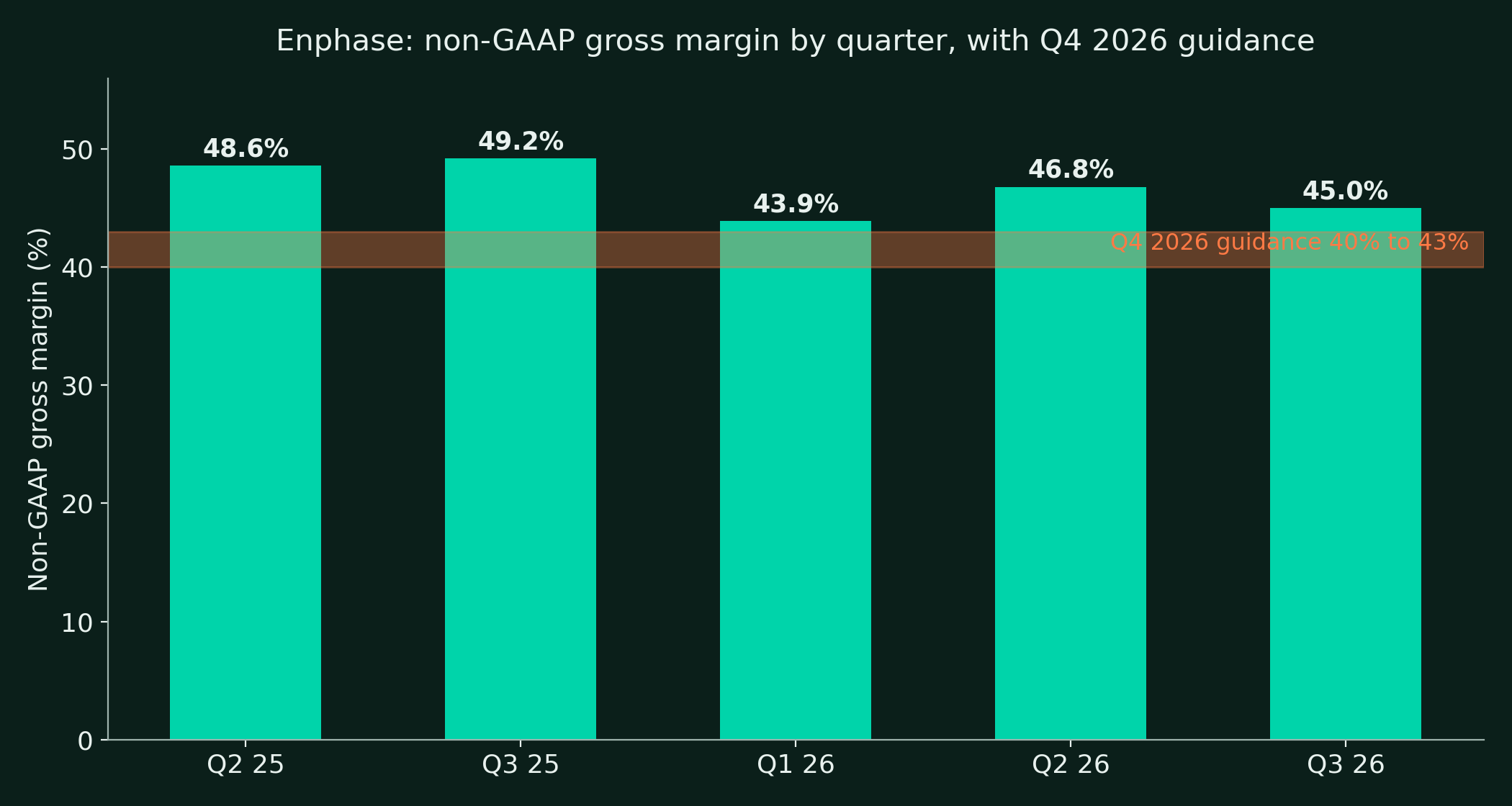
- The Q1 2026 guide was met on revenue, batteries and non-GAAP gross margin, and the GAAP margin miss that quarter was an accounting presentation on the credit sale, disclosed in the Form 10-Q.
- The 2026 deduction is demand forecasting. Global sell-through grew 1% in Q3 2026 against a management expectation of 10%, and the battery guide landed at 129.9 MWh against a 130 to 150 MWh range.
- To management's credit, the miss was named on the call, the Q4 guide embedded a further 10% sell-through decline, and about $20M of deliberate under-shipment was guided to clear channel inventory.
- The February 2026 restructuring cut about 160 roles, 6% of the workforce, sized to the cliff rather than to hope.
- The 2027 targets were set after the miss was known, which makes them post-reset targets. They are graded as pending in the companion report.
- The grade is PARTIAL. Execution passes, forecasting does not, and the 2027 frame is where the grade gets re-earned.
Pillar 3, Moat: why does it pass?
- A microinverter under every panel removes the single point of failure that defines the string architecture.
- Enphase microinverters carry a 25-year warranty matching panel life. SolarEdge pairs 25-year optimizers with a 12-year inverter, and Tesla's Powerwall 3 carries 10 years.
- The installed base passed 86.4M microinverters and 5.1M systems at the end of 2025, all reporting into Enlighten.
- That base produces an over-time revenue stream of about 10% of revenue and the second-sale channel for batteries and EV chargers into homes already on the platform.
- US manufacturing earns the Section 45X credit of $0.11 per watt that an importing rival cannot claim, worth $238.7M in fiscal 2025.
- Battery warranties of 15 years lead the field the spec table in the companion report grades, against 10 years at Tesla and Generac.
- The contested edge is real. SolarEdge recognized roughly triple the battery volume in Q3 2026, Tesla owns storage mindshare, and FranklinWH owns the retrofit job.
- Contested is not breached. The new-install ecosystem, the warranty structure and the credit-backed cost position hold.
- The grade is PASS.
Pillar 4, Iron Fortress: why does it pass?
- Cash and marketable securities were $931.8M at September 30, 2026.
- The only funded debt is $575M of zero-coupon convertible notes due March 1, 2028, at a fair value of $534.75M in June 2026.
- The $632.5M maturity of March 2026 was settled in full for cash, the fortress test the balance sheet actually sat.
- Net cash runs about $320M to $360M depending on whether leases are counted, and there is no bank debt and no dividend claim on the pile.
- Interest cost is near zero by construction. The converts pay no coupon.
- The deductions are named rather than hidden. Warranty obligations of $204.2M accrue against 25-year promises, and deferred revenue of $582.5M at June 2026 is product owed, much of it safe harbor shipments the partners schedule.
- Neither deduction threatens solvency on any scenario in the companion report, including the bear case.
- The grade is PASS, the cleanest on the card.
Pillar 5, Free Cash Flow: why does it grade partial?
- The history passes easily. Free cash flow was $698M in fiscal 2022, $586M in fiscal 2023 and $480M in fiscal 2024, on capital expenditure near 2% of revenue.
- Fiscal 2025 broke the line. Operating cash flow fell 73% to $137M and free cash flow to $96M, on a $123M inventory build and $243M of prepaid income taxes.
- The trailing twelve months recovered only to $135M of free cash flow, and Q3 2026 printed about negative $11.4M.
- The quality caveats run both ways. First-half 2026 operating cash flow of $143.3M included proceeds from selling manufacturing credits at 93% of face, real cash at a real discount.
- Stock compensation of $92.5M in the first half of 2026 remains the honest deduction from every cash figure on this page.
- The repair path is visible. Inventory has stopped building, the prepaid tax balance is being consumed, and the credit transfer program now has a second agreement for up to $100M signed on October 28, 2026.
- A pillar that printed $480M two years ago and $96M last year cannot pass on history alone.
- The grade is PARTIAL, and it upgrades on two consecutive quarters of free cash flow above $75M without credit-sale proceeds doing the lifting.
What do the pillars miss?
The pillars grade the business, and on that test Enphase is two strong walls and three open windows. What they cannot grade is the calendar. The entire investment question is whether the demand trough ends on the 2027 schedule management has published or on the slower schedule the Street has priced, and no pillar can certify a calendar.
That is why the investment report, not this scorecard, carries the final number. The walls earn the 58. The weather caps it there until sell-through, not guidance, says the trough is over.
Frequently asked questions
Why does Sunrise grade only partial for a solar company?
Sunrise grades partial because the industry is rising and shrinking at the same time. Storage attach rose to 37% of US residential installs in 2025, yet total residential installations are expected to contract about 19% in 2026 after the homeowner credit expired. The storage half of the market carries the grade up, and the solar half holds it at partial.
Why does Free Cash Flow grade partial after a decade of strength?
Free Cash Flow grades partial because the recent record broke. Free cash flow fell from $480M in fiscal 2024 to $96M in fiscal 2025 as operating cash flow dropped 73% on an inventory build and prepaid taxes. The trailing twelve months recovered only to $135M, and Q3 2026 was negative.
What would change the pillar grades?
The grades change on evidence. Sunrise upgrades when US installations grow again, Free Cash Flow upgrades on two quarters above $75M without credit sales doing the work, and Leadership upgrades if the 2027 battery and commercial targets land. Iron Fortress and Moat are reviewed if the 2028 converts need refinancing on worse terms or a rival takes the installer channel.
Sources and disclosures
- Enphase Form 10-K for fiscal 2025 and Forms 10-Q for Q1 and Q2 2026, for cash, debt, warranty and deferred revenue balances.
- Enphase earnings releases through Q3 2026 and the Q3 2026 earnings call, for shipments, sell-through, margins, free cash flow and the 2027 targets.
- SEIA and Wood Mackenzie Solar Market Insight data and Berkeley Lab attach data for the Sunrise evidence.
- SolarEdge Q3 2026 results and Tesla Q3 2026 update deck for the competitive evidence in the Moat pillar.
- The companion investment report carries the full financial statements, the roadmap audit and the fiscal 2029 scenarios behind this scorecard.
- Disclosures. DalalBytes holds no position in Enphase Energy (ENPH) at publication. This analysis is research and opinion for educational purposes only and is not investment advice, a recommendation, or a solicitation. Prices and estimates are as of November 4, 2026.