

What is the verdict on eBay?
66/100. Selective Positive. The marketplace that refused to die has re-accelerated to double-digit GMV growth on focus categories, C2C and recommerce, and the stock has already been paid for most of that story.
| 66/100 | DalalBytes score |
| $123.52 | Reference price, Nov 10, 2026 close |
| ~$53.5B | Market cap (provider range $53.1B to $54.2B) |
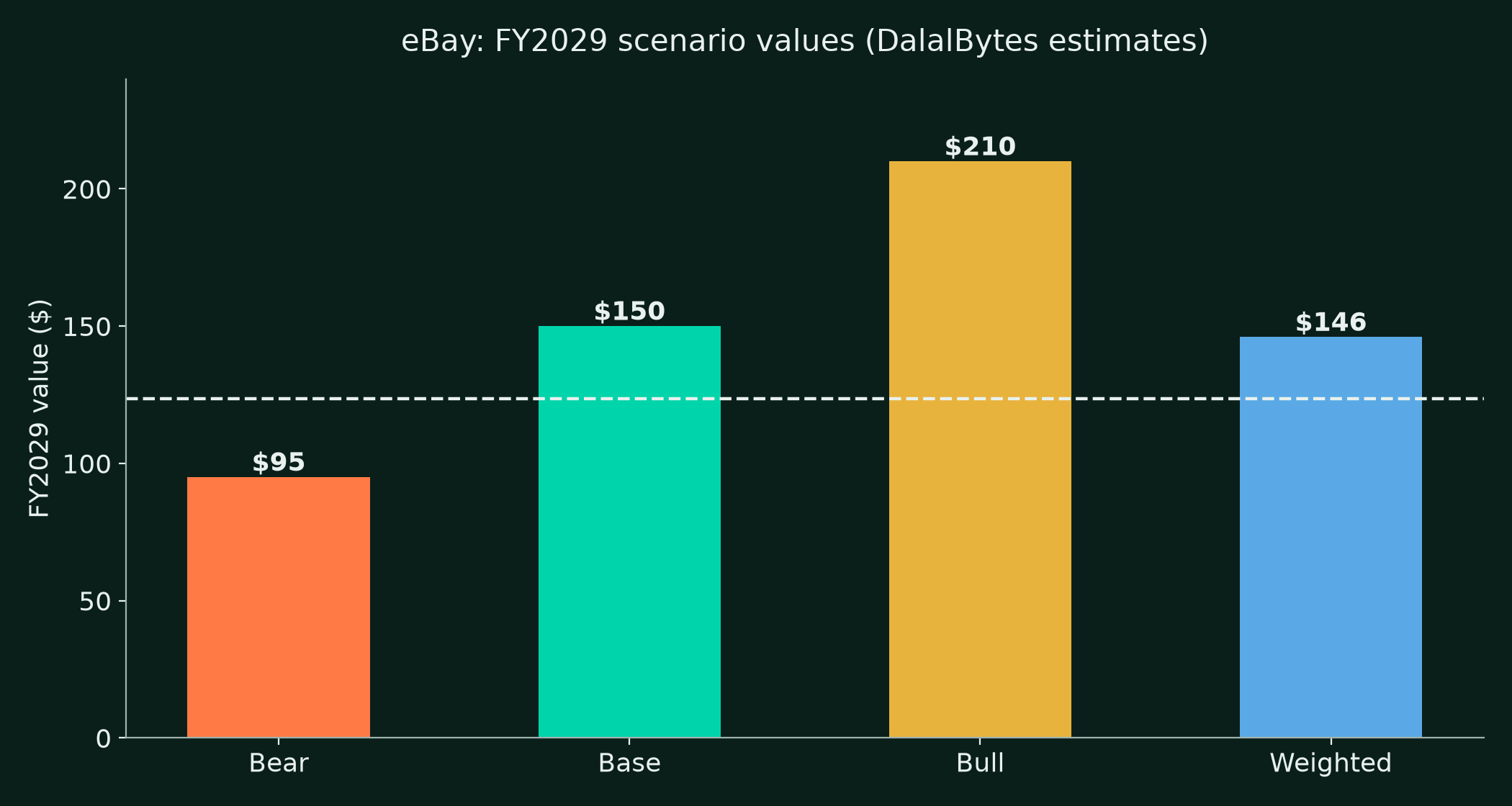
| $95 / $150 / $210 | FY2029 bear / base / bull |
What would change the score. The score rises if organic GMV growth holds in double digits through 2027 while the non-GAAP operating margin returns to 28 percent or better, and it falls if organic growth slips back under 8 percent or Depop needs a second year of marketing spend at the 2026 pace.
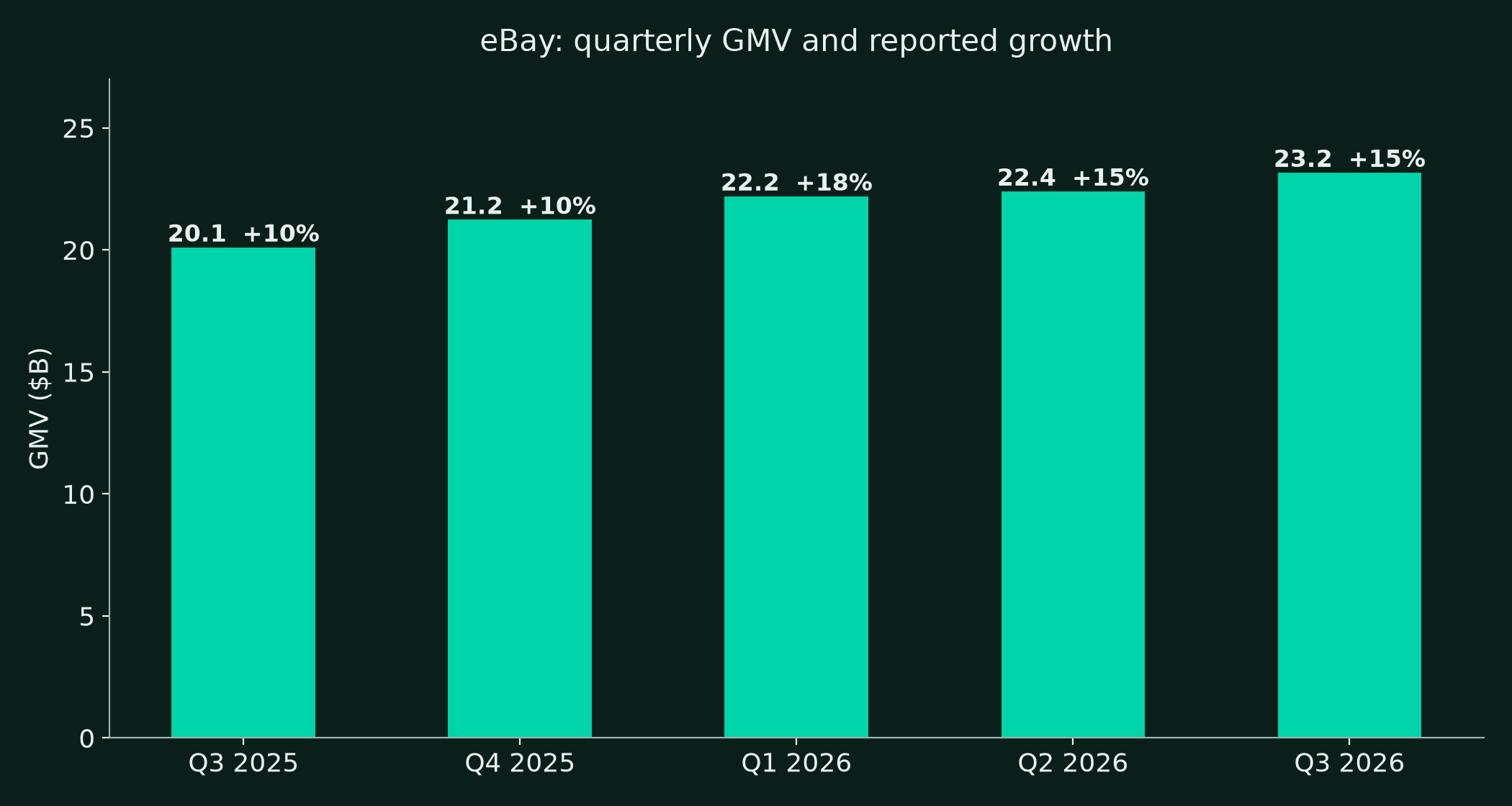
The delivery in 2026 is the best in eBay's modern history. GMV grew 18 percent as reported in Q1, 15 percent in Q2 and 15 percent in Q3, and management beat its own guidance on every guided line in all three quarters. Focus categories grew 24 to 26 percent for three straight quarters. The strategic priorities of focus categories, C2C and recommerce now carry 72 percent of GMV excluding Depop and grew about 20 percent in aggregate. This is not a dead marketplace being harvested. It is a narrower, sharper marketplace compounding again.
The weak spots sit in the same print. Organic active buyers grew just 1 percent to 136 million, because the headline jump to 147 million was bought with Depop and Tise. International organic GMV grew only about 4 percent against 22 percent in the US. The non-GAAP operating margin fell 70 basis points to 26.3 percent, GAAP net income fell 16 percent on a tax-rate swing, and transaction losses rose 44 percent in the first nine months. Growth in 2026 is real, and it is also being bought with investment, restructuring charges and an acquired growth engine.
At $123.52 the price pays for the re-acceleration to continue. The stock trades at about 27 times trailing GAAP earnings and about 20 times trailing non-GAAP earnings, up from a year-end GAAP multiple of 8.4 times in 2023 and 19.7 times in 2025, and the consensus target sits essentially at the price. Our probability-weighted FY2029 value of about $146 offers roughly 18 percent over three years from here. That is a hold-and-add-on-weakness profile, not a chase. The business grades better than the entry price does.
The price basis of this report
The reference close is Tuesday, November 10, 2026, at $123.52. Market capitalisation is quoted as a range because providers use different share-count vintages. Figures labelled organic exclude Depop and Tise. FXN means FX-neutral growth as eBay defines it.
Frequently asked questions
Is eBay (EBAY) a buy at current prices?
DalalBytes rates eBay Selective Positive at 66/100. The stock closed at $123.52 on November 10, 2026, about 27 times trailing GAAP earnings and 20 times non-GAAP, after rising about 41 percent in 2026. Q3 GMV grew 15 percent and focus categories 24 percent, but organic buyers grew 1 percent and the non-GAAP margin fell. FY2029 weighted value is about $146.
What are eBay's FY2029 price targets?
DalalBytes FY2029 targets are bear $95, base $150 and bull $210 from the $123.52 reference price. Bear assumes GMV growth fades to about $100B with a 25 percent non-GAAP operating margin. Base assumes about $109B of GMV and EPS near $8.30. Bull assumes about $119B of GMV, a 29.5 percent margin and EPS near $10.55.
What did eBay pay for Depop and what has it delivered?
eBay paid about $1.4B in cash to Etsy for Depop at the July 30, 2026 close, above the $1.2B announced price after adjustments and interest. In its first quarter under eBay, Depop added nearly 3 points to GMV growth, US GMV more than doubled pro forma, and active buyers reached 11 million. Profit accretion is guided for 2028.
What is eBay today?
eBay was founded in 1995 in San Jose, California, and remains the world's largest marketplace built on unique and pre-owned inventory rather than stocked shelves. It owns no inventory and runs no fulfilment network. Its asset is the inventory graph itself: about 2.6 billion live listings of items that in many cases exist exactly once, from a 1952 trading card to a specific used camera lens to a discontinued car part. More than 190 markets transact on the platform.
The second act of the company is the story of this report. The first act was the everything store, and it stalled: GMV fell from $87.4B in 2021 to $73.2B in 2023 and revenue went sideways for four years. The second act, built under CEO Jamie Iannone since 2020, is the enthusiast store. eBay picked the categories where passionate buyers hunt for specific things, collectibles, motors parts, fashion and refurbished electronics, and rebuilt trust, product and community around each one. Sixteen million enthusiast buyers now visit more than once a day on average and contribute over 70 percent of GMV, spending about $3,700 each over the trailing year. The 2026 numbers say the second act is working. The open question is what it is worth.
| Metric | FY2024 | FY2025 | Q3 2026 |
|---|---|---|---|
| GMV | $74.667B | $79.609B | $23.166B |
| Net revenues | $10.283B | $11.100B | $3.206B |
| GAAP operating margin | 22.5% | 20.5% | 19.2% |
| Non-GAAP operating margin | 28.1% | 27.8% | 26.3% |
| GAAP diluted EPS, continuing | $3.95 | $4.26 | $1.11 |
| Non-GAAP diluted EPS, continuing | $4.88 | $5.52 | $1.51 |
| Active buyers | 134M | 135M | 147M (136M ex-Depop and Tise) |
Sources: eBay earnings releases for Q4 2024, Q4 2025 and Q3 2026. The story of the table is the split: volume and revenue compounding at rates not seen since the pandemic, margins giving back one to two points to fund it.
How does eBay make money?
eBay reports one operating segment in substance and disaggregates net revenues into two lines only. There is no separately reported payments line and no separately reported financial services line, and any model that shows one is inventing a split eBay does not disclose.
- Marketplace revenues. Final value fees, listing and feature fees, store subscriptions, shipping revenues and payment-related revenue embedded in the transaction, net of discounts, coupons and rewards.
- Advertising revenues. First-party Promoted Listings and related products on eBay's own platform, plus a small and shrinking third-party component.
- The headline fee. The US final value fee is 13.6 percent of the total sale amount in most categories for sellers without a Store, 12.7 percent for Store subscribers, plus a per-order fee of $0.30 or $0.40. Payment processing is bundled inside the fee since Managed Payments replaced PayPal, completed in 2021 to 2022.
- The realised take is below the headline. High-value categories price far below 13.6 percent, the fee tier falls to 2.35 percent above $7,500, and C2C sellers in the UK, France and Italy now sell free or near-free.
| $M | FY2023 | FY2024 | FY2025 |
|---|---|---|---|
| Marketplace revenues | 8,669 | 8,648 | 9,107 |
| Advertising revenues | 1,443 | 1,635 | 1,993 |
| Total net revenues | 10,112 | 10,283 | 11,100 |
| Advertising share of revenue | 14.3% | 15.9% | 18.0% |
Source: eBay FY2025 Form 10-K revenue-by-type disclosure, filed February 19, 2026. The two lines sum exactly to total net revenues in all three years.
The take rate, decomposed
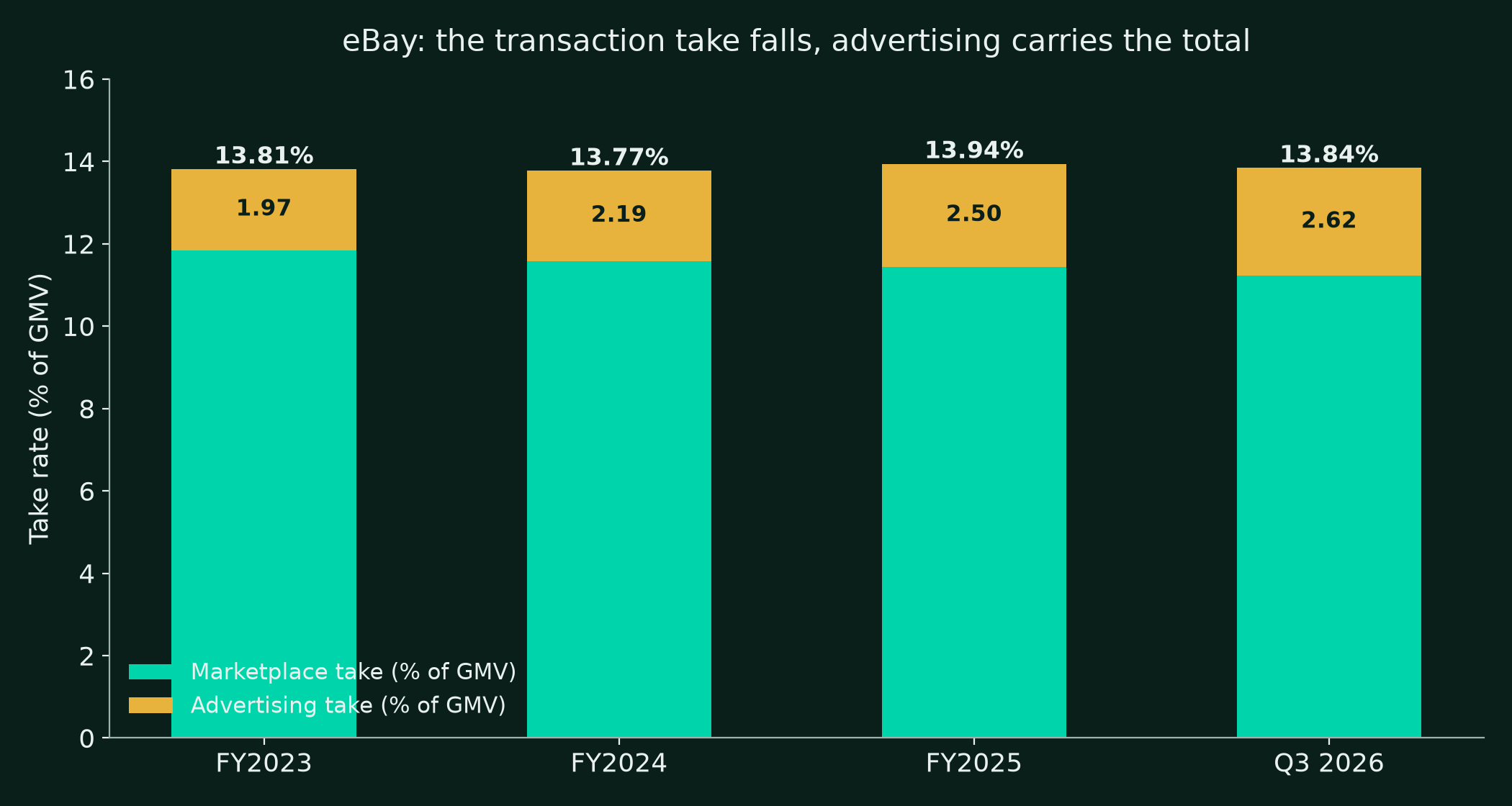
The single most important decomposition in the model: the transaction take is falling and all of the expansion is advertising.
| FY2023 | FY2024 | FY2025 | Q3 2026 | |
|---|---|---|---|---|
| GMV ($B) | 73.206 | 74.667 | 79.609 | 23.166 |
| Total take rate | 13.81% | 13.77% | 13.94% | 13.84% |
| Marketplace take | 11.84% | 11.58% | 11.44% | 11.22% |
| Advertising take | 1.97% | 2.19% | 2.50% | 2.62% |
DalalBytes calculations from eBay releases and the FY2025 10-K. Management framed the same point on the Q2 2026 call: the take rate held near 14 percent as gains in advertising and shipping offset category and price-point mix. Mix is the headwind: collectibles, vehicles and Depop's C2C fashion carry lower percentage fees, and fee-free C2C in Europe dilutes the transaction take by design. The strategy trades rate for volume and buyer acquisition.
How big is eBay's advertising business?
- Scale. Total advertising revenue was $1,993M in FY2025, up 22 percent, and reached $607M in Q3 2026.
- Growth share. Advertising supplied $358M of the $817M total revenue increment in FY2025: 44 percent of growth from 18 percent of revenue.
- First-party is the engine. First-party advertising was $575M in Q3 2026, up 16 percent. The third-party residual was just $32M in the quarter and is shrinking as a share.
- Deceleration is visible. First-party growth ran +33 percent in Q1 2026, +25 percent in Q2 and +16 percent in Q3 as comparisons toughened.
- Penetration. Advertising is 2.6 to 2.7 percent of GMV. Management calls 3 percent of GMV a midterm milestone, not a ceiling (Q2 2026 call).
- Adoption. About 1.3 billion of roughly 2.6 billion live listings were promoted in Q2 2026, and 5.7 million sellers used at least one advertising product.
| $M | Total advertising | First-party advertising | First-party growth |
|---|---|---|---|
| Q3 2025 | 525 | 496 | +25% |
| Q4 2025 | 544 | 517 | +19% |
| Q1 2026 | 581 | 555 | +33% |
| Q2 2026 | 596 | 570 | +25% |
| Q3 2026 | 607 | 575 | +16% |
Source: eBay quarterly earnings releases, Q3 2025 to Q3 2026. Growth rates are as reported.
What do payments and financial services contribute?
- Managed Payments is the only rail. All sellers are paid through eBay's own managed payments. There is no separate processing charge to the seller and no payments revenue line to strip out.
- The cost side is visible instead. Transaction losses, the P&L line that carries payment and fraud losses, were $393M in the first nine months of 2026, up 44 percent year over year. That rise is a cost of the growth mix and belongs in the risk ledger.
- Customer funds are not eBay money. The balance sheet carries matched customer accounts receivable and payable of $1,624M at September 30, 2026. This is buyer and seller money in transit.
- Seller Capital is a referral programme. eBay is explicitly not the lender. Partners including Liberis, iBusiness Funding and Fundbox in the US and YouLend and Liberis in the UK make the credit decisions and set the terms, with financing up to $2M per seller in the US.
- No volume is disclosed. No Seller Capital origination volume, revenue share or attach rate appears in any filing or release. We do not model a number for it, and neither should anyone else from public data.
- Pay by Bank and eBay Balance are checkout and wallet features inside the C2C proposition, launched in the UK and expanding in Europe. No revenue or volume is disclosed for either.
What do the financials show?
| $M except EPS | FY2023 | FY2024 | FY2025 |
|---|---|---|---|
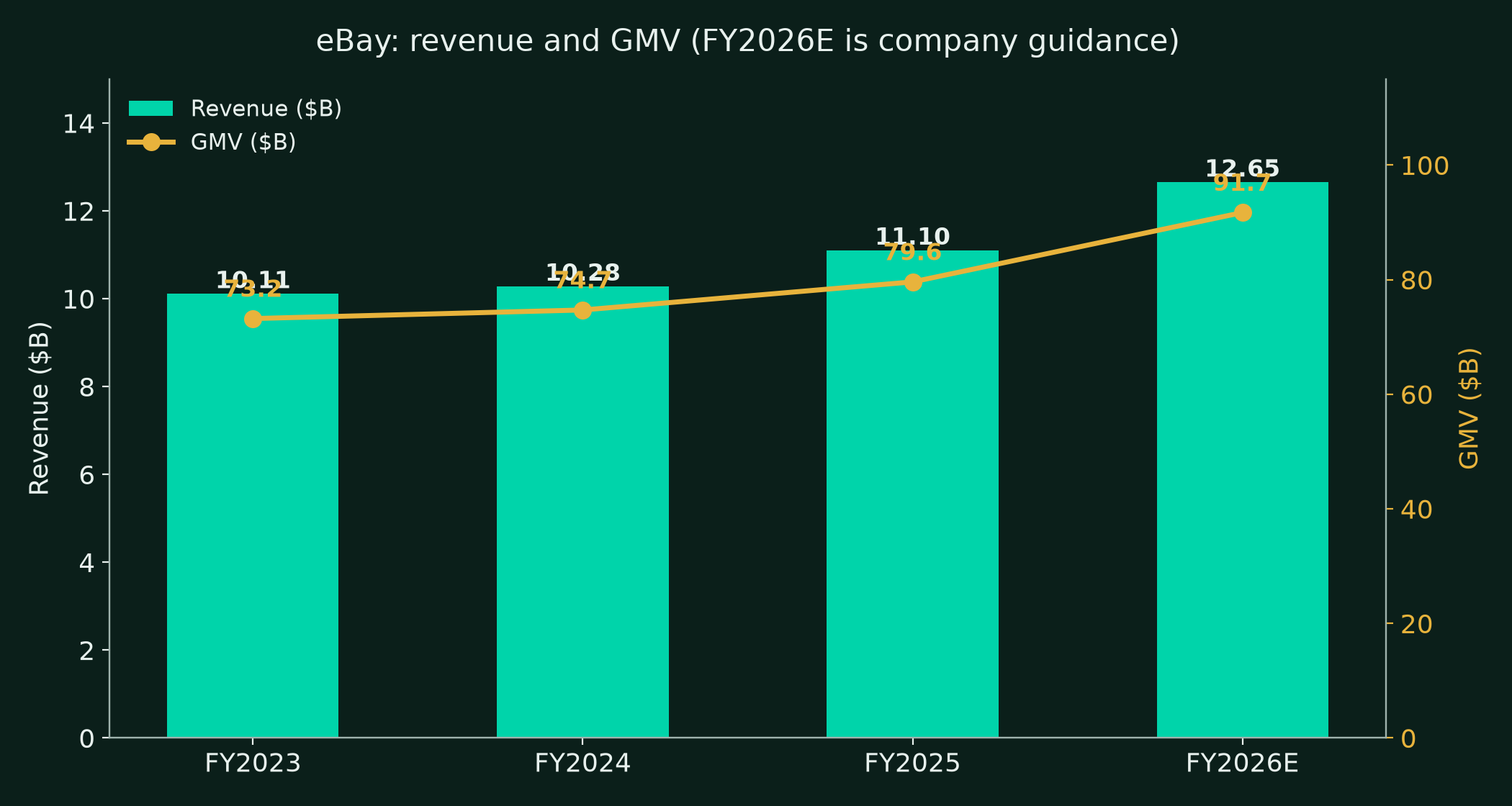
| GMV | 73,206 | 74,667 | 79,609 |
| Net revenues | 10,112 | 10,283 | 11,100 |
| Gross profit | 7,279 | 7,403 | 7,931 |
| Gross margin | 72.0% | 72.0% | 71.5% |
| GAAP operating income | 1,941 | 2,318 | 2,277 |
| GAAP operating margin | 19.2% | 22.5% | 20.5% |
| Non-GAAP operating margin | 27.4% | 28.1% | 27.8% |
| GAAP net income, total | 2,767 | 1,975 | 2,031 |
| GAAP diluted EPS, continuing | $5.21 | $3.95 | $4.26 |
| Non-GAAP diluted EPS, continuing | $4.24 | $4.88 | $5.52 |
| Diluted weighted shares | ~533M | 501M | 468M |
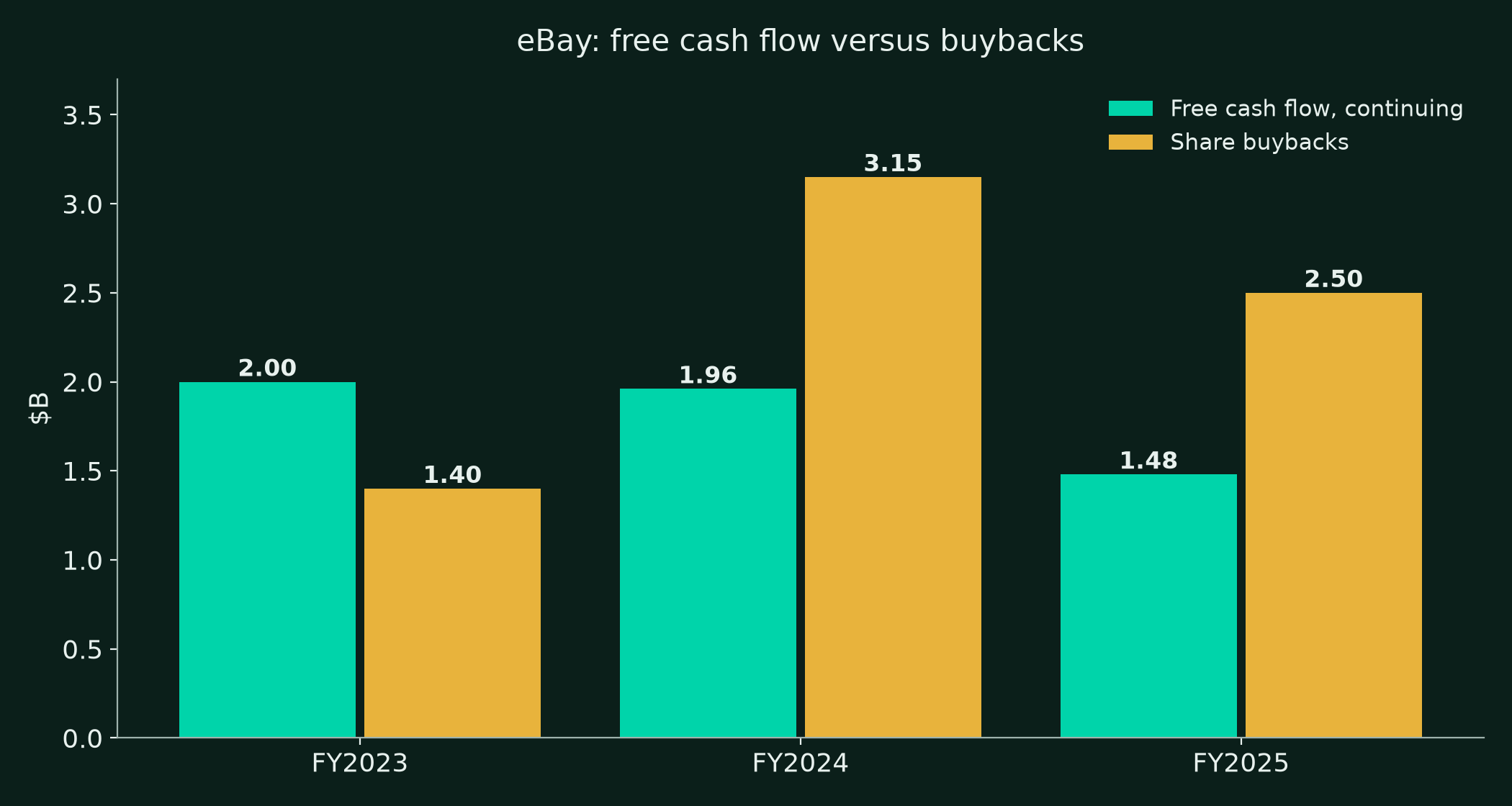
| Free cash flow, continuing | ~$2.0B | ~$1.96B | ~$1.48B |
Sources: eBay Q4 releases for FY2023, FY2024 and FY2025 and the FY2025 10-K. FY2023 GAAP EPS is distorted by below-the-line investment gains from the Adevinta and Adyen era, when pre-tax income of $3,707M sat far above operating income of $1,941M. Non-GAAP EPS is the cleaner series: $4.24 to $4.88 to $5.52, up 13 percent in FY2025. Free cash flow fell in FY2025 despite revenue growth, on a working-capital swing that included income taxes payable collapsing from $966M to $108M.
- Revenue geography. US revenue was $5,789M of the $11,100M total in FY2025, with international at $5,311M. In Q3 2026 the international share of revenue fell to 43 percent, because US GMV is growing at 27 percent while international grows at 4 percent.
- The stall, for the record. GMV went $87.4B in 2021, $73.9B in 2022, $73.2B in 2023, $74.7B in 2024, then $79.6B in 2025. The 2025 print was the first clean growth year since 2021, delivered against a low-single-digit guide.
- Stock-based compensation was $607M in FY2025, about 5.5 percent of revenue, and $511M in the first nine months of 2026. Buybacks run well ahead of it, so the share count still falls 6 to 7 percent a year.
What did eBay report in Q3 2026?
eBay reported Q3 2026 on October 28, 2026. The print beat the company's own guidance on every guided line, for the third consecutive quarter.
| Metric | Q3 2026 | Q3 2025 | Change |
|---|---|---|---|
| GMV | $23,166M | $20,105M | +15% reported, +16% FXN, +13% organic FXN |
| Net revenues | $3,206M | $2,820M | +14% reported, +13% FXN, +11% organic FXN |
| GAAP operating income | $616M | $571M | +8% |
| GAAP operating margin | 19.2% | 20.3% | Down 110 bps |
| Non-GAAP operating income | $843M | $760M | +11% |
| Non-GAAP operating margin | 26.3% | 27.0% | Down 70 bps |
| GAAP net income, continuing | $501M | $593M | Down 16% |
| GAAP diluted EPS, continuing | $1.11 | $1.27 | Down 13% |
| Non-GAAP diluted EPS, continuing | $1.51 | $1.35 | +12% |
| Free cash flow, continuing | $749M | ~$803M | Down about 7% |
| Active buyers | 147M | 134M | 136M excluding Depop and Tise |
Source: eBay Q3 2026 earnings release, October 28, 2026. GAAP net income fell only because the year-ago quarter carried a 4.3 percent negative effective tax rate against 17.1 percent this year. Operating income rose.
Graded against the promise
The Q3 guide was set on August 5, 2026 with the Q2 results. The Q3 earnings deck prints the comparison directly.
| Q3 2026 | Guide | Actual | Read |
|---|---|---|---|
| GMV | $22.0B to $22.4B | $23.2B | Beat by $0.8B above the high end |
| Revenue | $3.07B to $3.12B | $3.21B | Beat by $90M above the high end |
| Non-GAAP operating income | $0.77B to $0.80B | $0.84B | Above the high end |
| GAAP diluted EPS | $0.94 to $0.99 | $1.11 | Above the high end |
| Non-GAAP diluted EPS | $1.36 to $1.42 | $1.51 | Beat by $0.09 above the high end |
Source: eBay Q2 2026 release guidance and Q3 2026 earnings deck, guidance versus actuals page. Q1 and Q2 2026 also printed above the high end of their guides on revenue, GMV and non-GAAP EPS. Three straight beats is a pattern, and it cuts both ways: delivery is excellent, and guidance is set conservatively enough that beating it is becoming the base case the market prices.
What has eBay guided for Q4 and full year 2026?
| Q4 2026 guide | FY2026 guide | |
|---|---|---|
| Revenue | $3.19B to $3.24B | $12.62B to $12.67B |
| Revenue growth, FXN | +7% to +9% | +12% to +13% |
| GMV | $23.7B to $24.1B | $91.5B to $91.9B |
| GMV growth, FXN | +12% to +14% (organic +8% to +10%) | +14% |
| GAAP diluted EPS | $0.82 to $0.87 | $4.26 to $4.31 |
| Non-GAAP diluted EPS | $1.48 to $1.53 | $6.25 to $6.30 |
| Depop contribution to GMV growth | About 4 points | Included in the totals above |
Source: eBay Q3 2026 release, Business Outlook. The Q4 GAAP EPS guide sits well below Q3's $1.11 because it embeds an estimated $130M to $150M restructuring charge, from the October 2026 headcount reductions that management links to funding its highest growth priorities, with the reductions substantially complete by March 2027. The dividend declared for Q4 is $0.31 per share, payable December 18, 2026.
Which categories carry eBay's growth?
Focus categories are a management reporting construct, not a GAAP segment. eBay reports focus-category GMV growth each quarter and names the constituents: collectibles, eBay Motors, fashion including luxury and pre-loved, and refurbished including electronics.
| Period | Focus-category GMV growth, FXN | Gap over rest of marketplace |
|---|---|---|
| Q1 2026 | +24% | About 15 points |
| Q2 2026 | +26% | Not stated in points |
| Q3 2026 | +24% | 19 points |
Sources: eBay Q1 2026 deck, Q2 2026 call coverage and Q3 2026 call. Focus categories passed 40 percent of total GMV for the first time in Q2 2026.
- Collectibles is the largest growth contributor in every 2026 quarter. Trading cards lead, across sports cards and collectible card games, with coins and bullion helping.
- TCGplayer passed $1B of trailing twelve-month GMV for the first time in Q3 and opened seller registration in the UK and Canada.
- Goldin set another record GMV quarter in Q3, including a 1776 Exeter Broadside copy of the Declaration of Independence sold for over $3.6M.
- AI card scanning passed 130 million cumulative scans in Q3, up from 80 million in Q2, and expanded to the UK.
- Motors Parts and Accessories contributed nearly 2 points of total GMV growth in Q2. Guaranteed Fit expanded to Canada, Easy and Free Returns reached Germany in Q3, and Certified Recycled badging launched in the US.
- Electronics became a larger contributor to US growth in Q3, driven by computer hardware, consoles and video games, on both transactions and average selling price.
- No absolute collectibles, fashion or refurbished GMV is disclosed. Growth contribution is stated qualitatively plus the TCGplayer and Goldin anchors above. We do not fill the gap with estimates.
Has eBay delivered on its roadmap?
The roadmap audit is where this management team earns its grade, because the pattern is consistent: the promises are operational, dated and specific, and the delivery record against them in 2026 is unusually clean. Focus categories were promised to outgrow the rest of the marketplace and have beaten that commitment for three straight quarters at 24 to 26 percent. The C2C fee playbook was promised market by market and landed on schedule in Germany in 2023, the UK in 2024 and France and Italy in September 2026, with global C2C GMV growing more than 20 percent in both Q2 and Q3. eBay Live was promised market by market and self-service by category, and both arrived.
The audit also finds the two places where the roadmap is still a promise rather than a result. International was supposed to close the gap with the US as the C2C playbook exported, and in Q3 it grew about 4 percent organically against 22 percent in the US: the France and Italy relaunch is one quarter old and unproven in GMV terms. And the buyer-side AI products, the Shopping Agent, Shop the Look and Explore, have launches and pilots behind them but no disclosed usage or GMV economics at all. The roadmap grades beaten where management controls the supply side, and pending where it depends on changing buyer behaviour.
| Initiative | Grade | One-line evidence |
|---|---|---|
| Focus categories | Beaten | +24%, +26%, +24% FXN across Q1 to Q3 2026, 19 points over the rest in Q3 |
| Collectibles complex | Beaten | TCGplayer over $1B TTM GMV, Goldin record quarter, 130M card scans |
| C2C fee playbook | Met | Germany 2023, UK 2024, France and Italy September 2026, each as announced |
| C2C and recommerce growth | Beaten | Global C2C GMV up more than 20% in Q2 and Q3, priorities at 72% of GMV ex-Depop |
| eBay Live | Met operationally, pending economically | 7 markets and self-service delivered, no absolute GMV disclosed |
| Vehicles | Met | Triple-digit GMV growth, protection raised to $500,000, absolute scale undisclosed |
| AI seller tooling | Beaten on productivity, pending on GMV | Magical Listing in 6 markets, listings per attempter up over a third in Australia |
| AI buyer products and agents | Pending | Pilots and launches real, no usage or GMV economics disclosed |
| International turnaround | Pending, weak start | International organic GMV +4% FXN in Q3 against US +22% |
Sources: eBay earnings releases, decks and calls Q1 to Q3 2026, and the product announcements cited in the sections that follow.
Did Depop and Tise earn their cost?
Depop: the price rose, then the delivery beat
| Item | Fact |
|---|---|
| Announced | February 18, 2026, at about $1.2B cash, from Etsy |
| Depop at announcement | About $1B of 2025 GMS on Etsy's definition, 7M active buyers, about 90% under age 34, over 3M active sellers |
| Closed | July 30, 2026, after UK and Australian regulatory approvals |
| Cash paid at close | About $1.4B: the $1.2B price plus about $200M of net purchase-price adjustments and interest |
| Cash-flow statement line | Acquisition of Depop, net of cash acquired: $1,321M outflow |
| Goodwill effect | Goodwill rose from $4,467M to $5,242M across the deal |
| Structure | Depop keeps its brand, platform and culture inside eBay, with Peter Semple continuing as CEO |
| Etsy context | Etsy bought Depop in 2021 for about $1.625B and sold its fastest-growing asset to fund buybacks |
Sources: eBay and Etsy releases of February 18 and July 30, 2026, and eBay's Q2 and Q3 2026 releases. Etsy's GMS excludes shipping and tax and deducts refunds, while eBay's GMV includes shipping and tax with no deduction for returns, so the $1B GMS figure and eBay GMV figures are not directly comparable.
Delivery in the first quarter under eBay:
- Growth beat the deal case. Depop contributed nearly 3 points to total FX-neutral GMV growth in Q3, against a 2.5 point guide set in Q2 and a 1 to 2 point full-year run-rate assumption set at announcement. The Q4 guide is about 4 points.
- US momentum more than doubled. US GMV, monthly active users and sold items all more than doubled year over year on a pro forma basis.
- The community scaled. Trailing active buyers reached 11 million, up from 9 million, with 5 million active sellers.
- Revenue contribution ran below GMV contribution, at nearly 2 points, because Depop's take rate is lower than core eBay and shipping investment is recorded as contra-revenue.
- Profit is a 2028 promise. Management guided a low-single-digit headwind to 2026 non-GAAP operating income growth at announcement, a 3 to 4 point headwind to Q3 operating income growth, and accretion to non-GAAP operating income in 2028, reaffirmed since. Q3 sales and marketing rose 23 percent to $747M, driven in part by Depop investment.
- Integration evidence in 90 days. eBay carrier rates cut Depop's average parcel cost, Depop Balance launched, AI-assisted listing was simplified, and eBay began testing Depop inventory inside eBay search results for select fashion queries.
- The outside warning. Independent broker estimates cited in trade coverage put Depop marketing spend above $250M in 2026 against $119M in 2025. That is a broker estimate, not an eBay disclosure, and two firms downgraded the stock on it in August 2026.
What has to happen for the deal to earn its cost: at about 1.4 times 2025 GMS for a business that lost about $109M at the operating line under Etsy in 2025 on about $187M of revenue, the $1.4B cannot be earned back from the current P&L. It is earned only if the US growth rate compounds into 2027, the take rate rises toward core levels as shipping and marketing efficiencies land, and the 2028 accretion date holds. The first quarter says the growth leg is real. The profit leg is entirely still to prove.
Tise: coherent, small, and undisclosed
- Announced September 2025 and completed October 2, 2025. Tise is an Oslo-based social C2C marketplace for secondhand fashion and lifestyle goods across Norway, Sweden, Denmark and Finland.
- Price not disclosed. eBay stated that further transaction details would not be disclosed. A figure near $130M circulates in trade coverage, inferred from VNV Global's sale of its roughly 8.3 percent stake for about $11M. That is an inference, not a price, and we treat it as such.
- Scale at announcement: over 2.5 million users in trade coverage. No standalone GMV, revenue or profit figure has ever been disclosed.
- Integration evidence: Tise expanded into Australia in March 2026, and its buyers are inside the pro forma 147 million active buyer count.
- The test is product, not GMV. Tise earns its cost if its follow, like and recommendation mechanics transplant into core eBay C2C. There is no public figure to grade that against yet. Grade: pending.
The earlier two, for context
TCGplayer, acquired in 2022, passed $1B of trailing GMV in Q3 2026. Goldin, acquired in 2024, set another record GMV quarter. These are the two proven deals in the same vertical thesis that Depop now has to follow.
How does Authenticity Guarantee work and what has it delivered?
Authenticity Guarantee is eBay's post-sale physical inspection service. An eligible item routes to an authentication centre after purchase, experts run a multi-point inspection and confirm authenticity and condition, and only then does it ship to the buyer. A failed item refunds the buyer in full.
| Category | US eligibility | Optional paid add-on |
|---|---|---|
| Sneakers | Eligible listings from $75, cost covered by eBay | None |
| Handbags and accessories | Free at $500 and above | $40 for $200 to $499 |
| Watches | Free at $2,000 and above | $80 for $500 to $1,999 |
| Jewelry | Free at $500 and above for selected brands | $40 for $200 to $499 |
| Trading cards | Graded and ungraded cards at $250 and above | Grading and vault via PSA partnership |
| Coins | Launched August 2026 at $500 and above with PCGS | None |
Source: eBay programme pages, checked November 2026, and the Q3 2026 release. Thresholds are market-specific and change over time.
- Scale. Cumulative items inspected passed 20 million in July 2026. No category breakdown and no inspection cost is disclosed.
- The Q3 expansion. Buyers in 23 European Union countries can now buy authenticated luxury fashion from sellers in Germany, France and Italy. Australia launched watch authentication in the same quarter.
- Adjacent Q3 moves. Trading card thresholds were lowered in the US and UK, lifting US eligible sold items by over 20 percent, and coin authentication launched in the US with PCGS.
- Measured effect, stated honestly. Management describes luxury GMV growth as healthy double-digit, in near-identical words across several quarters, and credits the trust infrastructure with making eBay the leading online marketplace for secondhand luxury fashion sales in the US and UK, on the company's own H1 2026 estimates. No luxury GMV figure and no authentication-attributable GMV delta is published. The effect is directionally supported and unquantified, and this report grades it that way.
- The wider trust stack. eBay Money Back Guarantee, Vehicle Purchase Protection now up to $500,000, Guaranteed Fit for parts, buyer protection inside the C2C relaunch, and AI moderation in eBay Live. None is quantified in GMV terms publicly.
- Cost note. Authentication is a cost centre and a conversion lever, not a disclosed revenue line. Its margin cost rises with every expansion, including the 23-country step.
What do eBay Live and vehicles add?
- eBay Live launched in the US in June 2022 and reached seven markets by February 2026: the US, UK, Germany, Australia, France, Italy and Canada.
- Growth rates are triple-digit. Q2 2026 GMV grew about 8 times year over year, and Q3 growth stayed well into triple digits. Five of the seven markets were under a year old at the comparison, which mechanically flatters the rate.
- The only absolute anchor is management's Q3 phrase: a multibillion-dollar annualised GMV run rate. On about $92B of annualised total GMV, that is roughly 2 percent or more of the whole, growing fast.
- Self-service opened in July 2026 to eligible US sellers across more than 300 categories, extended to more markets in Q3. Q3 added multistreaming to social platforms and AI moderation of chat, audio and video.
- Engagement evidence from Q2: regular Live sellers earned median incremental GMV of about 3 times matched non-Live sellers, and first-time Live buyers in collectibles spent about 70 percent more across eBay than a control group. Both are management-reported with selection effects, and we present them as such.
- Absolute Live GMV, buyers, sellers and take rate are not disclosed. Live is a proven engagement tool and an unproven P&L line.
- Vehicles grew well into triple digits in Q3 on a small base. Vehicle Purchase Protection rose to $500,000, hundreds of independent dealers joined the Trusted Dealer programme, and several Q3 sales exceeded $1M, including a 2005 Porsche Carrera GT at $5M. No absolute vehicle GMV is disclosed.
Is AI an opportunity or a threat for eBay?
The opportunity: supply-side AI with measured effects
- Magical Listing turns a photo into a listing with AI-generated category, title, specifics, description and pricing guidance. Cumulative AI-assisted listings passed 300 million in October 2025 and 500 million by Q1 2026, with over 10 million sellers having used the tools.
- Measured effects, management-reported on the Q1 2026 call: new listing creation rate up over 50 percent, listings per lister up over 50 percent, sold items and GMV per lister up double digits, listing time down over 25 percent. These are eBay's own KPIs, not independently audited, and no dollar revenue attribution to AI has been disclosed.
- Q3 2026 rollout. The latest generation reached all new and reactivated listers in the US, UK, Germany, Australia, France and Italy. In Australia, active sellers produced over a third more listings per attempter in about a third less time.
- Card scanning is the fastest-quantified tool: 130 million cumulative scans by Q3 2026, with pricing and population data from a single photo, now feeding the price guide with TCGplayer and Goldin transaction data.
- Buyer-side products are earlier. Shop the Look launched in April 2024 and nearly doubled click-through rates at launch, with no update since. Explore, the AI discovery feed, has no published outcome metrics. The AI Shopping Agent pilot of May 2025 reached a small subset of US customers, with developer materials citing 3 percent of US native users. No usage, conversion or GMV figure exists for any of them.
The risk: agents at the front door
- eBay was a discovery partner, not a checkout partner. eBay was among the first collaborators on OpenAI's Operator research preview in January 2025, which directs users to eBay for unique-inventory finds. No traffic or GMV figure from that partnership has ever been published.
- The checkout slots went elsewhere. ChatGPT Instant Checkout launched in September 2025 with Etsy and then Walmart, not eBay, and OpenAI deprioritised it in March 2026 as in-chat conversion disappointed. Google's Universal Commerce Protocol named Shopify, Etsy, Wayfair, Target and Walmart as co-developers in January 2026. eBay's status in those checkout flows is not confirmed in public launch materials.
- eBay's defensive line is explicit. A User Agreement update effective February 20, 2026 bans unauthorised third-party buy-for-me agents and end-to-end agent checkout without human review. Only permitted agents may operate.
- AI referral traffic is small and converts unusually well. Adobe Analytics puts AI referral growth to US retail at +393 percent year over year in Q1 2026, with AI-referred visitors converting 60 to 90 percent better than other traffic by mid to late 2026. Contentsquare puts AI-referred visits at about 0.2 percent of all visits. Similarweb records marketplace destinations as the fastest-growing AI referral category, up 237 percent.
- No eBay-specific AI traffic figure exists in public data. The direction for retail is established. The magnitude for eBay is not, and this report does not invent one.
- The structural defence is the inventory itself. An agent cannot fulfil a one-of-one collectible or a specific discontinued part from a generic catalogue feed. The commodity tail of eBay's GMV, new and standardised goods, is where agent disintermediation bites first.
How does eBay compare with Amazon, Walmart, Etsy and the specialists?
| Marketplace | 2025 GMV | Growth | Basis |
|---|---|---|---|
| Amazon, global | About $830B | +9% | Marketplace Pulse estimate, Amazon does not publish GMV |
| TikTok Shop, global | About $64.3B | +94% | Momentum Works estimate |
| Shein, global | About $71.8B | Net revenue +8% to $41.8B | ECDB estimate, HK prospectus for revenue |
| eBay, global | $79.6B | +7% | Reported |
| Vinted | €10.8B | +47% | Reported, private company |
| Etsy marketplace | $10.5B GMS | Down 4% in 2025, then +5.5% to +8.8% across Q1 to Q3 2026 | Reported |
| Mercari marketplace | ¥1,285.6B | +15% in FY2026.6 | Reported |
| Whatnot | Over $8B | About doubled, then over $8B in H1 2026 alone | Company-reported |
| Walmart Marketplace, US | About $10B to $15B | Marketplace +17% in FY26 quarters | Estimates, Walmart does not publish marketplace GMV |
| Temu, global | Estimate only | H1 2025 about $35B, +50% | PDD does not break out Temu |
Sources as labelled in the table. Estimates are marked as estimates and are not blended with reported figures.
- Amazon is 10 times eBay's scale at about $830B of estimated global GMV, with third-party seller services revenue of $172.2B in FY2025, up 11 percent. eBay's defensible ground is the enthusiast and pre-owned niche, not breadth.
- US share estimates put Amazon near 40.5 percent of US retail e-commerce sales in 2025, Walmart near 9.2 percent and eBay near 2.8 percent (Statista series). On US third-party GMV alone, Marketplace Pulse estimates eBay at about $39B, second only to Amazon.
- Walmart is the fastest-growing large rival. Its seller count reached roughly 150,000 to 200,000 depending on definition, and marketplace sales grew 17 percent in FY26 quarters, monetised through fulfilment and advertising, the same two levers eBay leans on.
- Etsy made the opposite trade. Marketplace GMS fell from $11.6B in 2023 to $10.5B in 2025 while its take rate rose to 24.2 percent, and it sold Depop, its fastest-growing asset, to fund buybacks. Etsy marketplace GMS then inflected to +5.5, +7.5 and +8.8 percent across the first three quarters of 2026.
- The recommerce specialists grow faster than eBay's core. Vinted grew GMV 47 percent to €10.8B in 2025 and entered the US in January 2026. UK competition data cited in trade coverage puts Vinted at an estimated 50 to 60 percent of UK C2C online apparel GMV in 2025, against 10 to 20 percent for eBay and 0 to 5 percent for Depop. In UK fashion resale, eBay plus Depop is still the challenger.
- Live commerce is a scale race eBay has not yet joined in absolute terms. TikTok Shop did about $15.1B of US GMV in 2025, up 68 percent, and Whatnot passed $8B in H1 2026 alone at a $20B valuation. eBay Live's triple-digit growth is off a multibillion-dollar run rate it does not break out.
- The de minimis tailwind is real and fading. The US ended the $800 exemption for China parcels in May 2025 and globally in August 2025. US parcels under $800 fell 54 percent in the four months after August 2025, Temu's US audience fell as much as 62 percent at its low, and Shein's US net revenue fell 9.9 percent in H1 2026. That structurally raised the cost of eBay's cross-border new-goods competition. Temu then adapted with local warehousing and a semi-managed model and its growth rebounded toward +40 percent by Q3 2025. The tailwind helped 2026. It should not be underwritten as permanent.
How strong is eBay's moat?
The moat is narrow, real and category-shaped. eBay does not out-compete Amazon on price, speed or breadth, and it does not try to. What it owns is the deepest pool of unique and pre-owned inventory in its focus categories, plus the trust machinery that lets strangers transact in items whose entire value depends on authenticity. A graded card, a vintage watch and a discontinued OEM part are not catalogue goods. The buyer needs the specific item, needs to believe it is real, and needs a market liquid enough to price it. eBay is that market, and the liquidity itself is the moat: sellers list where the enthusiast buyers are, and the 16 million enthusiasts who drive over 70 percent of GMV are there because the inventory is.
The trust layer compounds the liquidity. Twenty million authenticated items, the PSA and PCGS partnerships, TCGplayer's price data, Goldin's auction credibility and Guaranteed Fit in parts are each expensive to replicate and worthless to copy one category at a time. The moat's weakness is its boundary. It protects the enthusiast core and does almost nothing for the commodity tail, where Amazon, Walmart and Temu compete on price and logistics that eBay does not own. The moat grades PASS inside the focus categories and would grade far lower as a claim about e-commerce in general. This report grades the business eBay actually runs.
How should investors grade eBay's leadership?
- CEO Jamie Iannone has run the vertical strategy since 2020. The delivery record is three consecutive 2026 quarters above the high end of guidance on every guided line.
- CFO Peggy Alford joined in 2025 and has fronted the Depop financial framing: contribution points guided before delivery, the 2028 accretion date stated at announcement and reaffirmed, and the marketing headwind quantified rather than buried.
- The October 2026 restructuring cuts headcount to fund the highest growth priorities, at a guided $130M to $150M charge, substantially complete by March 2027. Management links the cuts explicitly to the Depop and priorities investment.
- The marks against: the Depop cash price stepped up $200M between announcement and close through purchase-price adjustments, and GAAP operating margin has fallen year over year in two of the last three quarters. Delivery on volume is excellent. Delivery on margin is the open item.
- Activism and proposals are a live backdrop, in the company's own words. The Q3 release's forward-looking risk factors cite the impact of stockholder activism or unsolicited acquisition proposals, and the non-GAAP definitions cite costs related to unsolicited proposals. We note the disclosure language and do not build a thesis on bid speculation.
How strong is the balance sheet and where does the cash go?
| $M | Dec 31, 2025 | Sep 30, 2026 |
|---|---|---|
| Cash and equivalents | 1,867 | 1,166 |
| Short-term investments | 1,052 | 809 |
| Long-term investments | 2,767 | 2,171 |
| Goodwill | 4,467 | 5,242 |
| Total assets | 17,437 | 18,006 |
| Short-term debt | 750 | 1,599 |
| Long-term debt | 5,996 | 5,134 |
| Total debt | 6,746 | 6,733 |
| Total equity | 4,483 | 4,412 |
Source: eBay Q3 2026 release balance sheet, which restates December 2025 under the new internal-use software standard adopted January 1, 2026. One vintage is used consistently here.
- Gross debt is flat. Total debt of $6,733M is unchanged in substance from $6,746M at year-end. In nine months eBay repaid $750M of senior notes and issued commercial paper on a net basis. Depop was funded from cash and securities, not new term debt.
- Liquidity fell by design. Cash and non-equity investments on the company's definition fell from $4.9B at June 30, 2026 to $3.3B at September 30, 2026. The Depop payment is the dominant cause, with $689M of Q3 buybacks also paid, partly offset by $749M of Q3 free cash flow.
- Net debt rose. On balance-sheet totals, cash and investments of $4,146M against debt of $6,733M leaves net debt of about $2,587M, up from about $1,060M at year-end 2025.
- Equity is thin by construction. Years of buybacks leave book equity of $4,412M against $5,242M of goodwill. This is a returns machine's balance sheet, not a fortress one, and the Iron Fortress pillar grades it that way.
| FY2023 | FY2024 | FY2025 | 9M 2026 | |
|---|---|---|---|---|
| Buybacks | $1,401M | $3,149M | $2,500M | About $1,500M |
| Dividends paid | n/d | $533M | $531M | $415M |
| Free cash flow, continuing | ~$2,000M | ~$1,956M | ~$1,484M | $1,973M calc |
Sources: eBay releases and cash-flow statements. The February 2026 board authorisation added $2.0B of buyback capacity. Remaining authorisation at September 30, 2026 was about $1.3B. The dividend rose from $0.27 a quarter in 2024 to $0.29 in 2025 and $0.31 in 2026, a 1.00 percent yield at the reference price.
What does the current price already pay for?
- At $123.52: market cap about $53.5B inside a $53.1B to $54.2B provider range, enterprise value about $59.5B, beta about 1.3, dividend yield 1.00 percent.
- Trailing multiples. Trailing GAAP EPS is $4.58, so the stock trades at about 27.0 times trailing GAAP earnings. Trailing non-GAAP EPS is $6.18, so about 20.0 times non-GAAP. On the FY2026 non-GAAP guide of $6.25 to $6.30, about 19.7 times.
- The re-rating arc. Year-end GAAP multiples ran 8.4 times in 2023, 15.5 times in 2024 and 19.7 times in 2025, and now about 27 times. The 2026 stock gain of about 41 percent is mostly multiple, not earnings.
- GAAP history needs the warning. eBay's GAAP EPS includes large investment marks from the Adevinta and Adyen era: $20.87 in 2021 and a loss in 2022. Long-run average GAAP multiples for this stock are not a usable anchor. The 2023 to 2025 year-end run and the non-GAAP multiples are.
- Consensus sits at the price. Average analyst targets cluster at $123.52 to $126.74 across aggregators, a Hold lean, with a $71 to $153 range. Morgan Stanley named the stock a top internet pick in October 2026 with a $132 target, citing live commerce. Bernstein holds at $115.
- Peers. Mercado Libre trades near 41 times trailing and about 28 times forward for roughly triple eBay's growth rate. Etsy's headline multiple near 8 times is distorted by depressed GAAP EPS and should not be read as cheap without that caveat.
What the current price already pays for
Stated plainly: at about 20 times trailing non-GAAP earnings and 27 times GAAP, the price pays for the 2026 re-acceleration to be a run-rate rather than an event. It pays for GMV growth holding near double digits after the Depop annualisation and the de minimis tailwind fade. It pays for advertising to keep compounding toward 3 percent of GMV. And it pays for the margin to stop falling: a market paying this multiple for a marketplace does not expect 26 percent non-GAAP operating margins to be the ceiling. If growth reverts to the 2023 to 2024 pattern of flat GMV, the multiple that pattern carried was 8 to 16 times GAAP, and the downside is measured in tens of dollars, not in points of margin.
What are the FY2029 bear, base and bull targets?
Scenarios are built segment by segment from the FY2026 guide base of about $91.7B of GMV and $12.65B of revenue at the midpoint. FY2029 is the year ending December 2029.
| Driver | Bear | Base | Bull |
|---|---|---|---|
| GMV path | Growth fades as tailwinds lapse, GMV about $100B | GMV compounds about 6% a year to about $109B | GMV compounds about 9% a year to about $119B |
| Focus categories | Cool to high single digits as collectibles comps toughen | Mid-teens fading to low double digits | High teens held, Live reaches real scale |
| Depop | Growth normalises fast, marketing stays heavy | Compounds at market-beating rates, take rate rises | Becomes the Gen Z fashion leader in the US |
| International | Stays near +4% | Inflects to high single digits on the C2C playbook | Double digits by 2028 |
| Take rate | 13.8% as mix dilutes | 14.1% as advertising nears 3% of GMV | 14.4% on advertising and shipping |
| Revenue, FY2029 | About $13.9B | About $15.4B | About $17.3B |
| Non-GAAP operating margin | 25.0% | 27.5% | 29.5% |
| Non-GAAP EPS, FY2029 | About $6.90 | About $8.30 | About $10.55 |
| Exit multiple, non-GAAP | 14 times | 18 times | 20 times |
| FY2029 value | $95 | $150 | $210 |
DalalBytes estimates. Share counts assume buybacks continue at roughly the recent pace, slower in the bear case. The segment that does the most work in every scenario is focus-category GMV growth, and inside it, collectibles. The evidence that would break the base case is two consecutive quarters of focus-category growth under 15 percent, or Depop's GMV contribution fading before its marketing spend does.
Probability weights of 30 percent bear, 50 percent base and 20 percent bull give a weighted value of about $146, roughly 18 percent above the reference price across three years. That is the arithmetic behind Selective Positive rather than Positive: the direction is right, the delivery is proven, and the margin of safety at $123.52 is thin.
What does the chart say?
| Indicator | Value |
|---|---|
| Close, November 10, 2026 | $123.52, up 2.11% on the day |
| 52-week range | $78.03 to $127.74 |
| Year to date | +41.8% |
| 20-day average | About $121 |
| 50-day average | $113.26 |
| 200-day average | $104.98 |
| Price against averages | +9% over the 50-day, +18% over the 200-day |
| RSI, 14 day | About 59 to 61 on a closing basis |
| Beta | About 1.3 |
Sources: Finnhub and MarketBeat price data to November 10, 2026, with moving averages and RSI calculated from the daily candle series. Levels derived from price history are estimates, not company data.
- Trend. Price sits above the 20, 50, 100, 150 and 200-day averages, stacked in uptrend order with the 200-day rising. The structure is an unambiguous uptrend.
- Momentum. RSI near 60 is elevated but not overbought. The October run took the stock from $106.05 at September 30 to $123.52 in five weeks.
- Resistance. The 52-week high at $127.74, with the $125 zone tested and not held on November 4 and 5.
- Support. About $121 at the 20-day average, then the $118 pre-earnings base from October 26 to 28, then $113 at the 50-day, then $106, with the 200-day near $105 as the line that defines the 2026 uptrend.
- Read. Extended but not stretched. The chart supports holding a position and argues against chasing one 3 percent below the high after a 41 percent year.
What is the five-pillar scorecard?
- Pillar 1. Sunrise: PARTIAL. Evidence: recommerce is a genuine sunrise, with global secondhand apparel at $257B in 2025 and US secondhand growing 19 percent, about four times the broader clothing market, while the overall marketplace pond outside focus categories grows at low single digits.
- Pillar 2. Leadership: PASS. Evidence: three consecutive 2026 quarters above the high end of guidance on every guided line, Depop framed with dated profit promises before delivery, and restructuring explicitly tied to funding the priorities.
- Pillar 3. Moat: PASS. Evidence: 16 million enthusiast buyers driving over 70 percent of GMV, 20 million authenticated items, and the TCGplayer, Goldin and PSA collectibles complex that no rival has replicated as a set.
- Pillar 4. Iron Fortress: PARTIAL. Evidence: gross debt flat at $6,733M and Depop funded from cash, against net debt up to about $2,587M and book equity of $4,412M sitting below goodwill of $5,242M.
- Pillar 5. Free Cash Flow: PARTIAL. Evidence: free cash flow fell from about $1.96B in FY2024 to about $1.48B in FY2025 while revenue grew 8 percent, then recovered to $1,973M in the first nine months of 2026, with stock-based compensation steady near 5.5 percent of revenue.
Two of five pillars pass and three grade partial. The full grading, with the evidence and the tests that would change each grade, is in the companion five-pillar analysis.
What are the main risks?
The first risk is that 2026 is a stacked year rather than a new run-rate. Three tailwinds arrived together: a tariff and de minimis shock that raised rivals' costs, a collectibles cycle running hot enough to lap its own records, and an acquisition that added 3 points of GMV growth on arrival and is guided to add 4 in Q4. None of the three is fraudulent and all three are in the numbers honestly, but a price set at 27 times GAAP earnings does not distinguish between growth that compounds and growth that was borrowed from events. If focus-category growth halves when the comparisons toughen, the earnings path survives and the multiple does not.
The second risk is the margin path. Growth is being bought: sales and marketing up 23 percent in Q3, a $130M to $150M restructuring charge guided for Q4, transaction losses up 44 percent in nine months, and a Depop marketing programme that outside brokers estimate above $250M for 2026. Management's answer is that core marketing efficiency funds the new spend, and the 2028 accretion date is the test it has set itself. Until a quarter prints with double-digit organic growth and a rising non-GAAP margin together, the buy-the-growth reading stays open.
The third risk is concentration wearing a strategy's clothes. The growth is American (US GMV +27 percent, international +4), enthusiast-led (16 million buyers driving over 70 percent of GMV), category-led (collectibles the largest contributor every quarter) and increasingly acquisition-assisted (Depop carrying 3 to 4 points of the growth rate). Each concentration is a deliberate choice and each is also a single point of failure. Vinted's 47 percent growth and January 2026 US entry aim at exactly the fashion C2C buyer eBay just paid $1.4B to reach.
The fourth risk is the front door. If AI assistants become the default shopping interface, eBay's absence from the launched checkout flows and its ban on unauthorised buying agents could exclude it from agent-completed volume even as agent discovery grows. The counter-evidence is real: agent-completed commerce is still tiny, AI referrals are about 0.2 percent of visits, and in-chat checkout converted so poorly for Walmart that OpenAI stepped back from it. The risk is prospective, not current, and it is graded that way.
The strongest counter-evidence to this report's caution sits in Section 7: a management team that has beaten its own guide on every line for three straight quarters, in a stock the consensus already holds at the price, may simply keep doing it. If Q4 delivers the guided $23.7B to $24.1B of GMV with Depop at 4 points and the margin stabilises, the base case starts to look like the bear case for the multiple, and the score should rise. That is the next grading event.
What should investors watch next?
- Q4 2026 print against the guide: GMV of $23.7B to $24.1B, revenue of $3.19B to $3.24B, Depop at about 4 points of GMV growth, and the restructuring charge landing inside the $130M to $150M estimate.
- The margin quarter: any quarter pairing double-digit organic GMV growth with a non-GAAP operating margin at or above 28 percent upgrades the thesis.
- Focus-category growth against toughening comps: two quarters under 15 percent breaks the base case.
- Organic active buyers: the ex-acquisition count has been flat at 136 million for three quarters. Movement, either way, is signal.
- International organic growth after the France and Italy relaunch: the +4 percent line is the roadmap's weakest grade.
- Depop disclosure quality: any standalone revenue, take-rate or marketing figure, and the 2028 accretion language, repeated or revised.
- Buyback pace against the remaining $1.3B authorisation, and whether a new authorisation arrives with the Q4 print as it did in February 2026.
- Advertising deceleration: first-party growth has stepped down from +33 to +16 percent across 2026. Stabilisation matters more than the level.
Sources
- Company filings and releases: eBay Q3 2026 earnings release and earnings deck (October 28, 2026), Q2 2026 release (August 5, 2026), Q1 2026 release (April 29, 2026), Q4 and full year 2025 release (February 18, 2026), Q4 2024 and Q4 2023 releases, FY2025 Form 10-K (filed February 19, 2026), Q3 2026 earnings call (October 28, 2026)
- Deal sources: eBay and Etsy joint release on the Depop agreement (February 18, 2026), Etsy completion release (July 30, 2026), eBay release on the Tise agreement (September 2025), Value Added Resource and Digital Commerce 360 coverage of Depop marketing estimates, the Tise stake inference and eBay Live disclosure gaps
- Programme sources: eBay Authenticity Guarantee programme pages for sneakers, handbags, watches, jewelry, trading cards and coins, eBay seller fee pages, eBay Seller Capital partner pages (Liberis, iBusiness Funding, Fundbox, YouLend), eBay User Agreement update (effective February 20, 2026)
- Competition sources: Marketplace Pulse Amazon and Walmart estimates (2026), Walmart FY26 earnings calls, Etsy FY2025 results and 2026 shareholder letters, Mercari FY2026.6 results (August 5, 2026), Vinted 2025 annual results (April 9, 2026), Momentum Works and eMarketer TikTok Shop estimates, ThredUp 2026 Resale Report with GlobalData (April 2, 2026), Shein HK prospectus and interim report (2026), CBP and NBER material on the de minimis closure as cited in trade coverage
- AI sources: Adobe Analytics AI referral series (2026), Contentsquare AI traffic study, Similarweb Generative AI Landscape (September 2026), OpenAI Operator and Instant Checkout announcements (2025 to 2026), Google Universal Commerce Protocol announcement (January 11, 2026)
- Market data: Finnhub and MarketBeat price, multiple and consensus data to November 10, 2026, StockAnalysis and FinanceCharts multiple series, TipRanks technicals, Morgan Stanley top pick note coverage (October 2026), Bernstein target coverage