
Frequently asked questions
Is Control Print a buy at current prices?
DalalBytes rates Control Print Selective Positive at 63/100. The only Indian manufacturer in a four-player coding and marking oligopoly has installed more than 23,000 printers, earns standalone PAT of Rs 80.3 crore on FY26 standalone revenue of Rs 446 crore, holds Rs 453 crore of net worth against Rs 7 crore of borrowings, and pays a Rs 10 per share dividend. The selective part: European subsidiaries, mainly Italy, cut consolidated FY26 PAT to Rs 43.6 crore, the group tax rate was 40% in FY26 and 60% in Q1 FY27, and operating cash flow has been flat at Rs 50 crore for three years.
What are Control Print's FY2029 price targets?
DalalBytes' FY2029 targets for Control Print are bear Rs 445, base Rs 850, and bull Rs 1,390, from a Rs 587.25 reference price. Bear: 7% revenue CAGR, 7.5% PAT margin, 16x exit. Base: 12% CAGR, 10.0% margin, 20x exit, EPS about Rs 42.4. Bull: 17% CAGR, 12.5% margin, 23x exit. FY2029 is the year ending March 2029.
Why is Control Print's consolidated profit so much lower than its standalone profit?
Control Print's standalone FY26 PAT was Rs 80.3 crore but consolidated PAT was Rs 43.6 crore, a gap of about Rs 37 crore. Management attributes most non-India losses to the Italian packaging business built on the V-Shapes acquisition (business assets bought for about EUR 3.7 million in April 2024), which carries research spend of roughly EUR 100,000 a month and is still fixing design standardisation and supplier alignment. Because foreign losses earn no tax relief against Indian profits, the consolidated tax rate rose to 40% in FY26 and 60% in Q1 FY27, amplifying the drag.
What is the verdict on Control Print?
The core is an annuity and the consolidated P and L hides it. More than 23,000 printers sit on Indian factory floors consuming Control Print inks, make-ups, ribbons and service for five to eight years each, with consumables reported above 60% of consolidated revenue and a standalone gross margin near 58%. Against that: consolidated FY26 PAT of Rs 43.6 crore against standalone Rs 80.3 crore, a 40% group tax rate, operating margin down from 25% in FY23 to 18% in FY26 and 13% in Q1 FY27, and Q1 FY27 revenue growth of just 3.8%. At Rs 587.25, down about 21% in a year, the stock trades at 24.2x trailing earnings on a tax-distorted EPS, about 17x normalised FY26 earnings, and about 2.0x FY26 sales. What is left to underwrite is an end to the European burn, which is why the rating is Selective Positive.
How did Control Print start?
Basant Kabra founded Control Print in 1991 after seeing coding and marking technology abroad, and took it public with a February 1995 issue. The first phase was distribution: marketing and servicing foreign coding equipment in a market too small for local manufacture, which taught the company what Indian plants actually need. In 2008 it launched its first own machines, designed for Indian dust, heat and price points with some core German technology, and became the only Indian manufacturer competing head to head with the multinationals. Shiva Kabra, the founder's son, joined in 2005 and is Joint Managing Director; under the second generation the installed base passed 23,000 printers and revenue compounded at 17% a year over FY23 to FY26, before the European acquisition phase began in 2022.
What does Control Print sell?
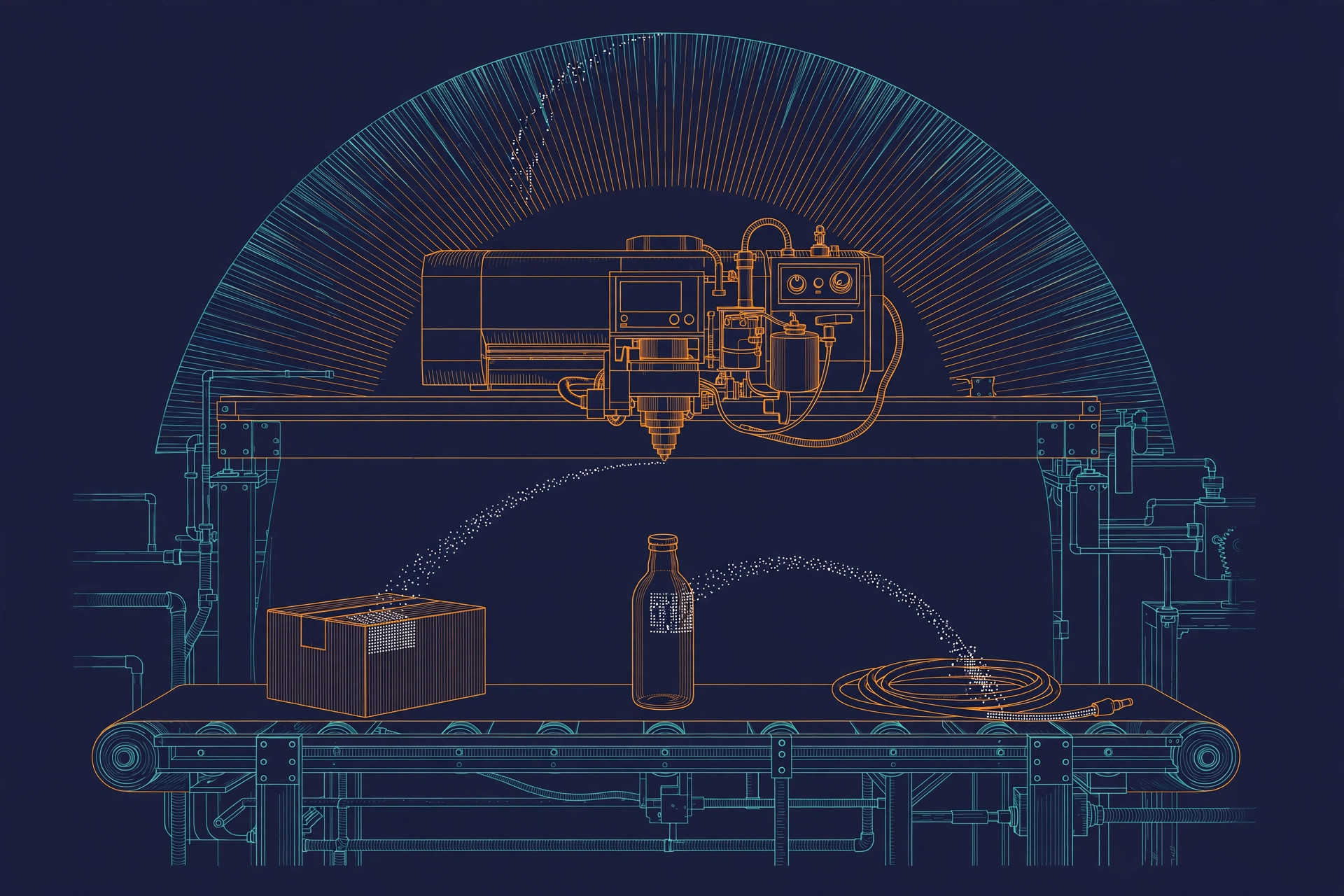
Coding and marking is about 95% of standalone operating revenue. The range covers continuous inkjet (the high-speed workhorse for bottles, cartons, cables and pipes), thermal inkjet, high-resolution piezo for shipper cartons, thermal transfer overprinters for flexible film, laser coders and large-character printers, all made at Nalagarh in Himachal Pradesh and Guwahati in Assam, plus the consumables and spares they consume and a service network covering 1,700+ cities and 2,700+ pin codes. Newer divisions are single-serve packaging machinery and materials in Italy, QR-based track and trace (with pilots at two large pharma customers), and a PPE division grown out of the 2020 Mask Lab. Management claims market leadership in cement, plywood, sugar and dairy.
What do the European deals show?
Three small, disciplined entry cheques with a large operating bill. Markprint BV in the Netherlands: 75% for EUR 1.5 million in July 2022, topped up in two 5% steps to 90% by October 2025, for single-pass digital printing technology. Codeology Group in the UK: 50.49% for GBP 1 million in March 2024, for label print-and-apply systems now being sold into India. V-Shapes in Italy: business assets for about EUR 3.7 million in April 2024, for patented single-serve packaging, followed in May 2026 by the parent agreeing to buy CP Italy's IP for EUR 2.86 million in an internal transfer. Management expects Codeology and Markprint to grow in the mid-teens and the UNNATI programme to cut packaging material unit costs by about 40%, but in FY26 the group still lost roughly Rs 37 crore between the standalone and consolidated profit lines, mainly in Italy.
What do the financials show?
Consolidated revenue of Rs 256 crore, Rs 304 crore, Rs 359 crore, Rs 425 crore and Rs 482 crore across FY22 to FY26, with operating profit of Rs 59 crore, Rs 76 crore, Rs 86 crore, Rs 80 crore and Rs 89 crore. Pre-tax profit has been stuck in a Rs 64 to 74 crore band for four years while revenue rose 59%, because operating leverage is being spent in Europe. Reported PAT is distorted both ways: Rs 100 crore in FY25 on a deferred tax credit (tax rate negative 50%), then Rs 44 crore in FY26 at a 40% tax rate. Returns diluted with the mix: ROCE fell from 24% in FY24 to 16% in FY26 and ROE to about 10%. Cash generation is reliable but flat: operating cash flow of Rs 50 crore in each of FY24, FY25 and FY26, free cash flow of Rs 23 crore in FY26, and a cash conversion cycle that lengthened to 283 days with inventory at 271 days. Q1 FY27 consolidated revenue of Rs 115.6 crore grew 3.8% with PAT of Rs 3.9 crore at a 60% tax rate, while standalone PAT excluding exceptional items was Rs 12.4 crore.
Who runs Control Print, and is governance clean?
Founder Basant Kabra chairs the company his family controls with 52.99%, a holding that has been stable to rising since FY21 (51.78% to 52.99%) with pledging at 0.00% throughout. The September 2026 promoter share movement (Basant Kabra receiving 3,58,740 shares on an HUF dissolution, taking his personal holding to 11.496%) was disclosed under SAST with total promoter holding unchanged and no encumbrance. The dividend has been held at Rs 10 per share, quarterly disclosure includes installed base and unit sales, and no auditor exit or SEBI action appears in the sources reviewed. Watch items: CRISIL's A/Stable and A1 ratings were withdrawn at the company's request in September 2026, removing an outside monitor, and the EUR 2.86 million intra-group purchase of CP Italy's IP is a valuation minorities cannot independently check. Institutions have thinned out meanwhile: DII holding fell from 4.11% in September 2023 to 0.16% in June 2026 and FII holding from 4.68% to 3.07%, with public shareholders at 43.78%.
What is Control Print worth?
At Rs 587.25: P/E 24.2x on TTM EPS of Rs 24.36 and 21.5x on FY26 EPS of Rs 27.26, price-to-sales about 2.0x, P/B about 2.1x on book value of Rs 283, dividend yield 1.70%. On normalised FY26 earnings (25% tax on Rs 73 crore of pre-tax profit, EPS about Rs 34) the multiple is about 17x, and enterprise value of roughly Rs 890 crore is about 10x FY26 operating profit (DalalBytes estimates). India has no other listed coding and marking name: the technology parents (Veralto for Videojet, Dover for Markem-Imaje, Brother for Domino) trade at diversified-group multiples, and Indian small-cap hardware comparators sit around 16x to 29x. The cleanest fact is internal: the stock de-rated from Rs 787 to Rs 587 while standalone earnings power rose, because the consolidated line the market prices went backwards. FY2029 scenarios from FY26 revenue of Rs 482 crore: bear Rs 445 (7% CAGR, 7.5% PAT margin, 16x), base Rs 850 (12% CAGR, 10.0% margin, 20x, EPS about Rs 42.4), bull Rs 1,390 (17% CAGR, 12.5% margin, 23x).
What are the key risks?
Europe first: if Italy's losses persist at the FY26 run rate, roughly half the Indian business's cash generation is consumed each year, and there is no stated breakeven deadline. Earnings quality second: tax rates of negative 50%, 40% and 60% across FY25 to Q1 FY27 make reported EPS a poor guide in both directions. Then the Q1 FY27 slowdown (revenue up 3.8%, operating margin 13.2%, PAT down 54%), working capital (283-day cash conversion cycle, 271 inventory days), permanent multinational competition from Videojet, Domino and Markem-Imaje with far larger R&D budgets, imported-input and rupee exposure that management already cites as a cost driver, thin institutional sponsorship (FII 3.07%, DII 0.16%), and diversification sprawl across packaging, PPE and track and trace for a Rs 482 crore revenue company.
© 2026 DalalBytes Research · For educational purposes only. Not investment advice.