Frequently asked questions
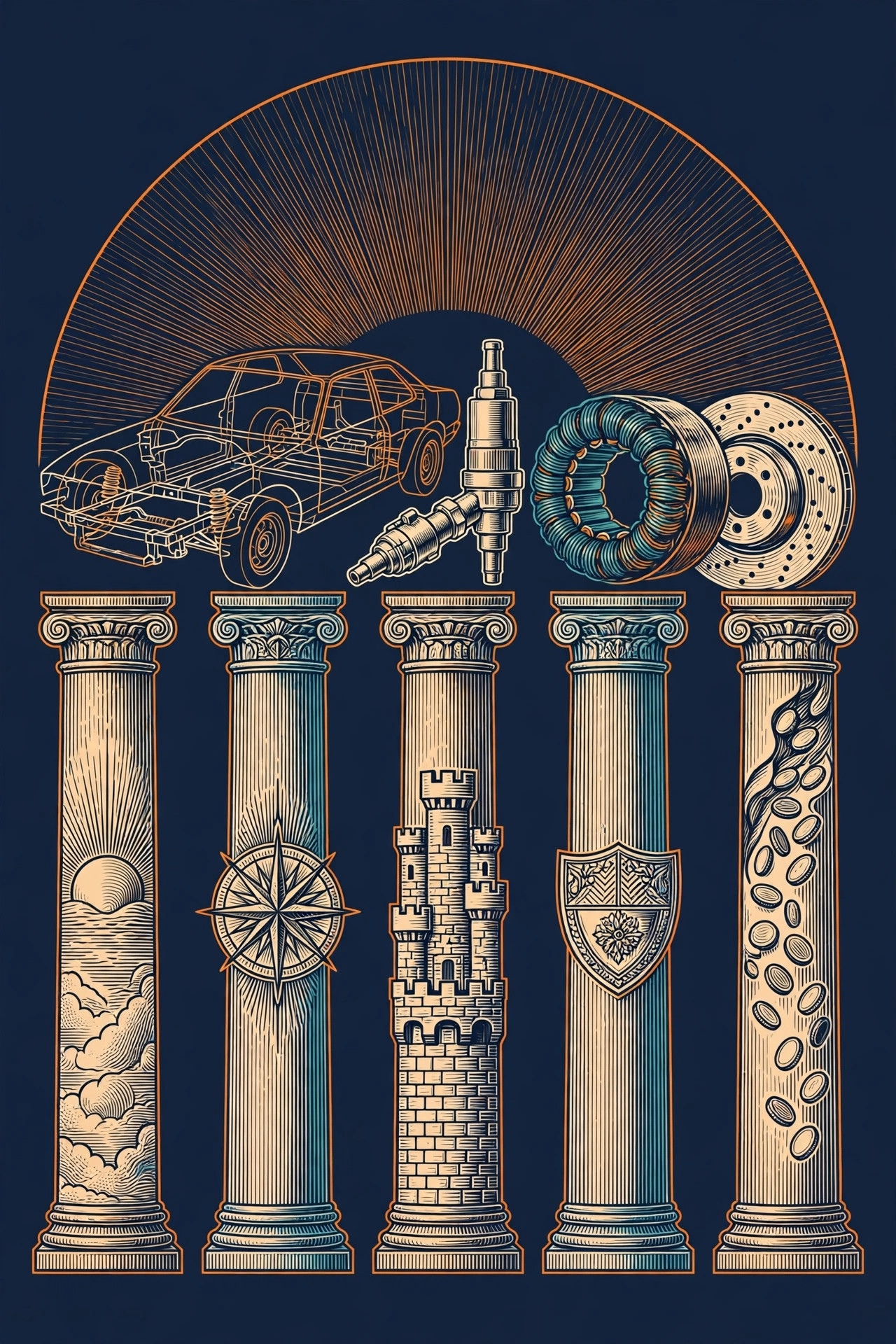
How does Bosch Ltd score on the five pillars?
Bosch Ltd passes three of five pillars: Leadership, Moat and Iron Fortress. Sunrise is partial because vehicle demand grows while the combustion profit pool is swapped for EV content not yet at scale, and Free Cash Flow is partial because reported free cash flow was negative in FY24 and FY26 as transition investment absorbed the year's cash.
Why do Bosch Ltd's moat and fortress pillars pass?
The moat is design-in incumbency across injection, braking, steering, electronics and sensors, backed by the world's largest automotive supplier's research and a parc-fed aftermarket. The fortress is borrowings of Rs 7 crore against net worth of about Rs 14,847 crore, with cash and investments of about Rs 8,700 crore and promoters at 70.54% with zero pledging.
Is the demand sunrise real for Bosch?
PARTIAL. Direction is favourable: vehicle production grows, premiumisation raises content per vehicle, and regulation keeps adding Bosch content, with OBD-II norms lifting the two-wheeler business 69.1% in FY26 and Power Solutions growing 17.6%. The deduction is the swap underneath: electric vehicles delete injection and exhaust content before they add power electronics and motor content of equal value, the new content (Tata AutoComp e-axles, TSF electronic air systems, localised charge controllers) is not yet visible at scale in segment prints, and hydrogen is conceded to be progressing slower than hoped.
Has leadership delivered at Bosch?
PASS. Under Managing Director Guruprasad Mudlapur (since July 1, 2023), revenue growth accelerated to 10.8% in FY26, the non-core Building Technologies business was exited cleanly at a Rs 556 crore gain, Bosch Chassis Systems India was fully acquired and consolidated, and two transition joint ventures were signed with named partners, dates and investment caps. Promoters hold 70.54%, flat since March 2020, with zero pledging, and the FY26 dividend was cut to Rs 270 a share (payout about 29%, from 75% in FY25). The structural deduction, recorded without breaking the grade, is parent control of strategy, technology and royalty (about 2 to 2.5% of sales), and the group's software arm sitting outside the listed perimeter.
How wide is Bosch's moat?
PASS. A Bosch system is qualified into a vehicle platform years before production, with tooling, calibration and validation sunk by both sides, so incumbency renews itself platform after platform. Breadth is unmatched in India: injection, powertrain control, braking, steering, sensors, electronics and tools from one supplier. Regulation is the second layer (OBD-II is the current proof) and the vehicle parc is the third, feeding spares, diagnostics and workshop services for decades. The limits are named: the moat protects content per platform, not the powertrain itself, vehicle makers are unbundling EV content, and the deepest technology is licensed from the parent, not owned in India.
Is the balance sheet a fortress?
PASS. Borrowings were Rs 7 crore at FY26 end against net worth of about Rs 14,847 crore. Cash and bank balances were about Rs 1,355 crore and investments about Rs 7,361 crore, a liquid book of about Rs 8,700 crore, more than a thousand times borrowings, earning other income of Rs 800 crore plus a year. Expansion, chassis consolidation and joint ventures are funded from internal accruals, not lenders. The watch item: return on equity of about 15% is diluted by the low-yielding treasury book, a valuation deduction, not a solvency question.
Does Bosch deliver free cash flow?
PARTIAL. Operating cash flow was about Rs 2,232 crore in FY26 against adjusted profit of about Rs 2,347 crore: core conversion is sound, and the Rs 270 a share dividend (about Rs 796 crore) was declared without borrowing. The deduction is what expansion took: reported free cash flow was negative in FY24 and again in FY26 as capital expenditure rose for the EV, electronics and chassis programmes, and positive in FY22, FY23 and FY25. A pillar that passes only in the years between investment programmes is a partial pass by this engine's rules. It upgrades if cash stays positive through the joint venture ramp.
What changes the grades?
Sunrise upgrades to pass if EV and electronics revenue becomes a disclosed, growing segment block, and downgrades to fail if combustion revenue declines outright for two consecutive years. Free Cash Flow upgrades to pass if it stays positive through the joint venture ramp. Moat is re-graded if a major Indian platform is lost to unbundled EV sourcing. Leadership is re-graded on the joint ventures shipping on their stated mid and end 2026 dates.
© 2026 DalalBytes Research · For educational purposes only. Not investment advice.