
What is the five-pillar scorecard?
Mixed fit: 1 of 5 pillars passes and 4 grade partial. Score 54/100, Neutral.
| PASS | Sunrise industry |
| PARTIAL | Leadership, Moat, Iron Fortress, Free Cash Flow |
| 54/100 | Overall DalalBytes score |
| $47 / $133 / $275 | FY2029 bear / base / bull |
What would change the score
Free cash flow that stays positive across consecutive quarters, rather than resting on one collection quarter, would lift this score, and another negative free cash flow quarter at record revenue would cut it.
| Pillar | Grade | One-line evidence |
|---|---|---|
| 1. Sunrise industry | PASS | Turbine slots run into 2030 and grid queues run past five years |
| 2. Leadership | PARTIAL | Three guidance raises in 2026, and a class action on supply chain statements |
| 3. Moat | PARTIAL | A real technology lead and service tail, sold at a premium to turbines |
| 4. Iron Fortress | PARTIAL | Cash of $2,486.7M against $2,473.5M of recourse debt, with $5.8B of supply commitments |
| 5. Free Cash Flow | PARTIAL | Trailing free cash flow of $436.7M built on one giant collection quarter |
The shape is unusual. No pillar fails outright, and only one pillar passes outright.
Bloom sits in the middle on every financial test while it leads on the market test. That is a growth company mid-crossing, graded at a price that assumes the crossing is done.
Pillar 1, Sunrise industry: why does it pass?
The sunrise test asks if the industry is rising. On site power is rising faster than almost any market in energy.
- United States data center load is the driver. Power is now the binding constraint on AI buildout.
- GE Vernova held 116 GW of gas backlog and slot reservations at June 30, 2026.
- Its output runs near 20 GW a year. New orders land in 2030 and 2031.
- Siemens Energy held 69 GW of gas backlog. Mitsubishi Heavy held 35 GW.
- Grid interconnection queues run past five years in much of the country.
- Bloom revenue grew 138.1% in Q3 2026 on that shortage.
- Management raised the FY2026 guide three times in one year.
- State policy leans in. Virginia named fuel cells a preferred resource for up to 5 GW by 2035.
The counter-evidence is real, and it does not break the grade:
- A sunrise market invites supply. Turbine makers are adding capacity toward 2030.
- Reciprocating engines and steam paths ship faster than large turbines and take some urgent demand.
- Power prices and AI capex can cool together. A capex pause would hit every name in this market at once.
The pillar grades the industry, not the entrant. The industry is in a genuine shortage. Pass.
Pillar 2, Leadership: why only partial?
The leadership test is simple. Did they do what they said, in order, on dates.
What landed:
- Guidance. The FY2026 revenue guide rose from $3.1B to $3.3B in February to $4.4B to $4.6B in October. Each raise came with delivery proof.
- The Brookfield frame. A $5B financing framework in August 2025 became $25B in June 2026, as reported.
- The Oracle program. Supply deals grew to a program of up to 2.8 GW, as reported.
- Delivery speed. One Oracle site in Utah took power less than two months after the project news, per press coverage.
- The balance sheet fix. The November 2025 convert deal termed out the debt stack to 2030 at a zero coupon.
What broke:
- The scandium statements. Management said Bloom was not dependent on China for scandium. A short seller report alleged the opposite on July 8, 2026. Bloom denied it in an 8-K.
- The lawsuit. A class action filed July 30, 2026 names Sridhar and three current or past finance chiefs.
- The CFO chair. The seat turned over three times in two years. Daniel Berenbaum left in May 2025. An acting officer held it for about eleven months. Simon Edwards started on April 13, 2026.
- Insider selling. Insiders sold about $21.8M of stock in the quarter before Q3, per analyst coverage.
- Dilution. Shares outstanding rose 29% in 21 months. Partners and lenders took equity at each step of the ramp.
The verdict on the pillar:
- Operating delivery in 2026 is excellent.
- Disclosure credibility now sits in a courtroom, not in a press release.
- A new CFO owns the numbers from here. His record is short and clean so far.
- Partial is the honest grade. It rises if the suit fades and the guide keeps landing.
Pillar 3, Moat: why only partial?
The moat test asks what stops a rival from taking the next order. Bloom's first answer is technology, because the solid oxide platform runs on gas, biogas, and hydrogen on one stack design, and it needs no combustion and no cooling water. The installed base is the second answer, with about 1,100 sites running in 9 countries and about 682 MW in South Korea alone through SK ecoplant.
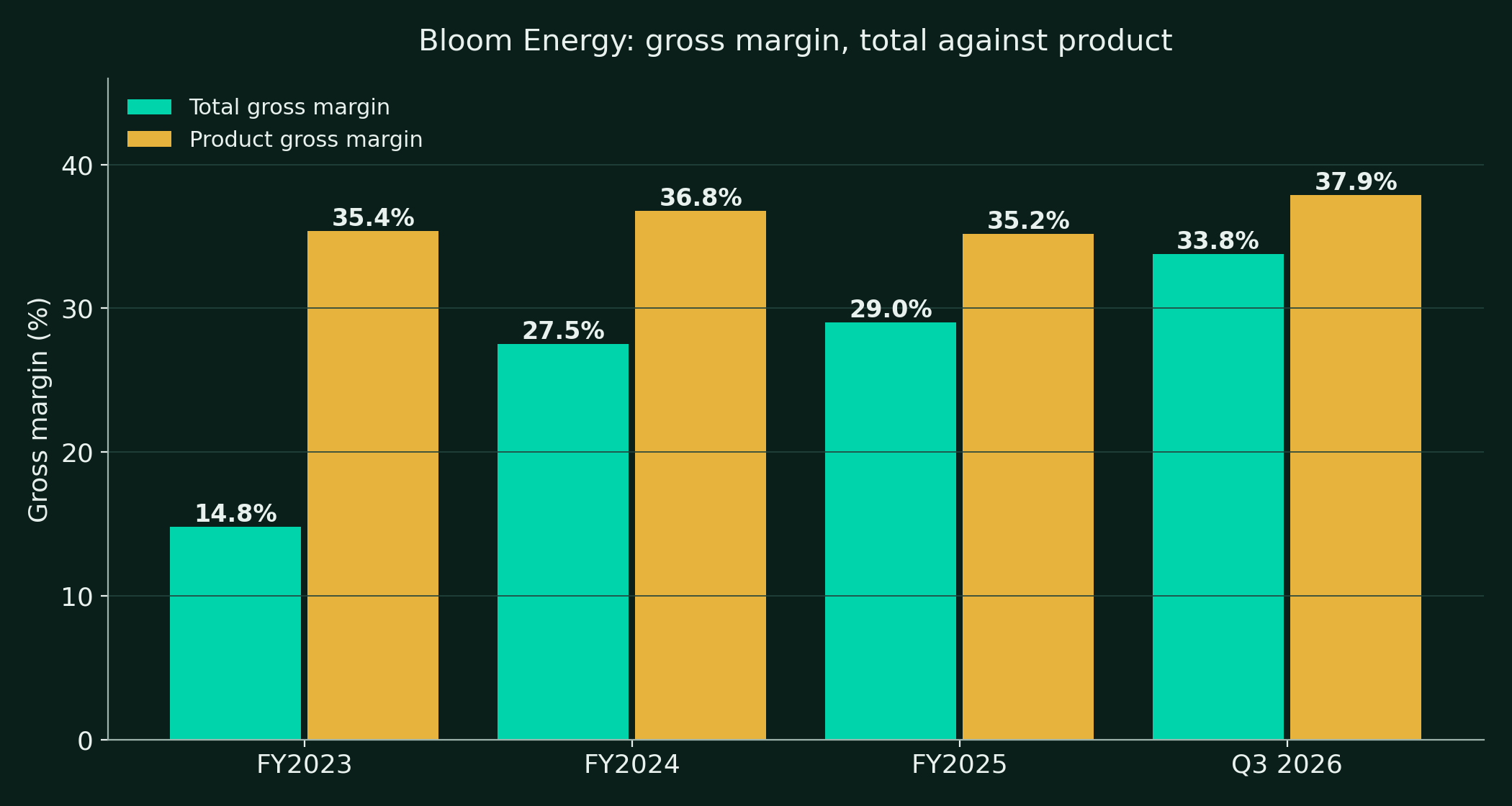
The service tail compounds that base, because each install signs a 5 to 20 year service contract, and service margin rose from a 20.7% loss in FY2023 to a 17.8% gain in Q3 2026. Channel lock adds another layer, since Brookfield funds projects with Bloom as preferred partner, AEP buys as a utility channel, and SK ecoplant owns about 2.5% of the stock. Speed adds a fifth layer, because months to power is a moat when the rival queue runs to 2030.
Price cuts against all of it, because a Bloom watt costs more than a turbine watt at list, and the AEP deal was reported near $2.65 per watt of project value. Rival scale cuts too, since GE Vernova holds 116 GW of turbine backlog and the service network to match. Input exposure and buyer power cut as well, because the electrolyte needs scandium from a thin and concentrated world supply, and the customers are the largest companies on earth and set terms, warrants included.
Fleet questions hang over the lead, because a short seller alleged degradation across the fleet, and warranty accruals did rise from $20.0M to $70.3M in nine months. The lead is real and the service tail compounds, but the lead is rented from speed and shortage, not owned outright. When turbine supply normalizes, Bloom must win on cost and uptime, not on the calendar, so the grade is Partial: a head start with a service annuity attached.
Pillar 4, Iron Fortress: why only partial?
The fortress test asks if the balance sheet can take a bad year without breaking.
What holds:
- Cash was $2,486.7M at September 30, 2026.
- Recourse debt was $2,473.5M. Cash covers the debt stack at par.
- Almost all debt is $2.5B of zero coupon converts due November 15, 2030.
- No cash interest runs on the main debt. No wall stands before a tiny 2028 stub.
- A $600M secured revolver stood undrawn at June 30, 2026.
- Equity rebuilt from $793.0M to $1,963.1M in nine months on profit and conversions.
- Customers prepay. Deferred revenue and deposits reached $754.4M.
What strains it:
- Supplier purchase commitments stand at $5.8B. About $2.6B falls due in 2027, per the 10-Q.
- Contract assets stand at $858.6M. That is revenue booked ahead of billing milestones.
- Accrued warranty rose from $20.0M to $70.3M in nine months.
- The accumulated deficit still stands at $3,470.7M.
- Financing obligations of $185.0M remain from old power purchase structures.
- The converts sit in the money at $194.97. Conversion adds about 12.8M shares.
- One counterparty drove about 73% of Q2 revenue. Fortress math assumes collections from a very short list of names.
The verdict on the pillar:
- This is no longer a distressed balance sheet. The 2025 refinance fixed the maturity problem.
- It is not yet a fortress. Commitments and working capital grow faster than equity.
- Partial. The grade rises when commitments fall as a share of cash and the warranty line calms down.
Pillar 5, Free Cash Flow: why only partial?
The cash test asks if the business funds itself after the factory bill.
The record:
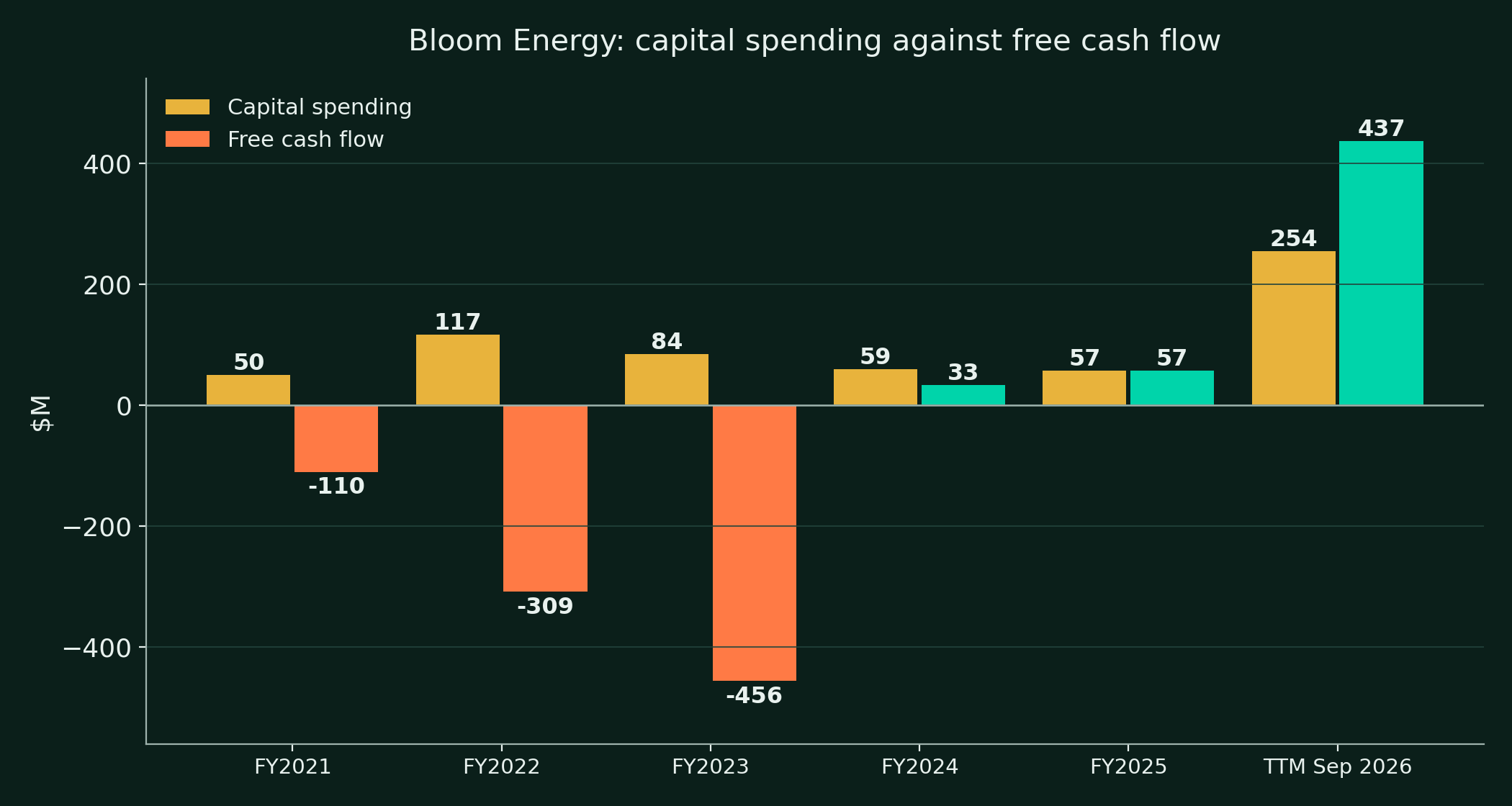
- Free cash flow was negative $456.3M in FY2023.
- It turned positive in FY2024 at $33.1M and FY2025 at $57.2M.
- Trailing free cash flow to September 2026 was $436.7M.
- One quarter made that trailing figure. Q4 2025 operating cash flow was about $418.0M, calculated from the filed year.
- The first nine months of 2026 made $41.6M of free cash flow on $3,052.3M of revenue.
- Q3 2026 used $180.6M of free cash in a record revenue quarter.
- Capital spending hit $231.3M in nine months, against $33.8M a year earlier.
- Stock based compensation ran $60.1M in Q3 alone. It never leaves through the cash statement, and it is still a cost.
The verdict on the pillar:
- The direction is right. The proof is not.
- Collections bunch into Q4 while spending runs all year.
- A self funding claim needs four straight positive quarters at this scale.
- Partial. Q4 2026 is the next exam, and it is the biggest quarter in company history.
What would change the grades?
| Pillar | Upgrade trigger | Downgrade trigger |
|---|---|---|
| Sunrise | Turbine queues stay past 2030 into the 2027 order season | AI capex guides fall and power demand forecasts follow |
| Leadership | The class action ends without findings against the statements | A court ruling or settlement that validates the sourcing claims |
| Moat | Service margin holds above 15% as the fleet ages | Warranty accruals double again or a marquee site underperforms in public |
| Iron Fortress | Commitments fall as a share of cash for two straight quarters | A new debt raise on weaker terms before 2028 |
| Free Cash Flow | Four straight positive free cash flow quarters at scale | A negative Q4 2026 print in the biggest delivery quarter |
The five-pillar read and the report verdict agree. Bloom leads a sunrise market with a partial moat, partial leadership credit, a partial fortress, and partial cash proof. None of that is failure, and all of it is unfinished.
At $222.30 the market charges for finished. Score 54/100, Neutral, with the grade path tied to collections and the courtroom.
Frequently asked questions
Why does no financial pillar pass?
Each one sits one proof short. Cash matches debt, but $5.8B of supply commitments stand behind it. Trailing free cash flow is positive, but one quarter made it. Leadership delivers on guidance, but a class action tests its past statements. Partial is the grade for strong and unproven at once.
Why does Sunrise pass so cleanly?
The shortage is measured in rival filings, not in Bloom claims. GE Vernova holds 116 GW of turbine backlog and reservations against output near 20 GW a year. Grid queues run past five years. A market that cannot ship its core product until 2030 is a sunrise market by any test.
What would lift this score the fastest?
Collections. A Q4 2026 print with strong operating cash flow and falling contract assets would lift Free Cash Flow first. Two such quarters in a row would start to lift Iron Fortress too. Delivery is no longer the question. Cash proof is.
Disclosures
- This analysis is research and opinion.
- It is not investment advice.
- DalalBytes Research. For educational purposes only. Not investment advice.
- Numbers come from company filings, company releases, and named press reports.
- Allegations from short seller reports and the class action are labeled as allegations. No court has ruled on them.
- The author holds no position in Bloom Energy at the time of publication.