
Frequently asked questions
How does Bajaj Auto score on the five pillars?
Bajaj Auto passes three of five pillars: sunrise, leadership and free cash flow, with the moat and the iron fortress grading partial. Premiumisation, electrification and exports are structural (EVs were about 30% of Q1 FY27 domestic revenue, exports rose 32% in September 2026), Rajiv Bajaj's two-decade record includes a 100% of PAT shareholder return in FY26, and standalone free cash flow was above Rs 8,000 crore. The partial grades both trace to the KTM takeover and to a model-cycle moat that must be re-won each cycle.
Why is Bajaj Auto's iron fortress only partial?
DalalBytes grades Bajaj Auto's iron fortress partial because the standalone core is still a fortress (surplus cash above Rs 18,000 crore at FY26 end and above Rs 21,000 crore after Q1 FY27, after a Rs 5,633 crore buyback), but the consolidated group now carries borrowings of Rs 22,713 crore, up from Rs 1,912 crore in FY24, with interest cost up from Rs 60 crore to Rs 1,169 crore and inventory days up from 22 to 54, most of it against the distressed Bajaj Mobility (KTM) business mid-restructuring. The pillar upgrades if consolidated borrowings fall for two consecutive years.
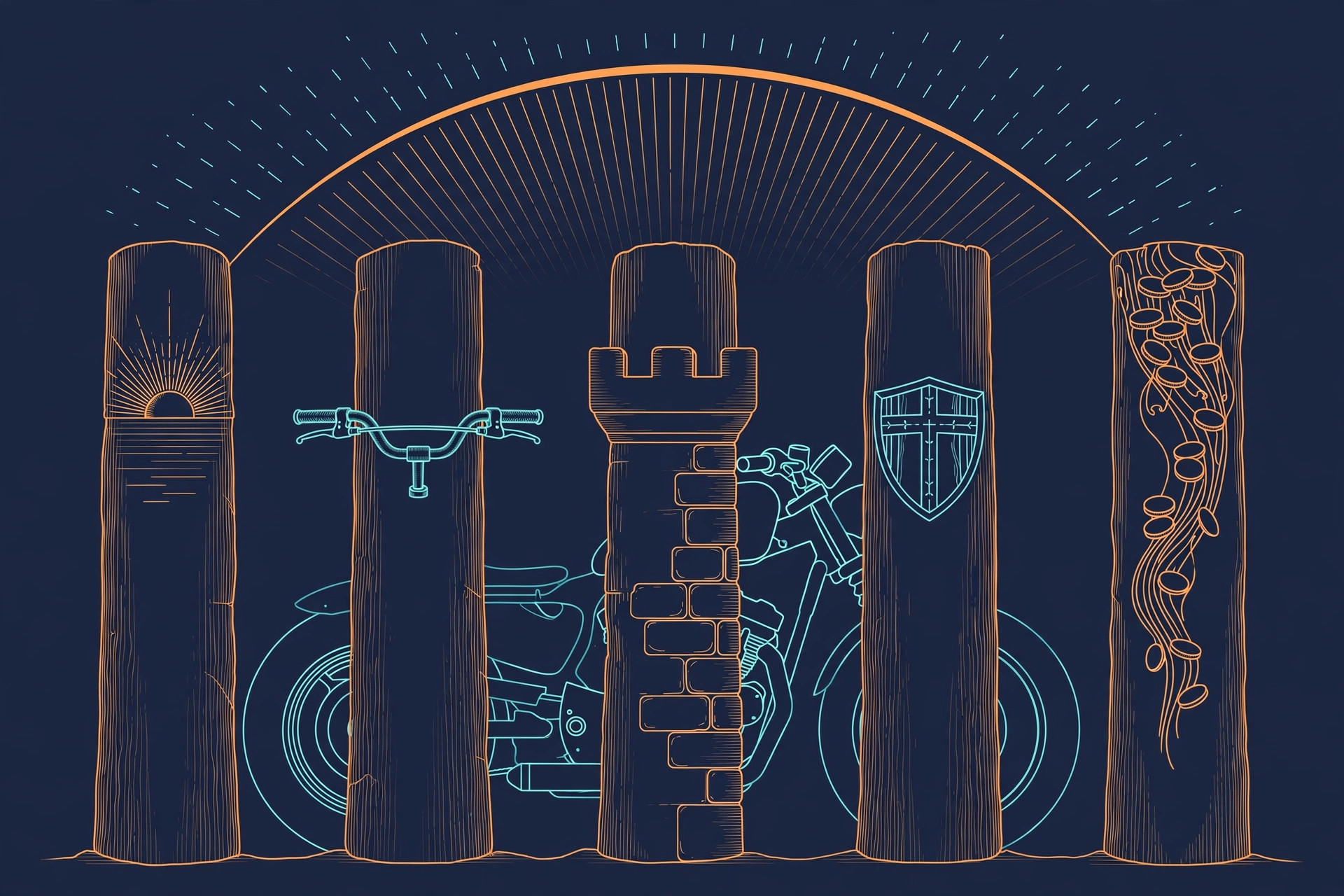
Pillar 1: Is the sector a sunrise? (PASS)
Bajaj competes where demand is going: 125cc-plus premium motorcycles (record FY26 billing and retail, KTM and Triumph growth above 40% in Q4 FY26), electric two and three-wheelers (EV revenue above Rs 8,000 crore in FY26, about 30% of Q1 FY27 domestic revenue, electric three-wheeler segment leadership), and emerging-market exports (79 countries, records in FY26, more than 7 lakh units in Q1 FY27, up 32% in September 2026 while domestic sales fell 9%). The base commuter industry is mature and cyclical, but the segments Bajaj chose are compounding structurally. PASS.
Pillar 2: Can the leadership execute? (PASS)
Rajiv Bajaj, in charge since 2005, rebuilt a fading scooter champion into the world's third-largest motorcycle maker on focus, premiumisation and cost discipline (standalone EBITDA margin of 20.5% in FY26 and 20.9% in Q1 FY27), bought into KTM in 2007 and converted patience into control in 2025, and runs one of India's best capital-allocation records: buybacks at Rs 10,000 and Rs 12,000, high payouts, and a FY26 dividend plus buyback equal to 100% of standalone PAT while surplus cash still rose. The open files are succession and Austria. PASS.
Pillar 3: Does a moat protect returns? (PARTIAL)
The advantages are real: the world's largest three-wheeler franchise with its parc, service and finance web; Pulsar's 25-year sports-commuter mindspace; a 79-country export system; an Indian cost base European factories cannot match; and exclusive premium brands (KTM, Husqvarna, GasGas, Triumph in India). The grade is partial because motorcycles are a model-cycle business with no regulatory protection, no network effect and no switching cost beyond brand habit: Hero's distribution is deeper, TVS is matching or beating Bajaj in scooters and EVs, Royal Enfield's retro brand is stronger than its new challenger, and electric share has swung violently within three years. Bajaj itself lost the scooter kingdom it once owned. A moat re-won every cycle is an advantage, not a wall. PARTIAL.
Pillar 4: Is the balance sheet a fortress? (PARTIAL)
The core passes on its own: standalone surplus cash above Rs 21,000 crore after Q1 FY27, after completing a Rs 5,633 crore buyback, in a company that paid Rs 9 crore of consolidated interest in FY22. The group does not: consolidated borrowings of Rs 22,713 crore in FY26 (Rs 1,912 crore in FY24), interest of Rs 1,169 crore, debt-to-equity of about 0.57, and inventory days of 54 against 22, most of it attached to a distressed European business mid-restructuring. Deliberate leverage to buy a strategic asset at the bottom is not the same as riskless leverage. PARTIAL, upgrading when consolidated borrowings fall two years in a row.
Pillar 5: Does the free cash flow show up? (PASS)
Standalone free cash flow was above Rs 8,000 crore in FY26, up about 30%, on standalone capex of about Rs 500 crore, and the consolidated series was positive every year from FY15 to FY24, through the pandemic and two downcycles. The payout record is the external proof: a Rs 150 per share dividend plus the Rs 5,633 crore buyback returned the entire FY26 standalone PAT, and surplus cash still rose the next quarter. The monitored metric is consolidated conversion, which fell to Rs 1,885 crore of free cash flow in FY26 as KTM working capital consolidated; if that is still the picture in FY28, this pillar downgrades. PASS today.
What would change the grade?
Iron Fortress upgrades to pass if consolidated borrowings fall for two consecutive years while Bajaj Mobility reaches cash breakeven. Moat upgrades if KTM and Triumph hold or gain global premium share through FY28 and the electric three-wheeler lead hardens into durable dominance. Free Cash Flow downgrades if consolidated free cash flow stays below about a third of standalone free cash flow through FY28. Leadership is re-graded on Bajaj Mobility disclosure quality and on Q2 FY27 results on October 27, 2026.
© 2026 DalalBytes Research · For educational purposes only. Not investment advice.