
What is the five-pillar scorecard?
Four pass, one partial, no fails. The pillars grade the business, not the price. The price is graded in the companion investment report, and the business grades better than the de-rated stock implies.
What would change the score. The score rises if fiscal 2027 AI revenue tracks the $115B guide with consolidated gross margin held at or above 72% and a seventh XPU customer reaches production volumes, and it falls if any top-three XPU customer moves a chip generation to a rival designer or in-house tooling, or if the fiscal 2028 AI guide is cut.
| 76/100 | DalalBytes score |
| 4 pass | 1 partial, 0 fail |
| $326.08 | Reference price. October 30 2026 close (Finnhub) |
| $310 / $840 / $1170 | Fiscal 2029 bear / base / bull |
| Pillar | Grade | The one-line reason |
|---|---|---|
| 1. Sunrise | PASS | AI demand is the strongest tide in semiconductors |
| 2. Leadership | PASS | Guides get beaten and acquisitions get integrated |
| 3. Moat | PASS | The design layer is locked in by cycle and by share |
| 4. Iron Fortress | PARTIAL | $59.4B of gross debt against a powerful repair flow |
| 5. Free Cash Flow | PASS | $26.9B a year on capex of 1% of revenue |
The business grades near the top of the DalalBytes library. Each pillar below carries its own evidence, with filed numbers carrying the grades and management claims labeled as claims.
Pillar 1, Sunrise: why does it pass?
The sunrise test asks one question. Is the industry itself rising?
- AI accelerators are the fastest-growing large product line in semiconductors.
- Broadcom AI revenue rose from $3.7B in Q4 fiscal 2024 to a guided $21.7B in Q4 fiscal 2026.
- The eight reported quarters in between grew every single quarter.
- Counterpoint projects custom ASIC shipments to pass data center GPU shipments in 2028.
- Hyperscaler capex guides keep rising into 2027 across the customer bench.
- Ethernet is consolidating as the scale-out fabric standard inside AI clusters.
- Anthropic and OpenAI alone are guided above 20 GW of combined deployments by the end of 2028.
- The software side has no sunrise and needs none. Renewals compound quietly underneath.
- A sunrise this strong forgives many execution sins. Broadcom has not needed the forgiveness.
Pillar 2, Leadership: why does it pass?
- Hock Tan has led the company since 2006, through Avago, the 2016 Broadcom merger and four major acquisitions.
- The fiscal 2024 AI target of about $10B was set in public and beaten with about $12.2B delivered.
- Fiscal 2026 AI guides were beaten in Q1 and Q2 and raised for the full year at the Q3 call.
- VMware was the largest software integration in the company's history, and the segment printed $20.8B of operating income in fiscal 2025.
- The dividend has risen for fifteen consecutive years, to $0.65 a quarter for fiscal 2026.
- The buyback was executed with conviction, $8.45B in nine months of fiscal 2026.
- CFO Amie Thuener runs the capital program that has cut gross debt every year since the VMware peak.
- The deduction is concentration. Strategy, deal-making and the top customer relationships run through one person.
- The fiscal 2028 guide of about $230B is the boldest claim of the tenure and is not yet evidence.
- The grade is PASS on the delivery record, with the key-man flag stated rather than buried.
Pillar 3, Moat: why does it pass?
- A custom accelerator takes two to three years from architecture to production silicon.
- Switching design partners mid-stream costs a customer a generation, not a quarter.
- Counterpoint estimates Broadcom's AI ASIC design-partner share near 60% by 2027.
- JPMorgan estimates 80 to 85% of the high-end design market on a narrower basis.
- Tomahawk and Jericho silicon sets the Ethernet roadmap the clusters are built around.
- A customer can leave an XPU program and still buy Broadcom switching, and several do.
- VMware renewals rest on switching costs across the largest enterprise estates in the world.
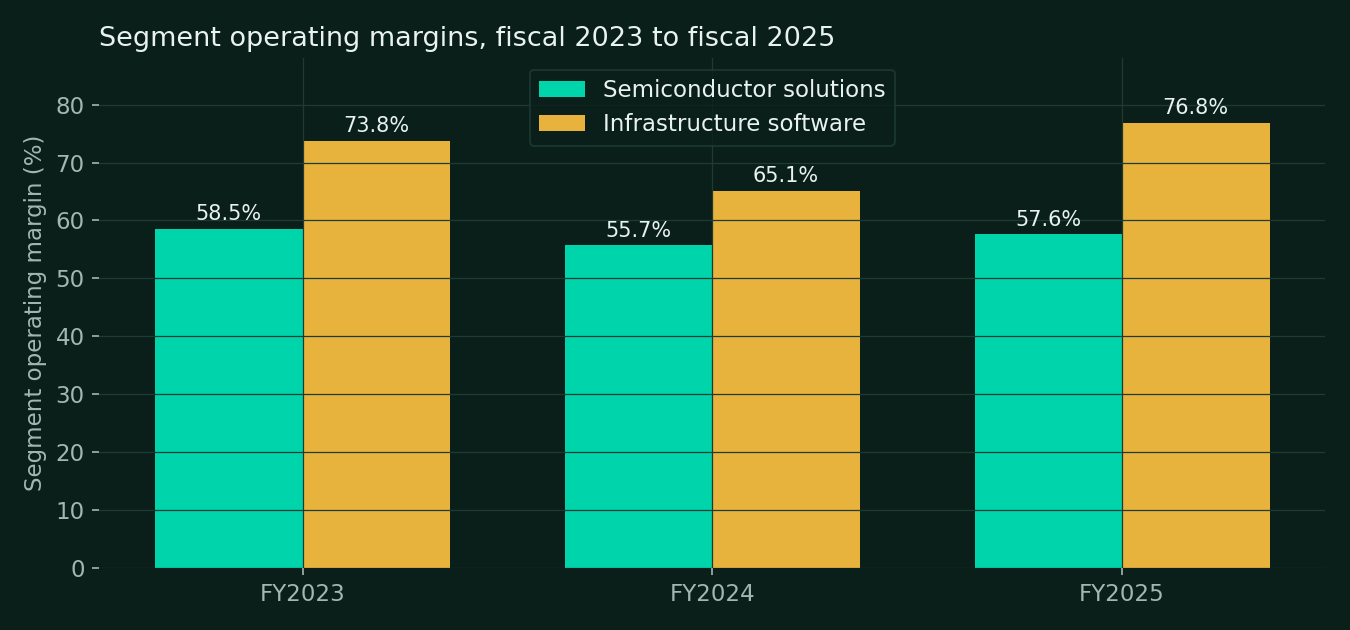
- Segment operating margins price the moat in numbers, shown in the chart below.
- The moat is contested at the customer boundary by MediaTek and by customer-owned tooling.
- Contested is not breached. The XPU customer bench grew from three to six during the contest.
- The grade is PASS.
Pillar 4, Iron Fortress: why only partial?
- Cash and equivalents were $24.0B at August 2, 2026.
- Gross debt was $59.4B, split $2.3B current and $57.2B long-term.
- Net debt of $35.4B is about 0.8 times fiscal 2025 adjusted EBITDA of $43.0B.
- Interest expense of $3.2B in fiscal 2025 was covered about eight times by GAAP operating income.
- There is no near-term maturity wall. The current portion is small against one quarter of free cash flow.
- The deduction is the stock of acquisition assets. Goodwill and intangibles total $124B on $188B of assets.
- A severe AI downturn would test both the debt and the goodwill at the same time.
- The trajectory is repair. Gross debt has fallen every year since peaking above $70B after VMware closed.
- The grade is PARTIAL. The flow against the debt is excellent and the debt itself is still large.
Pillar 5, Free Cash Flow: why does it pass?
- Free cash flow was $17.6B in fiscal 2023, $19.9B in fiscal 2024 and $26.9B in fiscal 2025.
- Q3 fiscal 2026 produced $13.7B of free cash flow in a single quarter, 46% of revenue.
- Capital expenditure was $0.6B in fiscal 2025, about 1% of revenue.
- The fabless model leaves the heavy capital with TSMC and its packaging partners.
- Operating cash flow grew from $18.1B to $27.5B across fiscal 2023 to fiscal 2025.
- Cash conversion funds the dividend, the buyback and the debt paydown at the same time.
- The deduction is stock compensation of $7.6B in fiscal 2025, about 28% of free cash flow.
- Net of that deduction the pillar still passes by the widest margin on the scorecard.
- The grade is PASS.
What do the pillars miss?
The pillars grade the business, and on that test Broadcom is one of the strongest names in the library. What they cannot grade is the distance between a delivered record and a guided future. The fiscal 2028 AI guide of about $230B does more work in the current price than any single delivered number, and no pillar can certify a guide.
That is why the investment report, not this scorecard, carries the final number. The business earns four passes. The price, after a 34% fall from the June 2026 high, earns the 76/100 Positive that goes with them.
Frequently asked questions
Why does Iron Fortress grade only partial?
Iron Fortress grades partial because gross debt is $59.4B against $24.0B of cash, with $124B of goodwill and intangibles on the balance sheet. The repair flow is excellent, with net debt at about 0.8 times fiscal 2025 adjusted EBITDA, but the stock of debt is still large.
Why does Leadership pass when so much runs through one person?
Leadership passes on delivery. Hock Tan's fiscal 2024 AI target was beaten, the fiscal 2026 quarterly AI guides were beaten and raised, and VMware integration delivered $20.8B of segment operating income in fiscal 2025. The key-man concentration is flagged in the pillar rather than used to fail it.
What would change the pillar grades?
The grades change on evidence. Iron Fortress upgrades as gross debt keeps falling while free cash flow holds, and Leadership and Moat come under review if a top-three XPU customer moves a chip generation to a rival designer or in-house tooling, or if the fiscal 2028 AI guide of about $230B is cut.
Sources and disclosures
- Broadcom Form 10-K for fiscal 2025, filed December 18, 2025, for segment margins, cash flow and the consolidated statements.
- Broadcom Forms 10-Q for fiscal 2026, for the August 2, 2026 balance sheet and shareholder returns.
- Broadcom earnings releases and earnings call reporting through the fiscal Q3 2026 call of September 2, 2026, for the AI revenue series and guidance history.
- Counterpoint Research and JPMorgan design-layer estimates as cited in The Compute Share Wars, DalalBytes, November 1, 2026.
- The companion investment report carries the full financial statements, the roadmap audit and the fiscal 2029 scenarios behind this scorecard.
- Disclosures. DalalBytes holds no position in Broadcom (AVGO) at publication. This analysis is research and opinion for educational purposes only and is not investment advice, a recommendation, or a solicitation. Prices and estimates are as of November 1, 2026.