
Frequently asked questions
Is Associated Alcohols a buy at current prices?
DalalBytes rates Associated Alcohols Selective Positive at 64/100. At Rs 539 the stock trades at 13.1x trailing earnings and about 1.6x book value, against FY26 revenue of Rs 1,019.40 cr, PAT of Rs 88.48 cr, borrowings of Rs 69 cr, and promoters at 62.35% with zero pledging. The selective part is the ethanol segment, which lost Rs 8.37 cr in Q1 FY27, a cash conversion cycle of 110 days, and state policy control over tenders, prices and allocations.
What are Associated Alcohols' FY2029 price targets?
DalalBytes' FY2029 targets are bear Rs 440, base Rs 900, and bull Rs 1,480, from a Rs 539 reference price. Bear: 4% revenue CAGR to Rs 1,146 cr, PAT of Rs 80 cr, EPS of Rs 40 at 11x. Base: 10% CAGR to Rs 1,357 cr, PAT of Rs 129 cr, EPS of Rs 64 at 14x. Bull: 16% CAGR to Rs 1,590 cr, PAT of Rs 175 cr, EPS of Rs 87 at 17x. FY2029 is the year ending March 2029.
How fast is the own brand IMFL business growing?
Proprietary IMFL revenue grew about 29% in FY26 and 58% year on year in Q1 FY27 to a record Rs 79.2 cr on 7.9 lakh cases, lifting own brands to 23% of revenue from 17% in FY26. Management guides about 30% proprietary IMFL growth for FY27. The segment earned a 22% EBITDA margin in Q4 FY26, the highest in the house.
What is the verdict on Associated Alcohols?
FY26 revenue fell 5.3% to Rs 1,019.40 cr, yet EBITDA rose 11.6% to Rs 142.93 cr and PAT rose 8.7% to Rs 88.48 cr, because the mix moved toward bottles the company owns. Part of the licensed book shifted to a lower revenue contract manufacturing model, ethanol weakened, and proprietary IMFL carried the year. In Q1 FY27 that pivot printed its best quarter yet, and in the same quarter the ethanol segment lost Rs 8.37 cr and consolidated PAT fell 24% to Rs 17.92 cr. Both halves of the story are in the numbers.
How did Associated Alcohols start, and who owns it now?
The Kedia family entered liquor about four decades ago in central India. The company was incorporated at Kolkata in July 1989 by Bhagwati Prasad Kedia and Anand Kumar Kedia, took over Associated Distilleries in April 1990, and listed via a December 1994 IPO that funded grain based distilling at Barwaha in Madhya Pradesh. Promoters now hold 62.35% (September 2026), raised from 59.29% by converting warrants at Rs 679 a share in March 2026, with pledging at 0.00%. The group's beer arm, Mount Everest Breweries, filed a Rs 230 cr IPO DRHP in September 2026, with an April 2026 non-compete separating beer from AABL's spirits, ENA and ethanol.
What does the business actually do?
One integrated Barwaha complex turns rice, maize, jowar and barley into extra neutral alcohol. ENA production was raised to 50 million litres in FY26. Captive use, spirit bottled in house, rose to 59% in Q1 FY27 from 50% in FY26. The spirit is sold four ways: proprietary IMFL (17 brands including Nicobar gin, Hillfort blended malt whisky, Central Province, Titanium and Bombay Special), licensed and contract bottling (a two decade Diageo partnership, one of four exclusive partners), IMIL country liquor into the Madhya Pradesh tender system, and merchant ENA plus fuel ethanol (about 40 MLPA). A 6,000 LPD malt spirit plant was commissioned in FY26.
Where does the revenue come from?
Statutory reporting splits Potable Alcohol and Ethanol. In Q1 FY27 potable revenue was Rs 219.16 cr with a segment result of Rs 34.27 cr, while ethanol segment revenue was Rs 74.38 cr with a segment result of minus Rs 8.37 cr (segment figures include inter segment transfers). Inside potable sit three unlike businesses: proprietary IMFL at a 22% EBITDA margin in Q4 FY26, IMIL at about 20%, and thin job work bottling. Q4 FY26 detail: proprietary IMFL 6.6 lakh cases and Rs 50 cr, IMIL 9.8 lakh cases and Rs 62 cr, merchant ENA 6.9 million litres and Rs 47 cr, ethanol 4.0 million litres and Rs 24 cr.
What do the financials show?
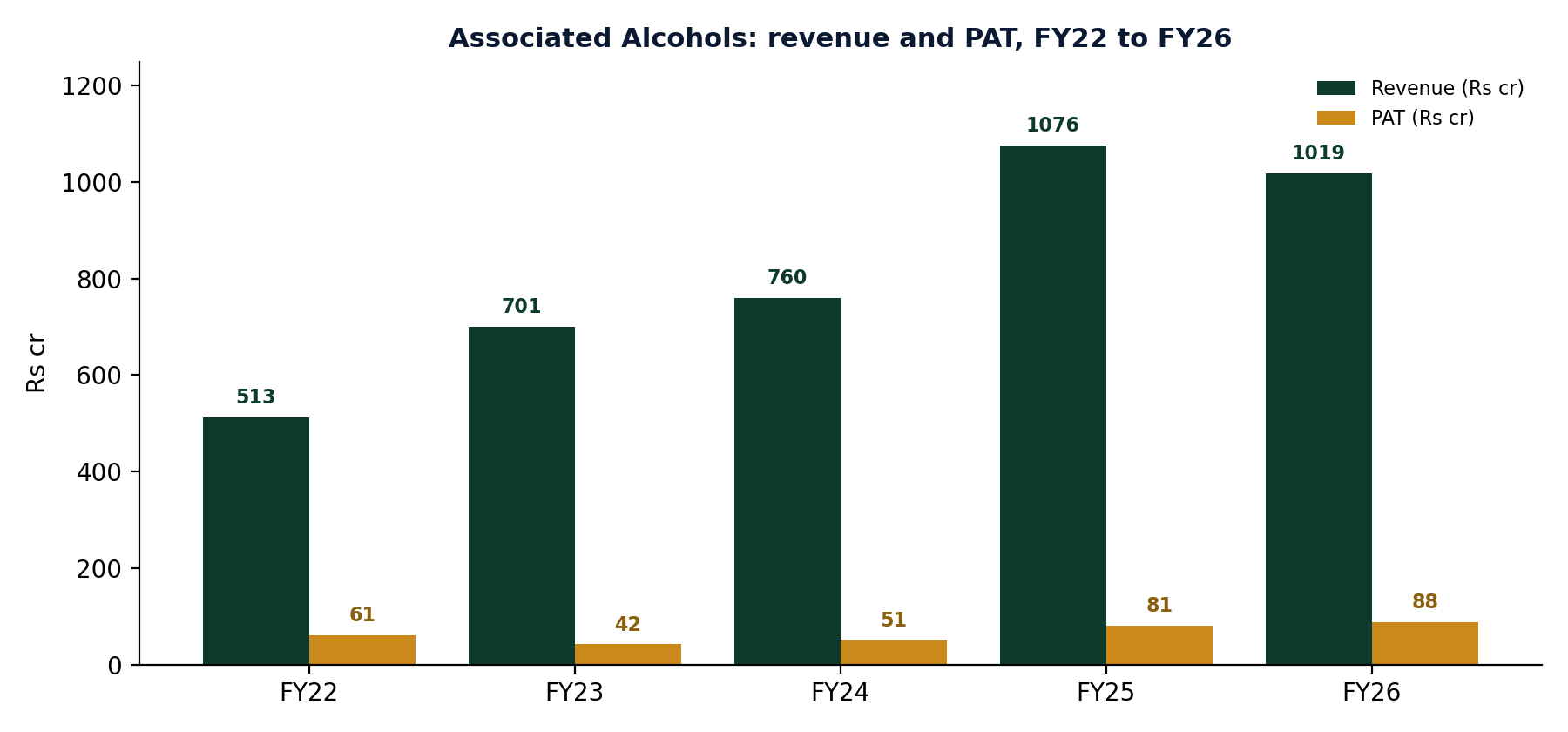
Revenue went Rs 513 cr, Rs 701 cr, Rs 760 cr, Rs 1,076 cr, Rs 1,019 cr across FY22 to FY26, with EBITDA margin of 16%, 9%, 10%, 12% and 14%, and PAT of Rs 61 cr, Rs 42 cr, Rs 51 cr, Rs 81 cr and Rs 88 cr. FY22 PAT carried higher other income. The five years read as three acts: a volatile ENA and IMIL house, a FY25 scale jump on ethanol, and a FY26 mix year where profit rose on falling revenue. Screener puts FY26 ROCE at 18.0% and ROE at 14.6%. Q2 FY27 results had not been announced at this report's date.
How strong is the balance sheet and cash flow?
Net worth is Rs 695 cr, borrowings fell from Rs 102 cr to Rs 69 cr, interest cost was Rs 6.2 cr against EBITDA of Rs 142.93 cr, and CRISIL reaffirmed A- with a Positive outlook in October 2025. The weak spots are working capital and conversion: inventory days rose to 125, the cash conversion cycle widened to 110 days from 80, operating cash flow was Rs 52 cr in FY26, and free cash flow was about zero after capex for the ethanol, malt, Kerala and UP builds. The dividend was Rs 2.00 a share, a payout of about 5%.
What is Associated Alcohols worth versus peers?
At Rs 539: P/E 13.1x, P/B about 1.56x, P/S about 1.06x, yield 0.37%. Branded peers price in another world: United Spirits at Rs 1,229 and about 48x (market cap about Rs 90,952 cr), Radico Khaitan at Rs 4,178 and about 79x (about Rs 55,873 cr), Allied Blenders at about Rs 700 and about 70x. The closest mix comp, Globus Spirits, trades near 25x, and the tender liquor anchor, GM Breweries, near 11.7x. FY2029 scenarios: bear Rs 440, base Rs 900, bull Rs 1,480. The discount fairly prices the distillery and the tender book, and prices the proprietary IMFL pivot at close to zero.
What are the key risks?
First, ethanol: a policy priced commodity in industry oversupply, with allocations and pricing set by government and oil companies. Second, the state: IMIL tenders, excise duties and label registrations decide the home market, and Madhya Pradesh policy reaches every segment at once. Third, single location: one Barwaha plant carries distilling and most bottling. Fourth, working capital: a 110 day cash conversion cycle and inventory at 125 days, part malt maturation by design and part commodity stocking. Fifth, grain: rice and maize prices flow straight into ENA and ethanol margins. Finally, scale, governance and liquidity: subscale premium brands against Diageo and Radico, a shared promoter group with the listing bound Mount Everest Breweries, lumped segment disclosure, near nil mutual fund holding and thin traded value.
© 2026 DalalBytes Research · For educational purposes only. Not investment advice.