
What is the verdict?
54/100. Neutral. The best seat in the AI CPU transition, a royalty claim on nearly every roadmap in the industry, and a share price that already pays for the fiscal 2031 plan today.
What would change the score. Royalty growth re-accelerating above the high-teens guide as the data center mix rises, at a price that no longer pre-pays the fiscal 2031 plan, would lift the score, while a Qualcomm royalty suspension or another guidance cut that leaves the multiple carrying the plan alone would cut it.
| 54/100 | DalalBytes score |
| $235.90 | Reference price, Oct 28, 2026 close |
| $251.9B | Market cap, 1068M ADS outstanding |
| $91 / $207 / $319 | FY2029 bear / base / bull |
Arm is the toll road of the AI build out, and every hyperscaler CPU program of size runs on it. Royalties grow even when phone units fall, because the rates per chip keep rising with Armv9 and CSS. The company now sells its own silicon too, which widens the toll road from a royalty claim into a product claim.
None of that is the argument at this price, because the argument is what the price already assumes. At $235.90 the market pays 243 times trailing GAAP earnings and about 49 times trailing sales. Our base case lands below the price, and the bull case needs the fiscal 2031 plan to arrive early.
Our read is simple. The business earns a premium, and the stock has already collected it. Owners of the architecture deserve patience. Buyers at this price deserve a discount that is not on offer.
The price basis of this report
Arm reports its fiscal second quarter on November 4, 2026, after the close. The company announced that date on October 5, 2026. This report is written before that print and uses the October 28, 2026 close throughout.
What is Arm today?
Arm Holdings plc is based in Cambridge, England, and was founded in 1990. SoftBank bought the company in 2016 for about $32B, and Arm listed on Nasdaq in September 2023. The fiscal year ends on March 31, so fiscal 2026 ended on March 31, 2026, and the latest reported quarter is Q1 FY2027, which ended on June 30, 2026.
Arm sells designs, not chips; its partners build the chips. More than 350 billion Arm-based chips have shipped, and Arm technology sits in more than 99% of premium smartphones. The company employs about 9,000 people.
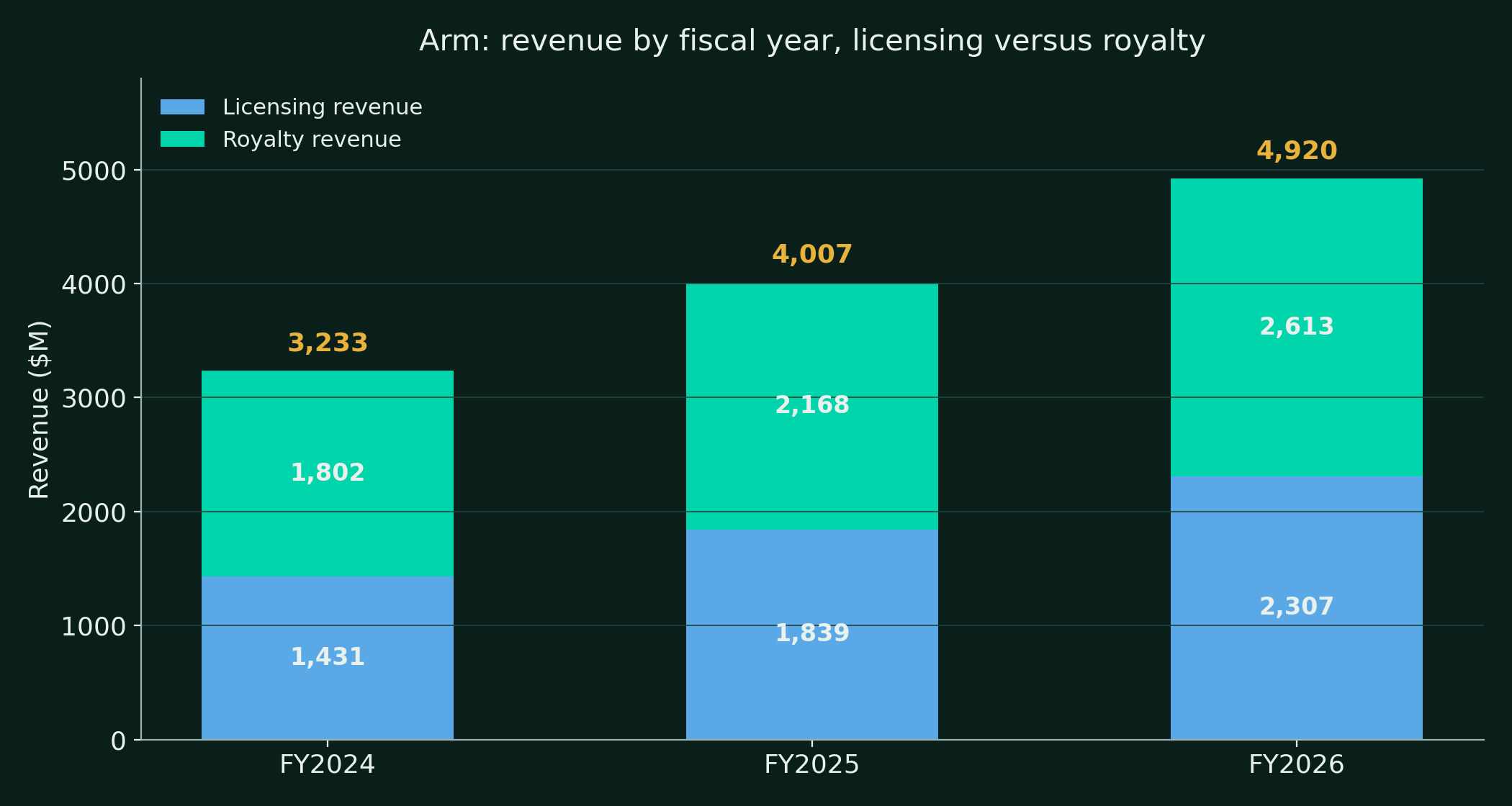
| Metric | FY2024 | FY2025 | FY2026 | Q1 FY2027 |
|---|---|---|---|---|
| Total revenue ($M) | 3,233 | 4,007 | 4,920 | 1,289 |
| Licensing revenue ($M) | 1,431 | 1,839 | 2,307 | 574 |
| Royalty revenue ($M) | 1,802 | 2,168 | 2,613 | 715 |
| GAAP net income ($M) | 306 | 792 | 904 | 270 |
| Non-GAAP diluted EPS | $1.27 | $1.63 | $1.77 | $0.45 |
| ACV at period end ($M) | n/a | n/a | n/a | 1,732 |
Revenue has grown more than 20% for three straight years. Royalties are now 53% of revenue, while licensing is 47% and swings with deal timing. The mix shift toward royalties is slow and real.
How does Arm make money?
Arm runs three offers. Each one charges more than the last.
The architecture license
- A partner buys the right to design its own Arm-compatible cores.
- Apple and Qualcomm hold this kind of license.
- The fee is large and paid up front.
- The royalty then runs per chip for years.
- This is the deepest access Arm sells.
The core license
- A partner licenses finished Arm core designs.
- The partner drops the cores into its own chip.
- Most phone and embedded chip makers buy this way.
- The work is faster and cheaper than designing a core.
- The royalty rate is lower than an architecture deal.
Compute Subsystems, or CSS
- CSS sells a pre-integrated block of cores and system IP.
- The block arrives close to production ready.
- The customer skips months of integration work.
- Arm charges more for CSS than for cores alone.
- CSS also lifts the royalty on every chip that ships.
- Royalty rates are a percentage of the chip price.
- A richer chip at a higher rate pays twice over.
- That double lift is the core of the equity story.
- Armv9 raises the rate. CSS raises it again.
- Section 5 puts numbers on both lifts.
What did Arm report in Q1 FY2027?
Q1 FY2027 ended on June 30, 2026. Arm reported on July 29, 2026.
| Q1 FY2027 | Result | Year ago | Change |
|---|---|---|---|
| Total revenue | $1,289M | $1,053M | +22% |
| Royalty revenue | $715M | $585M | +22% |
| Licensing revenue | $574M | $468M | +23% |
| GAAP operating income | $91M | $114M | -20% |
| Non-GAAP operating income | $531M | $412M | +29% |
| GAAP diluted EPS | $0.25 | $0.12 | +108% |
| Non-GAAP diluted EPS | $0.45 | $0.35 | +29% |
| Non-GAAP free cash flow | $665M | n/a | n/a |
- Revenue set a first quarter record.
- Data center royalties more than doubled again.
- ACV grew 13% to $1,732M.
- Non-GAAP EPS of $0.45 beat the top of the guide.
- GAAP operating margin fell to 7.1% from 10.8%.
- Stock pay and hiring explain most of that gap.
- One deal deserves a flag.
- The SoftBank agreement added $193M of the $574M licensing line.
- That is a third of licensing from the controlling owner group.
- Management guided Q2 FY2027 revenue to $1.38B, plus or minus $50M.
- It guided non-GAAP EPS to $0.47, plus or minus $0.04.
- On the call, CFO Jason Child cut the year.
- He said fiscal 2027 royalty growth now lands in the high teens.
- The prior expectation was about 20%.
- Smartphone units and memory prices did the damage.
The guidance cut
The print beat and the stock still fell. The lesson is the price. At this multiple, a guidance trim of two points costs more than a record quarter earns.
How do Arm royalties work?
Royalties are the annuity. Three forces drive them.
Rate per chip
- Armv9 carries about double the royalty rate of Armv8 in smartphones.
- Arm states that figure in its own materials.
- In infrastructure, v9 rates approach three times v8.
- Arm made that claim at its March 24, 2026 event.
- CSS adds a further uplift on top of v9.
- Haas has put the rates in plain numbers on an earnings call.
- He put v8 near 2.5% to 3.5% of chip price, v9 near 5%, and CSS near 10%.
- Arm does not print a rate card in its filings.
- Premium phones are now almost all v9.
- Arm put premium Android v9 penetration above 99% in May 2026.
Units per market
- Smartphone units are flat to down.
- Royalty per phone keeps climbing, so phone royalties still grow.
- Data center units are compounding fast.
- Neoverse shipments passed 1.5 billion cores in the June quarter.
- The last 500 million cores shipped in nine months.
- The first billion took six years.
- Automotive and robotics add a third unit engine.
The smartphone catch
- Q1 FY2027 smartphone royalties fell 2.5% year over year.
- Barclays relayed that figure from a company update.
- Memory shortages cut phone builds.
- Rate gains covered the unit fall at group level this time.
- The cover is not guaranteed every quarter.
| Royalty revenue by quarter | $M | Growth year over year |
|---|---|---|
| Q1 FY2026 | 585 | n/a |
| Q2 FY2026 | 620 | +21% |
| Q3 FY2026 | 737 | +27% |
| Q4 FY2026 | 671 | +11% |
| Q1 FY2027 | 715 | +22% |
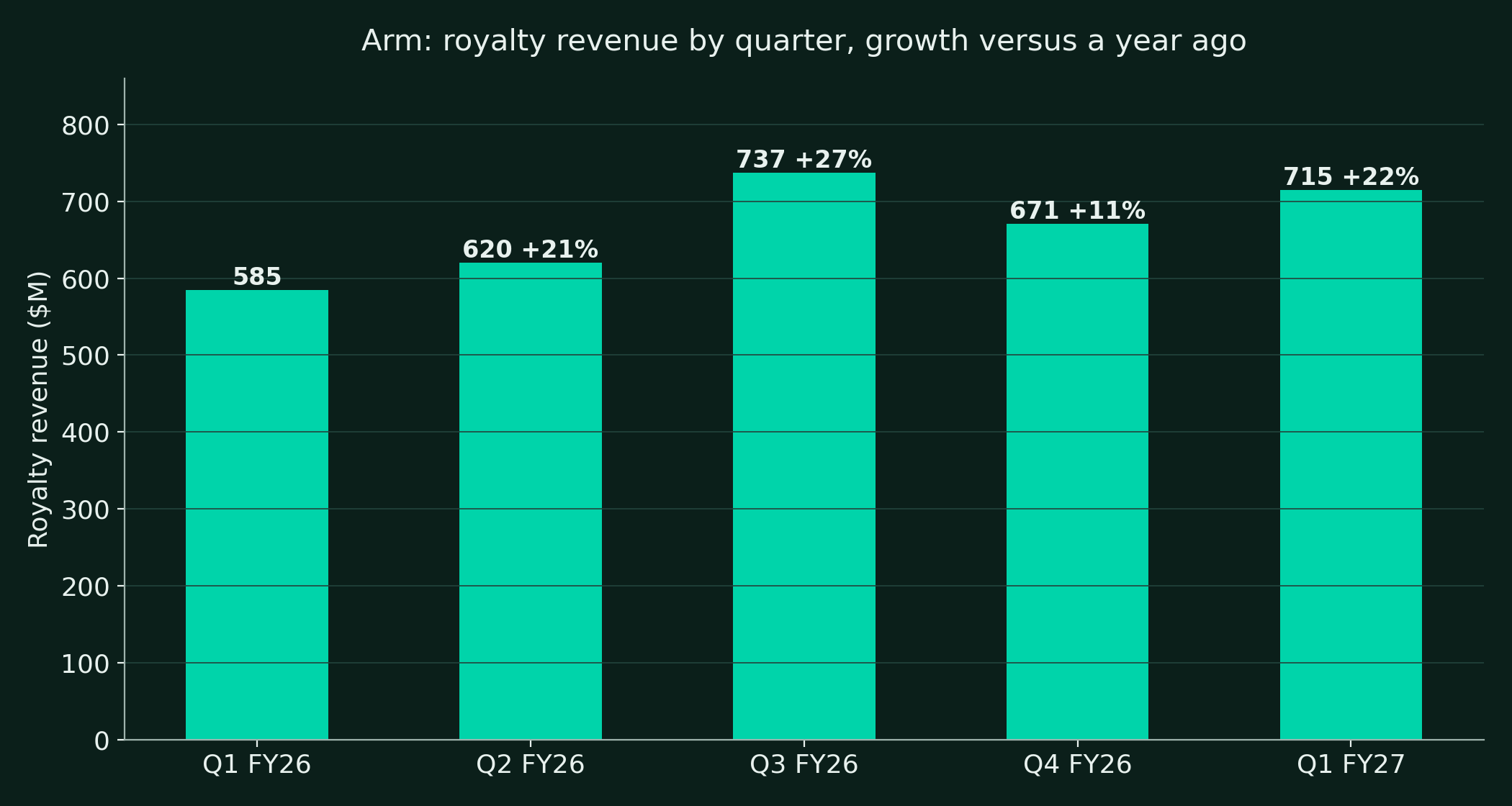
- Five straight quarters above $585M.
- The Q4 dip is seasonal, not structural.
- The growth rate swings with phone launches.
- The dollar line keeps setting records.
How fast is Arm taking the data center?
The data center is where the story changed.
- Arm claims about 50% of CPU compute at top hyperscalers.
- The company stated that share in May 2026.
- The measure is compute share, not revenue share.
- Mercury Research still gives x86 about 87% of server CPU revenue.
- Both numbers can be true at once.
- Hyperscaler in-house chips carry no merchant chip price.
- Arm wins the units first. The revenue follows slowly.
The partner bench, name by name
| Program | Status at October 2026 | What it contributes |
|---|---|---|
| AWS Graviton5 | Announced December 2025, 192 cores | The volume anchor of Neoverse |
| Google Axion | Host CPU for TPU v8 systems | Training and inference host share |
| Microsoft Cobalt 200 | In production, built on Neoverse CSS | Azure fleet share across regions |
| NVIDIA Vera | In full production, Rubin shipping | The CPU seat in the flagship AI rack |
| NVIDIA RTX Spark | First agentic PC on CSS | A new PC category on Arm |
| Qualcomm Dragonfly C1000 | Announced, entering data center CPUs | A licensee turned platform rival |
- AWS signed Meta to tens of millions of Graviton5 cores.
- Google is replacing x86 host CPUs with Axion in TPU systems.
- Microsoft says Cobalt 200 will power 35% to 40% of new Azure deployments in 2026.
- That figure is a Microsoft claim, not an Arm disclosure.
- NVIDIA Vera entered full production this year.
- Vera Rubin systems began shipping in August 2026.
- Each program pays Arm a royalty per chip.
- None of them can leave without redesigning a fleet.
The ecosystem point
IDC reports that spending on Arm-based accelerated server platforms has passed x86 platforms. Arm cited that data in its June quarter letter. The direction of travel is no longer in dispute. The speed is.
Why is Arm selling its own chip now?
On March 24, 2026, Arm broke its own model.
- Arm launched the Arm AGI CPU at its Arm Everywhere event.
- It is the first production chip Arm has ever sold.
- The chip targets agentic AI data centers.
- Meta is the lead partner and co-developer.
- OpenAI, Cerebras, Positron, and Rebellions are also integrating it.
- Commercial systems are orderable from Lenovo, Supermicro, Quanta, and ASRock.
- Arm claims more than twice the performance per rack of x86 platforms.
- That claim rests on Arm internal estimates.
Demand versus supply
- Demand across fiscal 2027 and 2028 now tops $2B.
- Arm doubled that figure within weeks of launch.
- The word demand matters. This is pipeline, not contracted backlog.
- Arm guides to about $1B of revenue from the program.
- Supply is the binding limit, not orders.
- Arm has secured capacity for the $1B plan.
- First silicon reached multiple customers by the June quarter.
- Meaningful chip revenue is a fiscal 2028 event.
Why the move cuts both ways
- A chip sale books the full price, not a 2% to 4% royalty.
- The revenue per socket is many times larger.
- The margin is far lower than IP margin.
- Arm guides AGI CPU margins near 30% at scale.
- IP margins run near 65% on the same non-GAAP basis.
- Licensees now compete with their own supplier.
- Qualcomm's Dragonfly entry shows the tension.
- The fiscal 2031 plan makes silicon more than half the company.
- Section 10 audits that plan line by line.
How much of Arm runs through Arm China and SoftBank?
Arm China is the oldest complication in the story.
- Arm China runs the China business under an IP license.
- Arm transferred its direct Arm China stake to a SoftBank subsidiary in 2022.
- Arm now holds only a small indirect interest.
- It owns 10% of Acetone Limited, the vehicle that holds about 48% of Arm China.
- That gives Arm an indirect interest near 4.8%.
- The stake sits on the books at $56.5M under the fair value option.
- Arm does not control Arm China and does not consolidate it.
- Arm China pays Arm for the IP like any large licensee.
- That payment is real revenue with a governance shadow.
- The fiscal 2026 annual report puts Arm China at about 16% of total revenue.
- The share was 17% in fiscal 2025 and 21% in fiscal 2024.
- Arm China remains the largest single customer.
- Governance lawsuits from the Allen Wu era remain partly on appeal.
The wider related party web
- Axis Intelligence counted $1,499M of fiscal 2026 revenue from related parties.
- That is 30.5% of the $4,920M total.
- The count covers Arm China and SoftBank-controlled entities.
- The SoftBank design services deal pays about $200M a quarter.
- It added $200M to Q3 FY2026 licensing.
- It added $193M to Q1 FY2027 licensing.
- Third-party revenue grew far slower than the headline 23%.
- Axis calculates third-party growth of about 7% for fiscal 2026 once related parties are stripped out.
- That calculation is theirs, not an Arm disclosure.
- It is still the sharpest question on the licensing line.
The quality question
A third of revenue comes from the owner's family of companies. The cash is real and the contracts are disclosed. The durability is the debate. Stargate-linked demand must convert into third-party royalties before skeptics retire this point.
Where does the Qualcomm case stand?
The license dispute is now two trials old.
- Qualcomm builds its Oryon cores under a 2019 architecture license.
- The cores came with the Nuvia purchase in 2021.
- Arm sued in 2022, saying the license did not transfer.
- A December 2024 jury cleared Qualcomm on the core claims.
- A judge later ruled for Qualcomm in that case, and Arm has appealed.
- Qualcomm had also sued Arm in 2024 over delivery duties under its own license.
- That second case opened at trial on October 5, 2026, in Delaware.
- The jury ruled on October 13, 2026.
- It found Arm breached the license agreement by failing to deliver software patches and tools.
- It found Arm interfered with Qualcomm's Meta relationship.
- Damages were nominal. The award was $2 in total.
- Arm won on the other breach allegations.
- The money question is still open.
- Qualcomm asks the court to suspend its royalties for up to five years.
- Judge Noreika heard closing arguments on October 20, 2026.
- Her ruling had not landed when this report was written.
What is at stake
- Qualcomm pays Arm about $443M a year, on one published estimate.
- That is about 9% of fiscal 2026 revenue.
- The suspended-royalty claim runs near $300M a year.
- Five years of suspension is about $1.5B of revenue at risk.
- The $2 verdict makes a large damages award unlikely.
- The suspension remedy is the real exposure.
- A suspension would also invite other licensees to test their contracts.
- The precedent matters more than the dollars.
Has Arm delivered on its roadmap?
Arm has made five testable promises. Here is the score.
| Promise | Set | State at October 2026 | Score |
|---|---|---|---|
| About 50% of hyperscaler CPU compute | 2025 | Claimed at about 50% in May 2026 | Met, on Arm's own measure |
| Fiscal 2027 royalty growth near 20% | February 2026 | Cut to high teens in July 2026 | Cut |
| AGI CPU demand above $1B | March 2026 | Demand above $2B by mid 2026 | Beaten |
| AGI CPU revenue near $1B by fiscal 2028 | March 2026 | Capacity secured, revenue pending | Pending |
| Fiscal 2031 revenue above $25B | March 2026 | Year one of a five year plan | Pending |
The fiscal 2031 plan, decomposed
Arm set the plan at the March 24, 2026 launch event and has repeated it since. The pieces are these.
The plan targets total revenue above $25B by fiscal 2031, with IP and CSS revenue near $10B of that total and AGI CPU silicon revenue near $15B. It holds IP non-GAAP operating margin near 65% and silicon non-GAAP operating margin near 30%, with group non-GAAP EPS above $9. It also calls for more than 30 new AGI CPU customers and annual IP research spending near $1.4B.
The IP leg needs royalty and licensing growth to hold near current rates, and that leg looks demanding but plausible. The silicon leg starts from zero in fiscal 2026 and must reach $15B in five years against NVIDIA, AMD, and its own licensees. The silicon leg does most of the work in the plan, and it is also the leg with the least proof, which is why our scenarios in section 16 price the plan at three speeds.
ACV, the quiet gauge
ACV grew 28% in the strongest fiscal 2026 quarters and 22% across fiscal 2026, then slowed to 13% in Q1 FY2027. Management calls mid-teens the long-term rate, and the gauge is gliding toward that rate, though licensing lumpiness hides the glide in any single quarter. A second straight quarter near 13% would confirm the slower path.
How do x86 and RISC-V stack up against Arm?
Arm has three rivals. Only one ships against it today.
x86, the incumbent
Intel and AMD still take about 87% of server CPU revenue, and Mercury Research holds that figure for early 2026. x86 owns the enterprise installed base, but its share of new hyperscaler designs is falling fast, because the fight is over new capacity rather than the installed base. Arm wins most new in-house hyperscaler designs, while x86 keeps the merchant market by default.
RISC-V, the open rival
RISC-V charges no license fee and no royalty, so the architecture is free, but the ecosystem is not. Gartner put RISC-V near 2.6% of total silicon units in 2025, an estimate Deloitte relayed this year, and unit growth runs near 30% a year off a small base. The strength sits in embedded controllers and China designs, and Andes alone has shipped more than 19 billion RISC-V cores.
No hyperscaler runs production AI fleets on RISC-V, and SiFive, Ventana, and Tenstorrent lead the commercial push. The threat is real at the low end today. It reaches servers only if the software support matures.
The licensee as rival
Qualcomm now sells data center CPUs against Arm's own chip, and Apple designs the cores Arm only licenses, so every architecture licensee is a potential platform rival. Arm's answer is CSS and now silicon. Both answers raise Arm's take per socket, and both raise the friction with the bench.
| Rival set | Share evidence | Threat horizon |
|---|---|---|
| x86 in server CPU revenue | About 87%, Mercury Research | Falling in new designs |
| Arm in hyperscaler CPU compute | About 50%, Arm claim | Already the standard |
| RISC-V in total silicon units | About 2.6%, Gartner via Deloitte | Embedded now, servers later |
| Arm in premium smartphone units | Above 99%, Arm claim | Saturated, rate-led growth |
How should investors grade Haas, Child, and SoftBank control?
The operators
- Rene Haas has been CEO since February 2022.
- He ran the IP products group before the top job.
- His record is three straight years of 20% plus revenue growth.
- He also owns the AGI CPU pivot and its execution risk.
- Jason Child has been CFO since November 2022.
- He held the same job at Splunk and Groupon.
- The July 2026 guidance trim was his call to make early.
- Dipesh Patel retired as chief commercial officer in May 2026.
- Mohamed Awad succeeded him.
- No other named executive change surfaced in 2026 filings.
The owner
- SoftBank owns about 86% of the shares.
- The exact filing figure is 922,733,999 shares as of May 2026.
- The public float is about 143M shares, near 13%.
- Arm is a controlled company under Nasdaq rules.
- SoftBank can name up to seven directors while it holds over 70%.
- Masayoshi Son sits on the board.
- Public holders cannot outvote the owner on anything.
- Haas told the February 2026 call that Son has no interest in selling.
- That was a report of a conversation, not a commitment.
- In September 2026, SoftBank raised its Arm-backed margin loan to $25B.
- Bloomberg reported the loan, secured by about 769M Arm shares.
- The loan matures in September 2027.
- It funds SoftBank's other AI bets, including OpenAI.
- A falling Arm price tightens that loan.
- The pledge is SoftBank's debt, not Arm's.
- It still hangs over the float every day.
The float problem
About 12% of the float is sold short, on the October 15, 2026 settlement. A thin float, a pledged controlling stake, and a rich multiple are a volatile mix. The October slide and rebound both showed it.
How strong is the balance sheet?
- Cash and short-term investments total $3,888M.
- That figure is from the June 30, 2026 letter.
- Borrowings are negligible.
- Lease obligations run near $464M.
- Total liabilities are about $2.6B against $11.2B of assets.
- The current ratio sits near 6 times.
- Arm carries no credit rating drama and no maturity wall.
- The company pays no dividend.
- The company runs no buyback.
- Share count creeps up about 1% a year on stock pay.
- Net cash is near $3.4B on market data.
- This is the cleanest balance sheet in large-cap semiconductors.
- The fortress grade in the pillar report rests on these lines.
Where does the cash go, and what does stock pay take out?
Cash generation is real. So is the pay bill that rides on it.
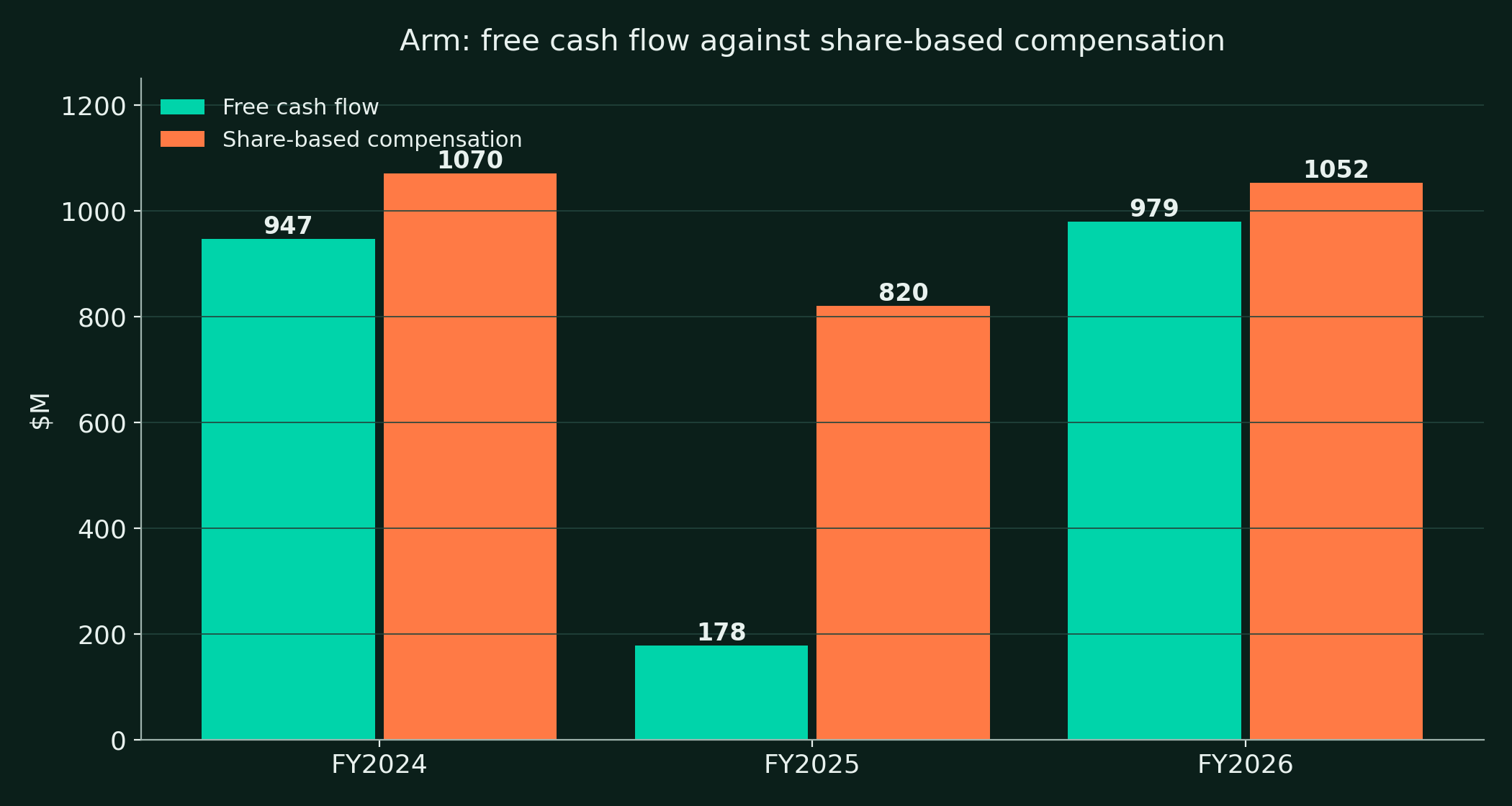
| $M | FY2024 | FY2025 | FY2026 |
|---|---|---|---|
| Operating cash flow | 1,090 | 397 | 1,520 |
| Free cash flow | 947 | 178 | 979 |
| Share-based compensation | 1,070 | 820 | 1,052 |
- Free cash flow here is operating cash flow less capital spending.
- The annual lines follow TipRanks cash flow data.
- Fiscal 2025 free cash flow fell on a large tax payment.
- Arm's own non-GAAP free cash flow prints differ.
- Arm put fiscal 2026 non-GAAP free cash flow near $882M.
- It put the trailing twelve months at about $1.4B in July 2026.
- Q1 FY2027 alone delivered $665M of non-GAAP free cash flow.
- Collections timing flattered that quarter.
- The harder line sits below the cash flow.
- Stock pay topped $1B in two of the last three years.
- Stock pay exceeded GAAP operating income in fiscal 2026.
- GAAP operating income was $900M that year.
- SBC ran to $1,052M on the annual report figures.
- In Q1 FY2027, stock pay was $343M in a single quarter.
- GAAP operating income in that quarter was $91M.
- The gap between GAAP and non-GAAP profit is mostly this one line.
- None of this makes the cash fake.
- It makes the share count the real cost.
- Owners are diluted about 1% a year with no buyback offset.
- At 243 times GAAP earnings, owners also fund the pay bill through the multiple.
- The pillar report grades this line PARTIAL for exactly that reason.
What is Arm worth at $235.90?
Here is what $235.90 buys, line by line.
| Multiple at $235.90 | Value | Basis |
|---|---|---|
| Market cap | $251.9B | 1,068M ADS |
| Trailing P/E, GAAP | 243x | TTM EPS of $0.97 |
| Price to trailing sales | About 49x | TTM revenue of $5.16B |
| Forward P/E, non-GAAP | About 106x | Fiscal 2027 consensus EPS of $2.23 |
| Forward P/E, fiscal 2028 | About 78x | Consensus EPS of $3.02 |
| Price to fiscal 2027 sales | About 42x | Consensus revenue of $6.06B |
| Analyst mean target | $290.71 | S and P Global, 43 analysts |
- Consensus sees fiscal 2027 revenue of about $6.06B.
- That is growth of about 23%.
- Consensus sees fiscal 2028 revenue near $8.21B.
- That figure rests on one consensus summary and is softer than the fiscal 2027 line.
- The stock trades at 47.9% below its 52-week high.
- The high was $452.70 on June 18, 2026.
- It trades 136% above its 52-week low of $100.02.
- Even after a 48% fall, the multiple leads the sector by a wide margin.
- NVIDIA trades near a third of Arm's sales multiple.
- The comparison is unfair on growth and still instructive.
- Arm must outgrow the multiple for years to meet it.
- The fiscal 2031 plan is the only path that does.
- At $235.90, the market already pays for much of that path.
- A $9 EPS in fiscal 2031 at 35 times earnings is $315 of value.
- Discounted back at 10% a year, that is about $235 today.
- The price is the plan, with no margin for a stumble.
What are the FY2029 bear, base, and bull targets?
Targets use the fiscal year ending March 31, 2029. The method is EPS times multiple. EPS here is non-GAAP diluted EPS, the basis Arm guides on.
| Scenario | FY2029 EPS | Multiple | Target | Path in words |
|---|---|---|---|---|
| Bear | $3.50 | 26x | $91 | Royalty suspension lands, phones stay weak, silicon slips |
| Base | $4.60 | 45x | $207 | High-teens royalties, silicon ramps on the $1B plan and beyond |
| Bull | $5.80 | 55x | $319 | The fiscal 2031 plan pulls forward, silicon demand converts at scale |
- The consensus path runs $2.23 for fiscal 2027 and $3.02 for fiscal 2028.
- Base fiscal 2029 EPS of $4.60 grows 52% off that path.
- It needs AGI CPU revenue to become a second engine by fiscal 2029.
- It keeps the glide toward $9 of EPS by fiscal 2031 intact.
- Bear EPS of $3.50 grows only 16% off fiscal 2028.
- The bear case assumes a partial Qualcomm suspension and a lost silicon year.
- Bull EPS of $5.80 grows 92% off fiscal 2028.
- The bull case assumes the $2B demand line converts and then doubles again.
- Against the $235.90 reference price, base is 12% lower.
- Bull is 35% higher. Bear is 61% lower.
- That spread is the honest shape of this stock.
- The downside case is a de-rating, not a business failure.
- The upside case is a plan delivered two years early.
What does the chart say?
- The October 28 close was $235.90, up 4.10% on the day.
- The close retook the 200-day average near $227.82.
- The 50-day average sits near $260.04, above the price.
- The 20-day average sits near $252.22.
- RSI on 14 days reads 44.21, neutral.
- The month low close was $210.10 on October 22.
- The shares fell about 21% across the mid-October chip selloff.
- A hot September CPI print started the slide.
- AI financing fears kept it going.
- The stock is up about 116% in calendar 2026.
- It is still 48% below the June record.
- Short interest runs near 12% of the float.
- The chart says the trend broke and is repairing.
- The averages say resistance starts near $252 and builds to $260.
- The fundamentals say the November 4 print matters more than either line.
What are the main risks?
Valuation risk. The price pays for the fiscal 2031 plan, and a single guidance trim cost 28% in July 2026. Rate risk. At this duration, hot inflation prints hit Arm first and hardest, as October showed.
Qualcomm risk. A royalty suspension ruling could remove about $300M of yearly revenue for up to five years. Precedent risk. A Qualcomm win on suspension invites other licensees to litigate their own rates, so one ruling can reopen contracts across the bench.
Silicon execution risk. The AGI CPU is Arm's first chip, and yield, supply, and support all sit with partners Arm does not control. Licensee friction risk. Arm now competes with the customers who pay its royalties.
Related party risk. About 30.5% of fiscal 2026 revenue came from Arm China and SoftBank entities, on the Axis count. China risk. Arm China is outside Arm's control and operates under export rules that can tighten. Smartphone risk. Phones still drive the royalty base, and memory prices and unit falls hit royalties within two quarters.
Float risk. SoftBank's $25B margin loan is secured by Arm shares, and a deep price fall could force selling into a thin float. RISC-V risk. The open rival takes embedded share today and aims higher as its software stack matures.
What should investors watch next?
- Watch November 4. Q2 FY2027 results land after the close.
- Watch the royalty growth line against the high-teens guide.
- Watch Judge Noreika. Her suspension ruling can land any week.
- Watch AGI CPU capacity news. Upside starts with supply.
- Watch ACV. A second quarter near 13% confirms the slower licensing path.
- Watch the SoftBank loan into its September 2027 maturity.
- Watch Arm China. Its revenue share and its governance both matter.
- Watch smartphone builds into the spring launch season.
The conclusion, in short:
- Arm owns the CPU layer of the AI era.
- The royalty machine is compounding and the rates keep rising.
- The silicon pivot could double the company or strain the model that made it.
- The balance sheet is a fortress and the float is a trapdoor.
- At $235.90 the market pays today for fiscal 2031 delivery.
- Our score of 54/100 says the business deserves a premium the price has already spent.
Frequently asked questions
Is Arm stock cheap at $235.90?
No. The stock trades at 243 times trailing GAAP earnings and about 49 times trailing sales. It has fallen 48% from its June 2026 high and still prices in most of the fiscal 2031 plan. Cheap would need either a much lower price or two years of delivery at the current one.
What is the biggest risk in Arm?
The Qualcomm ruling is the nearest risk. A royalty suspension could remove about $300M of revenue a year for up to five years and invite other licensees to sue. The largest risk is valuation. The price assumes the fiscal 2031 plan lands on time, and the silicon leg of that plan starts from zero.
How much of Arm does SoftBank own?
SoftBank owns about 86% of the shares, per the fiscal 2026 annual report. The public float is about 143M shares, near 13% of the total. SoftBank has also pledged about 769M Arm shares against a $25B margin loan, as Bloomberg reported in September 2026.
Disclosures
- This report is research and opinion.
- It is not investment advice.
- DalalBytes Research. For educational purposes only. Not investment advice.
- Numbers come from company filings, company releases, and named press reports.
- Estimates are labeled as estimates where they appear.
- Management targets are labeled as targets. They are not results.
- The author holds no position in Arm Holdings at the time of publication.