
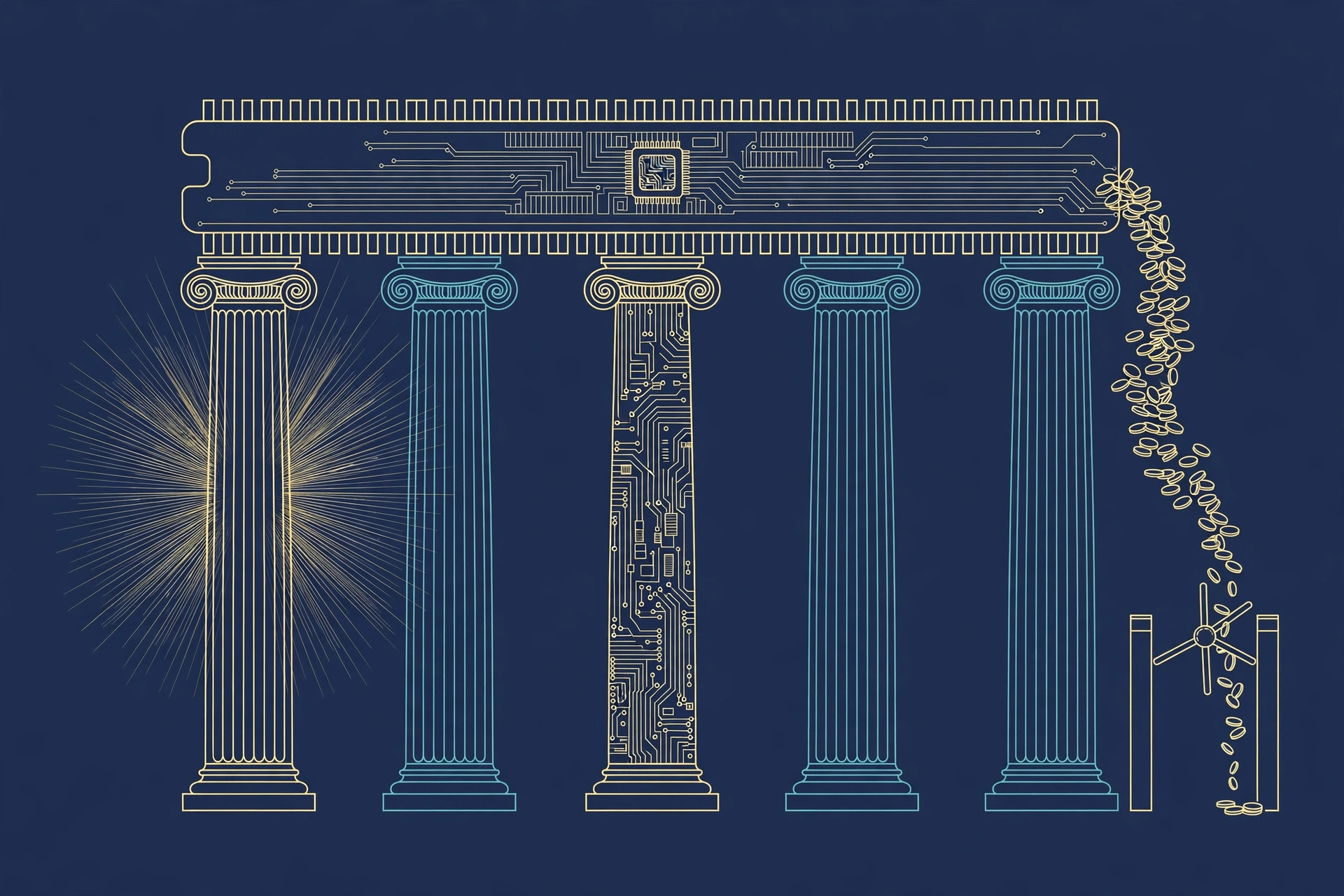
What is the five-pillar scorecard?
Three pass, two partial, no fails. The pillars grade the business, not the price. The price is graded in the investment report, and it is why the score stops at 54/100.
What would change the score. Royalty growth re-accelerating above the high-teens guide as the data center mix rises, at a price that no longer pre-pays the fiscal 2031 plan, would lift the score, while a Qualcomm royalty suspension or another guidance cut that leaves the multiple carrying the plan alone would cut it.
| 54/100 | DalalBytes score |
| 3 pass | 2 partial, 0 fail |
| $235.90 | Reference price, Oct 28, 2026 close |
| $91 / $207 / $319 | FY2029 bear / base / bull |
| Pillar | Grade | The one-line reason |
|---|---|---|
| 1. Sunrise | PASS | AI lifts CPU demand in every market Arm serves |
| 2. Leadership | PARTIAL | Strong operators under a controlling owner |
| 3. Moat | PASS | The architecture is the industry standard |
| 4. Iron Fortress | PASS | Net cash, no borrowings of size, no maturity wall |
| 5. Free Cash Flow | PARTIAL | Real cash flow, consumed by stock pay above $1B |
The business grades far better than the stock, and that gap is the whole report. Each pillar below carries its own evidence. Claims made by management are labeled as claims, and filed numbers carry the grades.
Pillar 1, Sunrise industry: why does it pass?
The sunrise test asks one question. Is the industry itself rising?
- AI raises CPU demand beside every accelerator.
- Agent workloads need CPUs to plan, fetch, and check.
- Arm stated that logic at its March 2026 event.
- Data center royalties more than doubled for two straight years.
- Neoverse core shipments hit 1.5 billion by June 2026.
- The last 500 million cores shipped in nine months.
- IDC says Arm-based accelerated server spending has passed x86.
- Phones add AI features that favor v9 and CSS rates.
- Cars add driver assistance that runs on Arm.
- Robots and edge devices add a fourth demand leg.
- Revenue grew 24% in fiscal 2025 and 23% in fiscal 2026.
- Q1 FY2027 grew 22% more.
- Three straight years above 20% is a sunrise with proof.
The grade
PASS. Every end market Arm serves is growing, and the newest one, AI infrastructure, grows fastest. The risk in this stock is not demand.
Pillar 2, Leadership: why only partial?
The leadership test asks two questions. Can the operators execute? And do outside owners share control?
The execution half
- Rene Haas has led Arm since February 2022.
- Revenue has more than doubled on his watch.
- The CSS strategy came from his team.
- The AGI CPU pivot is bold and early, not late.
- Jason Child runs a tight cost line as CFO.
- Non-GAAP operating margin reached about 49% in Q4 FY2026.
- He cut the fiscal 2027 royalty guide early, in July 2026.
- Early cuts grade better than late surprises.
- Dipesh Patel retired in May 2026 after long service.
- The succession to Mohamed Awad was orderly.
The control half
- SoftBank owns about 86% of the shares.
- Arm is a controlled company under Nasdaq rules.
- SoftBank can name up to seven directors.
- The float is about 13% of the company.
- Outside owners hold no blocking power on any vote.
- The owner has pledged about 769M shares to a $25B margin loan.
- Bloomberg reported that loan in September 2026.
- The pledge funds the owner's other bets.
- Arm's board cannot unpledge a single share.
- Licensing deals with the owner's group add about $200M a quarter.
- Those deals are disclosed and priced as related party work.
- They still blur the line between customer and owner.
The grade
PARTIAL. The operators earn a pass on delivery. The structure fails the control test. One grade must carry both facts, and PARTIAL is the honest middle.
Pillar 3, Moat: why does it pass?
The moat test asks one question. What does a customer lose by leaving?
The Arm architecture is the default CPU standard outside x86 servers, with more than 350 billion Arm-based chips shipped and more than 22 million developers writing for Arm. Software compiled for Arm does not run on rivals without work. A hyperscaler leaving Arm redesigns chips, boards, and fleets, and AWS, Google, Microsoft, and NVIDIA all deepened Arm programs in 2026.
Armv9 lifts royalty rates about two times over v8 in phones, and CSS lifts them again while shortening design cycles. Total Access licenses rose from 44 to 56 in fiscal 2026, and Flexible Access licenses rose from 314 to 329. Premium Android phones run v9 at above 99% penetration, so the rate lift now applies to nearly the whole premium base.
The moat now includes a services and silicon layer, and the AGI CPU gives Arm a direct seat in the rack. RISC-V is free and still near 2.6% of silicon units, and its software ecosystem trails Arm by a decade. Qualcomm's lawsuit attacks one contract, not the standard, and even Qualcomm keeps designing on Arm while it sues.
The grade
PASS. Standards with this installed base do not fall to a cheaper rival or a single lawsuit. The moat widens each time a partner tapes out a CSS design.
Pillar 4, Iron Fortress: why does it pass?
The fortress test asks one question. Can the balance sheet survive a bad year?
- Cash and short-term investments total $3,888M.
- The figure is from the June 30, 2026 shareholder letter.
- Borrowings are negligible.
- Lease obligations run near $464M.
- Total liabilities are about $2.6B.
- Total assets are about $11.2B.
- The current ratio sits near 6 times.
- There is no maturity wall to refinance.
- There is no dividend promise to defend.
- Revenue would need to halve before cash became a question.
- Even the bear case in the investment report keeps Arm profitable on a non-GAAP basis.
- The fortress has one crack, and it sits outside the walls.
- The controlling owner's margin loan is secured by Arm shares.
- A forced sale would hit the float, not the balance sheet.
- The loan is SoftBank's liability.
- Arm's own house is in order.
The grade
PASS. Graded on Arm's own balance sheet, this is the strongest fortress in large-cap semiconductors. The pledge overhang is graded under Leadership and Risks, where it belongs.
Pillar 5, Free Cash Flow: why only partial?
The cash test asks two questions. Does the business print cash? And what does the pay model take back?
The print half
- Operating cash flow reached $1,520M in fiscal 2026.
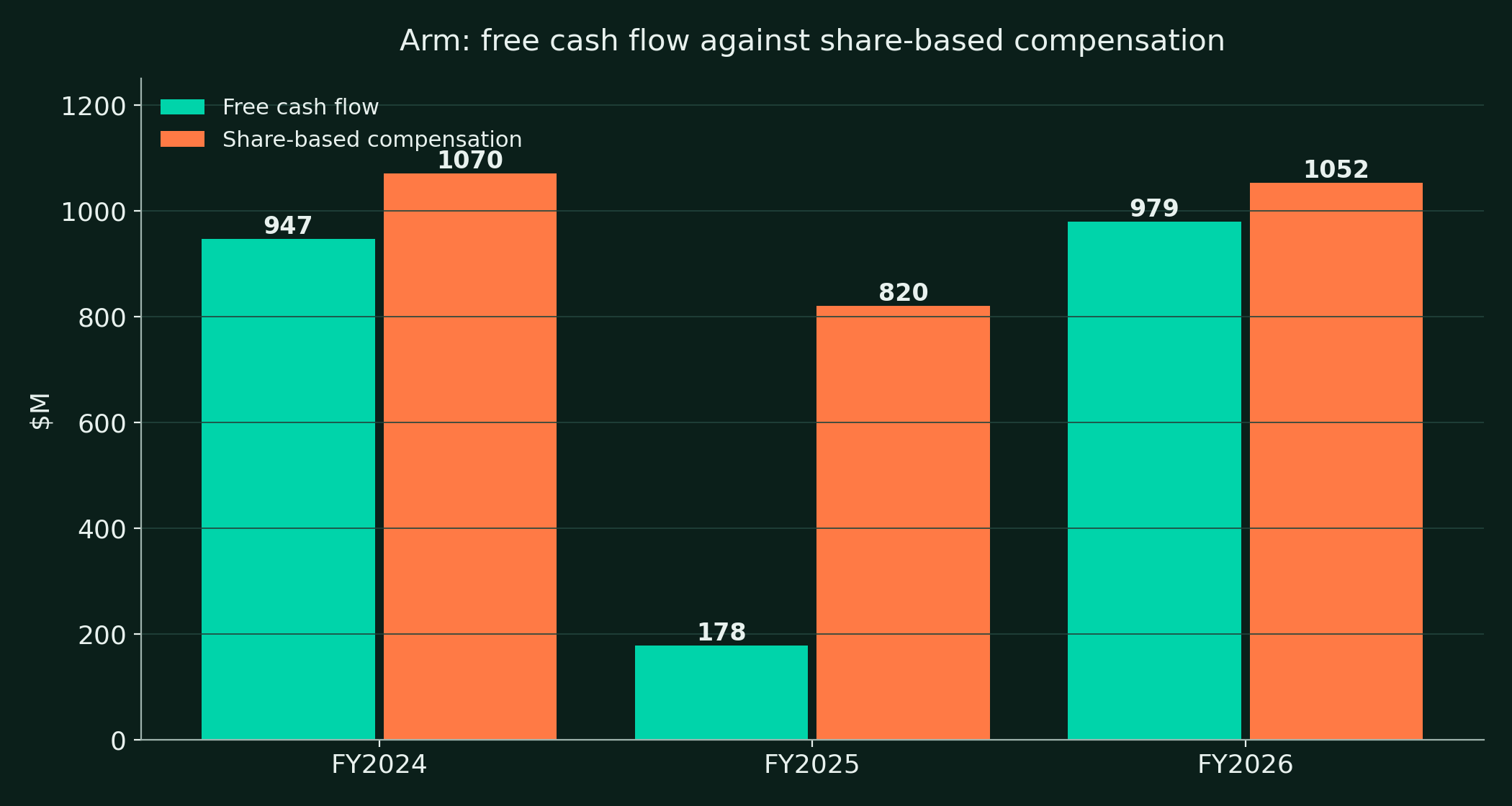
- Free cash flow reached $979M on the same basis.
- Arm's non-GAAP free cash flow was near $882M.
- Q1 FY2027 added $665M more in one quarter.
- Trailing twelve month non-GAAP free cash flow is about $1.4B.
- Gross margin runs near 97% on a GAAP basis.
- The model needs almost no capital to grow the IP side.
- Fiscal 2025 showed the weak spot.
- A large tax payment cut free cash flow to $178M that year.
The take-back half
- Stock pay ran to $1,052M in fiscal 2026.
- It topped $1B in two of the last three years.
- Stock pay exceeded GAAP operating income in fiscal 2026.
- GAAP operating income was $900M.
- Q1 FY2027 stock pay was $343M in one quarter.
- GAAP operating income that quarter was $91M.
- The share count rises about 1% a year.
- No buyback offsets the rise.
- An owner counting only non-GAAP profit overstates the claim.
- An owner counting GAAP profit understates the cash.
- The truth sits between, and it moves with the share price.
The grade
PARTIAL. The cash is real and growing. The dilution is also real and growing. A PASS needs stock pay back under a fifth of revenue with a buyback beside it. Neither is in sight.
What would change the grades?
- Leadership rises to PASS if the float grows by a real secondary sale.
- It also rises if related party licensing falls below a fifth of revenue.
- Leadership falls to FAIL if the margin loan forces share sales.
- Free Cash Flow rises to PASS if stock pay falls below free cash flow for a full year.
- It falls to FAIL if silicon working capital turns free cash flow negative.
- Moat falls to PARTIAL if Judge Noreika grants the five year royalty suspension.
- It also falls if a hyperscaler moves a flagship program to RISC-V.
- Sunrise falls to PARTIAL if data center royalty growth halves for two straight quarters.
- Iron Fortress falls only if Arm takes on real debt to fund the silicon build.
- The score rises fastest on delivery, not on hope.
- Two years of fiscal 2031 plan delivery at this price lifts the score into the 60s.
- The same delivery at a lower price lifts it further.
Frequently asked questions
Why does Leadership grade only partial when Arm keeps beating its numbers?
The operators deliver. Rene Haas has doubled revenue and Jason Child guides early and honestly. The grade falls on structure, not performance. SoftBank owns about 86% of the shares, names up to seven directors, and has pledged about 769M shares to a $25B margin loan. Outside owners hold no blocking power.
Why does Free Cash Flow grade partial when Arm prints cash every year?
The cash is real. Free cash flow was $979M in fiscal 2026 and trailing non-GAAP free cash flow is about $1.4B. The offset is stock pay of $1,052M in fiscal 2026, which topped GAAP operating income of $900M. Owners gain cash and lose share count at the same time, and no buyback repairs the count.
What would move the overall score the most?
Delivery on the fiscal 2031 plan at the current price. Two years of high-teens royalty growth with AGI CPU revenue ramping would lift the score into the 60s. A Qualcomm royalty suspension or a forced SoftBank share sale would cut it the fastest.
Disclosures
- This report is research and opinion.
- It is not investment advice.
- DalalBytes Research. For educational purposes only. Not investment advice.
- Numbers come from company filings, company releases, and named press reports.
- Estimates are labeled as estimates where they appear.
- Management targets are labeled as targets. They are not results.
- The author holds no position in Arm Holdings at the time of publication.