
What is the five-pillar scorecard?
Three pass, two partial, no fails. The pillars grade the business, not the price. The price is graded in the companion investment report, and the split on this scorecard is the whole Amazon argument in miniature, with operations at the top of the library and the cash pillars carrying the buildout bill.
What would change the score. The score rises if AWS growth holds at or above 40% through 2027 while trailing free cash flow turns positive and management puts a number on 2027 capex near the 2026 level, and it falls if AWS growth slips below 30%, if gross debt climbs past $225B without a dated free cash flow inflection, or if the Anthropic stake converts into listed equity worth materially less than its $238.7B carrying value.
| 74/100 | DalalBytes score |
| 3 pass | 2 partial, 0 fail |
| $240.35 | Reference price. October 30 2026 close |
| $125 / $305 / $455 | Fiscal 2029 bear / base / bull |
| Pillar | Grade | The one-line reason |
|---|---|---|
| 1. Sunrise | PASS | Cloud, AI and digital ads are all still rising |
| 2. Leadership | PASS | Margin expansion plus a delivered AWS re-acceleration |
| 3. Moat | PASS | Scale, silicon and switching costs compound |
| 4. Iron Fortress | PARTIAL | $180.9B of gross debt face value against $114.2B of liquid assets |
| 5. Free Cash Flow | PARTIAL | Record operating cash flow, negative trailing free cash flow |
The business grades near the top of the DalalBytes library on the three operating pillars. Each pillar below carries its own evidence, with filed numbers carrying the grades and management claims labeled as claims.
Pillar 1, Sunrise: why does it pass?
The sunrise test asks one question. Is the industry itself rising?
- Cloud demand is re-accelerating at the largest provider. AWS growth rose for six straight quarters to 39.3% in Q3 2026.
- The AWS backlog reached $578B at September 30, 2026, growing at a triple-digit rate year over year on management's account.
- Management guides AWS growth above 40% in both 2027 and 2028.
- AI services are the fastest layer. Bedrock token volume grew nearly 17 times year over year.
- Digital advertising keeps compounding. Amazon's ad line reached $76.1B trailing by Q2 2026.
- The rivals confirm the tide rather than refute it. Google Cloud grew 103% and Azure grew 48% in the same quarter.
- Custom silicon is a rising industry inside the industry, and Amazon's Trainium line is fully subscribed.
- A sunrise this strong forgives many execution sins. Amazon has needed less forgiveness than most.
Pillar 2, Leadership: why does it pass?
- Andy Jassy has led Amazon since July 2021, after running AWS from its founding era.
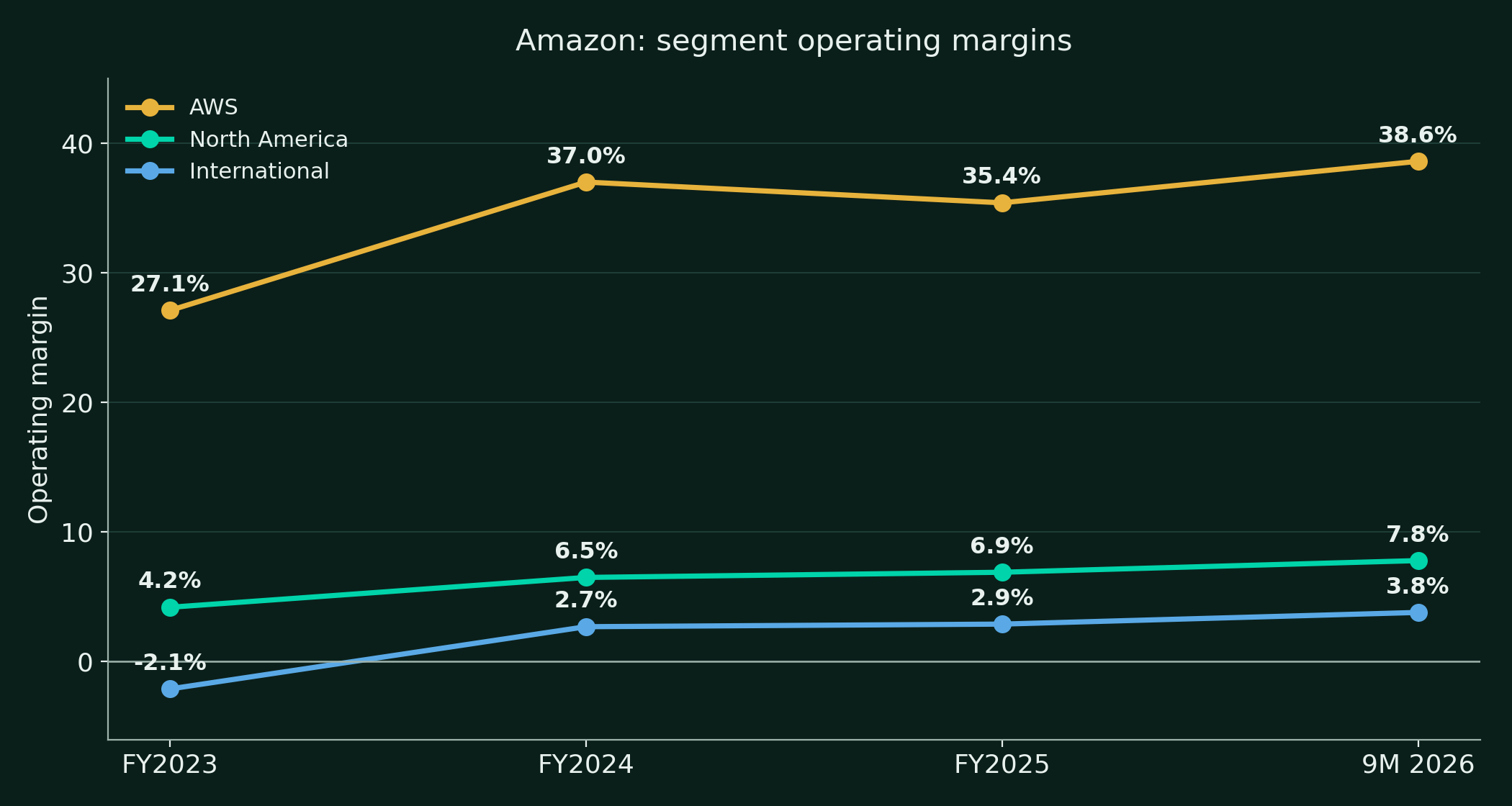
- The margin rebuild is delivered, not promised. North America segment margin rose from 4.2% in fiscal 2023 to 7.7% in Q3 2026.
- International swung from a $2.7B operating loss in fiscal 2023 to a $4.7B profit in fiscal 2025.
- Quarterly guidance was beaten on sales and operating income in all three reported quarters of 2026.
- The AWS re-acceleration was framed by management at 24% growth in Q4 2025 and delivered to 39.3% by Q3 2026.
- The silicon program was built under this team, from a standing start to 1.4 million Trainium2 chips landed and fully subscribed.
- The deduction is capital communication. The 2026 capex guide rose from about $200B to about $220B, and 2027 is guided only as meaningfully more.
- A second deduction is concentration of judgment. The Anthropic and OpenAI commitments, about $103B combined, are strategy set at the very top.
- The grade is PASS on the delivery record, with the capex opacity flagged rather than buried.
Pillar 3, Moat: why does it pass?
- AWS holds the largest cloud revenue base at $46.0B in Q3 2026 and the highest cloud operating margin of the three hyperscalers at 38.7%.
- Switching costs are structural. Data gravity, staff skills and committed contracts keep workloads in place.
- Trainium is exclusive capacity. Anthropic's compute commitment of at least $110.0B through 2036 prices what that exclusivity is worth.
- The commerce moat is density. Prime membership, 61% third-party unit mix and the regionalized fulfillment network reinforce each other.
- Advertising monetizes purchase intent at the point of decision, a position rivals cannot buy with capex.
- Segment operating margins price the moat in numbers, shown in the chart below.
- The moat is contested on growth rate. Azure and Google Cloud grow faster off smaller bases.
- Contested is not breached. AWS added more revenue dollars in Q3 2026 than either rival's growth implies on its own base.
- The grade is PASS.
Pillar 4, Iron Fortress: why only partial?
- Cash and marketable securities were $114.2B at September 30, 2026.
- Gross debt face value was $180.9B, up from $68.8B at December 31, 2025.
- Net debt on a face value basis is about $66.7B, a position Amazon did not carry for a decade.
- Debt proceeds of $135.8B in nine months funded the gap between record operating cash flow and the capex program.
- Interest expense of $1.7B in Q3 2026 is covered many times over by trailing operating income of $104.4B.
- Total contractual commitments reached $883.6B, including $164.9B of leases not yet commenced.
- An undrawn secured supplier facility of up to about $80B stands behind the equipment pipeline from 2027.
- Management expects further financing before the end of 2026, stated in the Form 10-Q.
- The grade is PARTIAL. Solvency is not the question. The lost net cash optionality is.
Pillar 5, Free Cash Flow: why only partial?
- Operating cash flow set a record at $168.3B over the twelve months to September 2026, up 29% year over year.
- Free cash flow on the same basis was negative $42.4B, against an inflow of $14.8B a year earlier.
- The cause is chosen spending. Net purchases of property and equipment reached about $210.7B trailing.
- The pre-buildout machine was real. Free cash flow was $36.8B in fiscal 2023 and $38.2B in fiscal 2024.
- Fiscal 2025 still printed positive $11.2B despite net capex of $128.3B.
- The deduction beyond the headline is stock compensation of $19.5B in fiscal 2025, with no buyback to offset it.
- The inflection management implies is undated, and 2027 capex is guided higher, not lower.
- The grade is PARTIAL. The cash engine is the strongest in the library and the current print is the weakest, and both facts belong in the grade.
What do the pillars miss?
The pillars grade the business, and on the operating pillars Amazon is one of the strongest names in the library. What they cannot grade is timing. The entire investment question is whether contracted AI demand converts to margin before the financing stack needs refinancing, and no pillar can certify a schedule.
That is why the investment report, not this scorecard, carries the final number. The business earns three passes. The two partials are both the same fact seen from two sides, a buildout being debt-funded ahead of its returns, and the price at $240.35 after an earnings-week selloff earns the 74/100 Positive that goes with them.
Frequently asked questions
Why does Free Cash Flow grade only partial when operating cash flow is a record?
The pillar grades cash left after investment, and on that test Amazon printed negative $42.4B over twelve months. The cause is chosen capex of about $210.7B net, not weak operations, since operating cash flow hit a record $168.3B. A pass requires the trailing print back above zero.
Why does Iron Fortress grade partial for a company with $114.2B of liquid assets?
Because the other side of the balance sheet moved faster. Gross debt face value reached $180.9B at September 30, 2026, up from $68.8B at the end of 2025, and total commitments reached $883.6B. Interest is covered many times over by operating income, but the net cash fortress Amazon carried for a decade is gone.
What would change the pillar grades?
Free Cash Flow upgrades when the trailing print turns positive without AWS growth breaking. Iron Fortress upgrades as gross debt falls from the $180.9B face value peak. Leadership and Moat come under review if AWS growth slips below 30% or the Anthropic conversion resolves well below carrying value.
Sources and disclosures
- Amazon Form 10-K for fiscal 2025, filed February 6, 2026, for segment margins, cash flow and the consolidated statements.
- Amazon Forms 10-Q for 2026, for the September 30, 2026 balance sheet, investments and shareholder returns.
- Amazon earnings releases and earnings call reporting through the Q3 2026 call of October 29, 2026, for the growth series and guidance history.
- Anthropic's Form S-1 for the conversion cap and compute commitments behind the balance sheet discussion.
- The companion investment report carries the full financial statements, the roadmap audit and the fiscal 2029 scenarios behind this scorecard.
- Disclosures. The author is long Amazon.com, Inc. (AMZN) at publication. This analysis is research and opinion for educational purposes only and is not investment advice, a recommendation, or a solicitation. Prices and estimates are as of November 2, 2026.