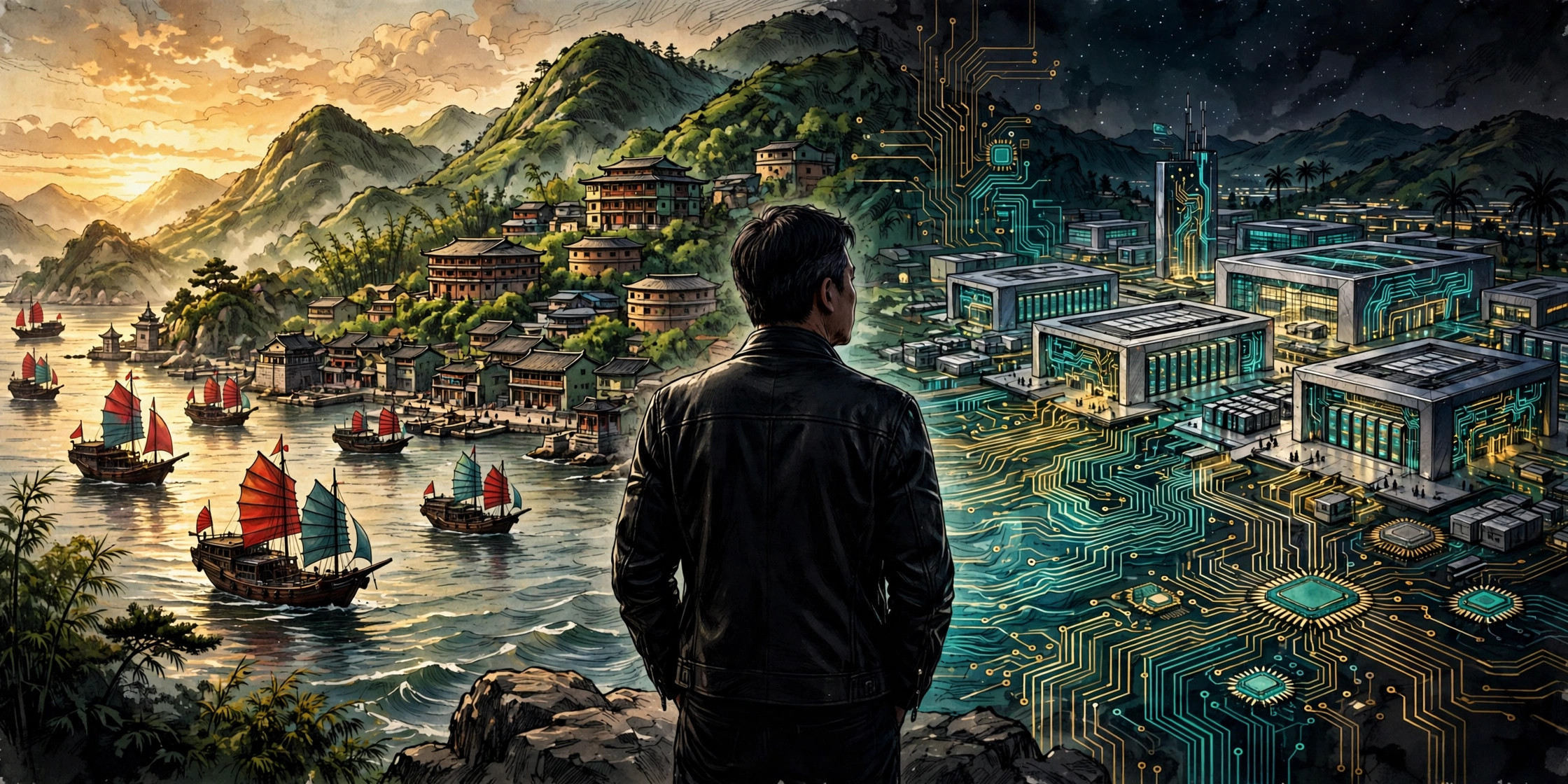
A boy does not become a man until the father is not around. The same test now faces Nvidia.
The founder has stepped away from the chair he held for 33 years. The company he built remains. What it becomes next will tell us whether the Fujian way was a personal style or a durable system.
A note on method first. This is a lens and not a bloodline claim.
Huang was born in Taiwan in 1963. Profiles differ on the city and his family later lived in Tainan. He grew up speaking Taiwanese Hokkien at home. Hokkien is the Minnan language of southern Fujian. Most Han Taiwanese trace their roots to Fujian settlers who crossed the strait from Quanzhou and Zhangzhou.
The culture crossed the water with the people. It then crossed the Pacific with his family.
THE DECISION ON THE TABLE
The new leadership faces three options. Keep the founder system as it is and trust the people who ran it. Codify the system into written process that a successor can operate. Or replace it with a conventional hierarchy and accept the slower speed. Every section of this case study returns to that choice. The verdict at the end grades which option the evidence supports.
What is the Fujian way of doing business?

Scarcity pushed people to the sea. Fujian is described in a local saying as eight parts mountain and one part water and one part farmland. Agriculture offered limited prospects. The sea offered trade.
That geography mattered. Fujian merchants were peripheral to imperial power for most of their history. They could not rely on the state. They built a niche in entrepreneurship and risk taking and diasporic migration instead.
Three parts fate. Seven parts hard work.
Only by striving can one win.
The Hokkien song Ai Pia Jia Eh Ya carries the Fujian code in three lines. It is not optimism. It is arithmetic for people with no cushion.
Family and hometown are the first bank. Min speaking peoples are a strongly diasporic community. Their business runs through communal networks based on guanxi and kinship.
One person leaves and finds a market. He sends for relatives. Relatives bring labor and capital and local knowledge. A cousin can replace months of due diligence because exile from the network is the real penalty for default.
Trust moves faster than contracts. It also enforces harder than contracts.
Love to fight
Dare to take risks and read the times well. The 2004 World Fujian Entrepreneurs Conference put fighting first in its summary of the merchant spirit.
Trust the network
Family and hometown ties move capital and information. A shared surname and a shared dialect open doors that paperwork cannot.
Never sit in a box
Do whatever the market needs. Sell curtains today. Build a factory tomorrow if imports are banned. The product is temporary.
Eat bitterness
Frugality and plain living are capital. The boss looks like a worker because he still works like one. Status is a cost.
Give back home
Success travels back to ancestors and hometown. The network that raised you gets repaid, and the repayment keeps the network alive.
Research on Fujian merchants names the same pattern from the other side. The culture is maritime and familial and diverse. The spirit is love of fighting and pragmatism and solidarity and trustworthiness.
How did the Fujian network actually work?
Traits are easy to praise and hard to audit. The Fujian system also had machinery, and the machinery can be named.
Rotating credit, the hui. Members pay a fixed sum into a common pot at regular intervals. One member takes the whole pot in each round until every member has collected once. In the bidding form, members bid interest for an early pot and the price of speed is set by the group itself.
The hui needed no bank and no court. It needed a trusted organizer and members who feared exclusion more than they wanted a free pot. Field research by Kellee Tsai documented these associations across Fujian and Zhejiang in the 1990s. Shui-Yan Tang estimated that informal credit supplied more than a third of total credit in Taiwan in that era.
Clan halls and hometown associations. A huiguan lodged new arrivals and stored goods and settled disputes among fellow countrymen. Constitutions commonly fined a member who ran to a magistrate before he submitted the dispute to the association. In Penang the five dominant early clans all came from one district in Zhangzhou. The Khoo Kongsi dates to 1835.
Mazu, the seafarer's goddess. Mazu was born on Meizhou Island off Putian in the Song dynasty. Merchants prayed to her before voyages and her temples rose in port cities along every route Fujian ships sailed. A 2025 study in PLOS One found that Mazu temples concentrate in ports and track the maritime economic network itself. The temple was a network node with an altar inside it.
The Jinjiang model. In Jinjiang households pooled idle money and idle people and idle houses into shared enterprises. The county backed market pricing and private hiring in 1980, years before that was normal. The shoe cluster at Chendai grew from that pooling, and Anta was founded there in 1991. Anta reported revenue of RMB 70.83 billion for 2024.
The scale of the family form. A 2018 study of southern Fujian counted more than 50,000 private enterprises in Quanzhou alone. More than 90 percent used the family management model. The largest shareholder typically held more than half the shares, and internal property rights were often unclear. That is the water the Fujian way swims in, at home and abroad.
How did that way show up at Nvidia?

| Fujian trait | Nvidia expression | Evidence in the record |
|---|---|---|
| Three parts fate and seven parts effort | How hard can it be? | His mother taught him English with a dictionary although she did not speak it. Huang says that approach defines him and defines Nvidia. |
| Run as if the sea can turn | Thirty days from going out of business | The near death of Nvidia in the late 1990s became a permanent operating motto and not a memory. |
| Trust the network and cut the layers | A flat company with about 60 direct reports | Huang holds no regular one on one meetings. He gathers the relevant people regardless of rank. |
| Information travels by the fastest route | Top 5 Things emails | Any employee can send five priorities. Huang reads about 100 each morning in search of weak signals. |
| The mission outranks the elder | The mission is the boss | Each project has a Pilot in Command with direct accountability. The org chart does not decide. |
| Make friends across the water | Partner with everyone you can | TSMC and the hyperscalers and sovereign buyers were courted personally and early and for decades. |
| Bet before the market exists | Zero billion dollar markets | CUDA was built for years before AI demand paid for it. Accelerated computing was one thesis held for 30 years. |
The Denny's detail is not a footnote. Huang worked as a dishwasher at Denny's as a teenager. He founded Nvidia in a Denny's booth at age 30. He returned to that story for decades.
In Fujian terms that is not branding. It is lineage proof. The founder started at the sink. No job sits below him. No worker sits outside the family story.
The CUDA bet was the purest Fujian bet in Silicon Valley history. Silicon Valley rewards speed to a visible market. Fujian merchants reward survival through an invisible one. CUDA had no large paying market for years, and Huang kept funding it while Wall Street asked why a gaming chip company needed a general computing platform. When AI arrived the network was already built.
Developers already knew CUDA. Researchers already trusted it. The sea had changed direction and Nvidia already owned the harbor.
Exhibit: two shores, one timeline
| Year | Event | Why it matters here |
|---|---|---|
| 1963 | Huang is born in Taiwan to a Hokkien speaking family | The Fujian inheritance arrives by language and household, not by address |
| 1973 | Age nine, he is sent to the US and lands by mistake at Oneida Baptist Institute in Kentucky | Scarcity and endurance stop being stories and become biography |
| 1978 to 1983 | He works the graveyard shift at a Denny's in Oregon | Dishwasher to waiter is his founding lineage proof |
| 1993 | Nvidia is planned in a Denny's booth in East San Jose and incorporated on April 5 | Three founders and pooled conviction, the clan form in miniature |
| 1995 to 1996 | The NV1 chip fails and Huang lays off more than half the staff | The company concentrates on one product and one fight |
| 1997 | RIVA 128 ships with about one month of payroll left and sells over a million units in four months | The thirty days motto is born from a real bank balance |
| 1997 to 1998 | Huang writes directly to Morris Chang after TSMC's local office does not answer, and TSMC makes the RIVA TNT in 1998 | A personal letter opens the most important network tie in company history |
| 1999 | Nvidia lists on Nasdaq at $12 a share | The family firm enters public markets without changing its center |
| 2006 | CUDA launches with the GeForce 8800 | The long bet on an invisible market begins |
| 2012 | AlexNet trains on two Nvidia GPUs and cuts the ImageNet error rate from about 26 percent to about 15 percent | The sea turns, six years after the harbor was built |
| 2020 | The Mellanox acquisition closes for about $7.0 billion | Networking joins compute inside one platform |
| 2022 | The $40 billion Arm deal is abandoned under regulatory pressure | The first clear limit of the fighting style at state scale |
| 2025 | Market value crosses $5 trillion on October 29, a first for any public company | The periphery now sits at the center of the world economy |
One detail in that timeline deserves a flag. The Sega lifeline of $5 million appears in most Nvidia histories. The amount is consistent in Huang's own retelling. The timing and mechanics are contested in an analysis of the 1998 filing, so this case study uses the amount and skips the legend's plumbing.
Exhibit: the numbers the culture produced
| Fiscal year | Revenue | Net income |
|---|---|---|
| FY2023, ended Jan 2023 | $27.0B | $4.4B |
| FY2024, ended Jan 2024 | $60.9B | $29.8B |
| FY2025, ended Jan 2025 | $130.5B | $72.9B |
| FY2026, ended Jan 2026 | $215.9B | $120.1B |
Data Center supplied $115.2B of the FY2025 revenue, or about 88 percent of the total. The most recent reported quarter before this case study, Q2 of fiscal 2027, printed revenue of $96.2B with Data Center at $89.0B. Headcount stood near 42,000 at the end of fiscal 2026.
CUDA developer counts are company claims made at keynotes and not an audited series. The claims ran 2.5 million in 2021 and 4 million in 2023 and 5 million in 2024 and 6 million in 2026. Even discounted as promotion, the direction is the exhibit. The network kept compounding while the market was still invisible to most rivals.
Market value milestones tell the same story in compressed form. One trillion in May 2023. Two trillion in February 2024. Three trillion in June 2024. Four trillion in July 2025. Five trillion in October 2025.
Exhibit: Huang in his own words
"My mom taught me English, and she doesn't speak English. In a lot of ways that kind of defines Nvidia, kind of defines me. I approach almost everything from the perspective of, how hard can it be?"
Cambridge Union, November 2025. His mother used a paper dictionary and picked ten words a day for her sons.
"For all of you Stanford students, I wish upon you ample doses of pain and suffering. People with very high expectations have very low resilience, and unfortunately resilience matters in success. One of my great advantages is that I have very low expectations."
Stanford SIEPR Economic Summit, March 1, 2024. Low expectations as a Fujian inheritance, stated as strategy.
The third quote is the company motto itself. "Our company is thirty days from going out of business" dates to August 1997 and the month of payroll left when RIVA 128 shipped. Huang opened staff presentations with it for years. A motto that outlives its bank balance has become culture.
How strong is the evidence for the Fujian link?
| Grade | What sits there |
|---|---|
| Documented in his own words | The dictionary story and the how hard can it be frame. Low expectations and pain and suffering as advantages. The thirty days motto and its 1997 origin. |
| Documented at Nvidia | About 60 direct reports and no scheduled one on one meetings. Top 5 Things emails read each morning. Pilot in Command missions. CUDA funded for years before its market paid. |
| Inferred by this case study | The mapping from Fujian merchant traits to those documented practices. The clan hall reading of the flat meeting. The harbor reading of CUDA. These are interpretation and they are labeled as such. |
That grading matters. A cultural lens earns trust only when it shows its seams.
What did the Fujian way build?
It built three things that are hard to copy.
First, speed without a chain of permission. A flat structure with shared information lets a junior engineer argue with the chief executive in the same room. That is a clan hall rebuilt as an engineering meeting.
Second, endurance as strategy. Most companies pivot away from pain. Nvidia learned to price pain as tuition. Low expectations produce fragile people, and Huang said so to students in plain words.
Third, a personal trust network at industrial scale. Huang personally held the TSMC relationship and the hyperscaler relationships and the sovereign relationships. Customers did not just buy a roadmap. They trusted the man who drew it.
That third strength is also the case study problem.
What else could explain Nvidia?
A lens that cannot lose is not a lens. Four rival explanations deserve a fair test.
Engineering first principles. Huang reasoned about accelerated computing from the physics of chips, and that reasoning was right for thirty years. This explanation is strong, and it is complementary rather than rival. Culture does not supply the insight. Culture supplies the willingness to fund the insight for six invisible years.
The gaming cash cow. GeForce profits paid for CUDA while rivals answered to quarterly product cycles. This is also strong. It explains the funding, though not the choice. Many firms with a cash cow bought back stock instead.
Timing and luck. AlexNet landed in 2012 on hardware Nvidia happened to sell. Luck is real in this story, and Huang's own arithmetic grants it three parts in ten. The Fujian claim is only about the other seven. A firm without the CUDA harbor already built would have watched AlexNet sail past.
Culture as a story told after victory. This is the sharpest challenge. Thousands of Hokkien speaking founders built ordinary firms, and survivorship makes any winner's culture look causal. The honest answer narrows the claim. The Fujian way does not explain why Nvidia won. It explains how Nvidia was organized to endure, and endurance is what the succession question now tests.
What do the two comparison cases show?
Morris Chang built the opposite machine. Chang was recruited to Taiwan by the state in 1985 after 25 years inside Texas Instruments. He founded TSMC in 1987 at age 55, with the Taiwan development fund holding 48.3 percent at the start. The foundry pledged never to compete with its customers, and trust was placed in the institution by design.
| Succession fact | TSMC | Nvidia |
|---|---|---|
| Successors named in advance | Mark Liu and C.C. Wei, named co-CEOs in 2013 | None named before the founder stepped away |
| Rehearsal period | About five years as co-CEOs under Chang as chairman | No rehearsal role existed |
| Founder exit | Complete in June 2018, with no board seat and no honorary role | Open, with the founder's system still in place |
| Second in command | Formal and layered | No chief operating officer, by design |
| The word succession | A decade of public planning | Absent from the 2026 proxy statement |
Huang stated his position himself on the Lex Fridman podcast. He said he does not believe in succession planning, and that he prefers to pass knowledge continuously to his roughly 60 direct reports. Read in Fujian terms, the network is the succession plan. Read in governance terms, the plan has no name on it.
Fuyao shows the Fujian middle path. Cao Dewang founded Fuyao Glass in Fujian in 1987 and built it into a world leader in auto glass. His son Cao Hui joined the company in 1989 and worked post after post for decades, including nine years running the American business. In October 2025 the father stepped down as chairman at 79 and the son took the chair.
The Fujian model can hand over. It hands over inside the family, after a 36 year apprenticeship, and the founder stays as honorary chairman for life. Nvidia has no family bench and no 36 years. It must find in a few quarters what Fuyao grew in a generation, or codify what Fuyao never had to write down.
Anta adds a smaller data point from the same county. The Ding family still divides the work among brothers and in-laws three decades after founding. Family division of labor scales further than critics expect, and it scales only while the family holds.
What are the limits written into the Fujian way itself?
The Fujian merchant literature is honest about its own shadow. Scholars list family management as a problem. They list working alone and a lack of foresight and weak formal systems alongside the strengths.
| Fujian strength | Shadow at Nvidia scale |
|---|---|
| Family at the center | Key person risk with no named successor |
| Trust over contracts | Personal relationships that a new leader must rebuild from zero |
| Fight through any storm | An endurance culture that can mistake exhaustion for virtue |
| Work alone and move fast | Concentration in one supplier and one architecture and one thesis |
| Read the times and ride the trend | Exposure when the times are set by governments and not markets |
Nvidia has had only one chief executive in 33 years. It has no public succession plan and no named heir. That is unusual for a company of its size.
The structure explains why. About 60 people reported to Huang. Replace the center and you do not replace one manager. You replace the switchboard.
The span has no research cover. In 1933 V. A. Graicunas showed that a manager supervises relationships and not just people. Six reports already create 222 relationships to track, by his formula. McKinsey's widest modern archetype starts at 15 reports, and it is conditioned on standardized work that needs little apprenticeship. No framework we could find validates a span of 55 to 60 for interlocking executive work. Huang's span worked because the mission system and the Top 5 emails carried the load that hierarchy carries elsewhere. Remove the reader at the center and the load has no carrier.
Research on sudden founder loss points the same way. A study of 449 chief executive deaths found average effects near zero and a very wide spread. About one firm in ten fell at least 13 percent, and founders under 59 averaged a 6 percent decline. A resignation is not a death and the study is context rather than forecast. The dispersion is the lesson. Key person outcomes are decided by preparation, not by averages.
What challenges does this bring going forward?
Can the flat system survive a formal center? The Top 5 system worked because one man read the signals and everyone trusted his judgment to sort weak signals from noise. A committee can read the same emails. It cannot reproduce the same pattern recognition on day one.
Nvidia now has to turn tacit judgment into explicit process without killing the speed that made the process unnecessary. That is the classic family firm transition. It is harder at Nvidia scale.
Can trust be transferred? In a Fujian network trust belongs to a person and a surname and a place. In public markets trust must belong to an institution. Will partners share early plans with the new leadership the way they shared them with Huang? Early information was part of the moat.
| The bench, as filed | Record |
|---|---|
| Colette Kress, interim chief executive | Chief financial officer since September 2013, with prior finance roles at Cisco and Microsoft and Texas Instruments |
| Ian Buck | Joined in 2004 and is credited by Nvidia as the inventor of CUDA, and he is not a named executive officer in the filings |
| Debora Shoquist | Runs operations since 2007, including the supply chain and the foundry relationships |
| Chris Malachowsky | Co-founder and Nvidia Fellow, the last founder beside Huang still inside the building |
The bench is deep in function and thin in rehearsal. The board held 11 members before the change, with 10 independent and no separate chair. The company's own fiscal 2026 filing warns that Nvidia is highly dependent on its longstanding executive team and that weak succession planning could hurt it. That sentence was boilerplate for years. It reads differently now.
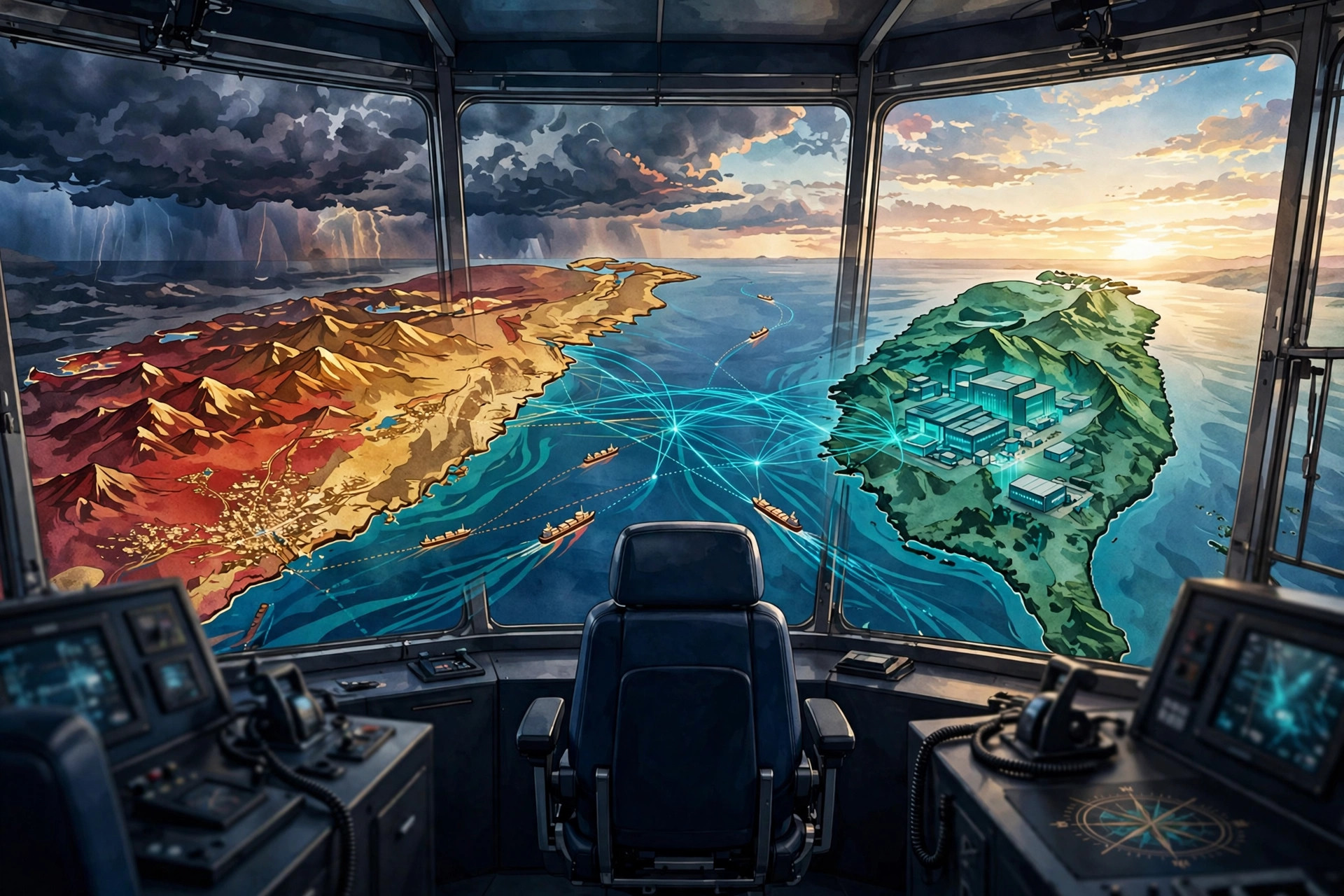
What happens when the periphery becomes the center? Fujian merchants thrived at the edge of power. They traded through bans and borders and official indifference. Nvidia now sits at the center of power, and Washington and Beijing and Taipei all treat its chips as state assets.
The home geography of the Fujian story is the Taiwan Strait itself. The company must now win with compliance departments and export licenses and formal governance. Those are not classic Fujian strengths.
Will customers use this moment to break the single harbor? Every large buyer already wanted a second source. AMD and Broadcom and the internal chip teams at Google and Amazon and Microsoft all gain from any hesitation at Nvidia. CUDA loyalty is real, and it is maintained by confidence in the next three roadmaps.
Can the next generation keep the fighting spirit without the scarcity? Kinship research carries a quiet warning. Heirs educated in comfort may value diversification over ancestral duty, and the relational glue frays. Nvidia faces the corporate version. Its next leaders did not face company death in 1997. The culture must teach scarcity to people who joined abundance.
WHAT TO WATCH
Roadmap delivery on schedule comes first. One clean generation under new leadership settles more than any statement. Watch whether named mission leaders gain visible authority. Listen for TSMC and hyperscaler executives naming the new leadership with the same specificity they used for Huang. Track any major training cluster built without Nvidia, and watch retention among the founder's direct reports. Good process will shorten decisions. Bad process will add approval layers and call it maturity.
What are the three scenarios from here?
| Scenario | What happens | Signs to watch |
|---|---|---|
| The system holds | The flat network runs on shared context for two or three product generations, and the new center earns trust by delivery | Roadmaps ship on cadence and the top 60 stays intact and partners name the new leadership early |
| The codification | Nvidia writes the founder system into process, with named mission leaders and a real second in command | A chief operating officer or a named deputy appears, and Pilot in Command leaders gain public authority |
| The harbor silts | Approval layers grow quietly, weak signals stop reaching the top, and buyers fund second sources faster | Senior departures cluster, roadmap language hedges, and a major training cluster is built without Nvidia |
The first two scenarios can blend, and the blend is probably the healthy path. The third rarely announces itself. It shows up first as politeness, in meetings where nobody argues with the chair the way they argued with the founder.
Questions for the reader
One, which of the three options in the decision box would you take in the interim chair, and what would you do in the first ninety days? Two, is a 60 person span a system or a biography, and what evidence would settle that? Three, where in your own portfolio does a Fujian strength sit one event away from becoming its shadow?
Frequently asked questions
What is the Fujian way of doing business?
The Fujian way is a merchant code shaped by scarce farmland and an open sea. It values risk taking, endurance, pragmatism and trust inside family and hometown networks. Its folk summary is three parts fate and seven parts hard work. Capital and information move through kinship faster than through contracts, and reputation inside the network enforces the deal.
How did the Fujian way influence Nvidia?
It influenced Nvidia through Jensen Huang and the operating system he built over 33 years. A flat structure with about 60 direct reports replaced hierarchy. Top 5 Things emails replaced status reports. The mission acted as the boss. CUDA was funded for years before a large market existed, which is the Fujian pattern of enduring through an invisible market until the sea turns.
What is the biggest challenge the Fujian way brings Nvidia now?
The biggest challenge is transfer. Trust at Nvidia was personal and it sat with the founder, who held the key partner relationships and read the weak signals himself. A family firm model scales on the strength of its center. After the center steps away, the company must turn tacit judgment into durable process without losing the speed that made the process unnecessary.
The verdict
The Fujian way explains Nvidia better than a standard Silicon Valley story does.
Silicon Valley explains the technology. Fujian explains the temperament. Scarcity taught endurance. The sea taught risk. Family taught trust and speed. Exile taught that no institution will save you, so you build your own network and hold it for decades.
It also explains the present risk in one line. The traits that made Nvidia hard to beat made it hard to hand over.
His last chapter is not yet written. Neither is Nvidia's first chapter without him.
Those two chapters will now be written apart. That separation is the test he spent 33 years delaying and preparing for at the same time. If the system he built can fight without the fighter at its center, the Fujian way will have done something it rarely managed in its long history.
It will have outlived the family.
Disclosures
Research and opinion, not investment advice. This case study is a cultural and organizational lens on Nvidia and its founder. It is not a claim about any individual's ancestry beyond the public record cited in the text. Figures are drawn from Nvidia filings and releases, including fiscal 2023 to fiscal 2026 revenue and net income and the Q2 fiscal 2027 release. Management practices are drawn from public reporting on Nvidia. Fujian material is drawn from published research on Fujian merchant culture, including Li and Zhang (2014) and Chen (2018) and Tsai on rotating credit. Contested items are flagged in the text where they appear. The author does not hold Nvidia (NVDA) as a core position at publication. Positions may change without notice.
© 2026 DalalBytes Research · For educational purposes only. Not investment advice.