
Ondas Inc. (NASDAQ: ONDS) reported third quarter 2026 results on Thursday, November 12, 2026. The quarter ended September 30, 2026. The call followed at 8:30 a.m. ET the same morning.
DalalBytes has no research package on Ondas. We published no preset scorecard ahead of this print. That basis matters here, so this article states it plainly. The six checkpoints in the grading section are built only from sources that existed before the print. They are the company revenue guide and the labeled Zacks consensus cluster. The third source is the second quarter baseline from the company release of August 13, 2026.
One more piece of housekeeping shapes every comparison below. The company renamed itself from Ondas Holdings to Ondas Inc. in January 2026. It also deconsolidated the Ondas Networks rail wireless business that month. The Ondas that printed this quarter is a defense autonomy company, and the year-ago comparisons cross that break.
The short story is a growth print of rare size carrying a margin print of rare weakness. Revenue doubled in one quarter and rose more than sixteen-fold in one year. Gross margin halved on the GAAP line over the same quarter. Both halves of that sentence are the story.
What did Ondas actually report?
The short version
Revenue beat the guide and the consensus. Margin and cash moved hard the other way.
- Revenue of $167.5M cleared the $155M guide top and the $147.1M Zacks consensus estimate
- Pro forma organic revenue grew 64% year over year on the company definition
- GAAP gross margin fell to 21.8% and adjusted gross margin fell to 34.8%
- Backlog rose 36% sequentially to $835M on $214M of new orders
- Cash and short-term investments fell to $820.3M from about $1.4B at June 30
The headline table below sets the print against the three references that existed before it. The company guided third quarter revenue to a range of $140M to $155M when it reported the second quarter in August. The Zacks consensus cluster sat at $147.1M of revenue and a loss of $0.09 per share ahead of the print. Both consensus figures are estimates and are labeled as such wherever they appear.
| Line | Q3 2026 | Guide or consensus | Q2 2026 | Q3 2025 |
|---|---|---|---|---|
| Revenue | $167.5M | $140M to $155M guide | $83.8M | $10.1M |
| Gross profit (GAAP) | $36.5M | Not guided | $36.1M | $2.6M |
| Gross margin (GAAP) | 21.8% | Not guided | 43.1% | 25.8% |
| Adjusted gross profit | $58.3M | Not guided | $42.3M | $2.8M |
| Adjusted gross margin | 34.8% | Not guided | 50.4% | 28.1% |
| Operating loss | $189.5M | Not guided | $162.9M | $15.5M |
| Adjusted EBITDA | -$59.7M | Not guided | -$46.2M | -$8.1M |
| Net loss | $64.7M | Not guided | $89.7M | $7.5M |
| EPS, basic and diluted | -$0.10 | -$0.09 consensus est. | Not stated | -$0.03 |
| Backlog | $835M | Not guided | $613M reported | Not stated |
| Cash, restricted cash and short-term investments | $820.3M | Not guided | About $1.4B | Not stated |
| Shares outstanding | 590.2M | Not guided | Not stated | 380.8M at Dec 31, 2025 |
Revenue of $167.489M beat the top of the company guide by 8.1% and the Zacks consensus estimate by 13.9%. Both percentages are calculated from the printed figures. Growth was 100% sequentially and more than sixteen-fold year over year. The company also reports pro forma organic growth of 64% year over year. That measure assumes the current portfolio was owned in both periods, and the article treats it as a company-defined figure rather than a reported one.
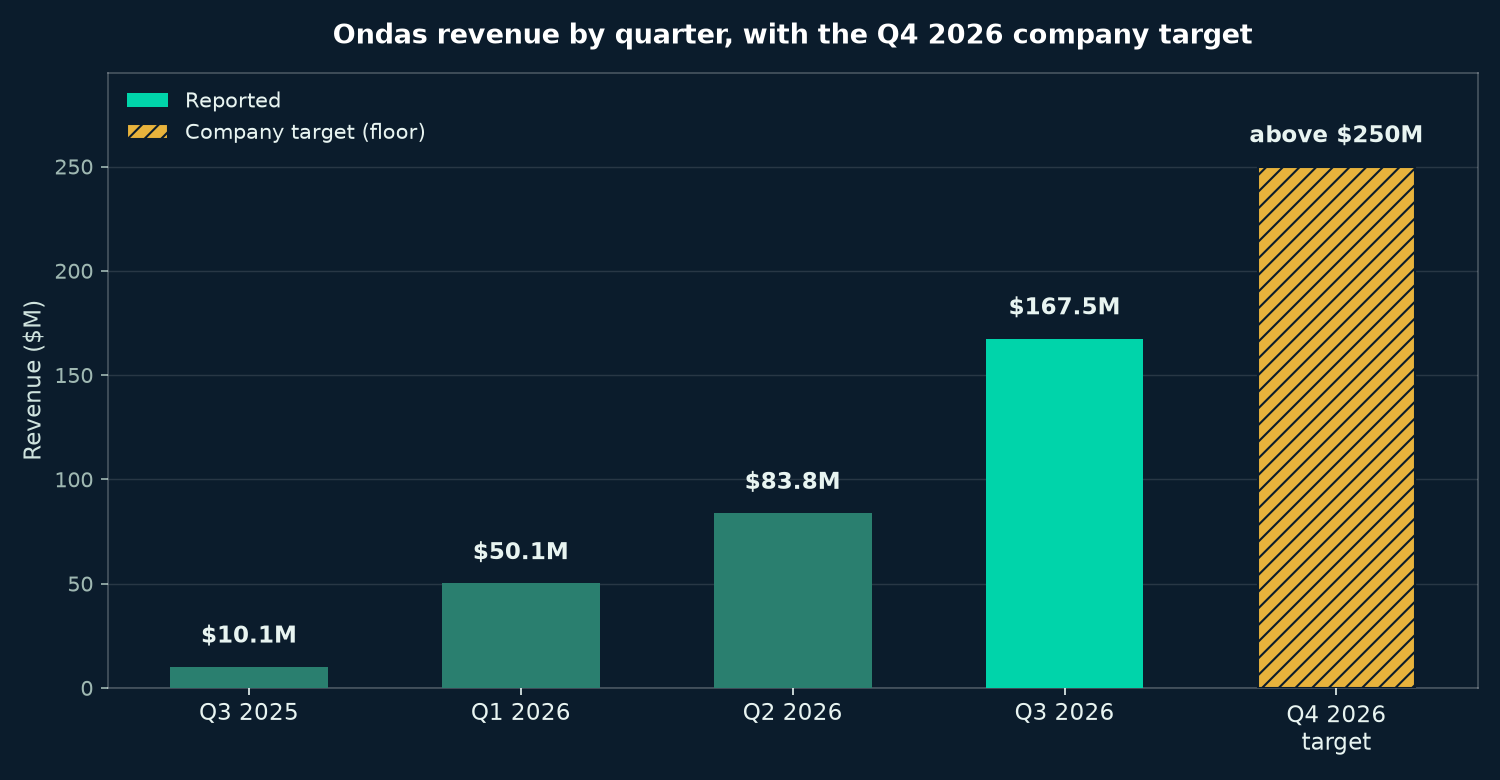
Orders did the work behind the revenue line. The company captured $214M of new orders in the quarter and $507M across the first nine months of 2026. The order figure against revenue gives a book-to-bill ratio of 1.28 for the quarter, calculated from the printed figures. Backlog closed at $835M. That is up 36% from the reported $613M at June 30 and more than twelve times the level at the end of 2025.
The margin walk is where the print turns. Gross profit was flat in dollars at $36.5M despite revenue doubling, because cost of goods sold reached $131.0M. The release assigns the GAAP decline to three causes. They are higher amortization of capitalized intellectual property, a $9.6M inventory step-up from purchase accounting, and inefficiencies in the early stages of ramping large programs. The adjusted line strips out the first two causes and still fell. Management assigns that decline to production and delivery inefficiencies in precision strike, which carried a disproportionate share of revenue in the quarter.
Operating expenses reached $226.0M. Research and development rose $30M sequentially to $61.6M. The expense total includes $88.1M of non-cash items, and stock-based compensation alone was $57.8M inside operating expenses. Acquisition-related cash expenses added $14.1M. The company measure called adjusted cash operating expenses printed $118.7M, up from $88.8M in the second quarter.
The net loss line needs its own warning label. The operating loss was $189.5M. The reported net loss was only $64.7M. The bridge between those two numbers is $133.1M of other income, and $125.1M of that income is a non-cash gain on warrants from the October 2025 and January 2026 equity raises. The warrants are remeasured at fair value each period. A falling share price therefore books accounting income while the operating business loses money.
The balance sheet closed the quarter in two halves. Liquidity is real, with $262.8M of cash and $526.1M of short-term investments inside the $820.3M total. Debt is negligible at about $6M of notes and convertible notes combined, calculated from the balance sheet lines. The other half is acquisition accounting. Goodwill of $1.50B and intangible assets of $1.03B together make up about 63% of the $4.03B of total assets, calculated from the printed balance sheet.
How did the print grade against the checkpoints?
The short version
Three checkpoints pass, one lands partial, and two fail on margin and dilution.
- Revenue and backlog cleared their lines with room to spare
- Adjusted gross margin of 34.8% missed the 40% floor set from the Q2 baseline
- The cash decline is mostly explained by acquisitions, and the EBITDA loss still widened
- Shares outstanding rose 55% in nine months to 590.2M
- Every guidance line moved up or pulled forward
The checkpoints below were fixed from pre-print sources only. Each one names its source and its line before the grade, so the grading can be audited against the release. There is no DalalBytes score for this name, and no checkpoint here imports one.
| Checkpoint | The line set before the print | What printed | Grade |
|---|---|---|---|
| 1. Revenue against the guide | Clear the $155M top of the company Q3 guide of $140M to $155M | $167.5M, with pro forma organic growth of 64% | Pass |
| 2. Backlog and order capture | Grow the reported Q2 backlog of $613M with a book-to-bill at or above 1.0 | Backlog of $835M and orders of $214M for a book-to-bill of 1.28, calculated | Pass |
| 3. Gross margin | Hold adjusted gross margin at or above 40% through the mix shift, against a Q2 print of 50.4% | Adjusted gross margin of 34.8% and a GAAP margin of 21.8% | Fail |
| 4. Cash and burn | Tie the cash decline to named acquisition payments and hold the adjusted EBITDA loss near the Q2 level of $46.2M | About $431M of Q3 cash went to acquisition completions, and the adjusted EBITDA loss widened 29% to $59.7M | Partial |
| 5. Share count and dilution | Slow the growth in shares outstanding now that the January raise filled the war chest, against 380.8M shares at December 31, 2025 | 590.2M shares at September 30, up 55% in nine months | Fail |
| 6. Guidance credibility | Hold or raise the full year target of $525M to $550M and keep the Q4 platform profitability promise intact | Full year raised to at least $550M, Q4 revenue targeted above $250M, and the company-wide profit timeline pulled forward to Q3 2027 | Pass |
Checkpoint 1, pass. Revenue beat the guide top by 8.1% and the consensus estimate by 13.9%, calculated from the printed figures. The GAAP loss per share of $0.10 sat one cent wider than the Zacks consensus loss estimate of $0.09. The revenue line is the one the guide actually governed, and it cleared with room.
Checkpoint 2, pass. Backlog grew 36% sequentially and orders ran ahead of revenue. One caveat rides on this grade and the article prints it rather than burying it. The company states that backlog growth reflects both newly acquired businesses and organic order capture. It does not split the two, so the organic share of the $222M sequential increase cannot be verified from the release.
Checkpoint 3, fail. Management had warned in advance that margin would fall on precision strike mix, and direction was never the test. Depth was the test. The adjusted line fell 15.6 points in one quarter to 34.8%, and the GAAP line fell to 21.8%. The fourth quarter is guided to the same zone, so recovery is now a 2027 claim rather than a current fact.
Checkpoint 4, partial. The cash walk is mostly explained, and the explanation is acquisitions rather than operations. The unexplained half of the checkpoint still failed. Adjusted cash operating expenses rose 34% sequentially to $118.7M while adjusted gross profit rose 38% to $58.3M, and the adjusted EBITDA loss widened anyway because the expense base is twice the gross profit base. The release also prints no quarterly operating cash flow statement, so the true cash burn rate cannot be read from the release alone.
Checkpoint 5, fail. The share count rose from 380.8M at the end of 2025 to 590.2M at September 30, 2026. That is an increase of about 209M shares in nine months. Stock-based compensation of $59.8M in the quarter and $148.6M across nine months keeps the count moving even between raises. The warrant liability of $918.6M is now the largest single liability on the balance sheet, and a further $268.2M of accrued purchase and contingent consideration remains payable for acquisitions already closed.
Checkpoint 6, pass. The full year revenue target rose to at least $550M from a range of $525M to $550M. The company initiated a 2027 revenue target of at least $1.1B and stated that the target excludes further acquisitions. It also pulled the company-wide adjusted EBITDA profitability target forward to Q3 2027 from Q4 2027. The promise of adjusted EBITDA profitability at the operating platform level in Q4 2026 was reiterated, and that promise now becomes a dated test for the next print.
What did the call add that the release did not?
The short version
The call quantified the cash walk and the margin path. It declined to quantify recurring revenue and Regna AI.
- About $431M of Q3 cash went to completing acquisitions, per CFO Neil Laird
- Fourth quarter adjusted gross margin is guided to the mid 30s, with a 45% to 50% target over 12 to 24 months
- Growth operating expense of about $37M was split into $27.6M at the corporate level and $9.5M at the platform level
- ULTRA economics were priced at $25M upfront and $23M a year per combat air patrol
- Recurring revenue share and Regna AI pricing were asked about and not answered with numbers
The prepared remarks added four facts the release does not carry. First, the margin decline was communicated in advance in direction, and Laird tied the extra pressure to production inefficiencies in scaling the Lethal Unmanned Strike program at Mistral. Second, fourth quarter adjusted gross margin is expected to stay in the mid-30% range on the same mix. Third, the cash decline has a named size, with about $431M deployed in the quarter to complete acquisitions. Fourth, the balance sheet holds $65M of investments in unaffiliated public and private companies, a line the release does not discuss.
The remarks also priced the flagship growth story. ULTRA holds a combat air patrol for about $25M upfront and $23M in annual operating cost. The legacy MQ-9 comparison on the same slide costs nearly $200M upfront and more than $50M a year. Stemme, the German maker of the ULTRA airframe under a definitive acquisition agreement, runs its European plant at 25% capacity utilization today. Management targets up to 10 ULTRA aircraft per month by 2028 and up to 345,000 square feet of added manufacturing space in the United States.
IonStrike received the second fullest treatment. The company has answered a $45M sole-source request for proposals and booked a separate $10M integration order from a new U.S. government customer. The targeted unit price sits below $50,000. Production is planned at hundreds of units per month in early 2027 and thousands per month by late 2027. Those are management targets, and the article labels them as targets wherever they appear.
The Q and A answered some questions with real numbers. Ryan Hartman unpacked the $1B ULTRA service revenue claim into about 110 global combat air patrols at $23M each, with less than half of those patrols producing the $1B figure. Brock then clarified that the figure is a U.S. number. Hartman also argued that current U.S. work sits inside 2026 budgets and operations and maintenance funding, which insulates it from an extended continuing resolution. Brock stated that none of the Israeli business is funded by the U.S. government. He denied directly that any Q4 revenue was pulled into Q3 to make the beat.
The deflections were just as specific. Asked to bracket recurring revenue as a share of 2027 revenue, Brock declined to add precision and called it a small piece of the stream today. Asked for Regna AI pricing, deal size and margin, management described a deployment model of engineers and researchers and confirmed that Regna sits outside the 2027 forecast. No price or margin figure was given. Land Systems received a pipeline figure of $3.25B in unweighted opportunities through 2031 and no 2027 revenue size. The ISR segment drew the sharpest question of the call, because it was the only category whose backlog did not grow sequentially. The answer was that the business is on plan and that ULTRA drives the ramp. No ISR delivery figure followed it.
Which segment is carrying the company?
The short version
One engine carries the company now, and the release prints no segment revenue split to grade it by.
- Ondas Networks left the consolidated group in January 2026 and contributes no revenue
- The company sells one defense autonomy platform across four market segments
- Ondas Sentinel captured about $100M of the $214M in Q3 bookings
- Precision strike carried a disproportionate share of Q3 revenue and the lowest margin in the book
- The United States produced more than 50% of Q3 revenue
The honest answer starts with a disclosure gap. The release reports one consolidated revenue line and no split by business unit. Any article claiming a precise segment revenue mix for this quarter is inventing it. What the print and the call do disclose is bookings, growth rates for named units, and one mix statement inside the margin discussion.
The structure itself changed twice this year. Ondas Sentinel was formed in the third quarter around DZYNE Technologies and World View, under Ryan Hartman as chief executive. It sits beside Ondas Autonomous Systems as the second operating group. The company sells across four market segments instead. They are aerial security and ISR and persistent intelligence. The other two are precision strike and autonomous ground systems under a new Land Systems division.
Bookings say Sentinel is carrying the order story. About $100M of the $214M in third quarter bookings landed at Sentinel. ULTRA follow-on orders of $53.7M and IonStrike orders of $21.7M anchor that total. Revenue tells a different part of the story. Precision strike carried a disproportionate share of the quarter on management's own margin explanation, and the LUS program behind it is the work that broke the margin line.
The unit growth rates in the prepared remarks show breadth underneath the two anchors. Sentrycs grew pro forma revenue more than 3.5 times year over year. Rotron grew revenue 250% and 4M grew nearly threefold. Mistral grew 136% organically while shipping against the LUS contract. These are company-reported figures for acquired units, and they support the claim that growth is not one program deep.
The networks side of the old story is simply gone from the numbers. Ondas Networks completed a Series B financing on January 16, 2026 that diluted the parent below a controlling interest. The parent deconsolidated the business that day and kept a stake of about 47.5%. That stake sits in investments in unconsolidated affiliates at $30.3M on the September balance sheet. The 900 MHz rail platform and its utility timeline now run outside the listed company, and they contribute nothing to the revenue this article grades.
What are the bears right about?
The short version
The bear case is not about demand. It is about margin, cash conversion and a share count that will not sit still.
- Adjusted cash operating expenses of $118.7M ran at roughly double adjusted gross profit of $58.3M
- Cash fell about $580M in one quarter and inventory is set to build again in Q4
- The nine-month GAAP profit exists only because of $581.4M of other income
- Deferred revenue of $37.8M is about 4.5% of the $835M backlog, calculated
- The non-GAAP definitions were revised in both Q2 and Q3, each time adding exclusions
The margin break is deeper than a mix story. Mix explains why precision strike revenue carries less profit than counter-UAS revenue. It does not explain production inefficiencies on the largest program in the book, and management owns that cause in its own words. The recovery path is now a target of 45% to 50% adjusted gross margin over the next 12 to 24 months. That target was offered on the call, and it converts this quarter's weakness into a two-year grading line.
The cash engine runs backwards at current scale. Adjusted gross profit of $58.3M faced adjusted cash operating expenses of $118.7M in the same quarter. Research and development alone rose $30M sequentially. Management calls about $37M of the expense discretionary growth investment, and that framing is partly fair. The remaining run rate still has to be carried by a gross profit pool half its size until volume closes the gap.
The balance sheet is an acquisition ledger. Six acquisitions closed in the third quarter alone, including DZYNE as the largest deal in company history. Goodwill and intangibles of $2.53B now dominate total assets of $4.03B. Contingent consideration of $268.2M remains payable on deals already closed. If any acquired program disappoints, the write-down path runs through that goodwill balance.
The reported profit figures are warrant artifacts. Nine-month net income of $206.9M sits on top of a nine-month operating loss of $395.1M. The difference is $581.4M of other income, driven by warrant remeasurement gains as the share price fell. The year also carries a $51.5M gain on the January deconsolidation of Ondas Networks. None of that income ships a product or collects a receivable.
Backlog is not the same as funded work. Management states plainly that backlog holds customer orders and awarded programs rather than unfunded pipeline, and that definition is the conservative one. Two limits still apply. The $982M Lethal Unmanned Strike award behind Mistral is an IDIQ ceiling, and a ceiling is a hunting license rather than an order. Deferred revenue of $37.8M also shows how little of the $835M book is prepaid, at about 4.5% calculated from the printed figures.
The adjusted numbers keep getting kinder. The company revised its non-GAAP definitions in the second quarter and again in the third quarter. The revisions added exclusions for contingent consideration swings, inventory step-ups, and qualifying acquisition employee and integration costs. Each change is disclosed in the release, and each one moves the adjusted lines in the company's favor. Readers grading the adjusted EBITDA trend across 2026 are not grading one fixed ruler.
Customer concentration cannot be graded from this print. The release names programs and services rather than revenue customers. The U.S. Army LUS contract, the ULTRA relationship with the Air Force Life Cycle Management Center, and an Israeli Ministry of Defense program anchor the narrative. No customer is disclosed with a revenue share, so concentration risk is real and unquantifiable from the release. That is a limit of the print, and the article states it rather than filling it in.
The market graded the print before this article could. The shares fell 7.2% on November 12 and a further 3.0% on November 13 to close at $5.16, calculated from Finnhub closing prices. The 52-week high is $15.28 from January 2026, and the market value sits near $3.3B on the same source. Demand is not what the market is discounting. Execution is.
What changes from here?
The short version
The print proves scale and leaves profitability unproven. The next four quarters carry dated tests for both.
- Q4 carries three promises at once on revenue and platform profitability and backlog
- The 2027 target of at least $1.1B assumes organic growth above 40% and no new acquisitions
- Margin recovery and cash conversion remain unproven rather than disproven
- DalalBytes will track this name from here, as an observation and not a rating
There is no library score to hold or move on this name. What the print establishes is narrower and still significant. Ondas now operates at a revenue scale that its own guidance history did not imagine eighteen months ago, with backlog cover above one and a half years at the 2027 target pace. The United States is the largest revenue source, and the order book spans four market segments rather than one program.
What it leaves unproven is the entire profitability bridge. Adjusted gross margin must climb from 34.8% back toward the 45% to 50% target band. Adjusted cash operating expenses must stop growing faster than gross profit. Six acquisitions closed in one quarter must integrate into one operating platform, and the two 2027 platforms must convert from targets to production. ULTRA needs a rate of 10 aircraft per month by 2028, and IonStrike needs a move from low-rate production to thousands of units per month.
The guidance position as given is unusually testable. The table below collects every dated promise now on the record. Each one grades at a named print or inside a named quarter.
| Promise | Level as stated | Graded at |
|---|---|---|
| Q4 2026 revenue | Above $250M | Q4 2026 report |
| Q4 2026 adjusted gross margin | Mid-30% range on the adjusted line | Q4 2026 report |
| Operating platform adjusted EBITDA | Profitability in Q4 2026 | Q4 2026 report |
| Backlog at year-end 2026 | Above the $835M printed at September 30 | Q4 2026 report |
| Full year 2026 revenue | At least $550M | Q4 2026 report |
| Full year 2027 revenue | At least $1.1B with organic growth above 40% | 2027 quarterly reports |
| Company-wide adjusted EBITDA | Profitability by Q3 2027 | Q3 2027 report |
| Adjusted gross margin target | 45% to 50% over 12 to 24 months | Quarterly reports through 2028 |
The Q4 2026 report is expected in March 2027, and that date is an aggregator estimate rather than a company announcement. It carries four of the eight tests above in a single print. The IonStrike sole-source award and the Stemme closing sit between now and then as undated checkpoints. Either one landing early would say something real about conversion speed.
The grading line from here
The next print decides whether Q3 was a margin accident inside a scaling story or the first clean look at the portfolio's true economics. Platform profitability in Q4 is the promise management chose to reiterate with the margin miss already on the table. A miss there costs more credibility than the Q3 margin line did. A hit there makes the 2027 target of at least $1.1B the argument instead.
This name joins the DalalBytes tracking list from this print forward. That is an observation about coverage. It is not a rating or a score or a recommendation. The first full test of the story arrives with the Q4 report and its four dated promises.
Frequently asked questions
Did Ondas beat expectations in Q3 2026?
Yes on revenue and no on margin. Revenue of $167.5M beat the $155M top of company guidance and the $147.1M Zacks consensus estimate. Gross margin moved the other way. The GAAP line fell to 21.8% and the adjusted line printed 34.8% against 50.4% in the second quarter.
Why did the Ondas cash balance fall by about $580M in one quarter?
Acquisitions explain most of the walk. Management put Q3 acquisition payments at about $431M on the call, and the quarter also carried an adjusted EBITDA loss of $59.7M plus an inventory build to $110.7M. Cash and short-term investments ended at $820.3M from about $1.4B at June 30.
Is Ondas profitable yet?
No. The operating loss was $189.5M in the quarter and the adjusted EBITDA loss was $59.7M. The reported net loss of $64.7M looked smaller only because a $125.1M non-cash warrant gain sat below the operating line. Management targets platform profitability in Q4 2026 and company-wide profitability by Q3 2027.
Disclosures
Research and opinion, not investment advice. The author holds no position in Ondas Inc. (ONDS). Figures are drawn from the Ondas third quarter 2026 earnings release of November 12, 2026 and the earnings call held the same day, unless labeled otherwise. The second quarter baseline is drawn from the company release of August 13, 2026. Consensus figures are the Zacks cluster published ahead of the print and are labeled as estimates. The deconsolidation of Ondas Networks is documented in the company quarterly report for the period ended March 31, 2026. Book-to-bill, percentage changes, balance sheet shares and the deferred revenue share of backlog are calculated from the printed figures and are labeled as calculated where they appear. Share prices and market value are Finnhub closing data for November 12 and 13, 2026. DalalBytes has no research package and no score for Ondas, and this article introduces no rating.
© 2026 DalalBytes Research · For educational purposes only. Not investment advice.