
What does Amazon actually own?
Start with the cash. Amazon has put $18.0B into Anthropic, in two waves that the headlines tended to compress into one. The first wave was $8.0B of convertible notes, funded in five pieces between the third quarter of 2023 and the fourth quarter of 2025. The second wave came fast: $10.0B of non-voting preferred stock in a single quarter, the second quarter of 2026, split between the Series G-2 round in April and the Series H round in May. The detail sits in Note 2 of Amazon's 10-K and 10-Q filings, and it is worth reading in full because the tranches tell the story of a landlord slowly becoming a partner.
| Period | Instrument | Amount |
|---|---|---|
| Q3 2023 | Convertible note | $1.25B |
| Q1 2024 | Convertible note | $2.75B |
| Q4 2024 | Convertible note | $1.3B |
| Q2 2025 | Convertible note | $1.3B |
| Q4 2025 | Convertible note | $1.4B |
| Q2 2026 | Series G-2 preferred | $5.0B |
| Q2 2026 | Series H preferred | $5.0B |
| Total funded | $18.0B |
And the commitment is not finished. Up to $15B more is available under a compute-linked financing facility that expires 30 months after a liquidity event, and Amazon holds an option to invest up to $5B in future Anthropic rounds. The facility matters for the IPO math later: the money is tied to compute delivery, so the stake and the cloud contract grow together or not at all.
Now the carrying value, which is where this stops looking like a venture portfolio line and starts looking like a sovereign wealth fund. Amazon carried the position at about $38.5B at September 30, 2025 ($23.7B of notes plus $14.8B of preferred). By March 31, 2026 it was $74.2B. By June 30, 2026 it was $190.4B, split between $97.9B of convertible notes at fair value and $92.5B of preferred stock. That is about $17.66 for every Amazon share outstanding, and about 7.0% of Amazon's entire market capitalization at Tuesday's $253.10 close. Amazon's non-current Other assets line rose from $122.6B at December 2025 to $284.1B at June 2026, and Anthropic is the reason.
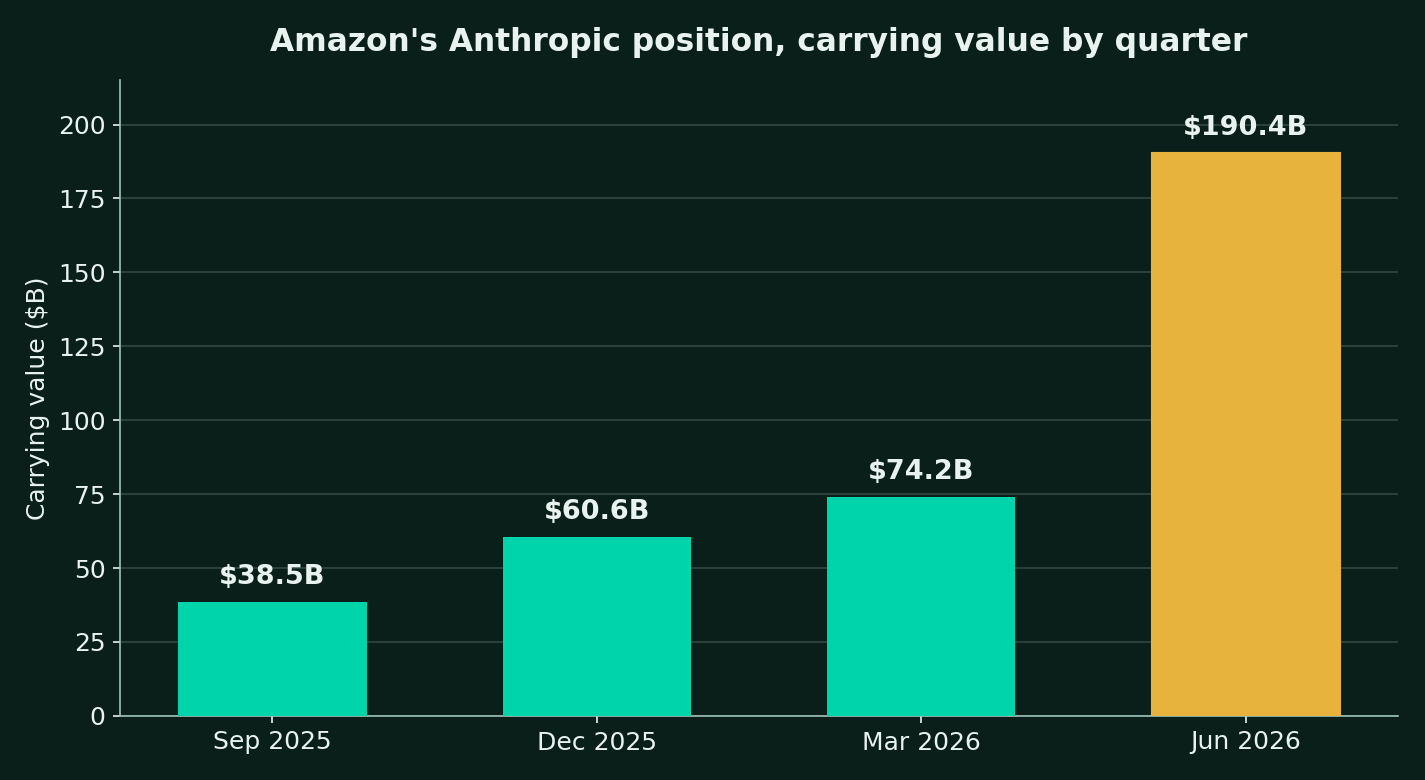
Two accounting machines produce these numbers, and they behave very differently. The convertible notes are available-for-sale Level 3 assets: their appreciation bypasses the income statement and accumulates in other comprehensive income, and it only enters earnings when the notes convert. At June 30, 2026, $92.0B of unrealized note gains sat in AOCI, a coiled spring on the balance sheet. The preferred stock runs under the measurement alternative: every observable price change flows straight through earnings. That is why Amazon's reported results now lurch with Anthropic's private marks. Cumulative pre-tax gains booked through earnings from Q1 2025 to Q2 2026 total about $80.1B, including $53.4B of other income in the second quarter of 2026 alone.
The asymmetry to hold in mind. The $80.1B already booked is real but backward-looking. The $92.0B in AOCI has never touched earnings. When the notes convert at the IPO, that gain reclassifies into a single quarter's income statement. Amazon's IPO quarter will print one of the largest non-operating gains in corporate history, and almost nobody's operating model will count it.
What does the S-1 reveal about the stake?
Anthropic's S-1, public since Monday, October 26, is a study in structured invisibility. The principal stockholders table lists voting securities only. Amazon and Google, the two largest strategic holders, hold non-voting Class N shares, so their share counts in the table are blank, accompanied only by the statement that each holds more than 5%. Amazon has no board seat and no observer seat. Related-party disclosures do not rescue the reader either: Anthropic defines related parties by voting stock, so the two counterparties that supply its compute, distribute its product, and anchor its cap table sit outside the related-party note entirely. The filing never quantifies the revenue Anthropic earns from Amazon or the payments it makes to Amazon.
The economics are nevertheless reconstructable, if you do the arithmetic the filing invites but does not perform. Anthropic has about 16.94B fully diluted shares, a figure anchored on the Public Benefit Fund's disclosed 5% holding. Amazon's preferred converts into about 1.64B shares, roughly 10 to 11% of that total. Its notes, $6.2B of principal and the entirety of Anthropic's debt, are non-interest-bearing and convert at fixed prices of $2.0928 and $5.0478 per share, prices set in 2023 and 2024 that now look like artifacts from another era. At those prices the notes convert into about 1.84B more Class N shares.
Then comes the cap, the single most important term in the structure. No portion of the notes converts if Amazon would then hold more than 12% of Anthropic's capitalization, unless Amazon waives the cap. Whatever is blocked does not disappear: it is reissued as a rollover note, marked to fair value, and conversion is attempted again at each subsequent quarter-end. The cap therefore governs the form of Amazon's claim, equity now versus notes that convert later, not its total value. Adding the pieces, the carrying value implies economic exposure of about 19.7% at the $965B Series H valuation. Say it precisely, because precision is the whole game here: Amazon has never disclosed a percentage, 19.7% is an implied proxy built from its own audited marks, and the equity it can actually own on day one of the IPO is capped at 12%.
Governance closes the loop. One Class F share gives the Founder LLC a fixed 50.1% of the shareholder vote. One Class T share lets the Long-Term Benefit Trust elect a majority of the board. Public Class A holders are capped at 49.9% of voting power in aggregate. Amazon's $18B bought economics, distribution, and a compute marriage. It bought no control, no seat, and no vote. Holders above 0.5% of fully diluted shares, a bucket that includes Amazon's converted stake, are locked up until the earlier of the second trading day after Q3 2027 results or 365 days after the prospectus date.
One more detail belongs in any honest account: the two filers disagree about the notes. Anthropic carries them on its own books at $108.6B. Amazon carries the same instrument at $97.9B. The roughly $10.7B gap means Amazon's mark is the conservative one, and it means the IPO price will adjudicate between two audited numbers that are $10.7B apart.
Google is the natural control case. It has invested about $23B, operates under a 14.99% cap, and gets the same blank treatment in the table. Alphabet's non-marketable equity bucket stood at $124.3B at June 30, 2026, implying a stake of roughly 13% at the Series H mark. The pattern is identical: the strategics fund the company, the founders keep the votes, and the disclosure regime lets both sides describe the position in the vaguest available language.
How big has Anthropic become?
The reason the marks keep moving is that the business underneath them is compounding at a rate with few precedents. Anthropic's revenue was $386M in fiscal 2024. It was $4,585M in fiscal 2025. In the first half of 2026 alone it was $16,286M, and the second quarter of 2026 contributed $11.56B of that, alongside the company's first operating profit, $974M. The company has told investors that third-quarter 2026 revenue reached $16.8B, and reported run rates put it near $65B annualized at the end of July 2026. Total capital raised stands at $141.1B, with $131.7B of cash and short-term investments still on the balance sheet at June 30, 2026.
| Anthropic revenue | FY2024 | FY2025 | H1 2026 |
|---|---|---|---|
| Revenue | $386M | $4,585M | $16,286M |
| Memo: Q2 2026 revenue | $11.56B | ||
| Memo: Q2 2026 operating income | $974M |
The quality of that revenue deserves the same scrutiny as its size. Consumption, the pay-per-token API business, was 80% of first-half revenue. About 48% of first-half revenue flowed through the three hyperscalers' marketplaces combined, Amazon Bedrock, Google Vertex, and Azure, recognized gross, with no Amazon-only split disclosed. Customers spending more than $100K on a trailing basis numbered more than 11,900 at September 30, 2026, up from about 950 a year earlier, and net revenue retention printed at about 900%. The reported losses are mostly an accounting mirror: the $80,748M net loss in H1 2026 is dominated by about $72.4B of non-cash fair-value charges on the very convertible notes whose appreciation Amazon and Google book as gains. Fiscal 2025 also carries a $1.5B charge for the Bartz copyright settlement.
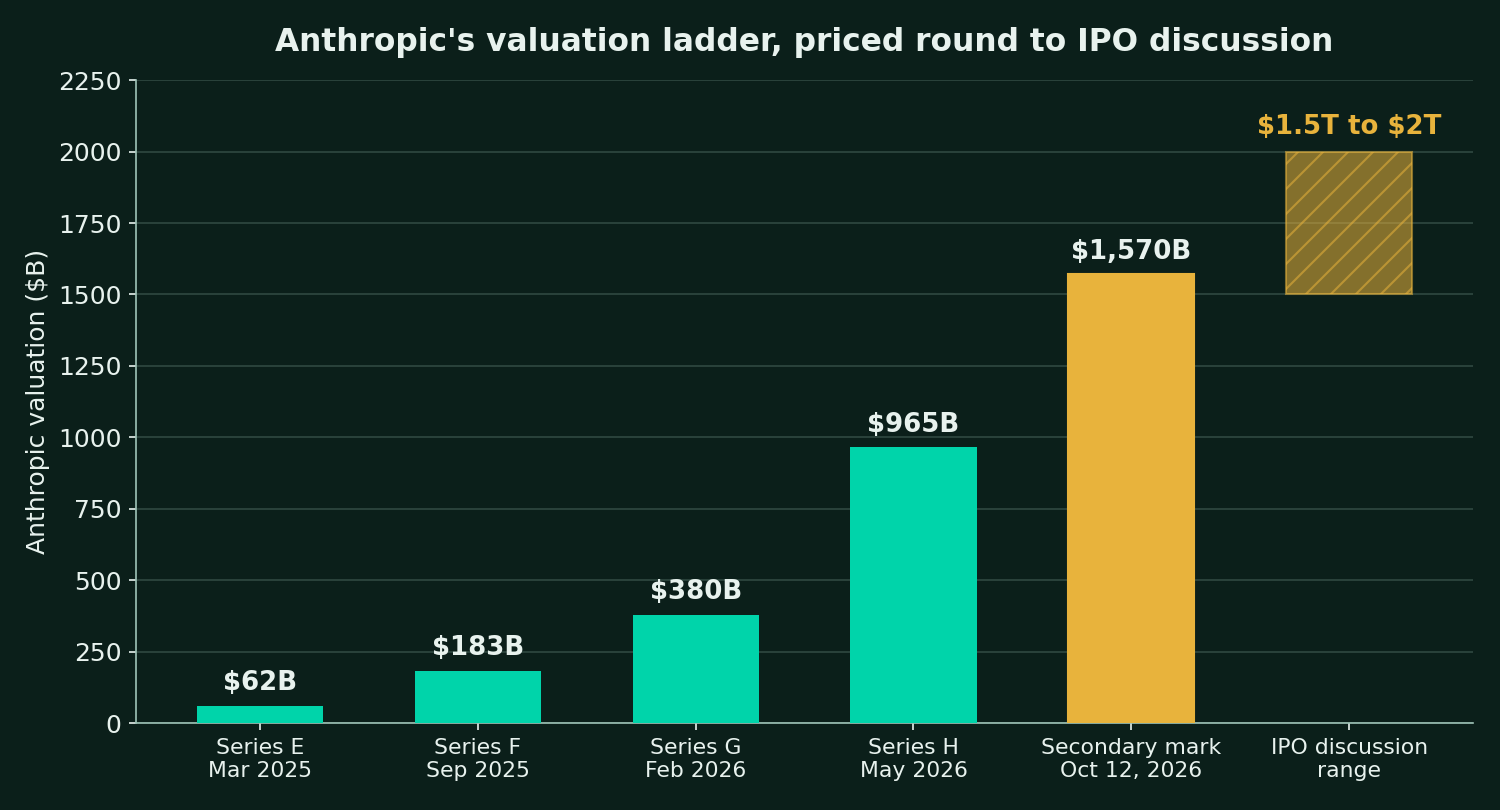
The catch, and it is a large one, is the commitment stack that funds the growth. Anthropic's contractual compute obligations include at least $110.0B payable to Amazon between May 2026 and April 2036, non-cancelable, with shortfall true-ups if it buys less than promised. Google is owed about $114.5B on a similar structure, Microsoft about $44.9B, and Broadcom's TPU leases carry about $161.2B of rent. Revenue that is mostly uncommitted consumption now stands against a decade of take-or-pay compute. That mismatch is Anthropic's central risk factor, and it is also, from Amazon's seat, the point: the $110B commitment is the longest-dated obligation in Anthropic's book, and it converts Amazon's equity upside into a contracted revenue stream whether or not the equity story works.
What is the claim worth at the IPO?
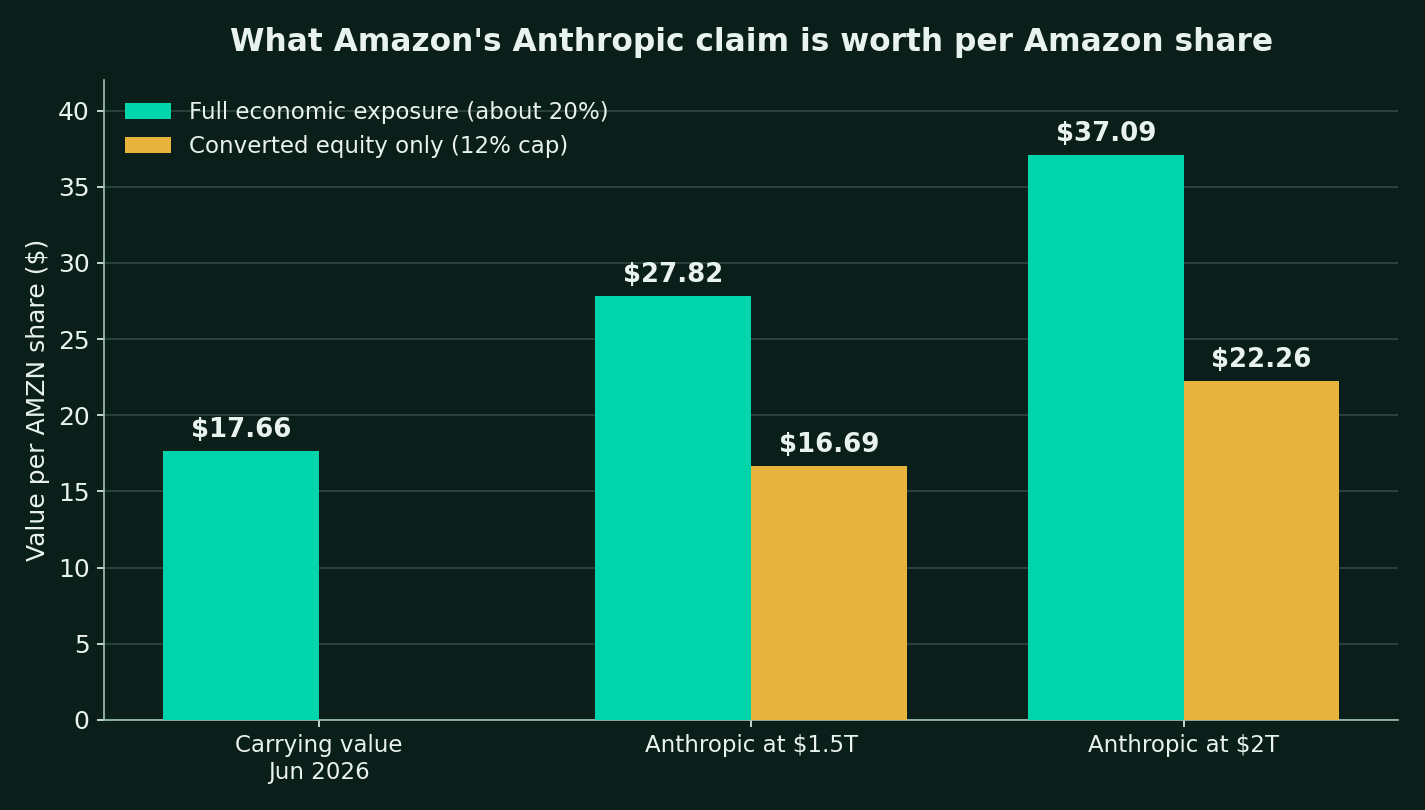
The filing prices nothing: the price range, share count, and proceeds are all blank, and reporting puts the roadshow about two weeks out with a listing targeted for the week of November 16, 2026 (The Information, via Dealroom). What exists is a discussion range. Reuters' most recent sourcing sits near $1.5T, the WSJ range runs to $2T, and a raise of up to $100B has been reported. Treat those as press expectations, not filing figures, and run the scenarios on both definitions of the claim: full economic exposure of about 20%, and converted equity only under the 12% cap, with the balance held as rollover notes.
| Anthropic value | Claim at full exposure | Per AMZN share | Share of AMZN market cap | Equity only, 12% cap | Per AMZN share |
|---|---|---|---|---|---|
| $965B (Series H mark) | $190.4B carrying value | $17.66 | 7.0% | n.a. pre-IPO | n.a. |
| $1.5T (press discussion) | About $300B | $27.82 | 11.0% | About $180B | $16.69 |
| $2.0T (press discussion) | About $400B | $37.09 | 14.7% | About $240B | $22.26 |
All scenario figures are calculated on 10.783B Amazon shares and the exposure implied by Amazon's carrying value. Two things stand out. First, even the capped column is not small: the equity Amazon can hold on day one is worth $16.69 to $22.26 per Amazon share at the discussed range. Second, the increment over today's carrying value is $110B to $210B, another $10 to $19 per share still to be marked if the IPO prices where the discussion sits. Google, for scale, holds an option to buy up to $10B more of Class N at the IPO price alongside the offering, which tells you how the other strategic values the print.
Is any of it in Amazon's share price?
Now the question the whole exercise turns on. Amazon closed Tuesday at $253.10, a market capitalization of about $2.73T, up 9.3% year to date and sitting between its 52-week range of $196.00 and $287.20. If the stake were capitalized at carrying value, it would account for $17.66 of that price. At the IPO discussion range, $27.82 to $37.09. Is the market paying for any of it?
The cleanest evidence is what the professionals who build Amazon's value piece by piece actually write down. In the published sum-of-the-parts frameworks retrieved on October 28, 2026, no major firm itemizes a current Anthropic value at all. The explicit lines that exist are stale to the point of comedy: a February 2026 framework carries the Anthropic stake at $20B, about $2 per share, before the Series G and Series H rounds repriced it nine-fold. An independent memo carries $15B to $25B for Anthropic, Rivian, and all other stakes combined. The one current treatment that engages seriously, Farstar in October 2026, credits the position at 75 cents on the dollar, about $143B, and pointedly refuses to apply an AI premium multiple to the operating business on top; those two choices explain its entire gap to the street, $275 of fair value against a consensus average target of about $325 to $331.
| Framework | Date | Anthropic treatment |
|---|---|---|
| Globlex sum of the parts | Feb 2026 | $20B line, about $2 per share |
| Levin Capital memo | 2026 | $15B to $25B for Anthropic, Rivian, and other stakes combined |
| Farstar deep dive | Oct 2026 | 75% of carrying value, about $143B; fair value $275 |
| Big-bank targets (BMO $380, Morgan Stanley $350, UBS $348, Wells Fargo $329, Deutsche Bank $325, Cantor $310) | Oct 2026 | No Anthropic value itemized in the coverage retrieved |
History says this treatment is the default, not an oversight. Amazon has run this experiment before, with Rivian. At Rivian's November 2021 IPO, Amazon held about 17 to 18% and recognized an $11.8B pre-tax gain in the fourth quarter, 82% of that quarter's net income. The stock's post-earnings re-rating was credited to AWS, advertising, and the Prime price increase. The mark was treated as noise, stripped from operating assessments, and the following year Amazon booked a $12.7B Rivian loss as the stock fell, and held anyway. The Anthropic gain complex is roughly 16 times the Rivian gain in dollars. The market's filing system for it has not changed: real in book value, invisible in capitalized value.
THE VERDICT
The stake is in Amazon's balance sheet and in its GAAP earnings. It is largely absent from Amazon's capitalized market value. At carrying value the claim is $17.66 per share against a $253.10 stock; at the valuations being discussed for the ANT listing it is $27.82 to $37.09. Published target math credits it at a small fraction of face or not at all, and the stock's 2026 trading story has been written by the roughly $220B capex program and AWS growth, not by Anthropic marks. That gap is the opportunity and the warning in the same line: it closes only if the IPO prints near the discussion range and stays there, and Anthropic at $1.5T to $2T trades at 23 to 31 times its run-rate revenue, richer than OpenAI's last round at about 17 times, so the mark can deflate as well as inflate.
One nuance keeps the verdict honest. Part of Anthropic's value to Amazon is already in the price, through the operating door. The $110B ten-year AWS commitment is contracted revenue. Trainium validation is real: Anthropic runs on more than one million Trainium2 chips, the reference proof Amazon's custom silicon program needed. Anthropic sits inside AWS's $496B of remaining performance obligations at June 30, 2026, and every AWS growth assumption the street does capitalize has some Anthropic in it. What is not capitalized is the equity claim itself, the $190.4B asset that would be a top holding of any fund on earth, carried inside a retailer at approximately zero in the models that set the targets.
What happens next?
The calendar is unusually kind to anyone tracking this. Amazon reports third-quarter results tomorrow, Thursday, October 29, with the call at 5 PM ET, and the 10-Q will carry fresh Anthropic marks through September 30. The September secondary marks ran well above the Series H level, so a further step up from $190.4B is the base case the filing arithmetic points to. Then the pricing itself, targeted for the week of November 16: the final prospectus fills in the percentages this draft leaves blank and settles every denominator argument in this article.
Three tells to watch inside that sequence. First, the waiver: whether Amazon waives its 12% cap at conversion is a revealed preference about how it wants the position to look, equity holder of record or patient note holder, and it will be visible in the final documents. Second, the AOCI reclassification: whatever portion of the $92.0B converts will land in one quarter's earnings as a gain the market has been trained to ignore, and the size of the shrug will measure how completely the stake has been excluded from the price. Third, the lock-up horizon: Amazon's converted stake cannot be sold until the earlier of Q3 2027 results or 365 days after the prospectus, so whatever the IPO prints, Amazon is a holder through at least the first year of trading, with the rollover notes converting in stages behind it.
And one question for tomorrow's call that nobody has yet had the chance to ask in public: whether management intends to keep compounding this position through the remaining $15B facility, now that the asset it buys into is about to have a screen price. The answer, or the dodge, will tell you whether Amazon thinks of Anthropic as a trade, a moat, or a treasury asset. At $190.4B and rising, the distinction is worth about $18 a share before the IPO prices a single share.
Frequently asked questions
How much has Amazon invested in Anthropic?
$18B in cash so far. Amazon funded $8B of convertible notes between 2023 and 2025, then bought $10B of non-voting preferred stock in the second quarter of 2026. Up to $15B more is available under a compute-linked facility, plus an option to invest $5B in future rounds.
What percentage of Anthropic does Amazon own?
Amazon has never disclosed it. Its filings imply economic exposure of about 19.7% at the May 2026 Series H valuation, based on the $190.4B carrying value. The equity Amazon can actually hold at the IPO is capped at 12% unless it waives the cap, with the excess held as rollover notes.
Why is the stake not reflected in Amazon's stock price?
Because the market prices Amazon on AWS, advertising and retail, and treats the stake as a non-operating asset. Published sum-of-the-parts models either omit Anthropic or carry stale values far below Amazon's own $190.4B mark. The same treatment followed the Rivian IPO gain in 2021, which the market stripped out of operating value.
Disclosures
Not financial advice. This article is published for educational purposes only. Nothing here is a recommendation to buy, sell, or hold any security, and nothing here is financial advice. Investing involves risk, including the possible loss of principal.
Positions. The author holds a long position in Amazon. The author holds no position in Anthropic, which is not yet a public company.
Accuracy. This analysis is built from public sources believed to be reliable, including the Anthropic S-1 registration statement, Amazon's SEC filings, and market data. Figures described as calculated are arithmetic on those stated inputs, and figures attributed to press reporting are expectations, not filing data. Errors can occur and facts change; verify independently before acting on anything you read.
No advisory relationship. Reading this site does not create an advisor-client relationship of any kind. See the full disclosures page.