
The Akamai story gets told as a compute story now. The inference cloud and the Anthropic commitments take the headlines, and the delivery business takes the blame for slow growth. Security takes neither. It just produces 55 percent of the revenue and most of the cash, quarter after quarter, largely out of frame.
That framing undersells what the security business is. It is also the reason the rest of the story exists. Enterprises sign decade-scale contracts with the company that already stands in front of their traffic and absorbs their worst days. This article takes the security business apart on its own, using filings, the company's published research and the public incident record. The stakes in that record are current. The largest attack ever recorded landed in December 2025, and the months since have raised the tempo again.
Two disclosures belong up front rather than only at the end. The author worked at Akamai from 2013 to 2018, and the author is long the stock. Everything below rests on public sources, and the argument uses structural knowledge of how the platform works rather than anything proprietary.
Why is the edge the first line of defense?
The short version
A flood can only be beaten by capacity larger than the flood, and that capacity lives at the edge or nowhere.
- Origin pipes are sized for business traffic, not for attack peaks
- Akamai filters traffic in layers, in the order the traffic arrives
- The delivery network already saw the traffic before security was a product
- Segmentation assumes one layer fails and contains what gets through
The physics come first. A volumetric attack is a capacity contest. The attacker rents or hijacks enough machines to generate more traffic than the victim's connection can carry. Defending at the origin means defending at the narrowest point of the pipe, which is exactly where the attacker wants the fight. The only durable answer is to meet the traffic somewhere with more capacity than the attack itself.
That somewhere is the edge. A globally distributed anycast network spreads one attack across hundreds of locations at once. Each location absorbs a small share of the flood, and scrubbing systems drop the bad traffic before anything reaches the customer. Akamai describes its connected cloud as roughly 4,100 locations across more than 130 countries. Its Prolexic scrubbing arm alone runs 32 metro locations with more than 20 Tbps of dedicated defense capacity, per the company's 2024 DDoS reference.
The layers run in traffic order. The first decision happens at DNS, where a lookup decides where traffic goes at all. Akamai's Edge DNS and its DNS security services keep resolution alive under attack and cut off known bad domains early. The second layer is network scrubbing, where Prolexic takes the Layer 3 and Layer 4 floods. The third layer is the application shield, where the web application firewall and API security inspect requests and Bot Manager separates machines from people. Only what survives all three reaches the origin.
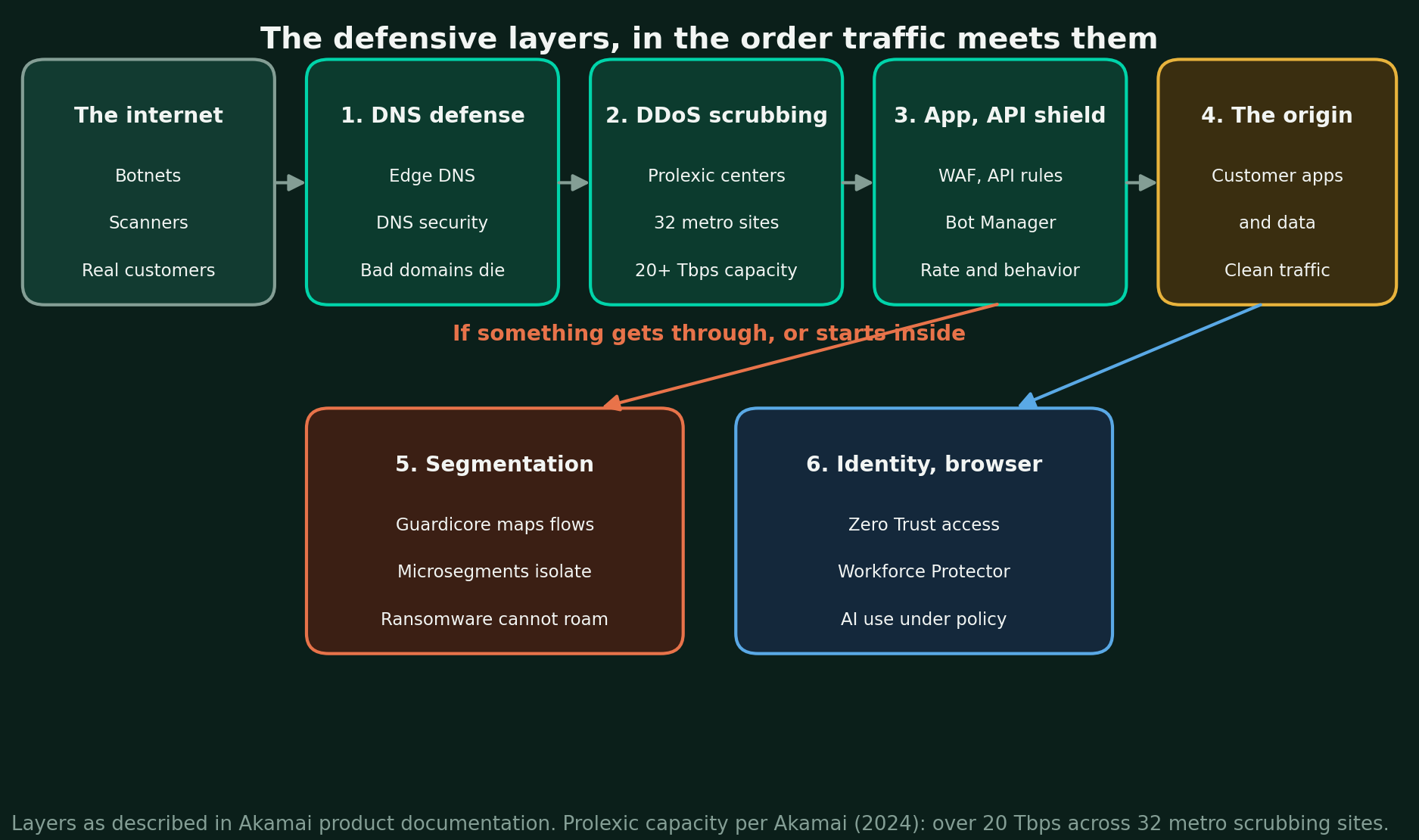
Containment is the second doctrine. Segmentation starts from the assumption that something gets through, or starts inside. Guardicore maps how workloads actually talk to each other and then walls them into microsegments. Ransomware that lands on one machine finds doors locked in every direction. Identity and browser controls guard the human edge of the same problem, where a phished employee or an unmanaged AI tool can open the wall from inside.
Caching turned into security by position. The delivery network already terminated connections close to users. It already saw a significant share of the world's web traffic, in the phrasing of Akamai's own research releases. It already owned the capacity that a flood has to beat. Security did not need a new network. It needed products built on the vantage point the network had occupied since the late 1990s.
People complete the design. Akamai's account of its largest mitigation credits a combination of automatic and human mitigation, run from its security operations centers. Automation handles the first seconds. Analysts who have seen thousands of attacks handle the shape changes that follow.
The application layer is where the design earns its keep. Modern attacks ride inside legitimate encrypted connections. A network that cannot open the envelope cannot judge the letter. Akamai's platform terminates encrypted sessions at the edge for delivery, and that same termination point lets the application and API defenses read each request before it travels onward. An origin behind encryption sees nothing until the traffic is already inside. The edge sees everything while it is still outside, which is the entire argument in one sentence.
The capacity proof is a football tournament. The platform carried a peak of 261 Tbps during the 2022 World Cup, per the company's own account of that event. A network built to serve that volume of legitimate traffic holds structural headroom against floods. Attackers must out-shout one of the largest legitimate traffic machines on earth, on infrastructure the defenders already own and operate for other reasons. That asymmetry is the moat in its rawest form, and no scrubbing-only rival starts with it.
Why does this matter more in November 2026 than it did a year ago?
The short version
The record attack is eleven months old, and the botnet behind it was recruiting again before its takedown was even announced.
- The disclosed record reached 31.4 Tbps in December 2025 and lasted 35 seconds
- Hyper-volumetric attacks rose 519 percent in the first half of 2026
- Akamai stopped the two largest attacks in an Indian bank's history in May 2026
- EU law now ties resilience to personal liability for management bodies
The record book was rewritten in one quarter. In October 2025, Microsoft reported absorbing a 15.7 Tbps attack against a single Azure endpoint in Australia. It was the largest cloud attack then recorded, and the Aisuru botnet launched it. Two months later the same botnet family hit Cloudflare at 31.4 Tbps. The attack lasted 35 seconds, per Cloudflare's fourth quarter 2025 threat report. The December attack closed a holiday campaign that Cloudflare later named The Night Before Christmas. The campaign began on December 19 and produced 902 hyper-volumetric attacks in the following weeks. Cloudflare counted 47.1M DDoS attacks across 2025, and its network-layer count tripled in a single year.
2026 raised the tempo rather than the ceiling. Cloudflare's half-year threat report counted more than 935 attacks above 1 Tbps in the first six months of 2026. Hyper-volumetric attacks rose 519 percent between quarters in the same report. Its third quarter report then counted 18.2M network-layer attacks in three months. That works out to more than 8,200 attacks an hour, and the pattern shifted toward shorter and more frequent strikes. More than 90 percent of network attacks in the first half lasted under ten minutes. A defense that waits for a human arrives after the attack has ended.
The takedown proved the point from the other side. The U.S. Department of Justice announced the disruption of Aisuru and three sibling botnets on March 19, 2026. The four networks had infected more than three million devices. Akamai was one of the private firms that assisted the operation, per the announcement. One day earlier, Nokia Deepfield documented a successor botnet already recruiting tens of thousands of Android TV devices. The infected devices remain in homes and remain unpatched. They wait for the next operator. Standing capacity is the only answer that survives that cycle.
Akamai's own 2026 entry is a bank that never went down. In May 2026 one of India's leading public sector banks took the two biggest attacks in its history, ten days apart. The first peaked at 1.72 Tbps. The second reached 1.78 Tbps and 171M packets per second. Akamai's June 2026 account says no attack traffic reached the bank and no customer saw a disruption. The attackers had aimed at a login endpoint shared by multiple banking applications. The edge was not one layer of that outcome. It was the whole of it.
The traffic itself has changed species. Akamai's commerce research found AI bots at 47.9 percent of commerce traffic by December 2025. Management said on the second quarter 2026 earnings call that more than half of the traffic on the network was already nonhuman. Akamai's Indian bank account describes attackers using AI-driven botnets with automated vector switching. Defense now means classifying machines at machine speed on every request, without pause. That workload is an edge platform's day job.
Regulation has moved the topic into the boardroom. DORA has applied to EU financial entities since January 17, 2025. It requires major incident notification within four hours of classification. Germany's NIS2 implementation act took force in December 2025, and Belgium set the first conformity assessment deadline for April 2026. NIS2 makes management bodies personally accountable for cybersecurity governance. Its fines reach 2 percent of global turnover for essential entities. In the United States, the SEC has required incident disclosure within four business days since December 2023. A bank that goes down now files paperwork about it, in public, on a clock. Boards buy standing defense before they buy explanations.
How much of the internet does the shield actually touch?
The short version
By the company's own published counts, the network runs almost 4,400 points of presence in more than 130 countries and sees up to 30 percent of global web traffic.
- Roughly 300,000 servers sit behind those locations
- About 1,200 network partners carry the platform inside their own networks
- Akamai reports processing more than 11 trillion DNS requests a day
- Coverage buys four concrete security advantages
Start with the company's own counts. Akamai's May 2026 platform account counts almost 4,400 points of presence across more than 130 countries. Roughly 300,000 servers sit behind them. The company's fiscal 2025 statement counts more than 4,300 edge points of presence in approximately 700 cities. The same statement puts the underlying network inside roughly 1,200 network partners. The counts differ by date and by definition. This article uses each with its date attached rather than blending them into one false precision.
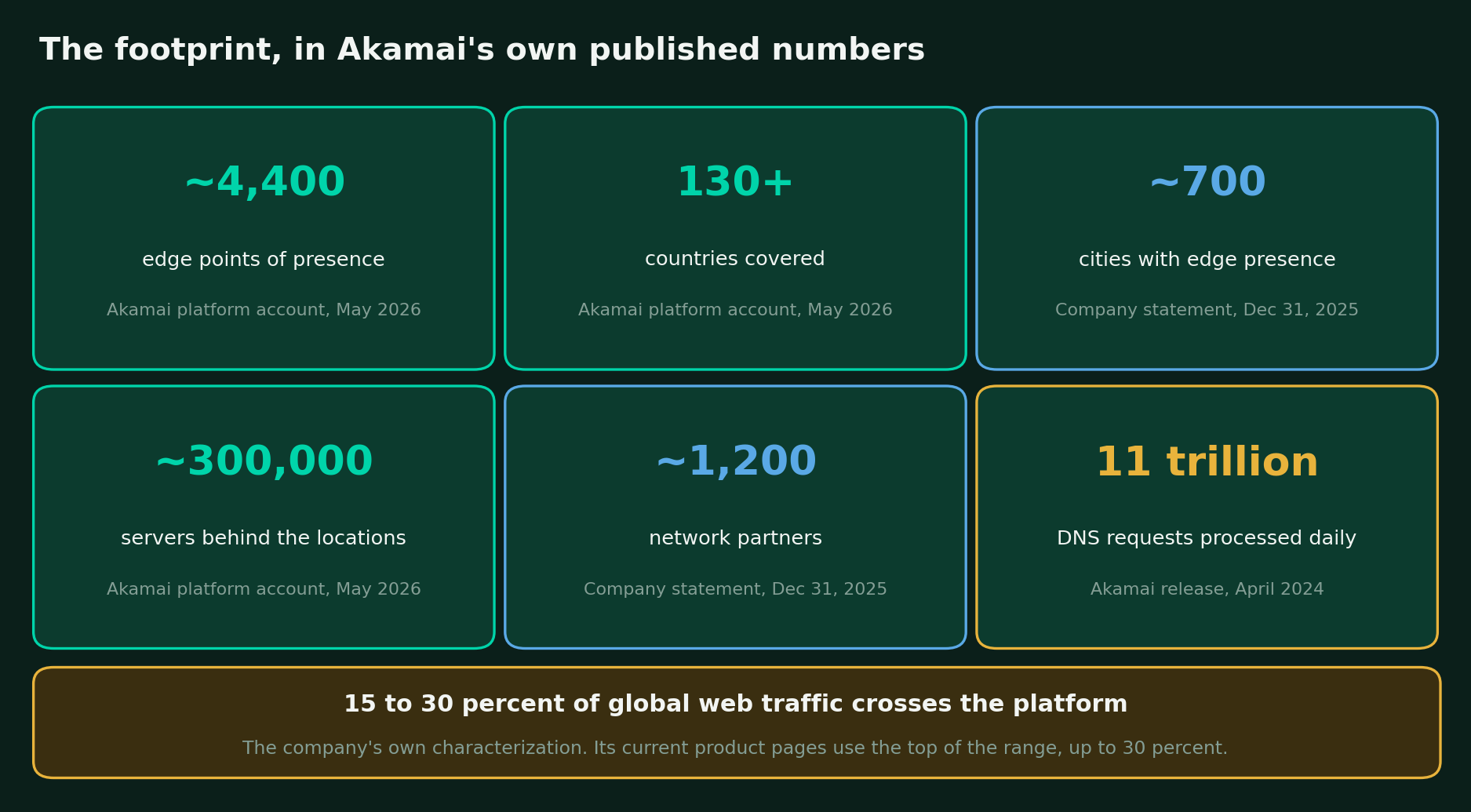
The traffic share is the number that matters most. Akamai has characterized its share of global web traffic at 15 to 30 percent for years. Its current product pages say the connected cloud manages up to 30 percent of global web traffic. Treat the range as the company's own characterization rather than an audited measurement. No third party can audit a share of a whole that nobody fully observes. Even the bottom of the range describes a sensor watching roughly one request in seven cross the public web.
The daily volumes turn share into workload. Akamai reported in April 2024 that it processes more than 11 trillion DNS requests daily. Its current Secure Internet Access pages repeat the figure for recursive DNS queries. DNS is the internet's first question, asked before any content moves. A platform answering 11 trillion of those questions a day holds a map of what the internet is trying to reach. The map includes domains registered an hour earlier for a phishing run. The first section's 261 Tbps World Cup peak states the same point in bandwidth.
Coverage buys absorption first. A flood spreads across every location that announces the victim's routes. Four thousand locations divide one attack into four thousand smaller attacks. Each fraction then meets local capacity sized for real traffic peaks. The Indian bank campaign of May 2026 shows the mechanism at work. Akamai's account says most of the attack traffic concentrated in its Brazil scrubbing centers. About 29 percent arrived outside the primary mitigation regions. A single-site scrubber faces the whole flood at once. A footprint faces fractions.
Coverage buys detection second. Detection quality follows the share of attacks a sensor has already seen. A platform watching up to 30 percent of web traffic meets most new attack signatures on somebody else's property first. The signature then protects every customer behind the platform. It protects them before the attacker rotates to their names. This is the network effect inside the security business, and it compounds with every point of presence added.
Coverage buys position third. Botnets live inside consumer networks in every jurisdiction, and their traffic enters the internet close to home. A footprint embedded within roughly 1,200 partner networks can filter that traffic near its source. Filtering near the source keeps attack traffic off long-haul links entirely. It also places the defense inside jurisdictions where a distant scrubbing center holds no presence and no peering.
Coverage buys authority fourth. The State of the Internet series rests on this footprint. A report built on that share of the web is an institution. A report built on a sample is a survey. The authority sells the products. The products fund the footprint. The footprint refreshes the authority. That flywheel is why a research series started in 2008 still anchors a security argument in 2026.
How strong was Akamai's security before it bought anything?
The short version
The network was the sensor and much of the shield years before the acquisition program began.
- State of the Internet research began in 2008, built on platform data
- Web application and DDoS protection for web properties predates Prolexic
- The platform measured the 623 Gbps Krebs attack in 2016 from its own telemetry
- The gaps were specific, and the later acquisitions map onto them one by one
The research institution came first. Akamai published its first quarterly State of the Internet report in 2008, edited by David Belson. The first issue already tracked attack traffic by country, observed from 125 countries across the platform. The connectivity edition ran through 2017, and a dedicated security edition followed. Akamai marked ten years of State of the Internet security reporting in 2024, and the series continues today.
That history matters commercially, not just academically. A vendor that publishes the industry's attack data becomes the authority buyers call when the data gets personal. The research also feeds the products, because the same telemetry that fills the reports trains the detection. The sensor and the research lab are the same asset seen from two sides.
The product base was real before 2013. Akamai sold web application firewall and DDoS protection for web properties on its own platform before it bought Prolexic. The December 2013 Prolexic announcement is the tell. It framed the deal as extending protection to data centers and enterprise IP applications, which only makes sense as an extension of a web security business that already existed. Prolexic filled the data center gap. It did not create the security line.
The telemetry proof arrived in 2016. When the Mirai botnet hit KrebsOnSecurity that September, it was Akamai's own State of the Internet security report that measured the attack at 623 Gbps. The platform could size the largest attack then known because the platform was already watching the internet at scale. Measurement at that level is not a marketing skill. It is a byproduct of position.
The honest limits were equally specific. Organic Akamai had no dedicated scrubbing network for data centers. It had no carrier-grade DNS security business. Its bot detection lacked a specialist team behind it. It had nothing inside the customer's data center, where segmentation lives. And it had no API security product when APIs became the attack surface. Read the acquisition table in the next section against that list. The deals map onto the gaps almost one for one.
There was also a market gap the organic line could not close. Web teams bought edge security. Chief information security officers bought scrubbing and segmentation from specialists with dedicated sales motions. Akamai's organic strength sat with the wrong buyer for the biggest budgets. Prolexic and Guardicore were technology acquisitions and sales-motion acquisitions at once. Each brought a product the security office already respected, and a team that already knew how to sell to that office.
What did Akamai buy, and what did each piece add?
The short version
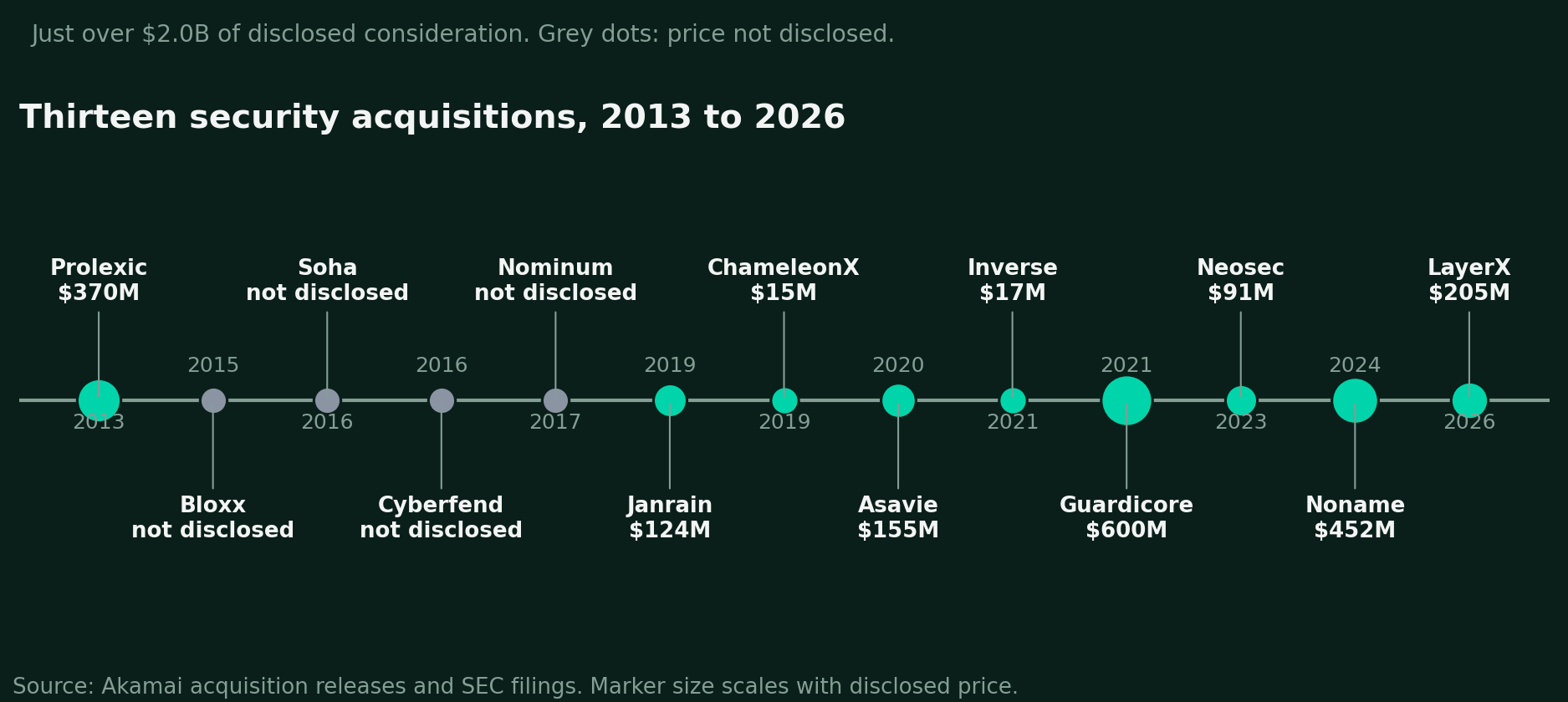
Thirteen security deals over thirteen years cost just over $2.0B in disclosed consideration, and three of them carry the segment.
- Prolexic, Guardicore and Noname are load-bearing products today
- Cyberfend and Nominum disappeared into the platform and stayed useful
- Janrain, Asavie and Bloxx stayed small relative to their promise
- LayerX is a strategy price at $205M against about $10M of expected ARR
| Target | Year | Price | What it added |
|---|---|---|---|
| Prolexic | 2013 | About $370M | Dedicated DDoS scrubbing for data centers and IP applications |
| Bloxx | 2015 | Not disclosed | Secure web gateway technology |
| Soha Systems | 2016 | Not disclosed | Secure application access, an early zero trust piece |
| Cyberfend | 2016 | Not disclosed | Bot and automation detection |
| Nominum | 2017 | Not disclosed | Carrier DNS and DNS security at scale |
| Janrain | 2019 | $123.6M | Customer identity and access management |
| ChameleonX | 2019 | About $15M | Website malware and skimming detection |
| Asavie | 2020 | $155.0M | Mobile and IoT device security and policy |
| Inverse | 2021 | $17.1M | Device identification and network access data |
| Guardicore | 2021 | About $600M | Microsegmentation and ransomware containment |
| Neosec | 2023 | $91.4M | API detection and response on behavioral analytics |
| Noname Security | 2024 | $451.5M | Full API security platform, including shadow API discovery |
| LayerX | 2026 | About $205M | Browser security and AI usage control |
Prices are as announced by the company, or as stated in its SEC filings where the announcement gave no figure. The disclosed total across the nine priced deals is just over $2.0B. Four smaller deals were never priced in public.
Three deals carry the segment. Prolexic is the clearest success. Twelve years after the deal closed, the scrubbing platform still runs under the Prolexic name, and every incident in the next section happened on it. Guardicore is the second. It produced $68M of revenue in 2022, its first full year inside Akamai, per the fourth quarter 2022 call. By the third quarter of 2026 it was still one of the two growth leaders inside security. Noname is the third, paired with Neosec. Together they built the API Security product that shared the growth lead in the latest quarter.
Two deals vanished and earned their keep anyway. Cyberfend's bot detection folded into Bot Manager, where it stopped being a brand and became a feature of the edge. Nominum's DNS technology went the same way, into the DNS security line that carriers and enterprises still buy. Acquisitions that disappear into a platform are hard to grade from outside. The products they fed are still on the price list, which is the grade that matters.
The middle of the record is honest mediocrity. Janrain brought real identity technology, and customer identity never became a headline business for Akamai. Asavie addressed mobile and IoT security, a market that stayed quieter than its forecasts. Bloxx fed the secure web gateway line without changing its trajectory. None of the three broke anything. None of them bent the segment curve either.
LayerX is too new to grade, and its price tells a story. Akamai agreed to pay about $205M in May 2026 for a browser security company with about $10M of expected recurring revenue at year end. That is a strategy price, paid for position in AI usage control rather than for current revenue. The third quarter call already had LayerX selling into large enterprises. The grade waits on whether the attach rate justifies the multiple.
The integration pattern explains the hit rate. Akamai keeps a bought brand when the category is a destination purchase, which is why Guardicore Segmentation and API Security still carry their own names. It absorbs a deal into the platform when the capability is a feature, which is why Cyberfend and Nominum disappeared. The company has also stayed disciplined about what it will not buy. It has never acquired an endpoint agent business or a SIEM platform. Every deal plugged into the same traffic path or the same identity layer, and that restraint is a large part of why the integrations worked.
The arithmetic of the program. Just over $2.0B of disclosed consideration bought the shelf that Prolexic, Guardicore and Noname anchor. Security revenue in 2025 alone was $2.24B. The entire disclosed buying program cost less than one year of the revenue line it helped build, though the organic base deserves part of that credit.
Which incidents prove the platform?
The short version
The proof is a decade of named floods absorbed in public, plus one famous case where the shield held and the company blinked.
- GitHub in 2018 was mitigated within about ten minutes of engagement
- The 1.78 Tbps defense of an Indian bank in May 2026 is the largest Akamai mitigation now disclosed
- An Israeli bank stayed up through 419 TB of attack traffic in July 2024
- KrebsOnSecurity in 2016 is the honest exception, and it was economic rather than technical
| Date | Target or event | Scale | What Akamai did |
|---|---|---|---|
| Sep 2016 | KrebsOnSecurity, Mirai botnet | 623 Gbps | Absorbed the attack for a pro bono customer, then ended the free protection on cost grounds |
| Feb 2018 | GitHub, memcached amplification | 1.35 Tbps | Prolexic scrubbing after a BGP failover, fully mitigated within about ten minutes |
| Jun 2020 | Internet hosting provider, nine vectors | 1.44 Tbps and 385 Mpps | Prolexic mitigation over nearly two hours, the platform record at the time |
| Jun 2020 | Large European bank | 809 Mpps | The largest packet rate attack then recorded on the platform, stopped in about ten minutes |
| Jul 2022 | Eastern European customer, 75th attack in 30 days | 853.7 Gbps and 659.6 Mpps | Prolexic held through a 14 hour campaign, the largest horizontal attack on the platform |
| Feb 2023 | Asia-Pacific Prolexic customer | 900.1 Gbps and 158.2 Mpps | The largest attack then launched against an Akamai customer in the region |
| Jul 2024 | Major Israeli financial services company | Peak 798 Gbps, about 419 TB blocked | Prolexic held for nearly 24 hours across more than 278 targeted addresses |
| May 2026 | Indian public sector bank, two attacks ten days apart | 1.78 Tbps and 171 Mpps peak | Prolexic absorbed both at the edge, no attack traffic reached the bank and no disruption was reported |
Sources: Akamai mitigation blogs and State of the Internet reporting for each event, the GitHub incident report of February 2018, and The Register for the July 2022 campaign.
GitHub is the cleanest exhibit. On February 28, 2018, a memcached amplification attack pushed 1.35 Tbps at GitHub. It was then the largest attack ever disclosed. GitHub failed its traffic over to Prolexic by BGP announcement. Akamai's scrubbing centers dropped the amplified traffic and returned clean traffic over tunnels. GitHub's own incident report puts full mitigation at roughly ten minutes from engagement, with about five minutes of hard downtime. The largest flood in history at that date cost the target less time than a routine deployment.
The packet record shows the other attack shape. Three days after the 1.44 Tbps event, a large European bank took 809M packets per second on June 21, 2020. The packets carried almost no payload. The design goal was to exhaust processing rather than bandwidth, and Akamai noted that 96.2 percent of the source addresses had not appeared in any earlier 2020 attack. A fresh botnet had been built for the purpose. Prolexic's pre-set mitigation controls stopped it in about ten minutes. Bandwidth records make headlines. Packet records are the ones that break under-provisioned defenses quietly.
The 2022 campaign adds the geopolitical chapter. The Eastern European customer in the table had been attacked 75 times in the 30 days before the July 21 peak. The campaign ran during the war in Ukraine, and Akamai did not attribute it. The pattern is the finding. Geopolitical conflict now arrives at civilian infrastructure as sustained DDoS pressure, renewed daily for weeks. Defense against that pattern is a standing service with standing capacity, not an emergency purchase made during the first flood.
Israel in July 2024 is the endurance exhibit. The target was a major financial services company that had been attacked repeatedly since late 2023. On July 15 the campaign ran for nearly 24 hours and peaked between 300 and 798 Gbps. Prolexic blocked about 419 TB of traffic across more than 278 addresses, and Akamai counted it as the sixth largest peak in platform history. It was also the customer's 27th significant attack in 90 days. Akamai's account notes that the customer had recently moved to Prolexic, and that other Israeli financial institutions reportedly suffered outages in the same wave.
KrebsOnSecurity is the entry that cuts the other way. In September 2016 the Mirai botnet aimed 623 Gbps at one journalist's website. Akamai had protected the site free for about four years, and its network absorbed the attack. Then the company withdrew the pro bono protection. Absorbing record attacks for free cost millions by Krebs's own reporting, and it set a precedent the company would not carry. Google's Project Shield took the site over. The lesson is precise. The technology held at record scale, and the economics of an unpaid account failed first. Bears who cite Krebs are citing a pricing decision, not a capacity failure, and the distinction matters.
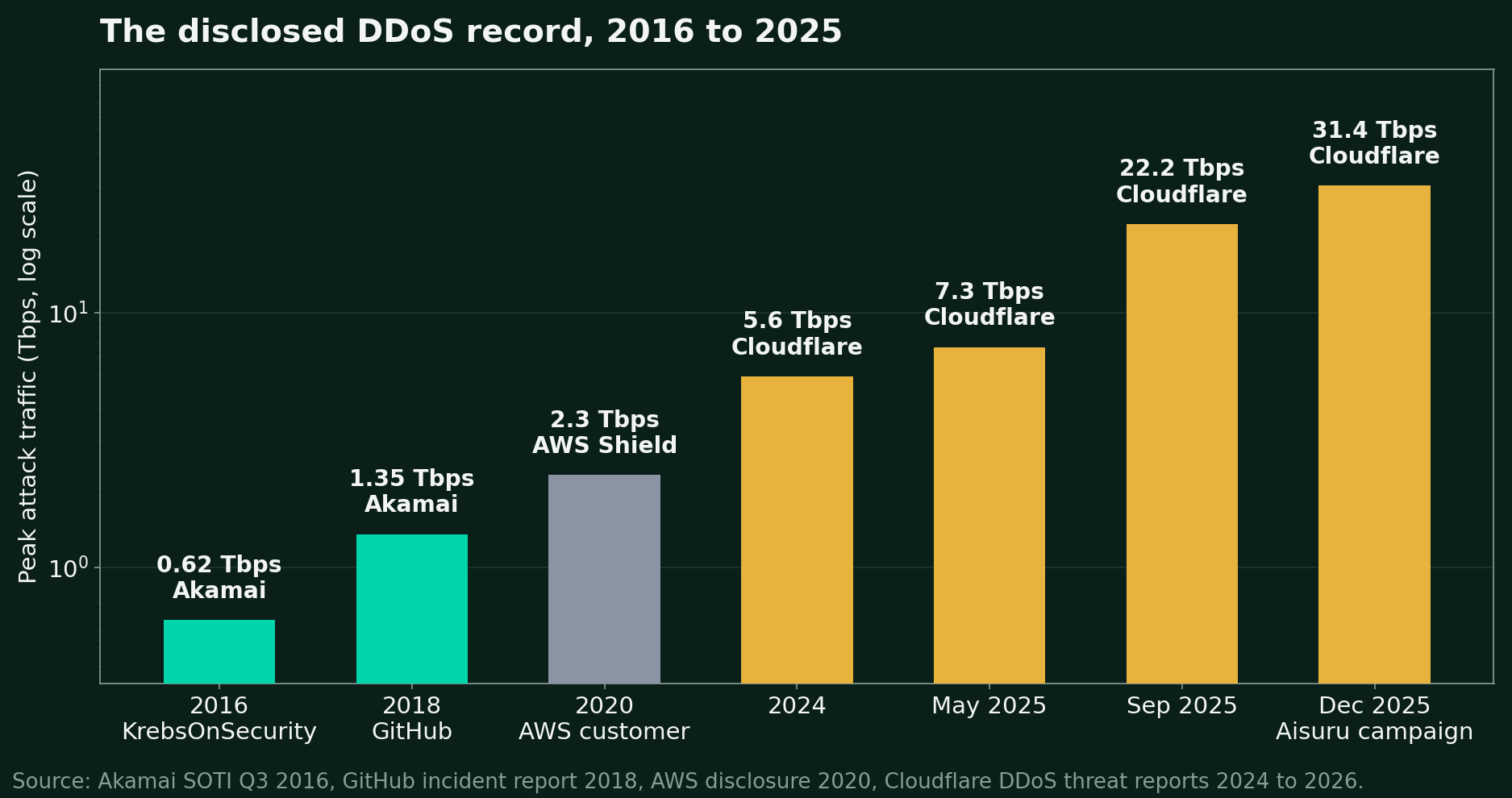
The record book needs an honest paragraph. Akamai's largest disclosed mitigation now stands at 1.78 Tbps, set against an Indian public sector bank in May 2026. The industry record has since moved to Cloudflare, most recently 31.4 Tbps in December 2025 from the Aisuru botnet family. A record measures the largest attack a network happened to receive and disclose. It is not a capacity ceiling, and Prolexic sells more than 20 Tbps of dedicated defense capacity. Still, the headline numbers shape procurement shortlists, and Akamai no longer owns them. That point returns in the bears section, where it belongs.
What do Akamai's own security reports say the threat has become?
The short version
Every series Akamai publishes points the same way: more automation, more API surface, bigger floods.
- Web application and API attacks reached 311B in 2024, up 33 percent
- More than 150B of those attacks targeted APIs
- Bots are 42 percent of web traffic, and 65 percent of bots are malicious
- AI bots reached 47.9 percent of commerce traffic by December 2025
The volume line is the headline. Akamai's State of Apps and API Security 2025 counted 311B web application and API attacks during 2024. That was a 33 percent rise on the year before. More than 150B of the attacks targeted APIs rather than web pages. The attack surface of the average enterprise is now mostly machine to machine, and the report series has tracked the crossover year by year.
APIs are the growth market in attacks. The 2024 report Lurking in the Shadows recorded 108B API attacks in the eighteen months to June 2024. When Akamai announced the Noname acquisition that May, it cited API attacks growing at 109 percent year over year in its own data. A company does not pay $451.5M for an API security platform against a shrinking problem. The research and the checkbook tell the same story, which is what makes both more credible.
Bots are the background radiation. The June 2024 report Scraping Away Your Bottom Line found that bots compose 42 percent of overall web traffic. It classified 65 percent of those bots as malicious. Scrapers feed counterfeit storefronts and phishing kits, and the same infrastructure runs credential attacks. For an edge platform, bot classification is not a niche product. It is a judgment the platform makes about nearly half of everything it carries.
The AI turn is already in the data. The 2026 commerce report, Securing the Agentic Storefront, found that AI bots accounted for 47.9 percent of commerce traffic as of December 2025. Layer 7 DDoS attacks against commerce approached 3 trillion events during 2025. Web attacks targeting APIs rose another 9 percent. The companion API Security Impact Study found that 85 percent of commerce respondents had suffered at least one API incident in the prior year, while only 22 percent knew which of their APIs expose sensitive data.
The regional cuts show the same slope. Total web attacks in Asia-Pacific and Japan reached 51B during 2024. That was up 73 percent year over year, per the regional data in the same 2025 report. Attack growth is not a North American story or a single sector's story. It is the background condition of operating on the internet now, in every region Akamai measures. A defense platform sells into a rising market by default, and still has to win each renewal on merit.
The products follow the reports. Akamai launched a Firewall for AI in 2025, aimed at the prompt and model traffic its research was flagging. It bought LayerX in 2026 for browser-level control of AI use. A skeptic can note that the research also markets the remedies. The stronger reading is that the telemetry arrives first, because the platform sees the traffic first, and the product roadmap is the telemetry monetized.
How to use SOTI as an investor. Treat the reports as demand evidence rather than as neutral science. The methodology is one vendor's traffic, and the vendor sells the cure. Then note that no rival dataset contradicts the direction, and that Cloudflare's own threat reports show the same escalation from a different network. Two competing sensors agreeing on the weather is close to ground truth.
How big is the security business, and how durable?
The short version
Security is a $2.24B business growing at high single digits, and it now funds a company whose legacy line shrinks every year.
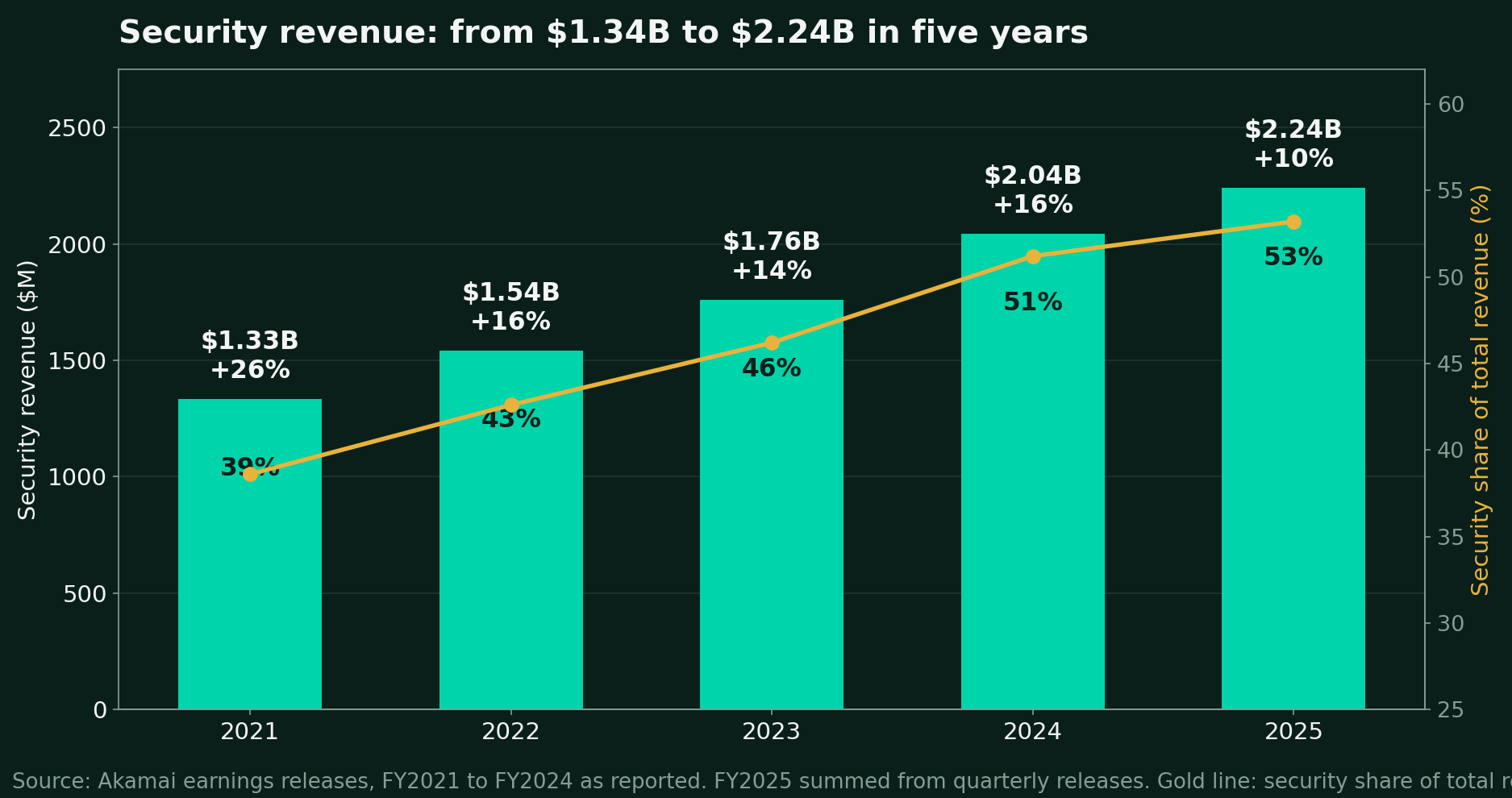
- Security grew from $1.33B in 2021 to $2.24B in 2025
- Delivery fell from $1.67B in 2022 to about $1.26B in 2025
- Q3 2026 security revenue was $622M, up 9 percent, at 55 percent of the total
- Palo Alto is five times larger, and Cloudflare grows three times faster
| Revenue by line ($M) | 2022 | 2023 | 2024 | 2025 | Q3 2026 |
|---|---|---|---|---|---|
| Security | 1,542 | 1,761 | 2,043 | 2,240 | 622 |
| Delivery and other cloud apps | 1,669 | 1,542 | 1,318 | 1,260 | 391 |
| Compute and CIS | 405 | 504 | 630 | 708 | 109 |
| Total | 3,617 | 3,812 | 3,991 | 4,208 | 1,122 |
Full years are as reported in Akamai's earnings releases, with 2025 summed from the quarterly releases. The Q3 2026 column uses the company's current labels, where CIS is broken out of compute and delivery carries the other cloud applications. The mix story survives any labeling. Security added about $700M between 2022 and 2025 while delivery gave back about $400M.
The latest quarter shows the cadence. Security revenue of $622M grew 9 percent as reported and 10 percent in constant currency. The chief financial officer described sequential additions of roughly $12M to $13M a quarter on the call. API Security and Guardicore Segmentation led the growth, web application firewall demand stayed strong, and LayerX was already selling into large enterprises within months of closing. That is a utility cadence, steady and unspectacular, attached to contracts that rarely churn in anger.
Durability comes from position inside the account. Security rides on the same platform contracts as delivery and compute. The managed services layer and the security operations centers attach people to the platform, and people renew more reliably than software. Platform consolidation is the explicit renewal pitch, one vendor for delivery, security and cloud on a single network. Akamai does not publish a net retention figure, and this article will not invent one. The revenue series itself is the retention evidence available: the segment has grown every year since it was broken out, through a pandemic boom and a normalization.
The segment also carries the company's profit shape. Akamai does not break out segment margins, so the claim has to be made at company level. The third quarter printed a 25 percent non-GAAP operating margin while capital spending ran at 41 percent of revenue. Subscription-like security revenue is what makes that combination survivable. Our own earnings scorecard for the quarter set double-digit security growth as the pass line and graded the 9 percent print borderline. Borderline growth from the base is a very different problem from a shrinking base, and the distinction is the durability argument.
The shrinking line has slowed to a glide. Delivery revenue fell 3 percent in the third quarter, with pricing holding better than it has in years, per the earnings call. A legacy line that declines slowly is a funding source. A legacy line in free fall is a crisis. Akamai's mix shift is happening at a pace the security segment can finance, which is exactly the pace the thesis needs.
| Comparison | Revenue | Growth | The honest read |
|---|---|---|---|
| Akamai security segment, 2025 | $2.24B | About 10% | A security line the size of a large pure-play vendor |
| Cloudflare total, 2025 | $2.17B | 30% | Akamai's security line alone roughly equals all of Cloudflare |
| Palo Alto Networks total, fiscal 2026 | $11.48B | About 25% | Five times Akamai's security revenue, across a far wider platform |
| Zscaler total, fiscal 2026 | $3.35B | About 25% | Larger than Akamai security, built on zero trust access alone |
| Fastly security line, 2025 | $125M | 21% | An edge rival whose whole company is a sixth of Akamai's security segment |
Fiscal years differ across the rows, with Palo Alto and Zscaler ending in July 2026 and the rest in December 2025. The comparison is of scale, not of like-for-like quarters. Akamai is neither the largest security vendor nor the fastest growing. Its claim is narrower and stronger: the only one of the set whose security business was born on its own global delivery network, and the only one whose security segment alone would rank among the industry's large vendors.
What are the bears right about?
The short version
The bears are right about the growth rate, the outage record and the price umbrella, and those are not small things.
- Security growth has decelerated from 26 percent in 2021 to 9 percent
- The July 2021 DNS outage showed the concentration risk in one hour
- Cloudflare gives DDoS protection away and resets price expectations
- The headline attack records now belong to a rival
The deceleration is arithmetic, not narrative. Security grew 26 percent in 2021. Growth then ran at 16, 14 and 16 percent before slowing to about 10 percent in 2025. The third quarter of 2026 printed 9 percent. Sequential additions of $12M to $13M a quarter describe a maturing franchise. A buyer of the stock today is buying durability at a utility growth rate, and the multiple should reflect that bargain honestly.
The 2021 outages are the concentration exhibit. On July 22, 2021, a software configuration update triggered a bug in the DNS system of Akamai's secure edge network. Airline, banking, shipping and gaming sites failed together for up to an hour. The rollback then restored service. Akamai confirmed it was not a cyberattack. Six weeks earlier, a Prolexic platform disruption had hit financial customers in Australia and beyond, as reported at the time. The same centrality that makes the shield valuable makes its failures systemic. One bad push can still become everyone's bad afternoon.
Cloudflare's bundle presses on price. Cloudflare includes unmetered DDoS protection on every plan, including its free tier. That model resets what the low end of the market expects to pay for scrubbing, and it forces Akamai to sell on operations and enterprise depth rather than on the feature itself. Akamai's answer is the high end, where attacks are campaigns rather than events. The answer works until a bundled rival becomes good enough at the high end too.
The funnel is the longer version of that risk. Cloudflare's free tier puts its network in front of millions of small properties. Some of those properties become large enterprises with the incumbent already installed and the switching cost already paid. Akamai sells top-down to enterprises and has no equivalent self-serve base. The model wins today's margin. It also mortgages tomorrow's default position, one free website at a time.
Breadth is rented in places. Two of the three growth engines inside security, segmentation and API security, were acquired rather than built. That is not a sin, and the integration record is good. It does mean the roadmap depends on continued buying in categories where point vendors set the terms. The LayerX price, about twenty times its expected recurring revenue, shows what that dependence costs when the category is hot.
The soft figures sit in the latest print. Third quarter GAAP earnings per share fell 21 percent year over year, and non-GAAP earnings fell 5 percent. Capital spending reached $464M in the quarter, 41 percent of revenue, as the compute build consumed cash. Security's maturity is what makes that spending possible. It is also what makes the segment's own story quieter each year, and quiet stories get valued quietly.
What does the security base mean for the Akamai thesis?
The short version
The compute story sits on top of the security franchise, and the franchise is what makes the compute contracts signable.
- Security funds the build at 55 percent of revenue
- About $14B of CIS commitments rest on enterprise trust the shield created
- The evidence supports the library score of 76 of 100
- This article makes no score change
Follow the cash. The third quarter of 2026 shows the machine in one frame. Security produced $622M of the $1.122B total, at a company operating margin structure that has funded decades of network build. Capital spending of $464M in the same quarter went largely to the compute expansion. The growth story spends what the security story earns. That is not a criticism of the growth story. It is the reason the growth story can be funded without heroic capital raises.
Follow the trust. The compute commitments are the headline of the current thesis: about $14B of multiyear CIS commitments, including about $11.6B from Anthropic. CIS is guided to $1.1B to $1.3B of revenue in 2027, and management says 2028 revenue above $7.0B is reachable from signed business alone. Enterprises do not sign commitments of that size with a vendor they merely like. They sign with the vendor that already stands in front of their traffic, absorbs their attacks and answers the phone during their worst hour of the year. The security franchise is the credential the compute contracts are written on.
Our own comparison work lands in the same place. The November comparison of Akamai and Cloudflare graded the two companies 78 and 76 as whole businesses. The security record assembled here is a large part of Akamai's side of that ledger. Its security line alone is bigger than Cloudflare's entire revenue, built and bought over thirteen years. The rival grows three times faster from a smaller base. Both facts can be true at once, and the 76 already prices the tension between them.
The verdict on the evidence. Our library package grades Akamai 76 of 100. The security record supports that grade. The durability is real, and 2026 is testing it in public against the largest attacks ever recorded. The incident record is long and public, the research institution is genuine, and the buying program cost less than a year of the revenue it built. The caps on the grade are equally visible in this article: high single digit growth, a rival holding the records, and a platform whose failures are everyone's failures. This article makes no score change. It establishes that the base under the thesis is the strongest part of the company, and that the thesis's risk sits in the growth layer above it rather than in the foundation.
What would change this view
Security growth slipping below mid-single digits for two straight quarters would break the durability claim at its strongest point. A repeat of a 2021 style platform outage would reprice the concentration risk. On the other side, AI-era attach through the Firewall for AI and Workforce Protector could push security growth back into double digits. With CIS converting on schedule, that would argue the base deserves more credit than a 76 carries. The next checkpoint is the February call, where 2027 component guidance arrives.
Frequently asked questions
How much of Akamai is security now?
Security revenue was $2.24B in 2025, about 53% of total revenue. It reached $622M in the third quarter of 2026, at 55% of that quarter's $1.122B. The segment passed delivery as the largest line in 2024. It has grown every year in the reported series, from $1.33B in 2021.
What is the largest attack Akamai has publicly mitigated?
The largest disclosed Akamai mitigation peaked at 1.78 Tbps against an Indian public sector bank in May 2026 at 171 million packets per second. Akamai mitigated 1.44 Tbps against a hosting provider in June 2020 and 1.35 Tbps against GitHub in February 2018. The disclosed industry record is Cloudflare's 31.4 Tbps from December 2025.
Did Akamai build its security business or buy it?
Both, in that order. The edge network came first, and the State of the Internet research series has run since 2008 on the visibility that network creates. Thirteen acquisitions since 2013 then added scrubbing, segmentation and API security for just over $2.0B of disclosed consideration. The largest single deal was Guardicore at about $600M in 2021.
Disclosures
Research and opinion, not investment advice. The author is long Akamai (AKAM). The author was employed by Akamai from 2013 to 2018. This article uses structural and architectural knowledge of how distributed edge platforms work, and no proprietary information. Every factual claim rests on public sources. Financial figures are drawn from Akamai's earnings releases and SEC filings, including the 10-K and 10-Q purchase prices cited for Janrain, Asavie, Inverse, Neosec and Noname Security. Incident figures are drawn from Akamai's mitigation blogs and State of the Internet reports, the GitHub incident report of February 2018, The Register, and KrebsOnSecurity. Threat figures are drawn from the Akamai State of the Internet reports named in the text. Competitor figures are drawn from each company's reported results, with Cloudflare's attack records from its DDoS threat reports. The 2026 relevance section also draws on a U.S. Department of Justice announcement and on Nokia Deepfield research. It also draws on Microsoft's October 2025 mitigation report and on the texts of the EU NIS2 directive and the DORA regulation. Footprint figures come from Akamai's published platform accounts and corporate statements, each dated where it appears. Prices marked as reported or approximate are labeled as such where they appear. DalalBytes research on Akamai: five-pillar analysis and Akamai versus Cloudflare.
© 2026 DalalBytes Research · For educational purposes only. Not investment advice.