What is the verdict?
58/100. Neutral. The world's most valuable option portfolio attached to a real, profitable, currently flat car company, priced as if both options pay.
| 58/100 | DalalBytes score |
| $386.47 | Reference price, Oct 21, 2026 close |
| ~$1.53T | Market cap, 3,949.5M issued shares |
| $120 / $330 / $620 | FY2029 bear / base / bull |
Tesla is two companies sharing one ticker. The first makes cars, batteries, and solar products: about $101B of trailing revenue, a gross margin rebuilt to the high teens, deliveries down two consecutive years, and a valuation, on any car-company math, that would be a rounding error against the current quote. The second company is a portfolio of options on robotaxis, humanoid robots, AI compute, and now a private chip fab, none of which contributes material revenue today. At $386.47, the market values the pair at about $1.53 trillion. The options are the company.
The arithmetic states the problem plainly. Trailing GAAP P/E is about 358x on trailing GAAP EPS of about $1.08. Forward P/E is about 188x next-twelve-month earnings (Reuters), and about 173-177x FY2027E adjusted EPS of $2.24. Price to sales is about 15.2x trailing. Our base case for FY2029, adjusted EPS of $5.50 at a still-rich 60x, produces $330, below the current price. The bull case, $8.25 at 75x, produces about $620. An investor buying here is not buying the base case. They are buying the bull case with a discount for execution, and the execution record, audited in Section 13, is the weakest part of the file.
What keeps this from being a Negative is that the options are real and the balance sheet funds them without capital markets. Robotaxis are genuinely driverless in six US cities. The Cybercab is in production and carrying paid riders. Semi is finally in volume production. Optimus production-quality units exist at Fremont. The fortress ($45.4B of cash and investments against about $9.5B of debt and leases) means Tesla gets to keep rolling these options for years. What keeps it from being a Positive is that none of that is news to the price. Neutral, with the upgrade and downgrade triggers stated in Section 19.
Written the day after the print
Q3 2026 results were released after the close on Wednesday, October 21, 2026. This report is written against the print and the Q3 call, at the October 21 close of $386.47. The stock rose 3.41% into the print and fell about 1 to 2% intraday on October 22, well inside the roughly 6.5% move the options market had priced.
What does Tesla actually sell?
Tesla designs, manufactures, and sells electric vehicles, energy storage and solar products, and an expanding set of software and autonomy services. It reports three revenue lines. In Q3 2026, automotive revenue was $20,560M (about 73% of the total), services and other was $4,605M (about 16%), and energy generation and storage was $2,881M (about 10%).
| Line | Q3 2026 revenue ($M) | Share | What sits inside |
|---|---|---|---|
| Automotive | 20,560 | 73% | Model 3/Y, Cybertruck, Semi, remaining S/X inventory, regulatory credits, FSD subscriptions |
| Services and other | 4,605 | 16% | Service centers, Supercharging, parts, used cars, insurance |
| Energy generation and storage | 2,881 | 10% | Megapack, Powerwall, solar |
| Total | 28,046 | 100% | Flat vs $28,095M in Q3 2025 |
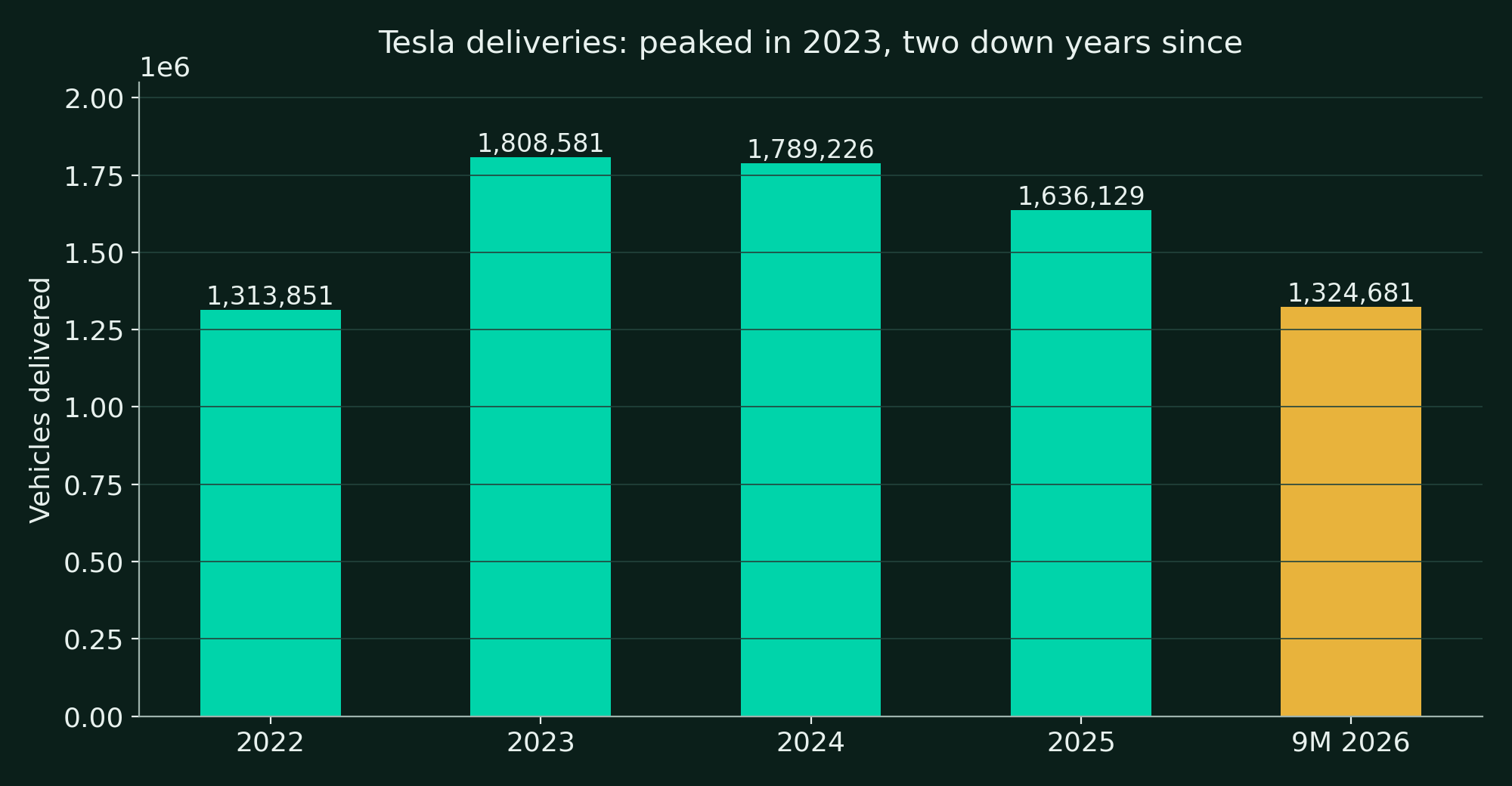
Cumulative deliveries passed 10.2 million vehicles in Q3 2026. Installed vehicle production capacity is over 2.35M units a year across Fremont, Shanghai, Berlin, and Austin, against 1,636,129 deliveries in FY2025: utilization, not capacity, is the constraint, and management said on the Q3 call that battery availability is the binding limit on volumes today, alongside what it called the largest passenger-vehicle backlog in four years.
The strategic identity has rotated in public. Through 2024 Tesla was a car company with an autonomy story. Through 2025 and 2026 the story inverted: the car company is now presented as the funding engine and the data fleet for an autonomy and robotics company. The five-pillar question is whether the funding engine stays healthy long enough, and whether the options convert to revenue before the multiple stops pre-paying for them.
What did Tesla report in Q3 2026?
The quarter was a modest beat where it mattered (EPS, cash flow, auto margin) and a clear miss where the growth story lives (energy revenue, storage volumes). Deliveries of 486,532 beat the Tesla-compiled consensus by about 5.3% and fell only 2% year over year, a better demand print than the post-credit-expiry setup suggested.
| Q3 2026 | Actual | Reference point |
|---|---|---|
| Total revenue | $28,046M | Flat vs $28,095M a year ago; Tesla-compiled consensus $28,341M; FactSet about $28.06B |
| Automotive revenue | $20,560M | Includes $113M of regulatory credits, down 73% YoY |
| Energy revenue | $2,881M | Down 16% YoY against consensus of about $3.7B: a clear miss |
| Services and other revenue | $4,605M | Growth carried by Supercharging and service volume |
| Gross profit | $5,494M (19.6%) | Consensus 17.9% |
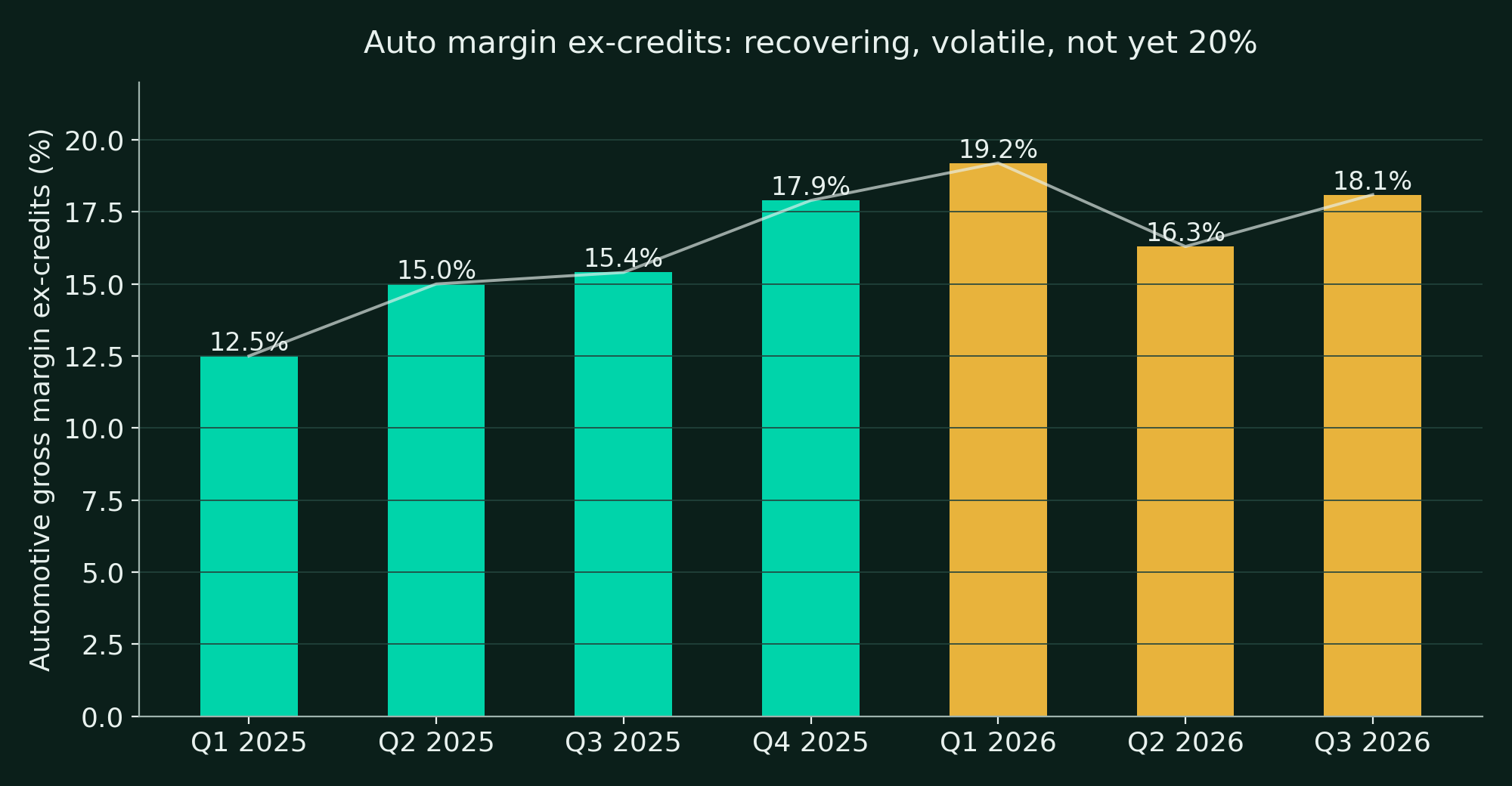
| Automotive gross margin ex-credits | 18.1% | 16.3% in Q2 2026; 15.4% in Q3 2025 |
| Operating income | $718M (2.6%) | Down 56% YoY on AI and program spending |
| GAAP net income | $787M ($0.22) | Includes a +$288M bitcoin gain and a -$142M SpaceX stake mark |
| Non-GAAP EPS | $0.48 | Consensus $0.45 |
| Operating cash flow | $6,263M | Capex of $4,732M |
| Free cash flow | +$1,531M | Consensus expected about -$4.5B |
| Stock-based compensation | $1,165M | Includes amortization of the CEO performance award |
| Deliveries | 486,532 | Down 2% YoY; inventory at 11 days of supply |
| Storage deployed | 13.7 GWh | Consensus 15.9 GWh: a volume miss |
| FSD attach | Over 75% of new North American deliveries | Company figure, Q3 call |
Read the beat carefully. The EPS and FCF beats are real, and the auto margin recovery to 18.1% ex-credits is the quarter's most important number, because it says pricing and mix stabilized even as regulatory credits collapsed to $113M. The offsets: operating margin of 2.6% shows how much of the recovered gross profit is being spent on AI programs; GAAP net income needed a bitcoin gain to reach $787M; and the energy line, the consensus growth engine, missed on both revenue and volume. The call added two forward facts that matter more than the quarter: robotaxi revenue is not expected to be noticeable until Q2 2027 (Section 7), and management is now evaluating a possible Tesla-SpaceX combination through independent committees (Section 15).
What does the four-year financial arc show?
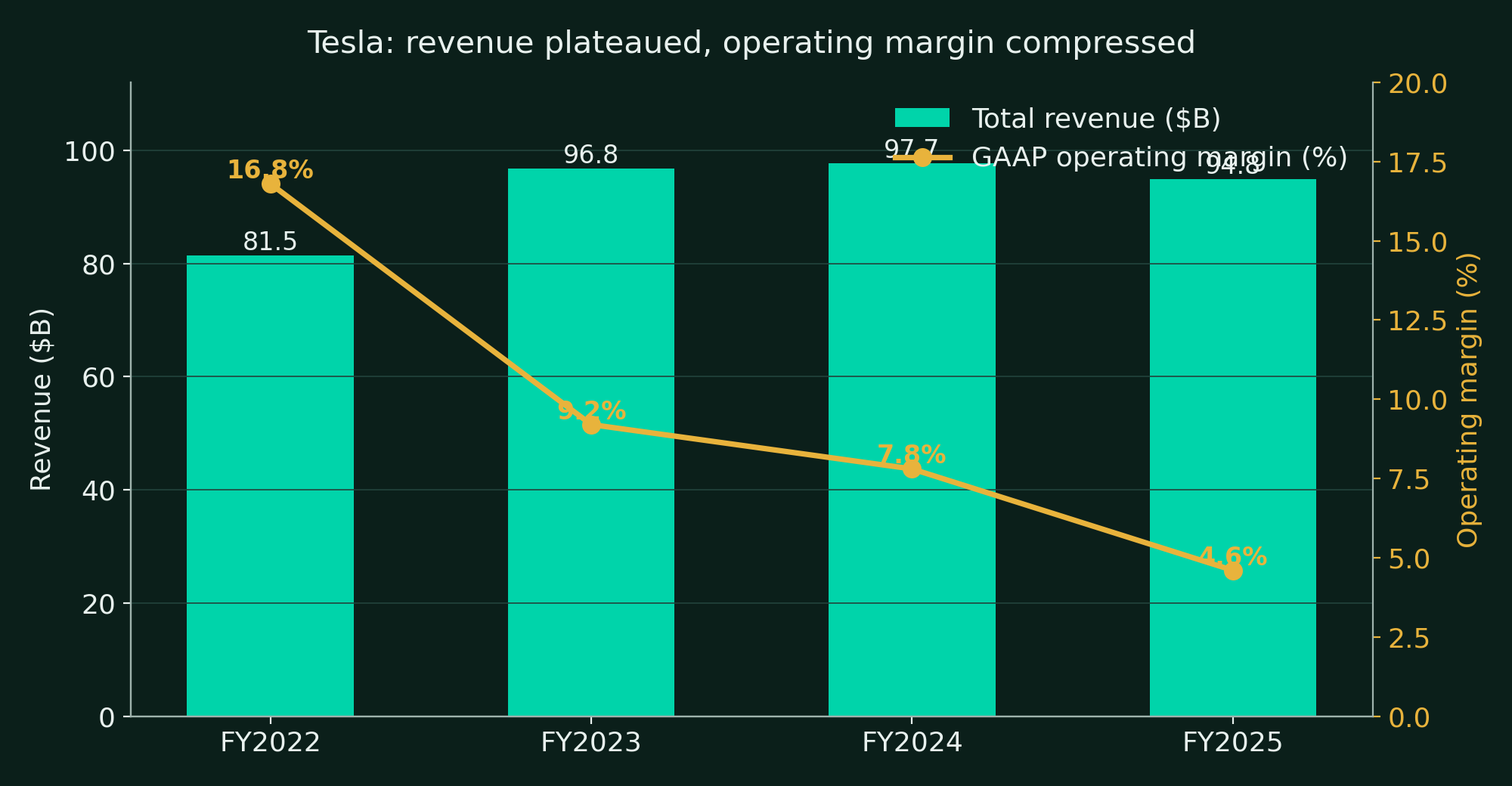
The four-year arc is a margin story, not a growth story. Revenue compounded into 2023, plateaued in 2024, and declined in 2025, while operating margin fell from 16.8% to 4.6% as price cuts, mix, and program spending compounded. Free cash flow held up far better than earnings, because the model collects cash early and spends capex late.
| $M except per share | FY2022 | FY2023 | FY2024 | FY2025 |
|---|---|---|---|---|
| Total revenue | 81,462 | 96,773 | 97,690 | 94,827 |
| Operating income (margin) | 13,692 (16.8%) | 8,891 (9.2%) | 7,659 (7.8%) | 4,355 (4.6%) |
| GAAP net income | 12,583 | 14,999 | 7,091 | 3,794 |
| GAAP EPS | $3.62 | $4.39 | $2.04 | $1.08 |
| Non-GAAP EPS | $4.07 | $3.12 | $2.42 | about $1.67 |
| Operating cash flow | 14,724 | 13,256 | 14,923 | 14,747 |
| Capex | 7,158 | 8,899 | 11,342 | 8,527 |
| Free cash flow | 7,561 | 4,357 | 3,581 | 6,220 |
| Stock-based compensation | about 1,560 | 1,812 | 1,999 | 2,825 |
Two footnotes belong on this table. FY2023 GAAP net income includes a one-time deferred tax benefit of about $5.9B booked in Q4 2023, so the FY2023 GAAP EPS of $4.39 is not an operating number; the non-GAAP $3.12 is the cleaner read. And stock-based compensation has risen every year to $2,825M in FY2025 before the CEO award amortization even begins to bite in 2026, which is why the gap between GAAP and non-GAAP EPS ($1.08 vs about $1.67 in FY2025) deserves attention rather than the usual pass.
The 2026 quarters show a company spending through the trough:
| 2026 | Q1 | Q2 | Q3 |
|---|---|---|---|
| Revenue ($M) | 22,387 | 28,236 | 28,046 |
| Operating income ($M) | 941 | 398 | 718 |
| Free cash flow ($M) | 1,444 | -1,092 | 1,531 |
Q2 2026 GAAP net income of $1,107M includes a +$1,005M pre-tax unrealized gain on the SpaceX stake, a reminder that quarterly GAAP EPS now carries a listed-equity mark inside it. Strip the marks and the pattern is consistent: revenue oscillating around $28B a quarter, operating income under $1B, and cash generation hostage to the capex phasing of the AI build (Section 12).
Is the car business recovering?
The car business has one genuinely good trend and three structural problems. The good trend: automotive gross margin ex-credits has recovered from the 12.5% trough of Q1 2025 to 18.1% in Q3 2026, through pricing discipline, mix, and cost work, even as the credit stream that used to flatter it disappears.
The problems start with that credit stream. Regulatory credits were $2,763M in FY2024, close to pure profit. By Q3 2026 they were $113M in the quarter, down 73% year over year, as US policy turned. A profit pool of that size does not get replaced by cost cuts alone; it has to be replaced by volume or by software revenue, and neither is currently growing fast enough to cover it.
Second, mix. The volume cars are now the de-contented Standard trims launched October 7, 2025: Model 3 at $36,990 and Model Y at $39,990, launched the week after the $7,500 federal credit expired, and, strikingly, about $2,000 more expensive out the door than the pre-expiry base cars they replaced. Tesla chose margin defense over a true price reset. Cybertruck, planned at 250,000 units a year, sold 38,965 in the US in 2024 and 20,237 in 2025, and runs at about 28-32k annualized in 2026, roughly 13% of ambition. Model S and X production ended in May 2026, closing the premium sedan chapter to free Fremont for Optimus (Section 10).
Third, the one clean delivery: Semi. Volume production began September 24, 2026 at the Nevada factory, with 50,000 units a year of capacity and a customer list (PepsiCo, DHL, US Foods, and others) that has been waiting since the 2017 reveal. A shipper consortium has selected Tesla for an initial 2,500 trucks. Semi is the roadmap item that arrived latest and matters least to the valuation, but it is the template proof that Tesla's manufacturing machine still finishes things. Against that, Musk's current volume ambition, "aiming for 5 million vehicles a year by approximately 2030," sits against 1.64M delivered in 2025 and installed capacity of 2.35M. Treat it as an aspiration in the scorecard sense of Section 13, not a plan.
The margin recovery is real but narrow
Auto margin ex-credits at 18.1% is the best bull fact in the car business. It rests on pricing discipline in a market where US EV demand just fell 38.6% in a quarter (Section 6) and on a Standard-trim mix that deliberately gives up content rather than price. A price war restart, or a BYD-led import wave, tests it directly.
How is demand holding up by region?
Tesla now faces three different demand problems on three continents, and Q3 2026 showed all three at once.
United States: a policy cliff, survived better than rivals. US EV sales fell 38.6% year over year in Q3 2026 after the $7,500 credit expired on September 30, 2025 (Cox Automotive: 266,630 total EV sales). Tesla's US sales fell 19.7% to 144,094, but its share rose to 54.0% because rivals fell further: GM's EV sales dropped 62%. Tesla is gaining share of a shrunken market, which defends the franchise while shrinking the pond.
Europe: brand damage, then a sharp but incomplete recovery. Registrations fell 27.8% in 2025 on brand damage tied to Musk's politics, and January 2026 tracked markets were down 44% year over year. Then the snapback: September 2026 EU+UK+EFTA registrations of 68,776, up 72.5% year over year. Even so, BYD leads Tesla year to date in Europe, 283,997 to 260,575 (ACEA, October 22, 2026). The European problem has shifted from demand collapse to competitive position against a rival with a broader, cheaper lineup.
China: the structural fight. Domestic retail fell 16% in Q3 2026, the sixth consecutive quarterly decline, and is down 11.9% over the first nine months of 2026, as domestic rivals take the market Tesla created. The offset is exports: Shanghai shipped a record 132,978 vehicles abroad in Q3, up 83%, and exports are now about 49% of Shanghai wholesale. The export valve faces its own policy turn: Beijing cut the NEV purchase-tax exemption framework, and on October 12, 2026 announced the EV export VAT rebate falls from 13% to 9% on April 1, 2027, directly taxing the export model Tesla now depends on in China.
| Region | Latest read | Direction |
|---|---|---|
| US | Q3 2026 Tesla sales 144,094 (-19.7% YoY); share 54.0% as total EV sales fell 38.6% post-credit | Share up, market down |
| Europe | Sep 2026 registrations 68,776 (+72.5% YoY); YTD BYD 283,997 vs Tesla 260,575 | Recovering, still behind BYD |
| China retail | Q3 2026 -16% YoY, sixth straight quarterly decline; 9M -11.9% | Structural share loss |
| China exports | Q3 2026: 132,978 (+83%), about 49% of Shanghai wholesale | Record, but VAT rebate cut lands Apr 2027 |
How big is the robotaxi business today?
The robotaxi business crossed the only line that matters in 2026: it is genuinely driverless. The service launched in Austin on June 22, 2025 as an invite-only product with a safety monitor in the car, at a $4.20 flat fare: the promised unsupervised product shipped supervised. Truly driverless operation began January 22, 2026, and the service is now live driverless in Austin, Dallas, Houston, Miami, Orlando, and Tampa. The Bay Area still runs with a driver, because Tesla holds no California driverless permit.
The disclosed scale, from Tesla's own Robotaxi Safety Report published October 21, 2026: 3,112,541 driverless miles between January 22 and October 18, 2026, with zero injuries by Tesla's definition and zero airbag deployments. The downloadable incident file lists 32 crashes between May 23 and October 18, most property-damage-only at low speed. The Texas DMV registry shows 803 Tesla autonomous vehicles statewide in mid-October (454 Model Y and 349 Cybercab). The Cybercab, which entered production in February 2026, began paid rides on September 3, 2026, with 300+ serving Austin by October 10. The Dallas Cybercab launch is set for November 2026.
| Robotaxi, October 2026 | Tesla | Waymo (reference) |
|---|---|---|
| Driverless cities | 6 (Austin, Dallas, Houston, Miami, Orlando, Tampa) | 10+ US metros, expanding |
| Disclosed driverless miles | 3,112,541 (Jan 22 to Oct 18, 2026) | 270M+ rider-only miles through June 2026 |
| Paid rides per week | Never disclosed | Over 500,000 |
| Fleet | 803 AVs registered in Texas | Thousands of vehicles, multiple partners |
| Revenue timing | "Not noticeable until Q2 2027" (Musk, Q3 call) | Material and growing |
The scale gap is about two orders of magnitude on every disclosed metric, and Tesla's most important robotaxi number, rides per week, remains undisclosed, which is itself information. Management's own framing on the Q3 call pushed the revenue inflection out: robotaxi revenue will not be noticeable until Q2 2027 and is "probably a big deal by Q3 or Q4 of next year" (Musk). CFO Vaibhav Taneja confirmed the $0.30 per paid mile cost target has not yet been met. Two regulatory files sit directly on the Cybercab: NHTSA Audit Query AQ26002 examines the vehicle's FMVSS self-certification, since the Cybercab has no steering wheel, pedals, or mirrors, with sworn answers due October 30, 2026; Defect Petition DP26010 concerns alleged school-zone speeding. A self-certified vehicle with no manual controls is the boldest regulatory bet in the industry, and its first formal test lands within days of this report.
What would change the robotaxi read
Rides-per-week disclosure. Every other operator in this industry reports ride volume; Tesla reports miles and registrations. The day Tesla discloses weekly rides and the number is large, the option starts converting into a business, and this section's framing inverts.
How is the FSD subscription pivot working?
Full Self-Driving is Tesla's highest-margin product and the bridge between the car company and the robotaxi option. On February 14, 2026, Tesla stopped selling FSD outright and moved to subscription-only at $99 a month, converting a one-time option sale into recurring revenue and aligning the product with the pay-award metric (Section 16).
Active FSD subscriptions reached 1.74M in Q3 2026, up 67% year over year. Read the footnote before celebrating: the metric uses the 2025 CEO pay-award definition and includes customers who bought FSD upfront, so fleet-wide penetration is only about 12-14% on third-party estimates. Attach on new North American deliveries is far stronger, over 75% in Q3 per the company, which is the forward indicator: the installed base converts slowly, the new-car buyer takes it at high rates.
The capability stack is mid-transition. The wide release is v14.3.12 for current (AI4) cars. HW3 cars run a distilled v14.3 Lite branch (Section 9). V15 is the release designated for customer unsupervised capability, and on the Q3 call Ashok Elluswamy moved its expectation to about Q2 2027, with owner cars joining the robotaxi fleet in geofenced areas on that timeline. Cumulative supervised FSD miles passed about 12 billion by mid-2026 (company), the data asset at the center of the moat argument. Each of those numbers is real; so is the pattern that the unsupervised milestone for customer cars has been about a year away for several consecutive years.
What happened to the HW3 self-driving promise?
The HW3 episode is the single most documented promise reversal in the file, and it matters because it prices the credibility of every forward autonomy claim, including V15.
Tesla sold cars from October 2016 on the claim that they carried all the hardware needed for full self-driving. In January 2025, Musk conceded an upgrade would be needed for HW3 cars, calling it "painful and difficult but we'll get it done." In October 2025 the strategy became a software bridge: a distilled v14 Lite build for the older hardware. Then, on April 22, 2026, the promise was formally narrowed: Musk stated HW3 "simply does not have the capability to achieve unsupervised FSD," citing memory bandwidth at about one-eighth of HW4.
What HW3 owners have today is a Lite software branch and an uncommitted possibility: a newer-computer upgrade possibly around mid-2027, with no committed program, hardware specification, price, or date. About 4 million HW3 cars are affected. The legal exposure narrowed on October 16, 2026, when the Ninth Circuit reversed class certification in the LoSavio litigation on procedural grounds (exposure too individualized), making no finding on the truth of the underlying claims.
For the pillar grades, the significance is precise. This is not a delay; delays fill Section 13. It is a multi-year, specifically-worded hardware claim, sold at a price, that the company has now said cannot be honored as stated, with the remedy undefined. Any valuation that capitalizes FSD subscription growth should carry that history as a discount on management's own forward autonomy language.
How real is Optimus?
Optimus is the larger of the two options and the less mature. The Q3 2026 update letter reported production underway at Fremont on the line converted from Model S/X production, a conversion the company says was torn out and rebuilt in 46 days, producing "the first production-quality bots we have manufactured." Trade coverage of company statements puts 1,000+ Gen 3 units operating internally.
The forward schedule, in management's current words: the million-unit line's equipment is largely in place, but a 20,000-per-week build rate is "at least a year, maybe a little longer" away; AI5 integration is targeted around April 2027; external supply is now targeted around the end of 2027, industrial customers first; and the price target remains $20,000-30,000 per unit (Musk, Davos, January 2026). Known engineering problems are named by the company itself: the robot hand, and access to Chinese rare-earth magnets.
The claim trail behind those numbers is the caution. For 2025, Musk guided 5,000 to 10,000+ Optimus units; in January 2026 he acknowledged "several hundred" learning-only units. External sales guided for 2026 are now an end-2027 target. Meanwhile the competitive set is shipping:
| Humanoid rival | Status at October 2026 |
|---|---|
| Figure AI | 350+ Figure 03 units delivered by April 2026; 1,000th unit July 2026; production work at BMW Spartanburg |
| Agility (Digit) | Deployed at 9 customer facilities; 65,000+ operating hours; the only humanoid earning real revenue (secondary coverage) |
| Unitree | 5,500+ units shipped in 2025; G1 priced from about $16,000, below Tesla's target price |
| Boston Dynamics (Atlas) | 2026 output fully committed to Hyundai and Google DeepMind |
Tesla's advantages are manufacturing scale, the AI5/AI6 chip line, and the balance sheet to build a million-unit line before demand is proven. Its disadvantage is that it is currently fourth or fifth in units actually delivered to anyone, including itself. The option is real; the leadership claim is not yet.
Why is energy revenue falling while deployments grow?
Energy was the consensus second engine, and Q3 2026 is where its two lines diverged. Deployments keep growing: 46.7 GWh in FY2025 (up 48%) and 13.7 GWh in Q3 2026 (up 10% year over year). Revenue went the other way: down 16% year over year in Q3 and down 6% over the first nine months of 2026, as pricing and mix overwhelmed volume.
Even the quarter's 33.1% energy gross margin needs its footnote: it was flattered by tariff-related customer refunds recognized in the quarter and a vendor cell-cost reimbursement (company disclosure), and management guides longer-term energy margins to the low-to-mid-20s. The competitive position also slipped a rung: BYD passed Tesla in 2025 battery-storage integrator shipments, at over 60 GWh and 13% share against Tesla's 10% (Benchmark Mineral Intelligence).
| Energy capacity and position | Figure |
|---|---|
| Deployments | 46.7 GWh FY2025; 50.2 GWh trailing twelve months to Q3 2026 |
| Q3 2026 revenue | $2,881M, down 16% YoY |
| Installed Megapack capacity | About 110 GWh: Lathrop 40, Texas 50 (production began Q3 2026), Shanghai 20-40 (company decks conflict between 20 and 40 GWh) |
| First Megapacks on Tesla's own Nevada LFP cells | Shipped in Q3 2026 |
| Backlog color (Q3 call) | "Highest-ever order rate and backlog"; inventory "nearly sold out through 2027" |
| Related-party sales | About $430M of storage products sold to xAI in FY2025 (10-K) |
The divergence resolves one of two ways: pricing stabilizes and the sold-out backlog converts at low-to-mid-20s margins (a good, utility-scale business worth having), or storage becomes a commodity knife fight with BYD and the Chinese integrators, in which case Tesla's 10% share and premium cost base are the wrong side of it. The backlog language supports the first read; the revenue line currently supports the second.
What is Tesla spending on AI infrastructure?
Tesla's AI strategy pivoted in public in August 2025, when the Dojo program was shut down and the team disbanded (Bloomberg; Musk on X said two chip designs did not make sense), weeks after Musk had guided a second Dojo cluster at scale in 2026. Training compute is now Nvidia-based, in the Cortex clusters: Cortex 1 at over 105 MW and Cortex 2 at over 120 MW by Q2-Q3 2026, with training compute guided from about 230 MW in September to 400 MW by December 2026. The chip roadmap continues on Tesla silicon at the inference edge: AI5 in production in 2027 and AI6 in 2028, under the $16.5B Samsung foundry agreement.
The newest and largest commitment is Terafab, the Austin chip fab being built with SpaceX: equipment commissioning in H1 2027, a first test chip around May-June 2027, volume production in late 2028, at a cost Musk described on the Q3 call as "tens of billions" through early 2028 and potentially over $100B long term. Set that beside the capex record:
| Capex item | Figure |
|---|---|
| FY2026 capex guidance | About $20B (Q3 call), cut from "more than $25B" guided on the Q2 call; the 10-K had guided "exceed $20B" |
| 9M 2026 capex | $13,014M |
| Credit facilities | $30B arranged September 29, 2026, undrawn, with no draws planned in 2026 |
| Terafab | "Tens of billions" through early 2028; potentially over $100B long term (Musk, Q3 call) |
Note the guidance direction as a governance data point in itself: the FY2026 capex guide was cut by about $5B between the Q2 and Q3 calls, the first capex trim of the AI era, suggesting either phasing discipline or the first recognition that the program stack (Cortex expansion, Cybercab ramp, Optimus line, Terafab) cannot all peak at once. The fortress balance sheet (Section 15) funds the roughly $20B year comfortably. A $100B Terafab program is a different claim on the same fortress, and it arrives intertwined with the SpaceX relationship discussed next.
Has Tesla delivered on its roadmap?
The deep-research method audits dated promises against dated deliveries. Tesla's scorecard is the longest in our coverage universe, and its shape matters: the misses concentrate on timing and on autonomy scope, while the manufacturing items eventually land, years late.
| # | Promise (date set) | Outcome by October 2026 | Score |
|---|---|---|---|
| 1 | Oct 2016: all cars ship with full self-driving hardware; coast-to-coast drive by end-2017 | No such drive; HW3 declared incapable of unsupervised FSD in April 2026 | MISSED |
| 2 | Autonomy Day 2019: 1M robotaxis on the road in 2020 | Zero robotaxis in 2020; service launched June 2025 | MISSED |
| 3 | Roadster production in 2020 | Reveal held October 15, 2026; production guided 2027-28 | MISSED |
| 4 | Semi production in 2019 | Volume production began September 24, 2026 | MISSED, DELIVERED 2026 |
| 5 | Battery Day 2020: a $25,000 car by 2023 | Program cancelled; cheapest Tesla is the $36,990 Model 3 Standard | MISSED |
| 6 | Cybertruck at 250,000 units a year | About 20,237 US sales in 2025, roughly 13% of the ambition | MISSED |
| 7 | Jan 2024: over 1M robotaxis in 2025 | One city, tens of vehicles, at end-2025 | MISSED |
| 8 | Jan 2025: unsupervised paid FSD in Austin in June 2025 | A supervised product shipped in June 2025; unsupervised began January 2026 | MISSED AS STATED |
| 9 | Jul 2025: robotaxi available to half the US population by end-2025 | Six cities, invite and geo-fenced scale | MISSED |
| 10 | Optimus: 5,000-10,000 units in 2025; external sales in 2026 | "Several hundred" learning units in 2025; external supply now targeted end-2027 | MISSED |
| 11 | Dojo 2 cluster at scale in 2026 | Dojo shut down, team disbanded, August 2025 | ABANDONED |
| 12 | Cybercab: production before 2027, priced under $30,000 | First unit February 17, 2026; paid rides September 2026; price still pending | MET ON PRODUCTION, PRICE PENDING |
Two fair mitigations belong beside the table. First, no other company in the industry has delivered even Tesla's missed versions: a driverless service in six cities and a production steering-wheel-less vehicle exist because Tesla kept spending through the misses. Second, the two clean deliveries inside the audit window (Semi volume production, Cybercab production) both landed in 2026, one seven years late and one on schedule, which is the strongest evidence that the current forward dates (V15 around Q2 2027, Optimus external supply end-2027, Terafab test chip mid-2027) deserve a probability weighting rather than outright dismissal. The weighting, not the dismissal, is what separates our base case from the street's (Section 18).
Who is beating Tesla, and where?
Tesla's competitive position is best read line by line, because it is simultaneously gaining share in its home market and losing it globally.
EVs: BYD is now the larger company. BYD sold 2,256,714 BEVs in FY2025 against Tesla's 1,636,129, and in August 2026 held 15.5% global BEV share against Tesla's 11.6%, from Tesla's 17.5% in August 2024. BYD's own momentum is not clean either: H1 2026 revenue fell 7.1% to RMB 344.8B and net profit fell 20.5% to RMB 12.3B, with overseas revenue passing half of BYD's total for the first time. The price war is hurting the winner too. Behind BYD, the Chinese cohort is compounding volume Tesla used to own: NIO delivered 109,178 in Q3 2026, XPeng 118,390, Li Auto 99,964, and Xiaomi 101,435.
| Rival | Latest verified read |
|---|---|
| BYD | FY2025 BEVs 2,256,714 vs Tesla 1,636,129; global BEV share 15.5% vs 11.6% (Aug 2026); also passed Tesla in storage shipments |
| Waymo | Over 500,000 paid rides a week; 270M+ rider-only miles; Tesla's disclosed scale is about 1% of that ride volume |
| Rivian | Q3 2026 deliveries 19,248, a record, up 45-46% YoY; R2 shipping since June 2026; FY2026 guide 65,000-70,000 |
| Lucid | Q3 2026 deliveries 3,806, a miss; production guide cut; new CEO seated April 2026 |
| NIO / XPeng / Li Auto / Xiaomi | Q3 2026 deliveries of 109,178 / 118,390 / 99,964 / 101,435 |
| Ford | December 2025: a $19.5B EV charge and strategic retreat; the F-150 Lightning ended |
| Hyundai-Kia | 4.5% combined global BEV+PHEV share (Aug 2026), disciplined and profitable |
The Western legacy retreat (Ford's charge is the marker) removes one class of competitor and concentrates the fight where Tesla is weakest: against BYD's cost curve in the segments below $35,000, in the markets outside the US, and in storage. Tesla's defenses are the charging network (84,465 connectors, the de facto North American standard), the brand's US resilience (54% share in a down quarter), and the FSD attach rate. None of those addresses the sub-$35,000 global segment, which is where the units are.
How strong is the balance sheet, and where does the cash go?
The balance sheet is the strongest page in the file, and it is what makes the option portfolio financeable.
| September 30, 2026 | $M |
|---|---|
| Cash and investments | 45,447 |
| Total debt and finance leases | about 9,523 |
| Net cash | about 36,000 |
| Total equity | 89,289 |
| Total assets | 157,517 |
Tesla has never paid a dividend and has never run a buyback program; financing cash flow shows net issuance, not returns of capital. Capital allocation is therefore a single question: what does the cash buy? Increasingly, the answer involves Musk's other companies. Tesla sold about $430M of storage products to xAI in FY2025. On January 16, 2026 it agreed to invest about $2B into what was announced as xAI's Series E; after SpaceX acquired xAI on February 2, 2026 (secondary reporting), the investment closed in March 2026 as 18,990,195 shares of SpaceX Class A stock, under 1% of SpaceX, with no control. The position is carried at fair value ($3,007M at June 30, 2026) and now marks through earnings: +$1,005M pre-tax in Q2 2026 and -$142M in Q3 2026. SpaceX is Nasdaq-listed (SPCX), so the mark is observable rather than modeled.
The governance sequence around that investment deserves exact statement. A November 6, 2025 shareholder proposal to authorize a Tesla investment in xAI drew more votes for (about 1.06B) than against (about 916M), but failed because about 473M abstentions count as votes against under Tesla's bylaws. The board proceeded anyway during 2026. Musk's public comment: "We're just doing what shareholders asked us to do, pretty much."
The merger committee disclosure
On the Q3 2026 call, Tesla disclosed that Tesla and SpaceX have each formed special committees of independent directors to evaluate a possible merger, with Musk recused and no terms agreed. A combination vote would require a majority of ALL outstanding Tesla shares, not just votes cast. This is a live, two-sided overhang on the stock: it could consolidate the AI and space assets bulls already price together, or it could transfer Tesla's fortress balance sheet into a larger, less liquid structure at terms minority holders do not control. It is, on its own, a sufficient reason the Neutral grade does not round up.
How should investors grade Musk and the board?
Tesla's leadership file has three layers: the most valuable pay package ever written, a share count transformed by its exercise, and a bench that has thinned at exactly the layers that execute.
The 2025 award. Shareholders approved the CEO Performance Award on November 6, 2025 with over 75% support (ISS and Glass Lewis against; Norway's sovereign fund against). It grants 423,743,904 restricted shares in 12 tranches of 35,311,992 shares, about 10.7% of the company. Each tranche pairs a market-cap milestone (starting at $2.0 trillion, rising to $8.5 trillion) with an operational milestone drawn from: 20M cumulative vehicles, 10M active FSD subscriptions, 1M bots delivered, 1M robotaxis in commercial operation, or adjusted EBITDA steps from $50B to $400B. The proxy valued the award at $158.4B. No tranche had been earned as of the October 19, 2026 proxy statement; earned shares vest over 7.5 to 10 years, subject to a $334.09 per share offset. Whatever one's view of the size, the structure is legible: Musk is paid only if the option portfolio in Sections 7 and 10 converts at civilizational scale.
The 2018 award and the share count. The Delaware Supreme Court reversed the rescission of the 2018 package on December 19, 2025 (per curiam; $1 of nominal damages; plaintiff fees cut from $345M to about $54M). In June 2026 Musk exercised all 303,960,630 of the 2018 options at $23.34, receiving 286,428,773 restricted shares vesting January 19, 2028. That exercise is the jump in shares issued to 3,949.5M (including 286.4M restricted shares; diluted weighted-average shares are about 3.54B, and we quote market cap on the full issued count). The August 2025 interim award (96M shares, about $29B) was forfeited in full in April 2026.
Ownership, pledging, and the insider tape. Musk's beneficial ownership is 699,580,882 shares: 19.8% on a beneficial basis, about 17.7% of shares outstanding. Of those, 207,498,721 shares are pledged (2026 proxy), a standing margin-call tail risk that predates this report and has never been reduced. He bought about $1B of stock in the open market in September 2025, the only insider purchase of size. Everyone else sold: 2026 tallies show about $87.7M of sales from four sellers and zero open-market purchases besides Musk's 2025 buy; Chair Robyn Denholm sold 449,560 shares (about $152M) in one six-month tally and director Kathleen Wilson-Thompson sold 300,000 shares (about $111M); most sales run through 10b5-1 plans or tax withholding per the filings.
Bench and brand. CFO Vaibhav Taneja and Tom Zhu hold the senior operating roles. The 2025 departure list is heavy at the execution layer: Omead Afshar (June), Optimus head Milan Kovac, software VP David Lau, and Dojo head Peter Bannon. On brand, Brand Finance's January 2026 ranking values Tesla's brand at $27.61B, down 36% in 2025 and down for a third straight year from $66.2B in 2023; the US recommendation score stands at 4.0 out of 10, from 8.2 in 2023. Musk spent about $366M in the 2025-26 political cycle, including $276M since July 2026 (Reuters, October 12, 2026), after leaving DOGE in May 2025; a Yale study estimates the political activity cost 1.0 to 1.26M US vehicle sales over three years (academic estimate). The annual meeting is December 3, 2026; next earnings are February 3, 2027 (single-sourced date).
The pay award is the valuation debate in contract form
The 2025 award's milestones (10M FSD subscriptions, 1M robotaxis, 1M bots, $8.5T market cap) are the bull case written as a compensation schedule. Shareholders approved it with full knowledge of Section 13's scorecard. An investor who finds the milestones implausible is, by construction, short the same numbers the CEO is paid to hit.
How serious is the regulatory file?
The regulatory file is unusually thick for a company of Tesla's size, and it concentrates exactly where the valuation does: autonomy.
| File | Status at October 2026 |
|---|---|
| NHTSA EA26002 | Reduced-visibility FSD crash investigation, escalated to an Engineering Analysis on March 18, 2026; about 3,203,754 vehicles |
| NHTSA PE25012 | FSD traffic-violation investigation opened October 7, 2025; about 2,882,566 vehicles, 58 incidents |
| NHTSA RQ24009 | Reviewing the adequacy of the December 2023 Autopilot recall remedy |
| NHTSA AQ26002 | Audit Query into the Cybercab's FMVSS self-certification (no wheel, pedals, or mirrors); sworn answers due October 30, 2026 |
| NHTSA DP26010 | Defect petition on alleged robotaxi school-zone speeding (about 1,000 vehicles); decision due by January 21, 2027 |
| Miami Autopilot verdict (Aug 2025) | $129M compensatory (Tesla 33% at fault, about $43M) plus $200M punitive, about $243M total; Tesla had rejected a $60M settlement; post-trial motions denied February 20, 2026; Eleventh Circuit appeal pending |
| California DMV | Violations found December 2025 over autonomy marketing; Tesla dropped the Autopilot name in January 2026, completed corrective action, and the DMV confirmed in February 2026 that suspension was avoided; Tesla has sued the DMV (as reported) |
Tesla's standing 10-Q line, that no government agency in any ongoing investigation has concluded wrongdoing occurred, remains accurate and remains the bull's one-sentence answer. The bears' answer is arithmetic: two FSD investigations covering about 3 million vehicles each, an engineering analysis (the stage before a recall decision), and a certification query on the one vehicle the robotaxi plan depends on, all open at once, with the first hard deadline on October 30, 2026.
Adjacent costs compound quietly. Insurance: the average Model 3 full-coverage premium is $308 a month against a $187 all-car average (Insurify, September 2026), a silent tax on the ownership proposition, and the Model 3 lost its IIHS Top Safety Pick+ rating in 2025. Neither item threatens the thesis; both narrow the funnel the option portfolio ultimately needs.
What is Tesla worth?
Start with what the market already believes. Consensus expects FY2026 revenue of about $107B and adjusted EPS of $1.69 (Zacks; GAAP EPS of $0.90 per Tesla's IR consensus), rising to revenue of $118-120B and adjusted EPS of $2.24 in FY2027, and revenue of about $141B with adjusted EPS of about $3.30 in FY2028. The implied EPS path then steepens dramatically (one widely-cited series grows EPS +4.7%, +23.4%, +50.7%, and +101.1% across 2026 to 2029): the valuation only works if the back-loaded ramp arrives. Short interest is modest (70,931,312 shares, 2.24% of float, 1.9 days to cover, September 30, 2026) and retail investors hold roughly 40% of the float (Bloomberg estimate via Barron's), a holder base that has historically defended the multiple through drawdowns.
Our FY2029 scenarios haircut the delivery record into the numbers:
| FY2029 scenario | Adjusted EPS | Multiple | Target | What has to be true |
|---|---|---|---|---|
| Bear | $3.00 | 40x | $120 | Autos grind at low-single-digit growth; robotaxi still immaterial; Optimus internal only; margins stay compressed |
| Base | $5.50 | 60x | $330 | Robotaxi contributes from 2027 and scales through 2029 without dominating; FSD subscriptions compound; energy growth resumes; auto margins hold in the high teens |
| Bull | $8.25 | 75x | about $620 | Robotaxi fleet scaling hard; Optimus external volumes begin late 2027 and ramp; FSD subscriptions head toward 5M+; AI compute and Terafab optionality re-rate |
Two honest notes on construction. First, our base EPS of $5.50 sits below the roughly $6.63 FY2029 figure implied by the consensus path, deliberately: the base case applies the Section 13 record as a haircut to the ramp rather than underwriting it whole. Second, even the base multiple of 60x is a growth multiple that no car company sustains; the debate is not really about the multiple, it is about which company Tesla is in 2029.
The sum-of-the-parts debate frames the same question, and its spread is the story (sources and vintages labeled): Bernstein valued the core EV business at under $200B, under about $55 a share, in 2024. Morningstar's fair value is $450, with roughly 30% of it (over $135 a share) tied to robotaxi. Piper Sandler's $500 target splits about $400 for existing businesses and about $100 for Optimus and AI optionality. ARK Invest's model, published October 21, 2026, puts 2031 expected value at about $4,400 a share with robotaxi at about 80% of enterprise value. The street's live targets cluster near the price: TipRanks averages $409.71 (14 Buy, 12 Hold, 2 Sell of 28 analysts) and MarketBeat about $412. When reasonable people can defend $55 and $4,400 for the same asset, the honest grade on price is the one in the middle of the distribution of outcomes, weighted by the delivery record. That is Neutral.
What are the risks, and what changes the verdict?
Technically the stock is at an inflection, not in a trend. The price sits essentially on the 200-day moving average (about $387 on one vendor's series, $377 on another's), above the 50-day at about $362, with RSI at 59.8. The 52-week range runs from $297.38 (July 29, 2026) to $498.83 (December 22, 2025, also the record high); the stock is down 15.9% year to date, printed a death cross in April 2026, and fell after each of its three prior earnings reports, including 14.5% after Q2 2026. Near-term levels: resistance around $400, support around $347. Against that history, the roughly 1 to 2% intraday fade after a beat print, on a 6.5% priced move, reads as relief, not reversal.
| Risk / catalyst | What we watch | Verdict impact |
|---|---|---|
| NHTSA engineering analysis (EA26002) | Any move from analysis to recall action on about 3.2M vehicles | A mandated remedy or restriction on FSD re-prices the subscription line and the moat |
| Cybercab certification (AQ26002) | Sworn answers due October 30, 2026; any NHTSA challenge to self-certification | A challenge delays the driverless fleet plan at its foundation |
| Robotaxi disclosure | Rides per week, fleet counts, city additions; Dallas Cybercab launch November 2026 | Disclosed scale at Waymo-like growth rates is the cleanest upgrade trigger |
| Tesla-SpaceX committees | Any terms, exchange ratio discussion, or vote scheduling | Cuts both ways; a cash-and-stock transfer of the fortress to a combined entity is the bear version |
| Terafab spending | Capex guide revisions; the H1 2027 equipment commissioning | A firm $100B program converts the fortress pillar into a funding question |
| Optimus external orders | Named customers, prices, delivery dates around end-2027 | Converts the second option from demonstration to business |
| China export economics | The April 1, 2027 VAT rebate cut (13% to 9%); Shanghai export mix | Pressures the one growing China line |
| FSD liability | Subscription growth toward 1.74M and beyond alongside EA26002 | Every new subscription is revenue and exposure in the same unit |
The conclusion folds the file together. Tesla in October 2026 is a flat $100B-revenue car and energy company with recovering margins, a fortress balance sheet, and two of the largest real options in the world attached: a driverless network that is live in six cities at about 1% of its main rival's disclosed ride volume, and a humanoid robot program that has produced its first production-quality units while rivals ship to paying customers. The founder's promise record, audited across 14 dated commitments, is dominated by misses on timing and autonomy scope; the same founder has also delivered, in the last ten months, Cybercab production, Semi volume production, a 46-day factory conversion, and a Q3 print that beat on EPS, margin, and cash flow simultaneously.
At $386.47, the market is not asking whether the options are real. It is paying, in advance and in full, for them to be large. Our verdict: 58/100, Neutral, with FY2029 targets of $120 / $330 / $620. The triggers that would change it are specific: robotaxi rides-per-week disclosure showing real scale; Optimus external orders with prices and dates; auto gross margin ex-credits holding at or above 18% while volumes grow; or a price that stops pre-paying for all three at once. Until one of those prints, the options are the company, and they are already in the price.
Frequently asked questions
Why is Tesla rated Neutral despite leading in EVs, robotaxis, and robots?
The $386.47 price already pays for two unproven businesses. Tesla trades at roughly 173-177x FY2027E adjusted EPS of $2.24, while robotaxi revenue is guided as not noticeable until Q2 2027 and Optimus external sales start around end-2027. Our base case, $5.50 of FY2029 EPS at 60x, values the stock at $330, below the price.
What did Tesla report in Q3 2026?
Revenue was $28,046M, flat year over year and near consensus. Non-GAAP EPS of $0.48 beat the $0.45 consensus, automotive gross margin ex-credits recovered to 18.1%, deliveries were 486,532, and free cash flow printed +$1,531M against a consensus expecting about -$4.5B. Energy revenue fell 16% and missed.
How big is the robotaxi business today, in numbers?
Small but real. Tesla runs genuinely driverless service in six US cities, logged 3,112,541 driverless miles from January 22 to October 18, 2026, and had 803 autonomous vehicles registered in Texas, including 349 Cybercabs. Management guides robotaxi revenue as not noticeable until Q2 2027; Waymo already does over 500,000 paid rides weekly.