
Frequently asked questions
Is Systematix Corporate Services a buy at current prices?
DalalBytes rates Systematix Corporate Services Neutral at 54/100. At Rs 75.61 the stock trades at 3.3x book value of Rs 23 a share and 74.9x FY26 earnings, with trailing twelve month earnings negative after losses in Q4 FY26 (Rs 11.79 cr) and Q1 FY27 (Rs 4.89 cr). Against that sit net worth of about Rs 314 cr, borrowings of Rs 19 cr, promoter holding of 70.58% with nil pledging, and a record Indian primary market. The price already pays for a repair that has not yet printed a clean quarter.
What are Systematix Corporate Services' FY2029 price targets?
DalalBytes' FY2029 targets for Systematix Corporate Services are bear Rs 38, base Rs 78, and bull Rs 125, from a Rs 75.61 reference price. Bear: operating revenue of Rs 155 cr, PAT of Rs 14 cr, valued at 1.35x FY29 book of about Rs 28. Base: operating revenue of Rs 225 cr, PAT of Rs 48 cr, EPS of Rs 3.50, 22x exit. Bull: operating revenue of Rs 275 cr, PAT of Rs 72 cr, EPS of Rs 5.24, 24x exit. FY2029 is the year ending March 2029.
Why did Systematix Corporate Services' profit fall in FY26?
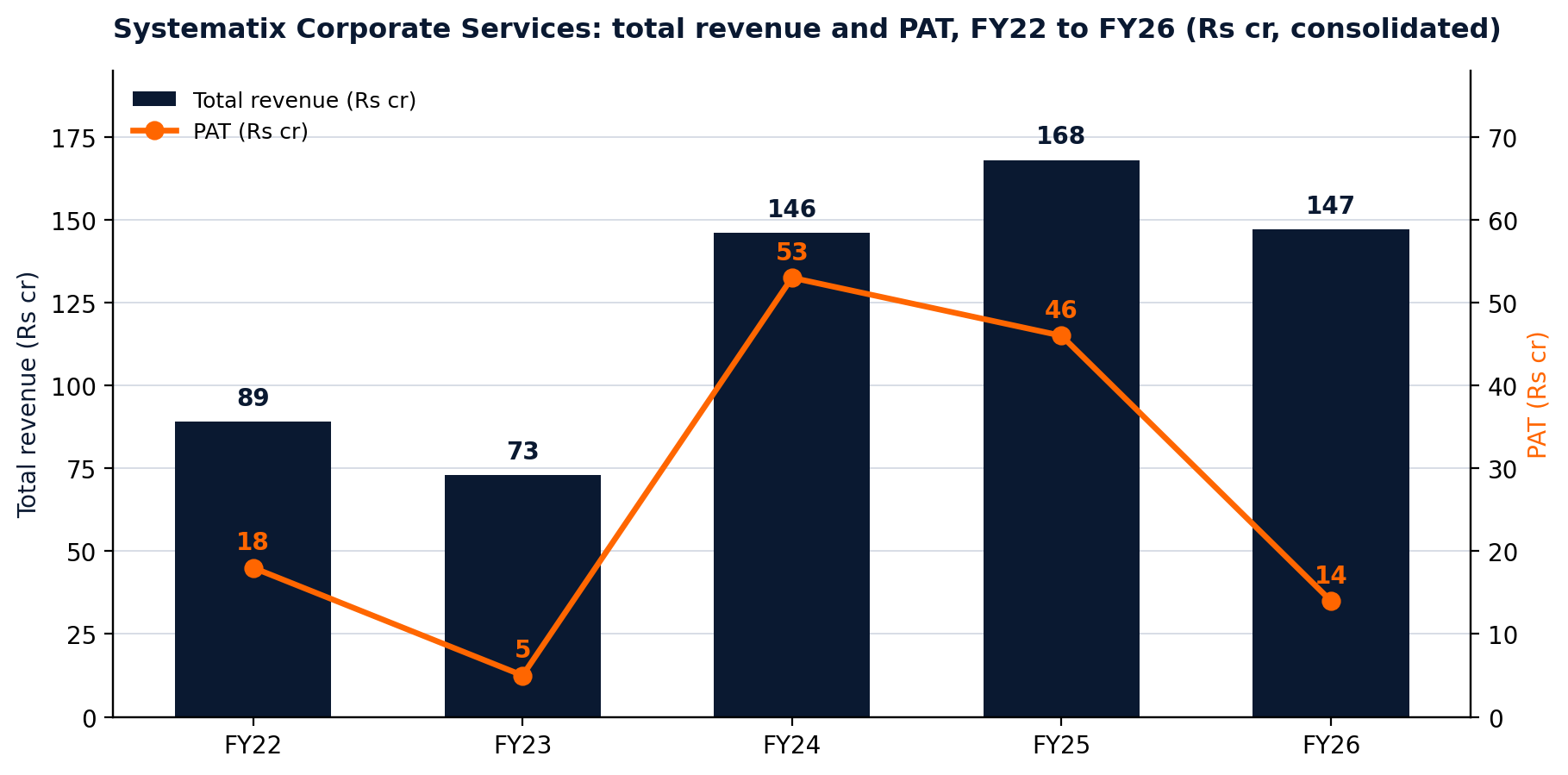
Consolidated PAT fell from Rs 46 cr in FY25 to Rs 14 cr in FY26 while operating revenue was flat at about Rs 146 cr. Other income collapsed from Rs 29.48 cr to Rs 1.44 cr, investment banking mandates were deferred, the newly expanded private wealth business lost money, and ESOP and mark to market costs rose, per ICRA's rating rationale. Employee costs reached 75.8% of revenue in Q4 FY26, when the group printed a loss of Rs 11.79 cr.
What is the verdict on Systematix Corporate Services?
India raised a record Rs 1.8 lakh cr through IPOs in FY26 and Rs 2.43 lakh cr of public equity in H1 FY27 alone, and this merchant banker's profit fell 70% in the same year. PAT ran Rs 53 cr in FY24 and Rs 46 cr in FY25, then Rs 14 cr in FY26, with Q4 FY26 at negative Rs 11.79 cr and Q1 FY27 at negative Rs 4.89 cr. The FY25 profit leaned on Rs 29.48 cr of other income that collapsed to Rs 1.44 cr. Costs did the rest: a private wealth build, ESOP charges, and mark to market losses, all named by ICRA. The balance sheet is the counterweight: net worth of about Rs 314 cr, borrowings of Rs 19 cr, promoters at 70.58% with zero pledging, and an ICRA BBB- (Stable) rating at the broking arm. At 3.3x book the market is paying today for earnings the company has yet to re-deliver. 54/100 Neutral.
How did Systematix start, and who owns it now?
Incorporated in August 1985 as Systematix Consultancy Services, renamed Systematix Corporate Services in 1993, and listed through a 1994 public issue. The Khandelwal family promotes the group today; Nikhil Khandelwal is Chairman and Managing Director, reappointed for three years from September 1, 2026. The broking arm, Systematix Shares and Stocks (India) Ltd, dates to 1995 and was the majority of group revenue until FY21, after which investment banking took over as the profit driver. ICRA's downgrade rationale records the promoter's arrest in June 2022 and bail in February 2023, a broking slump (institutional daily turnover down to Rs 144 cr from a Rs 213 cr average), and a rating cut to BB+, since restored to BBB- (Stable). In FY25 the group raised Rs 103 cr by preferential issue, diluting promoters from 74.23% to 70.58% and lifting reserves from Rs 139 cr to Rs 286 cr. Promoter holding has been flat at 70.58% for seven quarters since, with pledging nil; FII holding is 4.20% and DII 0.07% at September 2026.
What does the business actually do?
Four legs. Merchant banking: IPOs, rights issues, QIPs, open offers, delistings, buybacks, placements, valuations and ESOP advisory under a SEBI Category I licence, earning mandate fees with no capital at risk on a clean deal. Broking: institutional equities and research (distributed on Bloomberg and LSEG) plus retail broking through SSSIL, across 450-plus touchpoints in 115 cities for 40,000-plus clients and about 272 employees. Financing: loans against shares and a margin trade funding book inside the broking arm, the one balance sheet business in the mix, funded partly by Rs 100 cr of ICRA-rated bank lines. Wealth and assets: private wealth under Partha Sengupta (hired from Axis Bank), PMS, product distribution, a sponsor commitment of up to Rs 10 cr to the India SME Growth Fund Series 2 AIF, and a further Rs 10 cr into the wealth subsidiary in September 2026. EduInvesting estimates broking near 63% of revenue and investment banking near 33%; ICRA's framing is that investment banking has driven profit since FY22 and wealth is currently a drag.
What do the financials show, and how clean is the profit?
Operating revenue doubled in FY24, then stopped: about Rs 140 cr, Rs 139 cr, Rs 146 cr across FY24 to FY26, growing about 5% in a record fundraising year. That is share stagnation at best. Total revenue printed Rs 168 cr in FY25 only because other income contributed Rs 29.48 cr; at Rs 1.44 cr in FY26, reported PAT fell from Rs 46 cr to Rs 14 cr and ROE from about 20% to 4.6%, with ROCE at 8.5%. The quarterly path warns loudest: PAT of Rs 10.46 cr, Rs 14.49 cr, Rs 0.69 cr, negative Rs 11.79 cr, negative Rs 4.89 cr across the last five quarters, with operating profit negative in the last two. Q1 FY27 revenue of Rs 56.26 cr includes Rs 29.51 cr of sale of shares; the company's own adjusted revenue was Rs 26.75 cr, and its merchant banking segment lost Rs 6.52 cr before tax. Employee costs were Rs 20.57 cr in that quarter and 75.8% of revenue in Q4 FY26. Debtor days rose from 37 in FY24 to 94 in FY26.
How strong is the balance sheet and cash flow?
Two different answers. The balance sheet is a fortress: net worth of about Rs 314 cr at March 2026 (equity Rs 14 cr, reserves Rs 300 cr), borrowings of Rs 19 cr, investments of Rs 44 cr, nil pledging, and SSSIL capitalised at Rs 128 cr of net worth with negligible external borrowing at December 2025, per ICRA. The cash flow is not: operating cash flow was negative Rs 20 cr in FY25 and negative Rs 21 cr in FY26, and free cash flow negative Rs 23 cr and negative Rs 31 cr, after positive Rs 88 cr and Rs 75 cr in FY24. The build is funded from the FY25 raise: Rs 25 cr into SSSIL in H1 FY26 for margin funding, Rs 35 cr more in April 2026, Rs 10 cr into wealth in September 2026, plus an 80% stake in Urban Affordable Housing LLP in May 2025. The FY26 dividend is Rs 0.10 a share, a 0.13% yield. Holders are not paid to wait.
What is Systematix worth versus peers?
At Rs 75.61: market cap about Rs 1,004 cr, P/B 3.3x, P/E 74.9x on FY26 EPS of Rs 1.01, trailing P/E not meaningful, price to operating revenue about 6.9x. Peers price the ROE, not the licence: Motilal Oswal trades near 33.5x earnings and 4.8x book, Nuvama near 31.0x and 7.8x book, both on returns on equity in the twenties and thirties with large recurring wealth revenue, while Aditya Birla Capital sits near 26.9x and 2.8x book as a lending-led group (Tickertape, October 2026). DalalBytes estimates Systematix's mid-cycle earning power at Rs 30 cr to Rs 38 cr of PAT today (an estimate), or Rs 2.20 to Rs 2.80 of EPS, which puts the stock near 27x to 34x normalised earnings. FY2029 scenarios: bear Rs 38 (revenue Rs 155 cr, PAT Rs 14 cr, 1.35x book), base Rs 78 (revenue Rs 225 cr, PAT Rs 48 cr, EPS Rs 3.50, 22x), bull Rs 125 (revenue Rs 275 cr, PAT Rs 72 cr, EPS Rs 5.24, 24x).
What are the key risks?
First, the cycle: every leg of this business rides the same market tape, and FY26 showed that even a record tape does not guarantee this house a profit. Second, cost rigidity: salaries and ESOP charges are multi-year commitments against quarterly mandate revenue, and the ESOP scheme covers up to 68,26,901 options, about 5% of the share count. Third, revenue quality: proprietary and other income has swung PAT by tens of crores in both directions, and Q1 FY27's headline growth was a sale of shares line. Fourth, financing risk: the margin funding and loan against shares book carries collateral risk into any sharp correction, a constraint ICRA names. Fifth, governance history: the 2022 promoter arrest and bail are documented by ICRA and would reprice the stock instantly on any recurrence. Finally liquidity: a 25% public float, DII ownership of 0.07%, thin daily volumes, and a 52-week range of Rs 51.89 to Rs 177.90.
© 2026 DalalBytes Research · For educational purposes only. Not investment advice.