Download the full analysis (PDF)
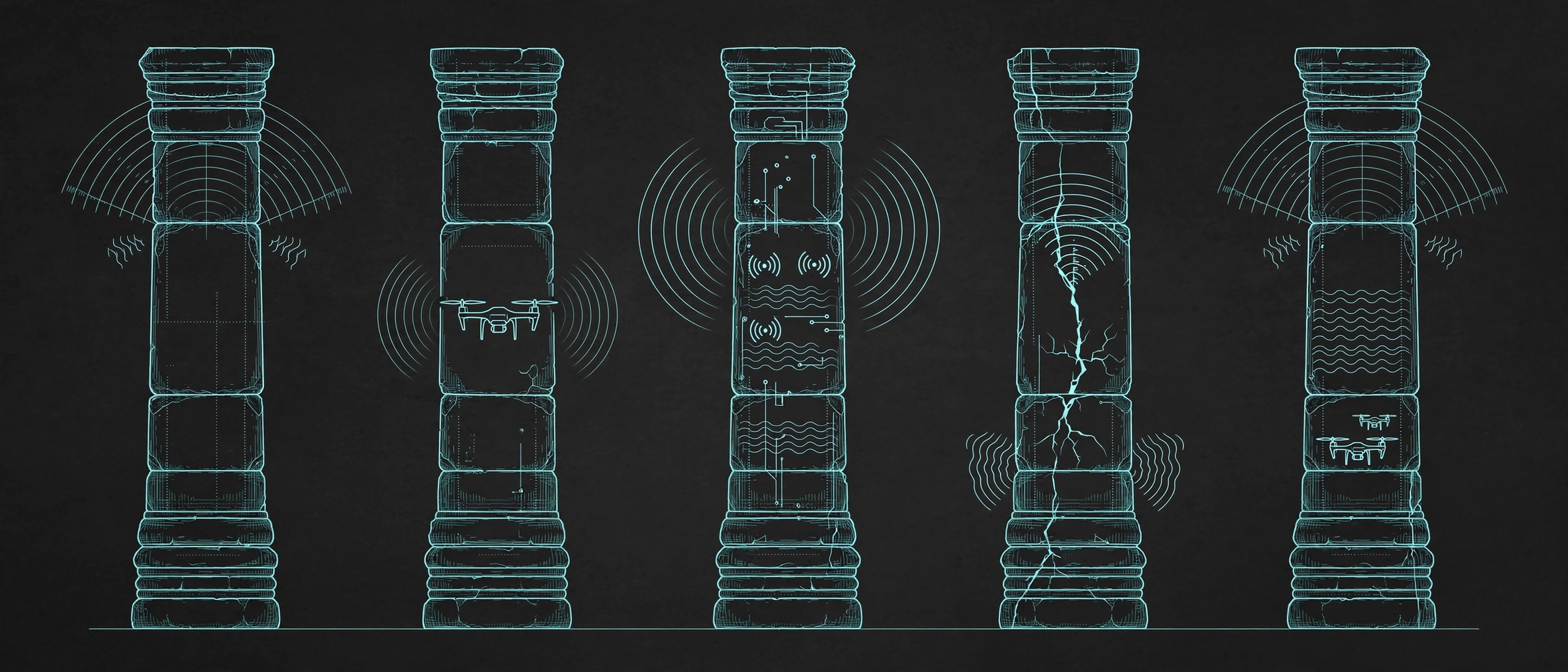
The five-pillar analysis grades a business on five questions: is the sector a sunrise, can the leadership execute, does a moat protect returns, is the balance sheet a fortress, and does the free cash flow show up. Each pillar passes, partially passes, or fails on evidence.
Frequently asked questions
Which of Ondas's five pillars pass?
Only the sunrise pillar passes: counter-UAS and loitering munitions are among the fastest-growing defense markets, and Ondas holds a $757M backlog with a pipeline above $11B. Management, moat, and fortress grade partial: Brock is a proven dealmaker but an unproven operator, the moats are real fragments rather than a wide moat, and the $1.4B cash fortress was funded by $1.9B of dilution. Free cash flow fails for now on a $93.8M quarterly burn.
What would upgrade Ondas's failing free-cash-flow pillar?
A printed quarter of operating-platform adjusted EBITDA positive, which management targets for Q4 2026. DZYNE is already EBITDA positive and GATE is expected to contribute more than $130M of aggregate adjusted EBITDA through 2028. The pillar upgrades when the consolidated business, not just the acquired pieces, shows it can convert the $757M backlog into cash.
Pillar 1: Is it a sunrise industry? (Autonomous defense systems, PASS)
The demand backdrop is as strong as anything in defense tech. Counter-drone is estimated to grow from $2.4B (2024) to $10.5B (2030) at 28% CAGR; loitering munitions from about $5.4B (2025) to $13.3B (2030) at about 20% CAGR. U.S. policy is explicitly pro-autonomy: the drone dominance directive, $1.2B of OBBA drone funding, the NDAA-compliant shift away from Chinese platforms, and FAA BVLOS rulemaking all push demand toward exactly what Ondas sells. Ondas' own commercial markers confirm the wave is real and current: a $757M pro forma backlog at June 30, 2026 (versus $68M at Q4 2025), $175M of Q2 new orders plus $105M quarter-to-date in Q3, and a two-year strategic pipeline above $11B, up 2.5x since May 2026. This pillar passes without qualification.
Pillar 2: Can the leadership execute? (Eric Brock, PARTIAL)
Eric Brock called the defense-autonomy wave early, raised about $1.9B, and assembled a 14-acquisition platform in under a year while scaling revenue 13x year over year. That is a genuine dealmaking record, and the deal terms show discipline on structure (six-month lockups on DZYNE stock, earnouts on GATE and the September tuck-ins).
The partial grade is the operating half of the job, which is still ahead. Fourteen businesses across the U.S., Israel, and Poland, most acquired in 2026, must become one P&L by the promised Q4 2026. Insider ownership is thin for a founder-style roll-up: Brock holds under 1%, all directors and officers 1.6%. December 2025 saw material insider selling (475,000 shares at $9.71 on December 31, 2025; 2,378,245 shares at $13.43, about $31.9M, described as covering tax withholding on RSU vesting). Dealmaker: proven. Operator: unproven. The grade upgrades when the integration prints a profitable quarter.
Pillar 3: Does a moat protect returns? (PARTIAL)
There are genuine moat fragments, and they are worth naming precisely. The Optimus drone holds an FAA Type Certification (the company's claim: the only Type Certified drone in the drone-in-a-box category), and American Robotics holds a BVLOS waiver through January 31, 2028 permitting operations without visual observers: competitors can build the box, but they cannot legally fly it unattended in U.S. airspace without equivalent approvals, which take years of flight data to earn. GATE's electronic fuzing is qualified into dozens of weapon systems across about 100 configurations, with long requalification switching costs once designed in. Sentrycs' protocol-layer counter-drone is legally deployable at airports and stadiums where jammers are banned. Bron's Polish production sits outside U.S. ITAR rules for European programs.
Against that: the field is crowded (AeroVironment, Kratos, Anduril, Red Cat, the primes), most of the portfolio was bought rather than built, and procurement incumbency still favors established primes. These are narrow, real moats around specific products. They do not add up to a wide corporate moat yet. The grade upgrades when the portfolio wins head-to-head program competitions against incumbents rather than growing by acquisition.
Pillar 4: Is the balance sheet a fortress? (PARTIAL)
On paper it looks like a fortress: $1.4B of cash, cash equivalents, restricted cash, and short-term investments against about $11M of debt, a 9.84x current ratio, and 0.03x debt-to-equity. The asterisk is how the fortress was built and how fast it drains. About $1.9B was raised from shareholders since June 2025, the share count nearly doubled in a year, authorized shares may double to 800M, and the GATE earnout of up to $185M can be paid in shares at the company's discretion. The quarterly free-cash-flow burn is $93.8M against $199.1M of quarterly operating expenses. A fortress funded by dilution is a fortress with an expiration date: it holds until the promised Q4 2026 turn to operating-platform profitability arrives. The grade upgrades when the cash starts being generated rather than raised.
Pillar 5: Does the free cash flow show up? (FAIL, for now)
The company has never produced positive free cash flow. Q2 2026 FCF was negative $93.8M on an operating loss of $162.9M. The bull case is entirely forward: management targets operating-platform adjusted EBITDA positive by Q4 2026, DZYNE is already EBITDA positive from 2026 with mid-teens margins expected in 2027, and GATE is expected to contribute more than $130M of aggregate adjusted EBITDA from 2026 through 2028. The most genuinely recurring-like revenue in the portfolio is GATE's: qualified consumable fuzing components reordered per munition produced. Until a consolidated quarter prints, this pillar fails. It has the clearest upgrade path of any pillar, and the Q4 2026 print is the single most important date in the thesis.
What would change each grade
- Pillar 1 is a pass and stays a pass barring a defense-budget reversal; it downgrades only if U.S. autonomy policy reverses, which nothing on the horizon suggests.
- Pillar 2 upgrades to pass on a printed Q4 2026 EBITDA-positive quarter plus one clean year of integrated execution; it downgrades on a guidance cut or a major acquired-business write-down.
- Pillar 3 upgrades on head-to-head program wins against incumbents (a second ESAD-scale order with a named customer would count); it downgrades if the BVLOS waiver renewal in January 2028 hits trouble.
- Pillar 4 upgrades when operating cash flow turns sustainably positive and the ATM-style dilution stops; it downgrades on another large equity raise without a matching order book.
- Pillar 5 upgrades on the first positive-FCF quarter; there is no partial credit until then.
How does Ondas's valuation compare to peers?
At $7.41 (about $2.9B enterprise value after $1.4B cash), Ondas trades at roughly 5.3x to 5.5x EV/Sales on 2026 guidance of $525 to $550M, compressing to an estimated 3.4x to 3.9x on a rough 2027 bridge near $750 to $850M. The profitable incumbent AeroVironment trades at a premium multiple on lower growth; the high-beta peer Red Cat trades on a similar story multiple with a smaller backlog. Ondas is priced as a show-me story: cheaper than the believers' comps, more expensive than the cash flows justify, which is exactly what a 1-pass, 3-partial, 1-fail pillar sheet should cost.
Bottom line
One pillar passes, three are partial, one fails, and the score is 62/100 with a Selective Positive verdict and an integration watch. The sunrise is not in doubt and the acquired assets are genuinely good: qualified fuzing, certified autonomy, protocol-layer counter-drone, and a $757M backlog in the fastest-growing corner of defense. Everything else is a bet that fourteen acquired businesses become one profitable company on the timeline management promised. That is a reasonable bet at $7.41 with $1.4B of cash behind it, and it is not a bet to make with eyes closed. Watch Q4 2026: the EBITDA print decides whether the roll-up was a platform or a collection.
Sources
Ondas Q2 2026 earnings release (August 13, 2026), Q3 2025 and Q4 2025 releases, October 5, 2026 ESAD order press release (ondas.com), DZYNE and GATE/Bron acquisition releases, Sentrycs acquisition and Lockheed Sanctum selection releases, Optimus FAA certification and BVLOS waiver press release, 10-Q Q2 2026, PRE 14A (October 2025), Form 4 filings. Reporting: StockTitan, citybiz, ainvest, zacks, ts2.tech, stocktitan, dronexl, schaeffersresearch, MarketBeat. Market data as of October 6-7, 2026.
Disclosure
This analysis is for educational purposes only and is not investment advice, a recommendation, or an offer to buy or sell any security. All grades, targets, and scores are DalalBytes research estimates based on public information available as of October 7, 2026. Investing involves risk, including loss of principal. The author may hold positions in securities mentioned. Readers should conduct their own due diligence and consult a qualified financial advisor before making investment decisions.
Research and opinion, not investment advice. Do your own due diligence before investing.