Frequently asked questions
Why does the moat pillar only get a partial?
Arista contests the AI fabric directly at 64x trailing earnings on 28% growth and 48% operating margins, and pure-play security vendors outgrow Cisco. The counter: $9.3 billion of AI infrastructure orders in FY2026, about 4.5 times the prior year, plus the installed-base advantage. Landing the $7.5 billion of guided AI revenue is the number that tests the moat.
How strong is Cisco's cash flow?
The cash is real and repeated. FY2026 operating cash flow of $14.2 billion converted to roughly $12.8 billion of free cash flow, about a 3% yield on the market cap, and funded $12.7 billion of dividends and buybacks with room to spare. The conversion has been consistent for a decade: Cisco returns cash through cycles.
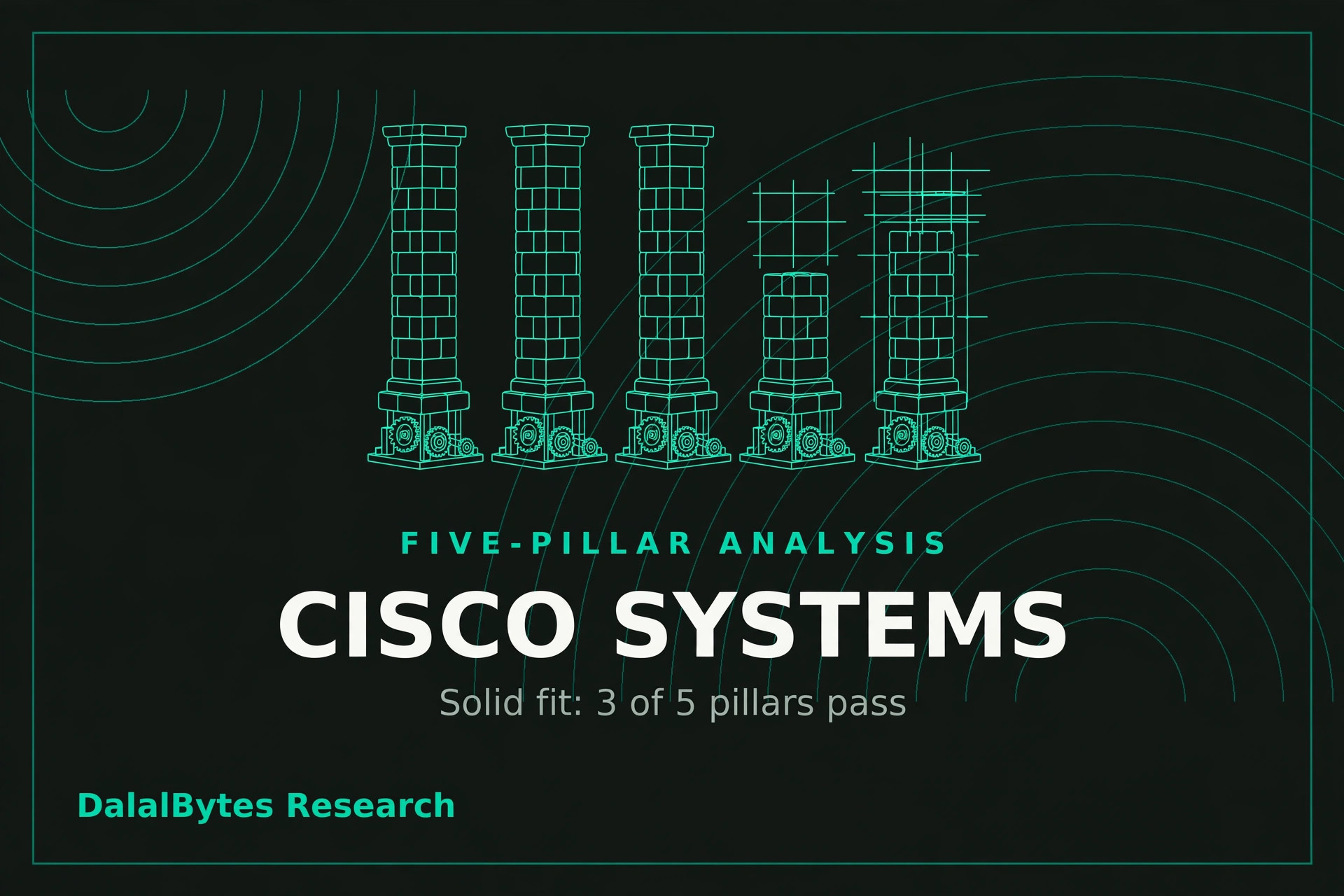
The five-pillar analysis grades a business on five questions: is the sector a sunrise, can the leadership execute, does a moat protect returns, is the balance sheet a fortress, and does the free cash flow show up. Each pillar passes, partially passes, or fails on evidence.
What is the answer first on Cisco?
Solid fit: 3 of 5 pillars pass. The AI infrastructure cycle is a genuine sunrise for Cisco's networking business ($9.3 billion of AI orders in FY2026, about 4.5 times the prior year), Chuck Robbins has executed a decade-long subscription transition to $32.1 billion of ARR, and the cash is real at roughly $12.8 billion of annual free cash flow. The two partials are the moat, where Arista contests AI fabrics and pure-play security vendors outgrow Cisco, and the iron fortress, where $13.6 billion of net debt from the Splunk deal keeps the balance sheet strong but leveraged. Reference price $106.70, market cap about $421 billion, trailing P/E about 32x.
Pillar 1: Sunrise sector, PASS
AI infrastructure networking is a multi-year capital cycle, and Cisco is positioned in its fastest-growing pocket. FY2026 AI orders of $9.3 billion beat a target management raised from $5 billion to $9 billion mid-year; $4 billion came from hyperscalers in Q4 alone, and FY2027 AI revenue of $7.5 billion is guided. Beyond AI, the sovereign-AI buildouts (G42, HUMAIN, the $30 billion AI Infrastructure Partnership) are a structurally premium segment that needs exactly what Cisco sells: a trusted Western full-stack integrator. Security is a durable sunrise too, with Cisco's refreshed portfolio (Hypershield GA August 2026, AI Defense, Secure Access at 2.5 million users) aimed at the agentic-AI security wave. Downgrade triggers: a hyperscaler capex pause that collapses AI orders, or sovereign-AI announcements failing to convert into revenue.
Pillar 2: Leadership, PASS
Chuck Robbins has been CEO since 2015 and Chair since 2017, and the record is a completed business-model transformation: subscriptions at 48% of revenue, ARR of $32.1 billion, software revenue of $6.2 billion growing 11%, and the $28 billion Splunk acquisition integrated into the product architecture rather than left as a standalone asset. FY2026 was, in the CFO's words, Cisco's most productive year in three decades by revenue, operating margin, and earnings per employee. Robbins also called the AI cycle early enough to matter: the original $5 billion AI order target was set when the business was still doubted, then beaten by 86%. Capital allocation is disciplined (minimum 50% of free cash flow returned; $12.7 billion returned in FY2026). The May 2026 restructuring (fewer than 5% of the workforce, up to $1 billion in charges) was framed as reallocation toward AI, security, silicon, and quantum, not retrenchment. Downgrade triggers: security growth stalling again after the refresh, or the restructuring proving to be cost-cutting dressed as reallocation.
Pillar 3: Moat, PARTIAL
The moat is real where the installed base lives and contested where growth lives. In enterprise campus networking, Cisco's switching share (28.7% globally, Q2 2026) plus IOS, Catalyst/Meraki, and decades of certified engineers create genuine switching costs: ripping out Cisco is a multi-year project no CIO volunteers for. In AI data-center fabrics, the moat thins: Arista is the sharper competitor, NVIDIA's Spectrum-X is a closed loop Cisco must adopt rather than displace, and in AI back-end Ethernet Cisco ranks fourth by share (gaining fastest, but fourth). In security, Cisco is a Gartner Visionary (firewall) and Challenger (SASE) behind Fortinet, Palo Alto Networks, and Zscaler, and the pure plays grow two to four times faster. Splunk is the strongest moat asset: deeply embedded in security operations centers with high switching costs and software margins. Upgrade path: Hypershield adoption proving the distributed-security architecture, or security revenue sustaining high-single-digit growth. Downgrade triggers: continued AI fabric share loss to Arista, or the security refresh failing to accelerate.
Pillar 4: Iron fortress, PARTIAL
The balance sheet is strong but not a fortress. Cash and investments of $15.9 billion against $29.5 billion of total debt leaves about $13.6 billion of net debt (calculated), the legacy of the Splunk acquisition. Offsetting this: $14.2 billion of annual operating cash flow, $29.8 billion of deferred revenue (+3%), a 0.39 debt-to-equity ratio, investment-grade ratings, and a dividend covered several times over by free cash flow. This is a balance sheet that can fund the AI cycle, sustain $6 billion-plus annual buybacks, and absorb a downturn, but it cannot do all three at maximum intensity simultaneously the way a net-cash fortress could. The $8.1 billion remaining buyback authorization is real firepower, not a constraint signal. Upgrade path: net debt paid down toward zero over the next two to three years from free cash flow. Downgrade triggers: debt-funded M&A at Splunk-like scale, or free cash flow deteriorating while buybacks continue.
Pillar 5: Free cash flow, PASS
The cash is real and repeated. FY2026 operating cash flow of $14.2 billion converted to roughly $12.8 billion of free cash flow (calculated), about a 3% yield on the market cap, and funded $12.7 billion of dividends and buybacks with room to spare. The conversion has been consistent for a decade: Cisco has returned capital every year through cycles, and the subscription mix (ARR $32.1 billion, RPO $46.7 billion) makes the cash flow more predictable each year, not less. The AI hardware mix is the watch item, since hardware carries lower margins than software, but FY2026 cash flow held flat against 12% revenue growth even as the mix shifted, which is the evidence that matters. Downgrade triggers: free cash flow declining two years running, or the payout ratio forcing a choice between the dividend and the buyback.
What would change each grade
Everything resolves through FY2027. The $7.5 billion of guided AI revenue is the number that tests pillars 1 and 3 together: landing it proves the sunrise is Cisco's to harvest and that the moat holds in AI fabrics. Security plus observability accelerating to high-single-digit growth, as management expects, is the second test: it upgrades the moat narrative and validates the entire portfolio refresh. The fortress upgrades only on evidence of deleveraging: net debt shrinking materially from $13.6 billion. Leadership's remaining exam is cycle management if hyperscaler capex pauses. If AI revenue lands, security accelerates, and debt falls, four pillars pass and the fifth is a deleveraging story, not a weakness.
How does Cisco compare with comps?
At $106.70, Cisco trades at about 32x trailing GAAP EPS and 20.7x forward non-GAAP guidance, a 1.6% dividend yield, and roughly 6.6x trailing revenue on a $421 billion market cap. Arista is the growth comp at 64x trailing earnings on 28% growth and 48% operating margins: the market pays double Cisco's multiple for AI-fabric purity. Palo Alto Networks (~100x) and Fortinet (~60x) show what security growth commands; CrowdStrike at 21x forward ARR shows what the ARR model is worth when it compounds near 30%. HPE, post-Juniper, is the value comp for full-stack enterprise networking. The pattern: Cisco is priced as a low-teens grower with a hardware-mix discount, roughly fair against the FY2027 guide, and the rerate case depends on AI revenue converting at software-like margins via Splunk attach.
Bottom line: Three of five pillars pass on evidence. The sunrise is real, the leadership has executed a genuine transformation, and the cash flow funds everything. What remains is the moat in AI fabrics and security, and the fortress after Splunk's leverage. Both have credible paths to upgrade through FY2027, and both will be decided by reported numbers, not narratives. Watch the $7.5 billion AI revenue target and the security growth rate.
Download the full analysis (PDF)
Research and opinion, not investment advice. Do your own due diligence before investing.